

Updated JAMB Direct Entry 2026 Registration Timeline and Critical Deadlines
If you are a Nigerian undergraduate applicant holding a Diploma, NCE, IJMB, JUPEB, or an equivalent A-Level qualification, mastering the JAMB Direct Entry 2026 timeline is the single most important step toward securing admission into your desired university, polytechnic, or college of education. The Joint Admissions and Boarding (JAMB) typically opens the DE registration portal earlier than the UTME window to give A-Level candidates enough runway to process transcripts, upload credentials, and prepare for the 2026/2027 academic session.

Based on official broadcasts from the Joint Admissions and Boarding and consistent historical patterns from previous admission cycles, the 2026 Direct Entry registration is expected to commence in the first quarter of 2026, usually around late January or early February. The registration window generally runs for approximately six to eight weeks, meaning the portal will likely close by late March 2026. However, JAMB is notorious for adjusting these dates based on logistical realities, so applicants must treat the weekly JAMB broadcast on the official portal as non-negotiable reading.
To participate, every candidate must purchase the DE ePIN at ₦5,000 (Five Thousand Naira only) from authorized vendors such as the NIBSS platform, designated banks, accredited mobile money operators, and JAMB-registered cyber cafés. Beyond the ePIN fee, candidates should budget an additional ₦700 for the mandatory reading text, bringing the total direct cost to ₦5,700. Please note that this figure refers strictly to the JAMB fee; CBT centre charges and document processing fees are separate and typically range between ₦500 and ₦1,500 depending on your location in Lagos, Abuja, Port Harcourt, or Kano.

The penalty period for late registration is a critical detail that catches many candidates off guard. Historically, JAMB extends the deadline by roughly two weeks, but strictly enforces a late fee of ₦10,000 on top of the standard ₦5,000 ePIN. This pushes the total cost to ₦15,000, a painful premium for procrastination. Once the extended window closes, the management typically shuts the portal with zero tolerance, so late registration fees do not apply after the absolute cutoff date. Candidates must also note that registration closing dates are separate from institution-based deadline for uploading O’Level and A-Level results.
- Anticipated Opening Date: Late January or early February 2026 (Subject to official confirmation via the JAMB weekly broadcast).
- Expected Closing Date: Mid-to-late March 2026, with a two-week penalty window extending into early April 2026.
- Late Registration Penalty: ₦10,000 additional fee, payable only during the official grace period.
- Absolute Cutoff: The portal will be closed without exception once the late window expires. No further late registration fees will be accepted.
- Mandatory Weekly Check: Visit the official JAMB portal every Friday for the Weekly Broadcast to capture real-time updates on portal maintenance, extension announcements, and procedural changes.
Beyond the JAMB deadlines, candidates must align their schedule with the Post-UTME/Post-DE timelines of their chosen institutions. For example, the University of Lagos (UNILAG), University of Ibadan (UI), and Obafemi Awolowo University (OAU) typically release their Post-DE screening forms between April and May 2026. Missing the JAMB window effectively disqualifies you from participating in these tertiary institution screenings, regardless of your academic credentials. Therefore, early action is not just advice, it is an absolute prerequisite for survival in this admission cycle.
Finally, ensure you verify all information directly from the JAMB portal at www.jamb.gov.ng and disregard unofficial social media rumours. Bookmark the portal, subscribe to SMS alerts, and keep your registered phone line active to receive one-time passwords (OTPs), ePIN delivery confirmations, and deadline reminders. Your admission journey for 2026 begins with respecting these timelines.
How to Complete JAMB Direct Entry Registration and ePIN Purchase
Navigating the JAMB Direct Entry registration portal can feel like threading a needle under pressure, especially when the calendar is unforgiving. For Nigerian undergraduates eyeing admission into the 2026/2027 academic session, completing your registration accurately and on time is the single most decisive step in securing your place. The process flows through the JAMB CAPS portal, the Central Admissions Processing System that now governs virtually every admissions decision across Nigerian tertiary institutions. Whether you are applying with an A-Level from IJMB or JUPEB, an NCE, a National Diploma, an HND from NABTEB, or a recognised equivalent qualification, the journey begins with the same disciplined sequence of digital and financial actions. Understanding each phase before you click a single button is what separates candidates who secure admission from those left scrambling for late-entry loopholes that simply do not exist.
Before anything else, generate your National Identification Number (NIN) profile code. This is non-negotiable. JAMB has made the NIN the only valid form of identification for all UTME and Direct Entry candidates since 2020, and the policy remains firmly in place for the 2026 cycle. Visit any NIMC enrolment centre nationwide, complete your biometric capture, and dial *346# on the SIM linked to your NIN to retrieve your unique profile code. Ensure the code is sent to the same phone number you intend to use throughout your registration, as JAMB uses this number for all OTP verifications and CAPS alerts. Candidates who mistakenly use a borrowed SIM often face painful lockouts during admission processing, so treat your phone number as sacrosanct.
Once your profile code is secured, proceed to the JAMB portal at portal.jamb.gov.ng and create your profile using a valid, accessible email address. After email verification, you will pay a processing fee of approximately ₦3,500 to obtain your ePIN. This is where the Remita platform, alongside other accredited payment gateways, becomes essential. Most candidates visit commercial banks such as First Bank, UBA, Zenith Bank, or GTBank, or use mobile money operators to generate the Remita Retrieval Reference (RRR) used by JAMB. Walk into any accredited bank branch with your profile code, request the JAMB ePIN payment of around ₦3,500, and collect your ePIN slip immediately. Keep both the printout and the SMS confirmation safe; you will need them repeatedly.
With your ePIN in hand, return to the JAMB portal to complete the registration form. Pay close attention to the institutions and programmes you select, paying particular attention to whether your chosen course accepts Direct Entry. Not every department does, and selecting wrongly is one of the most common reasons capable candidates are later denied admission despite holding strong qualifications. Upload your credentials meticulously. Candidates with IJMB, JUPEB, NABTEB, or HND qualifications must scan and upload their certificates, transcripts, or statement of results as the case may be. ND holders must upload their diploma certificate alongside their ND transcript, while NCE holders must present their NCE certificate and official transcripts. Blurry uploads, cropped documents, or wrong file formats will be rejected outright, so scan at 300 DPI minimum, save as JPG, and verify legibility before submission.
Payment errors are increasingly common and often avoidable. If your Remita transaction fails but money is debited, do not panic and do not attempt to pay twice. Wait for 24 hours while Remita automatically reverses failed transactions; persistent issues should be reported to your bank with the transaction reference, and unresolved cases escalated to JAMB support through support.jamb.gov.ng. Candidates who attempt multiple payments often end up with duplicate ePINs that create validation conflicts later. If your ePIN fails to validate after purchase, return to the issuing bank with your payment slip for a reissue; never buy ePINs from roadside vendors or unofficial WhatsApp groups, as these are almost always recycled or fraudulent.
Finally, after submission, print your registration slip, JAMB acknowledgement, and a duplicate copy of your credentials upload. These documents form your evidence trail should any dispute arise during Post-UTME screening, NELFUND student loan applications, or admission status verification. The Post-UTME cutoffs for Direct Entry applicants vary widely by institution and course, with most federal universities setting thresholds between 180 and 250 on the JAMB scale, but your A-Level grade profile, NUC CCMAS compliance, and catchment area status weigh just as heavily. Treat every upload, every payment, and every confirmation as a brick in the wall of your admission defence.
- Step 1: Generate your NIN profile code via *346# and verify the linked SIM remains active.
- Step 2: Pay the ₦3,500 ePIN fee at any accredited bank via Remita or approved payment channel.
- Step 3: Complete the online registration at portal.jamb.gov.ng, selecting only DE-eligible programmes.
- Step 4: Upload IJMB, NABTEB, HND, NCE, or diploma credentials in clear, high-resolution formats.
- Step 5: Resolve failed payments through Remita auto-reversal; avoid double purchases and unofficial vendors.
Post-UTME and DE Cutoff Marks for Federal, State, and Private Universities
If you are mapping out your admission strategy for the 2026/2027 academic session, understanding the realistic Post-UTME and Direct Entry (DE) cutoff marks across Nigerian universities is non-negotiable. While JAMB sets the general floor for Unified Tertiary Matriculation Examination (UTME) candidates at 150, the reality of departmental cutoffs—especially for high-stakes courses like Medicine and Surgery, Law, and Engineering—is far more competitive. These cutoffs are not arbitrary; they reflect institutional capacity, accreditation quotas, and historical applicant quality. For DE applicants, the picture is even sharper, as screening blends your A-Level, JUPEB, IJMB, NCE, or Diploma grades with your institution-specific screening score.
For federal universities—the traditional heavyweights like the University of Lagos (UNILAG), University of Ibadan (UI), and University of Benin (UNIBEN)—cutoff marks for elite courses routinely sit between 250 and 320 on the Post-UTME aggregate scale. UNILAG’s College of Medicine, for instance, rarely admits candidates scoring below 290, while UI’s Law faculty consistently demands an aggregate above 270. UNIBEN’s Engineering programs typically require a Post-UTME score of 240+ combined with a UTME score of 260+ to stand a chance. For DE candidates seeking admission through IJMB or JUPEB into these same programs, the expectation is a minimum of 7.0 CGPA on a 9-point scale, paired with a screening score of 65% or higher during the Post-UTME stage.
State universities offer slightly more breathing room, though competition remains fierce for premium departments. Lagos State University (LASU) and Ambrose Alli University (AAU) typically run cutoffs between 220 and 250 for Engineering and Law, while their Medicine programs demand 270+. For DE applicants, state varsities are increasingly favoring candidates with strong JUPEB or NCE results, especially for Education-related and Arts courses. However, state institutions sometimes struggle with accreditation bottlenecks, which can actually tighten available slots and push cutoffs upward unpredictably.
Private universities—Covenant University, Babcock University, Afe Babalola University (ABUAD), and Pan-Atlantic University—operate on a different financial logic but a competitive academic one. Their cutoffs for Medicine and Law often range from 230 to 260, and their DE pathways frequently accept a minimum of 5.0 CGPA on a 9-point JUPEB scale, paired with a robust screening interview. The catch is tuition: prospective students should budget between ₦2,500,000 and ₦8,000,000 annually for Medicine, though NELFUND (the Nigerian Education Loan Fund) now offers interest-free loans covering tuition for eligible indigent students who apply via nelfund.gov.ng before the academic session begins.
- Federal Universities (Medicine/Law/Engineering): Aggregate cutoffs typically range from 240–320; DE minimum is usually 7.0 CGPA on a 9-point scale.
- State Universities: Cutoffs fall between 220–270; DE entry requires 5.0–6.5 CGPA depending on the program.
- Private Universities: Cutoffs range from 200–260; DE minimum is generally 5.0 CGPA, with tuition between ₦2.5M–₦8M for clinical sciences.
- Strategic Takeaway: If your aggregate falls short of your first-choice institution’s historical cutoff, apply strategically to two lower-tier federal universities, one state university, and one accredited private university to maximize admission odds.
Given the volatility of cutoffs—often shifting by 5 to 15 points year-on-year based on applicant volume—your safest move is to treat the JAMB Central Admissions Processing System (CAPS) as your primary tracking tool. Once JAMB releases the 2026 DE registration portal, confirm your O’Level and A-Level uploads are accurate, as any discrepancy can void your screening eligibility regardless of your scores. If you are combining UTME and DE pathways, remember that Post-UTME screening fees typically range from ₦2,000 to ₦5,000 per institution, and you can sit for a maximum of three institutional screenings. Plan your NELFUND loan application alongside your admission processing to avoid financial delays that could cost you a slot in a competitive department.
Navigating JAMB CAPS: Admission Status, Acceptance, and Reprint Procedures
For every Nigerian Direct Entry candidate, the JAMB Central Admissions Processing System (CAPS) is the digital nerve centre where your academic destiny is ultimately decided. Think of it as the official bridge between your academic credentials and the university of your choice. Once your preferred school accesses your application, uploads your screening results, and recommends you for admission, the final decision—whether acceptance, rejection, or a waitlist—lives inside this portal. Understanding how to navigate it efficiently can save you weeks of anxiety and protect you from missing critical deadlines, especially since many federal universities like the University of Lagos (UNILAG), the University of Ibadan (UI), and Obafemi Awolowo University (OAU) often close their admission portals early. In the 2025/2026 cycle, over 1.2 million DE candidates interacted with CAPS, yet thousands missed offers due to delayed logins. Stay proactive, not reactive.
To access your dashboard, visit portal.jamb.gov.ng and log in with your registered email and password. Inside the interface, click on “Check Admission Status,” and the system will populate one of four crucial indicators. A “Recommended”” status means the institution has forwarded your details to JAMB for approval, but you are not yet admitted. A “Consider”” status signals that your institution is still reviewing your application—perhaps weighing your O’Level grades (which must include five credits including Mathematics and English, with at most two sittings in WAEC/NECO) against other DE applicants. A “Merit”” status, however, is your golden ticket: it indicates that JAMB has approved your admission, and you must act within 14 days to accept the offer, or it will lapse, and the slot will be offered to another candidate on the waiting list.
Handling the “Consider”” and “Merit”” statuses requires careful strategy. If your status remains on “Consider” for more than four weeks, it is wise to log into your institution’s portal to confirm your screening score—many schools require an aggregate of 50% or higher, with competitive programs like Medicine and Law demanding 65% and above. Additionally, review your course choices on the JAMB portal; if your first choice remains unconsidered, some institutions allow you to swap to a less competitive program mid-cycle, a popular workaround at universities like the University of Benin (UNIBEN) and Lagos State University (LASU). When your status updates to “Merit”“, accept immediately, then download and print your JAMB Admission Letter. This letter, along with your institution’s acceptance fee receipt (which can range from ₦20,000 to ₦75,000 depending on the school), is mandatory for clearance.
Lost your DE registration slip or admission letter? JAMB has streamlined reprint procedures to handle these common mishaps. For a lost DE slip, log in to portal.jamb.gov.ng/eFacility, navigate to “Print Registration Slip,” and use your JAMB profile code or registration number. A fee of ₦1,500 applies, payable via Remita using your ATM card or at any commercial bank nationwide. Similarly, to reprint your admission letter, click on “Print Admission Letter” after accepting your offer—ensure you have a stable internet connection and a working printer, as the portal generates a security-coded PDF. For students in rural areas of West Africa, like the border towns of Badagry or Seme, JAMB has partnered with accredited cyber cafés and CBT centres to offer reprint services for a small service fee. Remember: these reprints are not optional; without them, you cannot complete your matriculation or process your NELFUND student loan application, which requires your JAMB admission letter as primary proof of enrollment.
- Monitor daily: Check your JAMB profile and CAPS status every 48 hours to catch a “Merit” offer before it expires, especially during the August–October peak admission window.
- Verify institution details: Confirm your name, date of birth, and course of study on the portal—errors can delay your NELFUND loan processing by up to 90 days.
- Accept within the window: Once your status shows “Merit”, click “Accept Admission” and pay the acceptance fee immediately; do not wait until the final day.
- Reprint confidently: Use only the official JAMB portal for slips and letters; beware of fraudsters on WhatsApp or Telegram who promise “instant admission” for ₦50,000 or more.
- Keep digital backups: Save PDF copies of your DE slip, O’Level certificates, and admission letter on Google Drive or a flash drive—some institutions, like the Federal University of Technology Akure (FUTA), demand these for screening.
NUC CCMAS Curriculum and Its Impact on Direct Entry Course Duration
Since its rollout in 2023, the National Universities Commission’s Core Curriculum and Minimum Academic Standards (CCMAS) has fundamentally reshaped how Nigerian universities structure undergraduate programmes, and Direct Entry students admitted into 200-level courses are among the groups feeling the impact most tangibly. The policy introduced by the NUC aimed to harmonise learning outcomes across the country’s roughly 170 accredited universities, reduce duplication, and align Nigerian degrees with global standards. For anyone entering through JAMB Direct Entry in 2026, understanding how CCMAS reshapes your academic calendar is not just helpful, it is essential for accurate planning around tuition, NELFUND loan disbursement, and graduation timelines.
One of the most significant reforms within CCMAS is the 30% reduction in General Studies (GST) and entrepreneurial courses previously mandated for every undergraduate. Under the older Benchmark Minimum Academic Standards (BMAS), students were required to accumulate as many as 18 to 24 credit units of compulsory general studies, covering philosophy, logic, peace studies, and civic education, regardless of their major. CCMAS slashed that load to approximately 30% of the previous total, freeing up valuable semester hours that universities now reallocate to discipline-specific courses, vocational skills, and industry attachments. For a Direct Entry student joining at 200 level, this translates to fewer “unrelated” courses cluttering your transcript and a more focused academic path from Year Two onward.
Here is how the curriculum shift practically affects a Direct Entry student’s course duration:
- Compressed General Studies Load: Where Direct Entry students previously repeated courses like GST 101, GST 102, and ENT 211 because of credit-transfer loopholes, CCMAS now allows clearer recognition of prior learning, meaning most of those general courses are absorbed or waived entirely.
- Reallocated Credit Units to Core Discipline: Universities are redirecting the saved credit hours into specialised 200-level and 300-level courses, allowing Direct Entry students to dive deeper into their chosen field without lengthening the programme.
- Streamlined Industrial Attachment: SIWES (Students Industrial Work Experience Scheme) has been better integrated, and with CCMAS, some faculties now count attachment hours toward credit units, potentially shortening the time between 300-level and graduation.
- Standardised Four-Year Completion: Most accredited four-year degree programmes remain four years for Direct Entry students, but the reduction in redundant courses eliminates the unofficial “extra year” that some students previously endured to clear carryover GST courses.
- Stronger Alignment with PG Programmes: Because CCMAS mirrors international undergraduate structures, Direct Entry graduates transitioning to master’s programmes abroad or in Nigerian universities spend less time remediating foundational gaps.
Despite these gains, students must remain vigilant. Not every Nigerian university has implemented CCMAS uniformly. Some institutions are still phasing out old BMAS courses, which can create friction if you transfer schools or apply for a change of programme through JAMB. Before accepting a Direct Entry admission in 2026, confirm directly with the university’s academic affairs office that its CCMAS-compliant curriculum has been approved by the NUC and Senate. You should also request a course-by-course credit transfer evaluation for your Diploma, NCE, or A-Level certificate to know exactly which 100-level courses you are exempted from and which 200-level ones you must take fresh.
Financially, the CCMAS reduction is a quiet but meaningful relief. With fewer compulsory courses, Direct Entry students typically register for lower credit loads in their first two semesters, which can reduce school fees by ₦25,000 to ₦75,000 per session in public universities, and even more in private institutions where charges are credit-unit-based. If you are a NELFUND student loan beneficiary, this reduction can keep you well within the loan ceiling and reduce the lifetime repayment burden after your NYSC year.
Actionable takeaway: before the JAMB Direct Entry 2026 deadline closes, download the CCMAS implementation circular from your preferred university’s portal, compare it against the NUC template, and ask the admissions office two specific questions: which 100-level courses will be credited, and how many new credit units must I carry per semester? Doing this single piece of homework protects you from graduating late and ensures that the three or four years you invest yield a transcript that is both NUC-compliant and globally competitive.
Securing NELFUND Student Loans and Tuition Costs for DE Admitted Students
Congratulations on securing your Direct Entry admission, but the race is not over yet. Between now and resumption, you have one critical financial decision to make: how to fund your studies without falling victim to the predatory loan apps that have ruined many Nigerian students. The Nigerian Education Loan Fund (NELFUND) remains the safest, most reliable, and most legally protected avenue for indigent students, and the 2026 application cycle is already active.
Here is what you need to know to secure your funding and avoid the financial pitfalls that derail even the brightest DE candidates.
- Eligibility Requirements for NELFUND 2026: To qualify, you must be an admitted student in a NUC-approved Nigerian tertiary institution (federal, state, or accredited private), hold a valid UTME or DE registration, and submit a JAMB Admission Letter. You must also provide a verified National Identification Number (NIN), BVN, and the admission details from your school. Most importantly, your parents or guardians must earn less than ₦500,000 per annum at the point of application. NELFUND 2026 also supports students with disabilities (with valid medical evidence), indigent students, and those with pending NYSC mobilization but already enrolled.
- Application Process and Required Documents: Visit the official NELFUND portal at nelf.gov.ng, create a profile, fill in your JAMB details, upload your admission letter, and complete your parents’ BVN and NIN verification. The 2026 cycle now requires a verified guarantor (a civil servant earning at least ₦70,000 monthly or a known bank official). Expect biometric capture, and you will receive an SMS and email confirmation once your profile is approved.
- Loan Coverage and Interest Structure: NELFUND covers tuition (capped at your school’s actual charges), accommodation (only for on-campus hostels), and a ₦20,000 monthly upkeep allowance for undergraduates. Interest is set at zero percent from disbursement to graduation, repayment begins two years after NYSC at 10 percent of monthly income. Loans are 100 percent interest-free for students who complete their programmes within five years for DE candidates.
- Disbursement Timelines: For 2026 admitted students, NELFUND has promised disbursement within 30 days of approval for federal institutions. State and private universities currently take between 45 and 90 days. The fund confirms disbursement via SMS and emails the receipt to your school’s bursary. If your school has a portal, you can verify the credit on the NELFUND dashboard.
- Tuition Ranges for DE Candidates in Nigerian Institutions: Federal Universities charge between ₦45,000 and ₦120,000 per session for tuition. State universities range from ₦80,000 to ₦250,000. Private universities charge between ₦600,000 and ₦2.5 million. Nursing, Medicine, Pharmacy, and Engineering programmes at private universities cost between ₦1.5 million and ₦3.5 million per session.
- Critical Warning on Tuition Inflation: Some private universities are inflating 200-level fees for DE candidates due to the 2026 economic pressures. Always check the official fee schedule on your school’s portal before committing. If your school charges above the NUC-approved range (above ₦3.5 million for non-clinical courses), escalate to NUC via nuc.gov.ng/complaints.
- Actionable Next Steps for DE Candidates: Step 1: Print your JAMB Admission Letter immediately. Step 2: Complete your NELFUND profile and submit before the November 30, 2026 deadline. Step 3: Accept your admission on the JAMB CAPS portal within 3 weeks of your admission letter. Step 4: Pay your acceptance fee (₦20,000 to ₦100,000 depending on the school) to secure your slot before the December 31, 2026 cutoff.
Final Word: The JAMB Direct Entry 2026 admission is meaningless if you cannot fund it. NELFUND is your legal right as a Nigerian student; do not let desperation push you into predatory loans. Apply today, follow up consistently, and stay alert for SMS updates. Your education is worth the effort, and NELFUND 2026 was designed to make your journey seamless.
| Admission Pathway | Qualification Required | Estimated Cost (₦) | JAMB Cut-Off Mark | Processing Timeline | Career ROI (5-Year Earning Potential) |
|---|---|---|---|---|---|
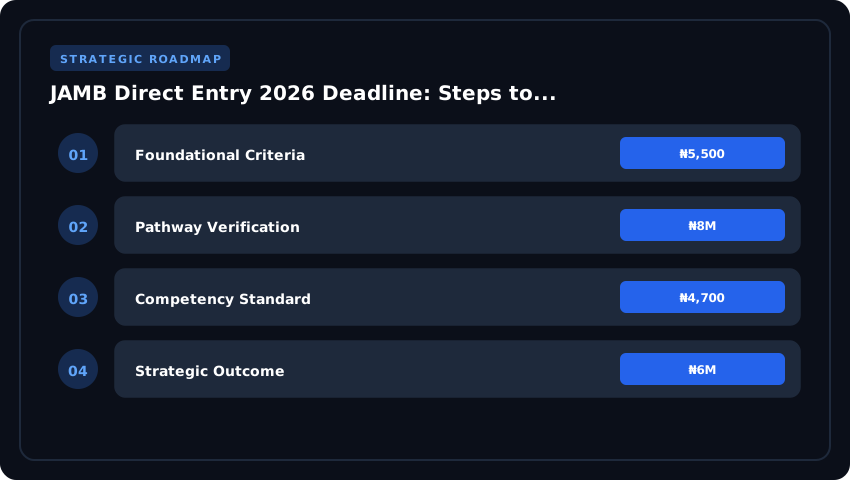
| JAMB Direct Entry (DE) | Diploma, NCE, IJMB, JUPEB, A-Level | ₦5,500 – ₦7,500 | 200+ (University Specific) | 3 – 6 Months | ₦8M – ₦25M+ |
| JAMB UTME | SSCE / WAEC / NECO Result | ₦4,700 – ₦6,200 | 140 – 200 | 4 – 8 Months | ₦6M – ₦20M+ |
| Pre-Degree / IJMB | SSCE (Pre-Degree Programs) | ₦150,000 – ₦400,000 | 150 – 180 | 9 – 12 Months | ₦7M – ₦22M+ |
| JUPEB Program | SSCE (JUPEB Affiliated Centres) | ₦250,000 – ₦500,000 | 160 – 190 | 9 – 12 Months | ₦8M – ₦24M+ |
| NCE (College of Education) | SSCE + NCE Completion | ₦180,000 – ₦350,000 | 140 – 160 | 24 – 36 Months | ₦4M – ₦12M+ |
| Polytechnic ND → HND | ND (National Diploma) | ₦60,000 – ₦150,000 (ND) | 100 – 150 | 24 – 48 Months | ₦5M – ₦15M+ |
| Part-Time / Sandwich | SSCE + Working Experience | ₦120,000 – ₦300,000 | 140 – 180 | 36 – 60 Months | ₦6M – ₦18M+ |
Frequently Asked Questions
What is the JAMB Direct Entry 2026 registration deadline?
The JAMB Direct Entry 2026 registration typically runs from January to April 2026, though exact dates are announced by JAMB annually. Candidates must purchase the DE form via the JAMB portal, complete their registration, and upload required credentials before the official closure date. Missing this deadline forfeits your admission opportunity for the 2026/2027 academic session.
What qualifications are eligible for JAMB Direct Entry admission?
JAMB Direct Entry accepts candidates holding a Diploma (OND/HND), NCE, IJMB, JUPEB, or equivalent A-Level qualifications. These credentials allow successful applicants to gain admission into the 200 Level of Nigerian universities, polytechnics, or colleges of education, bypassing the standard UTME process and saving one full academic year.
How much does JAMB Direct Entry registration cost in 2026?
The JAMB Direct Entry form costs approximately ₦5,500 to ₦7,500, depending on optional services like mock notifications or CBT centre preferences. Candidates should budget extra for institution change, late registration penalties, and transcript verification, which may add ₦2,000 to ₦5,000 to the total admission expenses.
What is the JAMB Direct Entry cut-off mark for 2026?
The JAMB Direct Entry cut-off mark for universities is generally set at 200, while polytechnics and colleges of education accept scores from 150 and above. However, individual institutions and competitive courses such as Medicine, Law, and Engineering typically require higher scores ranging between 220 and 280 for admission consideration.
Strategic Final Takeaway
Success in evaluating JAMB Direct Entry 2026 Deadline: Steps to Secure Admission Now relies on early preparation, adherence to verified accredited requirements, and cross-referencing official portals. Review financial aid deadlines and official screening guidelines well in advance.

