The New-Job AGI Shock: Why Paychecks Climb But Federal Loan Bills Explode
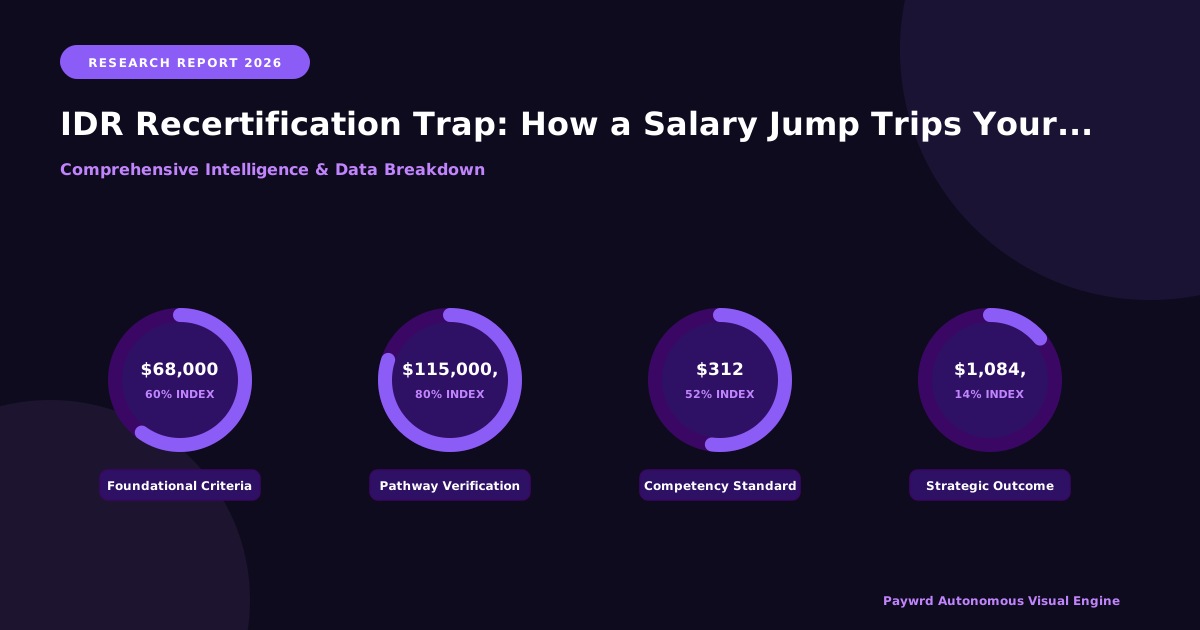
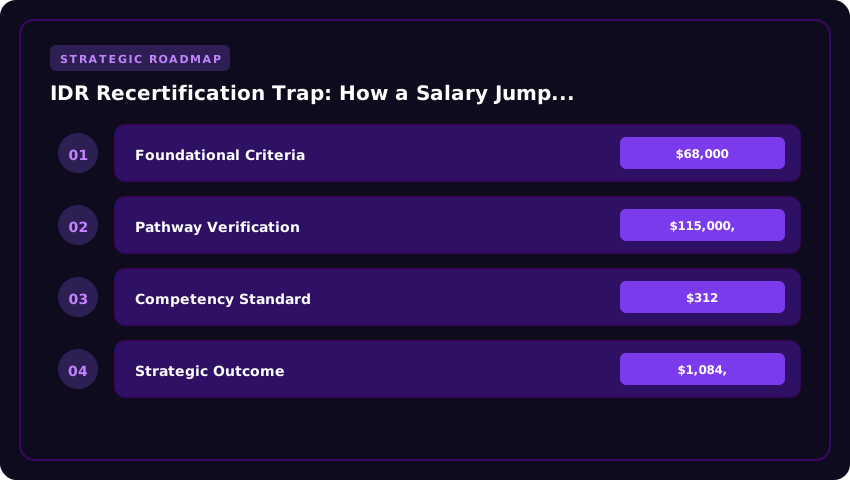
For millions of American borrowers on Income-Driven Repayment (IDR) plans, the moment a new job offer is signed, the financial math shifts in ways that no HR onboarding packet ever warns you about. Your gross salary might climb from $68,000 to $115,000, your biweekly paycheck finally starts to feel comfortable, and then—sixty to ninety days later—an IDR recertification notice arrives from your federal student loan servicer. The monthly payment that used to be $312 suddenly recalculates to $1,084, and the forgiveness timeline you were counting on looks fundamentally different. This is the AGI shock: the precise mechanism through which a higher Adjusted Gross Income, reported on a recent federal tax return and pulled directly into the recertification formula, transforms an affordable student loan payment into a budget emergency.
Understanding the mechanics of this shift is critical for any borrower considering a mid-career salary jump. The Department of Education uses a standardized discretionary income formula to calculate your required monthly payment on plans such as SAVE, PAYE, IBR, and ICR. Under the SAVE plan—the most generous IDR option available in 2024 and 2025—the formula currently sets your payment at 5% of discretionary income for undergraduate loans and 10% for graduate balances. Under older plans like PAYE and IBR, the threshold is 15% of discretionary income. Discretionary income, in turn, is defined as the difference between your AGI and 225% of the federal poverty guidelines for your family size and state of residence.
Here is where Travis County, Texas becomes a useful case study. For a single adult with no dependents in 2024, the federal poverty guideline sits at $15,060, which means 225% of that guideline equals $33,885. That is the income floor that is protected from IDR payment calculations. A borrower earning $60,000 reports only $26,115 in discretionary income under SAVE, generating a monthly payment of roughly $108. But the moment that same borrower lands a $115,000 position, discretionary income balloons to $81,115. At the 5% SAVE undergraduate rate, the monthly payment jumps to approximately $337. At the older 15% IBR rate, that same single filer suddenly owes roughly $1,014 every month—more than triple the previous obligation.
- AGI is the trigger, not your take-home pay. Your servicer pulls the Adjusted Gross Income from your most recent IRS Form 1040, which means signing bonuses, taxable relocation reimbursements, and equity vesting events can all inflate the figure even if your base pay only ticked up 8%.
- Recertification is annual but the cliff is permanent. Once your AGI crosses a threshold, the new payment sticks for the full twelve-month cycle, and there is no mid-year recalculation unless your income drops dramatically or you experience a qualifying life event.
- Family size and geography matter more than most borrowers realize. The poverty guideline multipliers vary by household, and borrowers in high-cost-of-living states like California or New York get the same dollar-for-dollar protection as someone in Travis County, even though their actual expenses are wildly different.
- Plan choice locks in the percentage for the life of the loan. Switching from PAYE to SAVE can drop your percentage from 15% to 5%, but only if you formally recertify into the new plan during an open enrollment window.
The practical takeaway for any professional evaluating a career move is straightforward: before you accept that offer letter, model your projected AGI through the Federal Student Aid Loan Simulator and calculate the worst-case monthly payment at the 15% discretionary income formula. A $115,000 salary in Travis County does not just change your tax bracket—it fundamentally restructures your federal loan repayment trajectory, and the difference between planning for that moment and being surprised by it can easily exceed $8,000 per year in unexpected cash flow.
2024-2025 IDR Plan Menu: SAVE, PAYE, IBR, and the Hidden Career Risk Inside Each
Choosing an Income-Driven Repayment (IDR) plan is one of the most consequential financial decisions a federal student loan borrower can make, yet most borrowers treat it like a cafeteria line, grabbing whichever plan has the lowest monthly sticker price without reading the ingredients list. In reality, the U.S. Department of Education currently accepts four major IDR plans through Federal Student Aid: SAVE (Saving on a Valuable Education, the newest REPAYE replacement), PAYE (Pay As You Earn), IBR (Income-Based Repayment), and ICR (Income-Contingent Repayment, typically reserved for Parent PLUS borrowers). For a professional staring at a $115,000 offer, the differences between these plans can mean the difference between a $280 monthly payment and a $1,100 monthly payment, even on the exact same Adjusted Gross Income.
Every IDR plan recalculates your discretionary income, sets a payment cap, and runs a forgiveness clock, but the math under the hood is wildly different. SAVE, which became the default plan for new borrowers after July 2024, defines discretionary income as what remains after subtracting 225% of the federal poverty guideline for your family size, an extraordinarily generous threshold that shields the first chunk of your paycheck. PAYE and the IBR for new borrowers (post-2014) use a 150% threshold, while the older IBR for pre-2014 borrowers uses 150% as well but caps payments at 15% of discretionary income instead of 10%. ICR uses a completely different formula based on 20% of discretionary income.
Here is where the hidden career risk lives. SAVE’s 225% shield sounds generous, and it is, until you remember that the moment your AGI crosses the salary threshold equivalent to roughly $32,800 for a single borrower in most states, the entire unprotected balance of your income becomes taxable for loan purposes. For a new hire jumping from a $58,000 salary to a $115,000 salary, that means a one-year AGI swing of $57,000, nearly all of which suddenly sits inside SAVE’s “discretionary” zone at the start of your new role. Because Federal Student Aid calculates your payment based on your most recent tax return’s AGI (or your prior year’s pay stubs if you recertify early), your very first year in the new seat is precisely the year the bill is largest.
- SAVE plan: Best for borrowers with low-to-moderate income who expect stable or slowly rising wages. Monthly payment is 5% of discretionary income for undergraduate loans (10% for graduate). Forgives remaining balance after 20 years (undergrad) or 25 years (graduate). Capitalization rules are borrower-friendly. Career risk: payments spike aggressively once AGI crosses the 225% poverty threshold, and interest accrual during forbearance can balloon balances.
- PAYE plan: Caps payments at 10% of discretionary income above 150% of poverty. Forgives after 20 years. Excellent for borrowers who expect their income to rise steadily, because payments can never exceed the 10-year Standard payment cap. Career risk: requires “partial financial hardship” to enter, and recertification is mandatory every 12 months, even if your income has not changed.
- IBR (new borrower, post-2014): 10% or 15% of discretionary income above 150% of poverty, depending on when you borrowed. 20-year forgiveness timeline. Career risk: similar AGI sensitivity to PAYE, but the 15% version applies if you have older loans.
- IBR (pre-2014): 15% of discretionary income above 150% of poverty. 25-year forgiveness. Career risk: highest payment percentage of the standard IDR menu, often making it the most expensive long-term option.
- ICR plan: 20% of discretionary income, or a 12-year Standard payment, whichever is lower. 25-year forgiveness. Career risk: rarely the best choice for a professional with predictable W-2 income.
Before you accept that $115,000 offer, the actionable playbook is this: pull your most recent AGI, project your new salary through the IRS W-4 calculator, and run the numbers on each plan using the official Federal Student Aid Loan Simulator at studentaid.gov. Then, decide whether to stay on SAVE, switch to PAYE for the 10-year payment ceiling protection, or even pay more aggressively for the first 12 months to avoid recertification shock. Recertification timing is the lever most borrowers forget: if you recertify before your new W-2 arrives, you lock in a lower payment for the full 12-month cycle. If you recertify after, your payment recalculates the moment the higher AGI hits the system.
Bottom line: there is no universally “best” IDR plan, only the plan that matches your income trajectory. A borrower planning to chase a $115k offer, then a $160k promotion in 24 months, will bleed cash on PAYE’s 10% ceiling. A borrower planning a stable $115k salary for a decade will find SAVE’s 5% undergraduate rate the cheapest path to 20-year forgiveness. Map your salary curve first, then pick your plan, and you will never be ambushed by The Raise That Changed Everything.
The 14-Day Recertification Countdown: A Step-by-Step Federal Student Aid Workflow
When your federal student loan servicer—Nelnet, Mohela, Aidvantage, or another approved federal partner—sends your annual IDR recertification notice, you typically have about 14 calendar days to respond before your payment recalculation defaults to a punitive baseline. That compressed window is not a suggestion; it is the operational cadence set by the U.S. Department of Education through Federal Student Aid (FSA) workflows on studentaid.gov. Borrowers who understand the exact sequence of screens and supporting documents can complete the process in under thirty minutes, while those who improvise risk rejected submissions, lost income-driven forbearance, and involuntary capitalization of unpaid interest.
The journey begins at the FSA ID portal, where you authenticate using your verified username, password, and two-factor confirmation. Once inside, you will navigate to the “Account” tab, then select “Income-Driven Repayment Plan Request.” This launches the IDR Annual Recertification form, which pre-populates your personal data, dependent count, and existing plan type (SAVE, formerly REPAYE, PAYE, IBR, or ICR). The platform then routes you to a third-party income verification module that interrogates the IRS database via the Data Retrieval Tool (DRT), or alternatively, accepts manually uploaded documentation.
Understanding which income figure you elect—and which documentary proof the servicer demands—is where most career-changers stumble. Most servicers will give you two pathways: current-paystub income or most recent IRS Adjusted Gross Income (AGI).
- Current-paystub income pathway: Best for borrowers who recently changed jobs or received a raise and whose new salary is not yet reflected in a filed tax return. The standard request is one to two recent pay stubs covering at least 30 consecutive days within the last 90 days, plus a signed Income Certification Worksheet. Servicers may also request employer verification letters when commission, bonus, or equity compensation complicates the calculation.
- IRS AGI pathway: Best for borrowers whose income has been stable or whose prior-year return (typically the most recent filed return, which lags by roughly 12 to 24 months) remains representative. You will need your IRS Form 1040 AGI line, or alternatively an IRS Tax Return Transcript retrievable through irs.gov via Get Transcript Online, Get Transcript by Mail, or Form 4506-C.
- W-2 forms: Occasionally requested as supplementary proof, particularly if pay-stub earnings appear inconsistent with year-to-date totals, or if the borrower is self-employed, contract-based (1099), or has multiple income streams.
- Alternative documentation: For borrowers whose reported AGI is zero or negative, servicers may request a written certification of zero income or, where unemployment benefits or disability payments apply, a Standard Form 1099-G or SSA award letter.
The structural difference matters enormously. AGI-based recertification anchors your payment to last year’s tax filings—so a salary jump that occurred in March of the current year will not surface until you file the following year’s return. By contrast, current-paystub recertification forces the servicer to recalculate your payment using the new, higher gross monthly earnings, often within the same pay cycle. For a borrower who jumps from $65,000 to $115,000, switching from AGI to current-paystub reporting can elevate a $0 IDR payment to several hundred dollars almost overnight.
Once your documentation is uploaded, the platform displays a calculated Monthly Payment Amount derived from your new figure against the relevant IDR formula—generally 10% of discretionary income for SAVE and PAYE borrowers, 15% for IBR, and 20% for ICR. Review this figure carefully before signing. Click “Sign and Submit,” then download or screenshot the confirmation page, which contains a Federal Student Aid submission ID and timestamp. Save it. If your servicer later claims non-receipt, this artifact is your defense against involuntary capitalization or interest accrual disputes.
Actionable takeaway: Build a 14-day reminder into your digital calendar the moment your servicer issues the recertification notice. Prepare two folders—one containing pay stubs, the other containing tax transcripts—before you log in. Choose AGI when your raise is not yet annualized, but pivot to current-paystub income the moment the raise reflects in at least 30 days of documented pay. Always retain the signed confirmation.
Public Service Loan Forgiveness (PSLF) Crossroads: 501(c)(3) vs. Tech Switch
Walking away from a 501(c)(3) employer in pursuit of a higher salary is one of the most financially consequential decisions a borrower can make, yet most people only do the math on their gross paycheck. They completely ignore the silent ticking clock of the Public Service Loan Forgiveness (PSLF) program. To qualify for total student loan forgiveness under PSLF, you are required to make 120 qualifying monthly payments while working full-time for a qualifying employer, which typically means a government organization or a 501(c)(3) nonprofit. At its core, PSLF rewards ten years of disciplined, lower-compensated service by erasing your remaining Direct Loan balance. However, the moment you transition to a private, for-profit corporation, the math changes dramatically, and a generous signing bonus can quickly turn into a seven-figure mistake over the long term.
For borrowers who have already invested five or more years into public service, the stakes are exceptionally high. The Employment Certification Form (ECF) is the official mechanism through which FedLoan Servicer (now managed by MOHELA) verifies your qualifying employment and tracks your progress toward the 120-payment threshold. Submitting the ECF annually, or every time you switch eligible employers, is not just a bureaucratic formality; it is the only way to officially bank your qualifying payments. If you accept a position at a major tech hub, a Fortune 500 corporate headquarters, or a venture-backed startup, your employer will almost certainly fail the PSLF eligibility test. The payments you make after that date will no longer count toward forgiveness, and you will lose the safety net you spent half a decade building.
Compounding this risk is the historical limitation on which repayment plans actually qualified for the program. Before the limited PSLF Waiver introduced in October 2021 and extended through the ongoing account adjustments, only payments made under specific Income-Driven Repayment (IDR) plans counted. Borrowers who made 24 or 36 months of payments under the now-defunct 10-Year Standard Repayment plan found themselves effectively locked out. The waiver temporarily relaxed those restrictions, allowing past payments to be recertified as qualifying. However, the waiver is a backward-looking fix. If you change jobs today, you will still be bound by the strict standard rules going forward, meaning your new tech paycheck is once again tied to qualifying IDR enrollment for the remainder of your 120-payment journey.
For borrowers evaluating a career transition, the following decision matrix clarifies the trade-offs based on your current standing in the program:
- If you have 60 or fewer qualifying payments: You retain significant optionality. Because you have not yet crossed the halfway threshold, switching to a higher-paying tech or private sector role is mathematically justifiable if the increased Adjusted Gross Income (AGI) allows you to aggressively pay down the principal in five to seven years. The remaining 60+ payments required for PSLF would tie you to a lower salary for another five years, which may have a higher opportunity cost than the forgiven balance. In this scenario, prioritizing aggressive principal reduction over a tax-free forgiveness pathway often yields a higher lifetime net worth.
- If you have 60 to 90 qualifying payments: You are entering the danger zone. The closer you get to 120, the harder it becomes to walk away, because each remaining payment represents a larger percentage of your remaining forgiveness runway. A salary jump of $40,000 at this stage will inflate your IDR payment under plans like SAVE or PAYE, but the forgiven balance is still mathematically substantial. Borrowers in this range should aggressively model the tax bomb of the forgiven amount against the lost IDR payments before signing an offer letter.
- If you have 90 or more qualifying payments: Treat the finish line as sacred. You are less than 30 months away from complete debt elimination. Quitting now wastes nearly a decade of nonprofit labor. Even a $200,000 tech salary is rarely worth paying $50,000 to $150,000 out of pocket to finish the final stretch on an IDR plan. The federal forgiveness is functionally a guaranteed return on investment that no private sector stock option or 401(k) match can replicate.
Ultimately, the decision framework requires borrowers to look beyond the immediate monthly cash flow and recognize the structural value of tax-free loan discharge. Always verify a new employer’s tax-exempt status using the IRS Tax Exempt Organization Search before assuming your payments will continue to qualify.
State and Metro Cost-of-Living Adjustments: Why Austin, Seattle, and Boston Hit Differently
A salary bump that looks identical on paper can quietly reshape your Income-Driven Repayment (IDR) obligation depending on where you cash the check. The federal student loan forgiveness calculator does not care whether your $115,000 salary buys you a one-bedroom bungalow in Austin or a windowless alcove in Boston. It treats your Adjusted Gross Income as a single, flat number on Schedule 1 of your federal return, then applies the Income-Based Repayment (IBR) multiplier to that gross figure. What gets ignored is the very real question every American professional asks: What can I actually do with this paycheck after rent, state income tax, and the local cost of groceries, transit, and healthcare? The Bureau of Economic Analysis (BEA) publishes Regional Price Parities (RPP) that quantify this gap, and the 2023–2024 data shows that the same nominal income stretches dramatically further in Texas than in Massachusetts or Washington.
Consider a single borrower, age 32, filing single, with $52,000 in federal Direct Loans, working in a senior software role. The offer letter reads $115,000 base. Before we even discuss forgiveness timelines, let us anchor this salary in three very different metros using BEA RPP indices, 2024 state income tax schedules, and Zillow Observed Rent Index (ZORI) median one-bedroom rents. In Austin, TX, there is no state income tax, so the borrower takes home roughly $89,950 after federal withholding on a $115,000 Adjusted Gross Income. Median rent for a one-bedroom sits near $1,520, leaving approximately $71,710 for everything else. In Seattle, WA, Washington also forgoes a state income tax, so net pay mirrors Austin at about $89,950, but ZORI median one-bedroom rent climbs to roughly $2,260, dropping discretionary income to roughly $62,810. In Boston, MA, the borrower faces a 5% state income tax (plus a 4% surtax above $1 million, which does not apply here, plus a 12% flat Part B kicker starting at $1 million), netting closer to $84,200 after state withholding. With median rent near $3,050, discretionary income falls to roughly $47,600. Same paycheck, three radically different lived experiences.
Here is the trap: IDR plans ignore every single one of these numbers. Under IBR, your monthly payment is 15% of discretionary income, defined as the difference between your Adjusted Gross Income and 150% of the Federal Poverty Guidelines for your family size. For a single borrower in the continental U.S., the 2024 poverty guideline is $15,060, so 150% is $22,590. Discretionary income at $115,000 AGI is therefore $92,410, and 15% of that divided across 12 months is approximately $1,155 per month, regardless of whether you live in a $1,520 apartment or a $3,050 apartment. The Boston borrower is paying the federal government the same monthly IDR amount as the Austin borrower, yet has 34% less leftover cash after rent.
This is where the discretionary squeeze becomes psychologically and financially painful. The Austin borrower keeps roughly $4,230 in monthly surplus after rent and IDR. The Seattle borrower keeps about $3,215. The Boston borrower keeps about $2,135, and that figure shrinks further once you add Massachusetts auto insurance premiums (averaging 22% above the national median), commuter rail passes ($90 to $120 per month on the MBTA), and the state’s higher grocery index (about 8% above the national average per the BEA). The Boston borrower is, in effect, subsidizing the federal forgiveness program with a higher local cost of living, while the Austin borrower is funding the same forgiveness program out of genuine surplus.
- Austin, TX (No state income tax): AGI $115,000; estimated monthly take-home $7,496; median 1BR rent $1,520; IDR payment $1,155; discretionary surplus after rent and IDR ~$4,230.
- Seattle, WA (No state income tax): AGI $115,000; estimated monthly take-home $7,496; median 1BR rent $2,260; IDR payment $1,155; discretionary surplus after rent and IDR ~$3,215.
- Boston, MA (5% state income tax): AGI $115,000; estimated monthly take-home $7,016; median 1BR rent $3,050; IDR payment $1,155; discretionary surplus after rent and IDR ~$2,135.
The actionable takeaway for borrowers weighing a geographic move: do not optimize for gross salary alone. Use the BEA Regional Price Parities table, your state’s Department of Revenue withholding calculator, and the ZORI rent index for your target ZIP code to model your real post-IDR discretionary income. If you are pursuing Public Service Loan Forgiveness (PSLF), every extra dollar that disappears into rent or state tax is a dollar that does not accelerate your forgiveness timeline, because the timeline is fixed at 120 qualifying payments regardless of payment size. For those on 20- or 25-year IDR forgiveness tracks, however, larger discretionary surplus means more capacity to make voluntary additional payments and shorten the forgiveness horizon. Before you sign the offer letter in Boston for that $115,000 role, run the same offer letter through Austin and Seattle comps and pressure-test your budget against Schedule 1, not just your rent receipt.
Pre-Offer Negotiation Tactics: Income Bunching, Spousal Income, and Strategic Withholding
Before you formally accept a higher-paying position, you hold one powerful advantage: time. The gap between an offer letter and your start date is the only window in which you can legally restructure your W-2 wages, retirement contributions, and pre-tax deductions to soften the AGI shock that awaits on the other side. Savvy borrowers use this window to engage in what financial planners call income smoothing, a strategy that keeps your Adjusted Gross Income (AGI) in a lower IDR bracket during the recertification year without sacrificing the long-term earnings upside of the new role. All of the strategies below are entirely legal, IRS-sanctioned, and fully compatible with federal student loan regulations under 34 CFR 685.221.
Roth versus Traditional 401(k) Allocation: One of the most overlooked levers is the type of contribution you make to your employer-sponsored plan. A Traditional 401(k) contribution reduces your AGI dollar-for-dollar in the year it is made, which directly lowers your IDR payment under SAVE, IBR, PAYE, and ICR plans. If your new employer offers a Traditional 401(k) match, maximizing that bucket during your first calendar year can shield tens of thousands of dollars from your recertification calculation. For 2025, the elective deferral limit remains $23,500 for employees under age 50, with a $7,500 catch-up contribution for those 50 and older, bringing the total possible pre-tax shelter to $31,000. Conversely, a Roth 401(k) contribution does not reduce AGI because it is made with after-tax dollars, even though it grows tax-free. Strategically withholding Roth dollars while you sit in a lower tax bracket, then pivoting to Traditional contributions during your high-earning transition year, can preserve cash flow while still lowering your IDR payment.
- Health Savings Account (HSA) Maximization: For 2025, the IRS HSA contribution limits are $4,300 for self-only coverage and $8,550 for family coverage, with an additional $1,000 catch-up for account holders 55 and older. Because HSA contributions reduce your AGI, maxing your account before recertification can shield thousands of dollars and drop you into a lower IDR bracket. Triple tax advantages apply: deductible going in, tax-free growing, and tax-free coming out for qualified medical expenses.
- Section 125 Cafeteria Plans: Premiums paid through a Section 125 plan (health, dental, vision, dependent care) are excluded from your W-2 Box 1 wages, which means they never reach your AGI in the first place. During a transition year, enrolling in the most expensive plan tier, funding a Dependent Care FSA up to the $5,000 household limit, and setting aside medical FSA contributions up to $3,300 for 2025 can collectively remove thousands from your reported income.
- Marriage Timing and Spousal Income: Under SAVE and PAYE, spousal income is generally excluded from your IDR payment calculation if you file taxes separately (MFS). Borrowers in higher-tax states like California, New York, or New Jersey should still model both Married Filing Jointly and Married Filing Separately outcomes, because the AGI shielding from MFS can outweigh the lost standard deduction. If a marriage is already planned, accelerating or delaying the wedding date by even a single calendar quarter can determine whether your new household income is blended for IDR purposes during recertification.
- Strategic Withholding and Bonus Deferral: Your final paycheck at your current employer can be engineered. Many employers allow you to defer a signing bonus, equity vesting, or commission payment into the following calendar year. Because IDR recertification looks at prior-year AGI, deferring even $20,000 of compensation from December to January can keep you safely in a lower bracket for 12 additional months.
The unifying principle is this: IDR plans are notoriously mechanical, recalculating your payment purely from a single AGI line on your IRS tax return. Every dollar you legally divert into a Traditional 401(k), HSA, FSA, or Section 125 plan never appears on that line, and therefore never enters the federal payment formula. Run the math before you sign, coordinate with a tax professional or a certified student loan planner (not a general financial advisor), and you can capture the salary jump without letting your loan servicer capture your refund.
| IDR Plan Type | Monthly Payment (vs. Standard) | Discretionary Income Threshold | Forgiveness Timeline | AGI Jump Impact (e.g., $68K → $115K) | Career ROI Risk |
|---|---|---|---|---|---|
| SAVE Plan | 5%–10% of discretionary income (vs. ~$0–$400 standard) | 225% of Federal Poverty Line | 20–25 years (10 for undergrad borrowers as of 2024 rules) | Payment increase ~$150–$350/month | High: short-term IDR savings vanish |
| IBR (Income-Based Repayment) | 15% of discretionary income (vs. standard 10-yr) | 150% of Federal Poverty Line | 20 years (new borrowers) / 25 years | Payment increase ~$250–$450/month | High: recertification shock common |
| PAYE (Pay As You Earn) | 10% of discretionary income | 150% of Federal Poverty Line | 20 years | Payment increase ~$200–$400/month | High: new job = mandatory recertification |
| ICR (Income-Contingent) | 20% of discretionary income OR 12-yr fixed | 100% of Federal Poverty Line | 25 years | Smallest jump impact ~$100–$250/month | Medium: better for high earners |
| Standard 10-Year (non-IDR) | Fixed payment ~$550–$700/month on $55K balance | N/A | 10 years (no forgiveness) | No payment change, but tax bomb at end | Low: predictable budgeting |
Frequently Asked Questions
How does a salary increase trigger an IDR recertification payment spike?
Federal IDR plans require borrowers to recertify income annually using their most recent AGI from the IRS. When your salary jumps from $68,000 to $115,000, your new AGI triggers a recalculated monthly payment based on discretionary income. The result is often a $200–$450 monthly increase with no warning, because loan servicers pull tax data automatically.
Can I avoid the IDR payment jump when changing jobs or getting a raise?
Yes, strategically. You can time your recertification date by submitting a paystub instead of using IRS AGI data, which reflects current (lower) income. Alternatively, filing taxes separately from a spouse (for PAYE/IBR) reduces the counted income. Both tactics buy 12 months of lower payments during transition.
Does a higher salary shorten my student loan forgiveness timeline?
No. Forgiveness timelines on IDR plans—20 or 25 years—are based on payment count, not income level. However, higher payments during the forgiveness window mean more of your balance is paid down, reducing the forgiven (and potentially taxable) amount at the end of the term under current IRS rules.
What is the IDR recertification trap for new job earners in 2025?
The trap occurs when borrowers accept higher-paying positions without anticipating the automatic AGI recertification. Under SAVE, IBR, PAYE, and ICR, loan servicers use IRS data to reset payments within 30–60 days. The 'raise trap' can add $2,400–$5,400 annually in payments, erasing the after-tax benefit of the promotion.
Strategic Final Takeaway
Success in evaluating IDR Recertification Trap: How a Salary Jump Trips Your Student Loan Forgiveness relies on early preparation, adherence to verified accredited requirements, and cross-referencing official portals. Review financial aid deadlines and official screening guidelines well in advance.