ICAN 2026 Exemption Framework: ATSWA, ACCA, CIMA & Degree Holder Eligibility Matrix
Navigating the ICAN exemption matrix requires precision, especially with the 2026 syllabus update restructuring the pathway into three distinct tiers: Foundation, Skills, and Professional. Understanding exactly where your prior learning slots in saves you both time and significant tuition fees. Below is the authoritative breakdown for the current diet, mapped directly to the Institute’s current guidelines.
University Graduates: B.Sc & HND Holders
The most common entry point remains the university degree, but the distinction between Accounting and Non-Accounting backgrounds dictates your starting line.
- B.Sc / HND Accounting (First Class / Second Class Upper / Distinction / Upper Credit): You enjoy the maximum exemption. You are exempted from the entire Foundation Level (5 papers) and the Skills Level (6 papers). You enter directly at the Professional Level, facing only 5 papers (P1–P5). This is the “Fast Track” route.
- B.Sc / HND Accounting (Second Class Lower / Lower Credit / Pass): You are exempted from the Foundation Level entirely. However, you must sit for all 6 papers at the Skills Level before progressing to Professional.
- Non-Accounting Degrees (B.Sc/HND in Economics, Business Admin, Engineering, etc.): Regardless of class of degree, you receive no exemption at the Foundation Level. You must write all 5 Foundation papers. Upon passing, you proceed to Skills Level. Note: Graduates with strong quantitative backgrounds (e.g., Mathematics, Statistics) should still prepare rigorously for Foundation Business Mathematics & Statistics; no automatic waivers exist here.
ATSWA Graduates (Accounting Technicians Scheme West Africa)
ATSWA remains a powerful feeder pipeline. If you hold the ATSWA certificate (or the legacy ANAN/ATS certificates), your exemptions are locked in as follows:

- Full ATSWA Certificate Holders: You are exempted from the entire Foundation Level. You commence at the Skills Level (6 papers). This effectively places you on par with a Second Class Lower Accounting graduate.
- ATSWA Final Level Pass (Partially Completed): If you have passed specific papers at the ATSWA Final level but haven’t graduated, ICAN grants paper-for-paper exemptions at Foundation Level only (e.g., ATSWA Financial Accounting exempts ICAN Foundation Financial Accounting). You must apply for this via the exemption portal with your result transcripts.
Foreign Professional Qualifications: ACCA, CIMA, CPA & Others
For holders of international designations, the 2026 framework respects reciprocity agreements but draws a hard line at the Professional Level.
- ACCA Affiliates / Members: If you have completed all ACCA exams (Affiliate) or are a full Member, you are exempted from Foundation and Skills Levels. You enter at the Professional Level. However, you must pass the Nigerian Law & Tax variant papers (P2: Advanced Taxation and P3: Corporate Reporting & Strategy) which contain mandatory Nigerian legislation content not covered in ACCA global variants.
- CIMA Members (ACMA/CGMA): Similar to ACCA, full members enter at Professional Level. You must attempt the Case Study (P5) and the Nigerian Tax/Law papers.
- CPA (USA, Canada, Australia, etc.): Full members generally receive exemption up to Skills Level. Entry at Professional Level is standard, subject to verification of the specific body’s current MoU with ICAN.
- Part-Qualified Foreign Students: If you are part-qualified (e.g., ACCA Applied Skills complete), you receive paper-for-paper mapping at Foundation and Skills levels. You do not jump to Professional until the foreign qualification is fully completed.
Actionable Takeaway: Before paying any exemption fees (currently ₦15,000 per paper at Foundation/Skills and ₦20,000 per paper at Professional), download the ICAN 2026 Exemption Guidelines PDF from the student portal. Cross-reference your transcript course codes against the ICAN syllabus grid. If a course title matches but the content coverage is below 70%, ICAN will reject the claim. Prepare your syllabus comparisons early to avoid wasted application cycles.
Step-by-Step Exemption Application Protocol on the ICAN Portal
Successfully navigating the Institute of Chartered Accountants of Nigeria (ICAN) exemption portal requires careful attention to detail, especially given the volume of applications processed each admission cycle. Whether you are a graduate from a NUC-accredited Nigerian university, an ACCA affiliate seeking reciprocity, or an ATSWA holder transitioning into the Professional level, the workflow follows a unified digital pipeline. Before you begin, ensure you have a stable internet connection, a valid Nigerian phone number, your JAMB registration details (where applicable for identity cross-verification), and scanned copies of your credentials ready in PDF format.
The process is divided into four critical phases: profile creation, transcript and credential upload, fee payment, and status tracking. Each phase has its own validation checkpoints, and skipping any step typically results in automatic disqualification. Below is a granular walkthrough designed for first-time applicants across Lagos, Abuja, Port Harcourt, and the broader West African sub-region.
Step 1: Profile Creation and Identity Verification. Visit the official ICAN portal at www.ican.ng and navigate to the “Students Registration” menu. Click on “Exemption Application” to launch the dedicated sub-portal. New users must create a profile using their active email address and phone number. The system will send an OTP (One-Time Password) to verify your mobile line, so ensure your SIM is functional and not on DO-NOT-DISTURB mode. You will be required to input personal biodata including your full name (matching exactly what appears on your WAEC/NECO certificate and degree certificate), date of birth, nationality, and residential address. Postgraduate applicants should note that ICAN cross-references your records with the National Youth Service Corps (NYSC) database, so graduates from 2015 to date must have completed or be exempted from service before final approval.
- Use a personal email you check frequently, not your workplace address, because all exemption status updates will be routed there.
- Double-check the spelling of your name against your university transcript. Mismatches are among the top five rejection triggers every cycle.
- Select the correct category at registration (Degree Holder, ATSWA Holder, ACCA, or CIMA) as changing it later requires manual intervention at the ICAN Secretariat in Lagos.
Step 2: Transcript Upload and University Portal Verification. Once your profile is active, proceed to the “Document Upload” tab. The portal accepts only PDF files, with a strict size cap of 2MB per document and a maximum of five documents per application. You will need to upload your degree certificate, official transcript, NYSC discharge or exemption certificate (for Nigerian graduates under 30 years old at graduation), and any professional body membership evidence (for ACCA/CIMA candidates). For university transcripts specifically, ICAN now requires that your institution must be on the NUC approved list and, where applicable, must have full accreditation status for the specific year of your graduation. Universities currently on ICAN’s unaccredited or probationary list, including some newly established private universities in the South-East and North-Central zones, will trigger an automatic “Institution Not Recognized” flag.
Step 3: Payment of Non-Refundable Assessment Fee. After successful upload, the portal generates an invoice for the non-refundable exemption assessment fee. As of the 2026 cycle, the fee structure is tiered according to applicant category:
- Nigerian Degree Holders (NUC-accredited): ₦75,000 (assessment) + ₦15,000 (administrative) = ₦90,000 total.
- ATSWA Holders transitioning to Professional Level: ₦60,000 (assessment) + ₦10,000 (administrative) = ₦70,000 total.
- ACCA, CIMA, and other ICAEW reciprocity candidates: ₦120,000 (assessment) + ₦20,000 (administrative) = ₦140,000 total.
- Foreign-trained candidates (non-NUC institutions): ₦150,000 (assessment) + ₦25,000 (administrative) = ₦175,000 total.
Payment is processed via Remita, Paystack, or direct bank transfer to designated ICAN Zenith Bank accounts. Keep your payment receipt, as it serves as your primary reference number throughout the 14-to-21 working day review window. Be aware that all fees are non-refundable once your application enters “Under Review” status, even if you are ultimately denied exemption.
Step 4: Tracking Application Status and Common Rejection Triggers. After payment confirmation, your application enters the review queue. You can monitor progress via the “My Dashboard” tab, where statuses move from Submitted to Under Review, Query Raised, or Approved/Rejected. To avoid the dreaded “Query Raised” status that delays processing, double-check these high-risk rejection triggers before submission:
- Missing or expired NYSC discharge certificate (a frequent issue for graduates above 30 who assumed exemption was automatic).
- Uploading JPG or PNG images instead of PDF documents, which the portal rejects silently.
- Selecting the wrong exemption category, such as claiming ATSWA exemption when you actually hold an ATSWA pass but lack the required skills level completion.
- Graduating from a university whose NUC accreditation was either revoked or under suspension at the time of your graduation.
- Failure to pay the administrative surcharge alongside the assessment fee, which leaves the application marked “Incomplete Payment.”
Once approved, you will receive an official Exemption Certificate (Ex-Cert) via email and your dashboard, which you can then present during Professional level registration to claim your credit papers. Remember that the exemption window for the 2026 diet closes by March 31, 2026, so early submission is strongly advised to avoid last-minute portal congestion.
2026 Exemption Cost Analysis: Assessment Fees, Annual Subscriptions & Hidden Charges
Budgeting for your ICAN journey requires looking beyond the headline exemption fee. For the 2026 diet, the Institute has maintained a tiered fee structure that rewards bulk applications but adds mandatory recurring costs that many candidates overlook. Below is a realistic, itemized breakdown projected for the 2026 session based on the latest Council-approved tariffs. All figures are in Naira (₦) and include the mandatory 7.5% VAT where applicable.
<table
<tr <th Cost Component<th Per Paper / Unit
<th Bulk / Level Rate
<th Notes
<tr <td Exemption Assessment Fee<td ₦28,500
<td ₦105,000 (Skills Level)
<td Bulk saves ~₦9,000 per level
<td ₦6,500
<td ₦6,500 (Flat)
<td Mandatory until ACA induction
<tr <td Study Pack (Per Level) <td ₦30,000 (3 Levels)
<td Digital access via ICAN portal
<td —
<td ₦85,000
<td Payable at Professional level completion
<tr <td Mandatory CPD (Post-Admission) <td ₦45,000 (3-yr cycle)
<td Starts immediately after induction
<td ₦12,000
<td Induction Ceremony Levy
<td ₦15,000/yr
Critical Comparison: Exemption Route vs. Foundation Entry
If you enter via the Foundation Level (writing all exams), your projected 3-year tuition, exam fees, and subscription costs hover around ₦650,000 – ₦750,000 (excluding tuition centre fees). The Exemption Route (assuming maximum Skills/Professional level exemptions) totals approximately ₦320,000 – ₦380,000 in direct ICAN fees alone. You save roughly 45–50% in direct costs and, crucially, 12–18 months of study time.
- Hidden Trap: The Annual Student Subscription (₦6,500) is non-negotiable. If your exemption processing drags into a second calendar year, you pay twice. Process your paperwork between January–March to avoid double renewal.
- Induction Levy: This ₦85,000 often catches finalists off guard. Budget for it the moment you clear your final Professional paper.
- CPD Costs: As a new Associate Chartered Accountant (ACA), you enter the mandatory Continuing Professional Development cycle immediately. Factor ₦15,000 annually into your first-year salary negotiations.
Actionable Takeaway: Request a “Fee Assessment Letter” from the ICAN Registry before paying any exemption assessment fees. This official document locks in your specific paper count and total liability, protecting you from mid-cycle tariff adjustments. Pay via the ICAN PayDirect portal (Remita) to generate instant receipts for your records.
Official Study Pack Acquisition: Download Links, Past Questions & CBT Simulation Tools
Securing the official ICAN 2026 study pack is your first concrete step toward exam readiness. The Institute operates a centralized digital ecosystem, and knowing exactly where to click saves you weeks of frustration. Start at the ICAN Student Portal (students.icanig.org). Once logged in with your registration number, navigate to the E-Library tab on the left-hand dashboard. Here, the 2026 Syllabus and Study Texts for all three levels—Foundation, Skills, and Professional—are hosted as downloadable PDFs. Do not rely on WhatsApp forwards or Telegram channels for these core texts; the portal versions are the only documents guaranteed to reflect the latest CCMAS-aligned curriculum updates.
For past questions, the portal archives diets from 2019 through 2024. I recommend downloading the Marking Guides alongside the question papers. The marking guides reveal the examiner’s marking scheme, allocation of marks per sub-question, and the specific technical keywords that earn credit. Create a local folder structure on your device: /ICAN_2026/Level_Foundation/Past_Questions/2024_May/. This discipline mirrors the file management habits you will need during the Computer-Based Test (CBT) proper.
Regarding CBT simulation tools, ICAN officially endorses a shortlist of vendors whose software mimics the live exam interface—timer, flag-for-review, calculator, and navigation pane. As of the 2026 cycle, the verified vendors include:
- FinTutor CBT Suite: Widely used in Lagos and Abuja tuition centers; offers offline mode and performance analytics by topic.
- ExamPrep NG: Cloud-based with a mobile app sync; includes a Time-Management Drill mode that locks you out after the allotted minutes per paper.
- ICAN Prep Hub (by Kaplan Nigeria): The premium option; integrates video debriefs for every past question from 2020 onward.
Before purchasing any license—typically priced between ₦15,000 and ₦35,000 per level—verify the vendor’s current accreditation status on the ICAN Tuition Providers Directory (tuition.icanig.org). Avoid cracked versions; they often lack the 2026 syllabus updates and may carry malware that compromises your registration data. Finally, schedule a full mock exam every Saturday starting eight weeks before your diet. Treat it like the real thing: same start time, same permitted materials, same silence. That rhythm builds the stamina no textbook alone can provide.
Critical Deadlines: 2026 Diet Timelines, Transcript Submission Windows & Appeal Process
Missing a deadline on the Institute of Chartered Accountants of Nigeria (ICAN) exemption calendar is one of the most common — and most preventable — reasons qualified candidates lose an entire diet cycle. Whether you are applying under the ATSWA, ACCA, CIMA, or Degree Holder exemption route for the 2026 May or November diets, every step runs on a strict, non-negotiable timetable. Understanding these deadlines — and building a buffer around them — protects both your application fee and your professional momentum.
The first hard deadline to lock into your calendar is the ICAN Exemption Application Closing Date. For the May 2026 diet, the portal typically closes by the last week of January 2026, with late applications attracting a penalty of ₦25,000 on top of the standard processing fee. For the November 2026 diet, the closing window falls around the last week of July 2026, following the same late-fee structure. Candidates writing the November diet often forget that public holidays, Sallah breaks, and end-of-year admin closures can compress the effective application window, so treat mid-July as your personal deadline.
The second — and arguably more dangerous — deadline is the Transcript Submission Window from your university. Here is where many Nigerian candidates get caught: ICAN gives you until January (or July) to apply for exemption, but your university transcript office usually needs 6 to 10 weeks to process and forward an official transcript directly to the ICAN Secretariat in Lagos, Abuja, or your nearest zonal office. If you graduated in 2024 or earlier, your transcript must reach ICAN no later than the first week of February 2026 for the May diet, or the first week of August 2026 for the November diet. Proactively pay the ₦10,000 to ₦15,000 express courier fee your institution charges for faster delivery — it is cheaper than missing an entire diet.
Third on the calendar is the Formal Appeal Window. If ICAN denies your exemption — usually citing incomplete transcripts, unaccredited institutions, or syllabus mismatches under the new 2026 CCMAS-aligned curriculum — you have exactly 30 calendar days from the date of the denial letter to file an appeal. The appeal fee is ₦50,000, payable via Remita or the ICAN online portal, and it is non-refundable regardless of the outcome. Your appeal submission must include:
- A formal appeal letter addressed to the Registrar, citing the specific exemption code (e.g., ATS 101, ACCA 200-series, or the relevant Degree Holder paper) and the grounds for review.
- Original transcript or certified true copy (CTC) showing the courses you claim exemption for, especially accounting, audit, and taxation papers.
- Syllabus alignment evidence — for Degree Holder appeals, this means a side-by-side comparison of your university’s course content with the current ICAN syllabus, often backed by your HOD’s signature on letterhead.
- For ACCA/CIMA appeals, official exemption letters from those bodies and proof of completed papers at the strategic, operational, or professional level.
- Payment evidence of the ₦50,000 appeal fee.
The appeal review typically takes 45 to 60 working days, which means an appeal filed in March 2026 for the May diet will likely not be resolved until after exams begin. This is why strategic candidates file appeals immediately upon receiving denial, and simultaneously register as full candidates — paying the full papers fee of approximately ₦185,000 to ₦215,000 — so they never lose a diet. Candidates who fail the appeal receive a partial refund of registration fees but lose the diet entirely.
Finally, integrate these dates into a single master calendar: mark the exemption closing date, subtract 8 weeks for transcript transit, subtract another 2 weeks for personal preparation, and you have your true internal deadline. For Nigerian candidates balancing NELFUND loan disbursements, NYSC service year timelines, and Post-UTME commitments, this reverse-planning method is the difference between walking into the exam hall exempt and watching the next diet slip away.
Strategic Pathway: Exemption vs. Direct Entry – ROI Calculation for Career Progression
Choosing between the ICAN Exemption Pathway and the Direct Entry route is one of the most consequential financial and career decisions a Nigerian accounting professional will make in 2026. This decision transcends a simple comparison of tuition fees; it directly influences your time-to-membership, your starting salary band at a Big 4 firm versus an industry role, and your eligibility for high-stakes regulatory appointments governed by the Financial Reporting Council of Nigeria (FRC). For candidates holding ACCA, CIMA, ATSWA, or a recognised degree, understanding the precise Return on Investment (ROI) of exemption papers is non-negotiable in the current ₦‑denominated economic landscape where naira depreciation has inflated professional study costs by roughly 18–24% year-on-year.
The exemption policy allows qualified graduates to skip between three and seven foundational papers, compressing the typical four-tier structure into a faster track. However, this compression comes with trade-offs in the practical training (TP) requirement, the mandatory 3-year structured programme designed by ICAN to bridge academic knowledge with real-world audit and tax exposure. While exemption candidates may sit professional papers earlier, the TP waiver nuances mean that some employers, particularly the Big 4 (Deloitte, PwC, EY, KPMG) and top-tier indigenous firms, still require evidence of 36 months of attested practical experience before signing off on ACA membership. Candidates who accelerate academically but neglect TP documentation often find their membership delayed at the final hurdle.
- Time-to-Membership (Associate Level):
- Direct Entry route: Approximately 3.5–4.5 years to ACA, assuming two papers per diet and full TP completion.
- Exemption route (ACCA/CIMA holders): Compressed to 2.5–3 years, but only if TP is actively logged at an approved training office.
- Total Financial Outlay (2026 estimates):
- Direct Entry tuition: ₦850,000–₦1,150,000 across all tiers, excluding study packs.
- Exemption route: ₦450,000–₦650,000 in tuition plus mandatory verification fees (₦85,000 per ICAN paper waived) and ATSWA bridging costs where applicable.
- Hidden cost: ICAN study pack download access currently costs ₦12,000–₦25,000 per tier; exemption candidates often need fewer packs but must still purchase mandatory 2026-updated materials.
- Salary Band Impact:
- Big 4 Entry-Level (Audit/Tax Associate): ₦4.8m–₦7.2m annually for ACA-track hires; ₦3.6m–₦5.4m for non-ACA graduates, a roughly 33% delta.
- Industry Manager Level (5+ years): ₦12m–₦22m base, with ACA plus FRC recognition unlocking the upper band for listed-company controllership roles.
- FRC-registered signing authority roles command a 40–55% premium over equivalent non-registered positions.
- FRC Registration Eligibility: Only fully admitted ICAN members (ACA/FCA) with attested TP can be nominated to the FRC’s register of auditors and reporting accountants. Exemption candidates who complete papers but delay TP forfeit this eligibility until attested.
The employer recognition weight differs sharply between sectors. Big 4 firms value the ICAN brand above partial qualifications; they will sponsor a Direct Entry candidate through all tiers but may restrict client-facing audit work until ACA is conferred. Conversely, multinational corporates and fintechs in Lagos and Abuja increasingly treat ACCA exemptions as a signal of accelerated competence, sometimes offering fast-track graduate programmes that mirror the ICAN pathway. For candidates weighing JAMB UTME entry into a Nigerian accounting degree (4 years, ₦1.8m–₦3.5m total tuition at private universities) against an immediate ATSWA-to-ACA pipeline, the ROI is calculated over a 10-year horizon where exemption routes typically recover their opportunity premium within the first three post-membership years.
- Decision Matrix Heuristics:
- Choose Direct Entry if you lack a recognised degree, hold only O’Level/WAEC/NECO credentials, and need the full structured knowledge foundation.
- Choose Exemption if you already hold ACCA (Fundamentals complete), CIMA (Operational/Managerial), a First Class or Second Class Upper accounting degree from an NUC-CCMAS accredited programme, or full ATSWA certification, and you have an approved TP training office lined up.
- Hybrid option: Sit ICAN while completing your degree under the NUC CCMAS framework, leveraging university tuition loans via NELFUND to offset living costs while studying.
- NELFUND Synergy: Federal student loan beneficiaries can stack NELFUND tuition coverage with ICAN exemption costs, reducing out-of-pocket spend to roughly ₦150,000–₦250,000 for the full 2026 exemption diet cycle.
The bottom line for 2026 candidates: calculate your effective years-to-ACA, subtract one for exemption papers, multiply the saved year by your projected post-membership salary band, and compare against the ₦400,000–₦600,000 incremental exemption cost. For most Big 4 aspirants, the ROI is decisively positive, provided the TP requirement is treated with the same rigour as the technical papers.
| Qualification | ICAN Tier Exempted | Number of Papers Exempted | Exemption Fee (₦) | Application Cut-off (2026) | Processing Timeline | Career ROI (Years to ICAN) |
|---|---|---|---|---|---|---|
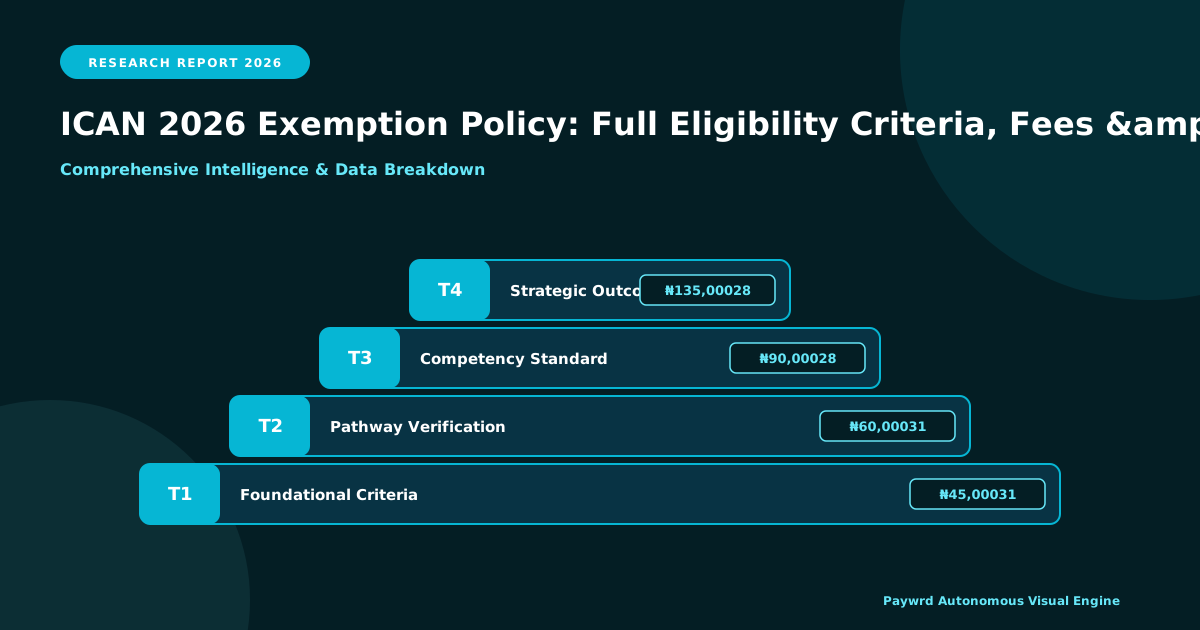
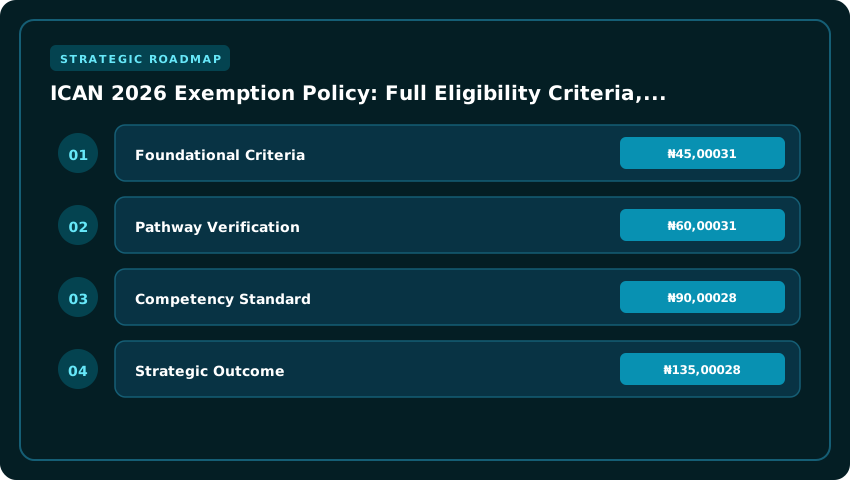
| ATSWA (Full Completion) | Foundation Level | 3 Papers | ₦45,000 | 31st January 2026 | 4–6 weeks | 1.5–2 years |
| B.Sc./HND Accounting | Foundation + 1 Skills Paper | 4 Papers | ₦60,000 | 31st January 2026 | 6–8 weeks | 2–2.5 years |
| ACCA (Knowledge Level) | Foundation + All Skills | 6 Papers | ₦90,000 | 28th February 2026 | 8–10 weeks | 2–3 years |
| ACCA (Full Qualified) | Foundation + Skills (All) | 9 Papers | ₦135,000 | 28th February 2026 | 10–12 weeks | 2.5–3.5 years |
| CIMA (Operational/Management) | Foundation + 2 Skills Papers | 5 Papers | ₦75,000 | 28th February 2026 | 8–10 weeks | 2.5–3 years |
| ICAN-Recognized Postgraduate (MSc/MBA Acct.) | Foundation + 2 Skills Papers | 5 Papers | ₦75,000 | 31st March 2026 | 6–8 weeks | 2–2.5 years |
| BNI / NIN (Other Professional Bodies) | Foundation Level Only | 3 Papers | ₦50,000 | 31st January 2026 | 6–8 weeks | 2.5–3 years |
| No Prior Qualification (Direct Entry) | None | 0 Papers | ₦0 | 30th April 2026 | N/A | 4–5 years |
Frequently Asked Questions
How much does ICAN 2026 exemption cost for ACCA and CIMA holders in Nigeria?
ACCA Knowledge Level holders pay ₦90,000 to skip 6 papers, while fully qualified ACCA members pay ₦135,000 for 9-paper exemptions. CIMA Operational/Management case holders pay ₦75,000 for 5-paper exemptions. All fees must be paid before the 28th February 2026 cut-off date via the ICAN portal.
What is the deadline to apply for ATSWA exemption under the 2026 ICAN syllabus?
The 2026 ICAN exemption application cut-off for ATSWA graduates is 31st January 2026. Candidates must complete the online form on the ICAN portal, upload their ATSWA completion certificate, and pay the ₦45,000 processing fee. Late applications are typically rejected without exceptions.
Can a B.Sc. or HND accounting graduate get exemptions from ICAN Professional exams in 2026?
Yes. B.Sc. and HND accounting graduates from accredited Nigerian institutions qualify for 4-paper exemptions covering the Foundation Level plus one Skills paper. The exemption fee is ₦60,000, and applications close 31st January 2026. Transcripts must be sent directly from your university to ICAN.
How long does ICAN exemption processing take in 2026, and when can I start exams?
ICAN exemption processing for 2026 takes between 4–12 weeks depending on qualification type. ATSWA exemptions are fastest at 4–6 weeks, while ACCA full exemptions take 10–12 weeks. Once approved, candidates can register for the next available diet, typically May/November sessions.
Strategic Final Takeaway
Success in evaluating ICAN 2026 Exemption Policy: Full Eligibility Criteria, Fees & Study Pack Access Guide relies on early preparation, adherence to verified accredited requirements, and cross-referencing official portals. Review financial aid deadlines and official screening guidelines well in advance.