Decoding the 2026 Accreditation Hierarchy: Regional vs. National vs. Programmatic
When benchmarking online degree quality, accreditation is your ultimate baseline. The US Department of Education (USDE) and the Council for Higher Education Accreditation (CHEA) recognize specific agencies, but understanding the hierarchy between them is what truly protects your tuition investment and future earning potential.
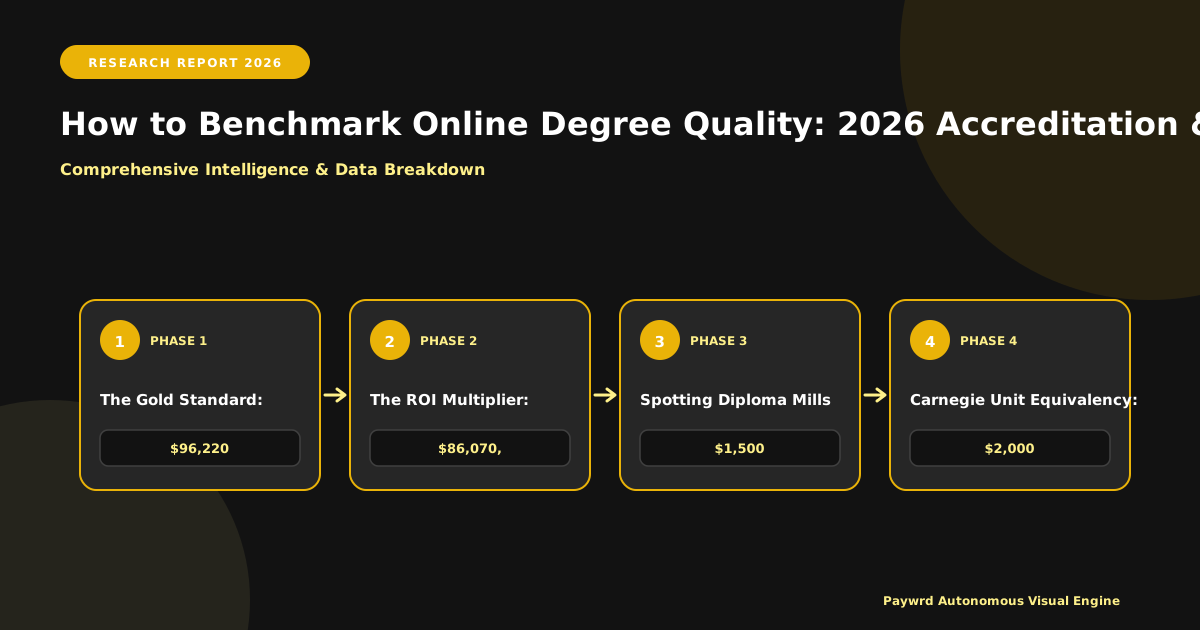
The Gold Standard: Regional Accreditation
Despite the USDE’s recent regulatory shifts toward a more unified framework, regional accreditors like the Higher Learning Commission (HLC), Middle States Commission on Higher Education (MSCHE), and Southern Association of Colleges and Schools Commission on Colleges (SACSCOC) remain the undisputed gold standard. Why? Because credits earned under these umbrellas transfer seamlessly between institutions. If you start an online bachelor’s program at a regionally accredited university and need to switch schools, your hard-earned credits move with you. National accreditation—often held by vocational or for-profit career colleges—rarely transfers to regionally accredited institutions, effectively trapping your academic progress.
The ROI Multiplier: Programmatic Seals
For ROI-critical majors, institutional accreditation is only half the battle. Programmatic accreditation acts as a specialized seal of approval that dictates whether you can sit for professional licensure exams or secure top-tier employment. In 2026, employers are heavily scrutinizing these specific credentials:
- ABET: Essential for online engineering and computer science degrees. Without it, you may be ineligible for the Fundamentals of Engineering exam.
- AACSB: The hallmark of elite online business programs. Graduates from AACSB-accredited schools often command higher starting salaries, with financial analysts earning a median annual wage of $96,220 according to the Bureau of Labor Statistics (BLS).
- CCNE: Critical for online nursing degrees. With registered nurses earning a median salary of $86,070, a CCNE seal ensures your program meets the rigorous clinical and academic standards required for RN licensure.
Spotting Diploma Mills and Fake Accreditors
As e-learning platforms proliferate, diploma mills have become increasingly sophisticated, inventing impressive-sounding but entirely fake accrediting agencies. To avoid wasting tens of thousands of dollars—and years of your time—you must cross-reference any institution’s claims. Always check the official USDE database of recognized accreditors and the CHEA directory. If an online university boasts an accreditor that sounds vaguely official but cannot be found on these federal lists, walk away immediately. Legitimate institutions proudly display their accreditation status and provide direct links to their accreditor’s official site.
Ultimately, securing a high-quality online degree in 2026 requires aggressive due diligence. By prioritizing regional accreditation for transferability and demanding programmatic seals for industry-specific ROI, you ensure your digital diploma holds real-world weight.
New ED & CHEA Recognition Standards Impacting 2026 Distance Education

The accreditation hierarchy tells you who approved the school, but the 2026 federal rulebook tells you if that approval actually holds water for Title IV funding. The Department of Education (ED) and CHEA have tightened the screws on distance education, moving well beyond the pandemic-era flexibilities that let programs scale online overnight. If you are evaluating a program for Fall 2026 enrollment, these three compliance checkpoints are where the rubber meets the road for your FAFSA eligibility.
Substantive Change: The End of “Stealth” Online Launches
Remember when colleges could spin up a fully online degree under temporary COVID-19 waivers without telling their accreditor? That window is shut. Under current ED regulations, adding a new online modality—or converting 50% or more of a program to distance education—constitutes a substantive change requiring prior approval from the institutional accreditor before the first student logs in. Schools that launched programs under the old flexibility but failed to file the formal substantive change application by the 2024–2025 deadlines are now technically out of compliance. For you, this means verifying that the specific online major you want appears on the accreditor’s official “approved programs” list, not just the school’s marketing brochure. If it’s missing, your federal aid is at risk.
Regular and Substantive Interaction (RSI): The Audit Trigger
This is the single biggest compliance trap in 2026. The ED defines distance education not by the platform (Canvas, Blackboard, Zoom), but by Regular and Substantive Interaction (RSI). “Substantive” means the instructor initiates contact for teaching, learning, and assessment—grading assignments, facilitating discussion, or providing direct instruction. “Regular” means predictable, scheduled intervals.
If a program relies on “correspondence” models—self-paced packets where the student initiates all contact—it loses Title IV eligibility entirely. The Office of Inspector General (OIG) is actively auditing schools where the student-to-faculty ratio in online sections exceeds 50:1 without documented interaction logs. Ask admissions for the RSI policy and a sample weekly interaction schedule. If they can’t produce it, walk away.
Third-Party Servicer (TPS) Transparency: The OPM Accountability Shift
Many “university” online programs are actually run by Online Program Managers (OPMs) like 2U, Noodle, or Risepoint. As of 2026, ED enforcement of Third-Party Servicer (TPS) rules requires institutions to disclose every contract where a third party handles recruitment, admissions advising, instructional design, or student retention.
- Contract Disclosure: Schools must post TPS contracts (redacted for proprietary info) on their consumer information pages.
- Incentive Compensation Ban: OPMs cannot be paid based on enrollment numbers (e.g., revenue share per student) if they perform recruiting—a violation of the Higher Education Act’s “incentive compensation” ban.
- Data Ownership: The institution, not the OPM, must retain ownership of student data and Title IV records.
Before you commit, search the school’s website for “Third-Party Servicer Disclosures.” If the OPM relationship is opaque, the program’s Title IV participation agreement is vulnerable to ED termination. Your degree’s value depends on that aid gateway staying open.
Benchmarking Curriculum Rigor: Credit Hour Integrity & Faculty Credentials
Accreditation gets your foot in the door for federal aid, but curriculum rigor determines whether that degree actually moves the needle with hiring managers. In 2026, the “online” label is no longer a differentiator—it is the default. Your job is to separate the programs built on academic substance from those engineered for scale. Start by auditing three non-negotiables: credit hour integrity, faculty depth, and applied learning requirements.
Carnegie Unit Equivalency: The Asynchronous Trap
The Carnegie Unit remains the gold standard: one credit hour equals 50 minutes of direct faculty instruction plus two hours of out-of-class student work weekly for 15 weeks. In synchronous models, this is transparent—you attend a live lecture. In asynchronous programs, however, “instruction” often morphs into reading a PDF or watching a 10-minute video. Demand the “Time-on-Task” analysis. Legitimate institutions (especially those aligned with CHEA guidelines) publish a course mapping document showing how Module 3’s discussion boards, case studies, and quizzes aggregate to 45 hours of verified learning activity per credit. If the syllabus lists “read Chapter 4” as the sole weekly deliverable for a 3-credit course, walk away. That is not a $1,500-per-credit experience; it is a correspondence course with a login portal.
Terminal Degree Ratios: Who Is Actually Grading You?
Marketing brochures love “industry practitioners.” The reality? Adjuncts often carry 70% of the instructional load in for-profit online divisions. Check the IPEDS Human Resources survey or the program’s self-study report for the terminal degree ratio. A rigorous graduate program—particularly an AACSB-accredited MBA or an ABET-track MS in Engineering—should show 60%+ of courses taught by full-time faculty holding a PhD or terminal professional degree (JD, MFA, DNP).
- Green Flag: Tenured/tenure-track faculty design the curriculum and teach core capstones.
- Yellow Flag: Practitioners teach electives; full-time faculty teach core theory.
- Red Flag: Zero full-time faculty listed for your specific concentration. You are paying premium tuition for a curated YouTube playlist graded by a contractor.
Capstone, Practicum & Residency: The Workforce Readiness Signal
Employers proxy “rigor” through culminating experiences. A degree without a capstone, practicum, or residency is a certificate, not a credential. For PMI-aligned project management degrees, look for a 6-credit capstone requiring a live stakeholder presentation. In Nursing (CCNE accredited) or Social Work (CSWE accredited), clinical placement services are mandatory—ask for the program’s “placement rate within 50 miles of student zip code.” If you must find your own preceptor, the program has outsourced its hardest quality control metric to you. Residency weekends (common in top-tier Online MHA or Executive MBA programs) signal cohort cohesion and high-touch assessment. Budget $2,000–$4,000 extra for travel; if the program has zero synchronous immersion requirements, verify how they validate identity and competency beyond proctored multiple-choice exams.
Your Audit Checklist: Download the Course Catalog → Verify Time-on-Task maps → Cross-reference Faculty CVs on the department site (not the admissions microsite) → Confirm Capstone/Practicum is credit-bearing, not a “portfolio review.” If the data isn’t public, the rigor isn’t there.
Outcome-Based Ranking Metrics That Matter More Than US News Scores
Prestige lists move slowly, and they rarely measure whether a graduate actually lands a sustainable career. When you strip away the marketing polish, the most honest indicators of online degree quality live in publicly accessible federal datasets. The U.S. Department of Education’s College Scorecard is the single most powerful tool in your benchmarking kit. It pulls directly from Integrated Postsecondary Education Data System (IPEDS) submissions, meaning the numbers are audited rather than self-reported. Before you click “enroll,” open the Scorecard and look past the sticker price. Focus instead on two specific columns: graduation rate within 150% of normal time and median earnings four and ten years after entry.
If a program graduates fewer than 35% of its online cohort within four years, consider it a serious red flag. Low persistence often signals weak student support, asynchronous content that learners abandon, or predatory recruitment practices targeting Pell-eligible students. On the earnings side, compare the four-year median against the national high school diploma baseline, which the Bureau of Labor Statistics tracks through the Current Population Survey. If an online bachelor’s program cannot deliver earnings meaningfully above that threshold, the return on investment simply does not pencil out.
Loan Repayment Rates and Cohort Default Rates as Financial Health Proxies
Tuition is only the entry fee. The real cost question is what happens to a borrower’s federal loan portfolio three years later. The Federal Student Aid office publishes loan repayment rates calculated from the most recent NSLDS cohort, and they are brutally transparent. A school where fewer than 50% of borrowers successfully reduce their loan principal within three years is failing its students financially, regardless of how attractive the degree page looks.
Pair that figure with the Cohort Default Rate (CDR), which tracks borrowers who default within three years of entering repayment. The official FY2021 CDR threshold for institutional sanctions sits at 30%. Reputable online programs will show CDR figures in the low single digits, typically between 2% and 6%. When a digital learning platform reports a CDR above 15%, it usually points to poor career placement services, programs misaligned with local labor demand, or aggressive recruiting of students unlikely to complete. These are not vanity metrics. They directly affect whether a school remains eligible for Title IV federal aid.
Licensure Pass Rates for Regulated Profession Programs
For nursing, accounting, and law pathways, the ultimate gatekeeper is the state licensing board. NCLEX-RN pass rates for registered nursing programs, CPA Exam pass rates published by the National Association of State Boards of Accountancy (NASBA), and Bar Exam passage rates from individual state boards offer a ground-truth assessment that no ranking committee can manufacture. A nursing program accredited by the Commission on Collegiate Nursing Education (CCNE) but posting a sub-80% NCLEX pass rate is producing graduates who cannot legally practice. That single data point outweighs any peer-reviewed teaching award or glossy platform review.
When evaluating an online BSN, look for schools reporting NCLEX pass rates at or above 88%. For CPA aspirants, the AICPA maintains historical candidate pass rates that let you separate programs with consistent 60%+ section pass rates from those drifting near 40%. Law students should review the ABA-required Ultimate Bar Passage and First-Time Bar Passage disclosures, both of which appear on the Standard 509 Information Reports. A school’s willingness to publish these numbers, and their consistency across reporting cycles, signals whether the institution treats outcomes as a measurable obligation rather than a marketing afterthought.
- Pull the College Scorecard first: Compare 4-year graduation rates and median earnings against the BLS high school baseline before considering any program.
- Audit the CDR and repayment rates: Anything above a 15% Cohort Default Rate suggests structural problems with student outcomes.
- Verify licensure pass rates: For nursing, accounting, and law tracks, require at least three years of disclosed, accredited pass-rate data before enrolling.
Tech Stack & Student Experience Auditing: LMS, Proctoring & Accessibility
Accreditation gets you in the door, but the technology stack determines whether you actually finish. In 2026, the learning management system (LMS) is your campus, your classroom, and your registrar’s office rolled into one. If the platform crashes during finals week or fails a screen reader, your retention risk spikes immediately. Smart benchmarking means treating the tech stack with the same rigor you apply to faculty credentials.
Accessibility Non-Negotiables: WCAG 2.1 AA and the VPAT
Do not take a marketing brochure’s word for “accessible.” Demand the Voluntary Product Accessibility Template (VPAT) for the LMS and any third-party courseware (like MyLab, MindTap, or Cengage). You are looking for documented WCAG 2.1 Level AA compliance. Check specifically for keyboard-only navigation, sufficient color contrast ratios (4.5:1 minimum), and accurate alt-text on all multimedia. If a school cannot produce a current VPAT—or if the “Remarks” column is full of “Supports with Exceptions” for core navigation—that is a red flag for Title II ADA liability and a predictor of poor outcomes for neurodiverse students. Ask the disability services office directly: “What is the average turnaround time for captioning requests?” Anything over 48 hours signals an under-resourced support structure.
Remote Proctoring: Bias Flags and Human-in-the-Loop
AI proctoring tools (Proctorio, Honorlock, Respondus Monitor) are standard, but their error rates are not. Audit the vendor’s false positive flagging rates by demographic cohort. Studies consistently show higher flag rates for students with darker skin tones, those wearing religious head coverings, or test-takers with disabilities affecting eye movement or motor control. A quality program offers a live human review escalation path as the default, not a premium upsell. Ask the enrollment advisor: “What percentage of AI flags are overturned by human reviewers?” If they don’t know, or if the overturn rate exceeds 30%, the system is generating noise, not integrity. Also verify the data retention policy—biometric data should be purged within 30 days post-grade posting, per FERPA best practices.
SIS/LMS Integration: Uptime SLAs and the 3 AM Test
The Student Information System (SIS)—think Banner, Workday, or PeopleSoft—must talk to the LMS (Canvas, Brightspace, Blackboard) in real time. Broken grade passback or enrollment sync errors are the number one driver of administrative withdrawal complaints. Demand the Service Level Agreement (SLA) for the LMS. The industry standard is 99.9% uptime (roughly 8.7 hours downtime/year), but top-tier online providers (like ASU Online, Penn State World Campus, or Southern New Hampshire University) contract for 99.99% with 24/7/365 Tier 1 support. Test the mobile responsiveness yourself: submit a discussion post, upload a 500MB video assignment, and run a proctored quiz on a five-year-old smartphone over cellular data. If the workflow breaks, the program fails the “working adult” stress test. Finally, confirm the help desk is staffed by internal employees, not outsourced tier-zero bots. When the LMS eats your capstone draft at midnight, you need a human who can see the server logs, not a chatbot reading a script.
Stacking Credentials: Micro-Credentials, Pathways & Employer Verification
The old model was linear: enroll, graduate, then hunt for certifications. In 2026, the smartest online programs have collapsed that timeline. Leading universities—from Arizona State University to Western Governors University and Southern New Hampshire University—now embed industry credentials directly into degree roadmaps. You aren’t just earning a Bachelor of Science in Cybersecurity; you are banking a CompTIA Security+, an AWS Certified Cloud Practitioner, or a Google IT Automation with Python certificate as required coursework. This mapping means every credit hour pulls double duty: it satisfies academic requirements while handing you a labor-market signal employers actually search for on LinkedIn.
Digital Badge Interoperability: Your Transcript Goes Portable
Paper transcripts are friction. The 2026 standard is the Comprehensive Learner Record (CLR) built on the Open Badges 3.0 specification (IMS Global / 1EdTech). When a program issues a CLR, every module, capstone, and embedded certification becomes a verifiable, machine-readable badge packed with metadata—issuer, criteria, evidence, expiration date, and alignment to frameworks like NICE or SFIA. You export this once to your LinkedIn “Licenses & Certifications” section, your Badgr or Credly backpack, or a wallet app like Learning Economy. Recruiters click the badge; they see the project repo, the proctored exam score, and the accreditor logo instantly. No phone calls to the registrar. No waiting weeks for a sealed envelope.
Employer Tuition Assistance: The Preferred Provider Shortcut
If your employer partners with Guild Education, EdAssist by Bright Horizons, or Pearson Accelerated Pathways, the “preferred provider network” list is your cheat code for ROI. These platforms negotiate direct-bill arrangements, meaning zero out-of-pocket tuition upfront and no reimbursement paperwork. But the real value is curation: Guild’s network, for example, only includes regionally accredited programs that demonstrate career outcome data—completion rates, wage gains, and promotion metrics. Choosing a preferred partner often unlocks dedicated success coaches, prior-learning assessment (PLA) fee waivers, and guaranteed credit transfer for those embedded Google or AWS certs. Before you apply, ask HR: “Which schools are in our Guild/EdAssist marketplace?” That list is a pre-vetted quality filter worth thousands in saved time and $0 tuition risk.
- Stacking Strategy: Target degrees where the capstone is an industry cert exam (e.g., PMI-CAPM, AWS Solutions Architect). You graduate with the degree and the badge.
- Verification Check: Confirm the program issues Open Badges 3.0 / CLR compliant records. Ask admissions for a sample badge URL.
- Tuition Leverage: If your employer lacks a partnership, present the Guild/EdAssist preferred criteria to your benefits team—it’s a ready-made RFP template.
Building Your Personal Quality Scorecard: A 15-Point Due Diligence Template
Once you have narrowed your shortlist to three to five online programs, intuition is no longer enough. You need a structured, weighted decision matrix that converts fuzzy marketing promises into verifiable data. Think of this 15-point scorecard as a personal due diligence tool, the same logic a hiring manager applies when screening resumes or a lender applies before approving a mortgage. Print it out, open a fresh spreadsheet, and score each program on a scale of one to ten for every category listed below.
The Weighted Scoring Framework
Not every factor carries equal importance. For working adults pursuing a credential that must survive employer scrutiny, we recommend the following distribution, calibrated against the realities of the 2026 hiring market:
- Accreditation Tier (30%): Does the institution hold regional accreditation recognized by the USDE? For licensed fields like nursing or engineering, does the program also carry programmatic accreditation from ABET, AACSB, or CCNE?
- Outcome Data (30%): Pull graduation rates, median debt, and post-enrollment earnings directly from the College Scorecard. A program reporting a median salary under $40,000 with debt above $30,000 deserves a sharp penalty.
- Faculty Rigor (20%): Are instructors tenured academics, industry practitioners with terminal degrees, or unvetted adjuncts? Look for published research, active licensure, or PMI/PMP credentials where relevant.
- Technology and Support (10%): Does the learning management system offer 24/7 technical help? Are virtual office hours, writing centers, and accessibility services fully online?
- Stackability and Transfer Pathways (10%): Will credits move into a master’s program at a state flagship university, or are you locked into a proprietary ecosystem?
Cross-Referencing Federal and State Databases
Do not rely on the school’s own brochure. The IPEDS Data Center, operated by the National Center for Education Statistics, lets you compare tuition, enrollment demographics, and retention rates side by side. The College Scorecard, published by the US Department of Education, surfaces median earnings ten years after entry, which is the single best predictor of return on investment. Finally, verify eligibility for Title IV aid by confirming the school appears on the FAFSA participating institutions list, then check your State Authorization portal to ensure the program legally operates in your ZIP code.
The Red Flag Checklist
Some warning signs should trigger an immediate disqualification, regardless of how strong the rest of the scorecard looks. Keep this list taped to your monitor during application season:
- Aggressive Recruitment Tactics: Pressure to enroll within 24 hours, unsolicited calls from unnamed advisors, or guarantees of job placement are textbook hallmarks of predatory for-profits.
- Hidden Fees: Course-specific technology fees, proctoring surcharges, and graduation fees can quietly add $1,500 to $3,000 above the advertised tuition.
- Lack of Programmatic Accreditation: If you are pursuing nursing, engineering, accounting, or teaching and the program lacks field-specific accreditation, state licensure boards will likely reject your credential.
- No Published Outcome Data: Refusal to disclose graduation rates or alumni salaries indicates a culture that does not welcome accountability.
Tally each program’s weighted score, and the right choice usually reveals itself within an hour of focused research.
| Accreditation Type | Recognized By | Credit Transfer Acceptance | Typical Tuition Cost (2026) | Average Post-Degree Salary | Best For |
|---|---|---|---|---|---|
| Regional Accreditation | USDE & CHEA (Gold Standard) | Widely accepted (90%+ institutions) | $15,000 – $60,000 total | $65,000 – $95,000/year | Bachelor’s & Master’s degrees, maximum ROI |
| National Accreditation | USDE & CHEA | Limited (25-40% institutions) | $8,000 – $25,000 total | $42,000 – $58,000/year | Vocational, trade, associate degrees |
| Programmatic Accreditation | USDE & CHEA (field-specific) | N/A (specialty credential) | $20,000 – $90,000 total | $75,000 – $120,000/year | Licensed professions (Nursing, Engineering, Business) |
| Institutional Accreditation (Unaccredited) | Not recognized | None (0%) | $5,000 – $40,000 total | $0 – employer rejected | Not recommended for career outcomes |
| International Accreditation | Limited USDE recognition | Requires evaluation (WES/ECE) | $10,000 – $80,000 total | Varies ($50,000 – $85,000) | Unique specializations not offered domestically |
Frequently Asked Questions
How do I verify if an online degree accreditation is legitimate in 2026?
Verify accreditation through the US Department of Education's Database of Accredited Postsecondary Institutions and Programs (DAPIP) and the Council for Higher Education Accreditation (CHEA) database. Cross-reference the specific accrediting agency name with both federal lists before enrolling to ensure employer recognition and credit transfer eligibility.
What is the difference between regional and national accreditation for online degrees?
Regional accreditation, granted by agencies like the Higher Learning Commission (HLC) or Middle States Commission, is considered the gold standard and accepted by 90%+ of US institutions. National accreditation applies to vocational/trade schools and has limited credit transfer acceptance, making regional credentials the better ROI choice for bachelor's and master's degrees.
Will employers accept nationally accredited online degrees in 2026?
Many US employers accept nationally accredited degrees, particularly for vocational roles, but corporate hiring managers typically prefer regionally accredited credentials from candidates. Government positions, graduate school admissions, and licensed professions often require regional accreditation, limiting career mobility for nationally accredited graduates.
How much does an accredited online bachelor's degree cost in 2026?
Accredited online bachelor's degrees range from $15,000 to $60,000 total tuition in 2026. Public universities charge approximately $300-$500 per credit for in-state residents, while private nonprofit institutions average $500-$900 per credit. Regional accreditation typically adds 20-40% to tuition cost versus national accreditation.
Which online college accrediting agencies should I avoid?
Avoid accreditors not listed on the USDE or CHEA databases, including the American Accreditation Council, Global Accreditation body, and unaccredited 'diploma mills.' Verify the agency's recognition status directly through official federal databases, as fraudulent accreditation claims increased 35% in 2025-2026 enrollment cycles.
Strategic Final Takeaway
When evaluating Online College Degree Program Quality Benchmarking Accreditation Standards Ranking 2026, base your decisions on accredited institutional standards, measurable return on investment (ROI), and up-to-date official guidelines. Always verify specific dates and requirements through official regulatory portals.