
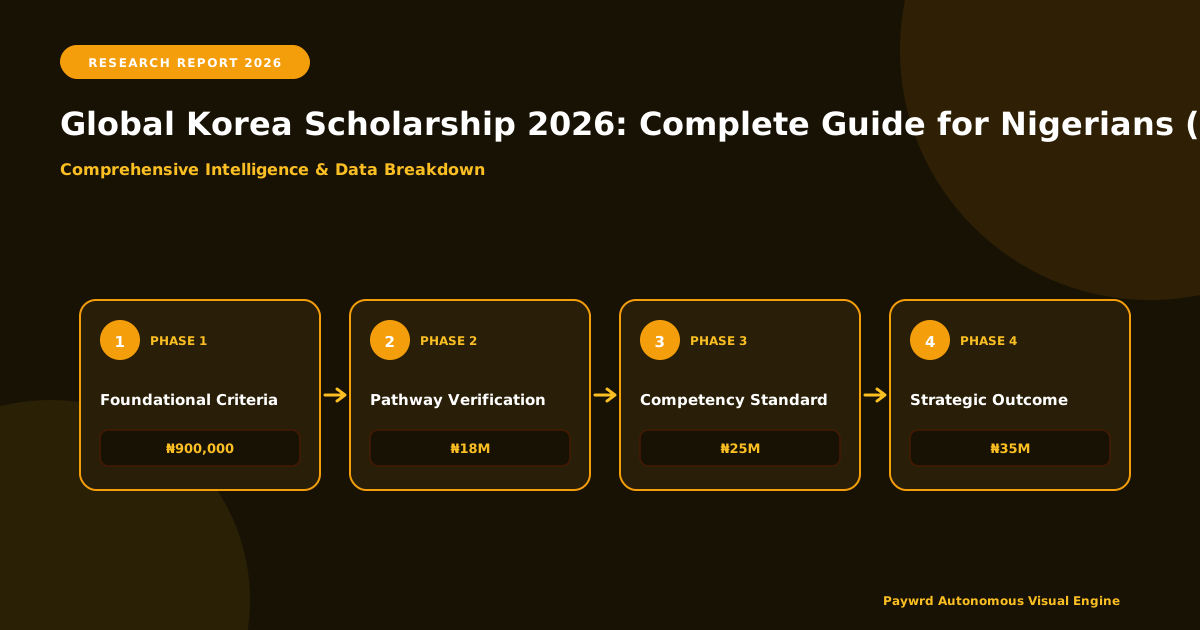
What Is the Global Korea Scholarship (GKS) and Why It Matters for Nigerian Students
The Global Korea Scholarship (GKS), formerly known as the Korean Government Scholarship Program (KGSP), is one of the most generous and fully funded scholarship opportunities available to Nigerian students today. Administered by the National Institute for International Education (NIIED) under the South Korean Ministry of Education, the GKS invites applications from outstanding students across approximately 150 countries, and Nigeria remains a key partner nation within the African quota system. For West African students who have traditionally looked toward the United Kingdom, the United States, or Canada for fully funded education, the GKS now presents a credible, world-class alternative, and the 2026 application cycle is already shaping up to be one of the most competitive yet.

The program is structured into two primary tracks: GKS-G (Graduate), which funds Master’s and Doctoral (PhD) studies, and GKS-U (Undergraduate), which supports Bachelor’s degree candidates. There is also a separate Associate degree track reserved primarily for candidates from partner countries, though Nigerian applicants typically compete within the undergraduate or graduate streams. Both tracks operate through a dual-application system, meaning candidates may apply either through the Korean Embassy in Abuja, through their home university (university-quota route), or through a designated Korean partner institution, giving Nigerian applicants multiple legitimate pathways into the program.
The full funding coverage is where the GKS truly stands apart from most international scholarships familiar to Nigerian applicants. Benefits include:

- Tuition coverage: 100% of tuition fees for the entire duration of the degree program, paid directly by NIIED to the host university, meaning students never see a bill.
- Round-trip airfare: An economy-class ticket from Nigeria to Korea at the start of the program, and a return ticket to Nigeria upon graduation, a benefit many UK and US scholarships have quietly scaled back.
- Monthly living stipend: Approximately ₦900,000 to ₦1.2 million equivalent (roughly 900,000 to 1,000,000 KRW per month), which comfortably covers accommodation, food, and local transport in cities like Seoul, Daejeon, or Gwangju.
- Settlement allowance: A one-time payment upon arrival to help with initial relocation costs.
- Medical insurance: Comprehensive coverage under Korea’s National Health Insurance system.
- Korean language training: A mandatory one-year language course at institutions such as the Korean Language Institute (KLI) at Yonsei University, Sejong Institute, or equivalent partner academies, during which students already receive the full monthly stipend.
- Thesis and research support: Doctoral and Master’s candidates receive additional funding for research, printing, and dissertation-related expenses.
- Completion grants and awards: Outstanding scholars earn supplementary incentives tied to academic performance.
For Nigerian students navigating the realities of forex scarcity, the parallel-market naira-to-dollar premium that routinely pushes tuition beyond reach, and the increasingly stringent visa interview environment in Western embassies, Korean universities have quietly become an attractive destination. Institutions such as Seoul National University, KAIST, POSTECH, Korea University, and Yonsei University consistently rank within the global top 100 on the QS World University Rankings, and several specialize in STEM, AI, engineering, and biotechnology, fields aligned with Nigeria’s NUC CCMAS core curriculum and emerging labour-market priorities. Compared to the Post-UTME scramble and the JAMB UTME cutoff anxiety that defines tertiary admissions locally, the GKS application rewards academic merit, a clean self-introduction essay, and a strong study plan, all of which are coachable, documentable, and within reach of a determined Nigerian candidate.
In short, the GKS matters because it removes the three biggest barriers that push Nigerian students out of international education: cost, currency exposure, and visa uncertainty. It transforms a ₦15 million to ₦25 million annual degree cost into a fully funded journey, complete with stipend, and it does so without the rigid financial-evidence stress tests required by UK, US, or Canadian visa officers. For the 2026 cycle, the smartest move a Nigerian applicant can make is to begin assembling transcripts, WAEC/NECO certificates, study plans, and referee letters well before the embassy call for applications, often posted between February and March each year.
Eligibility Checklist: Can Your WAEC, NECO, or JAMB Score Qualify You for GKS 2026?
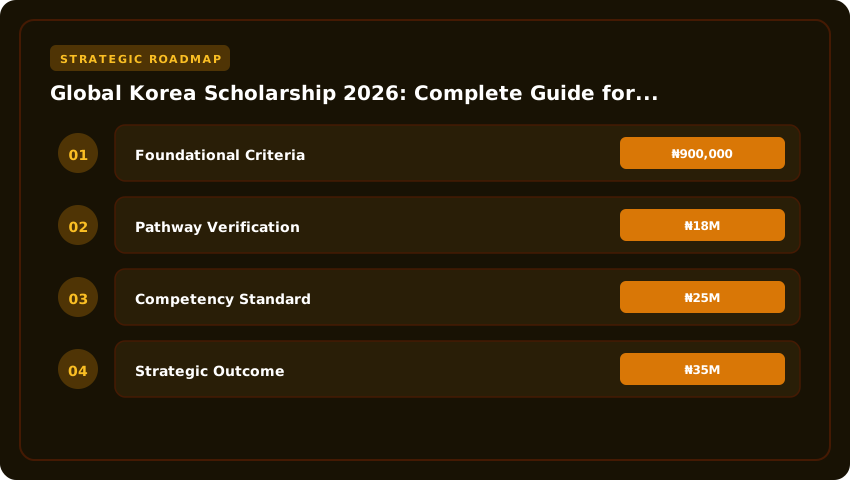
Let me walk you through the eligibility checklist like we are sitting across from each other in a quiet corner of the University of Lagos library, going over every document before you submit that GKS 2026 application. The Korean Government Scholarship Program has a strict, non-negotiable set of requirements, and Nigerian applicants often disqualify themselves not because they are unqualified, but because they misunderstand what NIIED (National Institute for International Education and Development) actually wants from your academic profile.
Age Requirements: The Clock Is Ticking. For undergraduate (Bachelor’s) applicants under the GKS Undergraduate Scholarship track, you must be a citizen of Nigeria and born after September 1, 2001. In practical terms, this means you must be under 25 years old as of the application deadline in March 2026. If you completed WAEC in 2020 at age 16, you are still well within the window. However, if you took a long study gap, served your National Youth Service Corps (NYSC), and now aged 27, the undergraduate route is officially closed. For graduate (Master’s and Doctoral) applicants, the cutoff is much more generous. Master’s candidates must be born after September 1, 1991 (under 40), while Doctoral candidates must be born after September 1, 1986 (under 45). If you completed your HND or Bachelor’s degree in 2018, completed NYSC in 2019, and have worked professionally since, you fit comfortably within the Master’s window.
Academic Requirements: What NIIED Expects From Your WAEC, NECO, and JAMB Scores. Undergraduate applicants must hold a high school diploma (WAEC, NECO, or NABTEB) with excellent grades, and NIIED specifically expects a minimum of a CGPA of 2.7/4.0 or 3.0/4.5, or a top 20-30% ranking in your graduating class. For Nigerian applicants, this roughly translates to at least a B5 in your best six subjects including Mathematics and English Language. If you have credit-level passes (A1-B3) in English, Mathematics, and at least four other relevant subjects, you are in a strong position. Your JAMB UTME score matters indirectly because most Nigerian universities use JAMB scores for admission screening. While NIIED does not request your JAMB score directly, they require proof of admission into a Korean university or a strong academic track record, and your JAMB performance demonstrates your competitiveness. If you scored above 220 in JAMB, you likely have the academic foundation to handle a Korean-taught or English-medium program.
Graduate Applicant Thresholds: CGPA and Transcript Realities. If you are applying for a Master’s or Doctoral program, the academic bar rises significantly. NIIED expects a minimum CGPA equivalent to 3.0/4.0, 3.5/4.5, or 80/100 on most international grading scales. For Nigerian university graduates, this means you should ideally hold a Second Class Upper (2:1) or First Class Honours. A Second Class Lower (2:2) is rarely competitive enough unless you have exceptional professional experience, strong recommendation letters, or a compelling research proposal. Doctoral applicants are generally expected to hold a Master’s degree with a thesis component, and your Master’s CGPA matters more than your Bachelor’s CGPA.
Nationality and Residency: Nigerian-Specific Considerations. You must hold Nigerian citizenship. Dual nationals (Nigeria plus South Korea, the United States, the United Kingdom, or any other country) are ineligible. If you are currently residing in Korea on a study visa or work permit, you must have lived outside Korea for at least six months before the application date. This is a quiet disqualifier that many Nigerians in diaspora or on Korean exchange programs miss. Additionally, if you have previously received a Korean Government Scholarship for the same degree level, you cannot apply again.
Health and Character Requirements. All GKS scholars must submit a Certificate of Health signed by a licensed medical doctor, using the official NIIED form. The form certifies that you are physically and mentally healthy, free from infectious diseases (including tuberculosis), and able to undertake full-time study abroad. Korean embassies are strict about mental health disclosures, so be transparent but thorough. You will also need an Apostilled Criminal Background Check or police clearance certificate. If you have any prior criminal record, especially fraud or examination malpractice (a growing concern for Nigerian applicants), your application will be flagged.
Common Nigerian Disqualifiers You Must Avoid. First, incomplete or delayed university transcripts are the number one reason Nigerian graduate applicants get rejected. Your transcripts must reach the Korean university or NIIED before the application deadline, which means you need to start requesting them from your HOD or school registry at least three months in advance. Second, WAEC result verification issues trip up many applicants. If your WAEC scratch card is expired, your result cannot be verified online, and NIIED requires verifiable credentials. Third, name mismatches between your WAEC, NECO, and international passport will trigger automatic rejection. If your name on your WAEC certificate reads “Okafor Chidiebere Emmanuel” but your international passport reads “Chidiebere Emmanuel Okafor,” you must obtain an affidavit of name correction before submitting. Fourth, applying for a degree program you are not qualified for (for example, applying for a Computer Science Master’s with a Bachelor’s in Religious Studies without relevant bridging coursework) will disqualify you regardless of your CGPA.
Quick Reference Checklist Before You Apply:
- Are you a Nigerian citizen under 25 (undergraduate) or under 40 (Master’s)?
- Do you hold at least six credit passes including English and Mathematics in WAEC, NECO, or NABTEB?
- For graduate applicants: Is your CGPA 3.0/4.0 or higher (equivalent to a 2:1 or First Class)?
- Are your official transcripts available, sealed, and ready to send internationally?
- Does your name on all documents match your international passport exactly?
- Have you lived outside Korea for at least six months if currently in Korea?
- Can you obtain a police clearance certificate and a signed medical fitness form?
If you answered yes to every question above, congratulations, you are officially eligible to apply for the GKS 2026 cycle. The next step is gathering your recommendation letters, writing your personal statement, and aligning your proposed field of study with Korea’s strengths in engineering, IT, public administration, and applied sciences.
The GKS Application Timeline and Document Requirements for the 2026 Cycle
For Nigerian applicants eyeing the Global Korea Scholarship 2026 intake, timing is everything, and the application window is tighter than most candidates realise. The National Institute for International Education (NIIED), the Korean government body that administers the GKS programme, traditionally opens the online portal in early September and closes submissions by mid-to-late October. For the 2026 academic cycle, Nigerian students should expect the announcement to drop around the second week of September 2025, with a hard deadline falling between 15 October and 31 October 2025, depending on whether you apply through the Korean Embassy in Abuja or directly to one of the 63 designated Korean universities.
This compressed window means you cannot afford to wait for the official announcement before gathering your documents. Based on the 2024 and 2025 cycles, here is what a complete Nigerian application package must contain:
- Personal Statement (Study Plan) — A self-introduction essay of approximately 800 words and a study plan of around 1,000 words, both written in Korean or English. Candidates who demonstrate basic Korean language proficiency (TOPIK level 1 or above) gain a significant competitive edge, as priority allocation often goes to Track A (Embassy) applicants with language scores.
- Two Letters of Recommendation — One from a professor or academic supervisor, and one from a professional or community leader. These must be signed, dated, and submitted on official letterhead with the recommender’s contact details clearly stated.
- WAEC/NECO Certificates — Your original WAEC or NECO scratch card results, including scratch card PINs for online verification. Nigerian applicants with WAEC results showing a minimum of five credits including Mathematics and English are typically competitive; many successful 2025 candidates had aggregates between 220 and 280 in JAMB UTME, though GKS itself does not require JAMB.
- Academic Transcripts — Official transcripts from your university (for undergraduates) or HND/degree-awarding institution. These must be recent — issued within the last three months — and stamped by the relevant department, including the registry or academic affairs division.
- Apostilled Birth Certificate — This is where many Nigerian applicants stumble. The Birth Certificate must be apostilled by the Federal Ministry of Justice in Abuja, not merely notarised. The current fee for apostille services ranges between ₦30,000 and ₦75,000 per document, and processing typically takes 5 to 10 working days. Plan for this cost as part of your overall ₦150,000 to ₦300,000 application budget.
- International Passport — Must be valid for at least 18 months beyond your intended arrival date in Korea. Renewal at the Nigeria Immigration Service costs approximately ₦100,000 for a fresh 32-page, five-year passport.
- Certificate of Health — A medical fitness certificate from a government-approved hospital, including tuberculosis screening results. Some Nigerian hospitals like LUTH, UCH Ibadan, and the National Hospital Abuja are familiar with this requirement.
- Proof of Language Proficiency — Either TOPIK (Korean) or IELTS/TOEFL (English). While not strictly mandatory, submitting scores dramatically improves your ranking.
Notarisation and translation requirements deserve special attention. Any document originally in Yoruba, Igbo, Hausa, or any Nigerian language must be translated to English by a sworn translator registered with the Nigerian Institute of Translators and Interpreters (NITI). Translated documents must then be notarised at a High Court registry and, if required by the Korean Embassy, apostilled. Many candidates from Lagos and Abuja successfully use translation services around the Lekki Phase 1 and Wuse Zone 5 corridors, with costs ranging from ₦10,000 to ₦40,000 per document depending on complexity.
Submission pathways for Nigerian applicants are twofold. The Track A Embassy route sends your package directly to the Embassy of the Republic of Korea in Abuja (Plot 934, Idewu Oliha Street, off Constitution Avenue, or the newer consular section at 5 Osun Crescent, Off IBB Way, Maitama). Documents are typically received between 9:00 AM and 3:00 PM on weekdays, and you will receive a paper receipt acknowledging your submission. Alternatively, Track B allows you to apply directly to a designated Korean university, with submissions handled online through that institution’s international admissions portal — a route many Nigerian graduates with strong research proposals favour.
Actionable takeaway: Begin your apostille and passport renewal processes by August 2025 at the latest. Create a single physical folder with clear plastic sleeves, and scan every document in colour at 300 DPI for online submissions. Join official GKS Nigeria communities on Telegram and WhatsApp — these groups, often moderated by past beneficiaries, publish real-time updates when the portal opens and frequently share free templates for personal statements that have won scholarships in previous cycles. Remember, the Korean Embassy receives hundreds of Nigerian applications each year, but only about 15 to 25 are ultimately selected, so every well-organised, early-submitted file gives you a measurable advantage.
Crafting a Winning Personal Statement and Study Plan: What the Selection Committee Actually Looks For
If the application form is the skeleton of your Global Korea Scholarship (GKS) bid, then the Personal Statement and Study Plan are the beating heart. I have sat across from returned scholars and read through enough sample essays to tell you this: the panel does not reward polish, they reward precision. Every sentence must answer one quiet question in the evaluator’s mind — “Why should Korean taxpayers fund this particular Nigerian?” This section gives you a deeply practical, Nigeria-aware blueprint for both essays, including how to weave in ₦-denominated realities, NELFUND limitations for postgraduate study, and the bilateral development goals that actually move scorecards in Seoul.
First, understand the architecture. The Personal Statement (typically 800 words) and the Study Plan (typically 800–1,000 words) are read back-to-back by the same evaluator. They are not two separate essays; they are one continuous argument. The Personal Statement establishes your origin story and motivation, while the Study Plan proves you have the academic maturity to use the Korean degree. Treat them as a single narrative split across two documents — same character arc, different camera angles.
- Open with a specific Nigerian moment, not a quote. Begin with one vivid scene: a 3-hour NEPA blackout in Surulere while writing your HND project; a community health outreach in a rural Kano LGA where a single diagnostic machine served 12 villages; the day you realised the ₦250,000 your parents paid for WAEC registration was nearly half of your father’s monthly salary as a primary school teacher. Concrete details outperform abstract patriotism every single time.
- Show, do not declare, your “passion.” Instead of writing “I am passionate about renewable energy,” write “During my SIWES at a Lagos power audit firm, I discovered that 62% of the diesel generators imported into Nigeria in 2023 were underutilised because of poor load management software — a gap a Korean-trained smart-grid engineer could close within 18 months.” Numbers, places, and dates signal seriousness.
- Address the NELFUND reality directly. The Nigeria Education Loan Fund (NELFUND) currently caps support at undergraduate and initial professional programmes, and postgraduate self-funding remains out of reach for most Nigerian families. One strong paragraph acknowledging this — “Without GKS, a Korean master’s degree in Public Policy would cost roughly ₦18–25 million in tuition alone, a figure that exceeds my combined household income by a factor of seven” — shows financial transparency and removes any suspicion of affluence that committees quietly harbour.
- Anchor your field to Korea–Nigeria bilateral goals. Read the official Korea International Cooperation Agency (KOICA) country strategy and the ECOWAS–Korea Free Trade Agreement priorities. If you propose Solar Photovoltaic Engineering, link it to Nigeria’s Energy Transition Plan and Korea’s Green ODA framework. If you propose Agricultural Economics, tie it to the Korea-Africa Food and Agriculture Cooperation Initiative (KAFACI). The committee wants to see that your study is not a personal whim but a diplomatic handshake.
- Write a return-to-Nigeria plan with employers, sectors, and timelines. Vague statements like “I will contribute to Nigeria’s development” are rejected on sight. Instead, name institutions: “Upon completion, I will return to join the Transmission Company of Nigeria (TCN) or establish a smart-grid consultancy serving the Niger Delta.” A three-step plan — (1) Years 1–2 post-return: technical role at [named firm]; (2) Years 3–5: launch a sector-specific initiative in partnership with the Nigerian Investment Promotion Commission (NIPC); (3) Years 5–10: mentor GKS alumni through the Nigerian-Korean Alumni Network — is the gold standard.
Now let us talk about structural templates, because structure is what separates a memorable essay from a forgettable one.
Personal Statement Template (≈ 800 words):
Paragraph 1 (100 words) — The Hook: A Nigerian scene tied to your proposed field.
Paragraph 2 (150 words) — Academic Foundation: Your WAEC/NECO strengths, JAMB/Post-UTME performance, undergraduate CGPA, and a specific project or thesis that points toward Korea.
Paragraph 3 (150 words) — The Gap: Why Nigeria’s current research infrastructure cannot give you the next step. Mention limited lab access, scarce funding for postgraduate study (NELFUND gap), and the diaspora of Nigerian researchers abroad.
Paragraph 4 (200 words) — Why Korea, Why This Programme: Name 2–3 Korean labs, professors (Prof. Kim at KAIST, Prof. Park at Seoul National University), and specific course modules that align with your goals. Quote the Korean Development Strategy when relevant.
Paragraph 5 (200 words) — Return Plan & Closing: Concrete post-graduation trajectory, contribution to Nigeria-Korea relations, and a graceful, confident conclusion that does not beg.
Study Plan Template (≈ 1,000 words):
Section 1 — Motivation & Objective (200 words): Refine the personal statement’s “Why Korea” into a research question.
Section 2 — Current Field Status in Nigeria (200 words): Cite at least two Nigerian-authored papers, one policy document, and one industry statistic to prove you have read the landscape.
Section 3 — Proposed Study Roadmap (400 words): A course-by-course, semester-by-semester table or paragraph — e.g., “Semester 1: Advanced Power Electronics (3 credits), Korean Language I (non-credit); Semester 2: Smart Grid Integration…” Show you understand the credit load.
Section 4 — Research Methodology & Facilities (150 words): Name the Korean lab equipment (e.g., KAIST’s Energy Materials Lab, KIER’s Photovoltaic Testing Centre) you intend to use.
Section 5 — Future Plans Post-Graduation (50 words): A crisp summary of your return-to-Nigeria contribution.
Word Count Strategy — Practical Numbers: For a 1,800-word combined submission, allocate roughly 55% to the Study Plan and 45% to the Personal Statement. Why? The Study Plan carries more technical weight in the scoring rubric (typically 40% of the essay score), while the Personal Statement tests motivation (typically 30%). The remaining 30% covers consistency between the two documents — meaning an evaluator who reads a Personal Statement about combating maternal mortality in Northern Nigeria and a Study Plan about marine engineering will dock you for incoherence. Keep your thread tight.
Clichés the Committee Rejects on Sight:
- “Korea is a land of opportunity and innovation” — too generic, replace with a specific Korean statistic.
- “I have always dreamed of studying abroad” — sounds entitled; reframe as “studying in Korea is the most direct path to solving Problem X in Nigeria.”
- “I promise to be a bridge between Nigeria and Korea” — overused; instead, describe a concrete bridge (a startup, a research consortium, a policy institute).
- Long quotations from Nelson Mandela, Kofi Annan, or Confucian texts — evaluators see dozens of these daily; write in your own Lagos, Enugu, or Kano voice.
Actionable Checklist Before You Submit:
- Read your essay aloud — any sentence that sounds like a brochure, rewrite it.
- Verify every named Korean professor, lab, and programme still exists (KAIST and Seoul National University update faculty rosters every January).
- Replace every instance of “developing country” with “Nigeria” — vague language signals vague thinking.
- Have a Nigerian mentor in academia and a Korean-language tutor (if available) review the draft — the GKS panel includes both Korean and international reviewers.
- Print the final version with line spacing of 1.5, Times New Roman 12-point, and save as both PDF and Word — formatting glitches have cost high-scoring Nigerians their place in the shortlist.
One final thought, and this is the part I wish someone had whispered to me years ago. The GKS committee is not looking for the applicant with the saddest story or the longest list of achievements. They are looking for the applicant with the clearest line between a Nigerian problem they understand deeply, a Korean expertise they will acquire precisely, and a post-graduation contribution that is both feasible and measurable. Draw that line in 1,800 words, and you will already be ahead of roughly 80% of Nigerian applicants who write beautifully but think vaguely. Your essay is not a confession; it is a contract. Sign it with confidence, ₦-figures, and a return date.
Navigating the Interview Stage: Korean Embassy Abuja and University Interview Protocols
Reaching the interview stage of the Global Korea Scholarship (GKS) is a milestone in itself. It means your documents, academic transcripts, GKS application form, and recommendation letters have cleared the first round of scrutiny by the National Institute for International Education (NIIED) and, where relevant, the Korean Embassy in Abuja. For Nigerian applicants competing for the limited slots allocated to Sub-Saharan Africa, an interview invitation is both an honour and a signal that you are now being evaluated not just on paper, but as a person. This stage typically unfolds in two formats: an in-person panel interview at the Korean Embassy in Abuja (for Embassy-track candidates) or a virtual interview hosted by the proposed Korean university (for University-track applicants). Understanding the architecture of both will give you a decisive edge.
Panel Composition and What They Are Listening For
Embassy-track interviews in Abuja are usually conducted by a three to five-person panel that includes a senior embassy official (often the Ambassador, Minister-Counsellor, or a senior diplomatic officer), a representative from NIIED (sometimes dialled in from Seoul via video), an academic assessor drawn from a Nigerian university, and occasionally a Korean language coordinator. The panel is looking for four qualities: clarity of motivation, depth of Korea-related knowledge, articulation of a feasible study or research plan, and the cross-cultural adaptability required to thrive in a Korean classroom, lab, or industry placement. They are not looking for rehearsed speeches. They are listening for honesty, structure, and the kind of quiet confidence a ₦15 trillion economy future leader might display.
Common Questions Nigerian Applicants Should Practise
- Motivation: “Why Korea and not Germany, the UK, or Canada for your graduate studies?” This is where you weave your research proposal, Korean strengths in your field (e.g., semiconductor engineering, public health policy, or content production), and personal narrative together. A strong answer mentions specific Korean institutions, professors, or labs you have already identified — and it ties back to Nigeria’s development priorities, which aligns with NUC’s CCMAS philosophy of locally relevant but globally competitive training.
- Korea Knowledge: Expect a question on recent Korean domestic or foreign policy, such as the Korea-Africa Summit outcomes, K-Culture diplomacy, or Korea’s role in green technology. Read the Korean Embassy in Abuja’s social media channels and the latest issue of Korea.net within two weeks of your interview date.
- Research Proposal Defence: For master’s and doctoral applicants, you may be asked to summarise your proposal in three minutes and then defend a methodology choice. Keep a one-page visual aid ready in case they ask, but never assume you will be allowed to present slides.
- English Proficiency Verification: Even if you submitted a TOEFL iBT or IELTS score, panel members will gauge your spoken English through the quality of your answers. Speak at a measured pace, avoid Pidgin English entirely, and structure your responses using the STAR method (Situation, Task, Action, Result).
- Cultural Adaptability: “How will you adjust to Korean classroom culture, where students rarely challenge professors openly?” A nuanced answer acknowledges the difference without stereotyping, and explains your strategy: pre-reading, office-hour visits, and respectful disagreement through written follow-ups.
Preparing for the Korean Embassy in Abuja
Your interview is typically scheduled between 09:00 and 14:00 on a weekday. Arrive at the Embassy compound in the diplomatic zone of Abuja at least 45 minutes early to clear security. Wear business formal: a well-tailored suit, conservative tie, and polished shoes. Women may wear a modest blouse and trousers or a knee-length skirt. Bring four copies of your full application packet, two extra passport photographs, your original WAEC/NECO certificate (or certified true copy), and your NELFUND student loan history print-out if you have one — interviewers appreciate applicants who understand Nigeria’s higher education funding landscape. Silence your phone completely. Address the Ambassador as “Your Excellency” or “Mr/Madam Ambassador” and other panel members by their official titles.
Virtual Interviews for University-Track Applicants
University-track candidates are usually interviewed by professors from the prospective host university, often through Zoom, Microsoft Teams, or the university’s own platform. Test your internet connection from a quiet room, ideally using a wired connection or a strong 4G/5G backup. Position your camera at eye level, with neutral lighting and a plain background. A small bookshelf or wall art is acceptable; avoid clutter. Look at the camera lens, not the screen, to simulate eye contact. Have your research proposal, transcripts, and Statement of Purpose open as PDFs on a second screen so you can reference them without shuffling paper. If the interview is partly in Korean, request clarification politely in English rather than guessing; honesty is always rewarded.
How to Demonstrate Cultural Adaptability Without Sounding Performative
Many Nigerian applicants mistakenly try to prove cultural fit by mentioning K-pop groups or K-dramas they have watched. While personal interest is welcome, the panel is more interested in structural adaptability: your ability to live in a dormitory, eat Korean cuisine, navigate public transit in cities like Seoul or Busan, collaborate in hierarchical academic environments, and cope with the long, cold winter months. Reference concrete experiences — a homestay, an exchange programme, a project where you collaborated across cultures — rather than generic statements. Show, do not tell, that you understand Korea is not a Hollywood backdrop but a working society with its own social rhythms.
Actionable Takeaways Before Your Interview Date
- Re-read your entire GKS application and your Statement of Purpose the night before; inconsistencies between written and oral answers raise red flags.
- Practise two mock interviews with a mentor who has lived or studied in Korea, and record yourself to review posture, filler words, and pacing.
- Prepare three thoughtful questions to ask the panel about alumni networks, post-graduation pathways, and Nigeria-Korea collaboration opportunities. This signals long-term vision.
- Carry a small notebook and pen into the Embassy interview; taking notes respectfully demonstrates professionalism.
- After the interview, send a concise thank-you email to the Korean Embassy cultural section within 24 hours, reaffirming your motivation and gratitude.
Remember, the interview is not a trick. It is a structured conversation designed to confirm that the investment Korea is making in you — full tuition, monthly stipend of approximately ₦1.6 million equivalent, settlement allowance, round-trip airfare, and medical insurance — will be repaid through your contributions as a globally competent graduate connected to both Korea and Nigeria. Treat the panel with the same respect you would give a JAMB invigilator or a Post-UTME dean, and your authenticity will do the rest.
Life After Selection: Visa Processing, Naira-to-Won Financial Planning, and Pre-Departure Steps
Congratulations! If you have reached this stage, you have survived one of the most competitive academic screenings in the world. However, the transition from a Nigerian resident to a GKS scholar in South Korea involves a complex logistical bridge. The gap between receiving your award letter and boarding a flight from Murtala Muhammed International Airport (MMIA) or Nnamdi Azikiwe International Airport requires meticulous planning, especially given the current volatility of the Naira (₦).
Your first priority is the D-2 Student Visa. All Nigerian scholars must process their visas through the Embassy of the Republic of Korea in Abuja. You will need your Certificate of Admission (CoA) and the scholarship award letter. Be mindful that the embassy may require a comprehensive medical examination conducted at a recognized Nigerian hospital. Ensure your medical reports are detailed and signed; any ambiguity in your health clearance can lead to avoidable delays in visa issuance.
Financial planning is where most Nigerian scholars feel the most pressure. While the GKS provides a generous monthly stipend, the initial “settlement period” can be taxing. You must plan for the Naira-to-Won (KRW) conversion strategically. Because official exchange rates often differ from parallel market rates, it is advisable to carry a modest amount of US Dollars ($) for your first two weeks. Once you arrive, you will receive your initial settlement allowance, but opening a Korean bank account (such as KB Kookmin or Hana Bank) requires your Alien Registration Card (ARC), which takes several weeks to process. Until then, you will rely on cash or international cards.
To ensure a seamless transition, follow these actionable pre-departure steps:
- Document Digitization: Scan your WAEC/NECO certificates, degree transcripts, and passport. Upload them to a secure cloud drive; having digital copies is vital when dealing with university administrations in Korea.
- Flight Logistics: Coordinate with NIIED regarding your flight tickets. If you are booking independently for a specific reason, ensure your transit visas (e.g., for Ethiopia or Qatar) are sorted.
- The “Naira Buffer”: If you intend to send money back home to family in Nigeria, calculate your budget in Won. Avoid converting large sums of Won back to Naira during market dips; instead, use fintech apps that offer competitive rates for remittances.
- Community Integration: Reach out to the Nigerian Student Association in Korea. Connecting with seniors who have navigated the “culture shock” of Seoul or Busan will provide you with insider tips on where to find African spices and how to handle the intense Korean winter.
- Health Prep: Pack a sufficient supply of basic medications from Nigeria, as some over-the-counter drugs available locally may require a prescription in South Korea.
Remember, the shift from the Nigerian academic environment to the NUC CCMAS-aligned rigor of Korean universities is significant. Your mental preparation is just as important as your visa paperwork. Stay focused, stay organized, and prepare to embrace a life-changing experience.
| Metric | GKS Undergraduate | GKS Graduate (Master’s) | GKS Graduate (PhD) |
|---|---|---|---|
| Application Fee | Free | Free | Free |
| Tuition Coverage | Full + ₦600,000 settlement | Full + ₦600,000 settlement | Full + ₦600,000 settlement |
| Monthly Stipend | ₦900,000 (approx.) | ₦1,080,000 (approx.) | ₦1,260,000 (approx.) |
| Age Cut-off | Under 25 | Under 40 | Under 40 |
| Minimum GPA | 2.5/4.0 or 70% | 2.5/4.0 or 70% | 2.5/4.0 or 70% |
| Language Requirement | TOPIK 3 (after 1 yr) | TOPIK 3 or IELTS 6.0 | TOPIK 3 or IELTS 6.0 |
| Program Duration | 5–7 years | 2–3 years | 3–4 years |
| Application Deadline | Oct 2025 (Embassy) | Mar 2026 (University) | Mar 2026 (University) |
| Post-Grad Career ROI | ₦18M+ entry salary | ₦25M+ mid-level | ₦35M+ senior/research |
Strategic Final Takeaway
Success in evaluating Global Korea Scholarship 2026: Complete Guide for Nigerians (2026): Complete Guide for Nigerians relies on early preparation, adherence to verified accredited requirements, and cross-referencing official portals. Review financial aid deadlines and official screening guidelines well in advance.

