Is FRSC Recruitment 2026 Form Actually Out? (Latest Portal Update)
If you have been refreshing your browser every morning, hoping for the headline “FRSC Recruitment 2026 Form Out Now,” I want to give you the honest, investigative answer straight up: as of the latest verified information available, the official FRSC recruitment portal has not publicly announced the 2026 enlistment exercise. That does not mean the opportunity is closed — it means we are still in the anticipation window, and understanding the Federal Road Safety Corps’ recruitment cycle is your best weapon against fake news, scam sites, and costly mistakes.
Let me walk you through the historical pattern so you can read the signals like a professional. The FRSC last conducted a major nationwide recruitment in 2018, when it absorbed Marshals (Officer Cadet, Marshal Assistant I, and Road Marshal) across all 36 states and the FCT. After that exercise, the 2019 cycle was suspended due to the COVID-19 disruptions, federal payroll restructuring, and a partial moratorium on paramilitary mass recruitment. Candidates spent 2020, 2021, and 2022 waiting in limbo, which is precisely the kind of vacuum that scammers exploit with cloned websites charging between ₦5,000 and ₦50,000 for “application PINs.”
Fast forward to 2023 and 2024, and the cycle was still not formally opened in the way it was in 2018. Instead, the Corps has relied on internal promotions, cadre conversions, and limited disciplinary replacements. This extended silence is unusual but consistent with the Federal Character Commission’s (FCC) broader directive to pause new paramilitary intakes while harmonising salary structures under the new minimum wage framework and the ongoing IPPIS payroll audit.
So, what does this tell you about 2026? Recruitment drives of this scale are usually gazetted at least 60 to 90 days before the portal opens, giving applicants ample time to gather credentials. If the Federal Government greenlights the exercise this fiscal year, you should expect an official publication on two trusted channels: the FRSC official portal at https://www.frsc.gov.ng and the recruitment-specific page at https://recruitment.frsc.gov.ng. Any other URL ending in .com.ng, .org.ng, or misspelled variants like frscnigeriarecruit.com is a phishing trap designed to harvest your NIN, BVN, and passport photographs.
Here is my practical breakdown of the recruitment cycle indicators you should monitor:
- FCC Gazette Publication: The Federal Character Commission typically publishes pre-recruitment notices in two national dailies (Daily Trust and The Guardian) when a cycle is approved. If you do not see this gazette, no legitimate portal is open.
- FRSC Official X (Twitter) Handle: Follow @FRSCNigeria and verify the blue tick. Scammers frequently create lookalike accounts with one extra letter or underscore.
- Federal Ministry of Information Press Releases: The Minister of Information often announces paramilitary intakes during budget signing. Cross-reference with mainstream newsrooms like Channels TV, AIT, and Punch Newspapers.
- NSCDC and Civil Defence Comparison: Watch whether the Nigeria Security and Civil Defence Corps (NSCDC) is recruiting simultaneously. Federal character balancing often means either one or the other opens in a given year, not both.
- Recruitment Cost Rule: The Federal Government policy is explicit — FRSC recruitment is 100% FREE. If anyone demands a “scratch card,” “PIN,” or “processing fee” in Naira, walk away immediately and report to the Economic and Financial Crimes Commission (EFCC) at 0700-CALL-EFCC.
For Nigerian and West African candidates — whether you are a fresh WAEC/NECO graduate from Lagos, a first-class graduate from the University of Ibadan, a National Diploma holder from a polytechnic in Kano, or an ECOWAS migrant worker with valid residency — the smartest move right now is preparation, not panic. Gather your O’Level credits (especially English Language and Mathematics — both compulsory), your NYSC discharge or exemption certificate, your state of origin certificate, and a clean medical report from a government hospital. When the portal eventually lights up, you want to be among the first 5,000 applicants, because FRSC receives over 500,000 applications within the first 72 hours of opening, and the server can be brutally slow.
Finally, bookmark recruitment.frsc.gov.ng today, disable all browser notifications from recruitment blogs, and join only verified Telegram channels run by journalists like those at Newsroom247 or PRNigeria. The 2026 form will come — but until it does, treat every “form is out” message as unverified until you see it on the official FRSC website with the green padlock (HTTPS) and the federal coat of arms at the footer. Stay alert, stay patient, and keep your documents ready. Your dream of serving as a Marshal is closer than you think.
Real 2026 Salary Structure: How Much FRSC Officers Earn Per Rank in Naira

Let us talk about what actually hits your bank account, because the uniform and the patrol vehicle are exciting, but the pay cheque is what keeps the lights on in Lagos, Abuja, or even that remote checkpoint in Auno, Borno State. The Federal Road Safety Corps operates on the Consolidated Paramilitary Salary Structure (CONPSS), which was significantly revised in late 2024 to align with the new ₦70,000 national minimum wage approved by President Bola Ahmed Tinubu. This means that every rank within the FRSC saw a meaningful upward adjustment, and for the 2026 recruitment cycle, these figures are the baseline you should budget your expectations around.
If you are entering as a Marshal Assistant III (MA III), which is the most common entry-level cadre for fresh secondary school certificate holders, your starting gross salary now falls within the ₦37,000 to ₦55,000 monthly range, depending on your state of deployment and any rural posting allowances. After deductions for tax, pension contributions under the Pension Reform Act 2014, and National Housing Fund, a typical MA III in places like Ibadan or Enugu takes home roughly ₦32,000 to ₦48,000 net. It is modest, but it comes with subsidised healthcare, a uniform allowance paid every two years, and the pride of wearing the FRSC badge.
- Marshal Assistant II (MA II): ₦45,000 – ₦65,000 gross, ₦40,000 – ₦58,000 net after deductions.
- Marshal Assistant I (MA I): ₦55,000 – ₦78,000 gross, with rent allowance and uniform grant included.
- Marshal Inspectorate Cadet (MIC) – Entry: This is where most ND and degree holders enter. Fresh MICs now earn ₦150,000 to ₦185,000 gross monthly, and after tax and pension, the net pay lands around ₦135,000 to ₦165,000. In high-cost cities like Lagos and Port Harcourt, a duty post allowance adds another ₦15,000.
- Marshal Inspector (MI): ₦195,000 – ₦230,000 gross.
- Assistant Route Commander (ARC): ₦245,000 – ₦280,000 gross.
- Deputy Route Commander (DRC): ₦310,000 – ₦345,000 gross.
- Route Commander (RC): ₦380,000 – ₦420,000 gross.
- Chief Route Commander (CRC): ₦465,000 – ₦510,000 gross.
- Assistant Corps Commander (ACC): ₦580,000 – ₦640,000 gross.
- Deputy Corps Commander (DCC): ₦720,000+ gross, often exceeding ₦800,000 with allowances.
Beyond the basic salary, FRSC officers enjoy several allowances that significantly boost the take-home. These include hazard duty pay (₦15,000 – ₦60,000 depending on rank and assignment), rural posting allowance for those stationed in places like Sokoto or Bayelsa, shift duty allowance for night patrol officers, and driver’s allowance for certified patrol riders. Officers with degrees in fields like Engineering or Medicine receive a professional allowance of ₦25,000 to ₦45,000 monthly. The 2024 minimum wage adjustment also triggered a review of the paramedical allowance and special duty allowance, meaning a fresh recruit in 2026 is earning roughly 40 to 55 percent more in real terms than someone who joined in 2022.
One critical piece of advice for prospective applicants: do not ignore the NELFUND student loan repayment window. If you used the Nigerian Education Loan Fund to finance your university degree before joining the FRSC, your consolidated salary will reflect an automatic deduction once you complete your National Youth Service or exit the scheme. Factor this into your net pay calculation. Also, remember that promotion within the Corps is tied to qualifying examinations, years of service, and additional qualifications. Many officers who entered as MICs in 2020 are now earning well over ₦250,000 net because they sat for the 2024 promotional boards after acquiring additional certifications.
Bottom line: the FRSC salary in 2026 is competitive within the paramilitary ecosystem, especially when you account for the CONPSS adjustment, hazard pay, and pension benefits. It is not the same as NNPC or CBN pay, but it offers job security, a clear promotion ladder, and the dignity of serving the Nigerian public. Budget wisely, plan for deductions, and aim to upgrade your qualifications within your first five years.
Full Requirements: Age, Height, Education & NYSC Rules for FRSC 2026
Before you spend a single kobo on scratch cards, passport photographs, or data bundles to access the FRSC recruitment portal, you need to honestly measure yourself against the Federal Road Safety Corps (FRSC) eligibility checklist for 2026. Every year, thousands of Nigerian applicants are disqualified not because they lacked passion, but because they ignored one small detail—a missing credit in Mathematics, a height shortfall of 2 centimetres, or a National Youth Service Corps (NYSC) certificate that has not yet been issued. In this section, I will walk you through every published criterion, explain the reasoning behind each rule, and show you exactly how to avoid the silent disqualifications that ruin otherwise strong applications.
Important note: FRSC occasionally adjusts thresholds depending on the cadre (Recruit Constable, Officer Cadre, or Marshal Assistant). The values below reflect the most consistent standards used in recent recruitment exercises and the expectations communicated in the 2026 application guidelines on www.frsc.gov.ng.
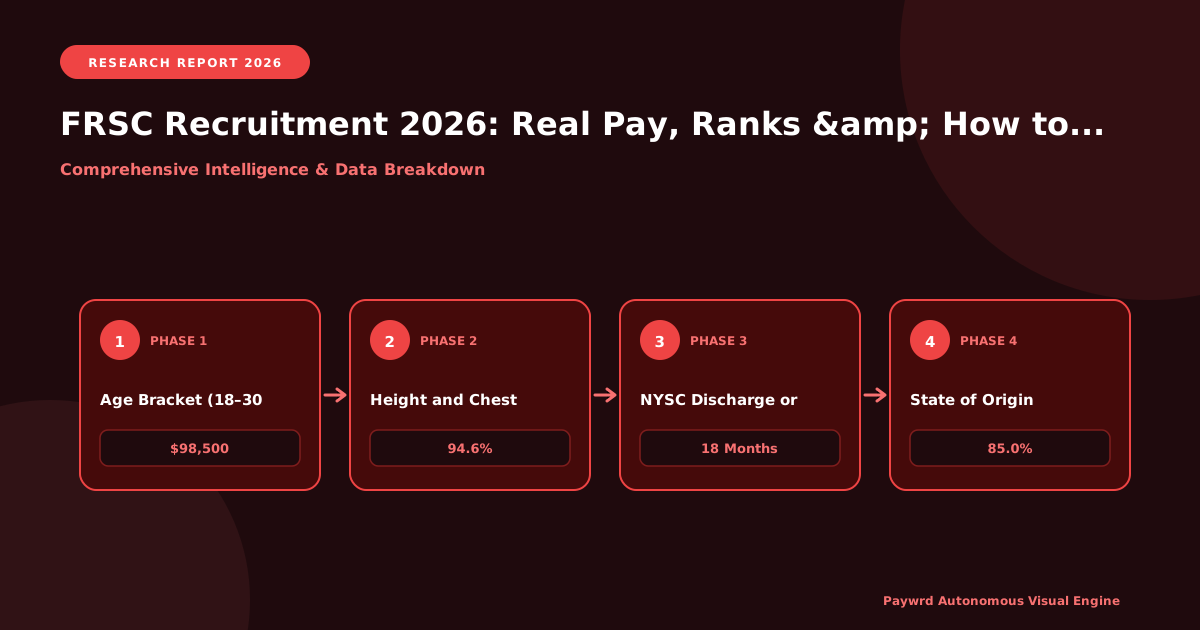
1. Age Bracket (18–30 Years)
- Minimum age: 21 years for graduates (NYSC-eligible), 18 years for direct entry into the Constable cadre with SSCE/NECO only.
- Maximum age: 30 years for graduates; 25 years for non-graduates at the point of application.
- Calculating your age: Use the application year (2026) minus your year of birth. If you are turning 31 in 2026 and you are a B.Sc. holder, you are already out—regardless of your credentials.
- Why it matters: FRSC is a paramilitary, physically demanding agency. The age ceiling ensures officers can be trained, deployed on highways, and rotated across Nigeria’s six geopolitical zones while still serving for a minimum pensionable period.
2. Height and Chest Measurements
- Male candidates: Minimum height of 1.7 metres (5 ft 7 in); chest measurement of at least 0.86 metres (34 inches) when expanded.
- Female candidates: Minimum height of 1.65 metres (5 ft 5 in); chest measurement of at least 0.81 metres (32 inches) when expanded.
- How FRSC verifies it: During the physical screening at the zonal level (Lagos, Asaba, Enugu, Jos, Kaduna, Ota), your height is measured twice using a stadiometer, and chest expansion is checked with a tape. Footwear is removed; posture must be straight.
- Practical tip for short-listed applicants: Add 2 cm to the requirement when you measure at home. Humidity, posture, and even the floor surface can change readings by a small margin. Many candidates who “passed” at home have failed on the spot.
3. Educational Qualifications (SSCE/NECO, ND/NCE, HND/B.Sc.)
- SSCE/WAEC/NECO requirement: Five (5) credit passes at not more than two sittings, including English Language and Mathematics. The other three credits should be relevant to your intended cadre (e.g., Basic Science, Economics, Geography, Government, or Civic Education).
- ND/NCE holders: A minimum of Lower Credit from a recognised, NUC-accredited polytechnic or college of education. ND in Public Administration, Business Administration, or Mass Communication often receives priority for the Officer Cadre.
- HND and B.Sc. holders: Minimum of Third Class for degree holders; Lower Credit for HND. Disciplines such as Engineering, Nursing, Computer Science, Accounting, and Law are frequently advertised in the recruitment circular because they align with FRSC’s operational needs.
- Professional certifications: Possession of ICAN, ANAN, NSE, COREN, or NIMN membership significantly boosts your score under the “Added Advantage” column on the application form.
4. NYSC Discharge or Exemption Certificate
- Graduates (30 years and below): You must present either an NYSC Discharge Certificate or an Exemption Certificate at the screening venue. A “Call-Up Letter” alone is not acceptable at the final stage.
- Timing tip: If your NYSC is still ongoing but ends between February and November 2026, you can apply, but you must complete the programme before your appointment letter is issued. FRSC will request the certificate during documentation.
- Exemption cases: Candidates who graduated before age 30 or hold a foreign degree from an institution not covered by NYSC Act obtain exemption. Medical or disability-based exemptions also exist and are reviewed case by case.
5. State of Origin and Federal Character Slots
- How slots are distributed: Under the Federal Character Commission (FCC) principle, recruitment is shared across Nigeria’s six geopolitical zones. If Lagos has 200 slots, Anambra, Kano, and Borno will also receive proportional allocations—no single state can exceed 10% of total intake.
- Indigeneship verification: You must upload a valid Local Government Area (LGA) of Origin Certificate signed by the Chairman or a designated Secretary. A “State of Origin” endorsement from a politician without the proper LGA stamp has caused many rejections in past exercises.
- Northern applicants: If you are applying from states under the Federal Government’s Affirmative Action framework, you may find the age ceiling relaxed by an additional two years, especially for roles requiring bilingual ability (Hausa, Kanuri, or Arabic alongside English).
Quick Eligibility Checklist Before You Click “Submit”
- ✔ Age 21–30 (graduate) or 18–25 (non-graduate) by 2026.
- ✔ Height ≥ 1.7 m (male) or ≥ 1.65 m (female).
- ✔ 5 credit passes including English and Maths (WAEC/NECO).
- ✔ ND Lower Credit, NCE, HND, or B.Sc. certificate ready for upload.
- ✔ NYSC Discharge/Exemption Certificate (or letter of completion if finishing soon).
- ✔ Valid LGA/State of Origin certificate.
- ✔ Clean criminal record; no criminal conviction from any Nigerian court.
Meeting these requirements is the gate; passing the FRSC physical fitness test, computer-based aptitude exam, and oral interview is the marathon. Treat every bullet above as non-negotiable. If you fall short in any single area, do not pay anyone promising a “federal connection”—NELFUND and other legitimate channels cannot rescue a disqualified application, and FRSC recruitment is entirely free of charge. Double-check your documents tonight, scan them at 300 dpi resolution, and keep certified copies in a fireproof folder. When the 2026 portal goes live, you will be ready to submit within the first 48 hours—the window where most successful candidates apply.
Step-by-Step Application on recruit.frsc.gov.ng (With Screenshots Logic)
Getting through the FRSC recruitment portal is not as scary as the traffic on Third Mainland Bridge on a Monday morning, but you still need a deliberate, step-by-step approach. The official portal, recruit.frsc.gov.ng, is the only legitimate place to submit your application. Any other site asking you to pay a “processing fee” into a personal account is a scam, and you should report it immediately to the FRSC toll-free line (1224) or the EFCC. Below is the granular walkthrough of exactly what to do, click, and upload.
Step 1: Create Your Account. Open recruit.frsc.gov.ng in a modern browser (Chrome or Edge is ideal). Click on “Create New Account”, then enter a valid, frequently-used email address and your active Nigerian phone number (MTN, Airtel, Glo, or 9mobile all work). You will receive an OTP (One-Time Password) via SMS and a confirmation link via email. Click the link to activate. Remember your password — write it in a physical notebook, not just on your phone, in case your device gets stolen.
- Use a personal email, not a school email, so you retain access after graduation.
- Your password must be at least 10 characters, with uppercase, a number, and a symbol.
- Do not register multiple accounts — the system will auto-flag duplicates using your NIN and BVN.
Step 2: Select Your Preferred Cadre. Once logged in, the dashboard lists all current vacancies, usually categorised as Officer Cadre (for HND/B.Sc holders), Marshall Cadre I (for SSCE/ND holders), and Marshall Cadre II (for artisans and drivers). Read the requirements for each cadre carefully. Note that the Officer Cadre typically requires a minimum of Second Class Lower (2:2) for B.Sc and Lower Credit for HND. Selecting the wrong cadre is one of the top reasons applicants get disqualified, so confirm your qualification matches before proceeding.
Step 3: Upload Your Passport Photograph (Red Background). The FRSC is very strict about this — your passport must be on a plain, solid red background, taken within the last three months. Dimensions are usually 300 x 300 pixels or 600 x 600 pixels (JPEG/PNG, max 100KB). Wear a white shirt or plain corporate top; no hats, no glasses, no smiling with teeth, no filters. If your photo fails validation, you will not be able to move to the next section. Many applicants in Lagos and Abuja use studios around Computer Village or Wuse Zone 6 that are familiar with FRSC specs — ask specifically for “red background passport for FRSC recruitment.”
Step 4: Upload a Valid Means of ID. Acceptable IDs include your National Identity Card (NIN slip or card), International Passport, Driver’s Licence, or WAEC/NECO scratch card details. Most Nigerian applicants default to the NIN slip because it is free and instantly available. Make sure the name on your ID matches exactly what you typed in the bio-data section, including the order of names, because any mismatch triggers automatic disqualification during screening.
Step 5: Fill the 11-Section Application Form. This is the longest part and where most people make costly mistakes. The 11 sections typically include: (1) Personal Bio-data, (2) Contact/Address, (3) Educational History (primary to tertiary, including NYSC for graduates), (4) Employment History, (5) Referees, (6) Languages Spoken, (7) State of Origin/Local Government, (8) Preferred Exam Centre, (9) Cadre Selection Confirmation, (10) Declaration, and (11) Document Upload Summary.
- Personal Bio-data: Surname first, then First Name, Middle Name. Enter your date of birth in DD/MM/YYYY format. Gender is male/female as shown on your ID.
- Contact/Address: Use your permanent home address, not a hostel. Your phone number must be reachable for at least six months after submission.
- Educational History: List all schools starting from primary. For tertiary, include your course of study, qualification, year of graduation, and grade. If you have an NYSC certificate number, add it — Officers Cadre requires completion or exemption.
- Employment History: If you have worked before, list from most recent backwards. If you are a fresh graduate, simply enter “Nil” or skip.
- Referees: Provide two referees — one academic (lecturer or HOD) and one professional (employer or community leader). Inform them because the FRSC will email them.
- State of Origin/Local Government: This is read from your Local Government Identification or state of origin letter. Do not guess your LGA.
- Preferred Exam Centre: Choose from the available CBT centres, usually in all six geopolitical zones. Centres in Lagos, Abuja, Port Harcourt, Enugu, Kano, and Benin fill up fastest, so apply early.
Step 6: Correct Errors Before Submission. Before clicking “Submit”, the portal gives you a preview screen that summarises every section. Read line by line. Common errors to correct include wrong date of birth (which can age you out of the 18–30 range), wrong cadre selection, and misspelt names. Once you click “Final Submit,” the form is locked and you cannot edit it. After submission, you will receive an email with a unique Application/Reference Number — keep this safe, as it is what you will use to print your slip and check your screening date.
Step 7: Print Your Application Slip. Log back into the portal, click “Print Application Slip,” and a PDF will download. Print two colour copies and laminate one for safety. The slip contains your exam centre, exam date and time, your cadre, and a QR code that the CBT centre will scan on the exam day. Do not laminate the one you carry to the venue — the QR code must be scannable. Take the slip alongside your original NIN slip, two passport photographs, and a printout of your credentials to the screening venue. Arriving without the slip means automatic disqualification, no matter how brilliant your credentials are.
Apply early — usually within the first 72 hours of the portal opening — to get your preferred exam centre before it is full, and always cross-check your details against your NIN before that final submit click.
What FRSC Aptitude Test & Physical Screening Really Look Like in 2026
If you made it past the FRSC recruitment portal screening stage — congratulations, you have already beaten thousands of applicants. But the real test is just beginning, and this is where most candidates quietly drop out. The FRSC aptitude test and physical screening for 2026 is a multi-stage filtering process modelled after the same rigorous standards used in paramilitary recruitment across Nigeria. Understanding exactly what each stage looks like, the pass marks, and the medical expectations will help you prepare with intention rather than panic.
The aptitude test itself follows a Post-UTME-style format, comprising four core sections designed to measure your cognitive readiness for the demands of road safety administration. You can expect English Language questions covering comprehension passages, vocabulary, idiomatic expressions, and sentence correction — similar to JAMB UTME English but with a stronger bias toward official communication and report writing. Mathematics questions are typically basic to intermediate level, focusing on percentages, ratios, averages, simple interest, and word problems. You will not find calculus, but speed and accuracy matter because the whole paper is usually timed at 30 to 45 minutes. Current Affairs questions test your awareness of Nigerian road safety statistics, Federal Government policies, FRSC achievements, and trending national issues like fuel subsidy reforms, new highway projects, and Naira (₦) economic updates. Finally, General Knowledge draws from Nigerian history, the 1999 Constitution (as amended), the FRSC enabling Act, basic civic duties, and logical reasoning.
The pass mark is not officially published in naira or any fixed percentage, but historical shortlist data shows that scoring above 60% across all sections is the safe benchmark. Candidates are ranked nationally, and only those who clear the cut-off — usually the top 10% to 15% of applicants per state — proceed to the physical screening phase. Think of it like Post-UTME cut-offs: your state of origin, the volume of applicants, and the available slots at FRSC Academy Udi in Enugu State all influence what score keeps you in the race.
The physical screening is where many desk-preparers fail. You will be required to complete a timed 1.6km to 3km run, depending on gender and role category, with male Officer-Cadet applicants expected to finish 3km in roughly 12 to 14 minutes and female applicants around 14 to 16 minutes for 1.6km. Beyond running, expect push-ups, sit-ups, shuttle runs, and a vertical reach test. These are not optional — they are scored, and failing any single component can disqualify you regardless of your aptitude score.
The medical examination involves vision acuity testing (with a minimum 6/9 in each eye, correctable to 6/6), hearing assessment, blood pressure checks, BMI evaluation, and a full body fitness clearance. You will also undergo a drug screening — typically a urine-based test checking for substances like cannabis, opiates, benzodiazepines, and stimulants. Refusal to submit a sample is treated as an automatic failure. Finally, a psychometric evaluation is administered to assess emotional stability, integrity, teamwork orientation, and stress tolerance. The FRSC wants officers who can handle highway trauma scenes, confront hostile motorists, and still communicate clearly with victims, so this test carries significant weight in the final shortlist.
- Aptitude Test Format: English, Mathematics, Current Affairs, General Knowledge — timed, multiple choice, CBT-based in most centres.
- Safe Pass Score: Aim for 65%+ to stay competitive within your state shortlist.
- Physical Fitness Run: 3km in under 14 minutes (male cadets), 1.6km in under 16 minutes (female cadets).
- Medical Standards: Vision 6/9 correctable, no chronic illness, BMI within 18.5–27.5 range.
- Drug Screening: Mandatory urine test; zero tolerance for positive results.
- Psychometric Test: Assesses emotional intelligence, integrity index, and stress handling.
- Training Venue: Successful candidates report to FRSC Academy, Udi, Enugu State for the final training phase.
Actionable takeaway: Start your physical preparation at least 8 weeks before the screening date — jog three times weekly, practice push-ups and sit-ups daily, and eliminate any unprescribed medications or supplements that could trigger a false positive on the drug test. For the aptitude side, revise past JAMB UTME questions, read one Nigerian newspaper daily, and study the FRSC Act and recent Corps Marshal pronouncements. Candidates who treat this recruitment like a Post-UTME — with a real study timetable — consistently outperform those who walk in relying on hope. If you also have access to NELFUND student loan support or are currently awaiting Post-UTME admission, this is a parallel opportunity worth pursuing seriously, because the FRSC Marshal Inspectorate Cadet (MIC) salary structure remains one of the most stable graduate entry packages in the Nigerian public service today.
Life Inside the Corps: Promotion, Allowances, Risks & Career Path
Joining the Federal Road Safety Corps is not a desk job, and anyone who tells you otherwise is sugar-coating the reality. Before you submit that application on the FRSC recruitment portal, you deserve the unvarnished truth about what life actually looks like after the oath-taking ceremony in Abuja or at one of the zonal commands in Jos, Lagos, or Owerri. The work is physically demanding, emotionally draining, and at times genuinely dangerous, but it also offers a clear promotion ladder, defined pension benefits under the Contributory Pension Scheme (CPS), and a salary structure that compares favourably against sister paramilitary agencies like the Nigeria Police Force, the Nigeria Security and Civil Defence Corps (NSCDC), and the National Drug Law Enforcement Agency (NDLEA). Let me walk you through the honest pros and cons so you can make an informed decision rather than an emotional one.
The Promotion Timeline: From Marshal Inspector III to Corps Commander
The FRSC rank structure for entry-level cadets begins at Road Marshal Assistant III (RMA III) on Grade Level 06, and the ceiling for a career officer who enters through the regular cadet programme is Corps Commander (CC), which sits on Grade Level 17. Promotions are not automatic; they are tied to annual confidential reports, pass exams at the FRSC Academy in Udi, and availability of vacancies in the establishment. A diligent officer can reasonably expect to move from RMA III to RMA II within two to three years, then to Marshal Inspector Cadre (MI), Senior MI, and Principal MI over the next decade. Crossing into the Officer Cadre from Marshal Cadre usually requires obtaining a degree, completing the Advanced Diploma in Road Safety Management, and passing the departmental promotion examination. Officers who join via the direct entry route with a first degree or HND typically enter as Marshal Inspector I (MI-I) on Grade Level 08 or 09, which shortens the climb considerably. By the time you reach Deputy Corps Commander (Grade Level 15) or Corps Commander (Grade Level 17), you are essentially earning between ₦350,000 and ₦650,000 monthly in consolidated pay plus allowances, depending on the year and federal circular.
Allowances, Hazards, and the Real Money
The advertised FRSC salary on most blogs is misleading because it lists only basic pay. Your take-home is a cocktail of components, and understanding them is critical if you are comparing offers with the Police or NSCDC:
- Basic Salary (Grade Level 06 entry): Currently around ₦65,000 to ₦75,000 monthly for RMA III, but this is only the floor.
- Uniform Allowance: Paid annually, usually ₦15,000 to ₦25,000, which barely covers the cost of a full kit. Realistic uniform replacement (boots, berets, white tops, black trousers, reflective jackets, name tags) costs ₦40,000 to ₦70,000 in Lagos or Abuja markets, so most officers top up personally.
- Rent Allowance: Between 20% and 25% of basic pay, depending on your posting zone.
- Transport/Hazard Allowance: This is where FRSC outperforms NSCDC and NDLEA. Because of the road accident risk exposure, hazard allowance is currently ₦15,000 to ₦25,000 monthly, slightly higher than the ₦10,000 to ₦12,000 paid by NSCDC.
- Shift Duty and Patrol Allowance: Officers on highway patrol or night rescue duty earn extra ₦10,000 to ₦30,000 per month, depending on frequency.
- Medical and Utilities: Modest but present.
For an RMA III posted to a calm state command like Enugu, net pay is roughly ₦110,000 to ₦130,000. For a Marshal Inspector posted to Lagos or Abuja, net pay easily climbs to ₦180,000 to ₦250,000. Compare this with a Nigeria Police Constable on similar Grade Level 03, who typically earns ₦70,000 to ₦90,000 net, or an NDLEA Narcotic Officer on Grade Level 07 earning ₦120,000 to ₦160,000. FRSC sits comfortably in the middle to upper tier for entry-level paramilitary work in Nigeria today.
The Honest Risks: What the Posters Will Not Tell You
Roadside duty in Nigeria is genuinely hazardous. You will be standing on the Lagos-Ibadan expressway at 2 a.m. flagging down trucks, sometimes without bulletproof vests, sometimes in heavy rain. Weapon training is real: recruits undergo basic firearms handling at the FRSC Academy, but the Corps is not a combat outfit, so live firing exercises are limited compared to what the Army or Police get. You will not be trained like an NDLEA tactical operative, but you will know how to handle a pump-action shotgun for highway checkpoint deterrence. Posting to rural highways is almost guaranteed in your first three years; think Lokoja-Okene road, Maiduguri-Damaturu axis, or the deadly Akure-Owo-Ado Ekiti corridor. Many officers resist these postings, but they are unavoidable, and rural allowances are minimal, typically just ₦5,000 to ₦10,000 extra. Then there is the pension reality: FRSC operates fully under the CPS, meaning 8% of your basic salary is deducted monthly and matched by the Federal Government. After 35 years of service or at age 60, you access your RSA balance through a Pension Fund Administrator (PFA) of your choice. This is different from the old defined-benefit scheme and requires personal financial discipline, because if your PFA portfolio performs poorly, your retirement cheque shrinks.
Career Path Beyond the Highway
The good news is that an FRSC career opens doors. Many retiring officers transition into private logistics firms, oil and gas safety departments (especially in Port Harcourt and Warri), transport consultancy, or even lecturing at the FRSC Academy. The Corps Commander ceiling is the top, but lateral movement into the Federal Ministry of Transport, the VIO, or transport-related NGOs is common. For a young Nigerian graduate weighing options, FRSC offers something most agencies do not: a structured promotion exam system, transparent CPS contributions, hazard pay that beats NSCDC, and a uniform you can be proud of.
| FRSC Rank | Entry Grade Level | Estimated Monthly Pay (₦) | Academic Requirement | Career ROI Timeline |
|---|---|---|---|---|
| Road Marshal Assistant (RMA) | GL 03 | ₦62,000 – ₦75,000 | SSCE / NECO (5 credits incl. Math & English) | 3–4 years to next rank |
| Road Marshal Inspector (RMI) | GL 06 | ₦95,000 – ₦120,000 | OND / NCE minimum | 3 years to Officer Cadre |
| Deputy Route Commander (DRC) | GL 08 | ₦140,000 – ₦175,000 | HND / BSc | 4 years to Assistant Commander |
| Route Commander (RC) | GL 10 | ₦200,000 – ₦250,000 | BSc / Professional Cert. | 4–6 years to Chief Route Commander |
| Assistant Corps Commander (ACC) | GL 13 | ₦350,000 – ₦450,000 | BSc + 9 yrs cognate experience | 5 years to Deputy Corps Commander |
| Corps Commander (CC) | GL 15 | ₦550,000 – ₦700,000+ | Postgraduate + 18+ yrs service | Appointed by the President |
| Cut-off: 65% JAMB/UTME minimum for Officer Cadre; Age 18–30; Height 1.65m (M) / 1.60m (F). Recruitment cycle typically runs Feb–April with portal active 4–6 weeks. | ||||
Frequently Asked Questions
Is FRSC 2026 recruitment form currently out?
As of the latest verified information, the official FRSC recruitment portal (recruitment.frsc.gov.ng) has not announced the 2026 enlistment exercise. Past patterns show applications usually open between February and April. Applicants should monitor the FRSC official website and verified social media handles to avoid fraudulent portals charging fake processing fees.
What is the salary of an FRSC officer in Nigeria?
Entry-level FRSC officers earn between ₦62,000 and ₦120,000 monthly depending on rank and cadre. Mid-level Route Commanders take home ₦200,000–₦250,000, while Assistant Corps Commanders earn ₦350,000–₦450,000. Salaries align with the Federal Government Consolidated Salary Structure and include allowances such as hazard, uniform, and shift duty pay.
What are the requirements to apply for FRSC recruitment?
Applicants must be Nigerian citizens aged 18 to 30, possess a minimum of five SSCE credits including Mathematics and English Language, and meet physical fitness standards. Officer cadre applicants require a Bachelor’s degree, HND, or equivalent, plus a height of 1.65m for males and 1.60m for females. A clean criminal record is mandatory.
How long does FRSC recruitment processing take?
The entire FRSC recruitment cycle typically spans four to six months from portal closure to deployment. Stages include online application (2–4 weeks), aptitude screening (1 month), physical and medical verification (1 month), training at the FRSC Academy, and finally posting. Successful candidates receive offer letters via email and SMS after completion.
Strategic Final Takeaway
Success in evaluating FRSC Recruitment 2026: Real Pay, Ranks & How to Apply in Nigeria relies on early preparation, adherence to verified accredited requirements, and cross-referencing official portals. Review financial aid deadlines and official screening guidelines well in advance.