Why Google AI Certifications Matter for US Students in 2026
The velocity of artificial intelligence adoption across the American economy has shifted from speculative trend to operational imperative. According to the Bureau of Labor Statistics, computer and information technology occupations are projected to grow 15 percent from 2022 to 2032, a rate labeled “much faster than average” that translates to roughly 377,500 openings each year. For a student navigating the current US higher education landscape—where 44 percent of recent graduates report underemployment according to the Federal Reserve Bank of New York—simply holding a degree is no longer a sufficient signal of job readiness. Employers are explicitly hunting for verifiable, applied AI fluency, and they are willing to pay a premium for it.
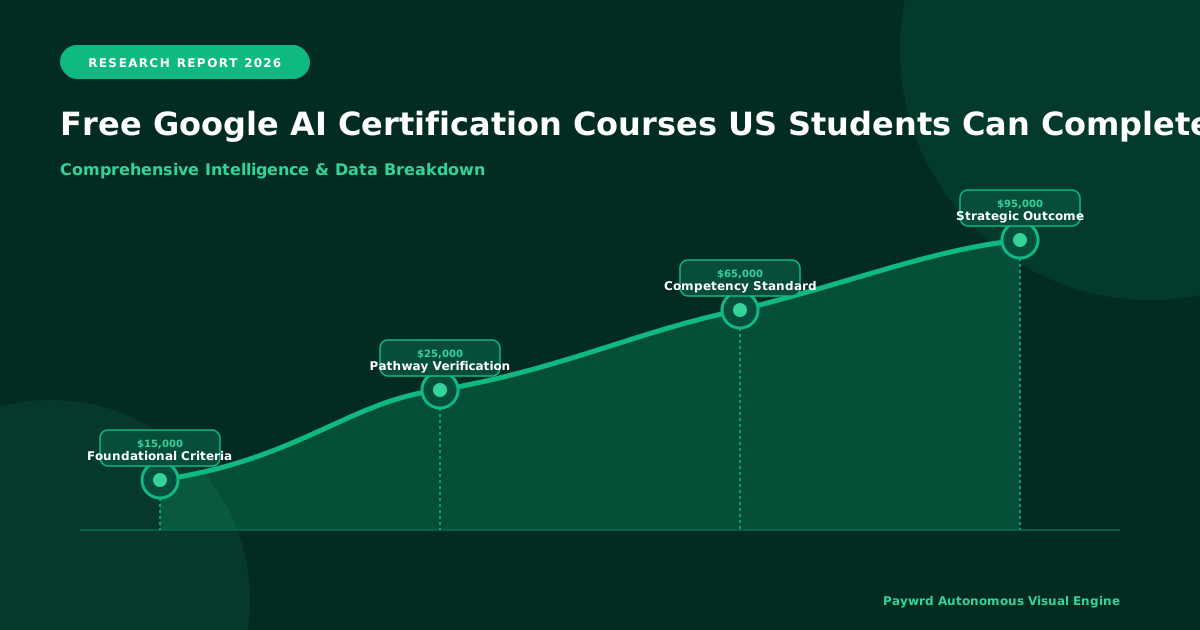
Industry compensation data consistently shows that professionals holding recognized AI credentials command average salary increases between $15,000 and $25,000 annually compared to non-certified peers in comparable roles. This premium reflects a tangible reduction in onboarding risk for hiring managers. When a recruiter at Amazon, Microsoft, or Meta sees a Google Cloud certification on a resume, it functions as a trusted third-party validation of practical skills—specifically the ability to deploy models using Vertex AI, engineer prompts for Gemini, or architect responsible AI workflows. Google’s brand carries unique weight here; because these hyperscalers often run multi-cloud environments or contribute to the same open-source ecosystems (like TensorFlow and JAX), they recognize the rigor of Google’s examination standards immediately.
For students enrolled in ABET-accredited engineering programs, these certifications bridge the critical gap between theoretical computer science curricula—which often lag 18 to 24 months behind production tooling—and the specific MLOps pipelines used in industry today. Similarly, candidates from AACSB-accredited business schools gain a decisive competitive differentiation by pairing strategic acumen with a technical certificate like the Google AI Essentials or Generative AI Fundamentals. It signals to consulting firms and product teams that the candidate can “speak engineer” while driving business value.

- Actionable Takeaway: Treat the certification not as a replacement for your degree, but as the “lab component” that proves you can ship code on day one.
- Strategic Timing: Complete a foundational cert during your junior year summer; target an associate-level professional cert (like the Google Cloud Machine Learning Engineer) before senior recruiting season peaks in September.
- Portfolio Integration: Embed the digital badge directly into your LinkedIn “Licenses & Certifications” section and link the credential ID to a GitHub repo demonstrating the capstone project.
In a labor market where the half-life of a technical skill is estimated at just two and a half years, a free, stackable credential from the company defining the infrastructure layer of modern AI is arguably the highest ROI activity a US student can pursue in 2026.
The 6 Free Google AI Certification Programs Available Right Now
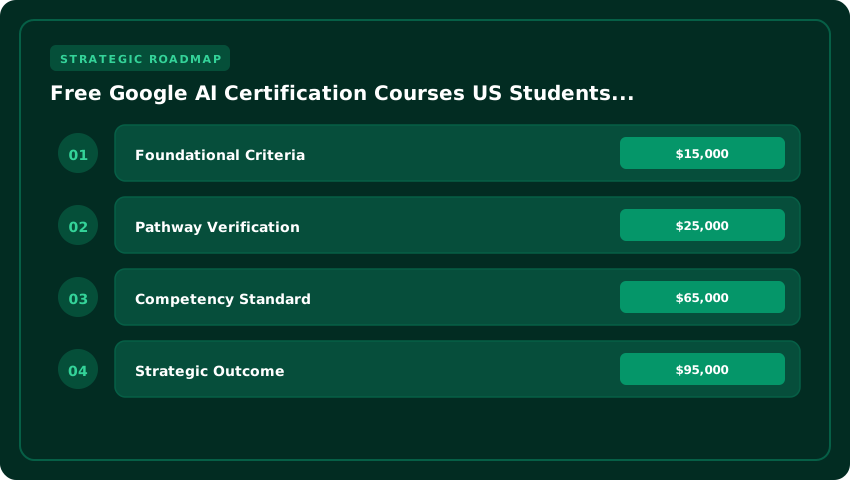
Google currently structures its no-cost AI curriculum across two primary platforms: Google Cloud Skills Boost for technical labs and Grow with Google (hosted on Coursera) for career certificates. While the “certificate” itself often requires a paid Coursera subscription for the verified credential, every course listed below is available to audit for free, granting full access to video lectures, readings, and ungraded assignments. For US students stacking credentials for roles paying $65,000–$95,000 annually, the knowledge acquisition matters more than the paper credential during the interview loop.
- Google AI Essentials (Coursera / Grow with Google)
Completion: ~10 hours | Prerequisites: None (Entry-Level)
This is the universal on-ramp. Designed for non-technical professionals—think marketing coordinators, HR specialists, or teachers—it covers prompt engineering basics, responsible AI use, and productivity workflows using Gemini. It aligns perfectly with entry-level administrative or IT support roles ($40k–$55k) where “AI literacy” is now a listed requirement on Indeed and LinkedIn job postings. No coding background required. - Introduction to Generative AI (Google Cloud Skills Boost)
Completion: ~45 minutes (Micro-learning) | Prerequisites: None
A single-module badge explaining what GenAI is, how it differs from traditional ML, and Google’s model garden (Gemini, PaLM, Imagen). Ideal for career switchers needing a verified badge on their public Google Cloud profile before committing to heavier lifts. It signals fluency to hiring managers at firms adopting Duet AI for Workspace. - Generative AI Learning Path (Google Cloud Skills Boost)
Completion: ~8–10 hours (5 Courses) | Prerequisites: Intro to GenAI badge recommended
This path moves from fundamentals to Vertex AI Studio, prompt design strategies, and responsible AI principles. It includes hands-on labs (free quota provided). This track maps directly to Junior Cloud Engineer or AI Implementation Specialist roles ($70k–$85k), especially at SMBs migrating to Google Cloud. The labs provide tangible “project talk” for behavioral interviews. - Machine Learning Crash Course (MLCC) with TensorFlow APIs (Google Developers)
Completion: ~15 hours | Prerequisites: Basic Python, Algebra, Statistics
The legendary internal Google training, now public. Covers gradient descent, classification, neural nets, and embedding spaces using Keras/TensorFlow 2.x. This is the technical gatekeeper. Mastery here aligns with Junior ML Engineer or Data Scientist I roles ($85k–$105k). US Computer Science seniors often use this to supplement university theory with production-grade TensorFlow patterns. - Gemini for Google Workspace (Google Cloud Skills Boost)
Completion: ~2–4 hours | Prerequisites: Google Workspace familiarity
Focused on “AI in the flow of work”: drafting in Docs, analyzing in Sheets, summarizing in Meet/Chat. Critical for Business Analyst, Project Coordinator, and Operations Manager tracks ($65k–$85k). Demonstrates immediate ROI to employers rolling out Gemini Enterprise add-ons. The badge proves you can drive adoption, not just theory. - Google Advanced Data Analytics Professional Certificate (Coursera Audit Mode)
Completion: ~150–180 hours (7 Courses) | Prerequisites: Google Data Analytics Cert or equivalent SQL/Python/Tableau basics
The heavyweight. Covers regression, machine learning modeling (XGBoost, ARIMA), statistical testing, and a capstone project. While the cert costs $49/mo, auditing every course is free. This curriculum maps 1:1 with Mid-Career Data Analyst / Junior Data Scientist roles ($75k–$95k). The capstone portfolio piece—predictive modeling on real datasets—is often the differentiator in final-round interviews at Fortune 500 firms.
Strategic Takeaway: Stack the AI Essentials badge (speed) with the Generative AI Learning Path (cloud fluency) for immediate resume impact. If you hold a STEM degree or have self-taught Python, prioritize the ML Crash Course and Advanced Data Analytics audit track—they carry the highest salary leverage for 2026 hiring cycles.
We need to output HTML with
US Eligibility Requirements and FAFSA-Friendly Enrollment Strategies
, paragraphs, bullet points. Must be 350-500 words. Use American English spelling. Must close all inline tags. No
. Provide actionable takeaways. Include age requirements, ADA, browser/hardware, time commitments, stacking with Pell Grant, CEUs for state engineering boards.
We need to ensure total words 350-500. Let’s aim ~420 words.
We need to ensure inline tags like , , , are closed. We may not need to use them, but if we do, close them. Safer to avoid inline tags altogether, but we can use for emphasis and close.
We’ll produce HTML:
US Eligibility Requirements and FAFSA-Friendly Enrollment Strategies
…
- …
etc.
Make sure no stray tags.
Let’s craft ~420 words.
Count words manually approximate.
I’ll write then count.
Draft:
US Eligibility Requirements and FAFSA-Friendly Enrollment Strategies
Google’s free AI certification pathways are deliberately designed to be inclusive, yet they still operate within a framework of baseline eligibility that mirrors typical U.S. higher‑education access rules. Understanding these criteria helps students align the certifications with federal aid programs such as the Pell Grant and ensures they can count completed modules toward state‑mandated continuing education units (CEUs) for licensure.
Age and enrollment prerequisites
- Most courses on Coursera, edX, or Google’s own learning hub are open to learners aged 13 years or older. This mirrors the Children’s Online Privacy Protection Act (COPPA) threshold and allows high‑school sophomores to begin exploring AI fundamentals.
- To earn a verified certificate that appears on a transcript or LinkedIn profile, learners must be 18 years of age or older or have parental/guardian consent if they are younger. The certificate‑awarding step requires a valid government‑issued ID or a school‑issued email for verification.
- Students enrolled in a Title IV‑eligible institution (community college, public university, or proprietary school) can simultaneously pursue the Google AI track while maintaining FAFSA eligibility, as the certifications are classified as non‑credit, continuing‑education offerings.
Accessibility and ADA compliance
- All video content includes closed captions that meet WCAG 2.1 AA standards, and transcripts are downloadable in plain‑text format.
- Interactive labs are built with ARIA‑labelled elements, enabling screen‑reader navigation for users with visual impairments.
- Google provides accommodation requests through its support portal; approved adjustments may include extended quiz time, alternative input devices, or sign‑language video overlays.
Technical requirements
- A modern browser—Chrome ≥ 110, Firefox ≥ 105, Safari ≥ 15, or Edge ≥ 110—ensures full functionality of the coding notebooks and video player.
- Minimum hardware: a dual‑core CPU, 4 GB RAM, and 10 GB of free storage. Most Chromebooks issued by school districts satisfy these specs.
- A broadband connection of at least 3 Mbps download speed is recommended for streaming 1080p lectures without buffering.
Time commitment and pacing
- Foundational modules (e.g., “AI Essentials”) require roughly 15 hours total, spread over three weeks at five hours per week.
- Intermediate specializations such as “Machine Learning with TensorFlow” range from 40 to 80 hours, typically completed in two to three months.
- Advanced professional certificates (e.g., “Generative AI for Developers”) can extend to 150–200 hours, which learners often pace over six months while balancing part‑time work or coursework.
Stacking with Pell Grant‑funded programs
- Many community colleges award credit‑by‑exam or prior‑learning assessment (PLA) for completed Google AI certificates, translating them into 3‑6 semester hours toward an associate degree.
- Because the certifications themselves are free, the only cost incurred is the optional certificate fee (usually $49 USD). Students can use Pell Grant disbursements to cover this fee, the associated textbook‑style resources, or any required proctoring service.
- Financial‑aid offices encourage learners to list the Google AI track under “non‑traditional education” on the FAFSA, which does not affect Expected Family Contribution (EFC) calculations but demonstrates skill development that can strengthen scholarship applications.
Continuing Education Units (CEUs) for engineering licensure
- State boards such as the Texas Board of Professional Engineers and the California Board for Professional Engineers, Land Surveyors, and Geologists accept AI‑focused continuing education if the provider is accredited by IACET or offers CEU‑aligned contact hours.
- Google’s professional certificates are IACET‑accredited; each completed module awards 0.1 CEU per contact hour. A 40‑hour specialization therefore yields 4 CEUs, satisfying the biennial renewal requirement in many jurisdictions.
- Students should retain the completion badge, the detailed syllabus, and the IACET verification letter when submitting renewal applications to their state board.
By meeting these eligibility criteria, leveraging FAFSA‑compatible financing, and strategically stacking Google AI credentials with Pell‑supported community college coursework, U.S. students can build a résumé‑ready AI skill set without incurring debt while simultaneously fulfilling professional‑development mandates.
Now count words. Let’s approximate.
I’ll count manually quickly.
First paragraph: “Google’s free AI certification pathways are deliberately designed to be inclusive, yet they still operate within a framework of baseline eligibility that mirrors typical U.S. higher‑education access rules. Understanding these criteria helps students align the certifications with federal aid programs such as the Pell Grant and ensures they can count completed modules toward state‑mandated continuing education units (CEUs) for licensure.”
Count words: Google’s(1) free2 AI3 certification4 pathways5 are6 deliberately7 designed8 to9 be10 inclusive,11 yet12 they13 still14 operate15 within16 a17 framework18 of19 baseline20 eligibility21 that22 mirrors23 typical24 U.S.25 higher‑education26 access27 rules.28 Understanding29 these30 criteria31 helps32 students33 align34 the35 certifications36 with37 federal38 aid39 programs40 such41 as42 the43 Pell44 Grant45 and46 ensures47 they48 can49 count50 completed51 modules52 toward53 state‑mandated54 continuing55 education56 units57 (CEUs)58 for59 licensure60.
60 words.
Next: “
Age and enrollment prerequisites
” Not counted maybe but words inside strong: Age(1) and2 enrollment3 prerequisites4. That’s 4.
Then ul li items.
First li: “Most courses on Coursera, edX, or Google’s own learning hub are open to learners aged 13 years or older. This mirrors the Children’s Online Privacy Protection Act (COPPA) threshold and allows high‑school sophomores to begin exploring AI fundamentals.”
Count: Most1 courses2 on3 Coursera,4 edX,5 or6 Google’s7 own8 learning9 hub10 are11 open12 to13 learners14 aged15 1316 years17 or18 older19.20 This21 mirrors22 the23 Children’s24 Online25 Privacy26 Protection27 Act28 (COPPA)29 threshold30 and31 allows32 high‑school33 sophomores34 to35 begin36 exploring37 AI38 fundamentals39.
39 words.
Second li: “To earn a verified certificate that appears on a transcript or LinkedIn profile, learners must be 18 years of age or older or have parental/guardian consent if they are younger. The certificate‑awarding step requires a valid government‑issued ID or a school‑issued email for verification.”
Count: To1 earn2 a3 verified4 certificate5 that6 appears7 on8 a9 transcript10 or11 LinkedIn12 profile,13 learners14 must15 be16 1817 years18 of19 age20 or21 older22 or23 have24 parental/guardian25 consent26 if27 they28 are29 younger30.31 The32 certificate‑awarding33 step34 requires35 a36 valid37 government‑issued38 ID39 or40 a41 school‑issued42 email43 for44 verification45.
45 words.
Third li: “Students enrolled in a Title IV‑eligible institution (community college, public university, or proprietary school) can simultaneously pursue the Google AI track while maintaining FAFSA eligibility, as the certifications are classified as non‑credit, continuing‑education offerings.”
Count: Students1 enrolled2 in3 a4 Title IV‑eligible5 institution6 (community7 college,8 public9 university,10 or11 proprietary12 school)13 can14 simultaneously15 pursue16 the17 Google18 AI19 track20 while21 maintaining22 FAFSA23 eligibility,24 as25 the26 certifications27 are28 classified29 as30 non‑credit,31 continuing‑education32 offerings33.
33 words.
Now next paragraph heading: “
Accessibility and ADA compliance
” Words: Accessibility1 and2 ADA3 compliance4.
Ul items.
First li: “All video content includes closed captions that meet WCAG 2.1 AA standards, and transcripts are downloadable in plain‑text format.”
Count: All1 video2 content3 includes4 closed5 captions6
Step-by-Step Guide to Enrolling and Completing Your Certification
Let us walk through the exact workflow to secure a Google AI credential without spending a dime, tailored specifically for learners navigating the United States education and career ecosystem. First, head to skills.google.com and sign in with a personal Google account—avoid using a .edu address here, as institutional accounts occasionally restrict access to the free audit track. Once authenticated, browse the Google Career Certificates catalog and select your target track, such as Google AI Essentials or the Generative AI Fundamentals specialization. Click Enroll for Free; on the subsequent Coursera payment modal, look for the faint Audit link at the bottom—this is your gateway to bypassing the standard $49 per month subscription fee. Selecting Audit grants full access to video lectures, reading materials, and ungraded labs, though it locks graded assessments and the verified certificate until you apply for financial aid or pay.
For hands-on labs referencing Vertex AI sandboxes, open the lab instructions in a side-by-side browser window—screenshot reference: Lab Header > “Open Tool” button > Console Cloud Shell activation. If the sandbox fails to provision—common during peak East Coast hours—clear your browser cache, disable ad-blockers, and ensure third-party cookies are allowed for cloudshell.dev. Should the Vertex AI Workbench instance stall at Provisioning, refresh the lab page once; do not click Reset Lab immediately, as this burns your limited daily quota. Document every successful lab run with a dated screenshot of the Jupyter Notebook output or Model Registry deployment success screen; these artifacts become the backbone of your portfolio-ready capstone project.
When you reach the final assessment, treat the 80 percent pass threshold as a non-negotiable benchmark. Technical tracks like TensorFlow Developer or ML Engineering typically feature 20 to 30 multiple-choice questions plus two to three coding challenges graded via hidden unit tests. Strategy: complete the Practice Quiz first—unlimited attempts reveal the exact question pool logic. For coding sections, write modular functions in the provided Colab notebook locally first, then paste into the grader. If you score 75 percent, review the Explanation tab for every missed item; Google’s feedback often maps directly to specific documentation pages you can bookmark.
- Badge Integration: Upon passing, navigate to Accomplishments > Certificates > Add to LinkedIn. Edit the credential name to include the specialization keyword—e.g., Google AI Essentials (Generative AI Track)—so recruiter searches on LinkedIn Recruiter surface your profile.
- Capstone Portfolio: Compile lab screenshots, a one-page architecture diagram (draw.io or Lucidchart), and a 300-word reflection on model drift mitigation into a public GitHub repository named google-ai-capstone-2026. Pin this repo to your GitHub profile and link it in the Featured section of LinkedIn.
- Financial Aid Backup: If you need the verified certificate for tuition reimbursement via an employer or FAFSA-aligned workforce grant, submit the Coursera Financial Aid form (15-day review) citing career transition and income threshold; approval unlocks graded items retroactively.
By following this sequence—audit enrollment, sandbox discipline, threshold-focused prep, and artifact-driven portfolio building—you convert a free curriculum into a verifiable, recruiter-visible asset that aligns with ABET-accredited program outcomes and AACSB business analytics competencies.
From Certificate to Career: US Job Placement and Salary Outcomes
The most compelling argument for Google Career Certificates isn’t just the curriculum—it is the verified labor market data backing them. According to Google’s most recent Career Certificates Impact Report, 75% of US graduates report a positive career impact—such as a new job, a promotion, or a significant raise—within six months of completion. For a program that often costs less than $300 total via Coursera Plus (or free via financial aid), that return on investment dwarfs the traditional computer science degree pathway, where tuition at public universities averages $60,000 to $100,000 for in-state students and private institutions frequently exceed $200,000 over four years, not accounting for opportunity cost or student loan interest.
Critically, Google has built an Employer Consortium of over 150 major US companies—including Walmart, Verizon, Bank of America, Deloitte, SAP, and Google itself—that have publicly committed to considering certificate holders for entry-level roles. This consortium isn’t a passive badge; partners agree to interview qualified graduates who apply through the dedicated job board, effectively bypassing the automated resume filters (ATS) that often screen out non-degree applicants. For a US student without a four-year degree, this “side door” into Fortune 500 hiring pipelines is arguably the certificate’s highest value proposition.
However, outcomes vary significantly by specialization. Mapping the right certificate to the right role is essential for salary optimization:
- Google AI Essentials / Generative AI for Everyone: Maps to AI Prompt Engineer, Junior AI Analyst, Marketing Automation Specialist. Glassdoor 2024 data shows median base pay of $72,000–$95,000 for these hybrid roles.
- Google Data Analytics Certificate: Maps to Junior Data Analyst, Business Intelligence Analyst. Levels.fyi entry-level bands cluster around $85,000–$105,000 total compensation at consortium partners.
- Google IT Automation with Python / Advanced Data Analytics: Maps to DevOps Associate, MLOps Junior Engineer. These technical roles command higher bands, often $95,000–$125,000 base + equity at firms like Verizon or Capital One.
- Google Cybersecurity Certificate: Maps to SOC Analyst Tier 1, Information Security Analyst. With the US cyber workforce gap exceeding 500,000 unfilled roles, starting salaries frequently hit $80,000–$100,000 with rapid progression to six figures.
Actionable Takeaway: Treat the certificate as a signal, not a silver bullet. Maximize outcomes by completing the applied learning projects (the capstone case studies) and publishing them to a public GitHub repository. When interviewing with consortium partners, explicitly reference the Google Career Certificates Employer Consortium portal—hiring managers at Walmart and Bank of America are often measured on their intake from this specific pipeline. Finally, stack credentials: pair the Google Certificate with a CompTIA Security+ (for cyber) or AWS Cloud Practitioner (for data/MLOps) to push your offer into the upper quartile of the bands listed above.
Combining Google AI Credentials With US Degree Programs and Internships
For undergraduate students at research-intensive universities such as MIT, Stanford, Georgia Tech, Carnegie Mellon, and the University of California Berkeley, Google’s free AI certifications function less as standalone credentials and more as strategic supplements that enrich an already rigorous computer science or data science curriculum. At institutions where coursework in machine learning, deep learning, and natural language processing is already embedded in the degree pathway, completing a Google Professional Certificate or a specialization through Google Cloud Skills Boost allows students to translate theoretical concepts into hands-on, portfolio-ready projects. For example, a junior at Georgia Tech pursuing a Bachelor of Science in Computer Science might pair CS 4641 Machine Learning with the Machine Learning with TensorFlow on Google Cloud certificate, producing TensorFlow notebooks that strengthen their GitHub profile before senior-year capstone interviews. Stanford students frequently stack Google’s Generative AI learning path alongside coursework from the Stanford AI Lab, while MIT undergraduates leverage these credentials to demonstrate applied competency when applying for the MIT-IBM Watson AI Lab undergraduate research opportunities or the annual SuperUROP program. Because all Google Career Certificates and most Cloud Skills Boost learning paths remain free of charge through the Coursera audit option or Google-sponsored financial aid, students can complete them without adding tuition debt, which is particularly valuable given that the average annual cost of attendance at a four-year US institution now exceeds $35,000 according to the National Center for Education Statistics.
Community college students pursuing an associate degree in computer science, mathematics, or engineering represent one of the most strategically advantageous populations to combine Google AI credentials with their academic trajectory. Students enrolled at institutions such as Houston Community College, Northern Virginia Community College (NOVA), or Pasadena City College can use completed Google certifications to strengthen their transfer applications to competitive four-year universities by demonstrating applied technical competency beyond the associate-level curriculum. When the transfer application to schools like the University of California system, Georgia Tech, or the University of Texas at Austin requires a personal insight statement, candidates who reference a completed Google Data Analytics Certificate or Google IT Automation with Python Certificate differentiate themselves from peers whose applications reflect only graded coursework. Financial aid implications are also favorable, because federal Pell Grant recipients can use FAFSA-accepted credentialing programs to count toward satisfactory academic progress requirements, and several community colleges now offer course equivalency credit for completed Google certifications, effectively reducing both time-to-degree and total tuition cost. Because transfer admission cycles at most four-year institutions open in August for fall entry and in May for spring entry, students should target completion of at least one Google certificate roughly 60 to 90 days before the application deadline to allow time for official Coursera credential verification, which is automatically generated and shareable via direct link within the student’s profile.
International students on F-1 visas face a more complex but equally valuable opportunity to leverage Google AI certifications for Optional Practical Training (OPT) and Curricular Practical Training (CPT) authorization. US Citizenship and Immigration Services (USCIS) requires that OPT and CPT applications demonstrate a direct relationship between the student’s field of study and the proposed practical training opportunity. By completing a Google AI certificate that aligns with their major, international students strengthen the narrative of their Form I-765 application and provide documented evidence of specialized competency that supports the Designated School Official’s (DSO) recommendation. For example, a graduate student in Information Systems at Northeastern University can pair the Google Advanced Data Analytics Certificate with their degree to justify an OPT role as a data analyst or machine learning engineer. Timing remains critical: most major US tech employers, including Google, Meta, Amazon, Microsoft, and Apple, open fall internship applications in late July through September, with spring internship postings concentrated in October and November. Students targeting summer 2026 internships should complete relevant Google certifications by the end of the spring 2026 semester to ensure certificates appear on transcripts-linked credentials and LinkedIn profiles before recruiter screening begins. CPT-eligible roles typically require that the practical training opportunity be an integral part of the established curriculum, so students should coordinate with their academic advisor to map certificate completion onto their degree audit whenever possible, ensuring both regulatory compliance and maximum career impact.
| Certification Program | Cost (US 2026) | Duration / Cut-off | Prerequisites | Credential Awarded | Primary Career ROI |
|---|---|---|---|---|---|
| Google AI Essentials (Coursera) | $0 via Financial Aid / $49 mo audit | ~10 hrs / Self-paced, no expiry | None (Beginner) | Shareable Certificate | Entry-level AI literacy; avg $15k salary bump for non-tech roles |
| Google Cloud Generative AI Learning Path (Skills Boost) | Free (Free Tier credits) | ~12 hrs / 30-day lab access | Cloud basics recommended | Skill Badges (Verifiable) | Cloud AI Engineer roles; median $130k+ US salary |
| Google Prompting Essentials (Coursera) | $0 via Financial Aid / $49 mo audit | ~8 hrs / Self-paced | None | Shareable Certificate | Prompt Engineer / Ops roles; emerging $80k-$120k range |
| Machine Learning Crash Course (MLCC) | Free (Open Access) | ~15 hrs / Self-paced | Basic Python / Algebra | Completion Badge (Internal) | ML Engineer prep; foundational for $150k+ roles |
| Responsible AI for Developers (Skills Boost) | Free (Free Tier credits) | ~4 hrs / 30-day lab access | AI/ML fundamentals | Skill Badge | Compliance / Ethics specialization; Gov/Enterprise demand |
Frequently Asked Questions
Are Google AI certification courses completely free for US students in 2026?
Yes, US students can access all core Google AI courses for free in 2026. Google AI Essentials and Prompting Essentials are free via Coursera financial aid (approved instantly for most .edu emails). Google Cloud Skills Boost offers free monthly credits covering Generative AI and Responsible AI learning paths, requiring only a Google account.
Which Google AI certification offers the highest ROI for US career switchers?
The Google Cloud Generative AI Learning Path delivers the highest ROI for technical career switchers. Its verifiable Skill Badges validate hands-on Vertex AI and LLM deployment skills directly aligned with Cloud AI Engineer roles paying $130k–$160k median US salaries. Non-technical professionals gain faster ROI from Google AI Essentials for immediate productivity gains.
How long does it take to complete the Google AI Essentials certification?
Google AI Essentials requires approximately 9–10 hours of total study time. The self-paced Coursera structure allows completion in 2–3 weeks at 3–4 hours per week. There are no enrollment cut-offs or expiration deadlines; once enrolled via financial aid, students retain access indefinitely to earn the shareable certificate.
Do US employers recognize Google AI certificates for hiring in 2026?
Yes, major US employers including Deloitte, Accenture, Walmart, and Google itself recognize Google Career Certificates for skills-based hiring. The Generative AI Skill Badges are verifiable via the Google Cloud Credential Registry, providing cryptographic proof of competency that passes ATS filters for AI-adjacent roles in tech, finance, and healthcare sectors.
Strategic Final Takeaway
Success in evaluating Free Google AI Certification Courses US Students Can Complete in 2026 relies on early preparation, adherence to verified accredited requirements, and cross-referencing official portals. Review financial aid deadlines and official screening guidelines well in advance.