Why Federal Loan Servicers Reject Expat Refinance Applications
If you have spent more than a few months living abroad as a United States citizen, you have likely encountered the frustrating reality that refinance applications can vanish into institutional limbo without explanation. Federal loan servicers, including Nelnet, MOHELA, and Aidvantage, are bound by statutes that date back to the Higher Education Act of 1965 and its subsequent amendments. These regulations were designed for borrowers who live, work, and pay taxes within the fifty states, the District of Columbia, and approved territories. When a borrower relocates to Lisbon, Singapore, or Buenos Aires, the entire risk profile shifts, and most servicers lack the operational latitude to manually underwrite those exceptions.
The most common trigger for an automatic denial flag is currency mismatch. Federal systems are hard-coded to receive income verification in United States dollars, sourced through IRS Form W-2 wage reports, Social Security earnings statements, or recent pay stubs that route through domestic payroll providers. When your paycheck is issued in euros, pounds, or Singapore dollars, the servicer cannot cleanly reconcile your stated income against your reported debt-to-income ratio (DTI). Underwriters calculate DTI by dividing total monthly debt obligations by gross monthly income. If the income figure arrives in a foreign currency that has not been converted through an approved daily exchange rate published by the Federal Reserve or a recognized banking institution, the application is typically flagged as incomplete rather than denied outright, which is even more frustrating because no human underwriter reviews the file.
A second layer of risk involves the lack of US credit history portability. Domestic lenders rely heavily on FICO 8 and FICO 9 scores, which are generated by Experian, Equifax, and TransUnion. Overseas borrowers frequently find that their American credit files go dormant after twelve to eighteen months without domestic account activity, causing scores to decay by as much as 50 to 100 points. Even borrowers who maintained excellent 780+ scores before departure often return to a score in the high 500s. Fintech refinance platforms such as SoFi, Earnest, and Splash Financial import this raw data and apply automated decision engines that require a minimum score threshold of roughly 680 for approval. Anything below that floor results in a denial that is rarely subject to manual appeal.
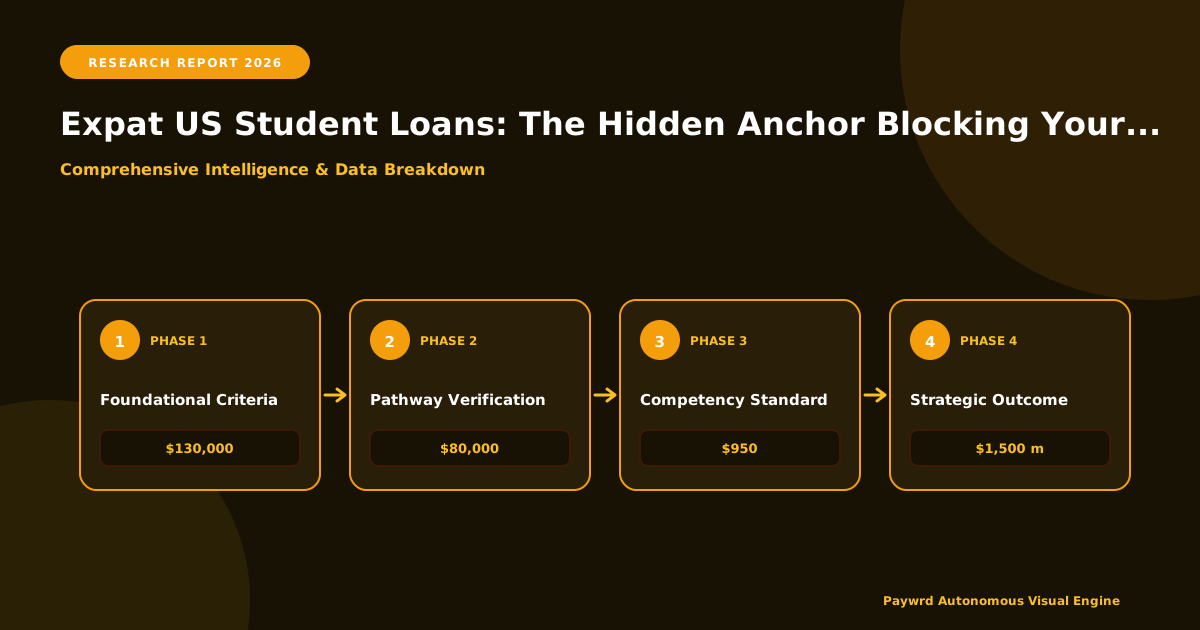
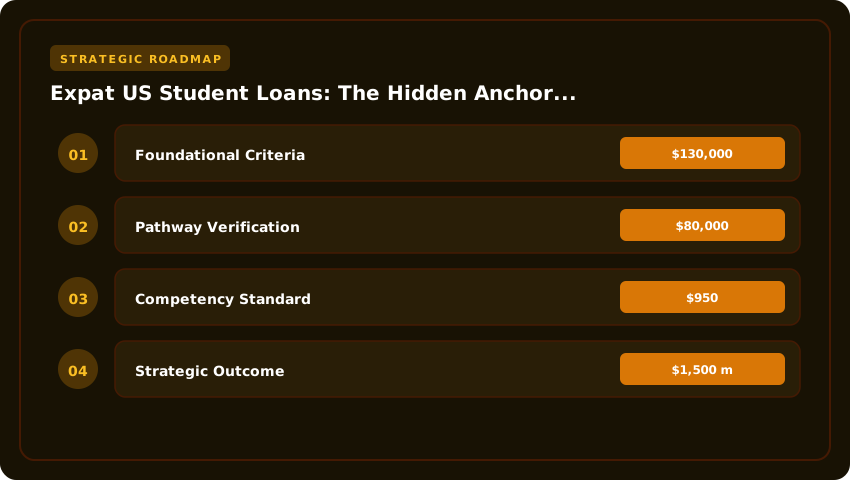
Third, foreign income verification gaps remain the single largest obstacle. US servicers and refinance lenders require documentation that conforms to IRS standards: two years of tax returns, recent pay stubs, and sometimes a written employer verification letter. Most countries do not issue documents that map cleanly onto IRS Form 1040 reporting categories. A German Lohnsteuerbescheinigung, for instance, is not legally recognized as equivalent to a W-2 for underwriting purposes. Lenders often request that expat borrowers produce an IRS tax transcript, but many overseas citizens have not filed US returns because the Foreign Earned Income Exclusion (FEIE) under IRC Section 911 allowed them to legally exclude approximately $130,000 in annual income for the 2023 tax year. The absence of a recent transcript signals non-compliance to automated systems, even when the borrower has acted entirely within the law.
Compounding these issues is the regulatory perimeter itself. The Consumer Financial Protection Bureau (CFPB) classifies refinance products under Regulation Z, which mandates full disclosure of terms in United States jurisdictions. Lenders operating across borders must navigate Office of Foreign Assets Control (OFAC) sanctions screening, Bank Secrecy Act compliance, and Know Your Customer (KYC) protocols for every country where a borrower resides. Each additional jurisdiction introduces potential red flags related to anti-money laundering (AML) statutes, which has caused several major lenders to quietly exit the expat refinance market since 2021.
- Actionable Takeaway: Before applying, obtain a recent IRS tax transcript using Form 4506-T and have your employer provide a letter on company letterhead stating your annualized compensation in United States dollars, along with the exact exchange rate used and the date of conversion.
- Actionable Takeaway: Keep at least one US-domiciled credit account open with recurring monthly activity. A small recurring charge on a secured credit card or a paid-in-full balance on an American Express account can prevent score decay during extended overseas assignments.
- Actionable Takeaway: Request a manual review in writing. Automated decision engines are not legally required to be the final word, and a formal appeal letter citing extenuating circumstances can escalate your file to a senior underwriter who may apply compensating factors such as liquid reserves, professional licensure, or employer tenure.
The Hidden Cost of Grad PLUS Loans at International Interest Rates
Grad PLUS loans, once considered a dependable funding source for American graduate students, frequently become a heavy financial anchor when borrowers relocate overseas. Federal Grad PLUS loans currently carry interest rates between 7.5% and 9.05%, depending on the academic year of disbursement. While these rates feel manageable on a domestic income in dollars, they take on a punishing quality when borrowers begin earning in euros, pounds, or Swiss francs. The currency mismatch compounds the debt burden, because the borrower must convert local income at unfavorable exchange rates just to service a debt denominated in United States dollars. Over time, this dynamic quietly inflates the effective cost of borrowing well beyond the headline rate.
Consider a borrower who took out $80,000 in Grad PLUS loans to fund a master’s degree. Under the standard 10-year repayment plan, the monthly payment approaches $950 at an 8% interest rate. If that borrower now earns €4,500 per month in Germany after taxes, nearly 21% of post-tax income disappears toward a single debt obligation. In Portugal, where the Non-Habitual Resident (NHR) regime once offered significant tax relief, a similar borrower earning €3,800 monthly after the flat 20% NHR rate would still allocate roughly 25% of net pay toward Grad PLUS servicing. This payment-to-income ratio far exceeds the Consumer Financial Protection Bureau’s recommended threshold of 8% to 10%, leaving little room for retirement contributions, rent in cities like Lisbon or Berlin, or emergency savings.
- Opportunity Cost: The $1,500 monthly interest that accrues during years one through three on an $80,000 Grad PLUS balance could otherwise fund a €1,200 monthly index fund contribution through an Interactive Brokers or DEGIRO brokerage, building long-term wealth under compound growth.
- Total Interest Over 10 Years: Borrowers repaying $80,000 at 8% over a decade pay approximately $34,000 in pure interest, meaning the effective cost of the degree rises by 42% before counting tuition itself.
- Total Interest Over 25 Years: Extending the term through an Income-Driven Repayment plan or extended schedule inflates total interest to roughly $115,000, more than the original principal balance.
- Currency Drag: A weak dollar against the euro adds another hidden 3% to 6% effective cost annually, depending on the prevailing EUR/USD rate trajectory.
The opportunity cost calculation grows sharper when we compare investment returns against loan interest. Historical S&P 500 annualized returns of 10% suggest that every dollar used to service high-interest Grad PLUS debt instead of investing represents a permanent loss of compounding potential. For a 35-year-old expat planning retirement at 65, the same $950 monthly payment redirected into a low-cost global equity ETF could accumulate to over $1.1 million across three decades. This is the silent tax that Grad PLUS loans impose on expat professionals: they not only drain current cash flow but also confiscate future wealth in a way that few borrowers fully recognize when signing the original Master Promissory Note.
Refinancing into lower-rate private or international student loans becomes the rational response, yet most federal servicers reject expat applications because they cannot verify United States-based income or credit history. Understanding the precise dollar impact of these high federal rates is the essential first step toward justifying the time, paperwork, and potential credit pull required to pursue legitimate international refinance alternatives.
Income-Driven Repayment (IDR) and the Foreign Earned Income Exclusion (FEIE) Trap
For United States expats managing federal student debt, navigating Income-Driven Repayment (IDR) plans such as Pay As You Earn (PAYE), Revised Pay As You Earn (REPAYE), and Income-Based Repayment (IBR) while working overseas introduces a uniquely punishing layer of financial complexity. The core of the issue lies in the intersection of the Internal Revenue Code’s Foreign Earned Income Exclusion (FEIE), claimed via IRS Form 2555, and the Department of Education’s methodology for calculating your Monthly Adjusted Gross Income (MAGI). When these two systems collide, the result is a structural trap: expats often end up overpaying on their loans, severely restricting their cash flow abroad, or worse, accidentally triggering a cascade of capitalized interest that can balloon the original principal balance over a standard repayment horizon.
Here is the fundamental tension. The IRS allows qualifying United States citizens living abroad to exclude a significant portion of their foreign earned income from federal taxation—up to roughly $130,000 per individual in recent tax years—when they meet either the Bona Fide Residence Test or the Physical Presence Test. This exclusion directly lowers your Adjusted Gross Income (AGI) on Form 1040, which generally means you owe less in federal income taxes. However, when calculating your monthly payment under an IDR plan, federal loan servicers like Nelnet, Mohela, Aidvantage, and EdFinancial are explicitly instructed by the Department of Education to ignore the FEIE entirely. Instead of relying on your tax-return AGI, servicers use a proprietary MAGI formula that adds back the excluded foreign income. Consequently, a software engineer in London earning £110,000 a year might assume their IDR payment will be near zero because their Form 1040 reports a low taxable income, only to receive a monthly bill based on the full unadjusted salary. This discrepancy is the most common reason expats experience sticker shock upon receiving their first IDR billing statement.
Understanding precisely how each IDR plan calculates the payment is critical to your financial planning:
- PAYE (Pay As You Earn): Caps your monthly payment at 10 percent of your discretionary income, defined as the difference between your MAGI and 150 percent of the federal poverty guideline for your family size. Discretionary income is calculated using the unexcluded foreign income, meaning high earners in high-cost-of-living cities like Zurich, Singapore, or Geneva often pay the maximum monthly cap, which is tied to the standard 10-year amortization schedule of their original debt.
- REPAYE (Revised Pay As You Earn, now SAVE): Also uses 10 percent of discretionary income but offers a broader forgiveness structure for low-balance borrowers and eliminates negative amortization for many. Despite recent legislative and litigation changes affecting the SAVE plan, the MAGI calculation for expats remains problematic, as the Department of Education still disregards the FEIE, resulting in maximum payments for most professionals working for multinational corporations overseas.
- IBR (Income-Based Repayment): Caps payments at 15 percent of discretionary income (or 10 percent for new borrowers). This is typically the most generous IDR option for high-earning expats whose MAGI remains high after adding back the excluded foreign income, though the higher cap still results in substantial monthly obligations.
The second layer of the trap involves documentation. Federal servicers are accustomed to reviewing standardized W-2 forms and domestic pay stubs to verify income, but expats rarely have these. If your employer is a foreign entity, you will need to provide a robust alternative documentation package to satisfy the servicer’s verification requirements. The Department of Education generally expects the following:
- Foreign Employer Pay Slips: Provide at least three to six months of recent payslips, ideally translated into English with the currency clearly converted to United States Dollars ($) using the official IRS yearly average exchange rate or the daily rate on the date of receipt.
- Employer Verification Letter: A signed letter on official company letterhead detailing your gross monthly or annual compensation, your start date, and the nature of your employment. This letter must clearly state the currency and payment structure.
- Tax Transcripts: An official IRS Tax Return Transcript or a signed copy of your most recent Form 1040. Critically, you must include Schedule 1 and the relevant sections of Form 2555, even though the FEIE itself is disregarded for MAGI purposes. Servicers use these documents to verify your overall tax filing status and confirm your identity within the federal student aid system.
To avoid the FEIE trap, proactive borrowers must take several strategic steps before recertification. First, consider the tax implications of revoking the FEIE for a single year. While it means a higher federal tax bill, it may lower your MAGI calculation dramatically, resulting in a lower IDR payment and significant cash flow savings. Second, maintain meticulous digital records of every payslip and currency conversion. Third, if your income is highly variable due to bonuses or equity vesting, document the timing carefully, as servicers may average your income over the prior year, which can yield unexpected results if you changed employers mid-year. By mastering these mechanics, you transform the IDR system from a punitive anchor into a manageable financial tool, keeping your path to student loan forgiveness or aggressive repayment clear and predictable.
Lender-by-Lender Comparison: Which US Refinance Programs Actually Approve Expats
When American citizens living overseas attempt to refinance their student loan debt, the pathway to approval becomes dramatically narrower than what domestic borrowers experience. Most mainstream refinance lenders operate under a traditional underwriting framework that assumes applicants maintain US-based W-2 employment, file standard tax returns, and possess verifiable domestic credit profiles. For expats, these assumptions collapse immediately. The four lenders most commonly discussed in expat financial circles—SoFi, Earnest, Splash Financial, and LendKey—each handle international applicants differently, and understanding these distinctions can save applicants months of wasted effort and unnecessary credit inquiries.
SoFi maintains the most restrictive expat policy among the four, generally requiring applicants to hold a primary residence in a US-eligible state with verifiable domestic income documentation. Their minimum income threshold typically starts at $50,000 annually for W-2 borrowers, though 1099 contractors face elevated scrutiny and often need to demonstrate two years of consistent self-employment earnings through US tax filings. Expats in Lisbon, Berlin, or Singapore frequently discover that SoFi’s system flags foreign employment contracts during the initial soft pull, effectively disqualifying them before a human underwriter ever reviews their file. The few expats who do receive SoFi approval typically possess strong US credit scores above 740, maintain US-domestic bank accounts receiving regular direct deposits, and retain a US-based cosigner willing to satisfy the lender’s secondary underwriting requirements.
Earnest approaches expat refinancing with marginally more flexibility through their customizable loan terms and willingness to evaluate non-traditional income documentation. Their baseline income requirement hovers around the $35,000-$40,000 USD-equivalent threshold, calculated using exchange rates at the time of application review. Importantly, Earnest has historically accepted applications from US citizens working abroad on foreign employment contracts, provided those contracts demonstrate multi-year commitments and verifiable salary payments traceable to overseas employers. For a tech professional in Berlin earning €75,000 annually on a permanent PAYE-equivalent contract, Earnest may approve refinancing—though they typically require the borrower to maintain US bank holdings for disbursement purposes. Foreign 1099 work presents greater difficulty, as Earnest’s underwriting model heavily weights consistent quarterly estimated tax payments filed with the IRS.
Splash Financial distinguishes itself by maintaining relationships with multiple lending partners, allowing them to match applicants against a broader spectrum of underwriting criteria. This marketplace model benefits expats because certain partner lenders within their network specialize in non-traditional employment situations. Splash’s minimum income thresholds vary by partner but generally begin around $36,000 USD-equivalent for qualified applicants. Their expat policy proves particularly relevant for 1099 contractors and freelancers, though they require documented international wire transfer history and may mandate that foreign-source income convert to US dollars at favorable exchange rates for debt-to-income calculations. Turnaround timelines for Singapore-based applicants can extend to 4-6 weeks due to additional documentation requirements and currency verification steps.
LendKey rounds out the comparison by offering community-focused lending partnerships that sometimes accommodate expat situations more readily than direct-to-consumer giants. Their income thresholds typically range from $30,000-$45,000 USD-equivalent depending on the partner credit union or community bank extending the actual loan offer. LendKey’s approach often proves successful for expats holding government contracts abroad or working for internationally-recognized institutions, as their partner network includes lenders comfortable evaluating foreign pension contributions and overseas employer verification letters. However, LendKey generally requires applicants to hold US bank accounts in good standing and maintain active US credit profiles with scores typically exceeding 680.
Across all four lenders, the requirement for a US-based cosigner remains the most consistent barrier for expats lacking domestic credit footprints. When lenders do accept applications from expat borrowers, turnaround timelines vary significantly by location—Lisbon applicants generally experience 2-3 week processing due to favorable US-Portugal financial transparency agreements, Berlin applicants face 3-5 week timelines owing to additional GDPR-related documentation exchanges, and Singapore-based borrowers should anticipate 4-7 week processing windows reflecting more complex cross-border verification requirements. Understanding these granular differences empowers expat borrowers to target the lender whose underwriting philosophy aligns most closely with their specific employment situation before investing time in formal applications.
The Co-Signer Bailout: Legal Structures That Protect Your US-Based Parents
When a United States citizen studies abroad or works as an expatriate, the weight of their student debt frequently falls on the shoulders of parents who step up as co-signers. While this arrangement frequently secures lower interest rates and stronger approval odds for the student, it creates a massive, often underestimated liability for the parents. If the expatriate borrower faces currency devaluation, political instability, or simple job loss overseas, the lending institution turns immediately to the co-signer for full repayment under the terms established by the Uniform Commercial Code (UCC). The UCC standardizes commercial transactions across state lines, and most private student loan agreements fall directly under its jurisdiction regarding default and liability enforcement.
Parents need to understand that they are personally on the hook. Their wages can be garnished, their tax refunds intercepted by the federal government, and their credit scores devastated. To navigate this reality without sacrificing their children’s educational opportunities, forward-thinking American families are increasingly turning to legal structures like Domestic Limited Liability Companies (LLCs) and family trusts. Creating a domestic LLC in the United States to hold the loan obligation allows parents to cap their liability strictly to the capital they have invested in that specific entity, rather than risking their entire personal balance sheet. By having the LLC act as the co-signer, parents protect their primary residence, retirement accounts, and brokerage portfolios from the cascading effects of a defaulted loan.
Family trusts offer an even more robust barrier. An irrevocable trust, drafted by a qualified estate planning attorney, can legally isolate assets from creditors. If structured properly, a trust holding liquid assets can serve as the co-signer, ensuring that if the expatriate struggles, the lenders pursue the trust’s funds rather than the parents’ personal savings. However, navigating these structures requires strict adherence to state-specific regulations, particularly for families residing in:
- California: Known for exceptionally strong consumer protection laws, California residents must ensure any LLC or trust formation does not violate the state’s strict rules against fraudulent conveyance. Creditors in California aggressively pursue transfers of assets designed to escape liability, so the trust must be established and funded well before the loan is signed.
- Texas: Texas offers exceptional protection through its robust homestead exemptions, but forming an LLC requires specific adherence to the Texas Business Organizations Code. Parents in Texas often use series LLCs to compartmentalize the risk of the student loan into a separate cell.
- Florida: With no state income tax and strong asset protection statutes, Florida is a popular jurisdiction for holding LLCs. Florida residents must comply with the Florida LLC Act, ensuring the operating agreement explicitly defines the loan obligation and limits the member’s liability to their capital contribution.
- New York: New York law requires careful navigation of the New York LLC Act and New York Debtor and Creditor Law. Charging order protections are strong, but families must avoid piercing the corporate veil by maintaining strict corporate formalities and separate banking accounts.
Actionable Takeaway: Before signing any co-signer agreement, consult with a United States-based estate attorney and a Certified Public Accountant (CPA) to analyze the costs of forming a protective entity. Weigh the $500 to $2,500 typical setup fees against the potential six-figure exposure of an unprotected co-signing scenario. Shielding your parents is not just an emotional necessity; it is a critical financial strategy. By isolating the debt within a legal structure, you allow your overseas career to flourish without jeopardizing your family’s domestic financial foundation.
Public Service Loan Forgiveness (PSLF) from a Foreign Address: What Still Qualifies
For United States expats pursuing Public Service Loan Forgiveness (PSLF), the program’s geography rules often feel counterintuitive. PSLF does not actually require you to live inside the fifty states, and it never required that to begin with. What the program requires is qualifying employment, qualifying loans, and 120 on-time payments submitted under the correct repayment plan. As long as those three pillars are intact, you can technically work from a beach in Portugal or a classroom in Seoul and still pursue forgiveness.
The Department of Education defines a PSLF-qualifying employer as a United States federal, state, local, or tribal government organization, or a nonprofit organization that has been designated as a 501(c)(3) tax-exempt under the Internal Revenue Code. Employment with other types of 501(c) nonprofits may also qualify, but only if the organization provides a qualifying public service, such as public health, education, or humanitarian assistance. The location of your desk does not appear anywhere in the regulatory text. What matters is the tax status of the organization on your W-2 or equivalent earnings document, not the country in which you file your taxes or sleep at night.
Here are the employment categories that remain PSLF-eligible from a foreign address:
- US Embassy and Consular Positions: Direct-hire and Locally Engaged Staff (LES) employed by the Department of State, United States Agency for International Development (USAID), or other federal agencies fall under qualifying federal employment.
- Military Service Overseas: Active-duty service members stationed abroad at bases such as Ramstein, Yokota, or Camp Humphreys retain full PSLF eligibility, including time served in designated combat zones.
- 501(c)(3) Nonprofits with International Operations: Organizations like the International Rescue Committee, Partners in Health, and the American Red Cross maintain their tax status regardless of where the employee physically works.
- Government Contractors: Only if the contractor is directly employed by a qualifying entity. Working for a defense contractor under a federal contract does not qualify.
- Federal Civil Service Deployed Overseas: Employees of agencies like the Peace Corps, CDC, and Department of Defense working internationally remain eligible.
The most common obstacle expats face is not eligibility itself, but rather employment certification. The Employment Certification Form (ECF) requires an authorized official to verify your employment, including EIN, job title, and period of service. When your Employer Compliance Representative (ECR) sits inside a US embassy or military base, the process is straightforward. You simply coordinate with your Human Resources liaison, who must hold signing authority for the organization. Many federal employees abroad, however, report that embassy HR offices process ECF forms slowly, sometimes taking 60 to 90 days. Plan accordingly and submit your ECF at least twice per year rather than waiting for the 120th payment.
Form I-9 complications are a separate but related issue that affects dual-employed contractors abroad. If you split your time between a 501(c)(3) and a private-sector client, you may need Form I-9 verification for any new employer operating on United States soil, even when you have never set foot in their domestic office. United States Citizenship and Immigration Services (USCIS) allows remote I-9 verification through an authorized representative, but that representative must physically inspect your documents, which means scheduling with a US-based notary or colleague.
To preserve your PSLF trajectory from abroad, follow these practical steps:
- Confirm your employer’s 501(c)(3) status using the IRS Tax Exempt Organization Search tool before accepting a position.
- Enroll in an Income-Driven Repayment (IDR) plan such as SAVE or IBR, since PSLF only credits payments made under qualifying repayment plans.
- Certify employment annually using the ECF, even if you are still waiting on the 120-payment mark.
- Keep digital copies of every pay stub, W-2, and contract addendum in case FedLoan Servicing or its successor, MOHELA, requests additional documentation.
- Avoid consolidation mid-program unless absolutely necessary, because consolidating resets the clock on previously certified payments.
Bottom line: PSLF remains one of the few federal benefits that travel with your passport. The hidden anchor is rarely the program itself, but the administrative friction of certifying work performed outside the continental United States. Treat your ECF submissions with the same discipline you apply to your monthly auto-pay, and the 120-payment finish line will follow regardless of your time zone.
Strategic Final Takeaway
Success in evaluating Expat US Student Loans: The Hidden Anchor Blocking Your Refinance relies on early preparation, adherence to verified accredited requirements, and cross-referencing official portals. Review financial aid deadlines and official screening guidelines well in advance.