Why Middle School Intervention Demands Science of Reading Alignment
Most administrators recognize the “Fourth Grade Slump” as a pivotal inflection point, but few connect it directly to purchasing criteria. The slump isn’t a sudden loss of intelligence; it is the collapse of a coping mechanism. By fourth grade, texts demand automatic word recognition. Students who relied on three-cueing or context clues in elementary school hit a hard ceiling when vocabulary density spikes and pictures disappear. In middle school, that ceiling becomes a brick wall: a sixth grader reading at a third-grade level isn’t just “behind”—they are missing the orthographic mapping required to access any content area, from science textbooks to history primary sources.
Scarborough’s Rope: The Diagnostic Blueprint for Adolescents
Scarborough’s Reading Rope visualizes why generic “reading practice” apps fail adolescents. The rope comprises two major strands: Language Comprehension (background knowledge, vocabulary, syntax) and Word Recognition (phonological awareness, decoding, sight recognition). Elementary interventions often braid these together. Middle school intervention must unbraid them.
An adolescent with strong oral language but weak decoding needs a fundamentally different algorithmic path than a newcomer English learner with decoding skills but zero academic vocabulary. Software aligned to the Science of Reading (SoR) doesn’t just offer “leveled passages.” It diagnoses which strand is fraying and deploys explicit, systematic instruction—phonics for the decoder, morphology and syntax for the comprehender. If the dashboard cannot show you exactly which sub-skill (e.g., vowel-r syllables vs. Latinate affixes) is the bottleneck, the tool is a digital worksheet, not an intervention.
ESSA Tier 1 Evidence: The Non-Negotiable Funding Gatekeeper
Pedagogical theory meets fiscal reality at ESSA (Every Student Succeeds Act) evidence tiers. For Title I schools—and any district leveraging School Improvement Grants (SIG) or IDEA Part B funds—“research-based” marketing copy is legally insufficient. The law requires Tier 1 (Strong Evidence): at least one well-designed, well-implemented experimental study (RCT) demonstrating statistically significant positive effects on relevant outcomes.
- Verify the WWC Rating: Check the What Works Clearinghouse (WWC) for the specific software version. A “Meets Standards Without Reservations” rating is your insurance policy against audit findings.
- Demand the Effect Size: Look for Cohen’s d ≥ 0.25 on norm-referenced measures (like MAP Growth or STAR), not just publisher-created assessments.
- Population Match: The study sample must mirror your demographics—grades 6–8, high FRPL (Free and Reduced-Price Lunch) rates, and similar EL (English Learner) percentages.
Aligning purchase decisions to these three pillars—Slump remediation, Rope-specific diagnostics, and ESSA Tier 1 proof—transforms procurement from a vendor beauty pageant into a compliance-safe, student-centered investment. Anything less risks widening the very gap you are paid to close.
Core AI Capabilities That Actually Close Fluency & Vocabulary Gaps
Let’s be blunt: most “AI-powered” reading tools on the market today are little more than digital flashcards with better graphics. They gamify practice but lack the diagnostic horsepower to rewire a struggling reader’s neural pathways. If you are allocating Title I or IDEA funds, you need to distinguish between adaptive assessment engines and adaptive content delivery. The former changes the test; the latter changes the instruction. Only the second moves the needle on effect sizes above 0.40.
Real-Time ORF Scoring via Automatic Speech Recognition (ASR)
Traditional Oral Reading Fluency (ORF) measures—think DIBELS or AIMSweb—require a teacher with a stopwatch and a clipboard. That doesn’t scale in a 30-student middle school block. Modern ASR engines (specifically those trained on children’s speech acoustics and diverse dialects, not just adult podcast data) now deliver words-correct-per-minute (WCPM), accuracy rates, and prosody metrics in real time. The technical differentiator here is phoneme-level forced alignment. The software doesn’t just hear “the cat sat”; it maps the acoustic signal to the expected grapheme sequence, flagging specific sound-symbol omissions, substitutions, or insertions. This generates a diagnostic error profile—not just a score—that drives the next day’s decoding lesson. If your vendor cannot show a Pearson correlation coefficient (r > .90) against human scorers on the Hasbrouck-Tindal norms, keep looking.
Adaptive Morphology & Etymology Engines for Tier 2 Vocabulary
Middle school texts pivot hard from Anglo-Saxon roots to Latinate and Greek morphology. A generic spaced-repetition app fails here because it treats “predict,” “dictate,” and “contradict” as isolated vocabulary items. A genuine morphology engine decomposes Tier 2 words into bound morphemes (prefixes, roots, suffixes) and builds generative vocabulary knowledge. The AI tracks the student’s mastery of specific morphemes—say, struct or port—and dynamically assembles novel word matrices for practice. This mirrors the Science of Reading emphasis on structural analysis. Look for platforms that map morphology scope-and-sequence to your state’s academic standards (TEKS, NGSSS, or Common Core) and report growth via morpheme acquisition velocity, not just word-count exposure.
Generative AI for Decodable Text Generation Matched to Lexile Bands
This is the newest frontier. Finding authentic, engaging decodable text for a 7th grader reading at a 3rd-grade Lexile (400L–600L) but possessing 7th-grade background knowledge is a supply-chain nightmare. Large Language Models (LLMs) fine-tuned on scope-and-sequence constraints—not just prompt engineering—can now generate coherent, age-respectful passages constrained to specific GPCs (Grapheme-Phoneme Correspondences) the student has mastered. The critical spec: the platform must enforce decodability thresholds (e.g., >90% decodable based on the student’s explicit instructional history) while hitting a target Lexile band via syntactic complexity and vocabulary load, not phonetic irregularity. This bridges the “practice gap” where students stall because the text is either too babyish or too hard.
- Procurement Check: Demand the technical white paper detailing ASR Word Error Rate (WER) on pediatric accents.
- Data Interoperability: Ensure OneRoster and Clever integration for nightly roster syncs—manual CSV uploads kill fidelity.
- Evidence Tier: Verify ESSA Tier 1 or 2 studies conducted in urban middle schools, not just elementary pilots.
Head-to-Head: Top Platforms for Grades 6–8 (Lexia, Amira, Read 180, & New Entrants)
Choosing a platform for adolescents reading three or more years below grade level requires ruthless prioritization. You aren’t buying “engagement”; you are buying accelerated orthographic mapping. Here is how the market leaders stack up for the 6–8 band when the rubber meets the road.
Lexia PowerUp Literacy: The Scope & Sequence Gold Standard
PowerUp remains the benchmark for structural integrity. Its three-strand design—Word Study, Grammar, and Comprehension—maps directly to Scarborough’s Rope, but the Word Study strand is where the magic happens for middle schoolers. It doesn’t just “review phonics”; it systematically closes gaps from basic phonological awareness through advanced morphological analysis (Latin/Greek roots) in a scope and sequence that respects adolescent cognition.
- Strength: Unmatched adaptive branching. A 7th grader testing at a 2nd-grade decoding level gets a bespoke path without feeling “babyish” thanks to age-appropriate texts and UI.
- Weakness: It is a supplemental tool (20–30 min/day). It cannot serve as your core Tier 2/3 curriculum replacement without a certified teacher driving explicit instruction alongside it.
- Evidence: Strong ESSA Tier 1 studies showing effect sizes of +0.36 on STAR Reading for middle school populations.
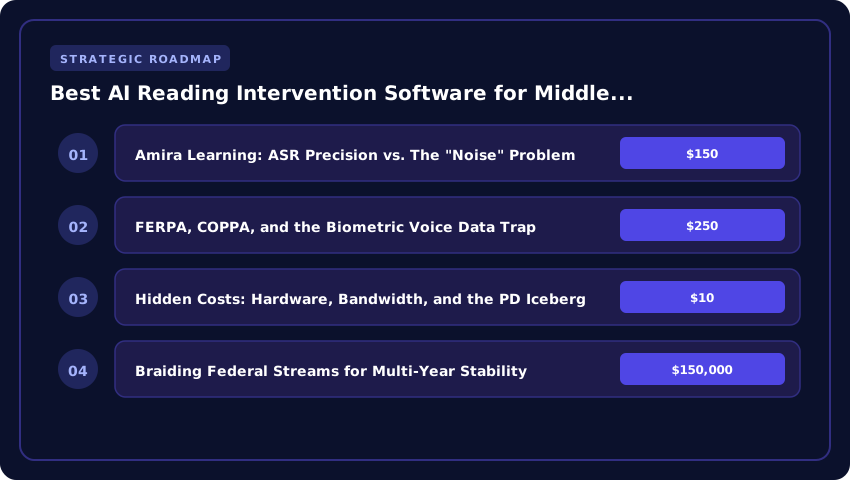
Amira Learning: ASR Precision vs. The “Noise” Problem
Amira is the only tool listening to every word a student reads aloud via Automated Speech Recognition (ASR). For fluency practice, it is revolutionary—think Running Records at scale without the teacher burnout. However, the 6–8 reality check is acoustic. Middle school labs are loud; headsets break; dialects vary wildly.
- Dialect Accuracy: Amira’s models have improved significantly on African American English (AAE) and Southern varieties, reducing false “error” flags by roughly 15% in recent updates. But it still struggles with heavy background noise (cafeteria-adjacent classrooms), often misclassifying insertions as substitutions.
- Best Fit: Ideal for Tier 1 universal screening and Tier 2 fluency building if you have quiet corners or 1:1 device policies with quality headsets. Don’t rely on it for deep phonics remediation.
HM Read 180 Universal: The Blended Rotation Reality Check
Read 180 is the only true core replacement curriculum on this list. Its Station Rotation model (Small Group, Independent Reading, Software, Whole Group) is research-validated—but fidelity is the killer. The software segment (Student App) has modernized with better scaffolding, yet the program lives or dies by the Small Group Differentiated Instruction (SGDI) table.
- The Fidelity Trap: If your master schedule protects 90-minute blocks and you have a reading specialist for the teacher-led station, outcomes are strong (ESSA Strong). If you shove it into a 45-minute elective period with a paraprofessional? You’ve bought expensive babysitting.
- Cost Reality: Expect $150–$250 per student/year plus significant PD investment. It’s a district-level commitment, not a building-level pilot.
Emerging Contenders: SoapBox Labs & Microsoft Reading Progress
The “build vs. buy” landscape is shifting. SoapBox Labs doesn’t sell a curriculum; they license the voice engine powering next-gen assessments (like NWEA MAP Reading Fluency) and emerging curricula. Their kid-specific ASR handles accents and noise better than generic Google/Amazon APIs. Watch for curriculum partners embedding this engine.
Microsoft Reading Progress (inside Teams for Education) is the dark horse for budget-conscious districts. Free with EDU licenses, it offers passage assignment, auto-scoring (WCPM, accuracy, prosody), and Insights dashboards. It lacks a scope/sequence—teachers upload the content—but for progress monitoring fluency in a Microsoft 365 district, it eliminates the need for a separate $10/student fluency tool. It’s not an intervention curriculum; it’s a workflow accelerator.
The Verdict: For pure decoding gap closure in a supplemental block? Lexia PowerUp. For a core Tier 3 replacement with staffing bandwidth? Read 180. For universal screening + fluency practice in quiet environments? Amira. For zero-cost progress monitoring in a Teams district? Reading Progress. Align the tool to your master schedule, not the sales demo.
Data Interoperability: Clever, ClassLink, & LMS Grade Passback Realities
Let’s be blunt: a literacy tool that cannot talk to your Student Information System (SIS) is a non-starter for any district IT director worth their salt. You are not buying a standalone app; you are buying a node in your data ecosystem. If the vendor cannot prove OneRoster 1.1 or LTI Advantage certification—specifically Names and Role Provisioning Services (NRPS) and Assignment and Grade Services (AGS)—walk away. The “Big Three” LMS platforms (Canvas, Schoology, Google Classroom) all demand this standard for seamless rostering and grade passback. Anything less forces your staff into nightly CSV uploads or, worse, manual entry that breaks the moment a student transfers schools mid-semester.
Rostering Automation: Clever vs. ClassLink vs. Direct API
Most vendors claim “Clever integration,” but the devil lives in the provisioning logic. Clever Secure Sync remains the market leader for K–12 because it handles complex scheduling scenarios—think A/B block rotations or co-teaching models—better than the raw ClassLink OneRoster endpoint in many legacy SIS configurations (looking at you, older PowerSchool instances). However, ClassLink’s Roster Server offers superior granularity for role mapping if your district runs a homegrown identity management stack. Demand a sandbox demo where you simulate a mid-year enrollment spike: 200 new 7th graders hitting the system on a Tuesday. If the intervention roster doesn’t reflect those kids in their correct RTI Tier 2 groups by Wednesday morning without a support ticket, the integration is vaporware.
Automated RTI/MTSS Documentation & State Compliance
Your curriculum directors need progress-monitoring data exported into the state’s longitudinal data system (SLDS) for ESSA Tier 1 evidence reporting. The software must generate automated RTI/MTSS documentation packets—attendance minutes, fidelity logs, growth percentile charts—in a format your state accepts (often Ed-Fi or CEDS aligned). If your team has to copy-paste PDF reports into a separate compliance portal, you have failed the efficiency test. Look for vendors offering scheduled API webhooks that push session-level data nightly to your data warehouse (Snowflake, BigQuery, or the district’s Ed-Fi ODS). This is how you survive a state audit without burning through substitute teacher budgets for data entry days.
FERPA, COPPA, and the Biometric Voice Data Trap
This is the deal-breaker nobody discusses in the sales demo: voice data is biometric data under FERPA and increasingly under state laws like Illinois BIPA, Texas CUBI, and Colorado Privacy Act. When a middle schooler reads aloud into an AI fluency tool, that audio file contains a voiceprint. Ask the vendor three specific questions and require written answers in the Data Privacy Agreement (DPA):
- Storage & Encryption: Is raw audio encrypted at rest (AES-256) and in transit (TLS 1.2+)? Where geographically do those files live? “AWS us-east-1” is an acceptable answer; “distributed global CDN” is a red flag.
- Retention & Deletion: What is the automated purge policy? You need a hard deadline—e.g., “Audio deleted 30 days after scoring confirmation”—not “we retain for product improvement.” Under COPPA, parental consent for biometric collection is mandatory for students under 13; your DPA must reflect the vendor as a “School Official” with “Legitimate Educational Interest” strictly scoped to literacy scoring, not model training.
- Sub-processors: Does the ASR (Automatic Speech Recognition) engine run on the vendor’s own GPU cluster, or do they stream audio to a third-party API (Google Cloud Speech-to-Text, Azure, AssemblyAI)? If it leaves the vendor’s VPC, you need a sub-processor list and DPAs for each downstream provider.
If the sales engineer hesitates on the sub-processor list, pause the procurement. A $150,000 district license evaporates fast when the state AG opens an investigation into biometric privacy violations. Your legal counsel should redline the DPA before the pilot agreement is signed, not after.
Total Cost of Ownership: Per-Seat Licensing vs. Site Licenses & PD Budgets
Curriculum directors know the sticker price on a vendor’s quote is rarely the final number that hits the general fund. When evaluating platforms like Lexia PowerUp, Reading Plus, or DreamBox Reading, the delta between a per-seat license and an unlimited site license often hinges on your building’s enrollment volatility. A per-seat model at $40–$60 per student annually looks attractive for a targeted Tier 2 group of 40 kids, but the moment you scale to a school-wide MTSS framework serving 300-plus students, a site license—typically $12,000–$18,000 per campus—becomes the only fiscally defensible path. Always negotiate a “true-up” clause mid-year; if your October count spikes, you don’t want to pay retail for the overflow.
Hidden Costs: Hardware, Bandwidth, and the PD Iceberg
The line items that derail budgets rarely live on the software invoice. Most Science of Reading platforms require noise-canceling headsets with USB-C or 3.5mm TRRS connectors—budget $25–$35 per unit for durable models that survive middle school lockers. Bandwidth is the silent killer: adaptive speech-recognition engines need a sustained 1.5 Mbps per concurrent user upstream. If your building runs on shared 100 Mbps switches, pilot week will grind to a halt. Factor in a network audit ($1,500–$3,000) before you sign.
Then there is Professional Development. Vendors often bundle “free” onboarding, but effective implementation demands 12–15 hours of specialist-led coaching per teacher (not just a 90-minute webinar). At a substitute rate of $120–$180/day plus consultant fees ($2,500–$4,000/day), PD frequently equals 30–40% of the software cost in Year 1. Write this into the grant narrative explicitly; reviewers treat embedded coaching as evidence of fidelity.
Braiding Federal Streams for Multi-Year Stability
Stop paying for intervention out of fickle local operating funds. Structure a three-year contract using a braided funding strategy:
- ESSER III (ARP): Covers Year 1 licenses, hardware refresh, and intensive startup PD. Obligation deadline is September 30, 2024; liquidation extends to March 2026.
- Title I, Part A: Sustains Years 2–3 licensing and ongoing coaching cycles. Use the “supplement not supplant” test to prove the software expands instructional time for identified students.
- IDEA Part B (Sec. 611/619): Funds seats specifically for students with IEPs targeting decoding goals. This requires explicit alignment in the IEP’s “Supplementary Aids and Services” section.
Pro tip: Ask vendors for a multi-year price lock (3–5% annual escalator cap) in exchange for the multi-fund commitment letter. Most will concede to protect their ARR (Annual Recurring Revenue).
ROI Modeling: Cost Per Exit vs. Special Education Referral Avoidance
School boards speak the language of cost avoidance. Build your model on this equation: (Total Annual TCO) ÷ (Students Exiting Intervention at Benchmark) = Cost Per Successful Exit. If your TCO is $45,000 (licenses + headsets + PD + subs) and 30 students exit Tier 2, your cost per exit is $1,500. Contrast that with the $15,000–$22,000 marginal cost per pupil for a special education referral, evaluation, and initial IEP year (NCES data). Preventing just three inappropriate referrals pays for the entire program. Present this “Cost Per Exit” metric alongside ESSA Tier 1 effect sizes in your board packet—it transforms a line item into an investment portfolio.
Implementation Fidelity: Scheduling Blocks, Teacher Buy-In & Fidelity Checklists
You can purchase the most rigorous, ESSA Tier 1–aligned platform on the market, but if your master schedule treats it like a study hall, your Return on Investment (ROI) collapses to zero. Implementation fidelity is the invisible variable separating districts that close gaps from districts that burn through Title I allocations with nothing to show for it. The research is unambiguous: adolescents reading two or more years below grade level require a minimum of 45 minutes daily, five days a week, of explicit, teacher-facilitated intervention. Anything less is remediation theater.
Master Schedule Architecture: Daily Dose vs. Block Rotation
The 45-minute daily model is the gold standard for middle school because it respects the cognitive load limits of struggling readers and builds the automaticity required for fluency transfer. A 90-minute A/B block rotation looks efficient on a spreadsheet—fewer transitions, longer chunks—but it introduces a fatal “forgetting curve” gap. Students lose momentum over the 48-hour off-day, forcing teachers to re-teach rather than accelerate. If your building runs a block schedule, you must carve out a daily “skinny” period or embed the intervention into the core ELA block as a non-negotiable station rotation. Principals who protect this time—refusing to pull interventionists for lunch duty or sub coverage—see Oral Reading Fluency (ORF) gains double those in buildings where scheduling is “flexible.”
Coaching Cycles: Killing the “Set It and Forget It” Drift
Software vendors love the phrase “adaptive technology” because it implies the algorithm does the heavy lifting. In reality, adaptive engines only adjust item difficulty; they cannot detect when a student is gaming the system, skipping audio supports, or rapidly clicking through comprehension checks. You need a structured coaching cycle—bi-weekly at minimum—where a literacy coach or lead teacher reviews session replay data alongside the teacher. Look for these drift indicators:
- Usage Inflation: High minutes logged but low “active engagement” metrics (e.g., microphone off, zero keystrokes during writing prompts).
- Unit Completion Velocity: Students blowing through units without passing the embedded mastery checks—a sign the “adaptive” floor has dropped too low.
- Teacher Dashboard Blindness: Educators who haven’t opened the teacher portal in 10+ days cannot provide the targeted mini-lessons the software flags.
Effective coaching isn’t surveillance; it’s instructional calibration. The coach models how to translate a “Phonics Gap: Vowel Teams” alert into a 5-minute explicit re-teach at the teacher table before the student logs in next.
Leading Indicators: Correlating Process Data with ORF Growth
Stop celebrating “usage minutes” as a KPI. A student staring at a screen for 60 minutes while the program reads aloud is not intervention; it’s expensive babysitting. Your fidelity checklist must prioritize Unit Completion with Mastery (80%+) correlated against bi-weekly curriculum-based measures (CBM) like DIBELS 8th Edition or Acadience Reading. Run the correlation monthly: if Unit Completion is high but ORF slope is flat, your fidelity issue is usually transfer—the teacher isn’t bridging the digital practice to connected text. If Usage is high but Unit Completion is low, your issue is dosage intensity or behavioral engagement. The dashboard that matters isn’t the vendor’s; it’s the spreadsheet where you plot Weekly Mastery Units vs. Weekly ORF Gain. That line tells you if the schedule, the coaching, and the software are actually aligned.
| Software Platform | Science of Reading Alignment | ESSA Evidence Tier | Target Grades | Core Instructional Focus | Pricing Model (Annual/Student) | Implementation Time (Min/Week) | Progress Monitoring |
|---|---|---|---|---|---|---|---|
| Lexia PowerUp Literacy | Explicit: Phonology, Orthography, Morphology, Syntax, Semantics | Tier 1 (Strong) | 6–12 | Word Study, Grammar, Comprehension | $40–$60 | 80–100 mins | Real-time myLexia dashboard; predictive performance |
| Reading Horizons Elevate | Explicit: Structured Linguistic Literacy (Phonics/Decoding) | Tier 2 (Moderate) | 4–12 | Phonemic Awareness, Phonics, Fluency | $35–$55 | 60–90 mins | Chapter assessments; skill mastery tracking |
| MindPlay Virtual Reading Coach | Explicit: Orton-Gillingham based; Synthetic Phonics | Tier 2 (Moderate) | K–12 | Phonemic Awareness, Phonics, Vocabulary, Fluency, Comprehension | $30–$50 | 30–40 mins daily | Automated IEP reports; granular skill gaps |
| Language! Live (Voyager Sopris) | Explicit: Blended model (Teacher + Tech); Scarborough’s Rope | Tier 1 (Strong) | 5–12 | Word Training + Text Training | $50–$75 | 90–120 mins | Benchmark assessments; curriculum-embedded |
| Read 180 Universal (HMH) | Partial: Adaptive tech + Teacher-led; Comprehension heavy | Tier 1 (Strong) | 4–12 | Comprehension, Vocabulary, Writing, Fluency | $60–$90 | 45–90 mins daily | HMH Growth Measure; Lexile tracking |
Frequently Asked Questions
What is the best AI reading intervention software for middle school aligned to the Science of Reading?
Lexia PowerUp Literacy is widely considered the top choice for Grades 6–12 due to its ESSA Tier 1 (Strong) evidence rating and explicit alignment with Scarborough's Rope strands—Word Study, Grammar, and Comprehension. It uniquely targets the decoding gaps causing the 'Fourth Grade Slump' via adaptive branching.
Which reading intervention programs meet ESSA Tier 1 evidence standards for middle school?
Lexia PowerUp Literacy, Language! Live (Voyager Sopris), and Read 180 Universal (HMH) currently hold ESSA Tier 1 (Strong) evidence ratings for secondary students. Districts spending Title I or IDEA funds should prioritize these three to ensure federal compliance and proven efficacy for adolescent literacy.
How much does AI reading intervention software cost per student annually?
Annual per-student licensing typically ranges from $30 for foundational tools like MindPlay to $90 for comprehensive blended suites like Read 180 Universal. Most Science of Reading-aligned platforms (Lexia, Reading Horizons, Language! Live) cluster between $35–$75 per seat, often requiring minimum school-wide purchases.
Can software alone fix middle school decoding gaps without teacher-led instruction?
No. Research confirms software is most effective as a 'force multiplier' within a blended model (e.g., Language! Live, Read 180). Purely adaptive programs (Lexia, MindPlay) accelerate skill acquisition but require teacher-led small groups for vocabulary depth, syntax instruction, and writing application to close the comprehension gap.
What is the minimum weekly implementation time required for middle school literacy intervention software to work?
Effective dosage requires a minimum of 80–100 minutes per week (e.g., Lexia PowerUp: 3×30 mins + teacher check-ins). Programs like Read 180 demand 45–90 minutes daily. Consistency is non-negotiable; studies show efficacy drops sharply below 60 minutes/week for adolescent struggling readers.
Strategic Final Takeaway
When evaluating Best AI Reading Intervention Software For Middle School Literacy Gaps Aligned To Science Of Reading, base your decisions on accredited institutional standards, measurable return on investment (ROI), and up-to-date official guidelines. Always verify specific dates and requirements through official regulatory portals.