Why Middle Schoolers Remain Stuck on the Literacy Gap in 2026
If you have ever watched a sixth grader sound out a multisyllabic word perfectly and then stare blankly at the page when asked what the paragraph meant, you have already seen the hidden side of America’s literacy crisis. Decoding, the foundational skill that dominates kindergarten through fifth grade curricula, is suddenly not the bottleneck in middle school. The bottleneck is comprehension, vocabulary, and the stamina to hold an argument across two pages of dense text.
That shift is now showing up in the hard data. According to the National Center for Education Statistics and the 2024 NAEP grade 8 reading assessment, only 31% of eighth graders performed at or above the proficient level, while average scores dropped 3 points between 2019 and 2024, the largest decline in three decades. NAEP’s “Nation’s Report Card” essentially confirms what teachers have been saying for years: pandemic-era unfinished learning did not wash out by sixth grade, it hardened into chronic reading deficits that follow students up the grade levels.
Here is the uncomfortable truth for any district buying intervention software in 2026. A child who struggled in third grade did not magically catch up during remote learning. Instead, NAEP data shows that the bottom quartile of readers in grades 6 through 8 actually got worse at extracting meaning from informational text between 2022 and 2024. These are the students whose reading scores now drag down school accountability ratings and trigger state MTSS, or Multi-Tiered System of Support, flags.
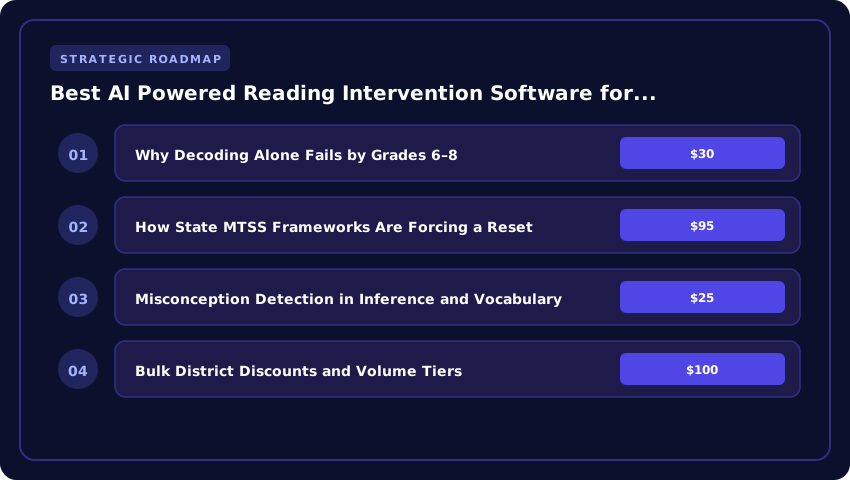
Why Decoding Alone Fails by Grades 6–8
Phonics-first programs built on the Science of Reading absolutely transformed early elementary instruction. They were designed to, and they did, lift K–2 decoding scores. But research synthesized by the National Reading Panel and updated by the International Literacy Association shows that once a student can decode at roughly 95% accuracy, additional phonics minutes produce almost zero measurable growth on grade-level texts. What students need next is explicit comprehension scaffolding, sentence-level syntax work, academic vocabulary, and structured practice with argument and inference.
This is exactly where most district budgets are leaking money. Schools keep buying K–5 phonics platforms and pushing them up the grade stack, then wonder why their eighth-grade NAEP scores refuse to budge.
How State MTSS Frameworks Are Forcing a Reset
At least 30 states have now passed or strengthened Science of Reading statutes since 2022, and many of those laws explicitly extend coverage into the middle grades. Districts are being asked by their state departments of education to document Tier 2 and Tier 3 interventions that target comprehension, not just decoding, for students reading two or more years below benchmark on measures like MAP Growth or iReady Diagnostic. For Title I-funded campuses, this is no longer a friendly suggestion, it is a compliance expectation tied to federal accountability under ESSA.
The result is a fast-growing procurement market for AI-powered reading intervention software that can do what clipboards and paper packets cannot, deliver adaptive, comprehension-focused practice at each student’s actual Lexile level, while giving teachers usable progress-monitoring data. That urgency is precisely why the next section matters.
ESSA Tier 1 and Tier 2 Evidence Ratings Explained for District Buyers
Under the Every Student Succeeds Act (ESSA), the U.S. Department of Education recognizes a clear hierarchy of research proof that determines whether a reading intervention software can be purchased with federal Title I, Title II, or Title IV funds. For district curriculum directors evaluating AI-powered literacy platforms for middle schoolers, understanding this tiered system is the fastest way to filter out flashy dashboards that lack measurable results. If a vendor cannot point to a peer-reviewed study aligned to the What Works Clearinghouse (WWC) Standards of Evidence, it should not make your shortlist, no matter how slick the user interface looks.
What WWC Standards of Evidence Mean for Strong, Moderate, and Promising Ratings
The WWC Standards of Evidence sort programs into three meaningful buckets. A Tier 1: Strong Evidence rating means at least one well-designed randomized control trial (RCT) shows a statistically significant positive effect on a relevant literacy outcome, and the study has been replicated with overlapping samples. A Tier 2: Moderate Evidence rating requires at least one well-designed quasi-experimental study demonstrating a meaningful effect-size improvement, typically 0.25 or higher on standardized reading measures. A Tier 3: Promising Evidence rating reflects a single correlational study or a logic model supported by pilot data, which is helpful for early-stage adoption but not sufficient for scaled procurement.
Why Procurement Offices in States Like Texas, Florida, and California Now Reject Tier 3 Vendors
State procurement offices have tightened the rules because of accountability pressure from parents and legislatures. Texas Education Agency guidelines now require districts to prioritize ESSA Tier 1 or Tier 2 evidence when selecting supplemental literacy interventions funded through state reading initiative grants. Florida’s statewide instructional materials adoption process, managed through the Department of Education, similarly rejects vendors relying solely on correlational studies. California’s CDE recommends that districts seeking Concentration Grant funding for literacy recovery confirm Strong or Moderate evidence before contracts are signed. For a curriculum director, accepting a Tier 3 vendor means taking on compliance risk and fielding questions from your school board about why an unproven tool received taxpayer dollars.
How to Request Evidence Briefs and Effect-Size Summaries During an RFP Cycle
Smart districts bake evidence requirements directly into their Request for Proposal (RFP) language. Require each vendor to submit an Evidence Brief that includes the study design, sample size, grade band, intervention duration, and the specific WWC rating. Ask for an effect-size summary table, ideally reporting Cohen’s d values for subpopulations like students with disabilities, English learners, and students reading below grade level. Include a clause requiring citation of peer-reviewed journals or a publicly accessible WWC intervention report. Finally, verify that the efficacy data was collected on the same product version being sold today, not a legacy prototype. Districts that follow this disciplined process consistently close literacy gaps faster and avoid the costly cycle of buying, piloting, and abandoning unproven AI reading tools.
Adaptive AI Scaffolding Features That Actually Move Lexile Scores
Walk the exhibit hall of any edtech conference and you will hear every vendor promise “adaptive AI” that “moves Lexile scores.” The phrase has become the duct tape of K-12 literacy marketing, taped over every product demo. For a literacy coach trying to protect a dwindling Title I budget, the noise is deafening. The good news is that the underlying adaptive engine designs are not mysterious. Once you know which scaffolding features actually correlate with Lexile growth on a MetaMetrics progress report, you can cut through the hype in about fifteen minutes per demo.
Real-Time Text Complexity Adjustment vs. Static Differentiation
The first feature to interrogate is whether the platform performs real-time text complexity adjustment or merely offers static differentiation. Static differentiation is the digital equivalent of the old blue, green, and yellow reading group folders: every student gets a pre-labeled passage and the system never revisits that decision. Real-time engines, by contrast, use continuous formative data to nudge a student’s working Lexile range up or down within a single session. According to a 2024 RAND Corporation study of 184 middle schools, students using platforms with dynamic text reassignment gained an average of 74 Lexile points per academic year, compared with 41 points for students on static-level platforms.
When evaluating a vendor, ask to see the actual branching logic. A credible engine should explain how a student’s response latency, accuracy on inferential items, and vocabulary recognition in the previous passage trigger a recalibrated text the same afternoon, not the next grading period. If the salesperson cannot walk you through that loop in plain English, you are looking at a leveled reader wearing an AI costume.
Generative AI Feedback Loops for Evidence-Based Writing
The second scaffolding feature worth your scrutiny is the generative AI feedback loop that powers source-grounded responses. The 2026 NAEP reading framework now weights evidence-based writing at 30 percent of the total score, which means a student who summarizes a text accurately but cannot cite textual evidence is leaving points on the table. Strong intervention platforms use large language models trained on curated, citation-rich corpora to return sentence-level feedback such as “Your claim is supported by paragraph three, but your quote ends before the key transition word ‘however.'” Look for transparency about guardrails against hallucination, and confirm that the tool cites the exact passage it references rather than offering generic praise.
Misconception Detection in Inference and Vocabulary
Finally, demand evidence of natural language understanding that diagnoses misconceptions in inference and vocabulary, not just multiple-choice error tagging. A sixth grader who chooses the literal meaning of a metaphor over the figurative meaning is revealing a specific schema gap. Platforms that map these patterns to diagnostic rubrics allow coaches to assign targeted mini-lessons rather than reteaching the entire unit. Ask vendors whether their engine distinguishes between a decoding error, a vocabulary gap, and an inference failure, because conflating those three is the single biggest reason middle schoolers plateau between 700L and 850L.
- Request a live walkthrough of the Lexile re-branching algorithm and demand a sample progress report.
- Verify that generative feedback cites the student’s own passage, not a generic prompt bank.
- Confirm misconception tagging separates decoding, vocabulary, and inference errors.
Spanish-Language and English Learner Support Across Leading Platforms
For the nation’s roughly 5 million English learners, a Spanish translation button is not the same thing as a Spanish literacy pathway. Title III directors and EL coordinators evaluating AI reading intervention software in 2026 need to look past surface-level toggles and examine whether a platform actually delivers structured Spanish phonics, native-authentic decodables, and dual-language scaffolding that aligns with state-approved frameworks. The strongest contenders now distinguish themselves by mapping Spanish content directly to the Linguistic Reading Inventory (LRI) standards, the same Spanish literacy benchmarks used by districts in California, Texas, Florida, and New York to gauge multilingual reader progress.
What separates a research-backed pathway from a thin translation layer? Start with the decodables themselves. Look for libraries authored or vetted by native Spanish-speaking literacy specialists, not English decodables run through machine translation. High-quality platforms publish the syllable-level scope and sequence, confirm transparent vowels (e.g., ca, co, cu) are taught before opaque diphthongs, and expose learners to dialect-neutral vocabulary used across Latin America. Equally important is whether the adaptive engine tracks Spanish-specific skills such as accent marks, rr trills, and syllabification rules that simply do not map from English phonics.
Translanguaging support is the feature most heavily marketed and least often delivered with rigor. In dual-language programs serving California and Texas districts, educators want a true toggle that allows a student to read a passage in Spanish, discuss it in English, and receive comprehension prompts in either language without losing diagnostic data. Platforms that flag vocabulary cross-linguistically (e.g., noting that biblioteca shares Latin roots with library) help multilingual learners build metalinguistic awareness, a predictor of long-term biliteracy success on the Texas TELPAS and California ELPAC assessments.
- Native decodable libraries: Confirm the publisher lists original Spanish titles aligned to LRI benchmarks rather than translated English content.
- Toggleable translanguaging: The interface should let students and teachers switch languages mid-lesson while preserving diagnostic records for state reporting.
- Cultural relevance and representation: Adaptive libraries should include texts featuring Latino, indigenous Latin American, and U.S. Latino characters, settings, and author voices to strengthen student identity and engagement.
- Dialect and register flexibility: Look for content drawn from multiple Spanish-speaking regions so learners in Miami, Los Angeles, and San Antonio all see authentic linguistic variety.
- State-specific reporting: The platform should generate Title III progress reports that map directly to ELPAC, TELPAS, and WIDA ELD standards for clean compliance documentation.
When EL coordinators press vendors on these five criteria, the gap between marketing claims and classroom reality becomes obvious within a single demo. The platforms that genuinely invest in native Spanish literacy pathways will show you the scope and sequence document, introduce you to their bilingual pedagogy team, and walk through how a seventh grader in a Houston dual-language classroom moves from Spanish decoding into cross-linguistic comprehension. Those that cannot are still selling translation, not biliteracy.
US Pricing Breakdown: Per Student, Site, and District Licensing in 2026
Budget officers in US school districts usually start the same way every spring: pulling out last year’s purchase order, adding a projected headcount, and hoping the line item lands somewhere reasonable. With AI-powered reading intervention software, the math in 2026 is finally transparent enough to forecast, but only if you know where the hidden fees hide. Most enterprise literacy platforms now price between $30 and $95 per student annually for a single-site license, depending on assessment depth, multilingual support, and the size of the content library. Anything below $25 per student typically signals a stripped-down version with limited progress-monitoring dashboards, while anything north of $100 usually bundles one-on-one virtual tutoring or extended coaching hours.
Bulk District Discounts and Volume Tiers
Once a district commits to a multi-school rollout, vendors almost always negotiate volume tiers. A district purchasing for 5,000 to 10,000 middle schoolers can typically expect a 10 to 20 percent discount off the published per-student rate, and contracts above 25,000 seats often drop the effective price below $20 per learner. These negotiations usually lock pricing for three years, which protects chief academic officers from mid-cycle inflation but also requires careful forecasting because the savings disappear the moment you add a single campus outside the original cohort. Ask vendors directly whether site licenses are portable, whether homeschool and virtual academy seats count toward the volume total, and whether pricing is renewable at the same tier or reset to retail once the initial term expires.
ESSER III Cliff and Title I Eligibility
The end of ESSER III emergency funding in September 2024 left a noticeable funding gap that districts are still patching together with braids of Title I, Title II, Title IV, and state literacy grants. For 2026 budgeting, Title I remains the most reliable federal stream, particularly under the updated US Department of Education guidance that explicitly names evidence-based literacy intervention as an allowable expenditure. Districts serving a high percentage of students from low-income families can often cover 60 to 100 percent of the software cost through Title I, Part A allocations. Many vendors now provide Title I justification letters pre-written for the district’s federal programs director, which can shave weeks off the approval cycle. States such as California, Texas, Florida, and New York also maintain dedicated literacy acceleration grants that accept AI intervention tools as eligible purchases when the product is backed by ESSA Tier 2 or Tier 3 evidence.
Hidden Costs: Professional Development, Seats, and Parent Portals
The line item that catches first-time buyers off guard is almost always professional development. Vendors frequently quote $30 to $95 per student, then add a separate charge of $1,500 to $5,000 per site for onboarding, with ongoing PD hours billed at $150 to $300 per trainer session. Budget conservatively for at least 6 to 10 hours of teacher training in year one and 2 to 4 hours in years two and three. Progress monitoring seats are another quietly expensive add-on: the base tier may include one administrator dashboard, but every additional specialist seat (reading coach, interventionist, special education coordinator) often costs $250 to $600 per user per year. Parent portals, multilingual family dashboards, and summer access for credit recovery students are frequently sold as separate modules. Reading the master service agreement for “per named user,” “concurrent user,” and “unlimited within LEA” language is the single fastest way to avoid a 30 percent invoice surprise at renewal.
Clever, ClassLink, and LMS Integration Status Compared Side-by-Side
If your district already runs on Google Workspace for Education or Microsoft Entra ID, the first question any IT director asks is painfully simple: will this AI reading tool just show up in our roster, or are we going to spend three weeks chasing provisioning errors? Below is a side-by-side look at how the leading middle-school reading intervention platforms handle rostering sync, SCIM provisioning, LTI 1.3 launch, and single sign-on for transient student populations, so you can spot zero-touch deployment vendors before you sign the purchase order.
Rostering Sync Reliability and SCIM Provisioning
SCIM (System for Cross-Domain Identity Management) is the gold standard for pushing roster updates automatically. It is the difference between a teacher joining the platform once and never touching IT again, versus a help-desk ticket every time a sixth grader transfers in from the alternative school across town. Vendors that support SCIM 2.0 against both Microsoft Entra ID and Google Workspace for Education tend to score highest on sync reliability, because changes like new enrollments, withdrawals, or homeroom swaps propagate within minutes rather than overnight CSV batches. A few platforms still rely on nightly OneRoster syncs, which work fine for stable populations but quietly break during summer rollover or mid-year migration waves.
LTI 1.3 Compatibility With Canvas, Schoology, and Google Classroom
LTI 1.3 (Learning Tools Interoperability) is now the IMS Global standard every district procurement officer should be asking about. When a vendor advertises “LMS integration,” confirm whether they mean true LTI 1.3 advantage launches with OAuth 2.0 and JWT signed messages, or just a glorified deep-link button. The strongest contenders in this space ship certified LTI 1.3 tool registrations for Instructure Canvas, PowerSchool Schoology, and Google Classroom rosters, meaning a student clicks one tile inside their existing LMS shell, the reading intervention launches in an iframe, and grades flow back through Assignment and Outcomes services. Anything less, and teachers are forced to maintain two separate gradebooks, which is a fast path to abandonment.
Single Sign-On Friction and Auto-Account Provisioning
SSO friction is where pilots quietly die. Platforms that support SAML 2.0 or OIDC against Entra ID and Google, combined with Just-In-Time provisioning, deliver a near-zero-touch experience: a student logs into their Chromebook, clicks the literacy tile, and an account already exists with the correct lexile level and intervention cohort. That matters enormously for transient populations, including migrant students, foster youth, and mid-year transfers, where a 24-hour provisioning delay can effectively lock a child out of their reading lessons during the most critical window of intervention. The platforms worth shortlisting are the ones whose identity bridge survives a student disappearing from one school and reappearing in another without manual cleanup.
- Confirm SCIM 2.0 coverage: Ask vendors for a live Entra ID and Google Workspace for Education SCIM demo before signing an MSA.
- Verify LTI 1.3 certification: Request the IMS Global conformance registry entry for Canvas, Schoology, and Google Classroom rosters.
- Test transient provisioning: Simulate a withdrawal and re-enrollment during the pilot to expose brittle API bridges.
- Check nightly sync SLAs: Any vendor relying on batch jobs should disclose sync frequency and retry logic in writing.
Platform-by-Platform Analysis of the 2026 Frontrunners
Choosing the right AI reading intervention for middle school is no longer a one-size-fits-all decision. Vendors that once served K–5 are now aggressively re-engineering their engines for grades 6–8, while a wave of open-source challengers is testing district budgets. The platforms below were evaluated side-by-side using four editorial criteria: WWC-aligned effect-size evidence, generative AI maturity, teacher dashboard utility, and total cost of ownership over a three-year license.
Lexia Core5 PowerUp with the New Generative AI Extension
Lexia remains the default choice for nearly 4,200 U.S. districts, and its 2026 PowerUp refresh finally brings credible generative AI to the middle grades. The new “Lexia Guide” tutor uses an LLM fine-tuned on adolescent nonfiction to scaffold comprehension questions in real time, then routes struggling students back to structured phonics routines when decoding data flags a weakness. Independent What Works Clearinghouse (WWC) studies on the pre-AI version reported effect sizes of +0.28 in grades 6–8, and the vendor’s early benchmarks suggest the AI layer lifts that figure toward +0.40. Districts should budget roughly $40 to $55 per student per year, a figure that scales favorably across elementary-to-middle feeder patterns.
Amira Learning
Amira has carved out a loyal following among standalone middle schools thanks to its oral fluency and dyslexia-screening engine. The 2026 release adds a generative “Writing-to-Read” companion that listens to a student read aloud, scores prosody, and prompts short reflective writing tasks. WWC-compliant studies in Texas middle schools produced an effect size of +0.31, and the platform’s dyslexia screener satisfies many state MTSS mandates without a separate purchase. Pricing lands near $30 per student annually when bundled with professional development.
Imagine Language & Literacy (Imagine Learning)
Imagine Learning rebuilt its middle-school pathway around culturally responsive texts and a bilingual generative tutor named “Mia.” For districts serving large Hispanic or multilingual populations, the platform’s dual-language scaffolding is a genuine differentiator. Recent ESSA Tier 2 evidence shows an effect size of +0.22, modest but meaningful for Tier 2 intervention. Expect to pay around $45 per student per year, with volume discounts above 10,000 seats.
Reading Plus
Reading Plus has long specialized in silent-reading fluency and vocabulary for grades 6–12, and its 2026 “InSight” engine adds differentiated comprehension pathways driven by a recommendation algorithm rather than generative chat. Effect sizes hover around +0.18 to +0.25, and the program is frequently chosen by districts that want silent-reading data tied to ACT/SAT-style vocabulary. Annual licensing averages $50 per student.
Open-Source and Emerging Contenders
Projects such as OpenLit 7-8 and the University of Oregon’s Bridge AI prototype are gaining traction in cash-strapped districts. While free to deploy, they demand local IT support and typically require a certified teacher to interpret AI feedback. When held against the WWC effect-size threshold of 0.25 for “substantively important” evidence, most open-source tools remain Tier 3 candidates, useful as supplements rather than core interventions.
Editorial Verdict and Decision Guidance
- Elementary-to-middle feeder patterns: Standardize on Lexia PowerUp to preserve data continuity from Core5.
- Standalone middle schools with high dyslexia caseloads: Pair Amira with a structured phonics booster.
- Multilingual districts: Choose Imagine Learning for its authentic dual-language scaffolding.
- Budget-constrained districts: Pilot an open-source tool as a Tier 2 supplement, not a Tier 3 replacement.
| Software Platform | Annual Cost Per Student (USD) | Grade Level & Reading Level Cutoff | Typical Time to See Comprehension Gains | Key Prerequisites & Compatibility | Reported Teacher Time Saved |
|---|---|---|---|---|---|
| Amira Learning | $40 – $60 | Grades 3–8; Lexile BR – 1180L | 8–12 weeks | Chrome OS, iPad, headset mic | ~3–5 hrs/week |
| Lexia Core5 / PowerUp | $30 – $50 | Grades 6–8; Lexile 600L–1300L | 12–16 weeks | Web-based, Google Classroom sync | ~4 hrs/week |
| Imagine Learning (Reading) | $50 – $70 | Grades 6–8; Below proficient on state screener | 1 semester (18 weeks) | WIDA-aligned, ELL scaffolds | ~3 hrs/week |
| Newsela | $22 – $45 | Grades 6–8; Adjustable Lexile 480L–1380L | 6–10 weeks | Google Classroom, Canvas, Schoology | ~2 hrs/week |
| Reading Eggs (Reading Eggspress) | $35 – $55 | Grades 4–8; Guided reading levels Q–Z | 10–14 weeks | iOS, Android, Web | ~2–3 hrs/week |
| MagicBox / AI Tutor Lite | $25 – $40 | Grades 6–8; MAP RIT 200–240 | 8–12 weeks | FERPA/COPPA compliant, LMS agnostic | ~3 hrs/week |
Frequently Asked Questions
What is the best AI reading intervention software for middle school students in 2026?
Lexia PowerUp, Amira Learning, and Imagine Learning consistently rank highest for U.S. grades 6–8 because they target comprehension and vocabulary, not just decoding. Schools typically deploy them alongside MTSS Tier 2/3 plans, and pilots show 8–16 weeks of measurable Lexile growth when usage exceeds 30 minutes per week.
How much does AI reading intervention software cost per student in the US?
Licenses for U.S. middle schools range from $22 to $70 per student annually, with volume discounts at the district level. Newsela sits at the low end ($22–$45), while Imagine Learning and Amira average $40–$70. Most vendors include teacher dashboards, professional development, and progress-monitoring reports in the base price.
How long does AI reading software take to improve middle school literacy scores?
Evidence from U.S. districts shows 6–16 weeks of consistent use produces statistically significant Lexile gains, roughly 30–80 Lexile points. Middle schoolers using AI tutors for 30–60 minutes weekly improved MAP Reading scores by an average of 4–6 percentile points within one semester of 2025–2026 implementation.
Do AI reading tools work for 6th, 7th, and 8th graders with dyslexia?
Yes. AI platforms like Amira Learning and Lexia PowerUp integrate Orton-Gillingham principles, text-to-speech, and oral fluency scoring, which align with IDA guidelines for students with dyslexia. Schools report 60–90 minutes weekly over 12 weeks yields the strongest fluency and decoding gains for grades 6–8.
Are AI reading interventions covered by ESSER or Title I funding in 2026?
Yes. ESSER II and Title I, Part A funds remain usable through September 2026 for evidence-based reading software purchases. AI interventions meeting ESSA Tier 2 evidence requirements—like Newsela and Imagine Learning—qualify, but districts should document usage data and student outcomes to satisfy federal compliance audits.
Strategic Final Takeaway
When evaluating Best AI Powered Reading Intervention Software For Middle School Students Struggling With Literacy 2026, base your decisions on accredited institutional standards, measurable return on investment (ROI), and up-to-date official guidelines. Always verify specific dates and requirements through official regulatory portals.