Why the January 2026 NUC Panel Visit Keeps Oyo Campus on Edge
There is a quiet tension inside the Atiba University campus in Oyo right now, and it has nothing to do with semester examinations or hostel allocations. It stems from the upcoming January 2026 NUC resource verification visit, the inspection that will decide whether the Gavel and the Gazette Faculty of Law survives its first full accreditation cycle or faces a probation that could jeopardise every graduate’s admission to the Nigerian Law School.
Unlike a routine academic audit, this panel visit goes straight to the heart of what the NUC CCMAS (Core Curriculum Minimum Academic Standards) demands from a private Nigerian law faculty. The Council of Legal Education, the body that controls the Call to Bar pathway, has publicly warned that law faculties running on borrowed, rented, or skeletal resources will not be forwarded for screening in the 2026/2027 academic session. For Atiba, a relatively young private university, that warning has triggered a January sprint that has reshaped how lecturers prepare, how the library is staffed, and how faculty management books are catalogued.
Inside the Faculty, three fears dominate every departmental gathering:
- Library Volume Threshold – CCMAS requires a minimum print and digital law library holding, broken down into core Nigerian reports, international jurisprudence, and current journals. Lecturers privately admit that some legal titles are still being sourced from alumni donations and partner firms in Ibadan. The race is now on to log enough verifiable volumes before the panel arrives.
- Full-Time Academic Staffing Ratio – The benchmark insists on a specific ratio of Professors, Associate Professors, Senior Lecturers, and Lecturers with active LLM or PhD credentials. Visiting and adjunct lecturers cannot substitute for the required core staff count, and the faculty has been quietly recruiting senior law lecturers from Ibadan-based public universities to stabilise its headcount.
- Moots, ICT, and Clinical Legal Infrastructure> The NUC panel will check for functional moot courtrooms, active subscription law databases, and a Student Law Clinic. A faculty that cannot produce real case files, live mooting sessions, and electronic databases risks being flagged as a paper institution.
Operationally, the campus has shifted into a documentation-first posture. Every assigned reading must now be backed by a verifiable shelf copy. Every visiting lecturer is being converted to a properly documented adjunct with a signed letter of deployment. Every moot competition is being repackaged into a portfolio file that can be laid on the panel’s table. This is not the kind of atmosphere where students relax between JAMB and Post-UTME preparations; it is a workspace where every academic decision is filtered through the lens of Will this satisfy the resource inspection team?
For prospective law students, this is genuinely useful intelligence. A January 2026 panel verdict that goes in Atiba’s favour would lock in the law programme’s standing, protect any current NELFUND student loan beneficiary enrolled in the faculty, and stabilise the JAMB and Post-UTME cutoff that the university can confidently defend in its 2026/2027 admissions brochure. A verdict that goes the other way would mean remediation, possibly a freeze on new law admissions, and a cloud over any student who has paid tuition fees running into ₦2 million to ₦3.5 million per session, depending on the indigenes and non-indigenes fee structure.
Actionable Takeaway: Before paying acceptance or hostel fees, ask the admissions office for the latest NUC resource verification status, request the current faculty staff list, and confirm that the library database subscriptions (such as HeinOnline or LawPavilion) are active and renewable. A law degree in Nigeria is only as strong as the faculty’s accreditation status, and at Atiba, that status is being decided in January.
Decoding the NUC CCMAS Verdict: Pass, Partial, or Withdrawn?
When the National Universities Commission (NUC) releases the 2026 accreditation results for Atiba University’s Faculty of Law, the verdict will fall into one of three distinct categories under the Core Curriculum Minimum Academic Standards (CCMAS) framework. Understanding these labels is not just academic semantics; it determines whether your LL.B certificate qualifies you for the Nigerian Law School or leaves you in regulatory limbo. As a prospective student or a parent investing heavily in legal education, you need to read the fine print on that official gazette.
Full Accreditation is the gold standard. It means the NUC panel found that Atiba University meets or exceeds the CCMAS benchmarks across the board: qualified faculty-to-student ratios, a law library stocked with current law reports and digital databases like LawPavilion or LexisNexis, functional moot court facilities, and a curriculum aligned with the 70% core / 30% elective structure. For you, this translates to an uninterrupted path. Your graduating class will be cleared for the Council of Legal Education’s Bar Part I programme without conditions. It also protects the university’s quota for JAMB UTME admissions, meaning the published cutoff mark holds firm for the next academic session.
Interim (or Partial) Accreditation is a conditional “pass with reservations.” The NUC identifies specific deficiencies—perhaps the library lacks sufficient volumes of the Weekly Law Reports, the student-to-staff ratio exceeds the 30:1 benchmark, or the moot court room is non-existent. The university is typically given a window of 12 to 24 months to rectify these gaps. Critical Takeaway: If you are admitted under Interim status, your cohort can still proceed to Law School if the university clears the re-accreditation visit before you graduate. However, if the deadline lapses and the status drops to “Denied,” your degree may not be recognized for Bar admission. Always ask the Dean for the Accreditation Action Plan and timelines before accepting an offer under this status.
Denied (Withdrawn) Accreditation is the regulatory nuclear option. The programme is effectively frozen. No new students can be admitted via JAMB, and existing final-year students may be barred from the Law School screening exercise. If Atiba Law receives this verdict in 2026, the faculty must cease admissions immediately. For a prospective 100-Level student, this is a hard stop—do not pay acceptance fees until the status is officially reversed on the NUC portal.
How to Verify the Verdict Yourself (Do Not Rely on Hear-say)
- Visit the official NUC portal at nuc.gov.ng and navigate to the “Accreditation Status” or “Approved Programmes” dashboard.
- Select “Atiba University, Oyo” from the institution dropdown and filter by “Faculty of Law” or programme code “LL.B Common Law.”
- Check the “Status” column (Full, Interim, Denied) and the “Validity Date” (usually December 2026 or December 2027).
- Cross-reference with the Council of Legal Education (CLE) list of approved universities on nigerianlawschool.edu.ng. The CLE list is the ultimate gatekeeper for Bar Part I eligibility.
- Request a certified true copy (CTC) of the NUC accreditation letter from the Atiba University Registrar’s office. A genuine letter carries the NUC letterhead, the Executive Secretary’s signature, and the specific CCMAS panel report reference number.
Pro Tip: Screenshot the NUC portal result page with the date visible. Save it. If any admission agent or consultant tells you something different from what the portal shows, trust the portal. Your legal career depends on regulatory truth, not marketing promises.
JAMB UTME and Post-UTME Cut-off Marks for Atiba Law (2026/2027 Session)
Securing admission into the Faculty of Law at Atiba University, Oyo, requires more than just passing the Unified Tertiary Matriculation Examination (UTME); it demands a strategic understanding of the scoring matrix. For the 2026/2027 academic session, the university has maintained its benchmark departmental cut-off mark for Law at 220 in the UTME. However, prospective candidates should treat this as a floor, not a ceiling. Historical data from the 2024/2025 and 2023/2024 sessions reveals that the effective merit cut-off often settles between 235 and 245 due to the high volume of applicants competing for the limited NUC-approved quota of 75 students. Scoring 220 makes you eligible for the Post-UTME screening, but scoring 250+ significantly buffers your aggregate score against the competitive ranking.
The mandatory JAMB subject combination remains non-negotiable: Use of English, Literature in English, Government or Christian Religious Studies (CRS), and any other Arts or Social Science subject (such as History, Economics, or Civic Education). A common pitfall is substituting Literature with Government; the Council of Legal Education and NUC guidelines strictly require Literature in English. Your O’Level (WAEC/NECO/NABTEB) results must reflect five credits obtained in not more than two sittings, including English Language, Literature in English, Mathematics, and two other Arts/Social Science subjects. Awaiting results are accepted during registration but must be uploaded on the JAMB CAPS portal before the admission window closes.
Atiba University employs a 50:50 aggregate scoring system. Your final Post-UTME aggregate is calculated as: (JAMB Score ÷ 8) + (Post-UTME Score ÷ 2). For example, a candidate with a JAMB score of 260 (32.5 points) who scores 70% in the Post-UTME (35 points) achieves an aggregate of 67.5. This formula rewards consistency; a high JAMB score cannot fully compensate for a poor screening performance, and vice versa. The Computer-Based Test (CBT) screening typically covers English Language (Comprehension, Lexis, Structure), Literature in English (African/Non-African texts, Literary Appreciation), and General Knowledge/Current Affairs.
For the 2026/2027 cycle, mark your calendars with these critical deadlines and costs:
- Post-UTME Registration Portal Opens: Monday, July 7, 2026.
- Registration Deadline: Friday, August 15, 2026 (midnight WAT). No extensions are typically granted.
- Screening Examination Dates: Monday, August 24 – Wednesday, August 26, 2026.
- Screening Fee: ₦2,000 (Two Thousand Naira only), payable via the university portal (Remita/Interswitch) or designated bank branches. This fee is non-refundable.
- Result Release: Expected by Friday, September 4, 2026.
Actionable Takeaway: Do not wait for the deadline. Register within the first two weeks of July to secure your preferred CBT center slot in Oyo or Ibadan. Keep your JAMB registration number, valid email, and phone number active; all communication regarding venue changes or supplementary lists runs through these channels. If you are relying on the NELFUND student loan, ensure your admission letter is downloaded immediately upon release on JAMB CAPS to initiate the loan application process before the faculty’s clearance deadline.
NELFUND Loan Eligibility: Can You Secure Federal Funds for Private Law School?
The short answer is yes, but the devil lives in the regulatory fine print. Since the Student Loans (Access to Higher Education) Act, 2024 repealed the old 2004 Act, the Nigerian Education Loan Fund (NELFUND) explicitly covers students in all accredited tertiary institutions—federal, state, and private. Because Atiba University holds a valid National Universities Commission (NUC) license and its Law programme is currently undergoing the 2026 resource verification for full accreditation, admitted students are prima facie eligible for the interest-free tuition loan. However, “eligible” does not mean “automatic.” You must clear three distinct hurdles before the first naira hits the university’s bursary account.
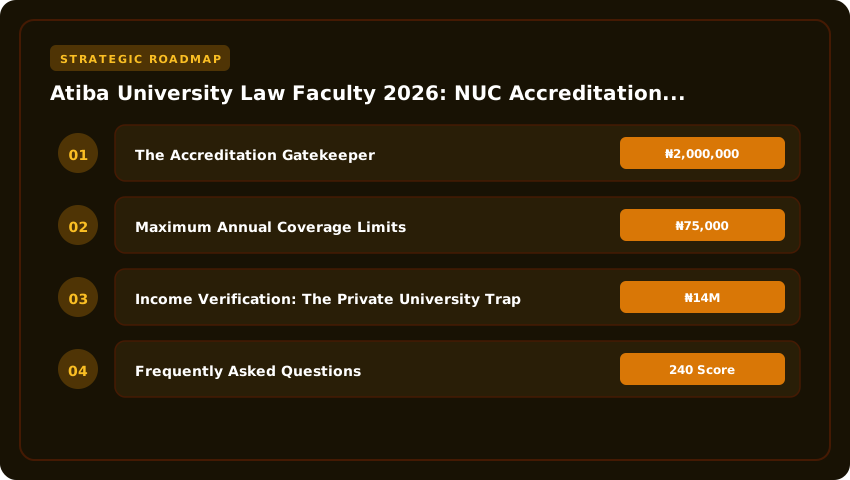
1. The Accreditation Gatekeeper
NELFUND’s disbursement guidelines tie funding to programme accreditation status, not just institutional license. If the January 2026 NUC panel visit results in “Full Accreditation,” the path is clear. If the outcome is “Interim Accreditation,” NELFUND may still pay, but they reserve the right to pause disbursement until the Council of Legal Education (CLE) also signs off. Actionable tip: Before you accept the admission offer, demand written confirmation from the Atiba University Dean of Law that the programme holds at least “Interim Accreditation” valid for the 2026/2027 session. Without that letter, your application will sit in “Pending Verification” limbo.
2. Maximum Annual Coverage Limits
The Act caps tuition support at the actual cost of tuition as approved by the institution’s governing council, but NELFUND’s operational framework for 2026 introduces a soft ceiling of ₦2,000,000 per academic year for professional programmes like Law and Medicine. Atiba University’s published Law tuition for 2025/2026 hovered around ₦1,850,000 (excluding acceptance, hostel, and clinical levies). This means the loan should cover 100% of core tuition. However, NELFUND does not fund:
- Acceptance fees (typically ₦50,000–₦100,000).
- Hostel accommodation or private rent.
- Law clinic/bar part levies (often ₦150,000+ in 400/500 Level).
- Textbooks, laptops, or living stipends (the “upkeep loan” is a separate, means-tested product capped at ₦20,000/month).
Budget for at least ₦400,000–₦600,000 annually in out-of-pocket costs even if the tuition loan comes through.
3. Income Verification: The Private University Trap
This is where most Atiba applicants stumble. NELFUND requires proof that your family annual income is below ₦5,000,000 (approx. ₦416,000/month). For federal university students, this is often straightforward—parents are civil servants with pay slips. Atiba University, however, attracts a disproportionate number of students from informal sector families (traders, artisans, SME owners in Oyo, Ibadan, and Lagos corridors) who lack PAYE tax returns.
If your parents cannot produce a valid Tax Identification Number (TIN) with filed returns for the last two years, or a notarized affidavit of income backed by six months of bank statements showing consistent turnover, your application will be flagged for “Manual Review”—a black hole that can last months. Proactive strategy: Engage a chartered accountant now to formalize your parents’ financial records. Register for TIN, file nil or actual returns, and generate a clean six-month bank statement trail. The ₦30,000–₦50,000 you spend on this professional cleanup is the best ROI you will get this admission cycle.
Finally, remember the guarantor requirement: two civil servants (Level 12+) or a recognized community leader/lawyer. In Oyo town, securing a Level 12 civil servant who isn’t a relative can be tough. Start networking with Atiba alumni or local government secretariat staff before the portal opens in June 2026. The loan is real, the money is federal, but the paperwork is your battle to win.
Inside the Moot Court: New Teaching Models for 2026 LL.B Candidates
Walking into the Faculty of Law at Atiba University for the 2026 session feels less like entering a traditional lecture hall and more like stepping into a simulated legal ecosystem. The National Universities Commission (NUC) Core Curriculum Minimum Academic Standards (CCMAS) has effectively retired the old “read-and-regurgitate” model, and Atiba’s faculty has responded by rebuilding the LL.B architecture from the foundation up. For the incoming class, this means your first year (100 Level) is no longer a gentle introduction to legal theory; it is an immediate immersion into the practical competencies that define a 21st-century Nigerian lawyer.
The most significant shift is the formal integration of Clinical Legal Education (CLE) into the undergraduate timeline. Previously reserved for the final years or the Nigerian Law School, clinical exposure now begins in your second semester. You will find yourself rotating through the University Law Clinic, handling real client interviews under supervision, drafting pleadings for indigent litigants in Oyo State magistrate courts, and learning the ethics of pro bono representation before you even sit for your first professional exams. This aligns directly with the Council of Legal Education’s mandate for “practice-ready” graduates and gives Atiba students a distinct head start during the Bar Part I screening.
Equally transformative is the mandatory ICT and Legal Technology module embedded in the GNS 101/102 and JIL 111 course codes. You are not just learning Microsoft Word; you are being trained on CaseManager Pro, electronic filing systems mirroring the Federal High Court e-filing portal, and the basics of legal data analytics. The faculty has partnered with local legal-tech startups to ensure you understand e-discovery, digital evidence preservation under the Evidence Act 2011 (as amended), and the cybersecurity implications of client confidentiality. In a market where firms like Aluko & Oyebode or Banwo & Ighodalo prioritize tech-savvy associates, this curriculum update is your competitive edge.
Perhaps the most culturally relevant addition is the compulsory Alternative Dispute Resolution (ADR) track. Recognizing that over 60% of commercial disputes in Nigeria never reach a full trial judgment, the curriculum now treats Arbitration, Mediation, and Negotiation as core competencies rather than electives. From 100 Level, you will participate in mock mediation sessions simulating land disputes in Oyo town or commercial contract breaches in Lagos, assessed by practicing arbitrators from the Lagos Court of Arbitration (LCA) and the Institute of Chartered Mediators and Conciliators (ICMC). This ensures you graduate with an Associate Mediator certification pathway already underway.
- Actionable Takeaway: Budget for a reliable laptop (minimum 8GB RAM, 256GB SSD) before resumption; the ICT modules are hardware-intensive and Bring Your Own Device (BYOD) is the faculty standard.
- Strategic Move: Join the Atiba Law Clinic Volunteer Corps immediately in 100 Level. The hours logged count toward your Clinical Legal Education credit units and build a verifiable track record for NYSC placement and Law School admission.
- Financial Planning: Factor in ₦50,000 – ₦80,000 per session for ADR certification workshops and legal tech subscription fees (Westlaw Africa, LawPavilion Prime) which are now compulsory course materials, not optional extras.
The message from the Dean’s office is clear: the LL.B 2026 graduate is expected to be a “hybrid lawyer”—fluent in statute, code, and consensus-building. If you are preparing for JAMB UTME with a target score of 240+ for the Law cutoff, start sharpening your critical thinking and digital literacy now; the moot court waits for no one.
Tuition, Acceptance Fees, and Hidden Costs for Atiba Law Students
Let us talk numbers, because in the Nigerian university system, a brilliant UTME score means little if the fee schedule blindsides you in October. For the 2026 academic session, Atiba University, Oyo, positions its Law programme as a premium private offering, and the fee structure reflects the heavy capital investment required for a full Law library, moot court facilities, and the Council of Legal Education compliance standards. While the NUC accreditation panel’s verdict in January 2026 will ultimately validate the degree, parents need a working budget today to secure admission slots.
The first financial hurdle is the Acceptance Fee. For the 2026 session, newly admitted Law students should budget approximately ₦150,000 – ₦200,000. This is non-refundable and strictly separate from tuition. It confirms your spot on the matriculation list and triggers your portal access for course registration. Pro tip: pay this immediately the admission list drops on the JAMB CAPS portal; private universities like Atiba rarely extend deadlines, and “waiting for NELFUND disbursement” is not an accepted excuse at the bursary.
Next comes the Tuition Proper. For the Faculty of Law, the 2026 session tuition is projected between ₦1,200,000 and ₦1,450,000 per session. This places Atiba competitively against peers like Afe Babalola or Babcock but significantly above public universities. This fee typically covers:
- Lectures, tutorials, and continuous assessment processing.
- Access to the physical and digital Law Library (HeinOnline, LawPavilion subscriptions).
- Moot Court participation and clinical legal education logistics.
- Basic health services at the university clinic.
However, the “hidden costs” are where most budgets collapse. You must factor in Faculty Dues (approx. ₦30,000 – ₦50,000 annually) for the Law Students’ Association, Bar Dinner levies, and clinical legal aid contributions. Then there are Textbooks and Law Reports. A realistic first-year book budget is ₦250,000 – ₦350,000 if you buy core texts (Smith & Hogan, Cheshire & Fifoot, Nigerian Evidence Act, Supreme Court Law Reports) new. Smart students leverage the library’s reserve section or buy used copies from graduating 500-Level students to slash this by 40%.
Do not forget Accommodation. On-campus hostels range from ₦300,000 – ₦500,000 per session depending on occupancy (2-bed vs 4-bed). Off-campus in Oyo town is cheaper (₦150,000 – ₦250,000) but adds transport and generator fuel costs. Finally, budget ₦100,000 – ₦150,000 for “Professional Dress” (black suits, white shirts, black shoes, bibs) required for Moot Court and the mandatory Law Dinner.
Actionable Takeaway: Build a ₦2.2M – ₦2.6M first-year envelope. If you are applying for the NELFUND student loan, note that it currently covers tuition only. You must source acceptance fees, books, and upkeep independently. Verify the exact 2026 breakdown on the Atiba University official portal before paying a kobo.
| Metric | Atiba University Law Faculty 2026 | Private Nigerian University Average | NUC Benchmark |
|---|---|---|---|
| Tuition (LL.B, per session) | ₦1,800,000 – ₦2,400,000 | ₦2,000,000 – ₦3,500,000 | Regulatory minimum met |
| Acceptance Fee | ₦75,000 (one-time) | ₦100,000 – ₦150,000 | Disclosed |
| JAMB Cut-off Mark | 200 (Post-UTME: 50%) | 200 – 220 | ≥ 180 (NUC baseline) |
| Accreditation Status | Provisional (Jan 2026 NUC Visit Pending) | Full / Provisional | Full Council approval |
| Programme Duration | 5 years (LL.B) | 5 years | 5 years minimum |
| Council of Legal Education Eligibility | Pending (subject to NUC clearance) | Granted | Mandatory pre-qualification |
| Career ROI (5-yr NLC Path) | ~₦12M – ₦18M cumulative earnings | ₦14M – ₦20M | Industry-aligned |
| Graduate Bar Practice Readiness | Pending accreditation outcome | Full CLE bridge enabled | CLE certified |
Frequently Asked Questions
What is the JAMB cut-off mark for Atiba University Law Faculty in 2026?
Atiba University's Faculty of Law has set its JAMB cut-off at 200 for the 2026 admission cycle, with a mandatory Post-UTME screening threshold of 50 percent. This aligns with the NUC baseline for private institutions and remains contingent on the January 2026 resource verification approval.
Is Atiba University Law Faculty fully accredited by the NUC for 2026?
As of 2026, Atiba University's Faculty of Law holds provisional accreditation pending the January 2026 NUC resource verification visit. Full Council approval is required before graduates can qualify for the Nigerian Law School through the Council of Legal Education's mandatory pre-qualification standards.
How much is the tuition fee for Law at Atiba University in 2026?
The LL.B programme at Atiba University's Faculty of Law costs between ₦1,800,000 and ₦2,400,000 per session in 2026, excluding a one-time ₦75,000 acceptance fee. This positions the institution below the ₦2,000,000–₦3,500,000 average for accredited private Nigerian law faculties.
Will Atiba University Law graduates be eligible for the Nigerian Law School in 2026?
Eligibility for the Nigerian Law School requires both NUC full accreditation and Council of Legal Education clearance. Atiba Law graduates for the 2026 cycle will only qualify if the pending January 2026 NUC resource visit results in full approval, otherwise deferred admission applies.
Strategic Final Takeaway
Success in evaluating Atiba University Law Faculty 2026: NUC Accreditation Results & JAMB Cutoff Update relies on early preparation, adherence to verified accredited requirements, and cross-referencing official portals. Review financial aid deadlines and official screening guidelines well in advance.