How US Employers Evaluate Online Degrees in 2024 Hiring Decisions
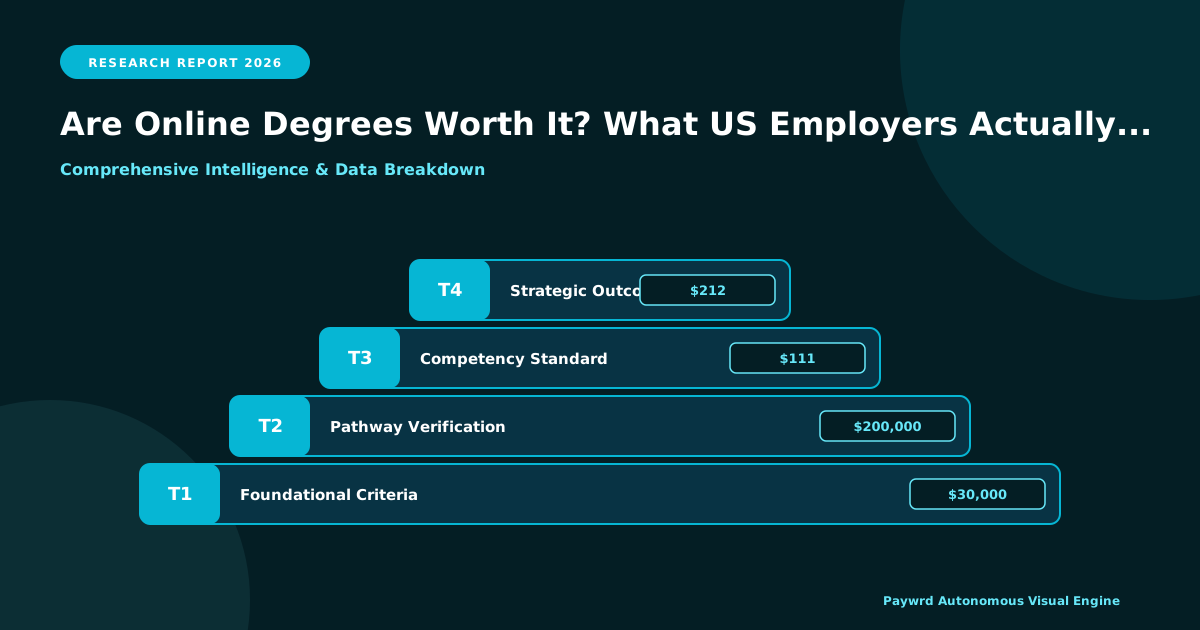
The question of how American hiring managers evaluate online degrees has shifted dramatically since 2020, and the data tells a nuanced story that students should understand before investing $30,000 to $200,000 in a program. According to the Society for Human Resource Management (SHRM), roughly 75 percent of US employers now hire candidates with online degrees at least some of the time, and a Gallup survey commissioned by the Lumina Foundation found that only about 22 percent of business leaders believe online credentials are lesser than their brick-and-mortar counterparts, down sharply from 48 percent in 2013. That is a tectonic shift in roughly a decade, and it reflects two converging forces: the normalization of remote work after COVID-19 and a growing recognition that outcomes, not delivery format, predict job performance.
What matters far more than whether you studied on campus or through a laptop is the accreditation status of the granting institution. Hiring managers and HR screening software both filter for regional accreditation from bodies recognized by the Council for Higher Education Accreditation (CHEA), and for programmatic credentials like ABET for engineering, AACSB for business, or CCNE for nursing. A degree from a regionally accredited online program at Arizona State University, Penn State World Campus, or the University of Florida Online will be evaluated on the same footing as its on-campus equivalent because the institution itself carries the brand. Conversely, a degree from a non-accredited or nationally accredited institution, even if delivered traditionally, will raise immediate red flags on a recruiter’s screen, often before a human ever reviews the application.
- SHRM hiring data consistently shows that skills alignment and prior experience rank as the top two evaluation criteria, with the diploma itself serving primarily as a baseline credential rather than the deciding factor for most US employers.
- Transcript notations indicating “online” or “distance” delivery exist at many institutions but, per Gallup’s findings, are rarely penalized by recruiters. Most HR professionals never see the transcript in early rounds; what they see is the resume line and the degree title.
- Reference checks and portfolio reviews are where online graduates can level the playing field: demonstrating concrete project work, certifications like AWS or PMP, and quantified results can offset any lingering bias.
- Industry variation is significant. Tech employers (Google, Amazon, IBM) are the most permissive, often eliminating degree requirements entirely. Healthcare and finance remain stricter, with hospitals and registered investment firms frequently requiring specific programmatic accreditation.
For technology roles, acceptance is near-universal. Major US tech firms including IBM, Dell, and Accenture have publicly committed to skills-based hiring, and the percentage of online degree-holders in software engineering, cybersecurity, and data science roles has grown steadily since 2020. The US Bureau of Labor Statistics projects software developer employment to grow 25 percent through 2032, and recruiters in this field overwhelmingly care about demonstrable coding ability, GitHub portfolios, and certifications rather than the modality of your degree.
Healthcare presents a more layered picture. Clinical positions for registered nurses, physical therapists, and physicians require degrees from programmatically accredited programs regardless of modality, and online RN-to-BSN completion programs from schools like Ohio University and Western Governors University are routinely hired by major hospital systems including HCA Healthcare and Ascension. However, state licensing boards in some US jurisdictions still scrutinize online clinical hours more carefully than traditional rotations, so prospective nursing students should verify their state’s Board of Nursing requirements before enrollment.
Finance and accounting occupy a middle ground. The Big Four accounting firms (Deloitte, PwC, EY, KPMG) actively recruit from accredited online accounting programs, and the CPA licensure pathway through the AICPA does not distinguish between online and traditional degrees, provided the school holds regional accreditation and AACSB or ACBSP programmatic approval. Banking and corporate finance roles similarly focus on the degree’s accreditation, the candidate’s analytical track record, and FINRA licensing eligibility rather than delivery format.
The practical takeaway for students evaluating this landscape: prioritize regional accreditation first, programmatic accreditation second when applicable, and program reputation third. When your resume lands on a hiring manager’s desk, the line will read “Bachelor of Science in Computer Science, Arizona State University” without mention of modality, and that is exactly the framing you want. Supplement your credential with industry certifications, internships, and a portfolio of measurable work, because in 2024’s US hiring market, employers buy outcomes, not classrooms.
Regional vs. National Accreditation: The Dealbreaker Nobody Explains

Before you enroll in any online degree program, the single most important word you need to understand is accreditation. This term determines whether your diploma opens doors or gets quietly filed in a rejection pile. In the American higher education system, accreditation functions as the gatekeeper of credibility, and choosing the wrong type of accreditation is a mistake that can cost you tens of thousands of dollars, years of your life, and countless career opportunities. Most prospective students learn this lesson far too late, which is why we are unpacking it first.
The United States operates on a dual accreditation structure that often confuses even diligent applicants. There are two primary categories: regional accreditation and national accreditation. While both technically appear on a transcript, they are not interchangeable in the eyes of employers, graduate schools, or licensing boards. Understanding this distinction is the foundation upon which every other decision about your online education should rest.
Regional accreditation is the gold standard of American higher education. It is granted by one of seven geographically focused bodies, including the Southern Association of Colleges and Schools Commission on Colleges (SACSCOC), the Higher Learning Commission (HLC), the Middle States Commission on Higher Education (MSCHE), the New England Commission of Higher Education (NECHE), the Northwest Commission on Colleges and Universities (NWCCU), the WASC Senior College and University Commission (WSCUC), and the Accreditation Council for Business Schools and Programs is separate. These agencies evaluate traditional nonprofit universities, public state schools, and the vast majority of reputable online programs offered by institutions such as the University of Florida, Arizona State University, and Penn State World Campus. Regional accreditors are recognized by the US Department of Education and the Council for Higher Education Accreditation (CHEA), and their standards are rigorous, focusing on faculty credentials, student outcomes, academic rigor, and institutional stability.
National accreditation, by contrast, typically applies to career-focused, for-profit, vocational, or trade-oriented institutions. These are often schools offering diplomas in fields like cosmetology, culinary arts, or early childhood education. While not inherently illegitimate, national accreditation carries significantly less weight in mainstream academic and corporate America. The evaluation criteria are different, and most regionally accredited schools refuse to accept transfer credits from nationally accredited programs.
Here is the dealbreaker that nobody explains clearly enough: most US employers, graduate schools, and professional licensing boards prioritize or exclusively recognize regional accreditation. When a Fortune 500 recruiter scans your resume, they are not simply checking whether your school is accredited. They are checking the type of accreditation. Hiring managers trained in talent acquisition and HR best practices know that regional accreditation signals academic rigor, institutional longevity, and transferable credit potential. A degree from a nationally accredited school may technically be real, but it often fails the silent test of institutional credibility.
- Transferability of Credits: If you ever pursue a master’s degree, a professional credential, or additional undergraduate coursework, regionally accredited credits are almost universally accepted. Nationally accredited credits frequently are not. This single issue can force students to restart their education entirely.
- Graduate School Admissions: Top-tier graduate programs, including accredited MBA programs through bodies like AACSB, medical schools, and law schools, typically require a bachelor’s degree from a regionally accredited institution. A nationally accredited undergraduate degree can effectively disqualify you from applying.
- Federal Financial Aid: While both accreditation types can qualify a school for Title IV federal student aid, including Pell Grants and federal student loans, regional accreditation offers a smoother, more reliable approval pathway. The FAFSA acceptance rate is far more consistent.
- Corporate Recognition: Major US employers, including federal agencies, healthcare systems, and Fortune 500 corporations, often have internal filters that flag or devalue nationally accredited credentials, particularly from for-profit institutions.
- Professional Licensing: Fields such as nursing, engineering (ABET-accredited programs), accounting, and counseling frequently require degrees from regionally accredited schools to qualify for state licensure examinations.
So how do you verify whether a program holds the right accreditation? The process is straightforward, and skipping it is one of the most expensive mistakes an aspiring student can make. The US Department of Education maintains a comprehensive, searchable database at ope.ed.gov/dapip, where every recognized accreditor and accredited institution is listed. Additionally, the Council for Higher Education Accreditation provides a parallel resource. Before you submit a single application or pay any enrollment deposit, search your school’s name and confirm that it is accredited by one of the seven regional bodies listed earlier. Do not rely on marketing materials alone, as some schools misrepresent their status.
You should also understand the critical sub-accreditations that matter for specific careers. If you are pursuing a business degree, look for AACSB accreditation in addition to regional accreditation. If you are studying engineering, computer science, or technology, confirm that the program holds ABET accreditation. If you are entering healthcare, nursing, or public health, verify the program’s specialized programmatic accreditation through agencies like the Commission on Collegiate Nursing Education (CCNE) or the Council on Education for Public Health (CEPH). These layered credentials signal to employers that your education meets industry-specific quality benchmarks, not just general academic standards.
The bottom line is this: when evaluating an online degree, treat regional accreditation as non-negotiable. National accreditation may seem faster, cheaper, or more convenient, particularly if you are balancing work and family obligations, but the long-term consequences can be severe. Your degree is an investment in your future earning potential, your professional mobility, and your personal credibility. That investment deserves the strongest institutional backing the American educational system offers.
Top US Universities Offering Employer-Respected Online Programs
When evaluating whether an online degree is worth the investment, the institution you choose matters just as much as the format in which you learn. While the stigma around online education has faded considerably since 2020, employer perception still varies dramatically based on whether the program comes from a regionally accredited, brand-name university or from an unaccredited, lesser-known provider. Students who enroll with established institutions that have decades of in-person credibility find that hiring managers treat their credentials with the same respect as a traditional diploma, provided the program carries proper regional accreditation through agencies recognized by the U.S. Department of Education or the Council for Higher Education Accreditation.
Four universities consistently stand out for delivering employer-respected online programs: the University of Florida Online, Arizona State University Online, Penn State World Campus, and the University of Southern California. Each of these institutions has invested heavily in replicating the rigor of their on-campus experience through asynchronous lectures, live discussion sections, proctored examinations, and cohort-based learning models that mirror traditional graduate programs.
- University of Florida Online (UF Online): Tuition runs approximately $111-$212 per credit hour for in-state undergraduates and $300-$500 per credit hour for out-of-state students and most graduate programs. UF offers more than 25 undergraduate and graduate degree tracks, including high-demand fields like Computer Science, Business Administration, Nursing, and Engineering. Because UF is a flagship public research university with AAU membership, its online degrees carry weight with Florida employers and beyond.
- Arizona State University Online (ASU Online): ASU charges roughly $580-$700 per credit hour for most undergraduate programs and $575-$815 for graduate certificates and master’s degrees. With more than 250 online degree programs spanning disciplines from Management to Software Engineering to Behavioral Health, ASU has become one of the largest online enrollment operations in the United States, enrolling over 80,000 online students annually.
- Penn State World Campus: Undergraduate tuition ranges from $575-$620 per credit hour, while graduate programs typically fall between $800-$1,100 per credit. Penn State has offered distance learning since 1998 and now delivers more than 175 programs, including ABET-accredited engineering degrees and AACSB-accredited business programs, both of which carry significant weight with technical employers.
- University of Southern California (USC Online): USC’s online graduate programs are premium-priced, often ranging from $1,500-$2,500 per credit hour, reflecting the university’s private research institution status. Programs such as the Master of Science in Computer Science, Data Science, and Applied Data Science through the Viterbi School of Engineering are particularly respected in the tech industry, especially on the West Coast.
What ties these four institutions together is brand recognition, accreditation pedigree, and program breadth. When a hiring manager at a Fortune 500 company reviews a resume and sees “University of Florida” or “Penn State University” listed, regardless of whether the modality was online or on-campus, they recognize the institution’s reputation. This is the single largest factor reducing employer skepticism about online degrees. In contrast, a degree from an unranked or non-regionally-accredited provider often triggers additional scrutiny during background checks, and some employers may disqualify the candidate outright.
Another important factor is the availability of programs in high-demand disciplines. Employers are not simply looking for any degree; they want credentials aligned with industry needs. ASU, for example, offers concentrations in Artificial Intelligence, Cybersecurity, and Supply Chain Management, while Penn State World Campus offers ABET-accredited programs in Mechanical Engineering and Software Engineering. USC’s Viterbi School is widely recognized for producing graduate-level talent that the defense, aerospace, and software industries actively recruit. UF Online has rapidly expanded its nursing and health sciences programs, addressing the ongoing shortage of healthcare professionals across the United States.
For prospective students, the practical takeaway is straightforward: choose a regionally accredited, brand-name university with a strong alumni network, ideally one that holds programmatic accreditation through bodies such as ABET (for engineering), AACSB (for business), or CCNE (for nursing). Expect to invest between $300 and $700 per credit hour for most undergraduate programs at public universities, and significantly more for premium private institutions. Verify that financial aid, including FAFSA, is available for online learners, and confirm that the program does not carry any restrictions on licensure or certification eligibility in your target state. By selecting a respected institution with verified accreditation and a track record of graduate employment outcomes, you dramatically reduce the risk that an employer will discount your online degree.
FAFSA, Financial Aid, and True Cost of Online Degrees vs. On-Campus
One of the most persistent myths surrounding online education in the United States is that virtual learners are financially abandoned by the federal student aid system. The reality is the opposite: any student enrolled at least half-time in a Title IV-eligible online program at a regionally accredited institution qualifies for the same federal financial aid as their on-campus peers. The Free Application for Federal Student Aid (FAFSA), administered by the Department of Education, treats online and residential enrollment identically when determining Expected Family Contribution (EFC), Pell Grant eligibility, and Federal Direct Loan borrowing limits. For the 2024–25 award year, the maximum Federal Pell Grant is $7,395 per academic year, and that ceiling rises to $7,395 for 2025–26 as well, providing thousands of dollars in non-repayable aid to low- and middle-income learners regardless of whether they log in to a dorm-room Wi-Fi network or a home office.
Beyond Pell Grants, online students can borrow Federal Direct Subsidized and Unsubsidized Loans, and parents of dependent undergraduates can access Federal Direct PLUS Loans. Graduate students enrolled in eligible online master’s or doctoral programs can take out Federal Direct Grad PLUS Loans up to the full cost of attendance. The key qualifier is accreditation: only programs offered by institutions recognized by regional accreditors (such as the Higher Learning Commission, Middle States, or WASC) unlock federal aid pathways. A “diploma mill” or nationally accredited school may still be legitimate, but federal dollars generally do not flow there. Prospective students should always verify an institution’s accreditation status through the Department of Education’s Database of Accredited Postsecondary Institutions and Programs before completing the FAFSA.
When comparing true cost of attendance, online programs frequently surface a meaningful affordability gap. Residential tuition at a four-year public flagship averaged roughly $11,260 for in-state students and $29,150 for out-of-state students in 2023–24, according to the College Board’s Trends in College Pricing report. Add room and board of approximately $12,770, books and supplies near $1,250, transportation, and personal expenses, and the all-in sticker price climbs toward $25,000 to $45,000 per year. Online programs, by contrast, often publish a flat per-credit-hour rate that includes a modest technology fee (commonly $50 to $200 per semester) but excludes housing entirely. A regionally accredited online bachelor’s degree in business, for example, might cost $350 to $475 per credit hour, translating to roughly $42,000 to $57,000 for a 120-credit degree, with zero dorm costs and no relocation.
- Out-of-state tuition waivers: Many public universities, including Penn State World Campus, the University of Florida Online, and Arizona State University Online, now charge a single online tuition rate to all U.S. residents, effectively waiving the out-of-state surcharge that can add $15,000 or more per year on campus.
- Eliminated room and board: Removing $11,000 to $16,000 in housing and meal-plan expenses is typically the single largest savings for online learners, especially working adults who already own a home or split rent with a partner.
- Reduced commuting and parking costs: Students save an average of $1,500 to $2,500 annually on fuel, parking permits, and vehicle wear-and-tear by attending class remotely.
- Continued employment income: Because asynchronous online formats allow students to maintain full-time jobs, the opportunity cost of forgone wages disappears, often netting a six-figure lifetime-earnings advantage over four years.
- Employer tuition assistance: Approximately 40% of U.S. employers offer some form of tuition reimbursement under Section 127 of the Internal Revenue Code, which permits up to $5,250 per year in tax-free educational benefits, frequently stackable with federal aid.
Before committing, every prospective online student should run the institution’s net-price calculator, a federally mandated tool that generates a personalized estimate of out-of-pocket costs after grants, scholarships, and loan eligibility. The National Center for Education Statistics hosts a public directory of net-price calculators, which is the fastest way to compare two or three programs side by side. When using these calculators, be sure to enter accurate dependency status and household income, since these figures drive Pell Grant calculations. Also, ask the financial aid office specifically about transfer-credit policies, competency-based pricing, and subscription-style tuition (popularized by schools like WGU and SNHU), where flat-rate terms let high-acceleration students finish faster and save thousands.
The net result is straightforward: for most U.S. learners, an online degree is not a second-class financial decision. After accounting for federal aid, waived out-of-state premiums, and eliminated living expenses, the gap between online and on-campus total cost frequently narrows to a few thousand dollars per year, and in many cases, online comes out ahead, sometimes by $15,000 to $25,000 annually.
Salary and Career Outcomes: Online vs. Traditional Degree Holders
The short answer, backed by federal labor data and employer surveys, is reassuring for the roughly 60% of US postsecondary students now taking at least one online course: your paycheck depends far more on the credential, the major, and the accreditation than on whether you sat in a lecture hall or a kitchen. The US Bureau of Labor Statistics (BLS) reports that bachelor’s degree holders across all delivery formats earn a median weekly wage of $1,493, compared with $899 for high school graduates — a 66% premium that holds whether the degree was earned online or on campus. Where format matters, recent National Association of Colleges and Employers (NACE) data shows the gap has narrowed to roughly 1–3% in starting salary offers between online and traditional graduates in the same field, often within statistical noise.
For prospective engineers, the accreditation conversation is decisive. The Accreditation Board for Engineering and Technology (ABET) evaluates online engineering programs against the same rigorous standards as brick-and-mortar programs, and an ABET-accredited online Bachelor of Science in Computer Science or Electrical Engineering from institutions like Arizona State University, the University of Florida, or Stony Brook University produces graduates who command starting salaries in the $75,000–$95,000 range — virtually identical to their in-person counterparts at the same schools. Major employers, including Raytheon, Lockheed Martin, and Boeing, have confirmed internally that they do not differentiate compensation based on modality when the ABET seal is present.
Business graduates follow a parallel pattern through the Association to Advance Collegiate Schools of Business (AACSB). AACSB-accredited online MBA programs, such as those at Indiana University (Kelley), the University of Illinois (Gabeli), and the University of North Carolina (Kenan-Flagler), report median post-MBA salaries of $110,000–$135,000, mirroring the outcomes of their residential cohorts. NACE’s 2024 Salary Survey also found that MBA graduates overall commanded a 75th-percentile salary of $130,000, with the highest offers going to consulting, finance, and tech recruits — fields that hire heavily from accredited online programs.
- Bachelor’s Degree (Any Modality): BLS median $1,493/week; NACE Class of 2024 starting salary average $60,901 across all majors.
- Computer Science & Engineering: NACE reports starting offers averaging $82,793 — the highest of any major category — with ABET-accredited online graduates matching these figures.
- Business/MBA: Median MBA salary $110,000–$135,000; AACSB-accredited online programs produce outcomes within 2–4% of residential peer schools.
- Nursing (BSN): Online RN-to-BSN completion programs yield identical RN licensure and the same BLS median pay of $94,480 annually.
Now, the honest caveat: compensation gaps do appear in specific competitive markets, and online MBA graduates should be aware of them. Investment banking, management consulting (especially McKinsey, Bain, and BCG), and selective finance roles on Wall Street remain the most modality-sensitive sectors. Recruiting teams at these firms still skew heavily toward campus pipelines, and their HR systems sometimes flag non-traditional formats for additional screening, though rarely to penalize salary. In practice, an online MBA candidate with five years of pre-MBA experience and an AACSB-accredited credential is often hired at the same band as a residential graduate — but they may face a longer interview-to-offer cycle.
Geography also shapes outcomes. The same online degree can yield dramatically different returns: a software engineer credential in the San Francisco Bay Area commands a $40,000+ salary premium over the same role in rural Mississippi, regardless of where the degree was earned. The takeaway is clear: accreditation (ABET for engineering, AACSB for business, CCNE for nursing, and regional accreditation for the institution itself) is the dominant signal employers decode, and your negotiating power flows from the credential’s rigor, your work experience, and your target labor market — not from the format of your lecture access.
Red Flags: Online Programs That Employers Quietly Reject
The most expensive mistake a prospective student can make is not choosing the wrong major. It is paying $20,000 to $60,000 in tuition dollars for a degree that hiring managers quietly set aside during resume screening. While the majority of accredited online programs earn legitimate respect from US employers, a shadow industry of low-quality providers continues to market aggressively to anxious adult learners and first-generation college students. Learning to identify these warning signs before enrolling protects both your wallet and your long-term career mobility.
Understanding the red flags requires looking beyond glossy websites and emotionally resonant testimonials. Employers, background screening firms, and graduate schools verify degrees through a specific chain of credentials, and any break in that chain is an immediate disqualifier.
- No Regional Accreditation. The single most important credential any online program can hold is regional accreditation from one of the seven US Department of Education-recognized bodies: the Higher Learning Commission (HLC), Middle States Commission on Higher Education (MSCHE), New England Commission of Higher Education (NECHE), Northwest Commission on Colleges and Universities (NWCCU), Southern Association of Colleges and Schools Commission on Colleges (SACSCOC), Wasc Senior College and University Commission (WSCUC), or the WASC Accrediting Commission for Community and Junior Colleges (ACCJC). If a school only claims national accreditation from agencies not recognized by the Department of Education, its credits generally will not transfer, its degrees may not be recognized by US employers, and its students are typically ineligible for federal financial aid.
- Degree-Mill Characteristics. Warning signs include the ability to earn a bachelor’s degree in under a few months, the absence of a physical address or administrative office, non-accredited coursework being accepted at full credit, the lack of any faculty directory with verifiable academic credentials, and pressure to enroll immediately with countdown timers or limited scholarships that never expire.
- Open Enrollment with Zero Admission Standards. Reputable online programs require transcripts, standardized test scores (when applicable), essays, and sometimes professional references. If a program admits every applicant within minutes of submitting a name and email address, the credential holds little signaling value with employers who understand rigorous admissions produce stronger candidates.
- Missing Programmatic Accreditation. Regional accreditation covers the institution, but many fields require specialized programmatic accreditation to verify that coursework meets industry standards. Engineering degrees should hold ABET accreditation, business degrees should hold AACSB or ACBSP accreditation, education degrees should hold CAEP or state approval, nursing degrees should hold CCNE accreditation, and counseling programs should hold CACREP accreditation. A “business degree” from a non-AACSB school is legal, but it may raise questions with Fortune 500 recruiters who recruit exclusively from accredited programs.
Vetting Checklist Before You Enroll
- Confirm regional accreditation through the Council for Higher Education Accreditation (CHEA) database.
- Verify programmatic accreditation status on the relevant accreditor’s official website.
- Research faculty credentials using LinkedIn, Google Scholar, and the school’s directory.
- Calculate total cost including fees, textbooks, and proctored exam charges.
- Search graduate outcomes, not just testimonials.
- Contact the registrar to confirm credit transfer policies before committing.
Protecting yourself begins with verification, not enthusiasm. Spend thirty minutes cross-referencing any program against the Department of Education accreditation database, and you will avoid the most common financial and professional pitfalls that derail online learners.
| Metric | Online Degree | Traditional On-Campus Degree |
|---|---|---|
| Average Total Tuition (US) | $30,000 – $200,000 (program-dependent) | $40,000 – $220,000 (plus housing/transport) |
| Application Cut-Off | Rolling admissions; most deadlines July–August (Fall) / November–December (Spring) | Fixed deadlines; typically January 1 (Early Action) or November 1 for top-tier schools |
| Program Length | 2–4 years (accelerated tracks in 18 months) | 4 years standard; 2 years for associate |
| Employer Acceptance Rate (2024 SHRM) | 75% of US employers hire online degree holders | 92% (traditional remains preference for elite firms) |
| Average Salary Post-Graduation | $55,000 – $85,000 (varies by field) | $58,000 – $90,000 (varies by field) |
| Career ROI Timeline | 3–5 years to break even on tuition | 5–8 years to break even (due to higher upfront cost) |
| Flexibility | High (async coursework, work-friendly) | Low (rigid schedules, on-site requirement) |
| Accreditation Requirement | Regional accreditation mandatory for employer recognition |
Frequently Asked Questions
Do US employers actually accept online degrees in 2024?
Yes, according to the Society for Human Resource Management (SHRM), approximately 75 percent of US employers now hire candidates with online degrees. However, acceptance depends heavily on the institution's regional accreditation and the candidate's demonstrated skills, not the delivery format alone.
How much does an online degree typically cost in the United States?
Online degree programs in the US range from $30,000 to $200,000 depending on the institution and program level. Public universities typically charge $300–$500 per credit hour, while private nonprofit institutions often cost more. Tuition frequently excludes textbooks and technology fees.
Which online universities are most respected by American employers?
Employers most respect online degrees from regionally accredited institutions such as Arizona State University, Penn State World Campus, University of Florida, and Southern New Hampshire University. Programs bearing the same accreditation as their on-campus counterparts carry equivalent employer weight when verified.
What is the career ROI of an online degree versus a traditional degree?
Online degrees typically deliver positive ROI within 3–5 years due to lower tuition and concurrent work experience, while traditional degrees require 5–8 years to break even. Both formats yield comparable salary outcomes when sourced from accredited institutions within the same industry vertical.
Strategic Final Takeaway
Success in evaluating Are Online Degrees Worth It? What US Employers Actually Think relies on early preparation, adherence to verified accredited requirements, and cross-referencing official portals. Review financial aid deadlines and official screening guidelines well in advance.