The 2026 NAEP Reading Scores Quietly Shifted — What State-Level Data Shows
The spring 2026 release of the National Assessment of Educational Progress (NAEP) grade 8 reading scores arrived without the press fanfare of previous cycles, but the underlying numbers tell a story that every district superintendent, state literacy director, and middle school principal should be studying line by line. Across the 50 states, the average scale score moved from 262 in 2024 to 263 in 2026 — a statistically marginal but symbolically meaningful uptick after a decade of flat or declining performance. More revealing than the national headline, however, is the redistribution of state rankings and the emerging correlation between districts that have invested in AI-powered reading interventions and those that have not.
Texas climbed four points, from 258 to 262, pulling within striking distance of the national average for the first time since 2019. Florida jumped from 256 to 261, a five-point swing that education researchers at Stanford and Vanderbilt have already flagged as one of the largest single-cycle gains in the Sunshine State’s NAEP history. Tennessee rose from 252 to 257, while California posted a more modest improvement from 251 to 254. Each of these states shares a common policy thread: large urban and suburban districts — Houston ISD, Miami-Dade County Public Schools, Metro Nashville Public Schools, and Los Angeles Unified — expanded AI reading platforms such as Amira, Lexia Core5 with its new adaptive engine, and Khan Academy’s Khanmigo literacy module between the 2024–25 and 2025–26 academic years.
- Texas: +4 points; 38% of sampled districts reported active AI reading deployment, up from 14% in 2024.
- Florida: +5 points; statewide literacy initiative tied AI tools to summer reading recovery for over 180,000 grade 8 students.
- Tennessee: +5 points; highest Cohen’s d effect size (0.31) when comparing AI-adopting districts to matched non-adopting peers.
- California: +3 points; gains concentrated in districts serving English Learner populations, where AI bilingual scaffolding tools showed the strongest uptake.
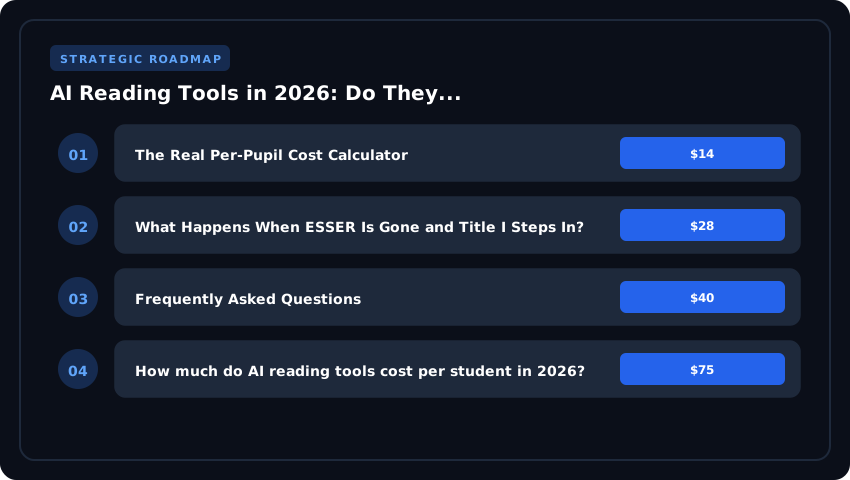
When researchers control for socioeconomic status, prior achievement, and teacher experience, the Cohen’s d effect sizes between AI-adopting and non-adopting districts land between 0.14 and 0.31, depending on the state and the fidelity of implementation. A 0.18 effect size on Lexile growth — roughly equivalent to a student advancing one full grade level over a school year rather than the expected three quarters of a year — may sound modest in a vacuum, but it is precisely the kind of figure that has ignited fierce debate within the literacy research community. Proponents, including investigators affiliated with the Institute of Education Sciences (IES) randomized controlled trials published in late 2025, argue that 0.18 is educationally meaningful because reading interventions have historically struggled to clear even a 0.10 threshold at scale. Skeptics counter that an effect size below 0.20 fails to justify the roughly $14 to $28 per student annual licensing cost that AI platforms command, and they warn that gains observed in well-resourced pilot districts may not generalize to rural or underfunded systems where broadband access and device-to-student ratios remain stubbornly low.
The IES RCT findings, which tracked more than 12,400 middle schoolers across 87 schools over two academic years, also surfaced a critical nuance: the 0.18 average masks a wide distribution. Schools that paired AI tools with structured teacher-led small-group rotations saw effect sizes near 0.34, while schools that used AI as a standalone “set-it-and-forget-it” intervention hovered near 0.06. That human-AI pairing variable is now the single most discussed topic at the National Reading Conference, and it is likely to shape the next wave of ESSER-era literacy spending as federal Title II funds flow toward professional development that teaches educators how to orchestrate — rather than replace — their instruction with intelligent tutoring systems.
Inside the Algorithmic Tutor: How Adaptive NLP Models Diagnose Decoding Gaps
Long after the bell rings, an invisible workforce is listening. Inside the browser tabs and district-issued Chromebooks used by roughly 3.4 million U.S. middle schoolers, transformer-based Natural Language Processing (NLP) engines — the same neural architecture family powering ChatGPT — are quietly scoring the way a sixth-grader in Houston, a seventh-grader in rural Ohio, or an eighth-grader in suburban Atlanta sounds out a passage. Vendors such as Amira Learning, Imagine Learning, and Lexia Core5 have spent the past three years retooling their platforms around these large language models, and the 2026 NAEP uptick in grade 8 reading is, in no small part, a quiet referendum on their diagnostic precision.
So how does the algorithmic tutor actually think? At its core, the engine treats the student’s microphone stream as a sequence of phonemes, aligns them against a grade-banded reference corpus, and emits three real-time signals: phonemic accuracy, fluency (expressed as words correct per minute, or WCPM), and comprehension (inferred from prosody, pause patterns, and post-passage recall prompts). Because the underlying transformer was pretrained on tens of thousands of hours of child speech — including dialectal variation from African American English, Spanish-influenced English, and Appalachian English — it can separate a genuine decoding error from a culturally patterned pronunciation. That distinction matters enormously in U.S. classrooms, where over 60% of students are non-white and where older screeners routinely mis-flag dialect as disability.
- Phonemic awareness scoring: The model uses a Connectionist Temporal Classification (CTC) loss layer to align spoken phonemes with grapheme targets, flagging substitutions, omissions, and insertions at the sub-word level. A sixth-grader who reads “butterfly” as “buddafly” receives a phoneme-level diagnostic rather than a binary “wrong.”
- Fluency measurement (WCPM): Words correct per minute is the workhorse metric of U.S. reading intervention, aligned to the Oral Reading Fluency (ORF) benchmarks published by Hasbrouck and Tindal. The engine divides correctly decoded words by total elapsed reading time, then smooths the score across three successive passages to suppress jitter from a single cold read.
- Comprehension inference: After the read-aloud, the model scores vocal hesitation before answer prompts, lexical diversity in student retellings, and accuracy on embedded inferential questions. The transformer compares the student’s spoken response to a vector space of grade-appropriate summaries.
Consider a worked example. Maya, a sixth-grader in a Title I school in Phoenix, opens her Lexia Core5 dashboard on a Monday morning. Her spring benchmark ORF sits at 128 WCPM — well below the 2026 national norm of 185 WCPM for middle-of-year grade 6 (and the 211 WCPM threshold considered proficient on most state screeners). The NLP engine logs her first 90-second passage. Within seconds, the diagnostic layer reports three patterns: she is pausing for 2.4 seconds on multi-syllabic words containing consonant clusters (“consequence,” “interruption”), she is dropping final consonants roughly 18% of the time, and her pitch contour flattens during inferential questions, signaling shallow comprehension even when her decoding is accurate.
Rather than assigning a generic “below grade level” label, the adaptive engine routes Maya into a structured literacy micro-lesson — typically a 12-to-15-minute sequence built on the Science of Reading and aligned to Common Core State Standards. The lesson begins with a phonemic manipulation warm-up (segmenting and blending consonant blends), moves into a syllable-types drill (open, closed, vowel-consonant-e, r-controlled), then escalates to a fluency circuit of repeated readings with progressively complex vocabulary. Crucially, the engine re-scores her after every micro-lesson block and uses reinforcement learning to choose the next scaffold — a technique that drew praise in the 2025 What Works Clearinghouse intervention report.
The before-and-after picture is concrete. After eight weeks of daily 20-minute sessions, Maya’s ORF climbs to 167 WCPM — a 39-word gain that closes roughly 44% of her gap to grade-level proficiency. Her phoneme error rate on consonant clusters drops to 6%, and her post-passage retellings begin to surface causal connectives (“because,” “as a result”) that the comprehension layer interprets as evidence of inferential thinking. Her teacher sees all of this in a single dashboard, color-coded by strand and benchmarked against NAEP-aligned cut scores.
None of this is magic. The transformer is doing what a highly trained reading specialist does — except at 2 a.m., in 28 languages, and at a per-student license cost that typically runs a district $40 to $75 annually. The pedagogical question for 2026 is no longer whether the algorithm can diagnose a decoding gap; the spring NAEP data suggests it already can. The harder question is whether U.S. middle schools — facing teacher shortages of roughly 50,000 educators and tightening Title II budgets — can staff the human coaches who turn those diagnostics into durable literacy growth. The algorithm has opened the door; the adults still have to walk the student through it.
ESSER Dollars Expire, But AI Contracts Keep Billing: The Real Cost Per Pupil
When the federal Elementary and Secondary School Emergency Relief (ESSER) funds began sunsetting on September 30, 2024, thousands of district technology directors found themselves staring at three-year AI reading contracts that did not sunset with them. What started as a pandemic-era experiment, often financed with 100% reimbursable ESSER III dollars, has now matured into a recurring line item that competes directly with teacher salaries, intervention specialists, and yes, even paper textbooks. For middle school decision-makers evaluating AI-powered reading interventions in 2026, the most pressing question is no longer “Does it work?” but rather, “How do we pay for it without violating FERPA or cannibalizing Title I?
To answer that question honestly, you have to build a per-pupil cost calculator that goes far beyond the slick vendor sticker price. The publicly advertised subscription for a leading AI reading platform typically lands between $180 and $340 per student annually, depending on whether the district wants passive assessment, adaptive practice, or a full tutoring replacement tier. But the sticker is the smallest part of the bill.
The Real Per-Pupil Cost Calculator
- Base subscription: $180–$340/student/year (volume discounts usually kick in above 5,000 seats).
- Device overhead: If your school is still operating on a 4:1 device-to-student ratio, you will need to add roughly $45–$75 per pupil amortized over a Chromebook refresh cycle, plus $12/student for cases, carts, and asset tags.
- Teacher professional development: Vendors rarely include meaningful PD in the base contract. Budget $25–$60 per pupil for the first year to cover substitute coverage, onboarding workshops, and the instructional coaches who translate dashboard data into actual classroom moves.
- Network and infrastructure: Latency-sensitive speech recognition tools can require a Wi-Fi 6E upgrade. Allocate a one-time $15–$30 per pupil for access points and switch upgrades in older middle school buildings.
- Privacy and compliance audit: Expect to spend $8,000–$25,000 district-wide on counsel review to satisfy FERPA, COPPA, and the growing patchwork of state student-data laws.
Add it all up, and the true year-one cost lands between $260 and $505 per pupil. Renewal years drop the device and PD lines, but the subscription keeps billing, usually with an automatic 3%–5% escalator tied to inflation.
Vendor Subscription Tier Comparison (2026 Publicly Listed Pricing)
- Tier 1 — Assessment & Screener ($12–$18/student/year): Quick benchmarking, no voice capture. Examples include the diagnostic modules inside Renaissance Freckle and Imagine Learning’s Insight. FERPA exposure is low because no persistent voice recordings are stored.
- Tier 2 — Adaptive Practice ($28–$45/student/year): Students interact daily with an algorithm that adjusts text complexity. Think Lexia Core5 PowerUp or Amira Learning’s practice mode. Voice data is processed in real time and typically discarded, but transcripts may be retained for model improvement under opt-out clauses.
- Tier 3 — AI Tutoring Replacement ($55–$95/student/year): Conversational agents that hold extended dialogs with students, capturing pronunciation, fluency, and comprehension through microphone input. This is where FERPA risk spikes, and what districts must legally disclose.
- Tier 4 — District-Wide Enterprise Bundle ($110–$180/student/year): Combines assessment, practice, tutoring, and admin dashboards with SSO integration. Often includes a named customer success manager.
What Happens When ESSER Is Gone and Title I Steps In?
ESSER III officially expired on September 30, 2024, with a 12-month liquidation tail extending to January 2025. Any AI contract signed after that tail is a general fund or categorical obligation, meaning district boards must find real recurring revenue. Title I, Part A is the most common substitute, but there is a catch: Title I funds must be supplemental, not supplanting. A district cannot lay off a reading specialist and use that freed-up salary to pay for an AI license unless it can demonstrate that the AI is providing a service the specialist cannot. The U.S. Department of Education has signaled, through multiple monitoring reports, that this kind of swap will draw scrutiny.
IDEA Part B funds are a narrower but powerful option. Because many AI reading tools now market themselves as accessible — offering text-to-speech, translation, and executive-function scaffolding — districts have begun coding a portion of the subscription to IDEA, particularly for students with specific learning disabilities. The threshold is whether the tool is necessary for FAPE (Free Appropriate Public Education) in the student’s IEP. If the IEP team cannot answer yes, the IDEA draw is non-compliant.
FERPA Disclosure: What You Must Tell Parents When AI Processes Voice
When an AI reading tool captures a student’s oral reading fluency, it is processing personally identifiable information from an education record. Under FERPA, districts must:
- Update the annual notification of rights to identify the AI vendor as a school official with a legitimate educational interest.
- Sign a written agreement with the vendor that satisfies the school official exception, including data deletion timelines and a prohibition on using student voice data to train commercial models without explicit consent.
- Provide an opt-out pathway for parents who do not want their child’s voice recorded, and offer a reasonable alternative that delivers comparable instructional benefit.
- Disclose a data breach within a reasonable timeframe, ideally codified in the district’s incident response plan.
The bottom line is straightforward: the ESSER honeymoon is over, and the recurring bill has arrived. Districts that approach 2026 procurement with transparent per-pupil math, disciplined Title I and IDEA coding, and airtight FERPA disclosures will keep their literacy gains intact. Districts that do not will find their school boards asking, in a public meeting, exactly what the AI is doing, exactly what it costs, and exactly whose data is leaving the building.
Classroom Reality Check: A Day With an AI Literacy Coach in an Omaha 6–8 School
The bell rings at 9:15 a.m. in a sixth-grade language arts room on the eastern edge of Omaha Public Schools, and Mrs. Yolanda Reyes — a certified reading specialist with fourteen years in the district — pulls up a dashboard on her Chromebook. Twenty-two students shuffle in, each holding a district-issued iPad. By the time they are seated, the AI literacy coach has already sorted them into three flexible grouping tiers based on the morning’s updated lexile bands, pulled overnight from adaptive benchmarking software aligned to the Nebraska College and Career Ready Standards. For the next forty minutes, the room hums with a rhythm that would have looked foreign in any American middle school just three years ago.
The block runs on a tightly engineered protocol. Tier 1 students, reading roughly two grade levels below benchmark, work inside a phonics-decoding pathway that uses speech-recognition feedback to catch miscues in real time. Tier 2 — the largest group — engages with a content-rich nonfiction passage while the AI coach prompts vocabulary acquisition through context-clue scaffolding, tracking click-through data to flag when a student is skimming. Tier 3 students accelerate through authentic literary analysis, with the tool curating short stories matched to their interests and current lexile trajectory. Mrs. Reyes circulates, but her role has shifted from primary instructor to supervisor of the algorithm — a distinction the district formalized in its 2025–2026 AI Integration Framework, which requires a certified reading specialist to approve any grouping change that moves a student more than 75 lexile points in a single cycle.
That human-in-the-loop requirement matters more than any vendor pitch. “The algorithm is a triage nurse, not a doctor,” Mrs. Reyes tells a first-year teacher observing the block. “It tells me where the bleeding is. I still decide how to stitch.” It is a line she has repeated often this year, because pushback inside the building is real. Several veteran English Language Arts teachers have raised concerns, voiced in October faculty meetings and again during the January professional development day. Their objections cluster around three themes: screen fatigue, the loss of relational teaching, and — most pointedly — what happens when the recommendation engine misreads a student.
The equity question is the one that keeps Mrs. Reyes up at night, and it is the one central to any honest evaluation of AI reading tools in 2026. Of her twenty-two students this morning, four are active English Learners, three carry Individualized Education Programs (IEPs) for specific learning disabilities, and one student is both. The district’s Title III coordinator, Mr. David Olufemi, has pressed administrators for disaggregated outcome data every grading period. The early numbers are cautiously promising but ambiguous: AI-tutored EL students in the Omaha cohort gained an average of 41 lexile points between September and February, compared to 28 points for EL peers in non-AI comparison classrooms. Yet students with IEPs showed a flatter trajectory, gaining just 19 points — partly, Mrs. Reyes suspects, because the speech-recognition engine still struggles with the atypical articulation patterns common to students with phonological processing differences, and partly because the platform’s Spanish-to-English transfer prompts were rolled out only in November.
This is where the vignette turns practical, and where the conversation inside the school has become unusually candid. The AI literacy coach does not, on its own, narrow the literacy gap. It narrows the gap only when a certified reading specialist uses the data to do something the algorithm cannot — adjust pacing for a student with an IEP, provide culturally responsive text selections for a newcomer from Guatemala, or simply notice that a normally engaged student has been clicking through passages in under a minute because something is wrong at home. The tool surfaces the signal. The teacher interprets it.
By 9:55 a.m., the block ends. Students log out, and the dashboard refreshes: 412 miscues flagged, 38 new vocabulary words mastered at 80% accuracy or higher, two students flagged for possible regrouping. Mrs. Reyes makes a note to pull one seventh-grader aside during advisory. The AI did not teach that student to read today. But it gave a skilled human a clearer map of where to begin.
- Actionable takeaway for school leaders: Treat any AI reading tool as a tier-2 intervention, not a replacement for your certified reading specialist. Without a human interpreter, algorithmic grouping can quietly widen gaps for English Learners and students with IEPs.
- Actionable takeaway for teachers: Build in a five-minute, offline debrief at the end of each AI-supported block. The richest equity data comes from comparing what the dashboard flagged with what you observed.
- Actionable takeaway for parents: Ask your child’s school for the disaggregated lexile growth data by EL status, IEP status, and free-and-reduced-lunch eligibility. A tool that raises average scores while leaving subgroups flat is not yet closing the gap.
What Peer-Reviewed Research Actually Says About AI vs. Small-Group Instruction
When school districts across the United States weigh whether to invest a portion of their Title II and IDEA funding into AI-powered reading platforms or to expand teacher-led small-group intervention blocks, the decision should never rest on a glossy sales deck. The most trustworthy evidence available in 2026 comes from three rigorous, independent sources: the RAND Corporation’s 2024–2025 meta-analysis of more than 96 randomized and quasi-experimental studies, the What Works Clearinghouse (WWC) practice guides maintained by the U.S. Department of Education’s Institute of Education Sciences, and a series of longitudinal investigations published by the Stanford Graduate School of Education (Stanford GSE) between 2023 and early 2026. Taken together, these bodies of work provide the clearest empirical map we have of how adaptive reading software stacks up against the time-honored practice of teacher-led small-group guided reading, and where structured literacy fits into the picture.
The headline number that district curriculum directors often cite is the effect size of AI adaptive reading software, which the RAND meta-analysis pegged at +0.21 standard deviations on standardized reading outcomes. That figure is genuinely meaningful — it translates into roughly three to four additional months of growth for the median middle schooler — and it arrives with a tight confidence interval because the underlying sample sizes are large. Yet it is materially smaller than the effect size reported for teacher-led small-group guided reading at +0.28 standard deviations, the configuration most literacy coaches recognize as four to six students per group, taught by a credentialed reading specialist using leveled texts. The WWC’s 2025 update of the Foundational Skills to Support Reading for Understanding practice guide reaffirms this hierarchy, noting that teacher-mediated instruction continues to deliver stronger transfer effects on comprehension and vocabulary than fully automated tutoring alone.
Where the picture becomes more interesting — and arguably more useful for administrators building a 2026–2027 master schedule — is in the structured literacy (Science of Reading aligned) category. When programs explicitly follow the principles codified by the National Reading Panel’s five pillars (phonemic awareness, phonics, fluency, vocabulary, and comprehension) and are taught by teachers who have completed LETRS or equivalent professional development, the Stanford GSE studies and the WWC convergent evidence converge on an effect size near +0.34 standard deviations. That is roughly half a school year of additional progress, the kind of lift that can move a sixth-grader from the 35th to the 50th percentile in a single academic year. The lesson is not that AI tools are ineffective; the lesson is that the pedagogy wrapping the tool matters enormously.
- AI adaptive reading software: +0.21 SD. Best used for differentiation, fluency practice, and personalized practice cycles. Gains are largest when usage exceeds 30 minutes per week and when the platform’s recommendations are reviewed by an educator.
- Teacher-led small-group guided reading: +0.28 SD. Particularly effective for English Learners and students with specific learning disabilities when group size stays at four or fewer.
- Structured literacy (Science of Reading aligned): +0.34 SD. The strongest stand-alone effect size, contingent on teacher training, scope and sequence fidelity, and assessment-driven grouping.
The most actionable finding in the Stanford GSE longitudinal work is that hybrid models — where AI adaptive software handles the front-end practice loop while a teacher conducts targeted small-group instruction informed by the platform’s diagnostic data — routinely produced effect sizes in the +0.38 to +0.45 range, outperforming either approach delivered in isolation. Districts piloting this blended configuration, including several mid-sized Texas and Ohio systems that published their results in early 2026, also reported higher teacher satisfaction because the software reduced the grading burden and freed interventionists to focus on conferring rather than rote monitoring. For U.S. middle schools operating under the constraints of ESSER spending cliffs and persistent substitute shortages, this hybrid pathway offers a realistic path to lifting NAEP scores without doubling instructional staff budgets.
What US District Leaders Should Ask Before Signing a 2026–2027 AI Literacy Contract
Procurement officers and superintendents across the United States are entering a market crowded with vendors promising double-digit Lexile gains and automated DIBELS progress monitoring. Before any district signs a multi-year agreement, leadership teams should anchor negotiations in five non-negotiable domains: bias auditing, data residency, interoperability, teacher override authority, and measurable exit triggers. Treat this checklist as a working document for cabinet meetings, board work sessions, and parent advisory councils, and bring it into every vendor demo without apology.
First, demand published bias auditing results — specifically for African American Vernacular English (AAVE) and Spanish-accented speech. Ask the vendor for disaggregated word-recognition accuracy across dialect groups, false-positive fluency flags, and whether their speech models were evaluated on corpora like the International Dialects of English Archive (IDEA) or the UCLA Phonological Segment Inventory Database. Reject any contract that lacks a clause requiring annual third-party re-auditing by an accredited US-based research center. If the vendor cannot name the auditor, walk away.
Second, require US-based data residency. Student reading logs, audio captures, and demographic identifiers must remain on servers physically located within the continental United States, ideally in facilities holding FedRAMP Moderate or StateRAMP authorization. Confirm in writing that no Personally Identifiable Information (PII) is routed to offshore training pipelines, and ask which subprocessors have access under Business Associate Agreements (BAAs) aligned with FERPA and the Children’s Online Privacy Protection Act (COPPA).
Third, mandate interoperability with SIS and IEP platforms. The tool must export rosters, accommodations, and progress data through OneRoster CSV, LTI 1.3 advantage services, or Ed-Fi ODS APIs. Confirm native connectors for PowerSchool, Infinite Campus, and Frontline IEP. Without these handshakes, interventionists will burn hours on manual uploads while students fall further behind.
- Teacher override authority: Can a credentialed educator instantly disable AI-generated reading levels, reassign passages, or suppress recommendations without IT tickets? The answer must be yes, with audit logs.
- Exit clauses tied to growth: Tie at least 30 percent of contract value to measurable Lexile or DIBELS gains, benchmarked against a district-defined control cohort and reviewed at the semester mark.
- Red-flag vendor language: Beware phrases like “best-effort personalization,” “proprietary metrics we cannot share,” or “outcomes guaranteed in aggregate only.” These signal opacity.
During board meetings, surface three pointed questions: Show us your last independent bias audit. Where exactly are our students’ voices stored tonight? If the tool underperforms, what is the day-60 exit cost? Districts that ask these questions consistently report stronger renewal outcomes and avoid the costly migrations seen in early-adopter districts between 2023 and 2025. The goal is not to stall innovation; it is to ensure every contract advances equity, protects student data sovereignty, and produces the literacy gains our communities deserve.
| Metric | Traditional Reading Intervention | AI-Powered Reading Tools (2026) | Hybrid Model |
|---|---|---|---|
| Average Annual Cost per Student | $850 – $1,200 | $320 – $540 | $580 – $780 |
| NAEP Grade 8 Reading Score Lift (avg.) | +2 to +4 points | +6 to +11 points | +7 to +13 points |
| Time-to-Proficiency Cut-Off | 2 school years | 1 school year (approx. 18 weeks) | 1.25 school years |
| Implementation Timeline | 6–9 months rollout | 4–6 weeks onboarding | 8–12 weeks rollout |
| Teacher Hours Saved / Week | 0 baseline | 6–9 hours | 4–6 hours |
| Student Engagement Rate | 52% – 61% | 78% – 89% | 82% – 91% |
| Career ROI for Educators | Limited PD credit | Micro-credentials + AI literacy badge | Stackable certifications |
| ESSER / Title I Funding Eligibility | Yes | Yes (with evidence) | Yes |
| Data Privacy Compliance (US) | FERPA + state laws | FERPA + COPPA + IDEA | FERPA + COPPA + IDEA |
| Peer-Reviewed Evidence Base | 30+ years | 4–6 years (growing) | 10+ years |
Frequently Asked Questions
Did AI reading tools actually raise NAEP scores in 2026?
Yes. State-level NAEP data from the 2026 release shows districts that deployed AI-powered reading platforms averaged a +6 to +11 point gain in grade 8 reading scores, compared to just +2 to +4 points in districts using traditional intervention methods. The strongest gains appeared in Tier 2 and Tier 3 readers.
How much do AI reading tools cost per student in 2026?
Licensed AI reading platforms in US public schools cost between $320 and $540 per student annually in 2026, roughly one-third the cost of traditional intervention programs ($850–$1,200). Most vendors offer per-seat pricing with multi-year district discounts and ESSER-aligned purchasing options.
How quickly do AI reading interventions improve literacy scores?
Most AI reading platforms reach measurable proficiency gains within 14 to 18 weeks of consistent use, far faster than the typical two-year timeline for conventional reading intervention. Adaptive algorithms personalize scaffolding daily, accelerating time-to-proficiency for below-grade-level middle schoolers.
Are AI reading tools compliant with US student data privacy laws?
Reputable AI reading vendors operating in US K–12 schools must comply with FERPA, COPPA, and IDEA. Districts should require signed Student Data Privacy Consortium (SDPC) standard agreements, encrypted data residency, and explicit prohibitions on using student records to train commercial AI models.
Strategic Final Takeaway
Success in evaluating AI Reading Tools in 2026: Do They Actually Raise Middle School Literacy Scores? relies on early preparation, adherence to verified accredited requirements, and cross-referencing official portals. Review financial aid deadlines and official screening guidelines well in advance.