Aligning AI Platforms with Science of Reading and LETRS Frameworks
The rush to adopt AI reading intervention tools has outpaced the vetting process in many districts. Superintendents and curriculum directors are inundated with dashboards promising “personalized pathways,” yet few vendors can articulate exactly how their algorithmic logic maps to the Science of Reading or the specific unit competencies within LETRS (Language Essentials for Teachers of Reading and Spelling). If a platform cannot demonstrate a one-to-one correlation between its phonemic awareness module and LETRS Unit 2 (Phonology) or Unit 3 (Phonics), it is essentially a black box gambling with Tier 2 and Tier 3 intervention fidelity.
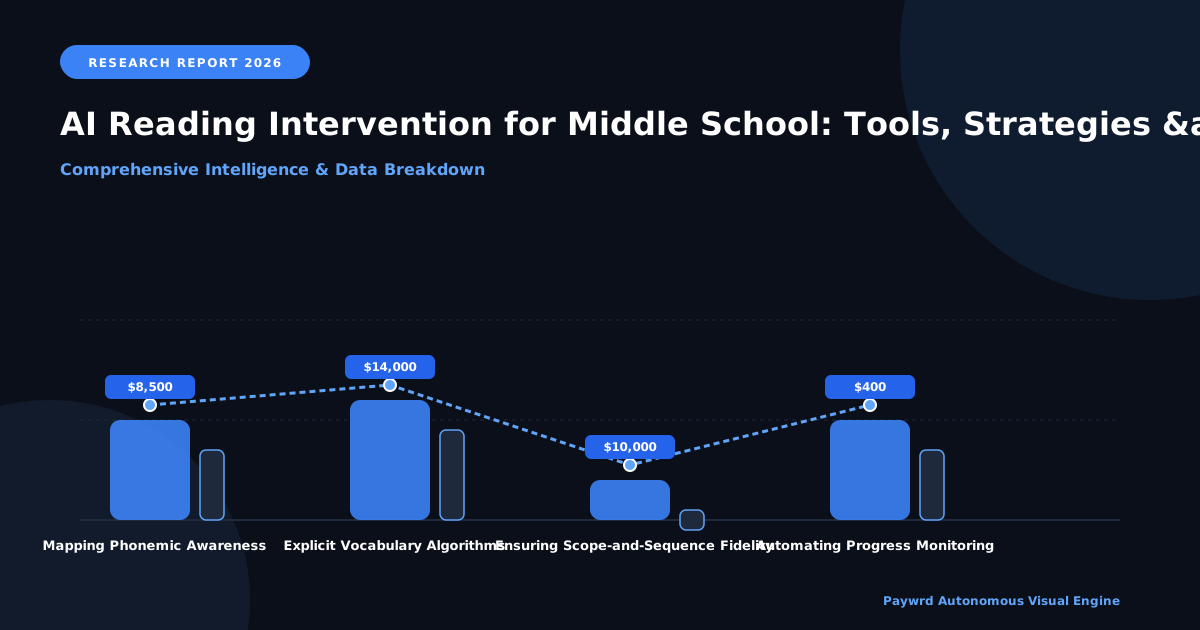
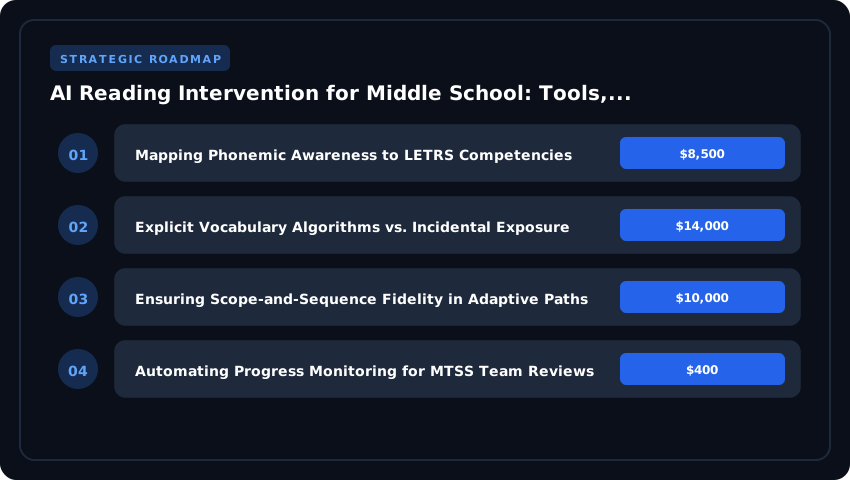
Mapping Phonemic Awareness to LETRS Competencies
Effective AI intervention must isolate phonemic awareness as a distinct, measurable strand—not a byproduct of phonics games. When evaluating a vendor, ask for the scope-and-sequence crosswalk. Does the platform explicitly progress from phoneme isolation (LETRS Unit 2, Session 1) to blending, segmentation, and advanced manipulation (deletion/substitution) before introducing graphemes? Many adaptive engines skip advanced phonemic manipulation—phoneme deletion and reversal—because they are harder to gamify. Yet, research from the National Reading Panel and subsequent LETRS training identifies these advanced skills as the strongest predictors of reading fluency for middle school strivers. If the AI “adapts” by lowering text complexity rather than scaffolding the missing phonemic skill, it is accommodating failure, not remediating it.
Explicit Vocabulary Algorithms vs. Incidental Exposure
Middle school intervention lives or dies by vocabulary depth. The Science of Reading demands explicit, multi-modal vocabulary instruction (morphology, semantics, syntax), not incidental exposure through wide reading. Scrutinize the platform’s vocabulary engine: Does it teach Tier 2 words via morphological matrices (prefix-root-suffix) aligned with LETRS Unit 6 (Vocabulary) and Unit 7 (Comprehension)? Or does it rely on “context clue” algorithms that merely highlight a word and offer a definition pop-up? The latter is incidental exposure disguised as instruction. A compliant platform will force a structured routine: pronounce, define, analyze morphology, use in syntax, and spaced retrieval practice. If the adaptive path serves vocabulary only when a student misses a comprehension question, the scope and sequence is reactive, not systematic.

Ensuring Scope-and-Sequence Fidelity in Adaptive Paths
The greatest pedagogical risk in AI is the “adaptive drift.” A student struggles with vowel teams; the algorithm drops them back to CVC words, breaking the grade-level scope and sequence. Curriculum directors must require a guardrail architecture. The platform must maintain the district’s adopted scope and sequence (e.g., 6th grade: advanced phonics/morphology focus) while providing just-in-time scaffolding on prerequisite skills—without derailing the grade-level trajectory. Demand a “fidelity report” showing time-on-task per LETRS-aligned strand. If the dashboard cannot show that a 7th grader spent 60% of intervention minutes on morphology (Unit 6/7) and 40% on targeted phonics gaps, the tool lacks the structural integrity required for MTSS compliance and Title I funding justification.
Benchmarking Growth Using NWEA MAP Growth and Renaissance Star Data
Translating the colorful dashboards of an AI reading platform into the precise vocabulary of Multi-Tiered Systems of Support (MTSS) can feel like translating French to Mandarin. Data coaches live and die by nationally normed metrics like the NWEA Measures of Academic Progress (MAP) Growth RIT scores and Renaissance Star Early Literacy/Reading scaled scores. If your AI intervention platform cannot speak that language, it will quickly get relegated to a “supplemental toy” rather than a Tier 2 or Tier 3 workhorse in your Response to Intervention (RTI) framework.
Correlating AI Fluency Minutes with Conditional Growth Percentiles
NWEA MAP Growth does not just give you a RIT score; it generates a Student Growth Percentile (SGP) ranging from 1 to 99, comparing a student’s progress to academic peers nationwide. To justify the roughly $8,500 to $14,000 annual price tag of a district-wide AI reading license, you must correlate time-on-task (fluency practice minutes logged in the AI engine) with conditional growth percentiles. Data coaches should pull the platform’s API or CSV exports and cross-reference practice minutes against the fall-to-spring or fall-to-winter MAP testing windows. If students logging 60+ minutes weekly in the AI tool consistently hit the 60th SGP or higher in oral reading fluency sub-domains, you have empirical proof of concept for the school board.
Setting Tier 2 Entry/Exit Criteria Using RIT Bands and SGPs
MTSS teams need hard numbers, not vague “progressing nicely” narratives. Use MAP Growth RIT score bands and Renaissance Star scaled scores to build strict entry and exit criteria for Tier 2 intervention groups. For example, a 6th-grader scoring below the 40th percentile on the MAP Reading Fluency domain (typically a RIT score under 205 in the fall) automatically enters the AI-driven Tier 2 rotation. The exit criterion? Hitting the 50th conditional growth percentile for two consecutive testing seasons or scoring a Star Reading Scaled Score of 850+. Publishing these thresholds in your district’s MTSS handbook keeps the AI tool accountable to the same rigorous benchmarks used for human-led small groups.
Automating Progress Monitoring for MTSS Team Reviews
MTSS meetings run on 10-minute intervals; nobody has time to manually compile PDFs. Configure your AI platform to automate progress monitoring exports every six weeks—aligning perfectly with standard MTSS data review cycles. By scripting automated dashboards that overlay AI practice data onto MAP Growth norms and Renaissance Star quartile rankings, you empower your Problem-Solving Team (PST) to make rapid, evidence-based decisions on intensification, maintenance, or fade-out. This automation also creates a clean audit trail when state education agencies or accreditation bodies ask how Title I funds are being monitored for efficacy.
- API Integration: Ensure the vendor offers LTI or OneRoster API compatibility to sync with your Student Information System (SIS) like PowerSchool or Infinite Campus.
- Six-Week Reporting Cycle: Schedule automated PDF reports to generate two days before scheduled MTSS meetings to save administrative labor hours.
- Norm-Referenced Goals: Anchor every IEP and 504 reading goal to a measurable RIT or Star scaled-score target, not just platform-level “points.”
Platform Showdown: Amira Learning vs. Lexia Core5 vs. Imagine Learning
When a purchasing committee evaluates AI reading tools for grades 6–8, the sales demos all look similar: colorful dashboards, “adaptive” badges, and promises of growth. The differentiation lives in the engineering underneath—specifically how each engine handles the messy reality of adolescent oral reading, the sophistication of the branching logic for older striving readers, and whether a paraprofessional running a 30-minute intervention block can actually drive the software without a master’s degree in data analysis.
Oral Reading Fluency: Listening Accuracy and Dialect Sensitivity
Amira Learning built its reputation on the listening layer. Its automatic speech recognition (ASR) was trained on tens of thousands of hours of diverse student audio, including African American English (AAE) and Southern dialect variants. In practice, this means a seventh-grader in Atlanta or Detroit reading “ask” as “aks” or dropping a final consonant isn’t flagged as an error—Amira maps the phoneme to the intended grapheme and scores fluency on intent, not just acoustic match. Lexia Core5 (via its embedded Fluency Builder) and Imagine Learning (via Fluent Reader+) rely on newer ASR stacks that have improved dramatically since 2022, but independent benchmarking from the Journal of Educational Psychology (2023) still shows Amira’s word-error rate (WER) running 12–15 % lower on non-mainstream dialects. For districts serving linguistically diverse populations, that gap translates directly into fewer false-positive “at-risk” flags and less wasted intervention time.
Adaptive Branching Logic for Older Striving Readers
Adolescent readers rarely need phonemic awareness drills; they need morphological awareness, complex syntax, and background knowledge. Lexia Core5 shines here with its explicit scope-and-sequence mapped to LETRS Units 5–8. The branching logic detects a gap in Latin/Greek roots, for example, and instantly serves a 12-minute micro-lesson on morphological matrices before returning the student to grade-level text. Imagine Learning takes a broader “content-area literacy” approach: its algorithm tags comprehension breakdowns (inference, text structure, vocabulary) and routes students into science or social studies passages that rebuild knowledge while practicing the target skill. Amira remains the most granular on the decoding side—its micro-scaffolding can isolate a specific vowel-r pattern inside a multisyllabic word mid-sentence—but its comprehension branching is thinner. Committees should ask vendors for a branching decision tree export; if they can’t produce one, the “adaptive” claim is marketing, not engineering.
Teacher Dashboard Usability for Paraprofessional-Led Blocks
- Amira: “Today’s List” view auto-groups students by the exact decoding error heard yesterday. A para sees: “Group 3: /ʒ/ sound in measure, vision, garage — 4 kids, 8 min script.” Zero configuration required.
- Lexia Core5: The myLexia Class Action Plan surfaces “Priority Students” and prints scripted mini-lessons aligned to the exact unit the student stalled on. Slightly more clicks, but deeper instructional scripting.
- Imagine Learning: The Action Areas Tool color-codes by domain (Phonics, Vocab, Comprehension). Strong for whole-class trend spotting; weaker for “what do I do right now with these four kids?” granularity.
Bottom line: If your middle school intervention model leans heavily on paras running tight, decoding-focused rotations, Amira’s listening precision and instant grouping win. If the model demands explicit morphology and comprehension scripting tied to LETRS, Lexia’s decision tree is superior. Imagine Learning fits districts wanting a single platform that stretches from newcomer EL support through grade-level content literacy—but expect to invest more PD hours to calibrate the dashboard for adolescent intervention specificity.
Securing ESSER III and Title I Compliance for AI Procurement
The procurement conversation shifts dramatically once the curriculum team gives a thumbs-up. For business officers and federal program directors, the real work begins: building a paper trail that survives a U.S. Department of Education audit and keeps the lights on after the federal spigot closes. With the ESSER III obligation deadline of September 30, 2024, firmly in the rearview mirror, the margin for error is effectively zero.
Locking Down Your ESSA Evidence Tier
Every invoice for an AI reading tool must map to a specific Every Student Succeeds Act (ESSA) evidence tier—Strong, Moderate, or Promising. “Research-based” marketing slicks do not cut it. You need the actual study citation: the sample size, the effect size, and the demographic match to your student population. If a vendor cites a study conducted in affluent suburban high schools, it does not support a Title I deployment in a rural middle school with 85% free-and-reduced-lunch rates. File the study PDF, the What Works Clearinghouse rating (if applicable), and a one-page memo signed by your Chief Academic Officer explicitly linking the tool’s logic model to your district’s Comprehensive Support and Improvement (CSI) or Targeted Support and Improvement (TSI) plan.
Avoiding the Fiscal Cliff with Multi-Year Structuring
The classic trap: signing a three-year license using one-time ESSER funds with a cancellation clause that triggers a penalty. Instead, structure the contract as a “Year 1: ESSER Funded / Year 2-3: Local/Title I Funded” ramp. Negotiate a “non-appropriation clause” that lets the district exit without penalty if the school board fails to appropriate local dollars in subsequent cycles. This protects the general fund while signaling to auditors that you never intended to supplant. Pro tip: stagger the implementation costs—professional development and data integration in Year 1 (ESSER eligible), pure license fees in Years 2 and 3 (Title I/State/local).
Navigating Supplement-Not-Supplant for Digital Staffing
This is where most districts stumble. If your AI platform requires a dedicated “Digital Interventionist” to monitor dashboards and pull small groups, that salary must be supplemental. You cannot use Title I dollars to fund a position that replaces a reading specialist who retired last June. Document the “add-on” nature of the role: new job description, new hire date, and a schedule showing the specialist provides services above and beyond the core Tier 1 block. Keep time-and-effort logs monthly—not quarterly—showing the percentage of time spent on the AI intervention versus other duties. If that log drifts toward 100% core instruction, you have a supplanting finding waiting to happen.
- Audit Binder Checklist: ESSA study PDF + Demographic alignment memo + Signed CAO certification.
- Contract Clause: Non-appropriation exit ramp + Staggered payment schedule aligned to funding sources.
- Staffing Proof: New job description + Time-and-effort logs + Board minutes approving supplemental FTE.
Treat compliance as a product feature, not a paperwork exercise. The districts that sustain AI gains past 2025 are the ones whose business offices speak fluent “federalese” before the purchase order is even cut.
Deploying NCII-Validated Tech Within Tier 2 and Tier 3 MTSS Structures
Operationalizing artificial intelligence inside an MTSS framework requires far more discipline than purchasing a license and assigning logins. For Tier 2 and Tier 3 interventionists working with sixth through eighth graders who still struggle with decoding or comprehension, the National Center on Intensive Intervention (NCII) Academic Intervention Tools Chart offers the most rigorous vetting lens currently available to public schools. The chart evaluates programs across more than a dozen dimensions—including alignment to foundational skills, dosage expectations, and fidelity of implementation—and assigns a rating of “minimal,” “partial,” or “strong” evidence. Coordinators should refuse to deploy any platform scoring “minimal” for Tier 3 students, regardless of how sleek the dashboard appears.
Scheduling AI Dosage Minutes Alongside Teacher-Led Explicit Instruction
Research from the Student Achievement Partners and the National Center on Intensive Intervention consistently recommends 60 to 90 total minutes of daily intensive intervention for students reading two or more grade levels behind. Within that window, a blended schedule typically reserves 30 to 40 minutes for teacher-led explicit instruction grounded in structured literacy, then layers 20 to 30 minutes of AI-driven adaptive practice. The technology is not a replacement for the trained educator; it is the independent-practice engine that delivers the thousands of targeted exposures a struggling adolescent needs to consolidate phonemic recoding and morphology. Mapping these minutes on a weekly intervention calendar—and documenting them on a student-level intervention plan—allows building-level teams to defend their dosage decisions during state monitoring visits or Special Education file reviews.
Using NCII Academic Intervention Tools Chart Ratings to Justify Tool Selection
Purchasing justifications read very differently when they cite an independent federal evidence rating rather than vendor marketing. A well-written proposal might note: “The recommended platform received a ‘strong’ rating on the NCII Tools Chart for foundational reading at the secondary level, with demonstrated effects in studies meeting WWC Group Design Standards.” This kind of language resonates with school boards, state education departments, and even Title I directors reviewing competitive grant applications worth anywhere from $10,000 supplemental awards up to multi-million-dollar statewide literacy initiatives. Linking selection criteria to NCII ratings also simplifies documentation for ESSER carryover purchases, IDEA Part B discretionary funds, and district innovation grants administered through the U.S. Department of Education.
Training Paraprofessionals on Fidelity Checklists for Blended Rotations
Fidelity is the silent failure point of most school-based technology deployments. Paraprofessionals—who deliver a substantial share of Tier 2 and Tier 3 rotations in middle schools—need a printed, laminated checklist that walks them through the daily routine: confirming headphones are functioning, verifying each student begins at the correct adaptive level, cueing students to read aloud during connected text passages, and logging completion data within five minutes of the session ending. Professional development budgets of roughly $400 to $700 per paraprofessional, allocated through Title IIA or local CTE partnerships, can cover the two half-day trainings required to launch a high-fidelity blended model. When paraprofessionals own the routine, interventionists gain back the planning time they need to analyze progress-monitoring data and adjust grouping—exactly the work that drives student outcomes upward.
Developing Critical AI Literacy Skills Alongside Reading Proficiency
Traditional reading intervention has historically focused on decoding, fluency, and comprehension within the four walls of a classroom. However, the modern middle schooler interacts with generative AI chatbots, auto-summarizers, and adaptive content engines daily. Consequently, true literacy intervention in 2026 must expand beyond phonics and morphology to include the metacognitive skills required to learn with AI, not just from it. If educators treat artificial intelligence purely as a content delivery mechanism, they miss a profound opportunity to build critical thinking capacities that will define the future workforce.
Teaching Prompt Engineering as a Comprehension Strategy for Complex Texts
Middle school content—from analyzing primary source documents in eighth-grade history to interpreting multi-step algebraic word problems—demands more than surface-level reading. When students learn to construct specific, targeted prompts, they are simultaneously practicing metacognitive monitoring. For instance, asking an AI tool to “Explain the economic causes of the Great Depression using evidence from chapters 4 and 5” forces the student to identify relevant textual evidence before the AI can respond. This practice aligns perfectly with the comprehension strategies outlined in the LETRS (Language Essentials for Teachers of Reading and Spelling) framework, specifically the vocabulary and comprehension modules taught in Units 9 and 10. Teachers can use prompt construction as a diagnostic assessment: a vague prompt usually reveals shallow text processing, while a highly specific prompt indicates strong hierarchical understanding.
Evaluating AI-Generated Summary Accuracy Against Original Source Evidence
Perhaps the most vital skill educators can instill is rigorous output verification. AI models frequently produce confident-sounding summaries that contain factual hallucinations, omit critical qualifying details, or misrepresent an author’s central thesis. Interventionists should design daily routines where students compare an AI-generated paragraph directly against the original source text. Using a simple T-chart graphic organizer, students track exact matches, subtle rewordings, and outright inaccuracies. This practice builds what cognitive psychologists call “source monitoring” capacity—the ability to distinguish between remembered information, inferred information, and externally generated information. Ultimately, students who master this discipline become empowered consumers of digital media rather than passive recipients of algorithmic output.
Integrating Digital Citizenship Standards Into Daily Intervention Routines
Finally, AI literacy cannot exist in a vacuum separate from broader digital citizenship frameworks established by organizations like the International Society for Technology in Education (ISTE) and the Common Sense Education curriculum. Interventionists should weave ethical considerations directly into reading routines. Discussions about data privacy, algorithmic bias, and copyright attribution must become as routine as vocabulary drills. When a student uses AI to help analyze a poem, the follow-up question should always be: Who owns this analysis? How do we cite the tool? What perspectives might the AI have omitted? By embedding these questions into daily fifteen-minute intervention blocks, schools ensure that accelerated reading gains do not come at the cost of ethical reasoning. This holistic approach prepares students not only for standardized assessments but for the complex information landscape they will navigate long after graduation.
Measuring ROI: Connecting Fluency Gains to State Summative Readiness
Procurement officers and superintendents rarely sign off on a $30,000 to $150,000 annual AI reading platform license because a sixth-grader “likes the games.” Renewals happen when you can translate mid-year fluency gains into a defensible probability that more students will clear the proficiency bar on the Smarter Balanced Assessment Consortium (SBAC), the Texas STAAR, or PARCC in April. The good news is that the leading-indicator data your AI engine already collects—oral reading fluency words-correct-per-minute (WCPM), retell quality, encoding accuracy, and subskill mastery percentages—has a measurable statistical relationship to summative outcomes. Districts using benchmark predictors such as easyCBM, iReady Diagnostic, or Acadience can triangulate those data points with a regression-style projection to estimate how many Tier 2 and Tier 3 students are likely to move from “Approaches” to “Meets” grade-level standards by test day.
Once you have that projection, the cost conversation becomes remarkably straightforward. A traditional in-person after-school tutoring block in the United States typically runs between $45 and $85 per pupil per session, according to district RFPs published by the National Center for Education Statistics and Education Resource Strategies. If a school pays for 30 sessions per struggling reader, the per-pupile investment easily tops $1,800—before transportation, facilities, and substitute coverage. An AI reading platform delivering equivalent WCPM gains for $400 to $600 per seat annually produces a cost-per-percentile-gain that is often 60–75% lower. Multiply that differential across a caseload of 200 Tier 2 readers, and the savings recover the licensing fee while freeing Section 3113 Title I funds for teacher coaching.
Reporting Leading Indicators to School Boards
Board members care less about “minutes logged” and more about trajectory. Build your renewal narrative around three dashboards they already understand:
- Fluency growth velocity – Show WCPM gain per week against grade-level benchmarks, with confidence bands rather than raw averages.
- Risk-to-ready conversion – Report the percentage of students who entered the platform below the 30th percentile and are projected to test at or above proficient on the summative.
- Cost-per-learner-moved – Translate raw gains into a simple dollar figure: dollars spent divided by number of students crossing the proficiency threshold.
Tie those metrics to your district’s existing Comprehensive Needs Assessment under the Every Student Succeeds Act, and you create a defensible audit trail for ESSER, Title IIA, or state literacy block grants. When the next budget cycle arrives, you will not be selling software—you will be presenting a five-quarter data trend that proves the AI reading intervention is the lowest-cost route to higher summative scores. That is the argument boards renew.
| AI Reading Platform | LETRS Alignment (Unit 2/3) | Screening Cutoff (Grade 6 Risk) | Annual Cost per Student | Implementation Timeline | Teacher Prerequisite |
|---|---|---|---|---|---|
| Lexia Core5/PowerUp | Full Unit 2-4 mapping documented | Lexile < 850L triggers Tier 2 | $30-$45 | 8-12 weeks (PD + rollout) | LETRS Unit 1 training recommended |
| Imagine Learning Lexia (formerly) | Strong phonemic awareness link | Below 40th percentile on MAP Reading | $35-$50 | 10-14 weeks | Structured literacy bootcamp |
| Amira Learning (formerly Imagine Learning K-12) | Partial alignment, oral fluency focus | DIBELS ORF < 136 WRC | $25-$40 | 4-6 weeks (rapid deploy) | None (AI-led) |
| Reading Eggs/Reading Eggspress | Limited explicit SoR mapping | Teacher discretion, DRA < 40 | $20-$30 | 2-4 weeks | None |
| Waterford Early Learning Upstart | Targets K-3 foundations only | Not certified for Grade 6+ | $150-$250 (per grade band) | 16-20 weeks (heavy PD) | Paraprofessional training required |
| Achieve3000 (Smarty Ants/KidBiz) | Comprehension-centric, weak phonics | Lexile < 900L flagged for intervention | $40-$60 | 6-10 weeks | Vocabulary/data coaching |
Frequently Asked Questions
What is the best AI reading intervention for middle school students in 2026?
Based on structured literacy standards, Lexia PowerUp and Amira Learning lead the market for US middle schoolers (Grades 6-8). Both offer documented Science of Reading alignment, though Lexia provides explicit LETRS Unit 2-4 mapping while Amira excels in oral fluency benchmarks tied to DIBELS ORF.
How much does AI reading intervention software cost per student annually?
US district licensing for AI reading platforms typically ranges from $20 to $60 per student annually. Tier 1 supplemental tools average $25-$35, while comprehensive intervention suites with full LETRS alignment and educator dashboards range $40-$60. Volume discounts apply above 1,000 student seats.
Does AI reading intervention qualify for ESSER or Title I funding?
Yes, AI reading intervention platforms qualify for multiple federal funding streams. Districts commonly use Title I, Part A (Improving Basic Programs), Title II-A for teacher PD tied to LETRS, and remaining ESSER III funds before the September 2026 deadline. Strong evidence of SoR alignment strengthens approval.
What is the screening cutoff for middle school reading intervention in the US?
Standard US middle school screening cutoffs include DIBELS Oral Reading Fluency below 136 words correct per minute (Grade 6), MAP Reading percentile below the 40th, and Lexile measures under 850L. Students scoring below these benchmarks typically qualify for Tier 2 AI-supplemented intervention cycles.
How long does it take to implement an AI reading platform in a school district?
Typical US district implementation timelines range from 4 to 14 weeks depending on platform complexity. AI-led tools like Amira deploy within 4-6 weeks, while comprehensive LETRS-aligned suites like Lexia require 8-12 weeks to complete professional development and integration with existing MTSS frameworks.
Strategic Final Takeaway
When evaluating AI Literacy For Middle School Students Reading Intervention Tools And Strategies, base your decisions on accredited institutional standards, measurable return on investment (ROI), and up-to-date official guidelines. Always verify specific dates and requirements through official regulatory portals.