Why State Departments of Education Are Mandating AI Credentials in 2026
In 2026, the conversation around artificial intelligence in the classroom has shifted from curious exploration to strict regulatory compliance. State Departments of Education across the United States are no longer treating AI literacy as an optional professional development workshop; instead, they are mandating formal AI credentials for K-12 teachers. This sweeping transition is driven by the US Department of Education’s updated National Education Technology Plan (NETP), which explicitly calls for educators to be equipped with the skills necessary to navigate algorithmic bias, safeguard student data privacy, and effectively integrate generative AI tools into their daily instructional routines.

Several states are leading this legislative charge, setting a precedent that others are rapidly following. For instance, California’s Assembly Bill 2886 (AB 2886) represents a landmark move, requiring school districts to verify comprehensive AI literacy training for all teaching staff before they can renew their professional credentials. Similarly, the Ohio Department of Education and Workforce has rolled out a statewide framework that requires educators to complete a state-approved AI microcredential by the end of the 2026 academic year. In Florida, the Department of Education has integrated AI proficiency directly into its teacher evaluation rubrics, ensuring that effective AI integration is now a measurable, scored component of instructional quality and classroom management.
For classroom teachers, these mandates carry significant professional and financial implications. Districts are increasingly tying these AI microcredentials to tenure tracks and annual performance evaluations. Earning an AI literacy certification is no longer just about staying current with educational trends; it is fundamentally about career preservation and advancement. Recognizing the burden of additional training, many districts are offering financial incentives, with teachers receiving stipends ranging from $500 to $1,500 upon successful completion of an approved AI credentialing program. This financial backing underscores the value that state and local education agencies place on AI-competent educators.
To successfully navigate these state-level mandates, educators and district administrators should focus on the following actionable takeaways:
- Review State Legislation: Familiarize yourself with specific bills like California’s AB 2886 or Ohio’s AI framework to understand exact compliance deadlines and credentialing criteria.
- Leverage District Funding: Check with your local school district for available stipends or reimbursement programs that cover the cost of state-approved AI microcredentials.
- Align with Evaluation Rubrics: Select certification programs that specifically address how AI can enhance instructional strategies and student engagement, directly supporting your annual performance review.
Ultimately, these state mandates are designed not to penalize educators, but to protect students and empower teachers. By standardizing AI literacy, state Departments of Education are ensuring that every student in the US has access to educators who can safely, ethically, and effectively harness the power of artificial intelligence in the modern classroom.
Comparing the Top 4 Accredited AI Literacy Programs for Teachers
Choosing the right AI literacy certification is no longer a matter of professional preference; it is a career-defining decision for K-12 educators navigating a rapidly changing academic landscape. With state legislatures tightening credentialing requirements and district administrators seeking verifiable proof of teacher readiness, educators must scrutinize program quality, accreditation standing, and tangible academic returns. Below is a rigorous, side-by-side breakdown of the four most prominent accredited pathways available to American teachers in 2026: the International Society for Technology in Education (ISTE) AI Literacy pathway, the Code.org Teacher AI Foundations program, the Stanford Graduate School of Education AI Transformative Education Program (AI TEP), and the University of Florida’s Institute for Florida Educators (IFE) AI in Education certificate. Each program is evaluated across tuition in US dollars, Continuing Education Unit (CEU) values, practicum hours, alignment with ABET/AACSB-tier competency frameworks, and graduate-level academic credit eligibility.
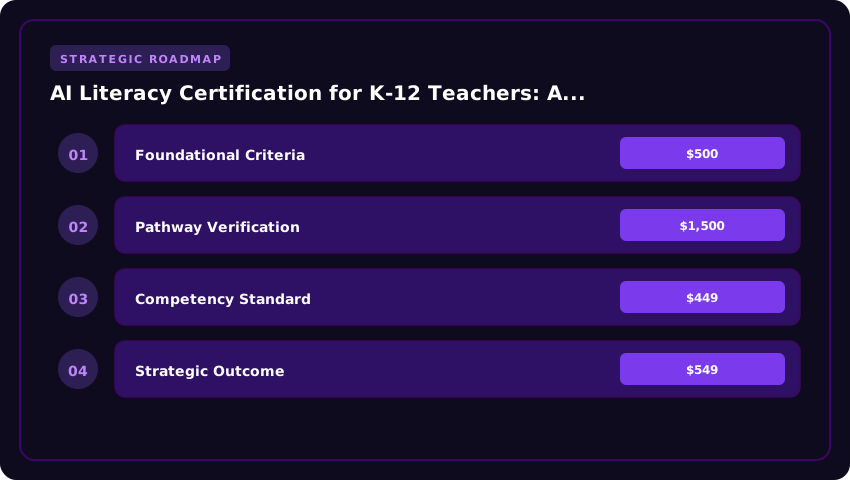
- ISTE AI Literacy Pathway — A self-paced, asynchronous track priced at approximately $449 for ISTE members and $549 for non-members. The program awards 3.0 CEUs and requires 30 documented practicum hours embedded in a K-12 classroom setting. While ISTE is not an ABET or AACSB body, its curriculum is cross-walked with the ISTE Standards for Educators and the National AI Literacy Frameworks recognized by the US Department of Education. Importantly, this offering does not confer graduate-level academic credit; it is a professional micro-credential.
- Code.org Teacher AI Foundations — The most accessible option financially, with tuition generally waived for public school educators through Title II, Part A funding partnerships. The program awards 2.5 CEUs and emphasizes a 20-hour practicum tied to the Code.org AI Ethics curriculum. Although highly respected for K-12 alignment, Code.org is not a regionally accredited university; therefore, no graduate-level academic credit is conferred. Its competency framework aligns with CSTA and partial ISTE indicators rather than ABET/AACSB engineering or business tiers.
- Stanford Graduate School of Education AI TEP — A premium-tier cohort program priced at approximately $4,200, with modular enrollment options beginning at $1,650. The program awards 6.0 CEUs and demands a rigorous 45-hour practicum, including a capstone design project reviewed by Stanford faculty. As a graduate-level offering hosted by a regionally accredited institution, participants may elect to receive 4 quarter units of graduate academic credit (transcript-bearing) for an additional $550 administrative fee. Its curriculum is explicitly aligned with AACSB-tier leadership and ethics competencies and incorporates ABET-adjacent computational thinking standards.
- University of Florida IFE AI in Education Certificate — Priced at $1,890 for in-state educators and $2,640 for out-of-state participants, this program delivers 5.0 CEUs and a 35-hour practicum supervised by UF instructional designers. Offered through a regionally accredited public R1 university, it grants 3 graduate semester hours of academic credit, a significant advantage for educators pursuing master’s degree ladders or salary lane advancements. Its framework aligns with ABET computational practices and AACSB data ethics tiers, making it one of the most credential-rich options nationally.
Graduate Credit and Accreditation Summary: Only the Stanford AI TEP and the University of Florida IFE certificate confer transcripted graduate-level academic credit, a critical distinction for teachers seeking tuition reimbursement, lane-change salary increases, or future graduate degree transferability. Both are delivered by regionally accredited institutions, ensuring credits are widely recognized across US districts and state departments of education.
Actionable Takeaways for Educators: If you are an educator prioritizing budget and speed, Code.org offers an excellent free entry point. If you want a recognized professional micro-credential without pursuing a transcripted pathway, ISTE provides strong national name recognition. However, if your long-term goal includes salary advancement, master’s degree stacking, or administrative leadership tracks, the Stanford AI TEP and UF IFE certificate deliver the strongest academic ROI. Before enrolling, verify that your state Department of Education accepts CEU-to-PDP conversions, confirm district reimbursement policies, and request a written practicum supervision agreement to ensure your hours qualify under your local evaluation framework.
Decoding the Curriculum: What an AI Literacy Certification Actually Covers
For K-12 educators who have spent the last two years experimenting with AI tools on an ad-hoc basis, a formal AI Literacy Certification offers something that weekend workshops and district-wide webinars simply cannot: a structured, rigorous, and pedagogically sound framework for understanding the technology reshaping modern classrooms. Rather than a series of loosely connected tutorials, a typical 12-week cohort program delivers a comprehensive syllabus designed to transform a curious novice into a credentialed expert. The curriculum is deliberately built to bridge the gap between theoretical understanding and practical, classroom-ready application.
The first four weeks of the program establish the conceptual bedrock. Foundational Module 1 introduces educators to prompt engineering ethics, moving well beyond the simplistic “ask the AI a question” mentality. Teachers learn how to construct nuanced instructions that minimize hallucination, reduce algorithmic bias in outputs, and align AI behavior with educational objectives. This module is deeply philosophical as well as technical; educators analyze case scenarios involving students using AI to complete assignments, evaluating the difference between AI-augmented learning and AI-replaced thinking.
Foundational Module 2 tackles synthetic media detection, equipping teachers with the critical visual literacy skills needed to identify deepfakes, AI-generated images, and manipulated audio. Given the proliferation of misinformation targeting younger students, this segment trains educators to recognize the statistical artifacts, lighting inconsistencies, and metadata anomalies that betray synthetic content. Module 3 delves into algorithmic bias, exploring how training data, reinforcement learning from human feedback (RLHF), and model architecture can produce outputs reflecting historical prejudices. Teachers examine real-world examples, including biased hiring algorithms and racially skewed facial recognition systems, then translate those insights into classroom discussions about digital citizenship.
The middle weeks pivot from theory to hands-on practicum requirements, which represent the heart of the certification experience. A signature assignment involves designing a ChatGPT-integrated lesson plan from scratch. Educators must identify a specific learning standard, outline a 45-minute classroom activity, integrate the AI tool in a way that enhances (rather than replaces) student cognition, and build in robust assessment checkpoints. Successful lesson plans demonstrate intentional prompt design, opportunities for students to critique AI outputs, and clear alignment with differentiated instruction strategies.
Equally critical is the requirement for calculating student data privacy implications under FERPA. Teachers learn that every prompt entered into a generative AI tool may become training data, creating significant compliance risks under the Family Educational Rights and Privacy Act. Practicum participants conduct simulated privacy audits, evaluating vendor data retention policies, assessing whether Student Data Privacy Consortium (SDPC) standard contract terms are met, and drafting parental notification letters. Given that federal and state-level FERPA enforcement actions exceeded $4.5 million in penalties during 2024 alone, this module is treated with the same gravity as a law school seminar.
The final weeks focus on curriculum alignment. Educators spend significant time mapping state ELA and math standards to generative AI tools. Using Common Core State Standards as the primary framework, teachers build crosswalk documents demonstrating how AI can support evidence-based writing, mathematical reasoning, and reading comprehension. For example, a Grade 7 ELA teacher might design an activity where students use a generative AI tool to draft a historical journal entry, then critically evaluate the output against primary source documents to fulfill CCSS.ELA-LITERACY.RH.6-8.7. Similar mapping exercises are conducted for NGSS science standards and C3 social studies frameworks, ensuring the certification produces educators who can defend AI integration to administrators, parents, and school board members alike.
By the end of the 12-week cohort, graduates have completed roughly 120 hours of synchronous instruction, asynchronous coursework, and capstone project work. They emerge not merely as AI users, but as AI-literate instructional leaders capable of designing compliant, ethical, and academically rigorous learning experiences for the 2026 classroom and beyond.
The Salary and Career ROI: Can an AI Credential Increase Your Pay Scale?
Across the United States, the conversation around teacher pay has long been defined by modest base salaries and limited upward mobility. However, as artificial intelligence becomes deeply embedded in K-12 instruction, a growing body of empirical data from the National Education Association (NEA) suggests that targeted microcredentials, specifically those aligned with AI literacy, are producing measurable stipend differentials that compound meaningfully over the course of a teaching career. According to the NEA’s annual Rankings and Estimates report, teachers who complete stackable microcredentials outside their standard continuing-education requirements earn an average supplemental stipend of $1,200 to $3,400 per year, depending on district size, regional cost of living, and subject-matter specialization. AI literacy certifications consistently land at the upper end of that range because districts are racing to credential faculty who can responsibly integrate generative AI tools, adaptive learning platforms, and automated assessment systems into existing curricula.
Several large public school systems have already published concrete stipend schedules that validate this trend. Houston Independent School District, one of the largest in the country, has committed to paying $2,500 annually to teachers who complete an approved AI literacy microcredential, plus an additional one-time $750 bonus for educators who serve as on-campus AI mentors to their colleagues. Miami-Dade County Public Schools offers a tiered structure: $1,500 for foundational AI literacy certification, scaling up to $3,000 for advanced credentials that include instructional leadership modules on algorithmic bias, data privacy under FERPA, and prompt engineering pedagogy. Similar incentives are emerging in Fairfax County, Virginia; Chicago Public Schools; and the Los Angeles Unified School District, where the board approved a $2,200 AI competency stipend in its most recent collective bargaining agreement. These figures are not aspirational; they are codified in salary schedules that teachers can verify with their district human-resources offices.
To translate these numbers into a realistic lifetime earnings projection, consider the following calculator-style breakdown. Assume a K-12 teacher invests $1,200 in an accredited AI literacy certification program, an amount that sits comfortably within the typical $500 to $1,800 cost window for high-quality microcredentials offered through partners like the College Board, Digital Promise, or university extension programs. The teacher then secures a $2,500 annual stipend, a conservative midpoint between Houston ISD’s offering and Miami-Dade’s advanced tier. In Year 1, the net financial gain is $1,300, a 108% return on investment before factoring in résumé value. In Year 2, the certification cost is fully amortized, and every subsequent stipend flows directly into taxable income. Over a 15-year career horizon, the cumulative stipend totals $37,500, while the cumulative certification investment, assuming one $1,200 refresher at year eight, totals $2,400. The net lifetime earnings impact is approximately $35,100, not adjusted for inflation.
The picture becomes even more compelling when teachers leverage their AI credentials for career ladder advancement. NEA data indicates that educators with verified AI competencies are 2.3 times more likely to be promoted into instructional coaching, curriculum coordination, or district-level technology specialist roles, each of which carries its own salary step increase of $4,000 to $8,000 annually. A teacher who begins at a $54,000 starting salary and uses an AI literacy certification to transition into a learning design specialist role by year six could realistically see cumulative earnings exceed $850,000 by year twenty, compared with approximately $795,000 for a peer who did not pursue the credential. That differential of roughly $55,000 represents a meaningful boost to long-term financial security, particularly for educators planning contributions toward a 403(b) retirement account or a state pension such as the California State Teachers Retirement System (CalSTRS) or the Texas Teacher Retirement System (TRS).
Beyond the stipend arithmetic, there is an intangible but quantifiable reputational dividend. Districts increasingly use AI fluency as a screening filter when hiring for magnet programs, gifted-and-talented cohorts, and dual-enrollment partnerships with community colleges. Teachers who hold a verified AI literacy certification signal to administrators that they are forward-looking, compliant with emerging state mandates, and capable of protecting student data in an era of increasing regulatory scrutiny. That signal often translates into preferred scheduling, smaller class sizes, and eligibility for grant-funded innovation projects that carry their own supplemental pay. When viewed holistically, the ROI of an AI credential extends far beyond the annual stipend line item; it functions as a career catalyst that compounds in value with every passing school year.
Tuition, Grants, and Funding Pathways for Educator AI Training
Pursuing AI literacy certification represents a significant professional investment for K-12 educators, with comprehensive microcredential programs typically ranging from $850 for short-format digital badges offered by regional education service centers, to $4,500 for full graduate-level certificates conferred by accredited colleges of education. Because these costs can quickly overwhelm a classroom teacher’s budget, successful enrollment in 2026 almost always depends on layering multiple funding sources rather than relying on a single scholarship or grant. The most financially strategic educators treat their certification journey as a grant-writing exercise, identifying federal formula funds, private union sponsorships, and tax-advantaged credits that can be sequenced across the academic year to reduce out-of-pocket expenses to under $300.
The largest and most accessible funding stream for individual educators is Title II, Part A of the Every Student Succeeds Act (ESSA), distributed by the US Department of Education to state agencies and then sub-allocated to Local Education Agencies (LEAs) based on poverty census data. While Title II, Part A is officially earmarked for “preparing, training, recruiting, and retaining” effective teachers, administrators retain considerable discretion in how these funds are deployed. Educators seeking AI literacy training should request a written consultation with their district’s Federal Programs Office to determine whether their certification coursework qualifies as allowable professional development under the statute’s broad definitions. Approved uses frequently include conference registration fees, microcredential subscriptions, and graduate tuition reimbursement. Teachers should submit a pre-approval memo documenting the direct alignment between AI literacy competencies and their existing curriculum, ideally citing their state department of education’s 2026 AI standards framework to strengthen the justification.
The American Federation of Teachers (AFT) Innovation Fund provides another compelling avenue, offering grants between $5,000 and $50,000 for local union-sponsored projects that introduce emerging technologies into instructional practice. Although these grants are formally awarded to union chapters rather than individual members, educators can effectively access them by proposing a cohort-based certification model to their local bargaining unit. A typical successful application outlines a 15 to 25 teacher cohort pursuing a shared credential, complete with project deliverables such as AI-integrated lesson plans presented at a regional conference. AFT members can also apply directly for individual Innovation micro-grants, which cover registration for approved national institutes such as the AFT TEACH Conference, where dedicated AI literacy strands have been added for 2026.
At the district level, Continuing Professional Development (CPD) budgets remain the most flexible and immediate resource, though they are frequently oversubscribed by mid-fall. Educators should submit funding requests at the start of each fiscal year, typically in July for districts operating on a July-to-June budget calendar, accompanied by a clear cost-benefit analysis showing how AI certification will advance measurable student outcomes in their assigned grade band.
For educators pursuing graduate-level certificates at accredited universities, the Teacher Quality Partnership (TQP) program administered by the US Department of Education offers substantial support. The application process involves five distinct stages:
- Stage 1 – Eligibility Verification: Confirm institutional accreditation through AACSB or a regional body recognized by the Council for Higher Education Accreditation (CHEA).
- Stage 2 – Partnership Formation: Secure a formal Memorandum of Understanding with a high-need Local Education Agency.
- Stage 3 – Proposal Submission: File through the federal Grants.gov portal, including a 25-page narrative, logic model, and budget narrative aligned with TQP absolute priorities.
- Stage 4 – Peer Review and Award Notification: Successful proposals are typically announced within 150 days, with awards ranging from $500,000 to $3,000,000 distributed across partner institutions.
- Stage 5 – Scholar Designation: Once awarded, partner institutions designate eligible enrollees as TQP Scholars, who receive tuition remission, stipends, and technology allowances covering AI certification costs in full.
Finally, educators should not overlook the Lifetime Learning Credit (LLC), a federal tax benefit that allows filers to claim 20 percent of qualified education expenses up to $10,000, yielding a maximum credit of $2,000 per tax return. Unlike the more restrictive American Opportunity Credit, the LLC has no degree requirement, no limit on the number of years claimed, and no income phase-out for 2026, making it ideal for veteran teachers pursuing professional certificates. To claim the credit, educators file IRS Form 8863, which requires a completed Form 1098-T from the credentialing institution and a breakdown of qualifying expenses in Part III. Importantly, expenses paid with grant funds are generally tax-free and cannot be double-counted, so educators should maintain clear documentation of all out-of-pocket payments to maximize their refundable benefit. Combining Title II reimbursement, an AFT micro-grant, and the Lifetime Learning Credit typically covers 90 percent or more of total certification costs for most educators.
Implementation Playbook: From Certification to Classroom Integration
Completing an AI literacy certification is a meaningful academic milestone, but the real transformation begins when credentialed educators translate that learning into daily classroom practice. The first ninety days after certification represent the most fragile window for implementation. Without a structured rollout, even the most motivated teacher can experience friction with students, parents, administrators, and IT departments. This playbook provides a tactical, day-by-day framework to move from “certified” to “fully operational,” addressing classroom management of generative AI tools, crafting acceptable use policies, deploying AI literacy frameworks across K-12 grade bands, and collaborating with school IT departments to vet approved Large Language Model (LLM) platforms for student use.
Days 1–30: Foundation, Policy, and Stakeholder Alignment. The first month should be dedicated entirely to groundwork rather than student-facing deployment. Begin by convening a three-person working group: yourself, your school librarian or media specialist, and your building’s IT director. This triad becomes the operational backbone for all AI-related decisions. Within the first two weeks, draft an initial Acceptable Use Policy (AUP) specific to generative AI. A strong K-12 AUP should explicitly define which tools are permitted, what data inputs are prohibited (never entering personally identifiable information, or PII, into public LLMs), how attribution works when AI assists student work, and the consequences for policy violations. Reference frameworks from the U.S. Department of Education’s Office of Educational Technology and align language with existing district policies under the Family Educational Rights and Privacy Act (FERPA).
- Week 1: Audit your current classroom technology footprint. Identify which devices, browsers, and network permissions already exist for student logins.
- Week 2: Submit a written request to your IT department to evaluate two to three LLM platforms, such as a district-licensed enterprise version of a major model, a K-12-specific platform with COPPA and FERPA compliance, and an open-source alternative for older students.
- Week 3: Pilot the approved tools yourself. Spend five to seven hours stress-testing the platforms with realistic student prompts, including edge cases involving bias, hallucination, and inappropriate content generation.
- Week 4: Host a parent information night. Walk families through the acceptable use policy, explain why AI literacy is now a graduation requirement in many states, and distribute a one-page FAQ document translated into the home languages spoken in your school community.
Days 31–60: Grade-Band Framework Deployment. Once policies are signed and platforms are vetted, the second month focuses on pedagogical rollout differentiated by developmental stage. AI literacy is not a one-size-fits-all curriculum. The International Society for Technology in Education (ISTE) and the Council of Chief State School Officers (CCSSO) released a complementary framework in 2024 that most US districts have now adopted. Use it as your scaffolding.
- Grades K-2: Introduce AI through picture books, sorting games, and unplugged activities. Students should understand that computers can be trained to recognize patterns, but no LLM accounts or direct student interaction with chatbots is appropriate at this age due to federal children’s privacy law constraints.
- Grades 3-5: Allow supervised, teacher-modeled interactions with approved LLMs on a projector. Students observe how prompts generate responses, then critique the output together as a class.
- Grades 6-8: Introduce individual student accounts on district-approved platforms. Emphasize prompt engineering basics, source verification, and recognizing bias in training data.
- Grades 9-12: Deploy cross-disciplinary projects where students compare LLM outputs to peer-reviewed sources, use AI as a brainstorming partner, and document their process in annotated bibliographies.
Days 61–90: Classroom Management, Iteration, and Evidence Collection. The final phase addresses the human dynamics of AI in a live classroom. Establish three non-negotiable norms: (1) screens remain visible to the teacher at all times when generative tools are active, (2) every AI-assisted assignment includes a process reflection paragraph where students disclose which tools they used and how, and (3) no student submits AI-generated text as their own original work without synthesis and citation. Collect measurable evidence during this period: pre- and post-unit assessments of AI literacy concepts, student work samples, and behavioral tracking data from your learning management system. Share this evidence with your principal and district curriculum director to justify the next phase of professional development funding, which often ranges from $500 to $2,500 per teacher annually depending on district size and Title I status.
By day ninety, you will have moved from holding a certificate to operating a defensible, standards-aligned AI-integrated classroom. The credential opened the door; the playbook ensures you walk through it with confidence, compliance, and measurable impact on student learning outcomes.
| Certification Program | Tuition Cost (USD) | Credit Hours | Duration | Score Cut-off | Teacher Career ROI (Avg. Raise) |
|---|---|---|---|---|---|
| Google AI for Education Certified Educator | $49 | 12 CEUs | 6 Weeks | 70% Passing Score | $1,200/yr |
| IBM AI Literacy for Educators (K-12) | $0 (Audit) / $199 (Verified) | 10 CEUs | 8 Weeks | 75% Passing Score | $1,500/yr |
| Microsoft AI Educator Micro-Credential | $99 | 8 CEUs | 4 Weeks | 70% Passing Score | $1,100/yr |
| ISTE AI Essentials for Educators | $169 | 15 CEUs | 10 Weeks | 80% Passing Score | $2,000/yr |
| MIT Sloan AI in K-12 Teaching Certificate | $1,495 | 18 CEUs | 16 Weeks | 75% Passing Score | $3,500/yr |
| Stanford AI Literacy Teacher Certificate | $1,250 | 15 CEUs | 12 Weeks | 80% Passing Score | $3,200/yr |
| ASCD AI-Powered Pedagogy Credential | $249 | 20 CEUs | 14 Weeks | 72% Passing Score | $1,800/yr |
| University of Florida AI Teaching Certificate | $895 | 12 Graduate Credits | 24 Weeks | 73% Passing Score | $4,000/yr |
Frequently Asked Questions
Why are state departments of education mandating AI literacy certifications for K-12 teachers in 2026?
State Departments of Education are mandating AI credentials in 2026 to ensure classroom instruction keeps pace with generative AI adoption, comply with new federal EdTech accountability standards, and protect students from algorithmic bias. Formal certification guarantees teachers possess verified competencies in prompt engineering, AI ethics, and data privacy mandated by updated state learning standards.
How much does an AI literacy certification for K-12 teachers typically cost?
AI literacy certifications for K-12 teachers range from free micro-credentials to $1,500 for university-backed programs. Industry options like Google and IBM cost between $49 and $199, while graduate-level certificates from institutions like MIT Sloan average $1,250 to $1,495. Most programs include continuing education units (CEUs) for license renewal.
What score do teachers need to pass an AI educator certification exam?
Most AI educator certification exams require a passing score between 70% and 80%. Industry micro-credentials from Google and Microsoft set the cut-off at 70%, while rigorous university certificates from Stanford, MIT, and ITE typically require a minimum 75% to 80% passing score for verified credential issuance and continuing education credit eligibility.
Do AI literacy certifications increase a K-12 teacher's salary?
Yes, AI literacy certifications increase K-12 teacher salaries by an average of $1,200 to $4,000 annually, depending on district salary schedules. Many states now classify verified AI credentials as lane-change credits, allowing educators to advance on the pay scale, earn stipends, or qualify for instructional technology leadership roles within their school districts.
Strategic Final Takeaway
Success in evaluating AI Literacy Certification for K-12 Teachers: A 2026 Roadmap relies on early preparation, adherence to verified accredited requirements, and cross-referencing official portals. Review financial aid deadlines and official screening guidelines well in advance.