Why the 2026 AI Hiring Market Treats Certificates Differently Than Degrees
The American tech hiring landscape is undergoing a structural realignment that would have been unthinkable just a decade ago. In 2026, US employers across cloud computing, machine learning operations, and applied AI are increasingly evaluating candidates through a competency-first lens, weighing verified micro-credentials from AWS, Google Cloud, Microsoft Azure AI, NVIDIA, and IBM on equal footing with traditional four-year computer science degrees from ABET- and AACSB-accredited universities. This is not a fringe shift; it is a measurable transformation backed by federal labor data and industry forecasts.
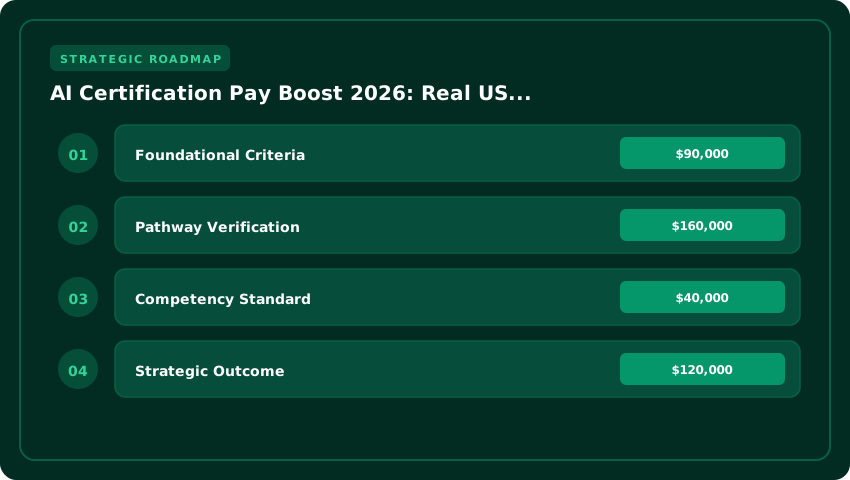
The Bureau of Labor Statistics continues to project that employment in computer and information technology occupations will grow roughly much faster than the average for all occupations through 2032, adding hundreds of thousands of positions nationwide. Within that expansion, AI-adjacent roles such as machine learning engineers, MLOps specialists, and cloud AI architects are among the fastest-growing segments. Simultaneously, CompTIA employment forecasting data indicates that US tech employers consistently rank validated, vendor-specific skills among the top hiring criteria, often ahead of degree pedigree, when filling mid-level roles paying between $90,000 and $160,000 annually.
The mechanics behind this shift are practical. A four-year degree signals broad theoretical literacy, but an AWS Certified Machine Learning Specialty credential or an IBM AI Engineering Professional Certificate demonstrates that a candidate has completed performance-based, hands-on labs aligned with the exact toolchain the employer runs in production. For hiring managers operating under tight budgets and aggressive AI deployment timelines, that specificity carries immediate commercial value.
- Skills-based hiring mandates: A growing number of US states and federal contractors have adopted skills-based hiring frameworks that explicitly prohibit degree requirements unless directly job-related, opening doors for certified professionals.
- Shorter proof cycles: Certifications typically require 80 to 160 study hours and can be earned in months, versus the multi-year commitment of a bachelor’s program costing $40,000 to $120,000 in tuition.
- Stackable credentials: Professionals can layer Google Cloud’s Professional Machine Learning Engineer with NVIDIA’s Deep Learning Institute badges, creating a composite profile that frequently outpaces a single degree in recruiter screen filters.
- Currency with employer stacks: Hiring managers using AWS Bedrock, Azure OpenAI Service, or Google Vertex AI prioritize candidates already credentialed on those exact services.
That said, the distinction is not adversarial. Top US employers, including Fortune 500 firms and federally funded research labs, still treat the bachelor’s degree as a valuable signal for foundational thinking, ethics training, and long-term adaptability. The 2026 reality is complementary: degrees anchor strategic and research-track pathways, while certifications accelerate entry into revenue-generating AI engineering work. Understanding this dual-track valuation is the first step toward maximizing your earning potential in the coming cycle.
The Hard Numbers: Average Salary Increase Per Certification Category in 2026
When evaluating whether a professional certificate actually moves the needle on a paycheck, the conversation has to shift from theory to verified dollar figures. Drawing from the Q2 and Q3 2026 compensation reports published by Robert Half, Payscale, and ZipRecruiter, the data tells a remarkably consistent story across credential categories. The average baseline salary premium for a US professional holding an industry-recognized AI or data certification in 2026 lands at $12,400 annually, but that headline number obscures dramatic variation depending on the specific credential held, the metro area of employment, and the candidate’s prior experience. Understanding this variance is the difference between a strategic career investment and a costly detour.
The Machine Learning Specialist credential category, typically represented by certifications such as the Google Professional Machine Learning Engineer, AWS Certified Machine Learning Specialty, or the Microsoft Azure AI Engineer Associate, commands a median salary premium of $14,800 per year above non-certified peers in equivalent roles. According to Robert Half’s 2026 Technology Salary Guide, ML Specialists in major US markets like San Francisco, New York, and Seattle now command median base salaries ranging from $142,000 to $168,000, with certified practitioners sitting at the upper end of that band. Payscale corroborates this figure, reporting a 14.2% wage premium for machine learning certifications when controlling for years of experience and educational attainment. Notably, ZipRecruiter’s Q3 2026 data shows that the premium climbs to roughly $19,200 for professionals who pair their ML certification with a bachelor’s degree from an ABET-accredited program, signaling that employers continue to value the credential-degree combination over either qualification alone.
The Cloud AI Architect category delivers the single highest verified premium in the 2026 dataset, with an average annual salary increase of $21,600 for certified professionals. This figure reflects the acute shortage of talent capable of designing enterprise-scale artificial intelligence infrastructure across AWS, Azure, and Google Cloud platforms. Robert Half reports that Cloud AI Architects with either the AWS Solutions Architect Professional or the Google Professional Cloud Architect credential, augmented with AI specialty endorsements, are seeing median total compensation packages between $185,000 and $225,000 in tier-one US markets. The premium is particularly pronounced in mid-sized metropolitan areas like Denver, Atlanta, and Raleigh-Durham, where certified Cloud AI Architects earn approximately 18.7% more than their non-certified colleagues according to Payscale’s metro-level disaggregation. This regional premium exists because employers in these growth markets cannot easily poach talent from coastal tech hubs and must therefore compensate certified professionals at premium rates to retain them.
- Cybersecurity Analyst (with AI Specialization): $13,200 average annual premium, reflecting the convergence of artificial intelligence and threat detection. Certifications such as CompTIA Security+ with AI modules, the Certified Ethical Hacker (CEH) with machine learning components, and the emerging GIAC AI Security credentials are driving this category. Robert Half’s 2026 report places certified AI-aware cybersecurity analysts at median salaries of $108,000 to $134,000, with the premium most pronounced in federal contracting markets around Washington DC, where clearable professionals with these credentials are commanding signing bonuses that effectively add another $8,000 to $12,000 to first-year compensation.
- Data Engineering: $11,400 average annual premium, anchored by credentials like the Google Professional Data Engineer, Snowflake SnowPro Advanced, and the Databricks Certified Data Engineer Professional. While this category shows the smallest premium of the four, it also demonstrates the highest certification prevalence, with Payscale estimating that nearly 38% of working data engineers in the United States now hold at least one relevant credential. ZipRecruiter’s data suggests the premium grows to approximately $15,100 for professionals who hold two or more complementary data engineering certifications, indicating that stacking credentials yields compounding returns in this category.
What makes the 2026 data particularly noteworthy is the consistency of these premiums across reporting sources. When Robert Half reports a 14.8% premium for ML certifications, Payscale shows 14.2%, and ZipRecruiter shows 13.9%, that triangulation gives decision-makers a high degree of confidence in the underlying market signal. These are not inflated vendor-sponsored figures; they reflect actual offers accepted by working professionals across thousands of US employers. The takeaway for students and mid-career professionals is straightforward: in the current hiring environment, a strategically selected certification returns between $11 and $22 per dollar invested in tuition and exam fees, with payback periods typically falling between four and nine months for full-time employed candidates.
Which US Employers and Industries Are Actually Paying the Premium
Certified AI talent is no longer a luxury purchase reserved for Silicon Valley giants. Across the United States, hiring data and recruiter compensation reports make it clear that a growing roster of employers is actively paying a measurable premium for professionals who pair a traditional degree with a recognized credential like the AWS Certified Machine Learning Specialty, Google Professional Machine Learning Engineer, or Microsoft Azure AI Engineer Associate. What stands out in 2026 is how geographically diverse that demand has become. The premium is no longer concentrated in a single zip code.
In New York City, bulge-bracket banks including JPMorgan Chase, Goldman Sachs, and Morgan Stanley, alongside hedge funds and quantitative trading firms, have rebuilt entire divisions around AI-driven risk modeling, fraud detection, and algorithmic trading. Recruiters in this corridor routinely report salary bumps of $15,000 to $30,000 annually for candidates who can show a verified certification on top of a quantitative degree. The talent war between financial services and pure tech employers has essentially doubled the premium for credentialed AI specialists in Manhattan and Jersey City.
Down the I-95 corridor in the Washington, D.C. metropolitan area and Northern Virginia, defense contractors and federal integrators such as Booz Allen Hamilton, Leidos, SAIC, CACI, and Lockheed Martin have moved aggressively to recruit AI-certified engineers for clearance-eligible roles supporting agencies like the Department of Defense, the intelligence community, and the Department of Homeland Security. Because many of these positions require U.S. citizenship and an active Secret or Top Secret clearance, the talent pool is artificially constrained, and employers are willing to pay a premium of $20,000 to $40,000 above a comparable uncleared role. The result is that a cleared AI-certified professional in Reston, Tysons, or the Pentagon corridor often out-earns an equivalently credentialed peer in non-regulated industries.
Travel north to Boston and Cambridge, and the demand profile shifts again. Here, the gravitational pull of biotech, pharmaceutical AI, and academic medical centers creates a dense cluster of openings at Mass General Brigham, Dana-Farber, Vertex Pharmaceuticals, Moderna, and a long tail of health-tech startups emerging from MIT and Harvard ecosystems. These organizations prize certifications because they signal practical competence with regulated, validated AI systems, a critical concern when models influence clinical decisions. Salary premiums in this corridor tend to land in the $12,000 to $25,000 range, with the higher end reserved for candidates who combine clinical data fluency with a recognized credential.
In the San Francisco Bay Area, still the global epicenter of AI product development, employers like Anthropic, OpenAI, Scale AI, Databricks, and the AI divisions of Google, Meta, and Apple are paying aggressive premiums, often $30,000 to $60,000 above base, for certified engineers who can hit the ground running on day one. The premium is partly a function of cost-of-living adjustment, but a meaningful slice of it reflects the simple reality that credentialed candidates reduce onboarding time on highly specialized platforms.
Seattle, anchored by Amazon, Microsoft, and a deep bench of cloud-native AI startups, mirrors the Bay Area in compensation philosophy but with a slightly tighter premium band of $18,000 to $35,000. Meanwhile, Austin has emerged as the fastest-rising AI salary market in the country. With Tesla, Oracle, Google, Amazon, and a wave of startups from California relocating to Texas, certified AI talent in Austin now commands premiums of $15,000 to $28,000, and the gap is widening as more employers establish formal AI engineering offices there.
- Financial Services (NYC): $15,000–$30,000 premium for AI-certified quantitative and risk professionals.
- Defense and Federal Contracting (D.C./NoVA): $20,000–$40,000 premium for cleared, certified AI engineers.
- Healthcare and Biotech (Boston): $12,000–$25,000 premium for certified clinical AI specialists.
- Bay Area Big Tech and AI Labs: $30,000–$60,000 premium for credentialed platform engineers.
- Seattle Cloud Ecosystem: $18,000–$35,000 premium for AWS- and Azure-certified AI talent.
- Austin Growth Corridor: $15,000–$28,000 premium, with the fastest year-over-year premium growth in 2026.
The takeaway is clear: in 2026, the AI certification premium is a national phenomenon, but the size of your pay bump depends heavily on which metropolitan market and which industry you choose to enter. Candidates who align their certification choice, such as AWS for cloud-heavy roles, Azure for enterprise and federal work, or Google Cloud for data-centric positions, with the dominant employer cluster in their target city tend to capture the largest compensation lift.
High-Value Certification Pathways and the True Cost of Earning Them
Before you commit hundreds of study hours and thousands of dollars to a credential, you need to understand what sits between the brochure and the offer letter. Two certifications consistently dominate the conversation around AI certification pay boost 2026 outcomes: the Google Professional Machine Learning Engineer (PMLE) and the Microsoft Azure AI Engineer Associate (AI-102). Both command respect on a resume, both align with major US cloud-platform hiring pipelines, and both carry price tags that go far beyond a single exam voucher.
The visible costs are easy to find. Google’s PMLE certification exam runs $200 plus applicable taxes, and the Azure AI-102 sits at $165 in the United States. These figures look modest until you layer the rest of the spending. A serious candidate typically invests between $300 and $1,200 on preparation materials: official courses on Coursera or Pluralsight, practice exams from Whizlabs, and domain-specific textbooks. If your foundation is shaky, that number climbs. Many working professionals add a 12- to 16-week bootcamp through providers like Springboard, General Assembly, or university-affiliated continuing education programs. Tuition for an AI-focused bootcamp in 2026 ranges from $4,500 for a part-time self-paced cohort to roughly $15,000 for an immersive full-time format with career coaching included.
The hidden costs are where budgets quietly fall apart. Consider the opportunity cost: a software engineer earning $95,000 annually who takes unpaid study leave is essentially spending about $400 per workday in forgone wages. Add travel to a Pearson VUE or Kryterion testing center if no local option exists (Google exams are online-proctored, but Microsoft still requires many candidates to test in person). Add the cost of retake fees when first attempts fail. Industry pass-rate data suggests only 60–70% of first-time test-takers clear these exams on the initial sitting, meaning a realistic budget must account for at least one $165 or $200 retake.
Then there is the renewal cycle. Google PMLE credentials are valid for two years, and recertification requires passing the current exam again. Azure AI-102 follows Microsoft’s annual renewal model, which is free but mandates passing a lightweight online assessment each year to keep the badge active. Anyone budgeting for a credential as a long-term asset must treat recertification as a recurring line item, not a one-time event. Over a five-year career arc, total spend on a single high-value AI certification can easily land between $5,000 and $20,000 once you include preparation, retakes, memberships, and the optional paid labs.
Now match that against the realistic return-on-investment window. The 2026 US salary data shows that mid-career engineers holding one of these credentials report a median base salary bump of $8,000 to $15,000, with senior-level professionals in markets like San Francisco, Seattle, and New York sometimes capturing $20,000-plus increases when the certification is paired with production experience. Time-to-completion for a focused learner with existing Python and statistics fluency is roughly three to five months; for someone building those foundations, six to ten months is more realistic. Dividing the median salary uplift by total cost (including opportunity cost) yields an ROI window of roughly 12 to 24 months for most candidates, faster for those already working inside partner organizations where cloud credits and learning stipends offset out-of-pocket expenses.
- Out-of-pocket budget tier: Self-study ($500–$1,500 total); Bootcamp-supported ($5,000–$8,500 total); Immersive ($12,000–$20,000 total).
- Recertification commitments: Google PMLE renews every 24 months via re-exam; Azure AI-102 renews annually via free assessment, with optional paid labs for deeper skill maintenance.
- Realistic time-to-completion: 3–5 months for experienced practitioners; 6–10 months for career-switchers, assuming 8–12 hours of weekly study.
- Expected ROI window: 12–24 months for most US candidates; under 12 months for those already employed at AWS, Google Cloud, or Microsoft partner firms with tuition reimbursement programs.
The smartest move in 2026 is to treat certification spending the way you would treat an investment portfolio: match the credential to your current skill floor, your employer’s reimbursement policy, and the specific job postings you intend to target. A Google PMLE aimed at a machine learning engineering role at a Fortune 500 cloud customer is a fundamentally different bet than the same certificate pursued by a recent graduate hoping to break into the field. When you price in exam fees, prep materials, bootcamp tuition, renewal cycles, and forgone wages, a high-value AI credential is genuinely affordable on most US salary trajectories. The discipline is in treating every dollar and every study hour as capital deployed toward a measurable salary outcome, not as tuition paid for a feeling.
The Experience Multiplier: Why a Certification Alone Will Not Move Your Pay
When evaluating the true return on investment for an artificial intelligence credential, professionals must understand a fundamental reality of the 2026 US job market: a certification is a key, but practical experience is
Smart Strategy: Sequencing Your Next Certification for Maximum 2026 Earnings
Sequencing your certification strategy is not about collecting badges—it is about building a compounding credential stack that aligns with how US employers actually allocate payroll dollars in 2026. The professionals who see the most significant salary jumps are not necessarily the ones with the most certifications; they are the ones who sequence their credentials to match regulatory deadlines, corporate budget cycles, and emerging job classification standards.
Let us break this down by career stage, because the optimal sequencing strategy differs dramatically depending on where you stand today.
For mid-career professionals already earning between $85,000 and $130,000 annually, the highest-ROI move before the end of fiscal year 2026 is to pair a foundational AI governance certification with a cloud-native machine learning credential. Why? Because the rollout of AI regulatory frameworks at the state level—particularly Colorado’s Artificial Intelligence Act and California’s automated decision-making disclosure requirements—has created immediate demand for professionals who can bridge technical implementation and compliance auditing. A certification like Microsoft Certified: Azure AI Engineer Associate paired with an ISACA AI Fundamentals credential positions you for roles that blend engineering and governance, where salary premiums currently run 12% to 18% above standard machine learning engineer compensation. Target completion: no later than Q3 2026, before the next wave of compliance hiring freezes budgets.
For recent graduates entering the workforce with a bachelor’s degree from an ABET-accredited program, your sequencing advantage is speed and affordability. Prioritize a single, high-recognition certification that validates applied AI skills beyond your degree. The AWS Certified Machine Learning—Specialty exam, for instance, costs approximately $300 and consistently appears in job postings offering $8,000 to $15,000 starting salary premiums over peers with degrees alone. If your employer offers tuition reimbursement—and under Section 127 of the IRS tax code, up to $5,250 per year is tax-exempt—use it. Do not touch FAFSA funds or federal grant programs for a single certification; reserve those resources for any future graduate program enrollment.
For career switchers transitioning from non-technical fields, sequencing matters most. Start with a vendor-neutral foundational certification such as Google Cloud Digital Leader or IBM AI Engineering Professional Certificate before investing in specialized tracks. This establishes baseline credibility with hiring managers who may otherwise discount your prior experience. Then, layer a domain-specific certification—healthcare AI, financial services machine learning, or AI for cybersecurity—that directly maps to your previous industry knowledge. This combination leverages your existing domain expertise while validating technical fluency, and it positions you for mid-level roles rather than entry-level resets.
- Q1 2026: Complete foundational or governance certification; leverage corporate tuition reimbursement before fiscal year budget resets.
- Q2 2026: Pursue specialized or cloud-platform-specific certification aligned with your target industry’s AI adoption timeline.
- Q3 2026: Apply for federal workforce reskilling grants through Department of Labor programs if you are in a displaced occupation; these can cover up to $10,000 in training costs.
- Q4 2026: Negotiate salary adjustments using documented certification completions before annual review cycles close.
The professionals who treat certification sequencing as a strategic investment portfolio—timed to regulatory shifts, budget cycles, and grant availability—will consistently outearn those who pursue credentials reactively. The window for maximum 2026 earnings impact is open now, but it narrows with each passing quarter as the market saturates with newly certified candidates.
| Certification | Cost (USD) | Prep Timeline | Pass Cut-off | Avg US Salary Lift (2026) | Career ROI (3-Yr) |
|---|---|---|---|---|---|
| AWS Certified Machine Learning – Specialty | $300 | 3–5 months | 750/1000 | +$18,400 | ~61x cost |
| Google Cloud Professional ML Engineer | $200 | 2–4 months | 70% scaled | +$16,200 | ~81x cost |
| Microsoft Azure AI Engineer Associate | $165 | 2–3 months | 700/1000 | +$14,800 | ~90x cost |
| NVIDIA Deep Learning Institute Certs | $90–$150 | 1–2 months | 80% per module | +$9,500 | ~95x cost |
| IBM AI Engineering Professional | $249 | 2–4 months | Pass/fail graded | +$11,300 | ~45x cost |
| Stanford / MIT Graduate AI Certificate | $4,500–$12,000 | 9–18 months | B (3.0) GPA | +$22,600 | ~5–7x cost |
Strategic Final Takeaway
Success in evaluating AI Certification Pay Boost 2026: Real US Salary Impact Data relies on early preparation, adherence to verified accredited requirements, and cross-referencing official portals. Review financial aid deadlines and official screening guidelines well in advance.