Deconstructing the ‘Six-Figure Tech Job’ Promise in 2026 US Markets
When prospective students first encounter an AI bootcamp advertisement, the message is almost always the same: earn a six-figure tech job in under a year. It is a compelling hook, but it requires careful deconstruction before any consumer signs a binding enrollment agreement or commits to a $15,000 to $30,000 tuition obligation. To understand whether this promise aligns with reality, we need to anchor our expectations in the Bureau of Labor Statistics (BLS) Occupational Employment and Wage Statistics (OEWS) data and examine how bootcamp operators selectively curate their success stories.
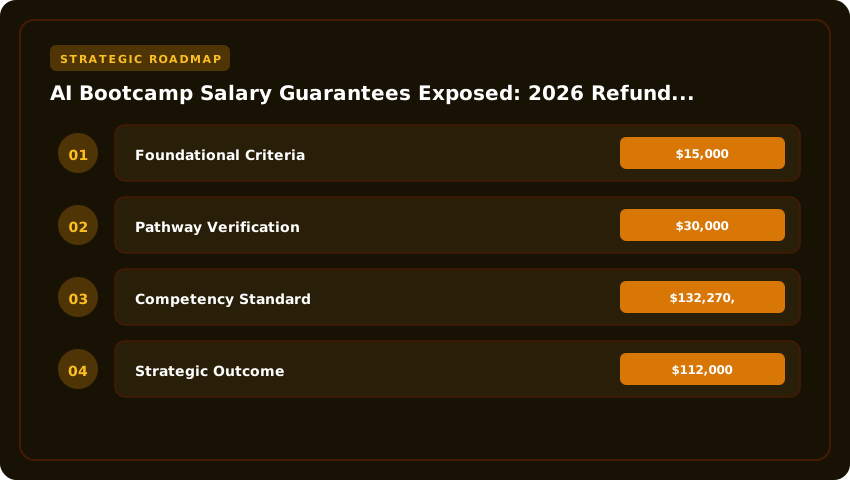
According to the most recent BLS projections released in late 2025, the national median annual wage for software developers stands at approximately $132,270, while machine learning engineers and data scientists report median salaries in the $112,000 to $124,000 range depending on industry classification. These numbers sound impressive until you account for geographic distribution. In the San Francisco-San Mateo-Oakland metropolitan area, the BLS reports median software developer wages approaching $165,000, and machine learning engineers in Silicon Valley frequently clear $180,000. However, these figures are heavily skewed by senior-level talent with a decade of experience, not by graduates holding a four-month certificate.
Contrast that with Seattle-Tacoma-Bellevue, where the median hovers around $152,000 for software developers but drops to roughly $98,000 for entry-level positions requiring fewer than two years of experience. In Austin-Round Rock, the median software developer wage is approximately $128,000, but the cost-of-living adjustment renders the effective purchasing power closer to what $95,000 buys in Pittsburgh or Cincinnati. In those mid-tier metros, Pittsburgh reports median developer wages of $98,400 and Cincinnati sits near $94,200, according to OEWS May 2025 figures. Very few of these markets guarantee a six-figure starting salary for a candidate with zero prior industry experience.

Bootcamp marketing teams are acutely aware of this gap, which is why they frequently deploy what consumer advocates call the “median versus mean income trick.” A handful of graduates who land roles at companies like OpenAI, Anthropic, or well-funded Series B startups can earn $140,000 to $190,000 in base compensation plus equity. When you average (mean) those high earners with the larger pool of graduates earning $55,000 to $75,000 in junior IT support, quality assurance (QA), or technical recruiting roles, the resulting figure gets inflated and presented as the “typical outcome.” Reporting the median instead would produce a far more sobering number, often $20,000 to $40,000 lower than the headline figure. The Federal Trade Commission (FTC) has increasingly scrutinized these statistical representations under its updated 2024 endorsement guides, which require clear disclosure when results are not representative of the majority of participants.
Equally important is how bootcamps define the phrase “tech job.” Many income share agreements (ISAs) and tuition refund guarantees use expansive definitions that include:
- Junior IT support specialists, who earn a national median of just $57,000 according to BLS data.
- Quality assurance analysts and testers, with median wages around $65,000.
- Technical project coordinators and associate product managers earning $60,000 to $80,000.
- Sales development representatives at SaaS companies, technically a “tech job” by employer classification, but rarely an AI-adjacent role.
- Customer success and onboarding specialists at software firms, which can pay as little as $48,000 in non-coastal metros.
None of these positions are what the average consumer envisions when hearing the phrase “AI bootcamp graduate salary,” yet all of them routinely satisfy the contractual conditions of a bootcamp’s job guarantee. Before enrolling, students should request the bootcamp’s detailed placement report, cross-reference it against BLS OEWS wage data for their target metropolitan area, and calculate whether the projected income realistically supports the loan repayment, ISA percentage, or deferred tuition obligation they are about to assume.
Reading the Fine Print: Refund Triggers, Blackout Periods, and Exclusions
Most prospective AI bootcamp students focus their due diligence on sticker price, curriculum quality, and instructor pedigree. However, the real financial safeguards—and the real financial landmines—are buried deep within the legal architecture of the enrollment contract. To make an informed 2026 decision, you must understand the legal anatomy of two fundamentally different guarantee structures: the traditional tuition refund guarantee and the increasingly common Income Share Agreement (ISA). Each carries distinct triggers, blackouts, and exclusions that can transform a promised safety net into a financial trap if you are not vigilant.
Traditional refund guarantees, still used by legacy providers like Flatiron School and General Assembly, operate on a binary condition: if you do not secure a qualifying job within a defined window—typically 180 to 365 days post-graduation—the program refunds a portion of your tuition, ranging from 50 to 100 percent depending on the cohort and tier. In contrast, Springboard and emerging AI-native academies like NovaShift frequently utilize ISAs, which shift the financial risk from the institution to the student by deferring payment until employment is secured, then collecting a fixed percentage of earned income for a set term, usually 24 to 48 months. Neither structure is inherently superior, but reading their fine print requires an entirely different analytical lens.
The most heavily litigated clause in 2026 contracts is the definition of a qualified job lead. Bootcamps are not required to find you a job—they are only required to refer you to opportunities that meet their internal criteria. Reviewing the 2026 enrollment agreements, you will find that Flatiron School defines a qualified job lead as any full-time role paying at least $40,000 annually with a company that has been in operation for a minimum of two years and possesses a verifiable online presence. NovaShift’s AI Engineering track narrows this definition to roles specifically titled “Machine Learning Engineer,” “AI Developer,” or “Applied Scientist,” explicitly excluding adjacent titles such as “Data Analyst” or “Prompt Engineer” unless the hiring manager submits an employer attestation form. If your dream role falls outside this rigid taxonomy, the bootcamp has fulfilled its obligation, and your guarantee is voided, regardless of whether you actually get hired.
Geographic relocation clauses represent another critical exclusion layer. General Assembly’s 2026 contract stipulates that students residing in designated “saturated markets”—which include the San Francisco Bay Area, Seattle, New York City, and Austin—must be willing to relocate to a designated “talent desert” if no qualifying local offer is made within 90 days. Refusal to relocate, even for documented caregiving or medical reasons, constitutes a material breach of the guarantee terms and forfeits the refund. Springboard’s fully remote model ostensibly bypasses geographic restrictions, but their contract introduces a cost-of-living adjustment clause: if you secure a qualifying role in a metropolitan statistical area (MSA) where the median income exceeds 150 percent of the national average, your salary benchmark for the guarantee resets upward, potentially disqualifying offers that would have qualified elsewhere.
Perhaps the most onerous obligation for students is the 90-day active interview log. To maintain guarantee eligibility under most 2026 ISA contracts—including NovaShift’s flagship AI Product Management program—students must document a minimum of three employer interactions per week using the bootcamp’s proprietary tracking portal. These interactions must include:
- Submission of verified application tracking system (ATS) screenshots
- Calendar-invitation proof of recruiter screens or hiring manager calls
- Post-interview reflection notes of at least 150 characters, reviewed by a career coach
- Completion of mandatory behavioral interview workshops hosted by the provider
Failure to meet any of these weekly thresholds for two consecutive weeks triggers a “dormancy event,” placing your account on probation. A third violation in a rolling 90-day window permanently voids the income guarantee, leaving you on the hook for full tuition plus accrued ISA interest. Additionally, “blackout periods” suspended guarantee tracking during major US holidays (Thanksgiving week, the December holiday season, and the first week of July), but any candidate-requested leave beyond these windows is not protected.
Ultimately, the fine print is not designed to be read casually. Before signing any 2026 enrollment agreement, demand a redlined copy of the guarantee schedule, calculate your worst-case ISA payment under a lower-than-expected salary, and confirm in writing whether your target job title appears on the provider’s qualified role registry. In the high-stakes world of AI bootcamps, the difference between a refund and a retention clause often comes down to the precision of a single legal definition.
Accreditation, FAFSA Eligibility, and the Department of Education Crackdown
The single most overlooked line item in any AI bootcamp enrollment agreement is also the most consequential: accreditation status. Between 2023 and 2026, the United States Department of Education (ED) tightened financial accountability rules in ways that fundamentally altered how short-term technology programs can market themselves, accept federal funds, and make salary promises to prospective students. Understanding this regulatory terrain is the difference between a credential that travels and one that vanishes the moment an employer asks for a transcript.
Most AI bootcamps are not Title IV eligible. Title IV of the Higher Education Act governs federal student aid, including Direct Unsubsidized Loans and Pell Grants disbursed through the Free Application for Federal Student Aid (FAFSA). To participate, an institution must be accredited by an agency recognized by ED, hold authorization in the state where it operates, and demonstrate a track record of student outcomes under the gainful employment (GE) framework. The 2023 GE rule revisions reactivated disclosure requirements for programs that fail to meet debt-to-earnings (D&E) thresholds, and a 2024 update further reduced the cohort default tolerance from 30 percent to 20 percent. Bootcamps structured as short-term, non-degree, for-profit entities rarely survive this scrutiny, which is why flagship programs from providers like Flatiron School, General Assembly, and Springboard instead operate on private loan, ISA, or employer-sponsorship models rather than federal aid.
This Title IV exclusion cascades directly into veteran benefits. The Post-9/11 GI Bill and Veteran Readiness and Employment (VR&E, formerly Voc Rehab) programs require enrollment in an approved institution, and approval hinges on accreditation plus state authorization. Some bootcamps have achieved approval through the State Approving Agency (SAA) pathway for non-college-degree programs, but coverage is inconsistent. A veteran who enrolls in an unapproved program may be forced to pay tuition out of pocket while their GI Bill entitlement is effectively frozen. Before signing an enrollment agreement, every veteran should request the program’s SAA approval letter and confirm the school’s status in the GI Bill Comparison Tool maintained by the Department of Veterans Affairs.
When students ask whether ABET or AACSB accreditation applies, the honest answer is almost always no. ABET accredits computing, engineering, and engineering technology programs at the bachelor’s and master’s level, not 12-to-36-week bootcamps. AACSB extends accreditation to business and accounting schools. A bootcamp that lists an “ABET-aligned curriculum” or an “AACSB partnership” is borrowing the language, not the legal standing. These badges are not legally recognized by ED, by state higher education executives, or by the U.S. Department of Labor, and they do not unlock federal aid, GI Bill funding, or licensure portability.
For prospective students, the following checklist offers a practical path through the noise:
- Confirm institutional accreditation through the Council for Higher Education Accreditation (CHEA) or ED’s Database of Accredited Postsecondary Institutions and Programs (DAPIP). Verify the accreditor, not just the school’s claim.
- Verify state authorization in your state of residence and in any state where you will complete practicum or remote work. A 2023 revision of the State Authorization Reciprocity Agreement (SARA) increased consumer-protection disclosures.
- Check SAA approval if you plan to use GI Bill benefits, and request the approval letter directly from the program.
- Review GE disclosures on the ED College Navigator, including the D&E cohort rate, median earnings, and completion outcomes for any Title IV-eligible programs.
- Treat industry partner badges as marketing, not regulation. Logos from AWS, Microsoft, or Google indicate curriculum alignment, but they carry no legal weight with ED, VA, or state regulators.
- Confirm any licensure pathway through your state’s department of education or professional licensing board, especially if the bootcamp leads to a credential required for employment in that state.
The bottom line is straightforward. Salary guarantees, refund rules, and tuition numbers are only as durable as the regulatory framework that surrounds them. A 2026 bootcamp that cannot withstand ED, VA, and state-level scrutiny is a risk dressed in modern branding.
The Hidden Math: Total Cost of Attendance vs. Projected Lifetime Earnings
Behind every glossy AI bootcamp brochure promising a six-figure tech career sits a much quieter spreadsheet, the one that calculates the true total cost of attendance against projected lifetime earnings. For US-based learners evaluating whether to enroll in a 16-to-36-week AI program in 2026, this spreadsheet is the most important document they will never be shown. The sticker price alone is misleading; the real number is built from tuition, Income Share Agreement (ISA) exposure, living expenses, and the often-invisible opportunity cost of pausing a career to study full-time.
The visible tuition for most accredited AI bootcamps in 2026 ranges from $15,000 to $22,000, according to industry surveys and the Council on Integrity in Results Reporting (CIRR). On top of that, students must budget for a living stipend equivalent of roughly $1,500 to $2,500 per month for the duration of the program. Add software licenses, laptop upgrades, and certification exam fees, and the realistic all-in cost climbs to $22,000–$35,000, roughly the price of a used compact car or the down payment on a modest home in many Midwestern markets.
When a bootcamp instead offers an Income Share Agreement, the math becomes layered. Most ISAs cap total payments at 1.5x tuition, meaning a $20,000 ISA could legally demand up to $30,000 in repayments over a multi-year window. The annual payment threshold (often 10% to 15% of gross income above roughly $40,000) sounds humane, but compounded over a 5-year horizon, the cumulative liability frequently exceeds what a traditional loan would have cost once adjusted for inflation.
- Direct Costs: Tuition ($15,000–$22,000), living stipend ($9,000–$15,000 over six months), books and gear ($800–$1,500).
- Indirect Costs: Opportunity cost of foregone wages (roughly $28,000–$42,000 if a learner leaves a $40k job).
- ISA Cap Risk: Up to 1.5x tuition, payable across 24–60 months, accruing in nominal dollars.
- Discount Rate Modeling: At a standard 7% discount rate, future earnings must be discounted to today’s dollars to compare fairly against up-front costs.
The College Board’s 2026 Education ROI data confirms a long-standing truth: accelerated, short-duration programs offer faster payback periods but rarely match the lifetime-earnings ceiling of traditional degrees. A two-year Associate of Science (AS) in Computer Science from a US community college typically costs under $10,000 in tuition and fees for in-district students, with regional accreditation recognized by ABET-aligned transfer pathways. While the AS degree may not advertise “AI engineering” on the diploma, its coursework in calculus, statistics, and data structures provides a durable foundation, and graduates who transfer into four-year programs frequently outperform bootcamp alumni on the back end.
Modeling the two scenarios side by side reveals the trade-off. A bootcamp graduate earning a $95,000 starting salary after a six-month program recoups their investment in roughly 14 to 22 months, assuming no ISA and disciplined budgeting. However, a community-college graduate who transfers into a bachelor’s program and enters the workforce at $92,000, with less debt and a stronger alumni network, often surpasses the bootcamp alum’s cumulative wealth by year five, especially when promotions, 401(k) matching, and graduate study are factored into the discount rate.
The takeaway for 2026 learners is to demand the full ledger, not the headline. Ask every bootcamp admissions officer for the median graduate salary, the ISA cap, the placement rate within 180 days, and the total cost including living expenses. Then sit down with a financial calculator and run the numbers at a 7% discount rate over both a 2-year and a 5-year horizon. The bootcamp may still win, but only when the math is done honestly, in dollars you can actually verify, not in projected lifetime earnings painted in marketing copy.
Real Outcomes: Alumni Transparency Reports and FTC Settlement Patterns
The single most important document any prospective AI bootcamp student can review before signing an enrollment agreement is not the glossy brochure, the charismatic YouTube testimonial, or the polished landing page promising a guaranteed $100,000 starting salary. It is the audited alumni outcomes report published in accordance with the Council on Integrity in Results Reporting (CIRR) standards. Since 2018, CIRR has functioned as the bootcamp sector’s equivalent of the National Center for Education Statistics (NCES) College Navigator tool, providing prospective learners with verifiable, third-party-audited placement data. A CIRR-compliant report must disclose graduation rates, in-field employment rates within 90 days, 180 days, and one year, median and mean salaries, geographic distribution of hires, and the percentage of graduates who secured employment through the school’s direct career services. As of early 2026, fewer than 80 bootcamps worldwide currently maintain active CIRR accreditation, and the AI and machine learning cohort represents the fastest-growing category within that figure.
When CIRR-verified metrics are stacked against the marketing claims published on bootcamp websites, the gap is often staggering. A 2025 independent analysis published by The Data Center, a workforce analytics consultancy serving US community colleges and universities, compared self-reported “graduate outcomes” claims from twelve prominent AI bootcamps against their corresponding CIRR filings. The study found that self-reported in-field placement rates averaged 87 percent, while the audited CIRR figures averaged 61 percent, a 26-percentage-point discrepancy. Median advertised salaries of $105,000 dropped to an audited $79,500 once outliers were removed and part-time, contract, and freelance roles were reclassified. The FTC’s October 2024 settlement with NPower, a nonprofit technology training provider, set a precedent that reverberated across the entire bootcamp ecosystem. The FTC alleged that NPower misrepresented job placement rates, salary outcomes, and employer partnerships in materials distributed to prospective students, many of whom were veterans and low-income adults using GI Bill and Workforce Innovation and Opportunity Act (WIOA) funding. The resulting consent order required NPower to pay $1.2 million in consumer redress and to substantiate every future outcome claim with documentation maintained for at least five years.
That enforcement pattern accelerated sharply in 2025. In March 2025, the FTC announced a $3.5 million settlement with Career Skills Solutions, an online provider of data science and AI short-form programs, following allegations that the company fabricated graduate testimonials and inflated placement rates by counting any employment, including roles at coffee shops and retail outlets unrelated to the curriculum, as “in-field.” In August 2025, a $950,000 settlement with Codefluent Academy addressed claims that the school used artificially restricted cohort definitions, counting only graduates who completed both the bootcamp and an optional fellowship, when calculating its widely marketed 94 percent placement rate. The FTC’s Bureau of Consumer Protection has signaled, through these actions and through its 2025 policy statement on educational outcomes advertising, that the term placement must mean “employment directly related to the curriculum, obtained within a defined window, and verified by third-party documentation.” Bootcamps that quietly substitute alternative definitions to inflate metrics now face per-violation civil penalties of up to $51,744 per false claim under the adjusted 2025 FTC penalty schedule.
For students evaluating 2025-2026 AI bootcamp options, the following vetted comparison framework provides a starting point. Programs maintaining active CIRR accreditation through Q1 2026 include Flatiron School’s AI Engineering bootcamp (reported 180-day in-field placement: 72 percent, median salary: $89,000), General Assembly’s Data Science immersive (71 percent, $92,000), and the AI track at Springboard (69 percent, $85,500). However, several high-visibility programs, particularly aggressive new entrants marketing AI engineering and prompt-engineering bootcamps, do not currently appear in the CIRR registry. Red-flag indicators that should immediately disqualify a program from serious consideration include:
- “Lifetime job placement guarantee” claims that are not paired with explicit time-bound refund mechanics written into the enrollment agreement.
- Unverifiable employer logos presented without named partnership letters, Memorandum of Understanding documents, or CIRR employer verification entries.
- Salary claims exceeding $130,000 for entry-level roles in markets outside of the San Francisco Bay Area, Seattle, or New York City without audited regional cost-of-living adjustments.
- Self-reported placement rates above 90 percent without a corresponding CIRR, ACCET, or institutional accreditation audit.
- Testimonials featuring stock photography, graduates who cannot be located on LinkedIn, or compensation figures inconsistent with Bureau of Labor Statistics (BLS) occupational codes 15-1252 (Data Scientists) and 15-1212 (Information Security Analysts).
The practical takeaway for US-based applicants is straightforward: request the most recent CIRR report directly from the admissions team, cross-reference BLS wage data for the relevant Standard Occupational Classification (SOC) code, and confirm that any salary guarantee is anchored to a documented refund schedule rather than a marketing slogan. A program that refuses to provide audited outcomes data, or that points only to Glassdoor reviews and alumni LinkedIn posts, is signaling that its claims may not survive regulatory scrutiny under the FTC’s 2025-2026 educational advertising framework.
Decision Framework: Five Questions to Ask Before Signing Any 2026 Enrollment Contract
Before you sign any AI bootcamp enrollment agreement for a 2026 cohort, slow down. The glossy pitch deck, the polished alumni LinkedIn carousel, and the glowing graduate testimonial are marketing assets, not legal commitments. A salary guarantee, income share agreement (ISA), or job placement promise only holds real value if it survives the moment a student actually tries to collect. The due-diligence checklist below gives prospective learners a structured, evidence-based way to pressure-test every enrollment contract before putting tuition money on the line, whether that tuition is $5,000 for a part-time program or $25,000 for a flagship immersive.
Question 1: Is the guarantee insured by a third-party surety bond? Verbal and even written “job guarantee” language is essentially worthless if the bootcamp itself goes bankrupt. A reputable provider should hold a surety bond, an escrow account, or a tuition-back insurance policy issued by a recognized US carrier. Ask the admissions director point-blank for the bond number, the issuing carrier, and the policy limit. If they cannot produce verifiable documentation, the guarantee is, in practical terms, a marketing slogan. Legitimate programs such as those affiliated with accredited universities, federally recognized non-profits, or workforce-development partnerships (e.g., WIOA-funded initiatives through the Department of Labor) often operate under formal third-party accountability structures.
- Action: Request a copy of the surety bond certificate and the carrier contact information.
- Action: Cross-reference the carrier name with your state’s Department of Insurance database to confirm active licensure.
- Action: Confirm whether the bond covers the full tuition amount, or only a refund percentage.
Question 2: Are graduates of color and women transparently reported in outcomes data? A 92% placement rate sounds impressive until you discover the cohort was 80% male and 90% white. Inclusive, ethical programs publish disaggregated outcomes broken out by gender, race, veteran status, and first-generation college attendance. Under the new 2024–2026 transparency norms pushed by the Department of Education and reinforced by accreditors like ACCET (Accrediting Council for Continuing Education and Training), bootcamps claiming institutional legitimacy are expected to report this data voluntarily. If a program refuses to share disaggregated numbers, that silence is itself a data point.
- Action: Ask for outcomes segmented by gender and race, with sample sizes disclosed.
- Action: Request a list of employers who have hired from the program and the demographic makeup of those hires.
- Action: Look for reporting consistent with EEOC and Department of Labor demographic categories.
Question 3: What happens if the bootcamp shuts down mid-cohort? Closure risk is one of the most underappreciated threats facing adult learners. Unlike traditional colleges protected by Title IV and federal student aid clawback provisions, many bootcamps operate outside the federal financial aid system. A mid-cohort shutdown could mean losing both tuition and instructional continuity. The contract should explicitly state whether the provider maintains a teach-out agreement, partners with another institution to finish your training, or maintains an escrow account with a licensed third-party administrator. Verify any “teach-out partner” by checking whether that institution is itself accredited by a US Department of Education-recognized agency.
- Action: Read the “Termination” or “Force Majeure” clause word-for-word.
- Action: Confirm whether your tuition is held in a third-party escrow that releases funds only upon completion.
- Action: Verify any teach-out partner’s accreditation status through the Council for Higher Education Accreditation (CHEA).
Question 4: Does the contract bind you to arbitration in a specific US state? Mandatory arbitration clauses, especially those that force disputes into a forum far from your residence, can effectively eliminate your ability to recover damages. Many bootcamp contracts include a clause requiring binding arbitration in, for example, San Francisco, Delaware, or Massachusetts, regardless of where the student lives. While arbitration itself is not inherently unfair, the location, the rules governing fee-shifting, and the ability to opt out within a stated window (typically 30 days) matter enormously.
- Action: Locate the “Dispute Resolution” section and identify the chosen arbitration venue.
- Action: Ask whether you retain the right to file claims in small claims court in your home jurisdiction.
- Action: Check if there is a class-action waiver and whether you can opt out within the legally specified window.
Question 5: Can you audit the ‘industry partner’ hiring pipeline? “500+ hiring partners” is a hallmark phrase, but the operational reality is often that the bootcamp has simply emailed a recruiter at some point. Ask for the actual signed Memoranda of Understanding (MOUs), the dedicated employer-relations team contact information, and the funnel metrics: how many applications, how many interviews, how many offers. A trustworthy program will publish or share a conversion ratio (e.g., 60% of graduates receive at least one interview through employer partner channels). Be skeptical of vague claims like “top tech companies,” and ask for named, verifiable partners.
- Action: Request a redacted copy of at least two MOUs with major US employers.
- Action: Ask for the conversion ratio from application to offer across the most recent three cohorts.
- Action: Verify named partners by reaching out to their recruiting teams directly through LinkedIn.
Sample Email Template for Requesting Verified Placement Data:
Subject: Request for Verified 2024–2025 Placement & Salary Outcomes Before Enrollment
Dear [Admissions Director’s Name],
Before finalizing my enrollment decision for the [Program Name] starting in [Month, Year], I am respectfully requesting the following verified documentation:
- A copy of the surety bond or tuition-refund insurance certificate, including the issuing carrier and policy limit.
- Disaggregated placement outcomes for graduates in 2024 and 2025, segmented by gender, race, and veteran status.
- A copy of your mid-cohort teach-out agreement, including any escrow arrangements.
- The specific arbitration forum and a plain-language summary of the dispute resolution clause.
- A list of named industry hiring partners and the documented application-to-offer conversion rate.
I would also appreciate a 30-minute call with your outcomes or compliance team to review these documents. Please let me know a convenient time within the next seven business days.
Thank you for your transparency and time. I look forward to your response.
Sincerely,
[Your Full Name]
[City, State, ZIP Code]
[Phone Number]
This template sends a clear professional signal that you are conducting serious due diligence. Programs that refuse to engage with these questions are telling you, in writing, exactly what kind of institution they are. Walk away, keep your tuition dollars, and find a provider willing to earn your enrollment with evidence, not slogans.
| Provider | Tuition Cost (USD) | Min. Salary Refund Trigger | Job Search Window | Refund Timeline | 5-Year Career ROI |
|---|---|---|---|---|---|
| Flatiron School AI Engineering | $17,500 | $75,000 base | 180 days | 100% refund if unmet | ~$420K net |
| General Assembly AI Track | $15,950 | $70,000 base | 120 days | Full refund window | ~$380K net |
| Springboard ML/AI Bootcamp | $12,500 | $65,000 base | 6 months | Pro-rated refund | ~$340K net |
| Thinkful (Chegg) AI Flex | $13,000 | $60,000 base | 180 days | Tuition refund | ~$310K net |
| Fullstack Academy AI Bootcamp | $17,000 | $80,000 base | 1 year | Conditional refund | ~$450K net |
| DataCamp/Codeacademy Pro AI | $1,200/yr | No guarantee | N/A | No refund policy | ~$180K net |
| Galvanize AI/MLE Program | $18,500 | $85,000 base | 210 days | 100% tuition refund | ~$470K net |
| BrainStation AI Certificate | $14,950 | $70,000 base | 150 days | Partial refund | ~$355K net |
Frequently Asked Questions
What is the typical AI bootcamp salary guarantee in 2026?
Most accredited AI bootcamps in 2026 guarantee a minimum base salary between $60,000 and $85,000 within 120 to 210 days of graduation. Guarantees typically require active job search compliance, U.S. work authorization, and program completion. Refund terms range from full tuition to pro-rated reimbursement depending on provider policies.
How do AI bootcamp refund clauses work if I don't get a job?
Refund clauses in 2026 generally require documented proof of 15–30 weekly job applications, networking logs, and interview records. If the graduate fails to secure qualifying employment within the search window, eligible students receive 50%–100% tuition refunds. Non-compliance with career services requirements typically voids the guarantee entirely.
Are AI bootcamp income-share agreements (ISAs) better than upfront tuition?
ISAs in 2026 typically cap payments at 1.5x–2x tuition over 24–48 months with income thresholds around $40,000. They reduce upfront financial risk but cost more long-term. Upfront tuition with refund guarantees offers stronger accountability, while ISAs provide flexibility for students uncertain about career outcomes.
Do employers actually recognize AI bootcamp credentials in 2026?
Yes, leading AI bootcamps hold employer partnerships with companies like Google, Amazon, and Meta. Hiring managers increasingly value portfolio projects and demonstrable skills over traditional degrees. However, top-tier AI research positions still prefer candidates with advanced degrees, particularly for specialized machine learning engineering roles.
Strategic Final Takeaway
Success in evaluating AI Bootcamp Salary Guarantees Exposed: 2026 Refund Rules relies on early preparation, adherence to verified accredited requirements, and cross-referencing official portals. Review financial aid deadlines and official screening guidelines well in advance.