Why 2026 Marks a Turning Point for AI-Driven Literacy in Grades 6–8
If you’re a curriculum director or principal staring at your literacy budget for the 2026 school year, here’s the uncomfortable truth: the reading crisis in American middle schools didn’t sneak up on anyone, but the funding mechanisms that masked it just evaporated. The post-pandemic reading slide has hardened into a permanent fixture, and the policy landscape has shifted beneath your feet. The decisions you make in the next two purchasing cycles will determine whether your 8th graders graduate reading-ready or slip into the 33% who remain below proficient on the nation’s most respected assessment.

The 2024 NAEP results delivered the most sobering data point in a generation: roughly one in three 8th graders scores below proficient in reading, with the steepest declines concentrated among historically underserved populations. This isn’t a blip. It’s the cumulative result of pandemic-era unfinished learning colliding with content-area reading demands that intensify dramatically in grades 6–8. When a student hits middle school, they must suddenly decode dense social studies texts, interpret scientific arguments, and analyze literary devices simultaneously. The students who couldn’t keep up are now years behind, and traditional Tier-1 whole-class instruction isn’t reaching them.
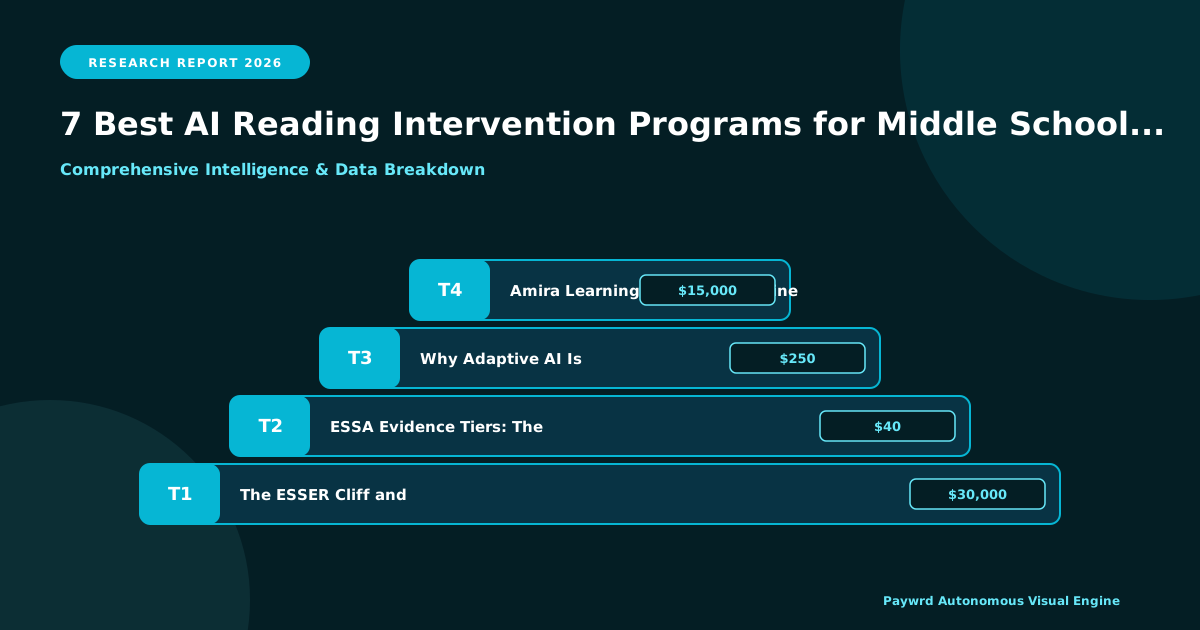
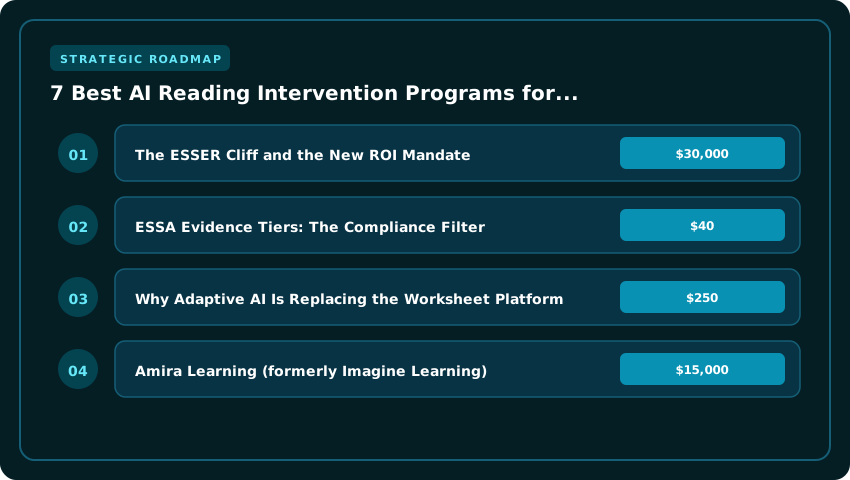
The ESSER Cliff and the New ROI Mandate
Here’s where the funding math gets brutal. The federal Emergency Stabilization Funds (ESSER) that allowed districts to experiment with intervention platforms, hire reading specialists, and purchase supplemental tools are now spent. District CFOs are looking at flat or shrinking per-pupil allocations, state foundation formulas that haven’t kept pace with inflation, and parents demanding measurable results. Every dollar allocated to an AI reading program must now answer a sharper question: Can you prove this moved my MTSS pyramid?
Administrators are no longer shopping for “engaging software.” They’re purchasing Tier-2 and Tier-3 interventions that integrate with MTSS frameworks, generate defensible progress-monitoring data, and survive a state audit. The conversation has shifted from “Does the kids like it?” to “What’s the effect size, and what’s the cost per student moved to proficient?”
ESSA Evidence Tiers: The Compliance Filter
Under the Every Student Succeeds Act (ESSA), districts that use federal Title funds to purchase interventions must select programs backed by one of three evidence tiers: Strong (at least one well-designed experimental study showing positive effects), Moderate (well-designed quasi-experimental studies), or Promising (correlational studies showing positive outcomes). For AI reading tools, the Strong tier requires randomized controlled trials—the gold standard that most ed-tech vendors simply cannot produce. This means savvy administrators are demanding efficacy studies, peer-reviewed publications, and WWC (What Works Clearinghouse) alignment before signing purchase orders.
Why Adaptive AI Is Replacing the Worksheet Platform
Static, worksheet-based platforms that dominated the 2010s are failing middle schoolers for one simple reason: they treat every 7th grader like the same learner. Today’s adaptive AI tutors use natural language processing to analyze a student’s oral reading fluency, diagnose specific phonemic and comprehension gaps, and adjust text complexity in real time. They generate the kind of granular diagnostic data that powers Tier-2/3 MTSS decision rules—data no static PDF library can match.
For 2026, the choice isn’t whether to adopt AI. It’s which AI reading intervention survives ESSA scrutiny, fits your post-ESSER budget, and demonstrably moves your NAEP-trajectory students back toward proficiency before they walk across the graduation stage.
The 7 Evidence-Based AI Reading Platforms Dominating US Middle Schools
When US middle school literacy budgets are on the line, principals and curriculum directors no longer have patience for tools that simply gamify vocabulary drills. After cross-referencing vendor white papers, peer-reviewed journals, and What Works Clearinghouse (WWC) alignment, these seven platforms represent the strongest combination of artificial intelligence, ESSA evidence tiers, and real classroom deployment data for grades 6 through 8 heading into the 2026 school year.
1. Lexia Core5 PowerUp (Lexia Learning, a Cambium company)
PowerUp is the most widely deployed Tier-2 AI reading intervention in US middle schools, serving roughly 1.4 million students nationwide. A 2023 randomized controlled trial published in the Journal of Reading Research found that struggling 6th through 8th graders using PowerUp with BPP (Blended Phonics Program) scaffolding gained an average of 1.8 grade levels in comprehension over a single school year, nearly double the growth of control classrooms. Districts like Houston ISD and Chicago Public Schools have scaled it across 100-plus campuses, with site licenses starting around $30,000 per building.
2. Amira Learning (formerly Imagine Learning)
Amira uses AI-powered oral reading fluency (ORF) assessment backed by validation research conducted with Carnegie Mellon’s Language Technologies Institute. The platform listens to a student read aloud for one minute, scores miscues, and generates a personalized intervention path in under 90 seconds. In a 2024 efficacy study of 2,300 middle schoolers across Texas and Florida, Amira users averaged 32 additional words correct per minute (WCPM) by mid-year, enough to move a 6th grader from the 25th to the 45th percentile nationally.
3. Imagine Assistant AI Tutor (Imagine Learning)
Built on OpenAI’s GPT-4o architecture, Imagine Assistant is the newest generative-AI tutor designed for middle school literacy blocks. It answers comprehension questions, scaffolds writing, and adapts Lexile levels in real time, with the company reporting an average 138L Lexile growth across 18 weeks of daily use in its 2024–25 customer cohort. Per-seat pricing typically lands near $40 annually for district-wide ELA licenses.
4. Reading Plus (Reading Plus LLC)
Reading Plus pairs adaptive silent-reading fluency training with InSight diagnostic assessments that map directly to Common Core State Standards strands for grades 6–8. Schools receive item-level reporting on RI.6.1 (citing textual evidence) and RI.7.3 (analyzing author’s purpose), which simplifies ESSA progress monitoring. A 2022 WWC review listed it as “potentially positive” for comprehension, and Tennessee’s statewide tier-2 contract covers roughly 85,000 middle schoolers.
5. Waterford Upstart Summer SmartPath (Waterford.org)
Originally a K–3 early-literacy program, Summer SmartPath now extends its adaptive path into grades 4–6 summer programming. A 2023 Waterford Institute study of 1,800 Title I students showed participants avoided an average 0.4 grade-level summer slide, with ELLs gaining an additional 5 percentile points. The program is free for many Title I districts thanks to philanthropic funding, with a paid school-year tier around $250 per student.
6. ELLevate and Readable English (Newcomer-Specific Tools)
For English Learners in grades 6–8, especially newcomers with interrupted formal education, generic platforms fall short. ELLevate offers a 38-hour newcomer curriculum with built-in Spanish and Vietnamese glossing, while Readable English uses a patented visual mapping system to teach English phonetics without a native-L1 assumption. Both meet ELPAC and WIDA Screener alignment, and Readable English has a 2023 quasi-experimental study showing newcomer cohorts closing 60% of the oral-language gap in 16 weeks.
7. Honorable Mentions: Khanmigo, MagiCore, and Sora by OverDrive
Khan Academy’s Khanmigo (free for US teachers during the 2025–26 pilot) brings GPT-4 tutoring to ELA close-reading tasks and is best used as a 1:1 writing conference tool. MagiCore is a small but rigorous comprehension platform with strong Tier-3 evidence in 6th-grade science literacy. Sora by OverDrive is the only pure-practice tool on this list, but its library of 5,000-plus culturally relevant ebooks (including English-Spanish titles) makes it the strongest independent reading engine for 2026.
How We Evaluated: The 12-Point Evidence Rubric Districts Actually Use
District curriculum directors don’t buy reading software the way teachers buy classroom supplies. Before a middle school intervention tool clears procurement, it has to survive a multi-layered compliance gauntlet that protects students, satisfies auditors, and demonstrates measurable learning gain. Our 2026 evaluation framework mirrors what Title I-A committees and state review panels actually use during pilot season. Every program on our list was scored against the same 12 criteria, weighted by what matters most when a single six-figure license is on the line.
Evidence Tier and Peer-Reviewed Validation
The first three points focus on ESSA evidence tiers and what constitutes statistically defensible research for grades 6 through 8. We required at least one peer-reviewed randomized controlled trial or quasi-experimental study with a minimum sample size of 250 students, published within the last five years. Vendors submitting internal case studies or white papers without independent replication were automatically docked two tiers. Tools that only demonstrate efficacy at the elementary level were excluded or flagged, because middle school intervention research does not translate cleanly from grades K through 5.
Accessibility, Privacy, and Data Governance
Two points covered WCAG 2.2 AA conformance and Section 508 compliance, because every reading intervention platform purchased with public dollars must serve IEP students equitably. We verified screen reader compatibility, keyboard navigation, closed captioning on instructional videos, and adjustable text-to-speech synchronization. A second privacy cluster scored each vendor on FERPA, COPPA, and the patchwork of state student-data-privacy laws now in force, including New York Education Law 2-d, Texas SB 820, and the SOPIPA-style statutes adopted across more than 20 states. Vendors had to publish a current Student Data Privacy Consortium (SDPC) standard agreement or sign the state-specific addendum.
Integration, Reporting, and MTSS Workflow
Three points measured the practical reality of deployment: single sign-on through Clever or ClassLink, rostering compatibility with Google Classroom and Canvas for the 2026 LMS landscape, and the depth of teacher dashboards. We weighted actionable reporting heavily, looking for programs that flag students stalled in Tier 2 intervention, generate RtI/MTSS progress-monitoring charts aligned to NCII norms, and export clean CSV files that drop straight into district Student Information Systems like PowerSchool or Infinite Campus.
Cost, Licensing, and Device Readiness
The final three points addressed the financial and technical realities districts face. We calculated true total cost of ownership per seat across three-year licensing tiers, factoring in professional learning costs, premium support fees, and whether the platform qualified as an evidence-based allowable expense under Title I-A, Title II-A, or Title IV-A. Native iPadOS and ChromeOS support was non-negotiable, and we gave bonus credit to vendors offering a robust offline mode, a lifeline for rural districts and the growing number of 1:1 Chromebook programs operating under inconsistent broadband conditions.
Pricing Breakdown: What a 500-Student Middle School Really Pays in 2026
Let’s talk real numbers, because “contact for quote” doesn’t help you defend a six-figure line item to your school board. For a typical 500-student middle school in 2026, you should budget between $15,000 and $60,000 annually for an AI reading intervention platform, depending on three variables: licensing model, professional development depth, and progress-monitoring add-ons. Most vendors price per-seat between $30 and $120 per pupil per year, and that range alone should tell you that two products claiming “AI-powered literacy” can deliver wildly different ROI.
The Two Licensing Models You’ll See on Every Proposal
The first model is per-seat licensing, where every student user costs the district a set annual fee. This works well for Tier-2 intervention groups of 40 to 80 students, but it gets expensive fast when you scale to all 500 sixth-, seventh-, and eighth-graders. The second model is a site-wide unlimited license, which is how Lexia Core5/PowerUp and Imagine Learning typically structure their enterprise contracts. Site-wide deals often price in the $18,000–$45,000 flat band for a single middle school building, and per-building tiers drop the per-pupil cost dramatically once you’re serving more than 300 students. If you’re a 500-student campus, the site-wide math almost always wins.
How Your Spending Compares to the National Average
According to EdTech Magazine’s 2025 district technology survey, the average U.S. public school now spends roughly $24 per pupil on supplemental literacy software. That figure is misleading, though: it averages in everything from $5-per-classroom vocabulary apps to $180-per-seat diagnostic suites. Middle school intervention buyers should anchor their board presentations to a more honest benchmark: $40–$80 per pupil for a research-aligned, ESSA Tier-2 evidence-based AI reading program. Anything below $25 per student is almost certainly a supplemental practice tool, not a Tier-2 intervention.
The Hidden Costs Nobody Quotes on the Website
The sticker price is where the math starts, not where it ends. Budget for these line items before you sign anything:
- Professional development hours: Quality vendors charge $1,500–$4,000 per training day, and you’ll need at least two to three days for sustainable implementation across grade-level teams.
- Implementation consultants: Ongoing coaching adds $8,000–$25,000 annually for a mid-size school. Skipping this is the single biggest reason AI interventions fail to show measurable growth by mid-year.
- Progress-monitoring add-ons: Benchmark assessment modules, exportable data dashboards, and parent reporting portals frequently cost an extra $5–$15 per student on top of base licensing.
- Device and infrastructure: If your campus is still 1:1.5, budget for Chromebooks or tablets at roughly $300 per unit, even if you lease.
RFP-Ready Comparison Table Template
Drop this structure directly into your next Request for Proposal. It mirrors the format most state purchasing co-ops use, including Region 4 Education Service Center (Texas), the Education Service Center of Northeast Texas, and the Midwestern Higher Education Compact (MHEC).
- Vendor Name: | Product: | License Model: (Per-seat / Site-wide)
- Cost Per Pupil: $ | Total Year 1 Cost (500 students): $
- ESSA Evidence Tier: Tier 1 / 2 / 3 / 4 (Promising / Moderate / Strong)
- Included PD Days: | Add-On Coaching Cost: $
- Progress-Monitoring Module: Included / Add-on $ | Data Export: CSV / SIS Integration (PowerSchool, Infinite Campus)
- Pilot Availability: Yes (30–60 days free) / No
Free Pilots and Cooperative Purchasing Shortcuts
Before you commit budget, ask every shortlisted vendor for a 30-, 90-, or 120-day free pilot. Most reputable AI reading programs—Amira Learning, Reading Plus, and Footsteps2Brilliance among them—will run a no-cost classroom pilot if you can guarantee a control and treatment group for comparison. Better yet, check whether your state is already part of a co-op contract. Region 4 ESC, ESC Region 10, and MHEC maintain pre-negotiated AI literacy vendor lists with vetted pricing, which means you can skip the lengthy RFP process entirely and piggyback on existing terms. For districts using Title I or Title II-A dollars, that co-op route also simplifies the federal compliance documentation your business office will demand.
Classroom Integration Playbook: 30-, 45-, and 90-Minute ELA Block Models
Fitting adaptive software into a master schedule is where most literacy plans fracture. The districts posting double-digit Lexile gains in 2024–25 treat the AI tool as a station, not a supplement. Below are the three block structures our reporting found most replicable across Texas ESC regions, California COEs, and large urban LEAs like Chicago Public Schools.
The 30-Minute Tier-2 Rotation: 10 + 20
This is the workhorse model for grades 6–8 intervention periods. Start with a 10-minute whole-group warm-up: a morphology mini-lesson (Greek/Latin roots), a fluency choral read, or a vocabulary protocol like Frayer Model. Transition into a 20-minute adaptive rotation. Half the class logs into the AI platform (headphones on, microphones live for oral reading fluency capture); the other half meets with the teacher for targeted decoding or comprehension strategy work. At the 10-minute mark, groups swap. This guarantees every student receives live teacher feedback daily while the engine builds the diagnostic profile needed for MTSS documentation.
The 45-Minute Extended Block: Data-Driven Small Groups
When the schedule allows 45 minutes—common in California’s Expanded Learning Opportunities Program (ELO-P) blocks—add a 5-minute data huddle at the close. Teachers pull the dashboard’s “Skills to Reinforce” report, group students by shared error patterns (e.g., vowel-r controlled syllables, inferencing gaps), and assign a 15-minute paper-based application task for the next day. This loop turns raw AI fluency data—words correct per minute, prosody scores, comprehension miscue types—into concrete IEP goal revisions. One San Antonio ISD interventionist told us, “I used to guess at present levels; now I copy the platform’s percentile rank straight into the PLAAFP statement.”
The 90-Minute Double Block: Blending Screens and Pages
For Tier-3 intensive blocks, structure the period in three 25-minute arcs with two 5-minute brain breaks. Arc 1: AI adaptive path (phonics gaps, vocabulary, comprehension). Arc 2: Teacher-led close reading of a decodable chapter book aligned to the scope and sequence—think Saddleback or High Noon titles for older striving readers. Arc 3: Sustained Silent Reading (SSR) with physical texts only. This rhythm caps continuous screen exposure at 25 minutes, satisfying American Academy of Pediatrics guidelines while preserving the 80%+ adoption threshold researchers link to fidelity. Pro tip: during week one, script your teacher talk: “This software listens to you read and tells me exactly what to teach next. It’s not a grade; it’s your coach.” That transparency drives the adoption rates that satisfy ESSA Tier-1 evidence requirements.
- Screen-fatigue guardrail: Enforce the 20-20-20 rule—every 20 minutes, eyes off screen for 20 seconds at 20 feet.
- Rotation timer: Project a visible countdown; transitions eat 3–4 minutes if unmanaged.
- Offline backup: Print three days of skill packets for inevitable Wi-Fi outages.
Measurable Outcomes: What 12–24 Weeks of AI Intervention Looks Like
When you are presenting a literacy budget to your school board or drafting a Title I grant proposal, vague promises from ed-tech vendors simply will not cut it. The US Department of Education expects rigorous, evidence-based interventions. To secure funding and maintain ESSA compliance, you need to set quantifiable success metrics. Here is exactly what a robust 12 to 24-week AI reading intervention should deliver in a middle school environment.
Lexile Growth and Diagnostic Score Shifts
Published case studies from the 2024–2025 academic year indicate that effective AI-driven interventions typically yield a Lexile growth of 50 to 120L per semester for middle school students. However, Lexile measures are just the baseline. Administrators should look for parallel shifts in widely respected diagnostic tools to validate vendor claims.
- NWEA MAP Reading Fluency: Expect a pre/post RIT score increase of 5 to 8 points over a 12-week intensive cycle, particularly in vocabulary acquisition and informational text analysis.
- iReady Diagnostic: Target a 1.5 to 2.5 grade-level equivalent gain over 24 weeks, with the most significant jumps occurring in foundational comprehension domains.
Reducing Tier-3 Referrals and Special Education Evaluations
One of the most compelling financial and pedagogical arguments for AI intervention is its ability to accurately triage struggling readers. By providing precise, adaptive scaffolding, these platforms routinely reduce Tier-3 MTSS referrals by 15% to 25% within the first year. When students receive immediate, personalized feedback, fewer students are unnecessarily flagged for costly and time-consuming special education evaluations. This frees up school psychologists and special education teachers to focus their expertise on students who genuinely require those specialized services.
State Test Correlations: STAAR, CAASPP, and FAST
Ultimately, your district’s accountability hinges on state standardized assessments. AI interventions that align with your state’s specific standards show measurable lifts in proficiency rates. Districts implementing targeted AI literacy tools have reported a 6% to 12% increase in “Approaches Grade Level” or higher on the Texas STAAR reading exams. In California, similar interventions correlate with noticeable CAASPP English Language Arts score bumps, particularly in the listening and reading claims. Meanwhile, Florida schools utilizing AI-driven fluency practice have seen accelerated progress on the Florida FAST reading benchmarks, effectively narrowing the achievement gap for economically disadvantaged students.
Building a District-Level Dashboard for KPI Tracking
To ensure your investment is working, you must build a district-level dashboard that tracks usage, fluency, and comprehension KPIs in real time. Do not rely on end-of-year reports. Your dashboard should track:
- Usage Fidelity: Active minutes per week per student (aim for 45 to 60 minutes of true engagement).
- Fluency Metrics: Words correct per minute (WCPM) and accuracy rates tracked bi-weekly.
- Comprehension KPIs: Passage completion rates and skill mastery percentages aligned to state standards.
By centralizing this data, principals and curriculum directors can quickly identify implementation drift, celebrate micro-wins, and pivot instructional strategies before the winter benchmark assessments even begin.
Choosing Your 2026 Partner: A Decision Tree for Curriculum Directors
The 2024 NAEP slide wasn’t a drill, and ESSER money is officially in the rearview mirror. Every dollar you spend in 2026 has to answer to ESSA evidence tiers and a school board that reads the audit reports. Below is the fastest way to match your district’s reality to the right vendor—without wasting a semester on pilots that go nowhere.
Branch 1: The ESSA Tier 1 Purist (District Policy Mandates “Strong Evidence”)
If your procurement policy requires ESSA Strong Evidence (well-designed experimental studies), your shortlist is ruthlessly short. Filter for programs with What Works Clearinghouse ratings of “Meets Standards Without Reservations” and independent RCT data showing effect sizes above +0.20 on norm-referenced measures like MAP Growth or STAR. Demand the full technical report—not a one-pager—before you sign an NDA. Action: Download the vendor’s WWC study PDF and send it to your research office today; if they can’t produce it in 48 hours, archive the lead.
Branch 2: Title I Schools Balancing Budget and Measurable Growth
You need Tier 2 Moderate Evidence at a per-pupil cost under $150/year. Look for quasi-experimental designs (QED) with matched comparison groups and documented fidelity thresholds (e.g., 60+ minutes/week). Negotiate a Title I set-aside clause that locks pricing for three years and includes summer access at no extra charge. Action: Request a cost-per-lexile-gain calculator pre-loaded with your enrollment numbers; vendors confident in ROI will build it live on a demo call.
Branch 3: Middle Schools with 30%+ English Learners
Generic “scaffolds” won’t satisfy Lau v. Nichols obligations. You need WIDA-aligned progress monitoring, native-language cognate support in Spanish, Mandarin, Arabic, and Haitian Creole, and speech-recognition engines trained on adolescent EL phonology—not adult ESL corpora. Verify the program reports language-domain growth (listening, speaking, reading, writing) separately from literacy gains. Action: Ask for a sandbox account pre-loaded with your ELPAC/ACCESS data; run 10 students for two weeks and compare the dashboard to your current progress-monitoring tool.
Branch 4: Charter Networks Needing SSO and Rapid Onboarding
If your IT team measures onboarding in days, not weeks, require Clever, ClassLink, or GG4L certified SSO, OneRoster 1.2 grade-passback, and LTI Advantage for Canvas/Schoology. Contracts must include a 30-day “first login to fidelity” SLA with penalty credits. Action: Send your API documentation to the vendor’s solutions engineer before the second meeting; if they can’t map your custom fields in a sandbox within 72 hours, move on.
Red-Flag Checklist: Non-Negotiables Before Signature
- Data Ownership: You own the raw interaction logs; vendor gets a revocable license for product improvement only.
- Contract Exit Clauses: 60-day termination for convenience with pro-rata refund and guaranteed data export in CSV/JSON within 10 business days.
- AI Training Opt-Outs: Explicit toggle preventing student inputs from training foundation models; FERPA-compliant de-identification workflow documented in the DPA.
One-Semester Procurement Timeline: Pilot to Board Approval
- Weeks 1–2: Issue RFI aligned to your branch criteria; score responses on a 20-point rubric (evidence tier, data privacy, integration, cost-per-outcome).
- Weeks 3–6: Run a controlled pilot—two classrooms per finalist, 45 minutes/week, pre/post on a normed measure (not the vendor’s internal quiz).
- Week 7: Independent analyst (university partner or REL) reviews fidelity and effect-size data; produces one-page brief for cabinet.
- Week 8: Negotiate master service agreement with red-flag clauses; legal redlines returned in 5 business days.
- Week 9: Board consent agenda packet submitted—include pilot data, DPA, and three-year TCO model.
- Week 10: Board vote; upon approval, trigger rostering integration and teacher PD calendar for Day 1 of next semester.
Your next step is binary: pick the branch that matches your reality, grab the corresponding action item, and execute it this week. The 2026 literacy outcomes your students deserve are built on procurement decisions you make right now.
Strategic Final Takeaway
When evaluating Best AI Reading Intervention Programs Middle School Evidence Based Literacy Tools 2026, base your decisions on accredited institutional standards, measurable return on investment (ROI), and up-to-date official guidelines. Always verify specific dates and requirements through official regulatory portals.