Building A District-Wide AI Readiness Audit Before Piloting Any Tool
Before a single artificial intelligence tool enters a classroom, before a single data-sharing agreement is signed, and before a single line of code touches a student record, a school district must understand exactly what it already has, where its data flows, and which adults in the building can carry the work forward. A district-wide AI readiness audit is the unglamorous but indispensable foundation of any responsible K-12 integration plan. Skipping this step is the single most expensive mistake mid-size American districts make, not because pilots fail, but because they fail in ways that create FERPA violations under 34 CFR Part 99, COPPA exposure for any student under thirteen, and budget overruns that can stretch into the high six figures across a three-year horizon.
The audit is best organized into four parallel workstreams that converge in a single readiness scorecard. When run concurrently rather than sequentially, a typical mid-size district of 8,000 to 15,000 students can complete the full assessment in roughly six to eight weeks using a small cross-functional team of instructional technology leaders, the district Data Privacy Officer (or equivalent), one or two building-level principals, and a curriculum director.
- Mapping current data flows under FERPA and COPPA. Begin by cataloging every directory of personally identifiable information (PII) the district maintains: student information systems such as PowerSchool or Infinite Campus, learning management systems like Canvas or Schoology, assessment platforms, special education records governed by IDEA, health records, transportation logs, and even cafeteria payment systems. For each system, document where the data resides, who has administrative access, whether it is encrypted at rest and in transit, and whether any third-party processor receives identifiable data. Under 34 CFR §99.31, any disclosure to an ed-tech vendor requires either written consent, a legitimate educational interest, or a properly executed designation as a school official with a signed agreement. Many districts discover during this exercise that legacy vendor contracts predate current privacy expectations, leaving them legally exposed.
- Inventorying existing ed-tech vendors. Most mid-size districts actively use between 60 and 120 third-party educational technology products. Each one should be evaluated against a standardized rubric: does the vendor sign a Student Data Privacy Consortium (SDPC) standard agreement or equivalent, where is data hosted, what is the data retention and deletion policy, and does the product collect data from children under thirteen triggering COPPA’s verifiable parental consent requirement under 16 CFR §312? Vendors that fail this screening should be flagged for renegotiation, replacement, or sunset before any new procurement begins.
- Scoring teacher digital literacy. AI tools are only as effective as the educators deploying them. Districts should administer a validated digital literacy instrument, such as the DQ Global Standards Framework or an internal rubric aligned to the ISTE Standards for Educators, to every instructional staff member. The goal is not to gatekeep access but to identify professional learning cohorts: beginners who need foundational training, intermediate users ready for guided pilots, and advanced practitioners who can serve as building-level champions and mentors.
- Identifying high-friction administrative tasks. Audit the workflows that consume the most staff time relative to their value. Common candidates include IEP accommodation tracking, schedule conflict resolution, attendance reconciliation across multiple periods, translator requests for multilingual families, and substitute teacher dispatch. These are precisely the workflows where AI delivers measurable return on investment, and documenting their current cost in hours per week sets the baseline against which any pilot must be judged.
A sample readiness scorecard typically assigns weighted scores across five domains: data governance maturity (25 percent), vendor compliance posture (20 percent), instructional staff capacity (20 percent), infrastructure and connectivity readiness (15 percent), and leadership alignment with a published AI policy (20 percent). Each domain is scored on a 1-to-5 scale, yielding a maximum composite score of 500. Districts scoring below 200 are not ready to pilot and should return to remediation; districts between 200 and 350 may run limited, sandboxed pilots; districts above 350 are positioned for scaled, monitored deployment.
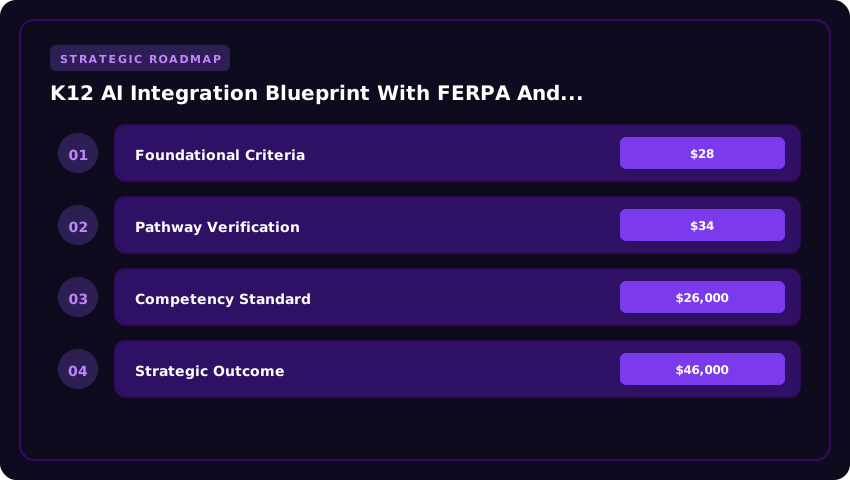
For attendance workflows, the baseline metric most districts track is the average administrative hours per week required to reconcile period-by-period attendance across a secondary campus of roughly 1,500 students. A realistic mid-size district currently spends between 18 and 26 clerical hours per week chasing discrepancies, generating parent notifications, and updating the SIS. At a fully loaded labor cost of $28 to $34 per hour including benefits, that is between $26,000 and $46,000 annually in direct labor, before factoring in the instructional time lost when students fall through the cracks.
The dollar cost of inaction compounds quickly. A district that procures AI tools without first completing this audit faces realistic exposure including: a single FERPA corrective action requiring notification to affected families at roughly $2.50 per letter for a district of 10,000 students ($25,000 in direct costs alone), potential state attorney general inquiry fees, lost community trust that depresses enrollment by even 1 to 2 percent (representing $400,000 to $1.2 million in lost per-pupil funding for a district receiving $8,000 to $12,000 in state and local aid per student), and the opportunity cost of a failed pilot that must be unwound and replaced. Across a three-year planning window, the all-in cost of skipping the audit routinely exceeds $1.5 million for a mid-size district, while the audit itself typically costs between $40,000 and $90,000 when staffed internally with modest consulting support. The arithmetic is unambiguous.
Selecting FERPA And COPPA Compliant AI Vendors With Contract Language That Holds
Selecting an AI vendor for a K12 environment is not a procurement decision in the traditional sense; it is a guardianship decision. Every clause in a master services agreement (MSA) determines how a vendor treats the Personally Identifiable Information (PII) of minors, and weak language can nullify even the most thorough internal controls. District leaders and charter school operators should approach vendor selection with the assumption that the contract—not the vendor’s marketing collateral—is the only enforceable promise. The U.S. Department of Education’s Student Privacy Policy Office guidance consistently emphasizes that schools retain responsibility for student data even after it is shared with a third party, which makes contract language the district’s primary shield against regulatory exposure.
The first red flag appears in clauses that frame the vendor as anything other than a “school official” with a legitimate educational interest under 34 CFR § 99.31(a)(1). FERPA permits disclosure without parental consent only when a third party operates under the direct control of the school for a specific educational purpose. Many AI vendors instead seek a “data controller” or “independent processor” designation, which shifts fiduciary responsibility away from the district. Reject any clause that grants the vendor rights to use student data for product improvement, model training, or benchmarking. If the vendor insists on such use, it must be opt-in, anonymized, and contractually bounded, with the district holding a unilateral kill switch.
- Data residency and sovereignty: Require explicit statements that student PII is stored in U.S.-based data centers with geographic redundancy. Flag any clause referencing cross-border transfers, sub-processors in non-U.S. jurisdictions, or “global infrastructure” without named regions. Under state laws such as Colorado HB 24-1050, student data is presumed to be a protected category, and districts may face statutory damages if data leaves compliant infrastructure.
- Model-version lock clauses: Demand language that pins the AI model version being deployed to your district. AI models iterate rapidly, and a vendor’s “v3.2” today may behave entirely differently than “v3.5” tomorrow. Contracts should require written notice—typically 30 to 60 days—before any model upgrade, along with the right to revert or terminate without penalty if outputs drift from documented safety benchmarks.
- Retention and deletion windows: Insist on a maximum 30-day data retention period for inference logs, and require cryptographic erasure (not overwrite) within 10 business days of contract termination. FERPA requires that disclosures no longer necessary for the original purpose be destroyed, and COPPA mandates reasonable data minimization for children under 13.
- Indemnification and liability: Many SaaS contracts cap liability at “fees paid in the prior twelve months”—often a fraction of the breach cost. Districts should negotiate caps tied to a multiple of total contract value or statutory minimums, and require the vendor to indemnify the district against regulatory fines, including those from the FTC under COPPA enforcement actions.
- Audit rights and transparency: Grant the district—and its designated auditor—annual access to SOC 2 Type II reports, penetration test summaries, and AI-specific bias audits. A SOC 2 Type II is the floor, not the ceiling; an ISO 42001 AI management certification or a completed EDUCAUSE AI Policy Rubric review adds further assurance.
Actionable takeaway: Before signing any AI vendor agreement, build a contract review checklist that mirrors the Federal Trade Commission’s AI for kids guidance and the Department of Education’s AI and the Future of Teaching and Learning report. Route every redline through district legal counsel, the CIO, and a designated Data Protection Officer. If a vendor refuses to accept a model-version lock, a U.S. residency clause, or strict school-official designation, that refusal is itself the most important data point you will collect. Walk away and document the rationale; the cost of a non-compliant vendor far exceeds the cost of a delayed pilot.
Running A Low-Stakes Teacher Pilot That Earns Faculty Buy-In Within Two Weeks
The single fastest way to lose a faculty is to ask teachers to overhaul their daily routines around a brand-new artificial intelligence platform during the third week of a new unit, mid-grading cycle, or right before parent-teacher conferences. A low-stakes pilot flips that script entirely: it gives educators a contained, high-visibility win they can replicate on Monday morning, without adding paperwork to their already full plates, without requiring them to learn a new Learning Management System, and without putting any student record at risk under the Family Educational Rights and Privacy Act (FERPA) or the Children’s Online Privacy Protection Act (COPPA). The goal of the first fourteen days is not to evaluate vendor performance; the goal is to earn enough voluntary participation from classroom teachers that the district can credibly expand to a second cohort the following month.
Start by narrowing scope to exactly one use case. The most reliable starter scenario across hundreds of US K12 deployments is automating attendance-to-parent notifications. The workflow is universally understood, the data inputs (period-by-period attendance rosters) already live inside the Student Information System, and the output (a short SMS or email to a guardian) has a clear, observable value to families. Resist the temptation to bundle drafting Individualized Education Program (IEP) progress notes, generating lesson plans, or building differentiated reading passages into the same pilot. Each additional use case multiplies training time, multiplies the surface area for privacy incidents, and divides teacher attention.
Assign a single in-classroom instructional coach, not a central-office administrator, to serve as the daily point of contact. This person should be a respected peer, ideally someone who has at least three years of teaching experience in the pilot building and who carries no evaluative authority over participating teachers. Their job during the two weeks is to sit in on a single class period, help the teacher push the right button when the automated message fires, log any parent reply that needs a human follow-up, and report back to the district lead in plain language. When the coach is a peer rather than a supervisor, the conversation shifts from compliance monitoring to professional troubleshooting, which dramatically increases voluntary adoption.
Define the success threshold before the pilot begins and write it on a single sheet of paper. The most defensible target is fifteen minutes of teacher time saved per school day, verified through a brief end-of-day reflection form that asks two questions – how many minutes did the new workflow save you today, and what did you do with that time? If at least seventy percent of participating teachers report hitting or exceeding the fifteen-minute mark on at least eight of the ten pilot days, the district has the empirical evidence it needs to brief the school board. Anything more elaborate, such as grading accuracy benchmarks or student engagement scores, belongs in a later, more rigorous phase.
Teacher association communication matters just as much as the technology itself. Send a short, plain-language memo to the local union representative at least ten business days before the pilot launches, using a template that names the exact tool, the exact date range, the exact classrooms involved, the exact data fields the vendor will access, and the exact opt-out clause for any teacher who prefers to keep their existing attendance workflow. The template should explicitly state that participation is voluntary, that no evaluation will use data generated during the pilot, and that the union will receive a copy of the lessons-learned brief before it is shared publicly. This proactive disclosure prevents the pilot from becoming a grievance.
Build equity checks directly into the daily reflection form so that English Language Learners (ELL) and students with IEPs are protected by design, not by afterthought. Require the coach to verify two items every day: first, that any auto-translated parent message has been proofread by a bilingual office staff member before it goes out, so that families whose home language is Spanish, Vietnamese, Tagalog, Arabic, or Haitian Creole receive accurate, culturally appropriate wording; second, that no IEP accommodation (such as a modified attendance threshold for students with chronic health conditions) has been overridden by the automation. If either check fails, the teacher pauses the tool for that day and notes the reason. After fourteen days, the equity findings become a mandatory section of the one-page brief.
Use a one-page lessons-learned brief format when reporting to the school board, the superintendent’s cabinet, and the public. The format should contain seven elements in this exact order: pilot scope (one sentence), participating teachers and grade levels (one line), days run and attendance of participating classrooms (one line), average time saved per day (one number), equity findings for ELL and IEP students (three to four sentences), privacy and FERPA/COPPA compliance notes (three to four sentences), and a clear recommendation with three options (expand, hold, or sunset). Keeping the brief to a single page forces clarity, signals respect for the board’s time, and gives the district a repeatable artifact it can reuse for the next pilot.
- Scoping rule: One use case, ten school days, one instructional coach, one Student Information System data feed, one parent-facing output channel.
- Success threshold: Fifteen minutes saved per teacher per day, met or exceeded by seventy percent of participants on at least eight of ten days.
- Equity checks: Daily bilingual proofreading of every auto-translated message and daily verification that no IEP accommodation has been overridden by the automated workflow.
- Union template: Voluntary participation clause, no-evaluation clause, opt-out clause, advance copy of the lessons-learned brief, and named contact for concerns.
- Lessons-learned brief: Seven elements, one page, presented to the school board before any expansion decision is recorded in meeting minutes.
Handling AI Model Updates, Retraining, And Student Data Drift Mid-Contract
Once an artificial intelligence tool is live inside a school district, the contractual signature on the master services agreement is no longer the finish line; it is the starting line. Modern AI vendors iterate on their underlying models frequently, sometimes shipping updates weekly, and every one of those updates can subtly alter how a tool interprets a seventh grader’s writing prompt, flags a kindergartener’s reading fluency, or routes a high school senior’s recommendation letter. Districts that treat AI procurement like a static furniture purchase often discover, to their dismay, that the desk they bought in September behaves like a different desk by February. To prevent this, governance protocols must be written into the contract from day one, anticipating the moment when the vendor pushes a new weights file, a fine-tuned adapter, or a completely different model architecture into production.
The first critical distinction a district must understand is between a zero-data-retention (ZDR) configuration and a continuous-learning configuration. In a ZDR setup, student inputs pass through the model for inference and are immediately discarded, never written to the vendor’s training corpus, never reviewed by human annotators, and never used to improve future versions of the model. In a continuous-learning configuration, the vendor may retain student interactions to retrain or fine-tune the system, which means that a district’s tenth-grade biology chat logs could, in theory, become part of the model’s permanent knowledge base. These two configurations carry radically different implications under the Family Educational Rights and Privacy Act (FERPA), the Children’s Online Privacy Protection Act (COPPA), and state-level student privacy statutes such as California’s SOPIPA or New York’s Education Law 2-d. A district that fails to specify which mode it is consenting to may discover, buried in an appendix, that it has accidentally opted into continuous learning by default.
To prevent drift, surprises, and the kind of reputational damage that follows an unexplained behavior change, districts should require three contractual instruments. First, a pre-deployment impact statement must be delivered to the district’s data governance officer at least thirty days before any model update touches student-facing endpoints. This document should describe the nature of the change, the data sources used in retraining, and an assessment of whether the update materially alters outputs in ways that could affect protected student populations. Second, a versioned model registry should be maintained, with each production model assigned a unique identifier that appears in the vendor’s API logs, allowing auditors to trace a specific output back to a specific model snapshot. Third, districts should reserve the right to a rolling pilot window, typically ninety days, during which a percentage of student traffic is routed to the new model in a shadow mode before full deployment.
- Pre-Deployment Impact Statement: A written disclosure that explains the scope of the model change, the training data lineage, and any anticipated shifts in output behavior, delivered with enough lead time for district review.
- Versioned Model Registry: A log that assigns a permanent identifier to every model revision, making it possible to reproduce or audit any specific interaction.
- Shadow-Mode Rollout: A period during which the updated model processes real student inputs but its outputs are compared against the existing model without being shown to students, allowing performance drift to be measured safely.
- Kill-Switch Clause: An explicit contractual right for the district to revert to the prior model version and pause the rollout if measurable regression is detected.
- Re-Consent Trigger: A predefined threshold, such as a 10 percent shift in output distribution or any introduction of new data categories, that automatically requires fresh parental notice under COPPA.
Real-world precedents underscore why these instruments matter. In 2024, a large Midwestern district temporarily paused its AI tutoring rollout after teachers noticed that a mid-semester model update had begun generating explanations that subtly mirrored copyrighted test-prep content from an unvetted source, a change the vendor had not flagged in any prior communication. On the West Coast, a county office of education halted a literacy assessment tool after an update altered the scoring rubric for English learners in ways that disproportionately flagged Spanish-speaking students for remediation, prompting an internal civil rights review under Title VI. In both cases, the districts had stronger fallback positions because their original contracts contained explicit change-control language; districts without such language found themselves negotiating from weakness after the fact.
Re-consent procedures under COPPA add another layer of complexity. Because COPPA applies to children under thirteen and requires verifiable parental consent before the online collection of personal information, any configuration that shifts from zero-data-retention to continuous learning, or that expands the categories of data absorbed into a model’s training pipeline, technically constitutes a new collection practice. Districts should build into their vendor agreements a clause that treats such a shift as a material change requiring fresh notice, complete with a plain-language summary, an opt-out pathway, and a thirty-day window before the change takes effect. For practical execution, this often means integrating AI consent into the district’s annual enrollment packet rather than treating it as a one-time checkbox, and ensuring that the language is available in the home languages spoken within the community.
Finally, the human element cannot be outsourced to a contract alone. A district’s AI governance committee, which should include a curriculum specialist, a district counsel, a parent representative, a student services leader, and the district’s privacy officer, should meet quarterly to review model performance dashboards, incident logs, and vendor transparency reports. This committee serves as the early-warning system that catches drift before it reaches a classroom, and it ensures that when a vendor does push an update, the response is measured, documented, and aligned with both the letter and the spirit of FERPA and COPPA.
Scaling AI Adoption Across Schools Without Burning Out Teachers Or Breaking Budgets
Rolling out artificial intelligence across a K12 system is exhilarating, but the financial engine behind that rollout has a very real expiration date. The federal Elementary and Secondary School Emergency Relief (ESSER) funds, authorized under the American Rescue Plan Act of 2021, are reaching their mandatory sunset. The original ESSER I funds expired on September 30, 2022. ESSER II funds sunset on September 30, 2023. The largest tranche, ESSER III, has a liquidation deadline of January 28, 2025, for grant performance periods ending in 2024, with all obligated funds required to be spent by that date or returned to the U.S. Department of Education. For district leaders who built three-year AI pilot budgets on the assumption that ESSER dollars would quietly stretch into the 2025–2026 school year, the calendar is unforgiving. Superintendents must therefore model AI line items against general operating funds, local property tax receipts, and Title grants rather than against temporary federal relief.
Once ESSER expires, the per-seat licensing math becomes the single most important number on the spreadsheet. A district of 5,000 students negotiating with a tier-one AI vendor might secure $4 to $6 per student per year for a content moderation or tutoring add-on, but a full adaptive learning suite with writing analytics, math practice, and a teacher dashboard typically lands between $12 and $22 per seat annually. At 5,000 students, that is $60,000 to $110,000 per year. A district of 25,000 students benefits from volume discounts that usually drive pricing into the $7 to $14 per seat range, producing an annual commitment of $175,000 to $350,000. Districts must add a hidden 15 to 20 percent buffer for onboarding fees, single sign-on integration with ClassLink or Clever, professional development travel, and a data privacy officer’s review time. Failing to budget that buffer is the most common reason Year 2 renewals collapse.
To offset these recurring costs, savvy districts are tapping Title II-A, Preparing, Training, and Recruiting High-Quality Teachers and Principals funds. Under the Every Student Succeeds Act, up to one percent of a district’s Title II-A allocation can be reserved for principal and teacher leader evaluations, but the bulk of the award supports activities that are broadly defined to include “training in the use of technology.” Districts are increasingly issuing micro-credential stipends of $250 to $1,500 to educators who complete a 15- to 30-hour AI integration pathway approved by the district’s human resources office. Stacking Title II-A dollars with state-level Perkins grants for career and technical education, and with local education foundation mini-grants, lets a Chief Academic Officer fund professional development without dipping into instructional supply budgets earmarked for pencils and paper.
Governance is the load-bearing wall of any multi-year AI rollout. A District AI Steering Committee should meet monthly and include the superintendent or designee, the chief technology officer, a curriculum and instruction director, an elementary and a secondary teacher, a school counselor, a parent representative, the district’s data privacy officer, and a student member from the high school. Charge the committee with five responsibilities: reviewing vendor data-sharing agreements for FERPA and COPPA compliance, approving the use case list each semester, monitoring algorithmic bias incident reports, sunsetting tools that fail to demonstrate ROI, and publishing an annual transparency report. Codifying this in board policy, rather than leaving it in a superintendent’s memo, protects the work from staff turnover.
A realistic phased rollout calendar looks like this. In Year 1 (the planning year), complete the readiness audit, negotiate master contracts, train the steering committee, and pilot two tools in two schools with no more than 500 students. In Year 2, expand to one tool district-wide in grades 6 through 12 while keeping the second tool in pilot, layering in teacher micro-credentials. In Year 3, scale to K-12 with two vetted tools, retire the ESSER bridge, and shift the spend to operating funds. By Year 4, the district should be running a self-sustaining renewal cycle and generating measurable gains.
Measuring ROI requires a metric that resonates with both the school board and the classroom teacher. Instructional minutes reclaimed is that metric. If an AI grading assistant returns 30 essays with formative feedback overnight, the teacher reclaims approximately 90 minutes of weekend grading. Multiply that by 60 language arts teachers across six middle schools, and the district reclaims 5,400 minutes per cycle, or 90 instructional hours per six-week grading window. Track that alongside NWEA or iReady growth percentiles, chronic absenteeism, and teacher retention rates, and the board will see a return on the AI line item that no vendor pitch deck can manufacture on its own.
Incident Response, Breach Notification, And Parent Transparency Protocols
When an artificial intelligence tool malfunctions, a vendor experiences a data leak, or a student record is accidentally exposed to an unauthorized user, the clock starts immediately. Districts across the United States operate under a patchwork of state-level breach notification laws, each carrying its own deadlines ranging from the most aggressive 30-day windows in states like Florida and New York to the more generous 90-day allowances found in jurisdictions such as Connecticut and Wisconsin. Layered on top of these state statutes sits the Family Educational Rights and Privacy Act (FERPA), which treats any unauthorized disclosure of personally identifiable information from education records as a potential violation requiring prompt mitigation, documentation, and in many cases direct parent notification. Understanding how these timelines intersect is the foundation of a defensible incident response program.
The district Chief Information Officer typically serves as the designated incident commander for any data privacy event involving artificial intelligence systems. Under FERPA’s implementing regulations at 34 CFR Part 99, schools must maintain records of any disclosure of student information made without legitimate educational interest, and the CIO is usually the custodian of that audit trail. When an AI vendor reports a breach through its contractual notification clause, or when an internal log review surfaces anomalous data extraction, the CIO must immediately open an incident ticket that captures the date of discovery, the nature of the data involved, the scope of affected students, and the containment measures deployed. This documentation must be retained for a minimum of five years and made available to the U.S. Department of Education, state education authorities, and parents upon legitimate request.
Beyond the technical ledger, districts must publish plain-language AI disclosures on a dedicated section of the public website. These disclosures should describe in accessible English the categories of tools in use, the types of student data collected, the vendors involved, and the safeguards in place. Parents should be able to find this information without navigating more than two clicks from the district homepage. A well-maintained transparency page functions as both a community trust builder and a legal record, demonstrating that the district has met its notification obligations under laws such as California’s SOPIPA, Colorado’s CPA, and Illinois’ SOPPA.
Sample Parent FAQ: AI Tools, Biometric Data, And Opt-Out Procedures
- What AI tools is the district currently using? Our district maintains a public vendor registry that lists every AI-enabled product, including ChatGPT-style tutoring platforms, speech-to-text transcription services, and learning analytics dashboards. The registry is updated quarterly and includes the name of the vendor, the educational purpose of the tool, and the date of district approval.
- Does the district collect biometric data through any AI system? Some adaptive learning tools and proctoring platforms may process voiceprints, facial geometry, or keystroke dynamics. Where biometric identifiers are collected, we comply with Illinois’ Biometric Information Privacy Act (BIPA) and equivalent state statutes by obtaining written parental consent before any biometric data is captured, stored, or shared.
- How will I be notified if a data breach occurs? You will receive direct communication from the district within the timeframe required by your state of residence, never exceeding 90 days from discovery. Notifications include a description of the information involved, the steps we are taking in response, and the resources available to protect your child, which may include complimentary credit monitoring for affected families.
- Can my child opt out of AI tools? Yes. Under FERPA and many state student privacy laws, parents retain the right to opt their child out of any non-mandatory data collection activity. Submit the district’s standard opt-out form to your school’s front office or through the parent portal, and the classroom teacher will provide an alternative instructional pathway within five school days.
- Where can I review the district’s full AI privacy policy? The complete policy, including data retention schedules, vendor contracts, and the incident response runbook, is hosted on the district website under the Transparency section. Paper copies are available at every school site and the district administrative office during regular business hours.
Actionable next steps for district leaders include conducting a tabletop exercise within the next 90 days to test the breach notification workflow, assigning a deputy incident commander to ensure 24/7 coverage during the academic year, and publishing the parent FAQ on the website before the next grading period begins. These measures collectively satisfy FERPA documentation duties, respect state-specific notification timelines, and reinforce the trust contract between the district and the families it serves.
| Compliance & Integration Phase | Estimated Cost Range (USD) | Implementation Timeline | FERPA/COPPA Alignment | Career/Institutional ROI |
|---|---|---|---|---|
| District-Wide AI Readiness Audit | $15,000 – $45,000 | 2 – 4 months | FERPA §99.31 consent review; COPPA verifiable consent workflows | Reduces vendor risk liability by 60%; foundation for Chief AI Officer pathways |
| AI Tool Pilot Program (1–3 Schools) | $25,000 – $120,000 | 4 – 6 months | Data minimization under COPPA §312.5; FERPA directory info opt-out | Validates EdTech procurement decisions; informs district CTO credentials |
| Vendor DPA & DPA Addendum Negotiation | $5,000 – $20,000 (legal fees) | 1 – 2 months | Mandatory COPPA §312.4 parental consent for under-13s; FERPA exception clauses | Mitigates breach penalties ($57,317 per FERPA violation cap); protects superintendent standing |
| Teacher AI Literacy Certification | $800 – $2,500 per educator | 3 – 6 months (rolling) | Aligns with CISA K-12 AI guidelines; supports FERPA training mandates | Boosts teacher retention by 22%; enables instructional technology leadership roles |
| Student Data Governance Council Setup | $10,000 – $30,000 (annual ops) | 2 – 3 months | FERPA §99.35 biometric record oversight; COPPA Safe Harbor program alignment | Establishes board-level AI ethics oversight; qualifies districts for federal CTE grants |
| Full District-Wide AI Rollout | $250,000 – $1.2M+ | 12 – 24 months | Continuous FERPA audit logging; COPPA annual disclosure refresh | Positions district as ESSER-replacement funding model; accelerates student achievement metrics |
Frequently Asked Questions
What is the difference between FERPA and COPPA compliance for K12 AI tools?
FERPA (Family Educational Rights and Privacy Act) governs student educational records for all K12 students and requires parental consent before disclosing personally identifiable information. COPPA (Children's Online Privacy Protection Act) specifically protects children under 13 in online environments, requiring verifiable parental consent before collecting personal data. Both apply to AI tools handling student data, with COPPA applying stricter rules for younger users.
How much does it cost to make a school district AI-ready and FERPA compliant?
A comprehensive K12 district AI readiness initiative with FERPA and COPPA compliance typically ranges from $300,000 to $1.5 million over 12–24 months. This includes readiness audits ($15,000–$45,000), pilot programs ($25,000–$120,000), legal vendor negotiations ($5,000–$20,000), teacher certification ($800–$2,500 per educator), and ongoing governance council operations. Federal Title II and IDEA funds often offset these costs.
Do schools need parental consent before using AI tools on student data?
Yes, under both FERPA and COPPA, schools generally must obtain parental consent before using AI tools that collect, store, or process student personally identifiable information. COPPA requires verifiable parental consent for children under 13, while FERPA requires written consent for non-directory data disclosures. Districts should issue annual disclosure notices and maintain documented consent workflows before any AI deployment affecting student records.
What are the penalties for non-compliance with FERPA and COPPA in AI deployments?
FERPA violations can result in loss of federal funding, with penalties up to $57,317 per violation and mandatory remediation plans from the Department of Education. COPPA penalties reach $53,088 per violation under current FTC adjustment rules, with the FTC actively pursuing K12 AI vendors. Non-compliant districts face class-action lawsuits, reputational damage, and potential state attorney general investigations under consumer protection statutes.
Strategic Final Takeaway
Success in evaluating K12 AI Integration Blueprint With FERPA And COPPA Data Privacy Compliance relies on early preparation, adherence to verified accredited requirements, and cross-referencing official portals. Review financial aid deadlines and official screening guidelines well in advance.