Why the Community College-to-Bachelor’s Pipeline Is Changing Early Childhood Education Careers
Walk into almost any preschool or elementary school in the United States right now, and the administrators will tell you the same thing: they cannot find enough qualified teachers. According to recent workforce data, more than 40 states are reporting measurable shortages of early childhood educators, particularly across preschool and K-3 classrooms. The U.S. Department of Education has flagged this as one of the most persistent staffing crises in the K-12 space, and the gap is not closing on its own. For working professionals, this shortage is the single biggest reason a bachelor’s degree in Early Childhood Education has become a career-altering credential rather than a nice-to-have.
Here is what most people miss: the community college-to-bachelor’s pipeline is not a fallback plan. It is, in many cases, the smartest financial move available. A typical Associate of Applied Science (AAS) in Early Childhood Education runs about $110 to $165 per credit hour at in-district public community colleges, according to College Board averages. That puts a two-year degree in the $6,000 to $8,000 range total. The same 60 credits at a four-year institution can easily cost $30,000 to $50,000, sometimes more. When you complete that associate degree and transfer through a state articulation agreement, you arrive at the four-year school as a junior, and the credits travel with you. No retaking required.
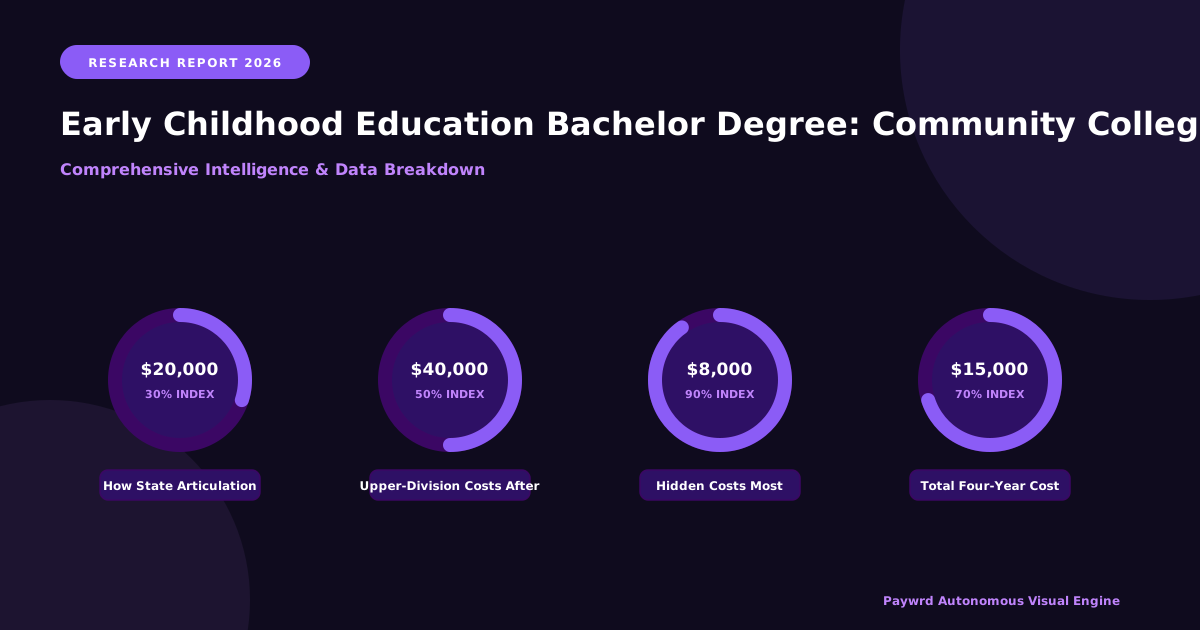
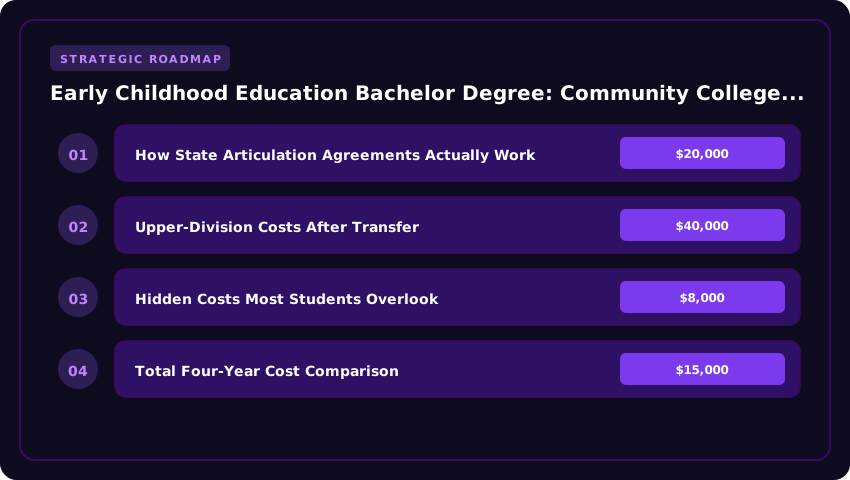
How State Articulation Agreements Actually Work
Every state that participates in articulation agreements has essentially pre-negotiated which community college courses count toward a bachelor’s degree at partnering public universities. If you graduate with an Associate of Arts (AA) or Associate of Science (AS) in ECE from an accredited program, the receiving institution is contractually obligated to accept your general education and core ECE coursework. This eliminates the classic transfer trap where students lose 15 to 30 credits and pay for them twice.
The Real Salary Gap Between an Associate and a Bachelor’s
The Bureau of Labor Statistics (BLS) reports that preschool teachers earn a median annual wage of around $34,000, while kindergarten and elementary teachers with a bachelor’s degree and state certification earn closer to $61,000 to $63,000. That is a $20,000-plus annual jump, before factoring in benefits, pension eligibility, and lead-teacher differentials. Even within the same employer, teachers with a bachelor’s degree frequently start $1 to $3 higher per hour, which compounds into thousands of additional dollars every year.
For professionals already in the field, the math is straightforward. The community college keeps costs low while you keep working. The bachelor’s degree unlocks the long-term ceiling. Together, the pipeline is the most reliable way to turn a passion for early childhood education into a financially sustainable career.
Actual Tuition and Fees: Community College vs State University for an ECE Bachelor’s
When you run the actual numbers for an Early Childhood Education bachelor’s degree, the community college pathway almost always delivers a five-figure savings. For the 2025-2026 academic year, in-district community college tuition averages roughly $3,500 to $5,000 per year, according to College Board data. The Northeast and West Coast skew higher, with states like California, New York, and Massachusetts hovering between $4,800 and $6,200 annually, while the Midwest and South sit closer to $3,200 to $4,400. These figures cover the lower-division coursework where you’ll complete your Associate of Applied Science (AAS) or Associate of Arts in ECE, including core early childhood courses and general education credits that satisfy most state articulation agreements.
Upper-Division Costs After Transfer
Once you transfer to a public four-year institution, your upper-division tuition jumps significantly. For in-state residents, state university tuition for the final two years averages $10,500 to $14,000 per year, with flagships like the University of Florida or University of Georgia sitting around $6,500 to $9,000 and systems like the University of California or State University of New York climbing to $14,000 to $18,000 annually. Out-of-state students face an even steeper climb, with some public universities charging $28,000 to $40,000 per year before transfer scholarships or regional exchange programs kick in. The key is confirming that your associate degree credits transfer seamlessly through a state-level articulation agreement, so you’re not repeating coursework at junior-level tuition rates.
Hidden Costs Most Students Overlook
The sticker price rarely tells the full story. Early Childhood Education students face several hidden fees that can add $1,500 to $3,000 to the total bill:
- Textbooks and course materials: $400 to $900 per semester, though ECE-specific texts can run higher
- Background checks and fingerprinting: $50 to $150, required for practicum placements in most states
- Praxis Core Academic Skills for Educators exam: $150 to $180 per subtest, with most states requiring passing scores before student teaching
- Praxis II ECE subject test: $160 to $300, depending on your state’s certification requirements
- TB tests, liability insurance, and CPR certification: $75 to $200 combined for clinical readiness
- Technology fees, parking permits, and student activity fees: $500 to $1,200 annually
Total Four-Year Cost Comparison
Here’s where the math becomes compelling. Starting as a freshman at a four-year public university, an in-state ECE bachelor’s student can expect a total tuition bill of $48,000 to $64,000, excluding room, board, and those hidden fees. Adding living costs pushes the figure well past $80,000 for on-campus attendance.
The community college transfer path? You’ll spend roughly $7,000 to $10,000 at the associate level, plus $21,000 to $28,000 at the four-year institution for upper-division coursework. Your grand total lands around $28,000 to $38,000, representing savings of $20,000 to $40,000, money you can redirect toward emergency savings, paying down prior student debt, or building a financial cushion during your lower-paying practicum semesters.
For working teachers pursuing upskilling through employer tuition reimbursement programs, the community college start often qualifies for immediate reimbursement at lower per-credit rates, while the upper-division portion unlocks larger annual employer caps once you’re officially enrolled in the bachelor’s program.
State-by-State Certification Requirements After Earning Your Bachelor’s Degree
Completing a bachelor’s degree in Early Childhood Education is a major milestone, but it is only the foundation of your certification journey. Each US state writes its own rules for who qualifies to lead a preschool classroom or teach in a public PreK-3 setting, and those rules directly shape which Praxis exams you must register for, which coursework your bachelor’s program must include, and whether your existing certificate will transfer when you relocate.
Bachelor’s vs. Associate Minimum: Which States Demand a Four-Year Degree
There is a sharp split between states that require a bachelor’s degree for lead teacher status and those that still allow an associate degree to satisfy licensing requirements. Roughly thirty states, including Massachusetts, New York, Connecticut, and Minnesota, require a bachelor’s degree for public PreK-3 licensure or for the lead teacher role in state-funded preschool programs. Other states, particularly those that have leaned hard on community college pipelines like Washington, Oregon, Colorado, and Illinois, still permit an associate degree to qualify for certain lead teacher positions in licensed childcare centers. If your goal is to work in a public school PreK-3 classroom or a state-funded pre-K program, you will almost always need the bachelor’s plus state licensure. If you plan to stay in private childcare or Head Start, an associate degree may still legally qualify you, though your salary ceiling under the US Bureau of Labor Statistics’ $36,000 to $43,000 early childhood teacher wage band will be noticeably lower.
Praxis Early Childhood Education: Test Codes, Content, and Passing Scores
ETS administers the Praxis Early Childhood Education battery, and most states require you to pass a combination of Core, Content, and Pedagogy subtests before issuing initial licensure. The most commonly cited exams include:
- Praxis 5024 – Early Childhood Education: Content Knowledge: Covers child development, language and literacy, mathematics, science, social studies, health, and the arts. Most states set the bar at a passing score of 158.
- Praxis 5025 – Early Childhood Education: Curriculum, Instruction, and Assessment: Focuses on planning, instructional strategies, and assessment for young learners. Typical passing thresholds range from 158 to 160.
- Praxis 5023 – Core Academic Skills for Educators (Reading, Writing, Mathematics): A general competency exam that satisfies the basic skills requirement in many states. Passing scores vary by subtest, with Reading at 156, Writing at 162, and Mathematics at 150 being the ETS-recommended benchmarks.
Always verify your state’s posted cut scores through your state Department of Education before registering, because using the wrong passing threshold is one of the most common reasons graduating seniors miss their certification window.
Reciprocity: Moving Your ECE Bachelor’s Across State Lines
Teaching reciprocity lets licensed educators transfer their credentials between states without completing an entirely new preparation program, but the rules are not uniform. States like Texas, Florida, and California generally accept an out-of-state bachelor’s degree in ECE and an active certificate, provided your Praxis Core scores meet their benchmarks and you pass any required state-specific jurisprudence or early reading exams. More restrictive states such as New York and Illinois often require additional coursework in state-mandated areas like the science of reading or early intervention before granting full reciprocity. Before relocating, file an application through your destination state’s educator licensing portal and request a transcript review from the certification office, because completing that paperwork two to three months ahead of your move prevents costly re-enrollment in redundant courses.
Transferring Seamlessly: Articulation Agreements, Guided Pathways, and Credit Caps
Securing a smooth transition from a two-year program to a four-year Early Childhood Education (ECE) bachelor’s degree starts with one critical document: the articulation agreement. Think of it as a legally binding handshake between your community college and the receiving university, guaranteeing that specific courses, general education blocks, and even your entire associate degree will transfer without surprise course-by-course evaluations. Before you enroll in a single ECE class, verify that your school holds a signed, dated, and state-approved articulation agreement with the four-year institution where you plan to finish. You can confirm this through the state’s higher education agency, the receiving university’s transfer admissions portal, or by asking your community college advisor to show you the formal Memorandum of Understanding. If no agreement exists, every credit you earn is essentially a gamble.
For most working educators, the Associate of Arts (AA) or Associate of Science (AS) in Early Childhood Education is the strongest transfer vehicle, because these degrees are specifically designed to satisfy lower-division general education requirements. An Associate of Applied Science (AAS), by contrast, is heavily weighted toward technical skills and may transfer only partially, leaving you scrambling to complete writing, math, and science prerequisites at the university level, where tuition is significantly higher. When stacked correctly, an AA or AS can save you between $20,000 and $40,000 in tuition costs, while simultaneously positioning you for the $8,000 to $15,000 annual salary bump that comes with a bachelor’s degree, according to the U.S. Bureau of Labor Statistics.
However, even airtight articulation agreements come with hidden traps that can cost you semesters of progress:
- Capped Transfer Credits: Many universities cap accepted community college credits at 60 or 66 semester hours. Anything beyond that threshold is typically dropped, which is why finishing your associate degree is non-negotiable before transferring.
- Missing Field Practicum Hours: A standard 120-hour practicum at the associate level rarely satisfies a 300- or 600-hour capstone requirement at the bachelor’s level. Confirm practicum alignment in writing before you begin your final semester.
- Non-Aligned CDA Coursework: A Child Development Associate (CDA) credential is a powerful career asset, but the college courses that prepared you for it may not articulate toward ECE upper-division requirements. Map CDA modules against the university’s course catalog early in your academic plan.
Use this tactical transfer checklist before committing to any course: confirm the articulation agreement is active and signed, verify whether your AA, AS, or AAS satisfies general education requirements, calculate the maximum accepted credit hours, align practicum hours with the receiving program, and crosswalk your CDA coursework against the upper-division curriculum. Checking every box on this list protects your time, your tuition dollars, and your final semester, ensuring that every associate-level class counts toward your bachelor’s capstone.
ABET, NAEYC, and Regional Accreditation: Which Credentials Actually Matter
If you have spent any time scrolling through early childhood education program brochures, you have probably noticed a forest of acronyms competing for your attention. ABET, NAEYC, CAEP, AAQEP, HLC, SACSCOC, MSCHE. It can feel deliberately confusing. Marketing teams love to blur the lines between programmatic accreditation (a stamp on a specific program) and regional accreditation (a stamp on the entire college or university), because the distinction is genuinely powerful, and a powerful distinction is a powerful sales tool.
Here is the version that actually matters when you are choosing where to enroll.
NAEYC Alignment: The Gold Standard for ECE Content
The National Association for the Education of Young Children (NAEYC) does not technically “accredit” bachelor’s programs the way regional bodies do. Instead, it publishes national standards that define what well-prepared early childhood educators should know and be able to do. Programs that intentionally align their coursework, fieldwork, and student teaching with these standards signal to employers and graduate admissions committees that graduates have been trained in evidence-based practice, developmentally appropriate curriculum, and family engagement.
- Employer signal: Head Start grantees, state-funded pre-K programs, and many private preschool chains explicitly look for NAEYC-aligned preparation because it maps onto their internal quality benchmarks.
- Graduate school signal: If you plan to pursue a Master of Education or state teaching license down the road, NAEYC-aligned coursework transfers cleanly into most MEd programs.
- Honest caveat: “NAEYC-aligned” is a self-reported claim. You still need to verify the institution is regionally accredited before you trust it.
Regional Accreditation: The Non-Negotiable Foundation
Regional accreditation is what unlocks federal financial aid under Title IV, makes your credits transferable to other accredited institutions, and satisfies state departments of education when they evaluate your transcript for certification. Seven bodies handle this in the United States, but three cover the majority of community colleges and state universities offering ECE programs:
- Higher Learning Commission (HLC): Serves 19 states, mostly across the Midwest and South-Central regions.
- Southern Association of Colleges and Schools Commission on Colleges (SACSCOC): Covers institutions in the Southeast and parts of Texas.
- Middle States Commission on Higher Education (MSCHE): Oversees Delaware, Maryland, New York, New Jersey, Pennsylvania, and Washington, D.C.
If your school is not regionally accredited, your FAFSA disbursement will be denied, your credits will not transfer, and your state’s department of education will likely reject your application for an initial teaching license. That is not a marketing nuance; it is a hard wall.
CAEP and AAQEP: The Teacher Preparation Layer
Once you move beyond the associate level and into a bachelor’s completion program, two national accreditors evaluate the quality of the teacher preparation pathway itself:
- Council for the Accreditation of Educator Preparation (CAEP): The larger and more widely recognized of the two. CAEP accreditation indicates the program meets rigorous standards for clinical partnerships, content knowledge, and candidate performance.
- Association for Advancing Quality in Educator Preparation (AAQEP): A newer, more flexible accreditor that focuses on continuous improvement and equity outcomes. Many state-approved programs are now seeking AAQEP in addition to, or instead of, CAEP.
For working teachers pursuing a Bachelor of Science or Bachelor of Arts in Early Childhood Education, CAEP or AAQEP accreditation is what guarantees your state’s department of education will accept the degree for an early childhood or elementary certification. ABET, by the way, accredits engineering and computing programs and has no relevance to ECE, so if you see it on an education brochure, that is an immediate red flag.
The takeaway is simple: regional accreditation is the floor, NAEYC alignment is the professional signal, and CAEP or AAQEP is the certification guarantee. Anything else is decorative.
Financial Aid, Scholarships, and Loan Forgiveness for Aspiring Early Childhood Educators
You have mapped the transfer route and calculated the tuition savings—now it is time to fund the final two years without drowning in debt. Because early childhood education is federally designated as a high-need field, the financial aid stack available to you is unusually aggressive. If you play your cards right, that remaining bachelor’s bill can shrink to near zero.
The TEACH Grant: Free Money with a Service String Attached
The Teacher Education Assistance for College and Higher Education (TEACH) Grant offers up to $4,000 per year (prorated for part-time enrollment) for students enrolled in eligible programs who sign an Agreement to Serve. For the 2025–2026 award year, you must commit to teaching full-time for four years within eight years of graduation at a low-income school or educational service agency—specifically in a high-need field like early childhood education, bilingual education, or special education. Critical warning: If you fail to meet the service obligation, the grant converts to a Direct Unsubsidized Loan with interest accruing from the original disbursement date. Only accept this if you are certain you will stay in the classroom.
State “Grow Your Own” Pipelines & Paraprofessional Residencies
Nearly 30 states now operate Grow Your Own (GYO) Teacher programs designed explicitly for current paraprofessionals, aides, and Head Start staff. These are not generic scholarships; they are workforce contracts. Programs in Illinois, Washington, and Colorado, for example, cover full tuition, fees, and books at partner universities while paying your current hourly wage—or a stipend—during your student teaching residency. Similarly, Paraprofessional Teacher Residency models (often funded through Title II or state workforce grants) allow you to earn your bachelor’s and license in 12–18 months while remaining employed. Check your state’s Department of Education website for “ECE Apprenticeship” or “Teacher Residency” RFPs; application cycles often close six months before the cohort starts.
Loan Forgiveness: The Long Game That Pays Off
Once you hold the bachelor’s and the license, two federal forgiveness programs run in parallel:
- Public Service Loan Forgiveness (PSLF): After 120 qualifying monthly payments (10 years) while working full-time for a 501(c)(3) nonprofit, government agency, or public school district, the remaining balance on your Direct Loans is wiped tax-free. Most Head Start centers and public Pre-K programs qualify.
- Teacher Loan Forgiveness: After five consecutive academic years in a low-income elementary or secondary school, you can receive up to $17,500 in forgiveness on Direct and FFEL Subsidized/Unsubsidized Loans (highly qualified math, science, and special ed teachers get the max; other subjects, including ECE, typically cap at $5,000 unless you teach special ed).
Pro tip: You cannot “double dip” the same payment months for both programs simultaneously, but you can apply for Teacher Loan Forgiveness after year five and then pivot to PSLF for the remaining five years.
Pell Grants & Head Start Stipends for 2025–2026
Do not overlook the foundation. The maximum Federal Pell Grant for the 2025–2026 award year is $7,395. Because Pell eligibility resets for your bachelor’s program, you have up to 12 semesters (600%) of lifetime eligibility remaining if you didn’t exhaust it at community college. File the FAFSA the moment it opens (typically October 1) to lock this in. Additionally, the Head Start Scholarship Program (administered regionally) frequently offers stipends of $3,000–$5,000 per year for current staff pursuing degrees, often stackable with Pell and TEACH. Ask your program director for the “Professional Development Fund” application—many centers have unspent allocation dollars they must return to the feds if unused.
Career and Salary Outlook: What a Bachelor’s in Early Childhood Education Pays in the US
The return on investment for a bachelor’s degree in Early Childhood Education (ECE) has never been clearer. According to the Bureau of Labor Statistics (BLS) May 2023 data—released in 2024—preschool teachers earned a median annual wage of $37,130. Contrast that with kindergarten and elementary school teachers, who commanded a median of $63,680. That $26,550 gap is the single most compelling argument for completing the bachelor’s and securing state licensure. While an associate degree qualifies you for assistant roles or private childcare, the bachelor’s unlocks the public school salary schedule, union protections, and pension eligibility that define a middle-class career in education.
Beyond the Classroom: High-Value Pivots for Bachelor’s Graduates
A bachelor’s degree also serves as the entry ticket for administrative and specialized roles that offer significantly higher ceilings. If you want to step off the daily teaching rotation, consider these median salary benchmarks from BLS and industry salary aggregates:
- Child Care Center Director: Median $54,290; top 10% exceed $90,000. Most states require a bachelor’s and the Child Development Associate (CDA) or state director credential.
- Early Intervention Specialist: Median $62,500 (categorized under Special Education Teachers, Preschool). This role often requires the bachelor’s plus a special education endorsement, but it opens doors to IFSP/IEP case management.
- Curriculum Coordinator / Instructional Coach: Median $74,620 (Instructional Coordinators). Districts increasingly prefer a master’s, but a bachelor’s with 3–5 years of classroom experience gets you into the pipeline.
Geography Is Destiny: Where the Money Lives
Location dramatically skews these numbers. The top-paying metropolitan areas for preschool and kindergarten teachers—San Jose-Sunnyvale-Santa Clara, CA; San Francisco-Oakland-Hayward, CA; and Seattle-Tacoma-Bellevue, WA—report annual mean wages ranging from $55,000 to $65,000+ for preschool roles alone. However, you must weigh that against housing costs that can consume 40–50% of take-home pay. Conversely, low-cost regions in the Midwest and South (think Wichita, KS or Jackson, MS) may offer salaries closer to $32,000–$38,000, but a dollar stretches 30% further. Remote curriculum and consulting roles are emerging as a geographic arbitrage play—living in a low-cost area while earning coastal rates.
Job Growth Projections Through 2032
The BLS projects 3% growth for preschool teachers and 1% for kindergarten/elementary teachers through 2032—roughly “as fast as average.” But the headline number masks a structural shift: universal pre-K expansion in states like California, Colorado, and New Mexico is creating thousands of new lead-teacher slots that require a bachelor’s and license. The real opportunity isn’t raw volume; it’s credential scarcity. Districts are offering signing bonuses of $2,500–$10,000 and tuition reimbursement for teachers willing to finish that bachelor’s. If you are currently on the community college track, the labor market is effectively subsidizing your final two years.
| Decision Criteria | Community College Transfer (AA → BA) | Direct 4-Year University (BA) | Alternative Certification / CDA Only |
|---|---|---|---|
| Avg. Total Tuition Cost (In-State, Public) | $12,000 – $22,000 | $38,000 – $65,000+ | $2,000 – $5,000 (CDA) / $8,000–$15,000 (Alt Cert) |
| Time to Bachelor’s Completion (Working Adult) | 3.5 – 5 Years (Part-time friendly) | 4 – 6 Years (Rigid cohort models) | N/A (No Bachelor’s awarded) |
| Admission / Screening Cutoffs | Open Access (AA); 2.5–2.75 GPA for Transfer | 3.0+ GPA; SAT/ACT often required; Praxis Core | HS Diploma/GED (CDA); Bachelor’s in any field (Alt Cert) |
| State Licensure Eligibility (Birth–Grade 3) | Yes (Upon BA completion + Praxis II) | Yes (Standard Path) | CDA: No (Assistant only); Alt Cert: Yes (Provisional) |
| Median Starting Salary (Lead Teacher, Public Pre-K) | $42,000 – $52,000 | $42,000 – $52,000 | $28,000 – $35,000 (Assistant/CDA) |
| 5-Year ROI (Salary Gain vs. Debt) | High ($150k+ earnings premium / Low debt) | Moderate ($150k+ premium / High debt) | Low (Capped earnings ceiling without BA) |
| Prerequisites for Upper-Division Entry | AA Degree (60 cr); Specific ECE Core (12–15 cr) | Gen Ed Core (45–60 cr); Pre-req courses | Varies by state Alt Cert provider |
| Articulation Guarantee | 35+ States have statewide agreements | N/A (Native student) | Stackable to AA/BA in some states (e.g., WA, CO) |
Frequently Asked Questions
How much money does a community college transfer pathway save on an Early Childhood Education bachelor's degree?
Starting at a community college saves $20,000–$40,000 in tuition versus a direct four-year public university. Average AA tuition is $3,800/year vs. $10,700/year at public four-years. With 35+ states offering guaranteed articulation agreements, all 60 associate credits transfer, preserving the full salary premium of a licensed lead teacher.
What GPA do I need to transfer from an associate degree to a bachelor's in Early Childhood Education?
Most state articulation agreements require a minimum 2.5–2.75 cumulative GPA for guaranteed junior-year admission. Competitive programs (e.g., UW, UT Austin) may require 3.0+. You must also pass the Praxis Core (or state basic skills test) and complete specific ECE prerequisites like Child Development and Curriculum Planning before transferring.
Can I get a state teaching license with just a CDA or Associate degree in Early Childhood Education?
No. A CDA qualifies you for Assistant Teacher roles ($28k–$35k). An Associate degree meets Head Start lead teacher minimums but not public school licensure (Birth–Grade 3). All 50 states require a Bachelor’s degree, approved educator prep program, and passing Praxis II scores for a standard early childhood teaching license.
What is the salary difference between an ECE Associate degree holder and a Bachelor's degree holder?
Bachelor’s holders earn $8,000–$15,000 more annually. Public Pre-K lead teachers (BA required) median: $48,000–$55,000. Associate-only roles (Head Start lead, private center director) median: $35,000–$42,000. Over a 30-year career, the BA premium exceeds $300,000 in nominal earnings, far outweighing the $12k–$22k community college transfer cost.
Are there fully online Early Childhood Education bachelor's completion programs for working teachers?
Yes. Over 200 CAEP-accredited institutions offer fully online BA completion programs designed for AA transfers. Major providers include University of Cincinnati, Arizona State, Florida International, and Western Governors. These accept 60–90 transfer credits, offer 7–8 week terms, and arrange local student teaching placements, allowing completion in 18–24 months while working full-time.
Strategic Final Takeaway
When evaluating Early Childhood Education Bachelor Degree Community College Cost And Certification, base your decisions on accredited institutional standards, measurable return on investment (ROI), and up-to-date official guidelines. Always verify specific dates and requirements through official regulatory portals.