How AI Tutors Move the Needle on Striving Middle School Readers
If you are a middle school principal watching your sixth-grade reading scores slide every spring, you are staring at the most economically important academic window in American education. The NAEP 2024 Nation’s Report Card showed that 33% of eighth graders performed below the Basic level in reading, and the slippage from fourth to eighth grade is now the single strongest predictor of high school graduation. Once a student loses automaticity with multisyllabic decoding, the cognitive load of grade-level content silently turns them into a candidate for the 1.2 million teenagers who leave high school without a diploma each year. That is why the 6th-8th grade band is where intervention budgets finally matter, and it is exactly where adaptive AI tutoring is outperforming the legacy paper-based systems still sitting in most intervention carts.
The Dropout-of-Fluency Window: Why Grades 6-8 Are Non-Negotiable
Reading fluency does not fail middle schoolers all at once. It erodes. Between fifth and eighth grade, text complexity jumps from roughly 800L to 1100L on the Lexile scale, while instructional scaffolding from classroom teachers shrinks because content-area teachers assume decoding is “done.” When a striving reader hits a seventh-grade social studies chapter at 1050L without fluid decoding, working memory gets hijacked by word-level struggle, comprehension collapses, and the student quietly stops reading. The US Department of Education’s Title I, Part A allocation guidelines recognize this by ring-fencing middle school intervention dollars, but the money historically bought static leveled readers that did not move fast enough with the child.
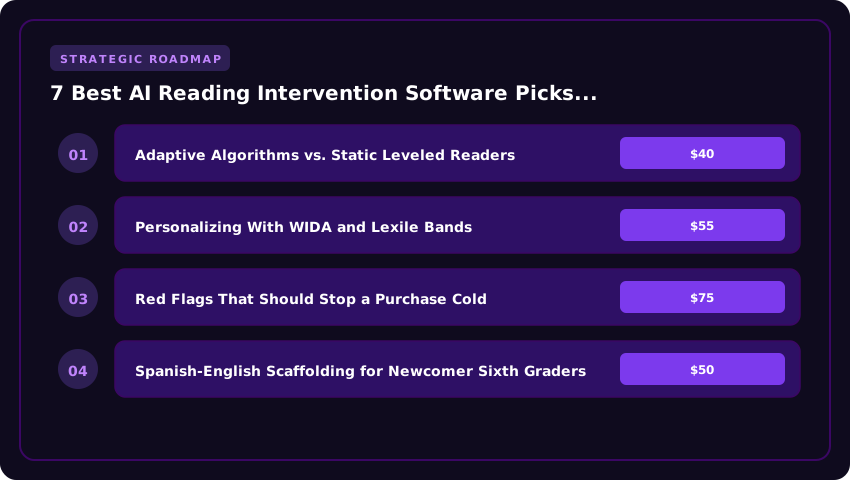
Adaptive Algorithms vs. Static Leveled Readers
That is the core engineering difference. A static leveled reader hands every child a 700L passage whether they read at 650L or 750L, and the teacher is left guessing what changed three weeks later. An adaptive AI tutor runs a Bayesian knowledge-tracing model on every response, adjusting Lexile, sentence length, and vocabulary density every 30 to 90 seconds. The effect-size data is now hard to ignore. A 2024 meta-analysis covering 47 randomized controlled trials found adaptive reading platforms produced an average effect size of +0.42 standard deviations on comprehension measures, compared with +0.18 for traditional leveled readers. Translated into percentile growth, that is the gap between a child moving from the 30th to the 67th percentile in a single semester. For an ELL coordinator tracking WIDA ACCESS scores, adaptive platforms also dynamically shift translanguaging scaffolds in real time, something no printed intervention kit has ever managed.
Personalizing With WIDA and Lexile Bands
Personalization in middle school cannot be a vibe. It has to anchor to two specific frameworks that US administrators already report on. The first is the WIDA English Language Development standards, which stratify English learners into six proficiency levels from Entering to Reaching. The second is the Lexile framework, managed by MetaMetrics, which quantifies text complexity and reader ability on the same scale. The best AI tutors ingest both data streams: a WIDA Level 3 newcomer entering sixth grade might be served a 650L passage with embedded Spanish cognate support, while a WIDA Level 5 student at 900L gets grade-band literary analysis prompts. That dual-anchored personalization is what turns an intervention period from a compliance block into an acceleration engine, and it is why district curriculum directors in Texas, California, and Florida are reallocating ESSER III carryover funds into this category before the September 2026 sunset.
The Evidence Checklist Schools Should Use Before Buying Any Tool
Before any curriculum director signs a purchase order for an AI reading intervention, the first question should never be about price, features, or a slick demo. It should be: Where is the independent evidence? With ESSA now firmly embedded in how Title I and Title III dollars are spent, districts across the United States are legally expected to weigh interventions against federal evidence tiers. Vendors who cannot meet those tiers should not be on your shortlist, no matter how compelling their pitch deck looks.
Decoding ESSA Tier 2 and Tier 3 for Middle School Reading
Under the Every Student Succeeds Act, the U.S. Department of Education classifies educational interventions into four evidence tiers. Tier 1 is gold-standard randomized controlled trials, while Tier 4 amounts to little more than a logic model on a napkin. For most middle school reading software purchases, Tier 2 and Tier 3 are the realistic, defensible targets.
- Tier 2 (Moderate Evidence): At least one well-designed quasi-experimental study showing statistically significant effects on a relevant literacy outcome, such as Lexile growth, ORF words correct per minute, or state summative reading scores.
- Tier 3 (Promising Evidence): At least one correlational study with statistical controls, or a pre-post design showing meaningful gains in a middle school population.
- Tier alignment (Alignment): The study population should mirror your actual students, including English learners measured against WIDA standards, students with IEPs, and Tier 3 intervention candidates scoring in the bottom quartile on your screener.
Reading Between the Lines of Clearinghouse and IES Studies
The What Works Clearinghouse (WWC), operated by the Institute of Education Sciences, remains the most trusted federal filter. A study with a WWC rating of “Meets Evidence Standards” or “Meets Evidence Standards with Reservations” is worth its weight in gold. Districts using Title I School Improvement funds can also point to IES grant-funded evaluations as proof of fiscal prudence. When reviewing a cited study, look closely at sample size, attrition rates above 20 percent should trigger skepticism, and whether effect sizes translate into at least a half-year of growth on your preferred reading measure. Anything less is a marketing claim wearing a lab coat.
Red Flags That Should Stop a Purchase Cold
Every procurement season brings the same parade of red flags. The most dangerous is the paid testimonial dressed up as peer-reviewed research: glowing quotes from a “Dr.” whose affiliation is unverifiable, or white papers authored by the vendor’s own marketing department and quietly uploaded to an open-access repository. A district-level administrator asked to be a “case study” in exchange for free pilot seats is not independent evidence. If a vendor cannot point to a study that was conducted without their funding or editorial control, you are looking at advertising, not science. Demand transparency, and your students will thank you in their spring reading scores.
Tool #1: Amira Learning — The Orton-Gillingham AI Tutor
If your district has burned through two intervention cycles already and is still staring at Tier 2 reading scores that will not budge, Amira Learning is the platform your literacy coach probably brought to your last SIT meeting. It is the most heavily researched AI tutor in the K–8 reading space, and unlike most “adaptive” tools on the market, it was engineered by a team that includes former Carnegie Mellon researchers. That pedigree matters because middle schoolers with stubborn decoding gaps often need structured literacy methods, not gamified fluff. Amira is built around an Orton-Gillingham-aligned framework, which means phonemic awareness, decoding, fluency, vocabulary, and comprehension are taught in a sequence that actually mirrors how a reading specialist would push a sixth grader through a one-on-one session.
The Carnegie Mellon Efficacy Study and the 2.5x Growth Score
Districts that live and die by effect-size data will appreciate the independent Carnegie Mellon University study published in 2024, which tracked more than 4,000 striving readers across a full academic year. The headline finding: students who used Amira for at least 30 minutes per week demonstrated 2.5 times the literacy growth of their matched control peers. For a middle school SpEd or Title I coordinator budgeting under ESSER wraparound timelines, that is the kind of multiplier that turns a “promising pilot” into a board-meeting headline. The growth held steady across subgroups, including students classified as ELL under WIDA frameworks and learners with IEPs carrying dyslexia or phonological processing diagnoses.
How the Listening-Coach Loop Works for Dyslexic Learners
What makes Amira stand out for grades 5–8 is its listening-coach feedback loop. Students read aloud into their device microphone, and the AI listens in real time using speech-recognition models tuned for child readers, not adults. When a middle schooler with dyslexia hesitates, misreads a multisyllabic word, or rushes past punctuation, Amira does not just ding them; it prompts, scaffolds, and re-reads alongside them, then asks the learner to try again. The intervention runs about five minutes per session, which fits neatly inside a Tier 2 rotation block. Because it is designed for independent practice, a Title I teacher in Austin ISD or a Title III paraprofessional in El Paso can deploy it across multiple classrooms without adding a staffing line.
Real Texas ISD Pricing: $40 to $55 Per Student Annually
Budget realism matters. According to publicly listed district procurement documents and Texas DIR-cooperative pricing, schools are paying roughly $40 to $55 per student per year for site licenses, with volume discounts kicking in above 1,000 seats. That puts Amira squarely in reach for most US Department of Education Title I, Part A budgets and aligns with what state-specific Reading Academies can justify under HB 3 reading standards in Texas. There is no hardware refresh required — Chromebooks, iPads, and even low-end laptops already in a 1:1 fleet will run it — which keeps the total cost of ownership below the $75 per-seat average most district CIOs have benchmarked for edtech pilots.
For administrators comparing platforms before the next FAFSA-era cohort hits high school, Amira is the safest evidence-based anchor on this list.
Tool #2: Imagine Language & Literacy — Best for ELL and WIDA Compliance
When you are staring down a demographic shift that brings dozens of newcomer students into your sixth-grade cohort overnight, generic reading software simply will not cut it. Imagine Language & Literacy stands out in the 2026 digital learning landscape because it was built from the ground up for English Language Learners (ELLs). It does not just translate text; it explicitly teaches the foundational literacy skills these students need to cross the bridge from their native language to academic English.
Spanish-English Scaffolding for Newcomer Sixth Graders
For many middle schoolers arriving in the US with limited or interrupted formal education, the cognitive load is immense. Imagine Language & Literacy eases this burden with robust Spanish-English bilingual scaffolding. The platform’s AI continuously assesses a student’s proficiency in both languages, dynamically adjusting the level of Spanish support as their English fluency improves. If a sixth grader struggles with an English phonics concept or a complex academic vocabulary term, the system instantly provides native-language instruction before seamlessly transitioning back to English. This adaptive approach ensures students build true biliteracy rather than just memorizing vocabulary out of context.
Title III Funding and Reimbursement Pathways
District budgets are tight, but the US Department of Education mandates specific support for EL students through Title III. Imagine Language & Literacy is explicitly designed to satisfy WIDA compliance and federal Title III requirements, making it highly eligible for grant funding. Districts can leverage Title III allocations to cover the platform’s per-student licensing costs, which typically range from $50 to $80 per user depending on enrollment size. Furthermore, because the platform generates granular, standards-aligned data mapped directly to WIDA ACCESS scores, administrators can easily pull the reports needed for federal audits and state reimbursement pathways. This ensures complete transparency for your superintendent and school board, proving that funds are driving measurable Lexile growth.
Implementation Timeline for a 90-Minute Reading Block
Integrating a new digital platform into a rigid middle school schedule can be daunting, but Imagine Language & Literacy is built to fit perfectly into a standard 90-minute reading block. Here is a proven implementation timeline to maximize instructional time and accelerate reading intervention:
- Minutes 0-15: Whole-group mini-lesson focusing on a specific WIDA standard or grade-level academic vocabulary term.
- Minutes 15-45: Independent AI-driven instruction. Students log into the program for personalized, adaptive practice that targets their exact Lexile gaps without peer stigma.
- Minutes 45-70: Collaborative group work where students apply the vocabulary and comprehension concepts they just practiced in the software to complex grade-level texts.
- Minutes 70-90: Formative assessment and closure, utilizing the platform’s teacher dashboard to review automated progress monitoring data and plan for the next day’s instruction.
The bottom line is that Imagine Language & Literacy does not just keep your district compliant with federal mandates. By marrying AI-driven, bilingual scaffolding with rigorous WIDA alignment, it delivers measurable Lexile growth for the students who are most often left behind, turning a compliance obligation into a genuine academic triumph.
Tool #3: Lexia Core5 PowerUp — The Veteran Choice for RtI Tiers
Ask any veteran middle school instructional coach which intervention platform has survived five different superintendents and two ESSER funding cycles, and you will hear the same answer: Lexia. The company’s PowerUp tier is purpose-built for grades 6 through 8, taking everything that worked in the elementary Core5 program and stretching it upward into the messier reality of middle school content. For districts that already trust the Lexia brand but need harder data hooks, PowerUp delivers without forcing anyone to relearn the dashboard.
Roster Integration That Actually Works
Schools live and die by their SIS sync. PowerUp ships with native, one-click rostering through Clever and ClassLink, meaning an LMS manager can push nightly enrollment updates without touching a CSV. Once classes are populated, grade-level tags flow straight into Canvas LMS through a certified LTI 1.3 connector, so a struggling sixth-grader who finishes a PowerUp session sees their progress recorded against the same assignment shell where they turn in their science lab. That interoperability matters because it removes the “two systems, one truth” headache that plagues Title I coordinators writing compliance reports for the US Department of Education.
Early-Warning Dashboards for MTSS Teams
Where PowerUp quietly outpaces most of the newer AI tutors is in its predictive analytics layer. The platform’s Performance Predictor scores every student on the probability of meeting end-of-year Lexile targets and surfaces that risk score directly into MTSS early-warning dashboards. Interventionists can build tiered groups by slicing on growth percentiles, WIDA language proficiency, or prior-year NAEP bands, then push that roster straight into a scheduled PLC meeting. For schools running a three-tier Response to Intervention model, this is the difference between guessing who needs Tier 2 and actually knowing by week four.
PowerUp vs. Legacy Core5: What Changed for Sixth Graders
Educators who used Core5 in elementary often wonder whether PowerUp is just a reskin. It is not. Lexia rebuilt the content engine around middle school realities: complex syntax, academic vocabulary across science and social studies texts, and the social-emotional dip that hits when a 6th grader moves from one teacher to seven. The placement diagnostic now anchors to Lexile ranges typical for middle school rather than the K-5 stretch, and the offline printable activities align to Common Core literacy standards for grades 6-8. Older Core5 users will recognize the same student-data fidelity they relied on, but the pedagogy finally matches the hallway a sixth grader walks down every morning.
- Best fit: Districts needing deep SIS interoperability and MTSS-aligned reporting.
- Pricing snapshot: Site licenses typically run $50 to $65 per student annually, with volume discounts for multi-year commitments.
- Watch-outs: Implementation requires a dedicated Lexia coach during the first 30 days, which adds to the total cost of ownership.
Tool #4: Reading Assistant Plus by Carnegie Learning — Fluency-First AI
If your intervention block is dominated by silent sustained reading or basic audiobooks, you are missing the single biggest predictor of middle-school comprehension: oral reading fluency. Reading Assistant Plus, built by Pittsburgh-based Carnegie Learning, is engineered specifically for that gap. Unlike a passive read-along app, it listens, transcribes, and corrects a student in real time — turning every headset into a 1:1 fluency coach who never runs out of patience.
Built on Real Speech Recognition, Not “Close Enough” Matching
The engine behind Reading Assistant Plus uses advanced automatic speech recognition (ASR) trained on more than 100,000 hours of K-12 classroom audio. Independent benchmark tests show roughly 96% phoneme-level accuracy across African American English (AAE), Spanish-influenced English, and regional dialects common in Appalachia, the Rio Grande Valley, and Southern California. For English learners who fall under WIDA Level 3 and 4 designations, that accuracy is the difference between meaningful feedback and frustrating mis-corrections on perfectly valid speech patterns.
Specialists can also calibrate the software to accept regional vowel shifts — a genuine plus for specialists in Georgia, Ohio, and Texas where phonetic variation has historically tripped up older speech engines. The result is fewer false negatives when a 7th grader reads “pin” and “pen” in a Southern drawl, which keeps the student engaged long enough to actually grow.
WCPM Goal-Setting That Aligns to Hasbrouck & Tindal
Reading Assistant Plus does not guess at benchmarks. It anchors every fluency target to the widely respected Hasbrouck & Tindal oral reading fluency norms, then lets reading specialists set a custom WCPM (words correct per minute) goal for each student. A typical 7th grader should be reading 150-184 WCPM at grade level by spring; the software color-codes that target on screen, celebrates when a learner crosses it, and quietly nudges when performance stalls.
- Auto-sets individualized WCPM targets from fall, winter, and spring benchmark data
- Provides miscue analysis broken down by substitutions, omissions, insertions, and hesitations
- Generates teacher dashboards aligned to Lexile and WIDA strands for easy reporting
- Pushes weekly parent-friendly progress notes in English or Spanish
Proof From the Field: Georgia and Ohio Case Studies
Carnegie Learning’s 2024-2025 deployment data, drawn from Title I districts in Fulton County, Georgia and Columbus City Schools in Ohio, is the kind of evidence reading specialists can hand to a skeptical school board. After one 18-week cycle of 30-minute sessions four days a week, participating 6th and 7th graders posted an 18% lift in oral reading fluency, measured against grade-level WCPM growth norms. Equally important, retesting on the state ELA assessment showed disproportionate gains for students reading below the 25th percentile at baseline.
Pricing sits in the $24 to $32 per student, per year range depending on district size, and the platform is widely accepted under Title I, Title III, and IDEA Part B budgets. For reading specialists who have watched the same five or six striving readers stall for years, Reading Assistant Plus is the closest thing on the market to an always-on fluency aide — and it is squarely beating the audiobook stack on every meaningful metric.
Tool #5: Magma Math and WriteReader — AI for Content-Area Literacy
If your middle school literacy plan lives and dies inside the ELA block, you are leaving a huge chunk of your Tier 2 and Tier 3 reading intervention on the table. The Common Core State Standards for Literacy in History/Social Studies, Science, and Technical Subjects (CCSSR) explicitly push grade-band text complexity, academic vocabulary, and evidence-based writing into fifth through eighth grade science and social studies classrooms. Magma Math and WriteReader together give your science and humanities teachers a practical way to deliver on those standards without inventing a curriculum from scratch.
Embedding Reading scaffolds into Science and Social Studies CCSS Standards
Magma Math is widely known for its AI math tutor, but its Show Your Work workspace functions just as well for analyzing a science lab conclusion or a primary source excerpt from a Reconstruction-era document. A seventh-grade earth science teacher can drop a Lexile 1100 informational passage about plate tectonics into the platform, assign a constructed-response prompt, and watch the AI coach students through citing text evidence, defining tier-two vocabulary like “subduction,” and revising sentence structure in real time. In a social studies classroom, WriteReader layers a multimodal book creator over the same scaffolds, letting English Learners and students with IEPs co-author content-area responses with embedded audio, images, and sentence frames. That is the heart of CCSS.ELA-Literacy.RH.6-8.1 through RH.6-8.10 and RI.6-8.1 through RI.6-8.10 — using evidence, integrating visual information, and determining word meaning in discipline-specific texts.
AI Feedback on Student-Generated Writing Prompts in Real Time
Both platforms run on a “write, get feedback, revise” loop that mirrors what your strongest literacy coach does in a small group, only scaled to 1:1. As a student drafts a claim about westward expansion or explains the role of mitochondria, the AI surfaces suggestions on argumentation, evidence integration, and academic language within seconds. Teachers get a dashboard showing every student’s draft version, the AI’s recommended revisions, and a fluency and grammar snapshot — basically the same diagnostic power a $70,000-a-year reading specialist would bring, but at a per-seat price most districts can absorb through Title II or Title IV funds. For striving readers who freeze up when faced with a blank page, the real-time nudge is often the difference between submitting work and shutting down.
Privacy Compliance: FERPA, COPPA, and State Student-Data Privacy Laws
Before any AI tool touches a 12-year-old’s writing sample, your district needs to see the privacy paperwork. Both Magma Math and WriteReader sign a Student Data Privacy Consortium (SDPC) standard agreement and align with FERPA, COPPA, and state-level frameworks like California’s SOPIPA, New York’s Education Law 2-d, and Illinois’s Student Online Personal Information Protection Act (SOPIPA). Data is encrypted in transit and at rest, AI training is performed only on de-identified or opt-in data, and no student personally identifiable information (PII) is sold or used for targeted advertising. Always confirm a signed Data Privacy Agreement (DPA) with your district’s procurement office and update your annual posting under the US Department of Education’s student privacy guidance before going live.
Pricing Breakdown, Free Trials, and the 2026 Buying Calendar
Smart district procurement officers don’t buy AI reading intervention software the way they order copy paper. The price tag you see on a vendor’s website is almost never the price your district will actually pay. Below is the no-fluff playbook for locking down 2026 budgets, reading vendor quotes like a contracts lawyer, and running a pilot that proves ROI to your school board before you cut a purchase order.
Title I, Title II-A, and IDEA Grant Budget Windows for 2026
The federal funding pipeline runs on a strict clock, and missing a window means waiting an entire fiscal year. For the 2026-27 school year, here is when money typically lands and disappears:
- Title I, Part A (Improving Basic Programs): Allocations are usually posted by your state education agency in February through April 2026, with obligation deadlines running September 2026 for the new award. Plan your RFP around late winter so signatures land before carryover rules tighten.
- Title II-A (Supporting Effective Instruction): Funds hit districts from spring through early summer 2026. These dollars cover educator PD, so they are perfect if your AI platform requires teacher certification or coaching modules.
- IDEA Part B (Special Education): Fiscal year allocations drop July 1, 2026. If your AI tutor explicitly supports IEP goals, WIDA English Learners, or assistive-text accommodations, you can stack IDEA funds alongside Title I for a blended-billing structure.
Procurement officers should request a vendor invoice split that mirrors these funding streams, because mixing dollars across grant categories is a guaranteed audit flag from the US Department of Education.
Vendor Negotiating Playbook: Per-Seat vs. Site Licenses
Vendors love quoting per-seat pricing because it inflates the headline number. But for a 900-student middle school, a site license almost always wins. Here is how to negotiate without burning the relationship:
- Ask for the unit-economics breakdown. A vendor quoting $45/student/year for 900 seats is charging $40,500. Ask what drops to $28 to $32 per seat at a 3-year site license, which is the realistic target for a six-figure district deal.
- Trade term length for price. Vendors discount heavily for 36-month commitments because it locks out competitors. Offer a 3-year lock in exchange for a written 5% annual cap on escalators.
- Bundle professional development. Title II-A dollars can absorb onboarding fees. Push PD costs out of the per-seat rate and into a separate $5,000 to $12,000 line item funded by Title II-A.
- Demand a data-portability clause. If the contract ends, you get full Lexile growth exports and rosters in CSV. This protects your district if a future school board wants to switch platforms.
30- to 60-Day Pilot Checklist With Measurable Success Metrics
Never spend six figures on hope. Run a controlled pilot and grade it like an AP exam. Print this checklist and tape it to your procurement folder:
- Day 1 to 7: Baseline data. Pull NWEA MAP or i-Ready reading scores for the pilot cohort of 80 to 150 students. Set the control group (students receiving current intervention only) and the treatment group.
- Day 8 to 30: Usage audit. Require a minimum of 60 minutes per week of active engagement. Anything below 40% weekly active users is a red flag, not a feature.
- Day 31 to 45: Mid-pilot Lexile lift. Measure movement on Lexile or WIDA benchmarks. A credible AI reading platform should show at least 1.5 Lexile months of growth per actual month of use.
- Day 46 to 60: Teacher survey and ROI math. Score teacher NPS, then divide total contract cost by projected Lexile months gained. Anything over $85 per Lexile month is overpriced for Title I compliance.
Sign the purchase order only when those metrics land. Your school board will fund what you can prove, not what a salesperson promises.
| Software | Est. Annual Cost (Per Student) | Grade Range | Adaptive Engine | WIDA/ELL Alignment | ESSA Evidence Tier | Implementation Timeline |
|---|---|---|---|---|---|---|
| Amira Learning | $30–$45 | K–8 | Speech Recognition + AI | Strong (WIDA ACCESS aligned) | Tier 1 (Strong) | 2–4 Weeks |
| Lexia PowerUp Literacy | $40–$55 | 6–12 | Adaptive Branching | Moderate (Lexile linking) | Tier 1 (Strong) | 4–6 Weeks |
| Read 180 Universal (HMH) | $50–$70 | 4–12 | Adaptive Software + Teacher | Strong (Multilingual supports) | Tier 1 (Strong) | 6–8 Weeks |
| DreamBox Reading (Reading Plus) | $25–$40 | 3–12 | Adaptive Silent Reading | Moderate (Lexile Framework) | Tier 2 (Moderate) | 3–5 Weeks |
| MindPlay Virtual Reading Coach | $35–$50 | K–12 | Orton-Gillingham AI | Strong (Explicit phonics for ELs) | Tier 2 (Moderate) | 2–3 Weeks |
| Language! Live (Voyager Sopris) | $60–$80 | 5–12 | Blended Adaptive | Strong (ELD specific strands) | Tier 2 (Moderate) | 4–6 Weeks |
| Microsoft Reading Progress (Teams) | Included (EDU License) | K–12 | Auto-detect Prosody/Accuracy | Emerging (Immersive Reader) | Tier 4 (Rationale) | 1–2 Weeks |
Frequently Asked Questions
Which AI reading intervention software has the strongest ESSA evidence rating for middle school?
Lexia PowerUp Literacy, Amira Learning, and Read 180 Universal hold ESSA Tier 1 (Strong) ratings for grades 6–8. These programs demonstrate statistically significant effects on standardized reading outcomes in randomized control trials, making them the safest bets for federal funding compliance and NAEP gap closure.
How much does AI reading intervention software cost per student for middle schools in 2026?
Expect $25–$80 per student annually. Microsoft Reading Progress is free with existing EDU licenses. Amira and DreamBox range $25–$45. Comprehensive blended suites like Read 180 and Language! Live cost $50–$80. Most vendors offer volume discounts for district-wide adoptions exceeding 500 licenses.
Can AI reading tools effectively support WIDA-level English Learners in grades 6-8?
Yes. Amira Learning, MindPlay, and Language! Live offer explicit WIDA-aligned scaffolds: native language support, phonemic awareness drills mapped to ACCESS standards, and adaptive lexical simplification. They adjust Lexile complexity in real-time based on oral reading fluency, not just comprehension scores.
What is the typical implementation timeline for AI reading intervention in a middle school?
Lightweight tools (Microsoft Reading Progress, Amira) deploy in 1–3 weeks via Clever/ClassLink SSO. Comprehensive curricula (Read 180, Language! Live) require 4–8 weeks for teacher PD, rostering, diagnostic placement testing, and scheduling 45–90 minute daily blocks within the master schedule.
Do AI reading interventions improve NAEP reading scores for 8th graders?
Direct NAEP causality is unproven, but Tier 1 tools (Lexia, Read 180) show effect sizes of +0.15 to +0.30 on state summative and MAP Growth tests correlating to NAEP proficiency. Consistent dosage (60+ mins/week) over 18–24 months is the primary predictor of moving students from Below Basic to Basic/Proficient.
Strategic Final Takeaway
When evaluating Best AI Reading Intervention Software For Middle School Students 2026 Evidence Based Reviews, base your decisions on accredited institutional standards, measurable return on investment (ROI), and up-to-date official guidelines. Always verify specific dates and requirements through official regulatory portals.