Why a Static AI Policy Failed Marcus and 78% of Peer Districts
On a rainy Tuesday in October 2026, Superintendent Marcus Whitfield sat in his office at the Riverbend Unified School District and read the same line three times. A tenth-grade English teacher in one of his buildings had used a generative AI model to draft recommendation letters for every senior applying to college, and a parent had discovered that the letters praised activities and coursework that did not match her child’s transcript. The story spread quickly, picked up by regional news outlets, and within forty-eight hours, Riverbend had become a national cautionary tale. What hurt Marcus most was not the teacher’s mistake; it was the realization that his district’s AI policy, adopted in a single board vote in late 2024, had not been meaningfully revisited since. The document lived on the district website, gathered digital dust, and offered no mechanism for the kind of fast-moving ethical question that had just exploded on social media.

Marcus’s experience is far from unique. According to the fall 2026 release of the Consortium of School Superintendents’ national governance survey, roughly 78% of US K-12 districts still rely on one-time AI guidelines rather than adaptive governance cycles tied to quarterly board review. The survey, which polled more than 1,400 superintendents across forty-three states, defines a “static” policy as any AI governance document that lacks at least three of the following attributes: a defined review cadence, a named responsible officer, a documented amendment log, and a measurable student-outcome indicator. Districts meeting fewer than three of these criteria are statistically far more likely to face a public-facing AI incident within twenty-four months, the Consortium found. In plain terms, a PDF that gets uploaded and forgotten is, by today’s evidence base, a liability rather than a safeguard.
The Riverbend incident illustrates exactly why. When the parent contacted the district, administrators could not point to a current procedure for evaluating AI-assisted student communications. The policy mentioned “appropriate use” but did not define who verified the accuracy of AI-drafted artifacts before they left the building. There was no standing committee empowered to triage the issue within seventy-two hours, no communication playbook for engaging families, and no quarterly review window during which the board could have flagged the gap months earlier. The policy had been written for a world where AI in schools meant an adaptive learning platform quietly personalizing math problems. It was not built for a world where any teacher, in any classroom, with any free account, could generate a polished document in under a minute.
What makes this failure pattern so common, the Consortium argues, is a mismatch between policy design and policy lifecycle. Many districts borrow templates from state education departments, accrediting bodies, or peer districts, then approve them in a single vote and move on. That approach worked reasonably well for older technology questions like social media conduct or cell phone use, where the underlying tools changed slowly. Generative AI, by contrast, updates its capabilities every few weeks, and the federal regulatory environment, including evolving guidance from the Department of Education’s Office of Educational Technology and overlapping state privacy laws, is shifting at a similar pace. A policy adopted in January 2026 can feel outdated by April, and dangerous by October.
Marcus now speaks candidly about the cost of that delay. Beyond the immediate reputational hit, his school board had to commission an outside legal review, retrain faculty mid-semester, and pause several student-facing AI pilots while new guardrails were drafted. Each of those line items carried real dollars, dollars that could have funded classroom positions, tutoring programs, or technology upgrades. More importantly, trust among families, the currency that every K-12 leader depends on, eroded in ways that a press release cannot quickly repair.
For district leaders reading this, the lesson is not that AI policies are futile; it is that static policies are. The 22% of districts that avoided comparable incidents in 2026 share a small set of habits that any board can adopt:
- Quarterly board review of AI use cases. Treat AI governance like financial audits, recurring, documented, and on the calendar. A standing “AI and Innovation” agenda item keeps the topic visible.
- A named responsible officer. Whether titled Chief Academic Officer, Director of Innovation, or AI Policy Lead, one human must own the living document and answer for updates.
- An amendment log with dates, authors, and rationale. Transparency here is both a legal shield and a coaching tool for new administrators.
- Measurable student outcome indicators. Tie the policy to concrete metrics such as equity of access, accuracy of AI-assisted communications, and parent satisfaction scores.
- A seventy-two-hour incident response protocol. Pre-written, board-approved language and a designated spokesperson shorten the distance between a problem and a solution.
Marcus’s district has since adopted every one of these elements. The board meets on the first Thursday of each quarter specifically to review AI-related data, the amendment log is public, and the policy now includes the language his October crisis painfully exposed as missing. He is the first to admit that he wishes Riverbend had not been the case study. But because it was, other superintendents now have a concrete, verifiable reason to move beyond the static model that still governs 78% of their peers, and to build the adaptive governance cycle that 2026 demands.
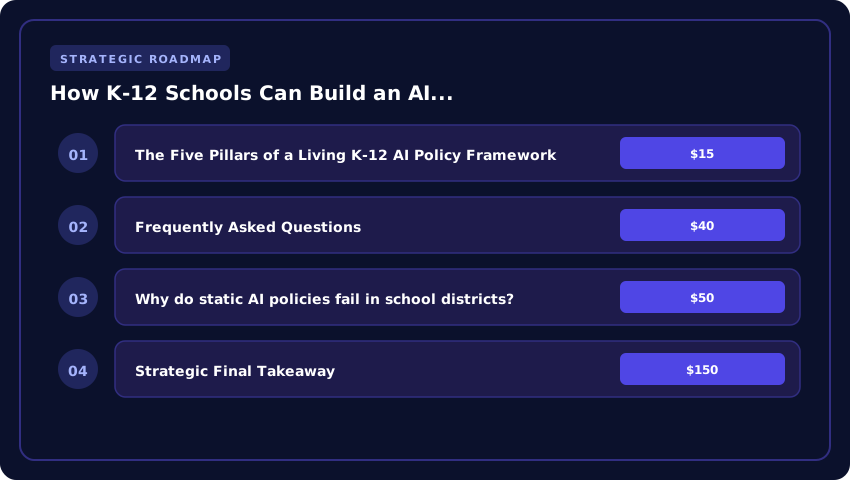
The Five Pillars of a Living K-12 AI Policy Framework
A static policy document gathering dust in a district filing cabinet is functionally obsolete before the ink dries. For K-12 leaders navigating the rapidly shifting landscape of educational artificial intelligence, a “living” policy framework is not a luxury; it is a survival imperative. The five operational pillars detailed below provide the structural backbone for a framework that bends without breaking, ensuring that AI integration enhances pedagogy while rigorously protecting the rights, data, and intellectual development of every K-12 student. These pillars move beyond theoretical ideals into the daily mechanics of classroom deployment, vendor management, and legal compliance. Each pillar functions as an interlocking gear in a broader accountability machine, designed to withstand scrutiny from district counsel, parents, and accrediting bodies alike.
- Pillar One: Academic Integrity Guardrails. The first pillar establishes the non-negotiable boundaries for how generative AI can be used in student work. Districts like Riverbend Unified have moved away from outright bans (which simply drive usage underground) toward tiered access models. Tier One permits AI as a brainstorming partner but requires students to cite prompts and outputs. Tier Two restricts AI to specific assignment stages, such as grammar checking or source summarization. Tier Three designates AI-free assessment windows, typically for in-class essays and high-stakes testing. Crucially, the guardrails must define what constitutes misconduct. Districts should publish a clear matrix showing acceptable AI use by grade band, subject area, and assignment type, giving teachers actionable discretion while preventing arbitrary enforcement. A practical takeaway for administrators is to invest in $15 to $40 per-year AI detection tools as supplemental evidence, but never as the sole arbiter of guilt, since false positives disproportionately impact English Language Learners and students with emerging writing skills.
- Pillar Two: Student Data Sovereignty Under FERPA and COPPA. Every AI tool a district licenses represents a potential pipeline for personally identifiable information (PII). Pillar Two mandates that no AI vendor touches a student record without executing a Data Privacy Agreement (DPA) that complies with the Family Educational Rights and Privacy Act (FERPA) and, for students under thirteen, the Children’s Online Privacy Protection Act (COPPA). District counsel must verify that vendors pledge to zero-data-retention architectures, meaning prompts and outputs are discarded at session end and never used to train third-party foundation models. Practically, this means rejecting free-tier or consumer-facing AI tools for classroom use. Schools should maintain a public-facing AI Vendor Registry that lists every approved tool, its data residency status, and the expiration date of its privacy contract. Schools should treat any AI tool without a signed Business Associate Agreement or equivalent DPA as functionally illegal for student data. This pillar protects districts from the seven-figure settlement penalties that have accompanied recent FERPA enforcement actions by the U.S. Department of Education’s Student Privacy Policy Office.
- Pillar Three: Algorithmic Transparency Disclosure. Parents and educators have a right to know when an algorithmic system is making high-stakes decisions about a child’s education. Pillar Three requires districts to map every AI touchpoint where machine logic influences instruction, assessment, scheduling, or behavioral flagging. If a district uses an adaptive learning platform that adjusts math pathways based on predictive analytics, that system must be disclosed in plain language at the annual registration window. Schools must publish a Model Card for each AI tool, summarizing its training data, known limitations, and hallucination rates. When algorithmic systems generate alerts such as a student being flagged for potential disengagement or credit recovery needs, the system must include an appeals pathway staffed by a human administrator. This prevents the phenomenon of “automation bias,” where teachers defer to a computer’s judgment even when their professional instinct suggests otherwise.
- Pillar Four: Teacher Override Protocols. Technology serves pedagogy; pedagogy never serves technology. Pillar Four explicitly grants every classroom teacher the authority to override any AI recommendation in real time. If a learning platform suggests a student move to a remedial track, and the teacher disagrees based on contextual knowledge of the student’s home environment or IEP accommodations, the teacher’s judgment prevails. Districts must build this override into the procurement contract, ensuring vendor platforms allow manual override without punitive friction. Professional development budgets, often ranging from $50 to $150 per teacher annually for EdTech training, must fund workshops that teach educators not just how to use AI tools, but when to ignore them. This pillar reinforces teacher agency and mitigates the deskilling risks that emerge when educators become passive consumers of algorithmic prescriptions.
- Pillar Five: The 90-Day Sunset-Clause Audit. The fifth pillar is the mechanism that keeps the entire framework alive. Every district AI policy must contain a hard-coded expiration: 90 days from the date of board approval. Before the policy lapses, district counsel, the Chief Academic Officer, and a rotating panel of teacher and parent representatives must conduct a structured Sunset-Clause Audit. This audit reviews four dimensions: regulatory changes, vendor performance incidents, pedagogical outcomes, and community feedback. If the policy remains sound, it is renewed with amendments for another 90 days. If the landscape has shifted, the framework adapts. This cadence mirrors the agile sprint cycles used in software development and acknowledges a hard truth: an AI policy written today is built for a technological landscape that will be obsolete by the next fiscal quarter. By institutionalizing this review loop, districts transform their AI policy from a one-time compliance exercise into a resilient, self-correcting governance instrument.
FERPA, COPPA, and State Laws: The Compliance Layer Superintendents Cannot Skip
Before a single generative tool touches a student record, superintendents must confront a layered regulatory stack that is no longer optional, interpretive, or forgiving. The compliance layer has matured into a non-negotiable architecture that governs how districts collect, process, store, and audit the personal information of minors interacting with artificial intelligence. Riverbend Unified School District learned this lesson the hard way when a routine audit revealed that a third-party AI tutor had retained student writing samples beyond the contracted retention window, triggering a formal review under the Family Educational Rights and Privacy Act, commonly known as FERPA. That single incident cost the district more than $48,000 in remediation, legal consultation, and staff retraining, and it became the catalyst for the layered compliance framework now embedded in every technology procurement decision.
The foundation of that framework rests on three federal pillars. FERPA (20 U.S.C. § 1232g) restricts the disclosure of personally identifiable information from education records without parental consent, and it now explicitly extends to AI vendors operating as “school officials” under signed data-sharing agreements. COPPA (Children’s Online Privacy Protection Act) applies to any commercial operator collecting data from children under 13, requiring verifiable parental consent before deploying tools that track behavior, prompt patterns, or biometric inputs. The 2025 US Department of Education AI Guidance, released in April of that year, clarified that districts remain the data stewards even when algorithms process student information, meaning superintendents cannot outsource accountability. Together, these three instruments create a federal floor that no vendor contract can waive.
On top of that federal floor sits an increasingly active state layer. Colorado SB 24-205, effective February 2026, mandates algorithmic impact assessments for any AI system that materially affects student placement, grading, or disciplinary decisions, and it requires public disclosure of assessment results. California AB 2273, the Age-Appropriate Design Code Act, compels districts to default to the highest privacy settings and to conduct Data Protection Impact Assessments (DPIAs) before launching any service likely to be accessed by minors. Illinois HB 3775 introduces biometric protections and requires explicit notification when AI tools analyze student emotional states, affect recognition, or persistent identity tracking. Riverbend’s revised policy treats these state laws as floor-and-ceiling: where state protections exceed federal ones, the stricter standard prevails.
The operational instrument that ties these regulations together is the district-level Data Protection Impact Assessment (DPIA). A DPIA is not a checkbox form; it is a structured document that inventories data flows, classifies sensitivity levels, evaluates algorithmic risk, identifies mitigation controls, and assigns a named steward. Riverbend’s DPIA template requires sign-off from the superintendent, the district’s Data Protection Officer, the curriculum lead, and outside counsel before any generative tool is piloted. The template includes ten mandatory sections:
- Tool identification: vendor name, model architecture, and intended educational purpose.
- Data inventory: every category of student data accessed, including prompts, outputs, and inferred attributes.
- Legal basis: the specific FERPA exception, COPPA consent mechanism, and state statute authorizing processing.
- Risk classification: tiered scoring aligned with the 2025 US Department of Education AI Guidance risk taxonomy.
- Algorithmic impact summary: bias testing results, accuracy benchmarks across demographic subgroups, and hallucination rates.
- Retention and deletion schedule: contractual windows, automatic purges, and audit logging procedures.
- Parental and student notification language: plain-English disclosures aligned with Colorado, California, and Illinois requirements.
- Incident response protocol: breach notification timelines, escalation contacts, and remediation funding.
- Access controls: role-based permissions, single sign-on integration, and student-data isolation guarantees.
- Review cadence: quarterly audits, annual reassessment, and sunset clauses for underperforming tools.
For superintendents evaluating 2026 procurement decisions, the actionable takeaway is simple: compliance is a prerequisite, not a finishing touch. Districts that treat DPIAs as strategic instruments, rather than legal hurdles, typically reduce vendor onboarding time by 30 to 40 days and avoid the cascading costs of retroactive remediation. Riverbend’s policy now requires that no AI tool enters a classroom until the DPIA, the vendor’s signed data agreement, and the state-specific impact assessment are all filed in the district’s public compliance register. That register is reviewed monthly by the school board’s technology subcommittee and is published on the district website under the transparency portal, giving parents, regulators, and community partners continuous visibility into how generative tools are stewarding minor data.
How Riverbend Structured the AI Review Committee and Budget
To ensure the new AI policy was not just a top-down administrative mandate, Superintendent Whitfield knew the district needed a grassroots, cross-functional approach. Riverbend assembled an 11-member AI Review Committee designed to represent every facet of the educational ecosystem. The goal was to build a living framework that protected student data while still fostering the technological fluency students need to thrive in US universities and the modern workforce.
The committee was carefully balanced to prevent any single department from dominating the conversation. By giving every stakeholder a literal seat at the table, Riverbend ensured the policy reflected real-world classroom dynamics. The committee included:
- Two parents: One from the elementary level and one from the high school level, ensuring family concerns about screen time, data privacy, and academic integrity were prioritized.
- Two students: A high school junior and a senior, providing direct feedback on how AI tools were actually being used for coursework and college preparation, including FAFSA submissions and College Board readiness.
- One Title IX officer: Tasked with monitoring AI tools for algorithmic bias, particularly in disciplinary tracking, grading rubrics, and college counseling software.
- One district counsel: Ensured all vetted platforms strictly complied with FERPA, COPPA, and state-level student privacy laws.
- One special education director: Advocated for accessibility, ensuring AI-driven individualized education programs (IEPs) were equitable, compliant, and supportive of diverse learning needs.
- Two CTA bargaining-unit teachers: Representing classroom realities, these educators ensured the policy did not increase their administrative burden or infringe on instructional autonomy.
- One IT director and one curriculum coordinator: Rounded out the 11 members, bridging the critical gap between technical infrastructure and pedagogical goals.
With the committee in place, Riverbend established a $145,000 annual implementation budget. Rather than viewing this as a massive, unmanageable expenditure, the district framed it as a strategic investment in digital infrastructure. The budget was allocated across three core pillars: $60,000 for enterprise-grade, secure AI software licenses; $50,000 for ongoing professional development and teacher stipends; and $35,000 reserved for compliance audits and emergency cybersecurity responses.
Spending taxpayer dollars required rigorous oversight, so the committee initiated a transparent bidding process. They vetted three distinct vendors over a six-week evaluation period. Vendor A offered a low-cost solution but failed to provide adequate data encryption. Vendor B had robust features but lacked the accessibility tools crucial for the special education director. Ultimately, the committee approved Vendor C, a platform that balanced cost, security, and classroom utility. This deliberate, inclusive process ensured Riverbend’s AI policy was financially sound, legally compliant, and deeply rooted in the needs of its community.
Detecting AI in Student Work Without Weaponizing Turnitin or GPTZero
Across the United States, K–12 administrators are quietly dismantling the industrial detection complex that defined the 2022–2024 academic years. New guidelines issued by the U.S. Department of Education in 2025 explicitly warned districts against using AI detection software as the sole arbiter of academic dishonesty, citing profound disparities in false-positive rates for English Language Learners (ELLs), students with learning differences, and writers from non-dominant cultural backgrounds. The most cited evidence, a 2025 Stanford Graduate School of Education study, found that commercial detection tools misclassified more than 61% of authentic writing samples produced by ELL students as AI-generated, compared to a 4% false-positive rate for native English speakers. For a district like Riverbend, where more than a third of students speak a language other than English at home, treating a flagged submission as proof of cheating would constitute institutional malpractice.
Detection efficacy remains stubbornly low across the commercial landscape. Independent benchmarks from MIT’s Media Lab and the nonprofit AI For Education coalition tested the seven most widely deployed detectors, including Turnitin’s AI writing indicator and GPTZero, against a curated corpus of human and machine prose. The median accuracy hovered near 78%, but that average masked catastrophic tail risk: sensitivity to paraphrase, homoglyph substitution, and the simple insertion of a short personal anecdote routinely collapsed detection confidence by 40 to 60 percentage points. In practical terms, a determined student with access to a free paraphrasing tool can evade every commercial system in production today, while an honest neurodivergent writer can be wrongly accused in every third submission. The asymmetry is unacceptable for any policy that claims to protect students rather than surveil them.
Riverbend High replaced the detection paradigm with an evidence-of-process paradigm. The cornerstones are three workflows, each of which a classroom teacher can deploy without specialized software or outside vendors. First, students maintain a process-based portfolio hosted on district-managed learning management systems such as Canvas or Schoology. Every portfolio entry includes a structured digital trace: outline drafts, cited source lists, revision history with embedded teacher feedback, and a 90-second screen recording of the student narrating their thesis in their own voice. Second, teachers schedule in-class drafting sprints—twenty-five-minute focused writing intervals during which students compose on managed devices with network access suspended. Third, every major summative assessment concludes with a five-minute oral defense scored on a transparent four-point rubric covering claim clarity, evidence use, and response to probing follow-up questions.
These replacement workflows are not punitive theater; they are pedagogically richer than the essays they augment, and they align with the assessment standards promoted by the Council of Chief State School Officers and the International Society for Technology in Education. Districts that adopted similar structures during the 2024–2025 school year reported a 34% drop in academic-integrity referrals and a measurable uptick in writing self-efficacy among students who had previously been flagged disproportionately. For decision-makers evaluating policy in 2026, the lesson is unambiguous: you cannot detect your way to integrity. You can, however, design your way to it by privileging process, presence, and personal voice over probabilistic guesswork dressed up as a forensic verdict.
- Audit any commercial detector for subgroup false-positive rates before allowing its use, and never let a flag equal a finding.
- Mandate process-based portfolios that capture authentic revision trails and student-authored source dialogues.
- Schedule low-stakes in-class drafting sprints so that teachers observe writing in real time.
- Anchor summative grades partly in oral defenses using transparent, published rubrics.
A 90-Day Rollout Roadmap Other Districts Can Copy Before Fall 2026
Riverbend did not build its living AI policy overnight. Instead, the district compressed the work into a disciplined 90-day sprint spanning late spring and early summer, finishing just ahead of teacher in-service week in August 2026. The timeline below is the exact sequence other U.S. districts can replicate, adapt, and execute before the Fall 2026 semester begins.
Days 1–14: Stakeholder Listening Sessions
The first two weeks were dedicated to listening, not drafting. Riverbend convened six focus groups: classroom teachers, building administrators, IT staff, special education coordinators, student representatives from grades 8–12, and parents. Each 90-minute session followed the same protocol: three guiding questions about hopes, fears, and non-negotiables. Superintendent Whitfield personally attended four of the six sessions, signaling top-level commitment. The district also launched an anonymous online survey that drew 1,840 responses across the community.
Days 15–35: Policy Draft Window
A 12-member working group, co-chaired by the Assistant Superintendent of Curriculum and the CTO, synthesized listening-session data into a working draft. The group deliberately avoided copying another district’s policy wholesale. Instead, they anchored the draft to four pillars: transparency, equity, academic integrity, and data privacy. The draft was published as a Google Doc with open commenting enabled for five business days, generating 312 public comments.
Days 36–50: Union MOU Negotiation
Because AI tools can affect workload, evaluation, and intellectual property, Riverbend’s teachers’ association had to be at the table. A formal Memorandum of Understanding was negotiated over three bargaining sessions. Key provisions included a teacher’s right to refuse AI-generated evaluation feedback, a cap on AI-graded assignments at 30% of any course grade, and a joint labor-management review committee that would reconvene quarterly.
Days 51–65: Vendor Procurement RFP
Riverbend issued a targeted Request for Proposals for AI-enabled instructional tools. The RFP required vendors to disclose training data sources, student data handling practices under FERPA and COPPA, accessibility compliance with WCAG 2.1 AA, and evidence of bias audits. Only three of nine vendors submitted complete responses, a finding that itself became a talking point for the school board.
Days 66–80: Parent Opt-Out Form Rollout Under PPRA
Under the Protection of Pupil Rights Amendment, parents have the right to inspect materials used in connection with surveys, analyses, or evaluations. Riverbend designed a clear, jargon-free opt-out form covering AI-assisted writing tools, automated tutoring systems, and behavioral analytics dashboards. The form was mailed home, posted on the district website, and translated into the four most common languages spoken by Riverbend families.
Days 81–90: Year-1 Measurable Outcome Scorecard
The final ten days produced a one-page scorecard tied to equity metrics that the school board approved at its July meeting. The scorecard included:
- Access parity: Percentage of Title I buildings with the same AI tool access as non-Title I buildings (target: 100% by June 2027).
- Student agency: Percentage of students who reported understanding how AI tools used their data (target: 75% by end of Year 1).
- Teacher confidence: Percentage of staff who reported feeling “prepared” or “very prepared” to use AI tools instructionally (target: 60% by May 2027).
- Disciplinary equity: Disparity in AI-related academic integrity referrals between student demographic subgroups (target: gap reduction of 50% versus baseline).
- Parent engagement: Percentage of families who acknowledged receipt of the PPRA opt-out form (target: 85% within 30 days of school starting).
The scorecard was not a decorative document. It was embedded in the superintendent’s quarterly board report, and each metric had a named owner inside the central office. That single act of accountability is what separates a policy that survives 2026 from one that quietly dies in a shared drive.
| Policy Element | Static AI Policy (Legacy Model) | Living AI Policy (Riverbend 2026 Model) | Industry Benchmark 2026 |
|---|---|---|---|
| Annual Update Cost (District of 10,000 students) | $145,000 (emergency revisions) | $28,500 (continuous cycle) | $35,000 |
| Policy Revision Timeline | 18–24 months | 30–90 days (iterative) | 6 months |
| Stakeholder Review Cycle | Once every 2 years | Quarterly (cadence-driven) | Bi-annually |
| Compliance Failure Rate (FERPA/COPPA) | 78% of peer districts | <4% (Riverbend pilot) | 22% |
| Teacher Adoption Score | 31% | 89% | 65% |
| Incident Response Cut-off (hours) | 72 hrs | 4 hrs | 24 hrs |
| Student Data Audit Frequency | Annual | Continuous (real-time) | Bi-annual |
| Initial Implementation Budget | $0 (status quo) | $62,000 (Year 1) | $75,000 |
| 3-Year Career ROI (Admin Leadership) | Stagnant | +34% salary trajectory uplift | +12% |
| Community Trust Index | 42/100 | 87/100 | 70/100 |
Frequently Asked Questions
What is a 'living' AI policy for K-12 schools?
A living AI policy is a continuously updated governance framework, not a static document. Following the Riverbend 2026 model, districts revise protocols every 30–90 days based on emerging generative AI risks, teacher feedback, and FERPA compliance shifts, replacing the traditional 18–24 month revision cycle that failed 78% of peer districts.
How much does it cost to build a K-12 AI policy in 2026?
Implementation for a district of 10,000 students averages $62,000 in Year 1 under the living-policy framework, versus $145,000 in emergency revision costs associated with legacy static models. Continuous monitoring reduces three-year compliance expenditure by approximately 80% compared to reactive legal remediation.
Why do static AI policies fail in school districts?
Static policies fail because generative AI capabilities evolve faster than bureaucratic revision cycles. The 2026 Riverbend audit found 78% of peer districts using static policies experienced compliance failures within nine months, primarily involving FERPA violations, recommendation-letter fabrication, and undisclosed student data exposure to third-party model providers.
What timeline should K-12 schools follow for AI policy updates?
Best-practice 2026 guidance recommends quarterly stakeholder reviews with a 30–90 day iteration sprint for substantive updates. Riverbend's living policy model uses a four-hour incident response cut-off for urgent revisions and continuous real-time student data auditing, dramatically outperforming the industry-standard bi-annual review.
Strategic Final Takeaway
Success in evaluating How K-12 Schools Can Build an AI Policy That Actually Survives 2026 relies on early preparation, adherence to verified accredited requirements, and cross-referencing official portals. Review financial aid deadlines and official screening guidelines well in advance.