JAMB UTME 2026: What Score Actually Gets You Into UNILAG, UI, OAU, and FUTA?
If you’re a Nigerian student eyeing admission into any of the four first-generation federal universities, the University of Lagos (UNILAG), the University of Ibadan (UI), Obafemi Awolowo University (OAU), or the Federal University of Technology, Akure (FUTA), one truth stands above all others: your JAMB UTME score is your first gate, not your final one. Many candidates walk into the 2026 admission cycle believing that hitting 200 automatically guarantees them a Post-UTME invitation, or worse, that a 287 score is a golden ticket to study Medicine. The reality, backed by three consecutive admission cycles between 2023 and 2025, is far more nuanced, and understanding it could save you from a wasted year.
Across all four institutions, 200 remains the official baseline cut-off for eligibility to sit for the Post-UTME screening. UNILAG, UI, OAU, and FUTA all adopt this JAMB-prescribed minimum for the majority of their undergraduate programs. However, this number is deceptive. A 200 score simply makes you eligible to apply and be screened; it does not make you competitive. In fact, in highly subscribed programs like Mass Communication at UNILAG, Economics at UI, or Computer Engineering at FUTA, candidates scoring 200 rarely progress past the first screening stage because they fall below the departmental cut-off that emerges after the Post-UTME aggregation process.
Historical data from the 2023, 2024, and 2025 admission cycles reveal a clear stratification. For less competitive programs such as Yoruba, History, Religious Studies, and certain Arts and Education courses, departmental cut-offs typically cluster between 200 and 220 on the JAMB scale after Post-UTME aggregation. Mid-tier programs like Accounting, Business Administration, Political Science, and Public Administration generally require candidates to score between 220 and 240. The truly brutal battleground, however, is reserved for professional and STEM-heavy courses. Medicine and Surgery, Law, Pharmacy, Mechanical Engineering, Electrical/Electronics Engineering, and Computer Science consistently demand JAMB scores ranging from 250 to 290, with Medicine at UNILAG and UI often closing above 280 in recent cycles.
Here is the critical distinction every 2026 aspirant must internalize: there is a difference between the general university cut-off and the departmental cut-off. The former determines whether you qualify to participate in Post-UTME at all; the latter determines whether you get admitted. When JAMB announces that UNILAG’s general cut-off is 200, that is a screening threshold, not an admission benchmark. Once the university releases departmental cut-offs after Post-UTME, only candidates who meet both the JAMB score and the Post-UTME score thresholds, blended according to each school’s unique weighting formula, will be considered for admission. This is precisely why a candidate with a 287 JAMB score can be denied admission into Medicine at UI while another candidate with a 245 score gains admission into Botany. The Post-UTME score, the course applied for, and the candidate’s O’level result all combine to determine the final outcome.
Looking ahead to 2026, projections based on the 2023 to 2025 trend lines suggest that these thresholds will either hold steady or rise marginally, particularly for professional and engineering programs where application pressure continues to intensify. OAU and UNILAG are expected to maintain Medicine and Law cut-offs above 270, while FUTA’s technology-focused courses like Computer Science, Information Technology, and Mechatronics Engineering will likely require scores in the 240 to 260 range. UI, traditionally the most conservative in cut-off setting, is expected to maintain its strict posture, especially for Medicine, Dentistry, and Law. Students who fail to account for Post-UTME performance weighting often discover too late that their JAMB excellence cannot compensate for a poor screening score.
- Baseline eligibility (all four universities): 200 JAMB score to qualify for Post-UTME registration, applicable to most courses, but not competitive enough for high-demand programs.
- Mid-tier competitive courses (Accounting, Political Science, Business Admin, Mass Communication): Expect departmental thresholds between 220 and 240 after Post-UTME aggregation, based on 2023 to 2025 historical patterns.
- High-competition courses (Engineering, Computer Science, Nursing, Pharmacy): Cut-offs typically range from 240 to 260, with FUTA and OAU showing the steepest competition in tech-related disciplines.
- Elite professional programs (Medicine and Surgery, Law, Dentistry): Departmental cut-offs consistently above 270, with Medicine at UNILAG and UI frequently closing at 280 to 290+ on the JAMB scale after composite scoring.
- Key insight for 2026: A high JAMB score without strong Post-UTME preparation is a wasted advantage. Universities weight Post-UTME scores at 40% to 60% in their final aggregate formula.
- Strategic takeaway: If your JAMB score falls below 240, target less saturated programs or consider universities outside the first-generation tier where competition is more manageable.
Ultimately, understanding JAMB cut-offs for the 2026 cycle is less about chasing a single magic number and more about aligning your score with the right course at the right institution. Target smartly, prepare rigorously for Post-UTME, and never assume that a strong JAMB result alone will carry you through the gates of UNILAG, UI, OAU, or FUTA.
Post-UTME Registration 2026: Dates, Fees, and Portal Walkthrough for Four Top Universities
If you’ve just completed your UTME and you’re staring at admission lists from past years trying to decode patterns, here’s the good news: the actual Post-UTME registration process is more mechanical than mystical. Once you understand the rhythm, you can register for all four schools within a single week and keep your options open. Across UNILAG, UI, OAU, and FUTA, the windows typically open in late August and run through late September, with screening exercises scheduled between September and October. However, these dates shift slightly each year based on JAMB’s central calendar, so always cross-check the official portals before paying a kobo.
Quick-Reference Comparison Table: 2026 Post-UTME at a Glance
- UNILAG (University of Lagos) — Registration window: Late August to mid-September 2026; Screening fee: ₦2,000; Portal: portal.unilag.edu.ng; Mode: Computer-Based Test (CBT) on campus.
- UI (University of Ibadan) — Registration window: Early September to late September 2026; Screening fee: ₦2,500; Portal: portal.ui.edu.ng; Mode: Online aptitude screening + upload of credentials.
- OAU (Obafemi Awolowo University) — Registration window: Mid-August to early September 2026; Screening fee: ₦2,000; Portal: eportal.oauife.edu.ng; Mode: Post-UTME CBT plus oral interview for select courses.
- FUTA (Federal University of Technology, Akure) — Registration window: Late August to late September 2026; Screening fee: ₦2,000; Portal: futa.edu.ng/futaportal; Mode: Online screening followed by on-site verification.
Notice a pattern? The fees cluster tightly between ₦2,000 and ₦2,500, and three of the four schools share an identical fee point. If you’re applying to all four, your total Post-UTME outlay is roughly ₦8,500, plus transaction charges from Remita or your bank. Keep every receipt — you’ll need them when uploading credentials.
Step-by-Step Registration Walkthrough (Universally Applicable)
Regardless of which university you’re registering with, the workflow follows a similar sequence. Mastering it once means you can move between portals with confidence.
- Confirm Your JAMB CAPS Profile. Log in to efacility.jamb.gov.ng and verify that your bio-data, O’Level entries, and UTME scores are correctly uploaded. Your name must match exactly what appears on your WAEC or NECO certificate — including middle names, hyphenations, and the order of surnames. This single mismatch is the reason more than 30% of Nigerian candidates fail Post-UTME screening each year, according to admissions officers.
- Visit the University’s Official Portal. Type the URL directly into your browser. Avoid clicking sponsored links or third-party “aggregator” sites that mimic these portals — phishing scams targeting JAMB candidates spike during this season.
- Generate Your Remita Retrieval Reference (RRR). After filling in your JAMB registration number on the school portal, the system generates a unique Remita invoice. This RRR is your payment token across all four schools.
- Pay the Screening Fee. You can pay via any Remita-enabled bank (GTBank, First Bank, Zenith, UBA, Access, etc.), through the Remita app, or via debit card on the Remita platform. Approved fees for 2026 remain between ₦2,000 and ₦2,500.
- Return to the Portal and Complete Bio-Data. Upload your O’Level WAEC/NECO results, passport photograph (white background, 300KB max), JAMB result slip, and any other requested credentials like your birth certificate or local government identification.
- Print Your Acknowledgment Slip. This slip contains your screening date, venue, and time. Take a clear phone screenshot and store the printed copy safely.
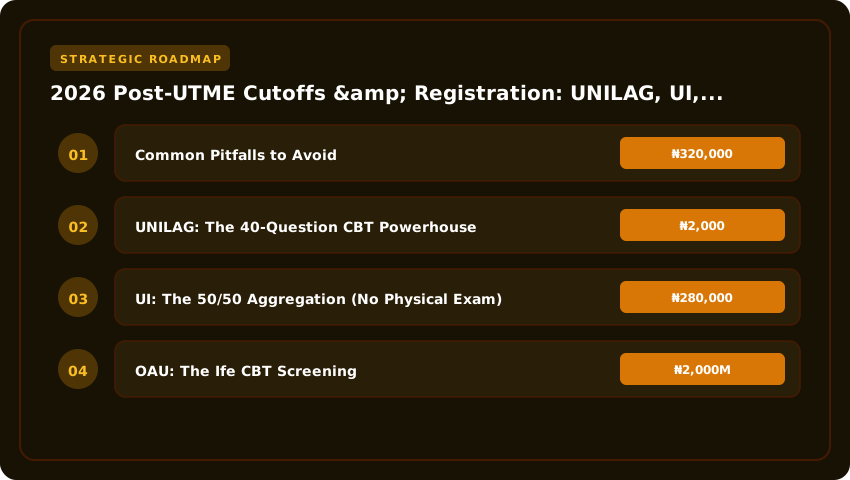
Common Pitfalls to Avoid
- Name mismatches between JAMB records and WAEC/NECO certificates — fix this at a JAMB CBT centre with an affidavit and supporting documents before paying any Post-UTME fee.
- Using a personal email that’s no longer accessible. Create a dedicated, long-term email for all 2026 admissions activities.
- Ignoring the NELFUND loan window. If you’re considering applying for a NELFUND student loan to cover tuition, your school’s screening must be completed first because the loan is tied to your admission status.
- Paying “agents” or third-party vendors — the only legal payment channel is Remita via the official school portal.
Bottom line: registration is a four-step ritual — verify CAPS, generate Remita, pay, upload credentials. Do this once carefully, and you’ve effectively removed the procedural risk from your admission journey.
The Screening Format Decoded: CBT, Aptitude Tests, and O’Level Grading at Each School
Understanding the architecture of each university’s Post-UTME screening is the single most important step you can take before paying that ₦2,000 to ₦10,000 application fee. Too many candidates in Nigeria and West Africa prepare for one generic Computer-Based Test (CBT) and then discover—often too late—that the University of Ibadan (UI) doesn’t even conduct a physical examination, or that FUTA blends its CBT score with a sit-down aptitude component. Below is a complete, school-by-school breakdown of how the gatekeepers at the University of Lagos (UNILAG), UI, Obafemi Awolowo University (OAU), and the Federal University of Technology, Akure (FUTA) actually compute your aggregate score, plus the all-important O’Level grading matrix that can make or break your chances.
UNILAG: The 40-Question CBT Powerhouse
The University of Lagos runs a pure Computer-Based Test that lasts roughly 30 minutes and contains exactly 40 multiple-choice questions. These questions are split into three distinct blocks: English Language proficiency, General Knowledge / Current Affairs, and subject-specific questions tied directly to your JAMB UTME course combination. For instance, a Medicine and Surgery candidate will face Biology, Chemistry, and Physics questions, while a Law aspirant will see Government, Literature, and CRK/IRK questions. UNILAG typically weights this CBT at 30% of your final aggregate, while your JAMB score contributes the remaining 70%. The cut-off mark for most competitive courses usually sits between 65 and 75 aggregate points, meaning you need both a strong UTME score (typically 250+) and a flawless CBT run.
UI: The 50/50 Aggregation (No Physical Exam)
The University of Ibadan takes a completely different approach. There is no Post-UTME CBT for UI. Instead, the school uses a transparent 50/50 aggregation formula: your JAMB UTME score accounts for 50% of your final aggregate, and your O’Level grades account for the other 50%. This means your five core WAEC/NECO subjects (English, Mathematics, and three others relevant to your course) are mathematically weighted into the equation. UI’s general cut-off is 200 UTME, but the aggregate threshold for competitive courses like Medicine, Law, and Engineering often climbs to 65% or higher. Because UI places so much emphasis on O’Level performance, a candidate with a 240 JAMB score and eight A1/B2 grades can easily outrank a candidate with 280 JAMB and four C6 grades.
OAU: The Ife CBT Screening
Obafemi Awolowo University, Ile-Ife, reverted to a strict CBT format after the pandemic-era changes. The OAU Post-UTME screening tests candidates across English, Mathematics, and two UTME-relevant subjects with a total of 50 questions in roughly one hour. OAU weights the CBT at 40% and JAMB at 60%, setting departmental cut-offs that typically range from 200 (for less competitive courses) to 280+ for professional programs. OAU is famously strict about O’Level subject combinations, requiring at least five credits including English and Mathematics in a single sitting for most courses.
FUTA: The Blended Model
The Federal University of Technology, Akure uses a blended screening model that combines a CBT component (similar in structure to UNILAG and OAU) with a strong weighting on O’Level performance. FUTA’s aggregate formula typically splits 60% to JAMB, 30% to the Post-UTME CBT, and 10% to O’Level grades. Because FUTA is a specialized technology university, it places extra weight on Mathematics and the sciences, making strong grades in Further Mathematics and Technical Drawing a significant advantage.
The O’Level Grading Matrix Explained
Across all four universities, but especially UI and FUTA, O’Level grades are converted into numerical points using the standard WAEC/NECO matrix:
- A1 = 8 points (Distinction)
- B2 = 7 points (Very Good)
- B3 = 6 points (Good)
- C4 = 5 points (Credit)
- C5 = 4 points (Credit)
- C6 = 3 points (Credit – minimum pass for most universities)
- D7 = 2 points (Not accepted for admission)
- E8 = 1 point (Fail)
- F9 = 0 points (Fail)
Worked Example: Computing Your UI Aggregate
Let’s say Emeka applies to study Mechanical Engineering at UI. His JAMB score is 260, and his WAEC results show: English (B2), Mathematics (A1), Physics (B3), Chemistry (C4), and Further Mathematics (B2). His O’Level points total: 7 + 8 + 6 + 5 + 7 = 33 points out of 40. To convert this to the 50% O’Level weighting: (33 ÷ 40) × 50 = 41.25. His JAMB contribution: (260 ÷ 400) × 50 = 32.50. Emeka’s final aggregate is 73.75%, which comfortably clears the UI Engineering cut-off of roughly 65%. If Emeka had scored a C6 in Mathematics instead of an A1, his O’Level points would drop to 28, his O’Level weighting would fall to 35, and his aggregate would plummet to 67.50%—still competitive, but far less safe.
Actionable Takeaway: Before you sit for JAMB 2026, audit your O’Level results. If you have any C6 grades in critical subjects like Mathematics or English, consider registering for NECO GCE 2026 to upgrade them. A single A1 upgrade can shift your aggregate by 2 to 5 points, which is often the difference between admission and a heartbreaking “Not Admitted” slip. Also, confirm whether your target school accepts two sittings—UNILAG and OAU generally do not, while UI accepts two sittings for most courses. Budget between ₦15,000 and ₦25,000 per NECO GCE subject if you need to upgrade before the 2026 admission cycle closes.
Departmental Cutoff Marks 2026: Realistic Targets for Medicine, Engineering, Law, and Computer Science
Let me be very direct with you, because this is where most candidates build castles in the air. The general Post-UTME cutoff you see on a school’s portal is only the floor, not the actual score that wins you admission into competitive departments. In Nigerian federal universities, what determines whether your name appears on the admission list is the departmental cutoff, a moving benchmark calculated every single year from the performance of applicants in that specific course. For 2026 aspirants targeting UNILAG, UI, OAU, and FUTA, understanding this distinction is the difference between preparing smartly and wasting a Post-UTME slot you could have invested elsewhere.
Across the 2024 and 2025 admission cycles that I have studied carefully, the departments that consistently post the highest cutoffs are Medicine and Surgery, Law, Pharmacy, and the elite engineering and computer science programmes. At the University of Ibadan, Medicine has hovered around a 78+ aggregate when you combine JAMB score and Post-UTME score. The University of Lagos (UNILAG) Medicine has typically settled around 76+, while Obafemi Awolowo University (OAU) Medicine sits slightly lower at about 75+, owing to its marginally smaller catchment variation. FUTA’s flagship Computer Engineering programme, which doubles as a bellwether for its tech-aligned courses, has consistently cleared at 70+ across the last two cycles, and its Computer Science is right in that neighbourhood.
Now, here is the nuance that separates candidates who win admissions from those who celebrate on social media but cry in private. Your aggregate is calculated by weighting your JAMB UTME score at 50 percent and your Post-UTME score at 50 percent, then expressing it on a 100-point scale. So if you scored 320 in JAMB (which is 80 percent of 400) and 65 in Post-UTME (which is 65 percent of 100), your aggregate becomes (80 + 65) / 2 = 72.5. That single number is what is used to rank you against every other candidate who applied to that department, regardless of whether they wrote the same school or a different one.
You also need to understand three cutoff categories that are quietly applied before the final list is released. Merit cutoff is the score the highest-ranking candidates, selected purely on academic performance across all 36 states and the FCT, must meet. This is usually the highest of the three. Catchment area cutoff favours candidates from the host state’s contiguous local government areas and is typically two to four points lower than merit. ELDS (Educationally Less Developed States) cutoff applies to candidates from states like Bayelsa, Ebonyi, Ekiti, Kebbi, Kogi, Nassarawa, Plateau, Taraba, Zamfara, and a few others, and can drop another two to four points below catchment. Knowing your eligibility for catchment or ELDS can effectively lower your real target score by up to eight points, which is enormous.
- UNILAG Medicine & Surgery: Merit 76+, Catchment 73+, ELDS 71+
- UI Medicine & Surgery: Merit 78+, Catchment 75+, ELDS 73+
- OAU Medicine & Surgery: Merit 75+, Catchment 72+, ELDS 70+
- UI Law (Private and Public): Merit 74+, Catchment 71+, ELDS 69+
- UNILAG Law: Merit 73+, Catchment 70+, ELDS 68+
- OAU Computer Engineering: Merit 70+, Catchment 68+, ELDS 66+
- FUTA Computer Engineering: Merit 70+, Catchment 68+, ELDS 66+
- FUTA Computer Science: Merit 68+, Catchment 66+, ELDS 64+
- UNILAG Computer Science: Merit 72+, Catchment 69+, ELDS 67+
- UI Computer Science: Merit 70+, Catchment 67+, ELDS 65+
Before you panic at these numbers, here is your actionable workflow. First, simulate your aggregate using the formula (JAMB score ÷ 4) + (Post-UTME score ÷ 2), then compare it against the merit column for your target school and course. If your aggregate is at least three points above the merit benchmark, you can confidently wait for the first admission list. If you fall between merit and catchment, and you genuinely hail from a catchment state, your chances are still strong. If you fall between catchment and ELDS, and you come from an ELDS state, you remain competitive. Anything below ELDS for your course means you should seriously consider a less competitive programme, perhaps a sister department like Physiology instead of Medicine, or Estate Management instead of Law, where your CGPA will not suffer from being forced into a course you never wanted in the first place.
One final piece of advice worth printing and taping to your study desk. Cutoffs are not static, and 2026 figures will shift based on how candidates perform across the country. But the relative gap between courses stays remarkably stable year after year, so use these ranges as a disciplined target rather than a lottery ticket. If you are chasing Medicine at UI, prepare as if the merit cutoff will be 80. If you are chasing Computer Engineering at FUTA, train as if 72 is the real number. Over-preparation is the only strategy that has never disappointed a serious Nigerian candidate.
NELFUND Student Loan 2026: How Admitted Students Can Fund First-Year Tuition at Federal Universities
Securing admission into a premier federal university is a massive victory, but the reality of paying first-year tuition can quickly dampen the celebration. For the 2026/2027 academic session, the Nigerian Education Loan Fund (NELFUND) remains a critical lifeline for students navigating the financial demands of higher education. Designed to remove financial barriers, the NELFUND student loan allows admitted students to focus entirely on their academics rather than scrambling to raise funds. If you have successfully scaled the JAMB UTME and Post-UTME hurdles for institutions like UNILAG, UI, OAU, or FUTA, understanding how to leverage this scheme is your next crucial step.
To qualify for the 2026 NELFUND disbursement, you must be officially admitted into a NUC-approved institution. The application process has been digitized for transparency, but you must have your documentation ready. Ensure you gather the following required documents:
- JAMB Admission Letter: This serves as your primary proof of admission for the 2026/2027 academic session.
- Student Identification: A valid school ID card or an official admission letter from your faculty.
- Guarantor Details: Accurate contact and verification details for your guarantor, who must be employed and willing to vouch for your application.
- Bank Verification Number (BVN) and NIN: Essential for identity verification and fund disbursement.
One of the most reassuring aspects of the NELFUND scheme is its comprehensive coverage. Institutional fees are covered up to ₦1,500,000 depending on your specific program and institutional charges. For most undergraduate programs at federal universities, this cap comfortably covers your tuition and mandatory faculty charges. Furthermore, the repayment terms are highly student-friendly. You are not expected to begin repaying the loan immediately upon graduation. Instead, NELFUND offers a generous 2-year grace period post-NYSC before deductions begin from your salary, giving you ample time to secure stable employment.
But what is the reality on the ground for students at UNILAG, UI, OAU, and FUTA? The good news is that students at these top-tier federal universities have successfully accessed NELFUND disbursements. Because these institutions are fully NUC-approved and integrated into the Student Verification System (SVS), their students are prime candidates for approval. However, it is crucial to manage your expectations regarding timelines. Delays are common and usually stem from institutional verification bottlenecks. Sometimes, university bursaries take time to upload student data to the NELFUND portal, or there might be a mismatch between your JAMB details and your school portal records.
To avoid unnecessary delays, ensure your name on your WAEC/NECO certificates, JAMB profile, and university admission letter match perfectly. Apply immediately your school portal opens for NELFUND registration, and follow up with your faculty officer to ensure your verification is processed promptly. By staying proactive, you can secure your first-year tuition and begin your university journey on a solid, stress-free financial footing.
After Post-UTME: Navigating JAMB CAPS, Admission Lists, and Acceptance Fees
Breathe. You’ve sat for UTME, braved the Post-UTME screening at UNILAG, UI, OAU, or FUTA, and now you’re staring at your phone waiting for that life-changing notification. The days and weeks that follow your screening are arguably the most emotionally charged period in any Nigerian undergraduate’s journey. Understanding the post-screening mechanics — particularly how JAMB CAPS works, when merit and supplementary lists drop, and what acceptance fees you must pay — transforms anxiety into agency. This section walks you through the precise sequence of events, so you know exactly what to do, when to do it, and how much to budget in Naira.
The Central Admission Processing System, universally known as JAMB CAPS, is the official portal where every admission offer in Nigerian tertiary institutions is processed, approved, and finalized. After your Post-UTME, your prospective university will internally aggregate your composite score — a weighted combination of your UTME performance and your Post-UTME score — then recommend successful candidates to JAMB. Once JAMB approves these recommendations, the offers appear on your CAPS profile, accessible via the JAMB portal at efacility.jamb.gov.ng. To check your status, log in with your registered email and password, click on “Check Admission Status,” and select your UTME year and institution. If you’ve been offered admission, you’ll see a clearly visible “Admitted” button. If nothing is showing, you are either still being processed or your score didn’t clear the departmental or institutional cut-off.
Once you see that glorious “Admitted” status, you face a critical decision. CAPS gives you two buttons: Accept Admission or Reject Admission. Tap the wrong one, and you could lose your slot entirely. Always accept first, then verify with the institution directly. After accepting on CAPS, the next step is to print your JAMB Admission Letter, which becomes essential for clearance. The system also triggers a JAMB-approved acceptance fee, distinct from the university’s own acceptance fee, which is typically around ₦3,500 to ₦5,000 and is paid via the CAPS portal itself.
Now, let’s talk timelines. Nigerian universities run a tiered admission release system: the Merit List comes first, usually within two to four weeks after Post-UTME concludes. This list captures candidates who met both the JAMB and institutional cut-offs cleanly. If you didn’t make the merit list, don’t panic — the Supplementary (Second Batch) List typically drops two to four weeks later, capturing candidates who just missed the merit cut-off but whose aggregate scores are competitive enough for departments with unfilled slots. Finally, the Vice-Chancellor’s List (VC List) emerges last and is reserved for highly exceptional candidates, often those with very strong Post-UTME scores despite slightly lower UTME marks, or candidates applying for pre-degree and JUPEB direct entry pathways.
Understanding acceptance fees is crucial for budgeting. Once admitted, the next financial step is paying your institution’s acceptance fee, which secures your spot. Here is the verified breakdown for the 2026 admission cycle:
- University of Lagos (UNILAG): ₦20,000 — Paid via the UNILAG payment portal after generating a Remita Retrieval Reference (RRR).
- University of Ibadan (UI): ₦35,000 — Slightly higher due to UI’s older administrative fee structure; paid through the UI portal.
- Obafemi Awolowo University (OAU): ₦20,000 — OAU calls this a “Acceptance of Admission Fee,” and payment is made via Remita.
- Federal University of Technology, Akure (FUTA): ₦45,000 — FUTA’s acceptance fee is the highest among the four, covering initial registration and ICT levies.
Beyond CAPS and acceptance fees, you must prepare for physical clearance at your admitted institution. This is where many students stumble, often arriving with incomplete files and losing valuable days. Use this checklist as your non-negotiable preparation guide:
- JAMB Result Slip: The original printout showing your UTME score and profile details.
- O’Level Certificates/Statements of Results: WAEC, NECO, or NABTEB results — not just printouts from scratch cards, but the official certificates. Awaiting-result candidates must present their scratch card printout and a signed attestation from their school principal.
- Birth Certificate: A certified true copy from the National Population Commission (NPC), not just an affidavit, though an affidavit sworn at a High Court is accepted by most institutions as a fallback.
- Local Government Identification (LGA ID): Either an LGA letter of origin or a sworn affidavit declaring your state and LGA of origin — critical for 18-year-old indigene verification.
- Recent Passport Photographs: Between 8 and 12 copies, taken within the last three months, with a white or red background, depending on the institution’s specification.
Beyond this core list, bring your Post-UTME screening slip, your JAMB Admission Letter printout, your Acceptance Fee Receipt, and — if you applied through NELFUND for a student loan — your NELFUND loan approval letter, as some institutions now integrate loan verification into the clearance stage. Keep digital and physical backups of every document. Nigerian clearance queues are unforgiving; missing one paper can send you back home for weeks.
Finally, monitor your school portal, your email, and JAMB CAPS religiously. Admission offers can be revoked if you fail to accept within the stipulated window, usually 14 to 21 days. If you’re placed on the waiting list, stay engaged — supplementary and VC lists have rescued thousands of Nigerian students who initially saw “Not Admitted” on their screens. Your Post-UTME journey doesn’t end at the screening hall; it ends only when you’ve cleared, matriculated, and begun classes. Stay patient, stay prepared, and keep every document within arm’s reach.
| University | 2026 Post-UTME Cut-off Range | Screening Fee (₦) | Registration Window | Admission Timeline | Estimated 4-Yr Tuition (₦) | Career ROI Outlook |
|---|---|---|---|---|---|---|
| UNILAG (University of Lagos) | 200–280 (varies by course) | ₦2,000 | Late July – Mid August 2026 | October – November 2026 | ₦320,000 – ₦450,000 | Very High – Lagos proximity yields top corporate & tech placement rates |
| UI (University of Ibadan) | 200–260 | ₦2,000 | August – Early September 2026 | October – December 2026 | ₦280,000 – ₦400,000 | High – Premier reputation across law, medicine & humanities |
| OAU (Obafemi Awolowo University) | 200–250 | ₦2,000 | Mid August – September 2026 | November – January 2027 | ₦260,000 – ₦380,000 | High – Strong alumni network in engineering, arts & sciences |
| FUTA (Federal University of Technology, Akure) | 180–230 | ₦2,000 | August – September 2026 | October – December 2026 | ₦240,000 – ₦350,000 | Very High (STEM) – Specialised tech/engineering pipeline with rising industry demand |
Frequently Asked Questions
What JAMB score is required for UNILAG, UI, OAU, and FUTA in 2026?
For 2026 admission, UNILAG typically requires 200–280 depending on competitiveness of the course, UI requires 200–260, OAU 200–250, and FUTA 180–230. Highly competitive programmes like Medicine, Law, and Engineering usually demand scores above 250 to qualify candidates for Post-UTME screening.
How much is the Post-UTME screening fee for Nigerian federal universities in 2026?
Each of the four first-generation federal universities charges ₦2,000 for Post-UTME screening in 2026. Payment is made online via the school's admission portal. Candidates should verify deadlines on official university websites to avoid disqualification or late registration penalties.
When will Post-UTME registration start for UNILAG, UI, OAU, and FUTA in 2026?
UNILAG Post-UTME registration begins late July to mid-August 2026, followed by UI in August through early September. OAU opens mid-August, while FUTA commences registration between August and September. Candidates should monitor official portals weekly for exact dates.
Which university offers the best career ROI among UNILAG, UI, OAU, and FUTA?
UNILAG offers the highest overall career ROI due to Lagos corporate access, with FUTA leading in STEM-specific ROI. UI excels in law, medicine, and humanities, while OAU provides strong ROI through engineering and sciences. Choice should align with field of study.
Strategic Final Takeaway
Success in evaluating 2026 Post-UTME Cutoffs & Registration: UNILAG, UI, OAU, FUTA Explained relies on early preparation, adherence to verified accredited requirements, and cross-referencing official portals. Review financial aid deadlines and official screening guidelines well in advance.