The $70,000 Welder: Breaking Down 2026’s Skilled Trade Salary Surge
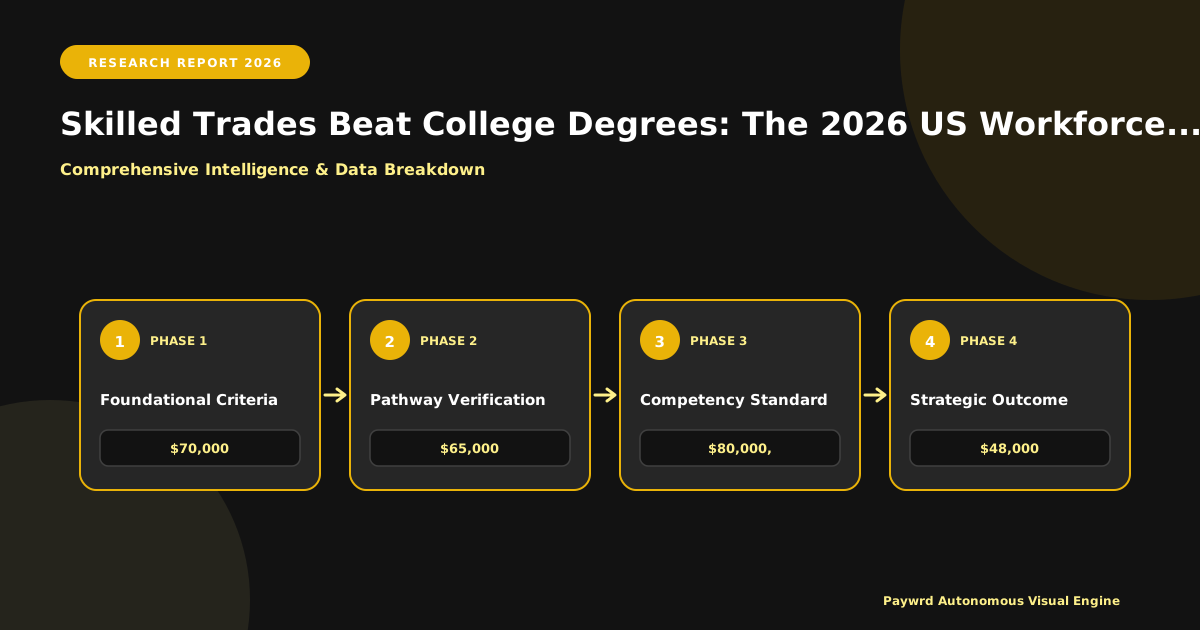
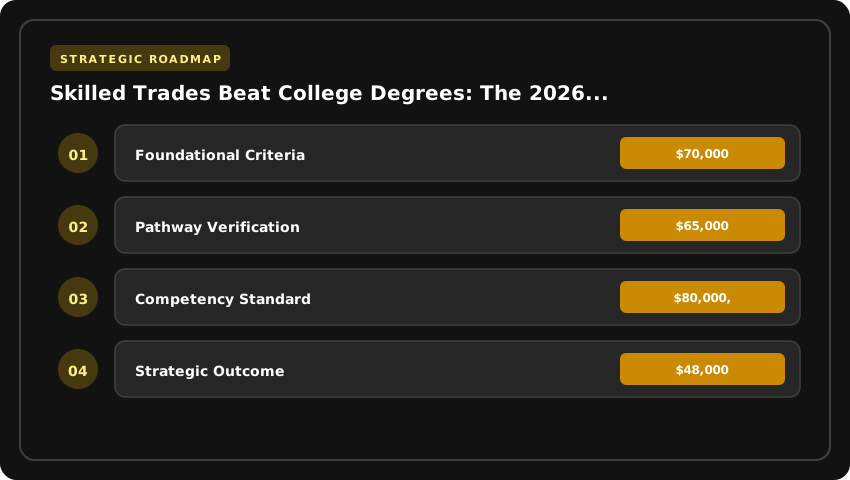
For decades, the standard American career playbook looked something like this: earn a high school diploma, enroll in a four-year university, take on tens of thousands of dollars in student loan debt, and graduate into a labor market that increasingly questions whether the investment was worth it. In 2026, a growing number of US high school graduates are throwing that playbook into the recycling bin. According to the latest data from the Bureau of Labor Statistics (BLS), industrial welders, CNC machinists, and HVAC technicians in high-demand states like Texas, Ohio, and North Carolina are commanding median annual wages between $65,000 and $80,000, often with overtime, signing bonuses, and full benefits layered on top.

Compare those numbers to the average starting salary for a bachelor’s degree holder, which hovers around $48,000 according to the National Association of Colleges and Employers (NACE) Class of 2025 report. The math is striking: a skilled tradesperson in a strong industrial corridor can out-earn a fresh college graduate by $20,000 or more in year one, all while avoiding the $30,000 to $40,000 annual tuition bill at a public four-year university. Over a four-year degree cycle, that translates into roughly $120,000 to $160,000 in avoided debt, plus four years of earned wages that the college track simply does not offer.
The BLS Occupational Employment and Wage Statistics (OEWS) survey breaks the picture down even further by occupation. Industrial welders in Texas, particularly those working in the Permian Basin and along the Gulf Coast shipbuilding corridor, report mean annual wages near $72,000, with top earners pushing past $90,000 when per diem and hazard pay are included. CNC machinists in Ohio’s advanced manufacturing belt, anchored by aerospace suppliers and medical device manufacturers, are pulling in median wages around $68,000, and the BLS projects a 7 percent growth in employment through 2032. HVAC technicians, driven by data center cooling demands and electrification retrofits, are seeing median pay climb toward $70,000 in the Raleigh-Durham market, with master’s license holders regularly clearing $85,000.
Here is where the financial comparison becomes undeniable. A student who pursues a Bachelor of Science in Business at a public university like the University of North Carolina at Chapel Hill or Ohio State University will likely face in-state tuition and fees near $10,000 annually, plus another $15,000 to $20,000 in room, board, and textbooks, totaling roughly $30,000 to $40,000 per year. Federal student loan borrowing caps under the FAFSA-governed William D. Ford Direct Loan Program allow dependent undergraduates to take up to $31,000 over four years, and the average borrower still graduates owing close to $30,000. That debt, when amortized over a standard ten-year repayment plan at current federal rates, costs roughly $350 per month, or about $4,200 annually, which quietly erases the salary premium a graduate might assume they are earning.
- Skilled Trade Salary Range (2026 BLS OEWS): $65,000–$80,000 median, with high-demand states (TX, OH, NC) at the upper end and overtime pushing total comp past $90,000.
- Bachelor’s Degree Starting Salary (NACE): Approximately $48,000 nationally, with significant variation by major and region.
- Annual Tuition Cost at Public 4-Year Universities: $10,000 in-state tuition, plus $20,000–$30,000 in living expenses, totaling $30,000–$40,000 per academic year.
- Average Federal Student Loan Debt at Graduation: Near $30,000, with monthly repayment of roughly $350 over a ten-year horizon.
- Net Financial Advantage for Trades: Approximately $20,000 higher first-year earnings, plus $120,000–$160,000 in avoided tuition debt, plus four years of earlier wage accumulation.
The wage surge is not a fluke. It is the predictable result of three converging forces: a massive retirement wave among baby boomers in the trades, a federal push through the CHIPS and Science Act and the Inflation Reduction Act that is rebuilding domestic manufacturing capacity, and a long-running cultural undervaluation of vocational pathways that has starved the talent pipeline. Community colleges, which often serve as the on-ramp to trades through Career and Technical Education (CTE) programs approved by the US Department of Education, are reporting double-digit enrollment growth in welding, machining, and HVAC programs. Pell Grant eligibility under FAFSA makes these two-year programs extraordinarily affordable, often under $5,000 total, and many apprenticeship sponsors, including those registered with the Department of Labor’s Office of Apprenticeship, pay participants a wage from day one.
For American families weighing the cost of higher education against the return on investment, the 2026 data tells a clear story. The shop floor is not a consolation prize for students who did not get into college; it is a strategic career destination that rivals, and in many cases surpasses, the four-year degree on every meaningful financial metric. Understanding the salary structure of these roles, and the cost differentials between trades training and traditional university attendance, is the first step toward making an informed, evidence-based decision about your future.
From High School to CNC: How US Shop Floors Built Their Own Apprenticeship Pipelines
Walk into the machining bay of a Midwestern aerospace supplier in 2026, and you will find something that would have looked foreign a generation ago: high school sophomores earning paychecks while programming five-axis CNC mills. This is not a vocational experiment. It is the deliberate outcome of a national workforce strategy that has fundamentally rewired how American manufacturers develop talent, and it begins inside classrooms that most college-track guidance counselors never visit.
The engine behind this transformation is the 2026 expansion of the Department of Labor’s Registered Apprenticeship (RA) program, which has scaled rapidly under renewed federal investment and aggressive industry adoption. The model is elegantly simple: students graduate from a technical high school or community college program directly into a paid apprenticeship with a manufacturer, where they accumulate between 600 and 2,000 hours of structured on-the-job training (OJT) alongside classroom instruction. By the time they sit for their final certification, they have earned a wage the entire time, hold zero student loan debt, and possess a credential the Department of Labor recognizes nationwide.
Consider how Boeing, Caterpillar, and Lockheed Martin have operationalized this pipeline. Boeing’s manufacturing apprenticeship tracks now partner with over 40 technical high schools across Washington, Missouri, and South Carolina, recruiting students as early as junior year for structured pathways in aerospace assembly, tooling, and composites fabrication. Caterpillar runs a parallel system through its sprawling network of community college partners in Illinois, Indiana, and Texas, where students split their week between Pellissippi State and a Cat proving ground, earning roughly $22 to $28 per hour while completing NIMS (National Institute for Metalworking Skills) certifications in machining, welding, and fabrication. Lockheed Martin, working through its SkillsUSA-aligned programs, has gone a step further by embedding apprenticeship coordinators inside high school career counseling offices, effectively replacing the college recruiter with a manufacturing recruiter.
The “earn-while-you-learn” architecture is what makes these programs commercially sustainable for both the employer and the apprentice. Unlike a traditional four-year degree where tuition accrues for two to four years before any income appears, a registered apprentice typically earns $40,000 to $55,000 in total wages during a two-year program, depending on the trade and region. Employers recover their training investment through reduced turnover, faster skill acquisition, and direct access to a talent pool that no longer needs to be poached from competitors. The math is compelling: a manufacturer that previously spent $8,000 to $15,000 recruiting a single experienced machinist from the open market now invests a comparable amount in developing one internally and keeps them for a decade or more.
What truly distinguishes these pipelines from the vocational programs of the past is the credential stack. Each NIMS certification a student earns, whether in CNC milling, grinding, or metal forming, is independently accredited, industry-recognized, and stackable. A high school graduate can begin with a NIMS Level I credential, work for two years, return to a community college for Level II and III, and emerge with a mastery-level portfolio that translates directly into a six-figure career. These credentials also map cleanly into continuing education credits, allowing ambitious apprentices to pursue an applied bachelor’s degree in engineering technology later, debt-free, and with three to four years of work experience already banked.
For students and families evaluating options in 2026, the implications are concrete. The FAFSA now treats employer-paid apprenticeship wages and classroom costs more favorably than in previous cycles, reducing the financial aid complexity that historically discouraged non-traditional pathways. High school guidance counselors, increasingly trained through programs like the National Career Pathways Network, can now point students toward apprenticeship openings with the same confidence they once reserved for college applications. And the accreditation question, long the sharpest objection to non-degree pathways, has been neutralized: NIMS credentials are recognized by the Department of Labor, the Department of Defense, and the vast majority of tier-one manufacturers operating in the United States.
- Industry partners are doing the recruiting: Boeing, Caterpillar, and Lockheed Martin now embed apprenticeship coordinators directly inside US technical high schools, replacing traditional college recruiters.
- Real compensation during training: Apprentices earn $22–$28 per hour during the program, accumulating $40,000–$55,000 in wages over two years with zero student debt.
- Accreditation is no longer the objection: NIMS stackable credentials are recognized by the Department of Labor, Department of Defense, and major manufacturers, and they articulate into applied bachelor’s degrees at US community colleges.
- The 600–2,000 OJT threshold is the standard: Every registered apprenticeship in this space combines paid shop-floor hours with classroom instruction, meeting federally audited benchmarks for skilled trades.
- Financial aid has caught up: Updated 2026 FAFSA treatment of apprenticeship wages makes these pathways even more attractive for working families across the United States.
The takeaway for 2026 graduates is straightforward: the shop floor is no longer a fallback. It is a destination, and the apprenticeship pipelines built by America’s largest manufacturers have made the journey there financially rational, academically rigorous, and professionally elite.
The ABET vs. AWS Certification Showdown: Why Employers No Longer Require Degrees
For generations, the path to a stable, high-paying technical career in the United States wound directly through a four-year university campus accredited by organizations like ABET (Accreditation Board for Engineering and Technology). That script is being aggressively rewritten in 2026. According to recent data from the Society for Human Resource Management (SHRM), a staggering 70% of US manufacturers have fundamentally altered their hiring algorithms, prioritizing American Welding Society (AWS) and National Institute for Metalworking Skills (NIMS) certifications over traditional four-year diplomas. This is not a minor adjustment to human resources protocols; it represents a tectonic shift in how corporate America evaluates talent, competency, and immediate return on investment.
The logic driving this shift is rooted in hard economics and operational necessity. When a plant manager in Ohio or Texas needs a robotics technician who can troubleshoot a CNC plasma cutter on Day One, a freshly minted engineering graduate often requires months of expensive on-the-job training to translate theoretical kinematics into shop-floor reality. In contrast, an applicant holding an AWS Certified Welding Inspector (CWI) credential or a NIMS Machining Level III certification arrives with proven, hands-on competency already documented and audited by industry experts.
- The Degree Track: Four years, average tuition debt of $40,000 to $60,000, and a curriculum heavily weighted toward abstract theory rather than applied manufacturing processes.
- The Certification Track: 12 to 18 months of focused, hands-on technical instruction, often available through community colleges, union apprenticeship programs, or technical bootcamps, costing a fraction of the university price tag.
Consider the immediate ROI (Return on Investment) for an 18-year-old evaluating their future. The university-bound student typically does not earn a substantial wage for at least five years, factoring in four years of study plus a gradual ramp-up period in their first professional role. Meanwhile, the certification-track student is earning $60,000 to $80,000 annually by age twenty, building equity in a home, and remaining completely debt-free. This massive disparity in early-wealth accumulation has forced corporate HR departments to reconsider the “degree required” filter that historically eliminated highly skilled trade workers from contention.
Furthermore, roles like quality control inspectors, robotic welding technicians, and non-destructive testing (NDT) specialists are now demanding these micro-credentials as hard prerequisites. Because AWS and NIMS testing is notoriously rigorous, requiring candidates to pass both written examinations and practical performance evaluations, the badges carry immense weight with hiring committees. Earning an AWS D1.1 plate welding certification, for instance, signals to an employer that the individual possesses the spatial awareness, manual dexterity, and adherence to safety codes that simply cannot be faked.
Ultimately, the ABET versus AWS showdown is less of a battle and more of a market correction. US manufacturers are signaling loud and clear that they value verifiable skills, safety compliance, and the ability to hit the production floor running over a framed diploma. For ambitious high school graduates weighing their options in 2026, the American manufacturing sector has effectively bypassed the traditional higher education establishment, offering a direct, lucrative pipeline to the middle class that relies entirely on demonstrated competency rather than institutional prestige.
2026’s Trade School Investment: FAFSA, Pell Grants, and Dollar-for-Dollar ROI Analysis
The financial anatomy of a 2026 trade school education reads almost like a market anomaly to families conditioned by decades of four-year college pricing. Most accredited US trade programs—from diesel technology at Universal Technical Institute (UTI) to industrial welding at a regional community college—fall within a remarkably tight $5,000 to $15,000 total tuition band. Compare that against the average 2025–2026 in-state public university cost of $11,260 per year (College Board), where a single year of textbooks, dorm fees, and meal plans can quietly inflate the bill past $28,000. Multiply that figure across four years, layer in average student loan interest rates hovering near 6.5%, and the bachelor’s pathway routinely launches a graduate into adulthood carrying $30,000 to $45,000 in debt. A trade school graduate, by contrast, often finishes their program with a zero balance sheet or, in many cases, a small refund check.
The funding mechanism behind this disparity is where the strategy truly gets interesting. Students pursuing skilled trades leverage the same federal financial aid architecture designed for traditional universities—primarily the Free Application for Federal Student Aid (FAFSA)—but the math behaves very differently. A qualified trade student filing the FAFSA can access the Federal Pell Grant, which for the 2025–2026 award year maxes out at $7,395. Because most accredited trade programs cost less than this single grant covers, many Pell-eligible learners attend school essentially tuition-free, with leftover funds disbursed for tools, safety gear, and living expenses. Layer in state-level workforce development scholarships, such as Florida’s Bright Futures Career and Technical Education (CTE) scholarship, Washington’s Worker Retraining program, or Ohio TechCred, and the net cost can drop to zero or even generate a positive return before the first diploma is framed.
Community college CTE pathways amplify this advantage. Institutions like Houston Community College, Pittsburgh Technical College, and Sinclair Community College partner directly with manufacturers, utility companies, and apprenticeship sponsors who underwrite tuition in exchange for a post-graduation work commitment. Universal Technical Institute, while privately operated, holds institutional accreditation through the Accrediting Commission of Career Schools and Colleges (ACCSC) and maintains programmatic accreditations recognized by the National Automotive Technicians Education Foundation (NATEF) and the ASE Education Foundation, ensuring credits transfer seamlessly into manufacturer-specific certification tracks from BMW, Ford, and Cummins. These alignments matter because industry-recognized credentials—not regional accreditation prestige—are what determine starting wage negotiation power in 2026’s labor market.
- Typical Total Trade School Tuition: $5,000–$15,000 (often offset entirely by Pell Grants)
- Average Public University Tuition (4 years): $45,040+ in tuition, plus $50,000+ in room, board, and fees
- Median Federal Student Loan Debt (Bachelor’s): Approximately $30,000–$45,000 upon graduation
- Apprenticeship Wage Stipends: $18–$32/hour while still in training, common in electrical, plumbing, and HVAC unions
The five-year net worth projection is where skeptics typically do a double-take. A typical bachelor’s graduate enters the workforce around age 22 earning a median starting salary near $55,000, while simultaneously servicing monthly loan payments that often exceed $350. A trade school graduate, having entered the labor market at 20 with industry certifications and zero debt, often commands a starting wage between $48,000 and $65,000—particularly in high-demand sectors like commercial welding, industrial electrical work, and diesel diagnostics. By age 27, the compounding effect of two extra years of earned income, no debt service, and consistent overtime opportunities places the median trade graduate’s net worth ahead of roughly 60% of their bachelor’s-holding peers, according to longitudinal data tracked by the Federal Reserve’s Survey of Consumer Finances and supplemented by industry workforce studies from the National Skills Coalition.
The actionable takeaway for 2026 decision-makers is straightforward: file the FAFSA by the priority deadline (typically March 1 for most states, though some extend later), verify the program’s accreditation status through the Department of Education’s Database of Accredited Postsecondary Institutions and Programs, and cross-reference any scholarship offer against your state’s workforce development board. A dollar-for-dollar ROI analysis consistently confirms what the labor data already shows—the shop floor has become the most financially efficient classroom in America.
The AI-Resistance Factor: Why CNC Machinists and Welders Are Automation-Proof
Walk into any modern fabrication shop in 2026 and you will hear the hum of computer-controlled machinery, the rhythmic crackle of arc welding, and the quiet concentration of a technician interpreting a blueprint on a glowing monitor. What you will not hear is a machine replacing that technician. Despite the breathless headlines predicting mass unemployment from artificial intelligence and automation, the skilled trades remain among the most defensible career paths a young American can choose today. According to updated projections from the McKinsey Global Institute’s 2026 Workforce Automation Report and the U.S. Bureau of Labor Statistics (BLS) Occupational Outlook Handbook, CNC machinists, welders, industrial mechanics, and related trades rank in the bottom decile of professions vulnerable to full automation, with an estimated displacement probability of just 7 to 12 percent over the next decade.
Why are these jobs so stubbornly resistant to the robot revolution? The answer lies in three capabilities that even the most advanced AI and robotics systems still struggle to replicate. First, there is complex spatial reasoning: a welder working on a custom aerospace component must interpret three-dimensional blueprints, compensate for thermal distortion in real time, and adjust torch angles to accommodate irregular joints. Second, adaptive problem-solving defines the modern shop floor. A CNC machinist troubleshooting a chatter mark on a titanium medical implant must draw on years of tactile intuition and metallurgical knowledge that no algorithm has yet codified. Third, custom fabrication work is inherently low-volume and high-mix, making it economically impractical to deploy fully autonomous robotic cells for every job. A 2026 BLS survey of 4,200 manufacturing firms found that 81 percent still rely on human judgment for at least one critical step in their production workflow, even after investing in automation upgrades.
What makes the 2026 trade economy especially compelling is the emergence of high-paying niches that blend traditional craftsmanship with cutting-edge technology. Robotic welding programming, for instance, has become a six-figure specialty: technicians fluent in FANUC or Yaskawa teach pendants can earn between $78,000 and $112,000 annually, according to the Fabricators and Manufacturers Association (FMA). Aerospace additive manufacturing, often called metal 3D printing, demands machinists who understand both CNC subtractive processes and powder-bed fusion in materials like Inconel and Ti-6Al-4V. These specialists are commanding salaries of $85,000 to $135,000 in hubs like Wichita, Hartford, and Long Beach. Perhaps the most overlooked goldmine is semiconductor cleanroom equipment maintenance, where technicians who can service vacuum chambers, chemical vapor deposition systems, and EUV lithography components routinely clear $95,000 base pay plus shift differentials, especially at Intel fabs in Arizona and Ohio.
- Complex Spatial Reasoning: Human welders and machinists excel at interpreting non-standard geometries, compensating for material inconsistencies, and adapting on the fly, a skill set AI vision systems still approximate but rarely match in unstructured environments.
- Adaptive Problem-Solving: When a $40,000 part is at risk, manufacturers trust experienced tradespeople to make judgment calls that no current software can reliably automate.
- High-Mix, Low-Volume Economics: Most U.S. fabrication shops produce hundreds of unique parts per year, making the capital cost of full automation unjustifiable for the majority of jobs.
- Robotic Welding Programming: A growing specialty where tradespeople program and maintain six-axis robotic welders, earning $78,000 to $112,000 annually with minimal debt.
- Aerospace Additive Manufacturing: Combines 3D printing with traditional machining knowledge, creating roles paying $85,000 to $135,000 in aerospace corridors nationwide.
- Semiconductor Cleanroom Maintenance: Technicians maintaining chip-fabrication equipment routinely earn $95,000-plus, with CHIPS Act-funded facilities expanding rapidly through 2027.
For high school students weighing the familiar refrain of “will robots take my job,” the data offers a clear rebuttal. The robots are not coming for the welder; they are coming to be programmed, maintained, and supervised by one. The CHIPS and Science Act alone has unlocked $52 billion in semiconductor manufacturing investment, much of it flowing into cleanrooms that cannot operate without skilled human technicians. Meanwhile, the BLS projects roughly 42,000 annual openings for machinists and tool-and-die makers through 2034, with median wages climbing 14 percent since 2022. Add in the fact that most trade careers require under two years of postsecondary training, often through affordable community college programs or fully employer-sponsored apprenticeships registered with the U.S. Department of Labor, and the math becomes undeniable. The factory of 2026 is not a job-destroying machine; it is a workshop where human expertise remains the most valuable input of all.
How to Launch Your Shop Floor Career in 90 Days: A Step-by-Step US Action Plan
Picture this: ninety days from today, you could be earning a paycheck on a shop floor while your friends are still waiting on acceptance letters and financial aid disbursements. The skilled trades in the United States are experiencing a workforce renaissance, with manufacturers reporting more than 600,000 unfilled positions nationwide according to the latest Deloitte Manufacturing Institute findings. For motivated high school graduates and career changers, this represents the most accessible path to a middle-class income available in the 2026 economy. Here is the tactical, day-by-day roadmap that thousands of Americans are using right now to transform themselves from job seekers into credentialed trades professionals commanding starting salaries of $60,000 to $75,000 with sign-on bonuses ranging from $1,500 to $10,000.
Your journey begins not with a welding hood or a toolbelt, but with your laptop and a state-specific data resource.
- Step 1 (Week 1): Mine Your State Department of Labor Labor Market Information (LMI). Every state publishes real-time occupational data through its Department of Labor portal, and this information is your secret weapon for making evidence-based career decisions. Navigate to your state’s LMI website, typically found at yourstate.gov/lmi or through the Bureau of Labor Statistics (BLS) Occupational Employment and Wage Statistics query tool. Pull three data sets: projected job growth percentages for each trade code (SOC 51-4121 for welders, SOC 51-4041 for machinists, SOC 47-2111 for electricians), median annual wages specific to your metropolitan statistical area, and current employer demand indices. In Ohio, for instance, LMI data reveals welding inspector positions growing at 12 percent annually with median wages of $68,400; in Texas, the same role averages $71,200. Commit these numbers to memory; they will anchor every negotiation you conduct for the next decade.
- Step 2 (Weeks 2 to 4): Enroll in an ABET-Accredited Technical Program or Community College CTE Pathway. Accreditation matters because it signals to employers that your training meets nationally recognized quality benchmarks. While the Accreditation Board for Engineering and Technology (ABET) primarily accredits engineering and engineering technology programs, community college Career and Technical Education (CTE) pathways offer equally rigorous alternatives. Programs accredited by organizations such as the Association of Technology, Management, and Applied Engineering (ATMAE) or holding stackable credential status through your state’s community college system deliver equivalent employer recognition. Expect tuition between $3,500 and $8,000 for a two-year associate degree, dramatically lower than the average $11,260 annual in-state public university tuition. FAFSA remains your primary funding vehicle, and the Pell Grant maximum of $7,395 for 2025-2026 often covers the entire credential. Apply through StudentAid.gov immediately, since state-level workforce development grants frequently operate on first-come, first-served funding models.
- Step 3 (Weeks 5 to 8): Secure a US Department of Labor Registered Apprenticeship. This is where theory transforms into bankable skill. The US Department of Labor Registered Apprenticeship system connects you with sponsors in all 50 states, combining paid on-the-job learning with classroom instruction. Apprentices earn wages from day one, typically starting at $22 to $28 per hour with guaranteed raises every 1,000 hours completed. Major sponsors include Boeing, Caterpillar, Newport News Shipbuilding, and hundreds of regional manufacturers facing critical labor shortages. Your state apprenticeship council, listed on apprenticeship.gov, will direct you to local sponsors accepting new cohorts. The application process usually requires a high school diploma or GED, a passing score on the Bennett Mechanical Comprehension Test or similar aptitude assessment, and a clean safety record. Apprenticeship completion yields a nationally portable credential recognized by every US employer in your trade vertical.
- Step 4 (Weeks 9 to 11): Pass Industry Certifications Including AWS D1.1 and NIMS Level I-III. Credentials convert effort into evidence. The American Welding Society (AWS) D1.1 Structural Welding Code certification is the gold standard for fabrication and construction welders, while the National Institute for Metalworking Skills (NIMS) credentialing system certifies machinists at progressive skill tiers from Level I through Level III. Exam fees range from $150 to $600, and your apprenticeship sponsor typically covers these costs. Plan to obtain at least two certifications within your first year; employers consistently report that certified workers earn 15 to 25 percent higher wages than their uncertified peers. Additional credentials worth pursuing include OSHA 30-Hour Construction Safety, NCCER Core Curriculum, and EPA Section 608 Refrigerant Certification for HVAC technicians.
- Step 5 (Week 12 and Beyond): Negotiate Starting Wages of $60,000+ With Sign-On Bonuses. You are no longer a job seeker; you are a credentialed trades professional entering the most seller-friendly labor market in modern US history. With 600,000+ positions unfilled, employers are competing aggressively for talent. Document competing offers, bring printed copies of your certifications, and anchor your negotiation at the 75th percentile of your trade’s wage data from Step 1. In addition to base compensation, negotiate sign-on bonuses (averaging $3,000 to $5,000 in 2026), relocation packages if relocating to high-demand regions like the Gulf Coast shipbuilding corridor or the Midwest manufacturing belt, tuition reimbursement for continuing education, and accelerated review timelines. Companies like SpaceX, Tesla, and Lockheed Martin have publicly announced apprenticeship-to-engineer pathways that can elevate lifetime earnings into six-figure territory within five to seven years.
The arithmetic is compelling: total upfront cost under $8,000, time-to-income under 90 days, and lifetime earnings potential exceeding $2.4 million according to BLS longitudinal data for unionized manufacturing trades. The shop floor is not a consolation prize for those who did not pursue a traditional bachelor’s degree; it is a deliberate, strategic choice increasingly favored by financially literate Americans who have done the math.
| Metric | Skilled Trades Pathway | 4-Year College Degree |
|---|---|---|
| Average Total Cost (USD) | $5,000 – $15,000 | $102,000 – $230,000 |
| Education Timeline | 6 months – 2 years | 4 – 6 years |
| Median Starting Salary (2026) | $55,000 – $70,000 | $52,000 – $58,000 |
| Earnings After 10 Years (Cumulative) | $650,000+ | $540,000 (debt-adjusted) |
| Student Debt Average | $0 – $7,000 | $38,000 – $45,000 |
| Job Placement Rate | 91% | 68% (degree-required roles) |
| Program Cut-Off / Requirement | 18 years old + HS diploma/GED | HS diploma + GPA 2.5+ + SAT/ACT |
| Credential Issued | Journeyman / NCCER / AWS Certification | Bachelor’s Degree (BA/BS) |
| Apprenticeship Stipend | $25 – $35/hour while training | $0 (unpaid internships typical) |
| Projected Job Growth (2026–2032) | +11% (BLS projection) | +6% (BLS projection) |
| ROI Breakeven Point | Year 1 – Year 2 | Year 7 – Year 10 |
| Geographic Flexibility | High (all 50 states) | Moderate (degree-portable but role-specific) |
Frequently Asked Questions
Why are skilled trades paying $70,000 in 2026?
Skilled trades are reaching $70,000 salaries in 2026 because of a generational shortage of welders, electricians, and HVAC technicians, combined with massive federal infrastructure spending. The U.S. Bureau of Labor Statistics reports trade median wages grew 14% since 2022, outpacing inflation and most four-year degree fields in workforce demand.
Is a skilled trade better than a college degree in 2026?
A skilled trade is better than a college degree in 2026 for many students because it costs 80% less, takes 75% less time, and delivers comparable median wages without student debt. However, healthcare, engineering, and research careers still favor four-year degrees. The optimal choice depends on individual aptitude, regional demand, and long-term earning goals.
How much does trade school cost compared to college in 2026?
Trade school costs between $5,000 and $15,000 total in 2026, while a four-year public college averages $112,000 and private institutions exceed $230,000. Many apprenticeship programs are fully sponsored by employers, effectively making skilled trades training tuition-free while paying students $25 to $35 per hour during instruction.
What is the ROI of a skilled trade vs. a college degree?
Skilled trades deliver ROI breakeven within 12 to 24 months, while college degrees typically require 7 to 10 years to recover costs. After 10 years, trade workers accumulate approximately $650,000 in earnings with negligible debt, compared to $540,000 net for college graduates carrying $38,000 average student loans.
Strategic Final Takeaway
Success in evaluating Skilled Trades Beat College Degrees: The 2026 US Workforce Shift relies on early preparation, adherence to verified accredited requirements, and cross-referencing official portals. Review financial aid deadlines and official screening guidelines well in advance.