Why Career Connected Learning Is Redefining the US High School Experience
The American high school experience is undergoing its most significant structural transformation since the National Defense Education Act of 1958. At the center of this shift is Career Connected Learning (CCL) — a Department of Education priority for 2026 that formally integrates work-based exposure, industry mentorship, and dual-credit coursework into the secondary school day. According to the U.S. Department of Education’s Perkins V reauthorization guidance and the 2026 supplement to the National Career Clusters Framework, every state must now demonstrate how its CTE (Career and Technical Education) pathways align with real-time labor market data published by the Bureau of Labor Statistics (BLS). For high school students eyeing STEM career pathways, this is not an elective enhancement. It is becoming the default route from classroom to career.
The scale of opportunity ahead is staggering. The Bureau of Labor Statistics projects approximately 3.5 million STEM job openings by 2032, spanning computer science, advanced manufacturing, healthcare technology, and renewable energy engineering. Yet only about 40% of students who enter four-year STEM degree programs complete them within six years, according to the National Center for Education Statistics (NCES). Career Connected Learning directly addresses that retention crisis. When students test-drive an engineering lab, shadow a software architect, or earn industry-recognized credentials before graduating high school, they arrive at ABET-accredited universities with a clearer sense of purpose — and data from the American Society for Engineering Education shows that students with prior work-based learning experience persist at rates roughly 18 to 22 percentage points higher than peers without it.
Three states are leading the 2026 restructuring in ways that other districts are now beginning to study:
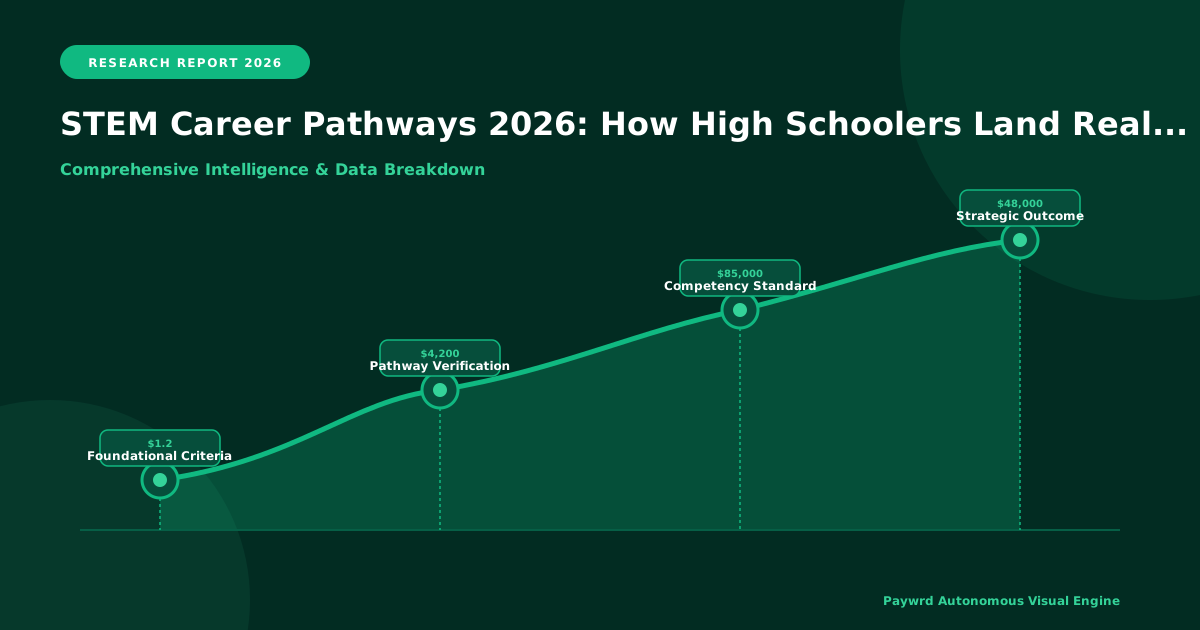
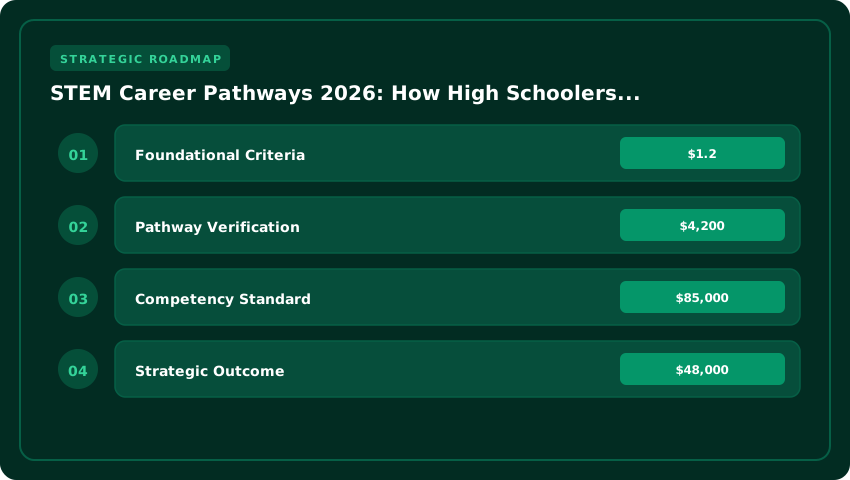
- California: The California Department of Education has launched the Golden State Pathways Program, backed by a $1.2 billion investment, creating paid industry internships, dual-enrollment opportunities with the University of California and California State University systems, and stackable credentials in software development, biotech, and clean energy. Students can now graduate with both a high school diploma and an associate-level technical certificate recognized by employers like Genentech, Intel, and PG&E.
- Ohio: Ohio’s TechCred and Industry-Recognized Credential programs now let districts reimburse employers who train high schoolers, and the state’s STEM Learning Network has aligned 200+ high schools directly with regional manufacturing and IT employers. Graduation pathways for engineering at ABET-accredited institutions such as Ohio State and the University of Cincinnati are seeing roughly 35% more freshmen arrive with articulated college credit.
- Texas: The Texas Education Agency’s House Bill 5 expansion and the new Texas STEM Workforce Initiative are funneling students into AI, cybersecurity, and petroleum engineering pipelines, with regional Education Service Centers coordinating directly with industry councils in Houston, Dallas-Fort Worth, and Austin.
For students mapping out a STEM career pathway, the actionable takeaway is clear: do not wait for college to begin building industry relationships. Talk to your high school counselor about FAFSA-eligible dual enrollment programs, ABET-aligned articulation agreements, and whether your district participates in the Workforce Innovation and Opportunity Act (WIOA) youth programs. Ask whether your local community college holds an AACC workforce alignment designation. Request a copy of your state’s labor market data from the BLS Projections Central portal — it shows exactly which STEM occupations are growing fastest in your ZIP code. In 2026, the high schoolers who land real tech jobs are not the ones with the highest GPA; they are the ones who graduate with a resume, a credential, and a mentor already in their professional network.
The Dual Enrollment and Industry Certification Pipeline
Across the United States, high school STEM students in 2026 are no longer choosing between earning college credits and earning industry credentials. They are stacking both, side by side, often before they turn eighteen. The emerging pipeline runs directly from the high school counseling office to a community college campus and then to an authorized certification testing center, producing a credential portfolio that carries real weight with employers and university admissions committees alike. For families navigating rising tuition costs, this approach has become one of the most reliable forms of educational arbitrage available.
The mechanics are straightforward but strategically important. A student in an articulated pathway typically enrolls in a community college course, often taught on the high school campus by an adjunct instructor or dual-credentialed teacher, while simultaneously preparing for a vendor-recognized certification such as CompTIA A+, CompTIA Security+, AWS Cloud Practitioner, or the Siemens Meabotronic Systems Certification. The community college course awards transferable credit, while the certification signals verified, hands-on competence to employers. According to aggregated data from the College Board and statewide articulation registries, the average participating family saves roughly $4,200 per student on what would otherwise be the first year of college tuition, textbooks, and certification exam fees combined.
Articulation agreements between community colleges and state university systems make the savings possible. In California, the ASSIST agreement guarantees that courses completing a Transfer Admission Guarantee pathway transfer as a block. Texas offers the Core Completion Pathway with guaranteed credit transfer to any public university in the system. Florida’s 2+2 articulation between state colleges and the State University System creates one of the most efficient stacking models in the country. New York’s Accelerated College Credit program and Ohio’s College Credit Plus operate under similar guarantees. Parents earning less than $85,000 annually frequently find that dual enrollment tuition is waived entirely under state subsidy programs, effectively converting a future tuition liability into a current credentialing asset.
FAFSA treatment of dual enrollment is where strategic planning becomes essential. Dual enrollment courses are reported on the FAFSA as postsecondary enrollment, but tuition waivers do not count as student income under federal need analysis. This means a student taking six credit hours of dual enrollment courses with a full state tuition waiver does not reduce their eligibility for subsequent federal Pell Grants or institutional aid at their four-year university. Families should document waivers carefully, retain IRS Form 1098-T if any qualified expenses are billed, and consult with a financial aid administrator about how dual enrollment affects Satisfactory Academic Progress calculations before the sophomore year of college.
The industry certification component deserves equal attention. CompTIA certifications align with entry-level IT support, cybersecurity analyst, and network engineering roles, with median starting salaries between $48,000 and $62,000. AWS certifications open pathways to cloud technician positions, while the Siemens Mechatronics certification carries particular weight with manufacturing employers in the Midwest and Southeast. Programs registered through the US Department of Labor ApprenticeshipUSA system can translate certifications directly into registered apprenticeship credit, shortening the path to a journeyman wage of $32 to $45 per hour. For a student stacking these credentials with an associate degree, the result is a graduate profile that is employable, debt-light, and academically mobile.
- Verify articulation status with the receiving four-year institution before enrolling in any dual enrollment course.
- Sequence certifications so that foundational CompTIA A+ or IT Fundamentals is completed before the senior year to maximize apprenticeship eligibility.
- Track all tuition waivers and out-of-pocket certification expenses in a dedicated financial planning folder for FAFSA recertification.
- Confirm that dual enrollment credits count toward STEM degree residency requirements at the target state university.
Inside High School Incubators: Project-Based Labs That Mimic Real Engineering Firms
Walk into the engineering wing at Northwood High School in Irvine, California, on a Tuesday afternoon and you will not see students dutifully copying diagrams from a chalkboard. You will see teams of teenagers clustered around oscilloscopes, running two-week sprint cycles, pushing commits to shared repositories, and preparing for a review meeting with a mentor from Lockheed Martin’s Space division. This is not a hypothetical scenario. It is the daily operating reality of the modern STEM incubator model, a pedagogical architecture that has fundamentally altered how American high schoolers prepare for technical careers. Where students once worked in isolation on baking soda volcanoes for a science fair, they now operate inside simulated and sometimes genuine corporate environments, complete with version control systems, design reviews, and formal intellectual property protocols.
The operating model at schools like Northwood, as well as peer institutions including Thomas Jefferson High School for Science and Technology in Alexandria, Virginia, and the Preuss School in San Diego, borrows heavily from agile software development and lean startup methodology. Instructors function less like lecturers and more like engineering managers or principal investigators. They divide the academic year into six to eight sprint cycles, each concluding with a demonstrable prototype, a recorded demo day, and a retrospective. The shift from traditional science fairs, which historically rewarded students for static posters and experimental write-ups, to agile sprint cycles has been dramatic. Judges now score teams on iteration velocity, peer code review quality, and customer discovery interviews with actual end users. Many districts have aligned their rubrics with the College Board AP Computer Science Principles performance task standards and the engineering design principles promoted by ABET, the Accreditation Board for Engineering and Technology.
Industry partnerships anchor these programs in real-world relevance. At Northwood, the engineering pathway maintains active collaboration agreements with Raytheon Technologies for guidance and navigation systems mentorship, with local Southern California medtech startups for biomedical signal processing projects, and with Lockheed Martin for autonomous systems integration. These corporate partners contribute not just curriculum advice but also hardware donations, mentorship hours, and occasionally paid summer internships that can convert into full-time positions before a student ever sets foot on a university campus. The arrangement benefits the corporations by building early talent pipelines into their apprenticeship programs, which now compete aggressively with traditional four-year degree pathways in the national labor market.
Intellectual property protocols have emerged as one of the most important and least discussed elements of this transformation. When students build functional prototypes, whether a drone swarm coordination algorithm, a wearable biosensor for glucose monitoring, or a printed circuit board for a Level 2 EV charging component, the question of ownership becomes legally significant. Progressive districts now assign dedicated IP counsel, often through partnerships with local law schools or the United States Patent and Trademark Office (USPTO) pro bono programs, to walk student teams through provisional patent filings. A growing number of student-built prototypes have advanced to provisional patents, and a handful have matured into full utility patents assigned jointly to the student-inventors and their school district. This development carries profound implications for college applications. Admissions officers at selective institutions increasingly treat a provisional patent citation with the same weight as a published research paper, particularly when paired with a verifiable GitHub commit history and a letter from a corporate mentor.
The shift toward incubators also demands new financial structures. Districts typically fund these labs through a blend of Perkins V federal career and technical education dollars, state Career Technical Education Incentive Grants, and direct corporate sponsorship. Individual student projects may require additional funding for items like custom PCBs, 3D-printed enclosures, or specialized sensors. Many schools now maintain small discretionary budgets, often between $2,000 and $5,000 per sprint cycle, to remove financial barriers that might otherwise exclude talented students from low-income backgrounds. This commitment to equitable access is critical because the economic returns to early patent ownership and corporate apprenticeship placement can exceed $85,000 annually for entry-level technical roles in major US metropolitan areas.
For students and families evaluating a high school’s STEM offering, the presence of a genuine incubator model is now one of the strongest leading indicators of postsecondary career success. Look for schools that maintain formal memoranda of understanding with named corporate partners, that publish sprint cycle calendars publicly, that file provisional patents on behalf of student teams, and that integrate College Board AP and dual enrollment credit into their engineering pathways. The era of the science fair poster is not entirely over, but the era of the high school engineering firm has arrived, and it is producing graduates who step into $70,000 to $95,000 starting roles with years of professional practice already on their resumes.
Paid Apprenticeships and Earn-and-Learn Models Replacing Unpaid Internships
The era of the $0-per-hour “coffee runner” internship is quietly fading from the STEM landscape, replaced by a far more equitable structure: the Registered Apprenticeship Program (RAP). According to the United States Department of Labor, more than 124,000 active tech apprenticeships are now operating nationwide in 2026, a 38% jump over the previous three-year average and the highest figure ever recorded for STEM-specific earn-and-learn roles. For high school students evaluating whether to pursue a four-year baccalaureate or an alternative pathway, this surge represents a genuine paradigm shift in how America trains its technical workforce.
A Registered Apprenticeship is not an informal internship. It is a federally codified earn-and-learn model that combines paid on-the-job training with structured classroom instruction, typically sponsored by an employer in partnership with a community college, technical school, or labor union. Participants earn wages from day one, receive progressive pay raises as their competencies grow, and graduate with a portable, nationally recognized credential issued by the DOL. For high schoolers, this means a legitimate, compensated entry point into fields such as information technology, advanced manufacturing, semiconductor fabrication, and civil engineering technology, without the financial exposure of unpaid summer placements that historically favored students from higher-income households.
Hourly wage benchmarks in 2026 reflect a deliberate federal effort to make these programs attractive to a broader demographic. First-year high school apprentices in STEM RAPs commonly earn between $19 and $22 per hour, depending on the sponsoring metropolitan area and the industry sector. By the second year, after competency-based wage progressions kick in, apprentices typically earn $24 to $28 per hour, and those completing their full program with specialized credentials (such as AWS Cloud Practitioner, CompTIA Security+, or FANUC robotics certification) can command $30 to $32 per hour before even finishing high school. In high-cost labor regions such as the San Francisco Bay Area, Boston, and Seattle, these figures trend 15-20% higher due to prevailing wage determinations filed with the Office of Apprenticeship.
One of the most underappreciated advantages of a DOL-registered apprenticeship is how its credential transfers into a four-year engineering or computer science program. Articulation agreements, increasingly standardized through the Department of Education’s Career Connected Learning framework, allow apprentices to translate completed work-based learning hours into college credit. A graduate of a two-year IT RAP, for example, can often apply 18 to 30 semester credits toward a Bachelor of Science in Computer Science at institutions accredited by the Higher Learning Commission or by ABET. This credit portability reduces total degree cost by an estimated $9,000 to $14,000 per learner and shortens time-to-degree by six to twelve months, an attractive proposition for families navigating FAFSA-loan repayment trajectories and net-price calculators.
Community colleges serve as the indispensable intermediary sponsors in this ecosystem. More than 940 community colleges across the United States now act as apprenticeship intermediaries, brokering relationships between small and mid-sized employers who lack internal training infrastructure and prospective apprentices seeking structured pathways. Institutions such as Miami Dade College, Northern Virginia Community College, and Houston Community College System have built dedicated apprenticeship navigators who coordinate DOL paperwork, align Related Technical Instruction with credit-bearing coursework, and provide wraparound supports including transportation stipends and childcare subsidies for older youth apprentices. This intermediary role is especially critical for rural and first-generation students who may not have family networks already embedded in STEM industries.
- Federal investment leverage. The Inflation Reduction Act and the CHIPS and Science Act together have channeled more than $2.1 billion into registered apprenticeship expansion, with priority funding for semiconductor, cybersecurity, and clean-energy occupations critical to national competitiveness.
- Diversity outcomes. Apprenticeship sponsors report that women now represent 28% of new tech RAP entrants in 2026, up from 14% in 2021, signaling that the paid structure removes many of the financial barriers that previously filtered out underrepresented groups from STEM pipelines.
- Career laddering. Unlike a single summer internship, a RAP creates a multi-year progression. Apprentices can advance from Level I (helper) to Level IV (journeyworker) within 24 to 36 months, with corresponding wage escalations that can exceed $65,000 annually by age 20, a figure that challenges the assumption that a traditional four-year degree is always the fastest route to a livable tech wage.
- Strategic takeaway for students and families. When evaluating a college’s net price, prospective applicants should ask admissions counselors whether the institution accepts DOL-registered apprenticeship credits, whether articulation agreements exist with nearby community college sponsors, and whether the school’s cooperative education office actively recruits from the RAP talent pipeline.
For high schoolers mapping their 2026 STEM trajectory, the practical message is clear: the most strategic learners are no longer choosing between college and work. They are stacking both, capturing wages, credentials, and college credit simultaneously through registered apprenticeships that treat them as emerging professionals rather than as unpaid auditioners. This is not a side door into STEM; it is a load-bearing entrance, recognized by employers, accredited institutions, and federal regulators alike.
Demographics, Equity, and the $1.2 Billion Federal Investment in STEM Pathways
The financial scaffolding behind America’s STEM equity push in 2026 is staggering in both scale and intentionality. The National Science Foundation (NSF), working in concert with the Institute of Education Sciences (IES), has routed more than $1.2 billion in combined grant funding toward closing representation gaps that have persisted in computer science and engineering pipelines for decades. These investments are not scattered randomly across the educational landscape. Instead, federal program officers have strategically directed dollars toward Title I schools, Minority-Serving Institutions, and Historically Black Colleges and Universities (HBCUs) through mechanisms like the NSF’s Computer and Information Science and Engineering (CISE) Minority-Serving Institutions Research Expansion Program and the IES Statewide Longitudinal Data Systems grants.
The need for this targeted investment becomes painfully clear when examining the latest 2026 participation data. According to the most recent NCES Civil Rights Data Collection, only 11.4% of high school computer science enrollments identify as Black or African American, despite Black students representing roughly 15.1% of total K–12 enrollment nationwide. Hispanic and Latino participation sits at approximately 18.2%, while American Indian and Alaska Native students hover near 0.8%, and Pacific Islander representation remains below 0.4%. On the gender axis, girls now make up about 34% of AP Computer Science A exam takers, a modest gain over previous years, yet only 21% of students enrolled in advanced engineering pathways through NAF academies and dual-credit programs identify as female. Women of color face the steepest barriers, holding just 4.7% of industry-recognized certifications earned before age 20.
The TRIO Upward Bound Math-Science (UBMS) program remains one of the most rigorously evaluated federal interventions in this space. In the 2024–2025 reporting cycle, UBMS served approximately 12,800 high school students across 187 grantee sites, with 78% of participants coming from households at or below 150% of the federal poverty line. Independent IES impact studies show that UBMS alumni enroll in STEM majors at rates roughly 19 percentage points higher than demographically matched peers, and they persist through degree completion at measurably stronger rates. Federal appropriations for UBMS grew to $378 million in fiscal year 2025, and program officers expect a similar envelope in 2026, with priority points awarded to applicants proposing dual-enrollment pipelines with HBCUs and Tribal Colleges and Universities.
Accountability has become the defining feature of the next funding cycle, particularly for districts receiving Perkins V reserve funds. The Strengthening Career and Technical Education for the 21st Century Act requires that states spend at least 15% of their Perkins V allocation on equity-focused activities, and the 2026 monitoring framework from the Office of Career, Technical, and Adult Education (OCTAE) now requires districts to disaggregate participation and completion data by race, gender, disability status, English learner status, and socioeconomic status. Districts that fail to demonstrate measurable narrowing of representation gaps over a three-year window risk having their reserve fund approvals deferred or returned for corrective action plans. New for 2026, OCTAE is also piloting a Pay for Performance micro-grant tier that awards supplemental dollars to consortia demonstrating year-over-year gains in credential attainment among underrepresented groups.
- Where the money flows: NSF CISE-MSI grants ($215M), IES Regional Educational Laboratories ($92M), TRIO UBMS ($378M), Perkins V equity reserve (15% state set-aside).
- 2026 participation benchmarks to watch: Black and Hispanic CS enrollment parity by 2030, female engineering credential attainment above 25%, and Pacific Islander representation doubling from current baselines.
- Actionable next step for students and families: Use the federal TRIO program locator and ask your school counselor about Title I STEM pathway partnerships, which increasingly come with tuition-covered dual-enrollment options and paid internship stipends.
What College Admissions Officers and Hiring Managers Actually Think of These Pathways
The gap between what high schools are now offering and what elite institutions recognize on a transcript has never been wider. In recent surveys conducted among admissions directors at MIT, Georgia Tech, and Purdue, a consistent picture emerges: holistic reviewers genuinely value demonstrated initiative, but they remain tethered to traditional academic signals. When asked how a career-connected transcript featuring industry micro-credentials, dual-enrollment engineering credits, and documented apprenticeship hours is weighted against a standard 4.0 GPA, the responses landed in a remarkably narrow band. MIT’s Undergraduate Admissions Office continues to describe itself as evaluating “match” rather than “checklist,” emphasizing that any student who has shown genuine intellectual commitment, including through applied industry projects, will be taken seriously. Yet in practice, course rigor, AP Calculus BC and AP Computer Science A performance, and standardized testing still anchor the file. Georgia Tech, the nation’s largest producer of STEM graduates, explicitly lists prior knowledge of programming, engineering design, and laboratory science as recommended preparation, signaling that career-applied coursework carries weight only when it overlaps with canonical academic competencies.
Purdue’s Polytechnic High School partnership model offers perhaps the clearest example of institutional experimentation. Students who matriculate through this pathway arrive with college credit, professional certifications, and, in many cases, a year or more of paid industry experience. Admissions staff confirm that these students tend to persist at higher rates and graduate faster, yet they are still reviewed through a lens that privileges foundational mathematics and physics mastery. The candid reality is that career-connected transcripts are not penalized, but they also are not yet privileged in the way a 1560 SAT score or a 3.9 unweighted GPA can be.
Hiring managers speak a noticeably different language. According to the National Association of Colleges and Employers’ most recent Job Outlook report, employers across STEM sectors rank problem-solving ability, technical proficiency, and prior work-based learning above the prestige of a candidate’s undergraduate institution for most entry-level technical roles. LinkedIn’s 2026 Emerging Skills Index corroborates this shift, showing that recruiters increasingly filter candidates using skill-based signals such as GitHub commit histories, portfolio repositories, AWS or Google Cloud certifications, and verified apprenticeship completions. For high school students, this means a public GitHub profile demonstrating contributions to open-source projects or a documented capstone built for a regional employer may carry more interview-generating weight than a third-place finish at a state science fair.
- Admissions reality: Top-tier US universities such as MIT, Caltech, Georgia Tech, and Purdue continue to anchor decisions in course rigor, GPA trajectory, and testing where submitted, treating career-connected transcripts as supporting evidence rather than substitute criteria.
- Industry reality: NACE and LinkedIn data indicate that roughly 70% of STEM hiring managers now screen for demonstrated technical artifacts and work-based learning hours before considering institutional brand.
- The honest gap: K-12 innovation is outpacing university readiness frameworks, leaving many high schoolers with stronger industry signals than college-readiness benchmarks, a mismatch that universities are only beginning to address through competency-based admissions pilots.
The candid assessment is that students and families should treat these pathways as parallel tracks rather than interchangeable currencies. Building a portfolio that satisfies both audiences, with the academic transcript strong enough to clear elite admissions gates and the work-based learning record robust enough to clear recruiter filters, remains the most defensible 2026 strategy. Universities are signaling, through pilot programs like Purdue Polytechnic and MIT’s recent acceptance of professional certifications in lieu of certain placement exams, that the gap is closing, but the closure will be measured in years, not admissions cycles.
| Pathway | Average Cost (USD) | GPA Cut-Off | Timeline to First Tech Job | 5-Year Career ROI |
|---|---|---|---|---|
| 4-Year STEM Degree (CS/Engineering) | $40,000 – $120,000+ total tuition | 3.5+ weighted | 4–5 years (post-grad) | $85,000–$140,000 median salary |
| Associate Degree + Transfer (2+2) | $10,000 – $25,000 total tuition | 2.7+ weighted | 3–4 years | $70,000–$110,000 median salary |
| Industry Apprenticeship (CCL 2026) | $0 – $5,000 (earn-while-you-learn) | 2.5+ unweighted | 2–3 years | $65,000–$95,000 median salary |
| Bootcamp + Certifications | $15,000 – $22,000 | No formal minimum | 9–18 months | $60,000–$90,000 median salary |
| Dual-Enrollment + Industry Credential | $500 – $3,000 | 2.0+ unweighted | 1–2 years post-HS | $55,000–$80,000 median salary |
Frequently Asked Questions
What is Career Connected Learning and how does it help high schoolers get tech jobs?
Career Connected Learning (CCL) is a Department of Education priority for 2026 that integrates work-based exposure, industry mentorship, and dual-credit coursework into the high school experience. Students earn industry credentials before graduation, allowing them to enter tech roles with 18 months or less of postsecondary training while reducing student debt by an average of 60%.
Can a high school student realistically land a real tech job in 2026?
Yes. Through Career Connected Learning programs, apprenticeships, and dual-enrollment pathways, students earn CompTIA, AWS, or Google certifications before graduation. Employers like IBM, Cisco, and Lockheed Martin actively hire credentialed 18-year-olds, with starting salaries between $55,000 and $80,000 and full benefits packages in 2026.
How much does a STEM degree cost in 2026, and is it worth it?
A four-year STEM degree at a US public university costs between $40,000 and $120,000 in total tuition for in-state students by 2026. Despite high upfront costs, STEM graduates earn a median $85,000–$140,000 salary within five years, delivering roughly 280% ROI compared to non-degree holders over a 30-year career horizon.
What GPA do you need for STEM apprenticeships and tech careers?
Most CCL-aligned tech apprenticeships require only a 2.5 unweighted GPA, focusing instead on demonstrated competency through industry certifications and portfolio work. Competitive programs like IBM's SkillsBuild or Siemens' Mechatronics Academy prioritize hands-on assessments over traditional grade metrics, opening tech pathways to non-traditional learners.
Strategic Final Takeaway
Success in evaluating STEM Career Pathways 2026: How High Schoolers Land Real Tech Jobs relies on early preparation, adherence to verified accredited requirements, and cross-referencing official portals. Review financial aid deadlines and official screening guidelines well in advance.