Top Nigerian Universities Offering Renewable Energy Engineering in 2026
Choosing the right institution for Renewable Energy Engineering in 2026 requires looking beyond the university’s name. With the Nigerian electricity grid facing persistent stability issues, the demand for homegrown expertise in solar, wind, and biomass has spiked. Today, the landscape is divided between established Federal giants and agile State universities, each offering distinct advantages for the aspiring engineer.
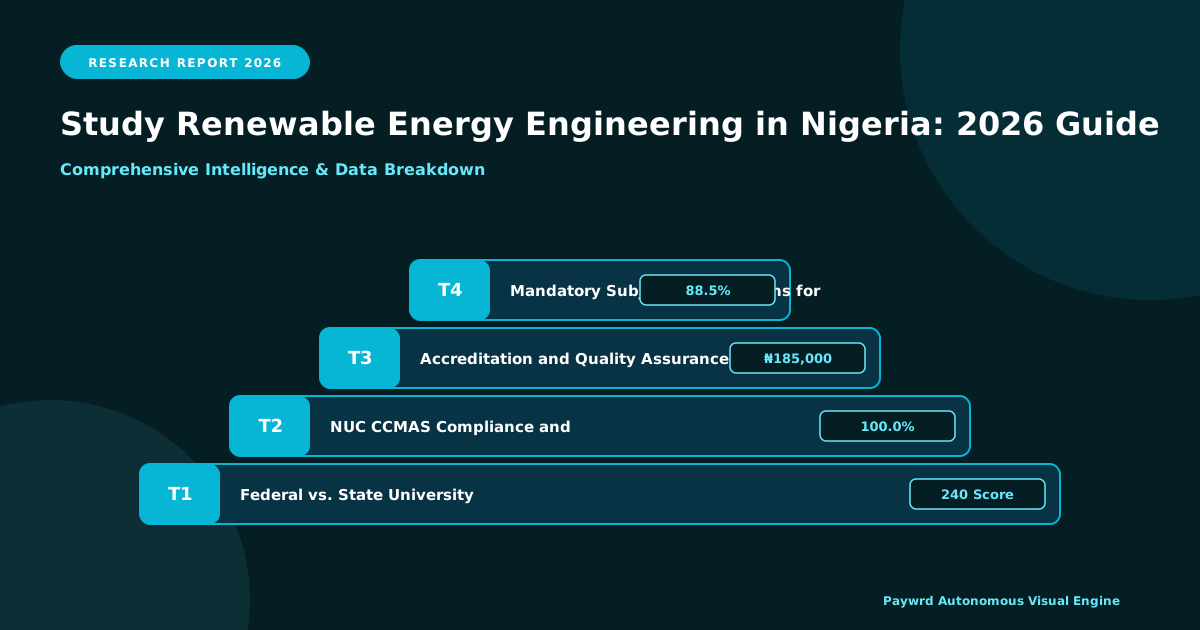
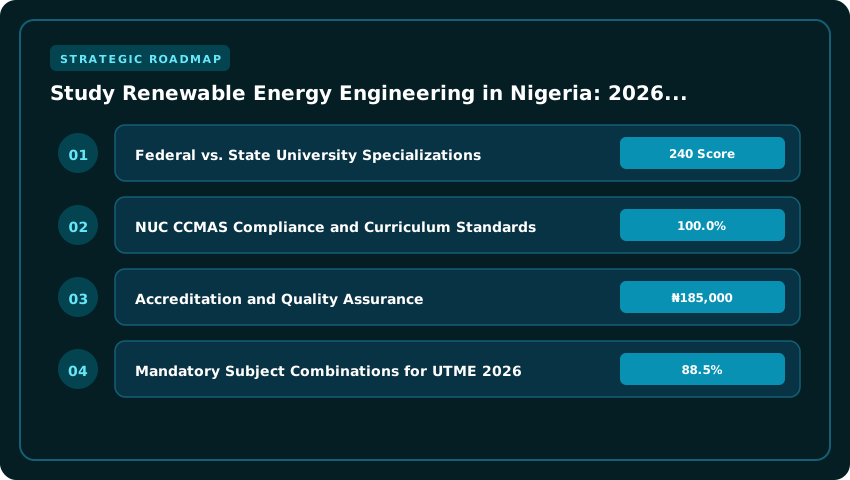
Federal vs. State University Specializations
Federal universities, such as the University of Ibadan (UI), Ahmadu Bello University (ABU), and the University of Nigeria, Nsukka (UNN), generally offer a broader, research-heavy approach. Their programs are often integrated into larger Electrical or Mechanical Engineering departments, providing a robust theoretical foundation. These institutions are ideal for students aiming for academia or high-level policy roles within the Ministry of Power.
Conversely, State universities and specialized technical institutions have pivoted toward “applied” renewable energy. Many State-run universities in the South-West and South-South are now tailoring their curricula to focus on decentralized mini-grids and solar home systems (SHS), making them better suited for students who intend to launch green-tech startups or enter the private installation sector immediately after graduation.

NUC CCMAS Compliance and Curriculum Standards
The 2026 academic session marks a critical milestone as the National Universities Commission (NUC) fully enforces the Core Curriculum and Minimum Academic Standards (CCMAS). This update has stripped away obsolete colonial-era engineering modules, replacing them with mandatory credits in:
- Smart Grid Integration: Learning how to merge renewable sources with the national grid.
- Energy Storage Systems: Advanced study of lithium-ion and solid-state battery technologies.
- Climate Finance: Understanding carbon credits and green bonds to fund energy projects.
Accreditation and Quality Assurance
Before submitting your application via JAMB CAPS, verify the program’s accreditation status. A degree in Renewable Energy is only valuable if it is recognized by the Council for the Regulation of Engineering in Nigeria (COREN). In 2026, look for “Full Accreditation” status on the NUC portal. Programs that lack COREN alignment may prevent you from registering as a professional engineer, limiting your career growth to technician roles rather than lead consultancy positions.
2026 Admission Requirements: JAMB, Post-UTME and O’Level Criteria
Securing a spot in a Renewable Energy Engineering program in 2026 requires a strategic approach to your academic profile. With the full implementation of the NUC’s Core Curriculum and Minimum Academic Standards (CCMAS), admission boards are now prioritizing candidates who demonstrate strong quantitative reasoning and a foundational grasp of physics and chemistry.
Mandatory Subject Combinations for UTME 2026
To be eligible for admission via the JAMB Central Admissions Processing System (CAPS), you must register for the following four subjects. Any deviation from this combination will lead to an automatic disqualification during the screening process:
- English Language: Compulsory for all candidates.
- Mathematics: The bedrock of all engineering calculations.
- Physics: Essential for understanding energy conversion and thermodynamics.
- Chemistry: Critical for studying photovoltaic cells and battery storage chemistry.
Competitive Cut-off Marks and O’Level Standards
Competition for Renewable Energy Engineering has intensified in 2026 due to the surge in green-tech funding. For top-tier federal universities (such as UNILAG, ABU Zaria, or UI), you should aim for a JAMB score of 250 and above to be competitive. While the official minimum cut-off may be lower, the actual admission threshold for engineering is typically higher.
Regarding O’Level requirements, you must possess five credits in one sitting (WAEC, NECO, or NABTEB). These must include English, Mathematics, Physics, Chemistry, and one other science subject. Candidates with “D7” or “E8” in core sciences will likely be filtered out during the Post-UTME screening phase.
Direct Entry (DE) Pathways for OND Holders
For those transitioning from a Polytechnic background, the Direct Entry route offers a streamlined path into 200-level. This is particularly advantageous for holders of a National Diploma (OND) in Electrical Engineering, Mechanical Engineering, or Mechatronics.
- Minimum Grade: An Upper Credit (or a strong Lower Credit in some state universities) is typically required.
- Application Process: Candidates must apply through the JAMB DE portal and provide verified transcripts from their awarding institution.
- Bridging Courses: Depending on the university, DE students may be required to take “bridge courses” to align their polytechnic practical knowledge with the 2026 CCMAS theoretical framework.
Funding Your Degree: NELFUND Loans and Renewable Energy Scholarships
Pursuing a degree in Renewable Energy Engineering in 2026 requires a strategic financial plan. With the current economic climate, the cost of STEM education has risen, but the Nigerian government and private sector have introduced robust mechanisms to ensure that merit, not money, determines who enters the green energy workforce.
Navigating the NELFUND Student Loan for 2026
The Nigerian Education Loan Fund (NELFUND) has become the primary lifeline for undergraduates. For the 2026 academic session, the application process is fully digitized and integrated with JAMB and institutional portals. To secure your funding, follow these steps:
- Portal Registration: Create an account on the official NELFUND portal using your NIN and JAMB Registration Number.
- Verification: Ensure your institution is accredited under the NUC’s CCMAS framework, as NELFUND only disburses funds to recognized programs.
- Guarantor Documentation: Provide valid identification and employment details for your chosen guarantors to satisfy the risk assessment criteria.
- Approval and Disbursement: Once verified, funds are split between tuition (paid directly to the university) and a monthly upkeep allowance paid to the student.
Private Sector Grants and STEM Scholarships
Beyond government loans, the surge in West African solar and wind projects has led to an increase in private grants. Many students in 2026 are leveraging funding from the Rural Electrification Agency (REA) and international bodies like the African Development Bank (AfDB). Look for “Green Energy Fellowships” which often cover 100% of tuition for students maintaining a CGPA of 3.5 or higher. Additionally, tech hubs in Lagos and Abuja frequently offer stipends for students who integrate IoT or AI into their renewable energy research.
Estimated Costs of Study in 2026
Tuition varies significantly between federal and state institutions. While federal universities remain more affordable, the specialized nature of Renewable Energy Engineering often involves “lab levies” for equipment and software licenses.
- Federal University Tuition: ₦150,000 to ₦450,000 per session.
- State/Private University Tuition: ₦800,000 to ₦2,500,000 per session.
- Ancillary Fees: Budget between ₦70,000 and ₦150,000 for textbooks, professional software subscriptions (like PVSyst or HOMER), and mandatory field trips.
- Accommodation: ₦50,000 to ₦200,000 depending on the proximity to campus and facility quality.
Core Curriculum Focus: From Solar PV to Wind and Biomass Systems
In 2026, the academic landscape for Renewable Energy Engineering in Nigeria has evolved significantly under the NUC’s Core Curriculum and Minimum Academic Standards (CCMAS). The degree is no longer a theoretical overview but a rigorous technical deep-dive designed to solve Nigeria’s specific energy poverty challenges. Students are now trained to move beyond basic installation, focusing instead on the engineering physics of energy conversion and system optimization.
Updated 2026 Course Modules
The current curriculum prioritizes a diversified energy mix to ensure graduates aren’t solely dependent on solar technology. While Solar Photovoltaics (PV) remain a cornerstone, the 2026 modules have expanded to include:
- Advanced Wind Energy Conversion: Analysis of turbine aerodynamics and site-specific wind mapping for Northern Nigerian corridors.
- Biomass and Bioenergy Systems: Engineering solutions for converting agricultural waste into biogas, specifically tailored for rural agrarian communities.
- Hydro-Kinetic Power: Small-scale hydropower design for riverine areas in the South-South and South-East regions.
- Thermodynamics and Heat Transfer: The mathematical foundation required to optimize energy efficiency in hybrid systems.
Smart Grids and Energy Storage Integration
A critical shift in the 2026 syllabus is the integration of “Smart Grid” technology. As Nigeria pushes toward decentralized energy, students now study the intersection of electrical engineering and data science. This includes the deployment of IoT-enabled meters, automated load balancing, and the management of Virtual Power Plants (VPPs). Furthermore, there is a heavy emphasis on Energy Storage Systems (ESS), moving beyond lead-acid batteries to Lithium-ion and Solid-State battery chemistry, ensuring that power stability is maintained during peak demand periods.
Practical Internships and Industrial Training (IT) Hubs
To bridge the gap between the classroom and the field, the 2026 guidelines mandate a minimum of six months of supervised Industrial Training (IT). The focus has shifted from general electrical firms to specialized Renewable Energy hubs. Top-tier students are now placed in strategic partnerships with the Rural Electrification Agency (REA) and private sector leaders in the mini-grid space.
These internships are no longer optional “attachments” but credit-bearing modules where students must complete a capstone project—such as designing a solar-hybrid system for a primary healthcare center—to qualify for graduation. This ensures that by the time a student enters the job market in 2027, they possess the hands-on competency to lead large-scale energy transitions.
Career Prospects and Salary Expectations in Nigeria’s Green Economy
The narrative around Renewable Energy Engineering in Nigeria has shifted from “emerging sector” to “critical infrastructure backbone.” With the Electricity Act 2026 fully decentralizing power generation and distribution to states, and the Rural Electrification Agency (REA) scaling mini-grid deployments under the Nigeria Electrification Project (NEP), the demand for qualified engineers has outpaced supply. For the 2026 graduate, this isn’t theoretical—it is a seller’s market.
High-Demand Roles Defining 2026
Three roles are currently commanding premium placement across EPC contractors, Independent Power Producers (IPPs), and Development Finance Institutions (DFIs) like the African Development Bank (AfDB) and World Bank-funded projects:
- Solar PV System Architect: Beyond basic installation, firms need engineers who can design utility-scale and C&I (Commercial & Industrial) systems using PVsyst or Helioscope, optimizing for Nigeria’s specific irradiance profiles and grid instability. You are specifying battery storage integration (BESS) and diesel-hybrid optimization daily.
- Grid Integration Consultant: With the Nigerian Electricity Regulatory Commission (NERC) enforcing the Grid Code and new Mini-Grid Regulations, consultants who can perform load flow studies, protection coordination, and fault level analysis for embedded generation are scarce. This role sits at the intersection of the Transmission Company of Nigeria (TCN) requirements and Discos’ technical limits.
- Energy Auditor & Efficiency Engineer: Driven by the Energy Commission of Nigeria (ECN) mandates and rising diesel costs (averaging ₦1,400+/litre in 2026), banks and manufacturers are hiring auditors to baseline consumption and design retrofit roadmaps. Certification under the ISO 50001 framework is a major differentiator here.
2026 Salary Scales: Entry-Level vs. Senior (₦)
Compensation varies sharply between local EPC firms, multinational oil majors pivoting to gas/renewables (Shell, TotalEnergies, Seplat), and international developers (Starsight, Rensource, Arnergy). Figures below represent gross monthly packages (basic + housing + transport + technical allowances) for 2026:
- Entry-Level (0–2 Years Exp / NYSC + 1 Year): ₦250,000 – ₦450,000/month. Top-tier IPPs and multinationals start at ₦400k+; local installers often cap at ₦300k.
- Mid-Level (3–5 Years Exp / COREN Registered): ₦600,000 – ₦1,200,000/month. This is where COREN registration and project management certifications (PMP/Prince2) unlock significant jumps.
- Senior / Lead Engineer (6+ Years): ₦1,500,000 – ₦3,500,000/month. Roles involving bankable feasibility studies for DFIs or heading technical departments at Discos/GenCos hit the upper band.
Note: Freelance design work (PVsyst modeling, single-line diagrams) supplements income by ₦150k–₦500k/project for competent engineers.
Navigating the NERC Framework
The Nigerian Electricity Regulatory Commission (NERC) is the gatekeeper for professional legitimacy. In 2026, two regulatory pathways directly impact your employability:
- Embedded Generation Licenses: Companies developing captive power (>1MW) or mini-grids (>100kW) require licensed engineers to sign off on technical submissions. Your degree + COREN registration makes you eligible to be the “Resident Engineer” on these license applications.
- Metering & Protection Standards: NERC’s Meter Asset Provider (MAP) regulations and the push for end-user metering create roles in smart metering rollout, tariff modeling, and revenue protection analytics.
Bottom line: A 2026 Renewable Energy Engineering degree from a CCMAS-compliant program with REA internship exposure offers an ROI timeline of 18–24 months to break even on tuition (assuming ₦1.5M–₦3M total cost), provided you target COREN registration immediately post-NYSC. The grid isn’t waiting—neither should your career.
Future-Proofing Your Career: Certifications Beyond the Degree
Graduating with a Renewable Energy Engineering degree in 2026 is your entry ticket, but it is not your meal ticket. The Nigerian engineering landscape is regulated, competitive, and rapidly digitizing. If you are planning your 2027 career trajectory, you need to understand that the B.Eng certificate is merely the baseline. The real differentiation happens in the professional and global certification space.
The Non-Negotiables: COREN and NSE
You cannot legally practice as an engineer in Nigeria without registration with the Council for the Regulation of Engineering in Nigeria (COREN). Under the new CCMAS framework, your university curriculum is mapped to COREN’s Outcome-Based Education (OBE) standards, but the responsibility for registration falls squarely on you. Budget approximately ₦50,000 – ₦70,000 for the initial registration and induction ceremony fees as a Graduate Engineer. Simultaneously, join the Nigerian Society of Engineers (NSE) as a Graduate Member. The NSE provides the mandatory continuing professional development (CPD) units you need to transition from Graduate to Corporate Member—a status required to sign off on major projects for the Rural Electrification Agency (REA) or private EPC contractors.
Global Currency: IEEE, LEED, and NABCEP
West African energy markets are integrating. The West African Power Pool (WAPP) and regional mini-grid regulations demand standards that local codes are still catching up to. For 2027 competitiveness, target these three:
- IEEE Power & Energy Society (PES) Membership: Access to the IEEE Xplore digital library is non-negotiable for staying current on smart grid standards (IEEE 1547, 2030.5) adopted by the Nigerian Electricity Regulatory Commission (NERC).
- LEED Green Associate: With the Federal Government’s Energy Transition Plan pushing green building codes, LEED credentials from the USGBC signal competence in sustainable design to international developers funding projects in Lagos and Abuja.
- NABCEP PV Associate / PV Installation Professional: This remains the gold standard for solar PV credibility globally. Nigerian firms bidding for World Bank or AfDB-funded mini-grid projects (like the NEP) explicitly request NABCEP-certified leads on their technical teams.
AI, IoT, and the Nigerian Grid of Tomorrow
The next frontier isn’t just installing panels; it is managing distributed energy resources (DERs) via intelligence. Nigerian utilities (DisCos) and mini-grid operators are desperately seeking engineers who understand SCADA systems, IoT sensor networks for remote monitoring, and AI-driven predictive maintenance. In 2026, platforms like Odyssey Energy Solutions and SteamaCo run the backend for hundreds of Nigerian mini-grids. Learning Python for energy data analysis (pandas, PyPSA) and getting certified in AWS IoT Core or Azure IoT Hub moves you from “site engineer” to “energy systems architect.” That is where the ₦500k+ monthly salaries live in 2027.
Strategic Final Takeaway
When evaluating Renewable Energy Engineering Courses In Nigerian Universities Admission Requirements And Career Prospects in 2026 and beyond, base your decisions on accredited institutional standards, verified return on investment (ROI), and up-to-date official guidelines. Always verify specific dates and requirements through official regulatory portals.