
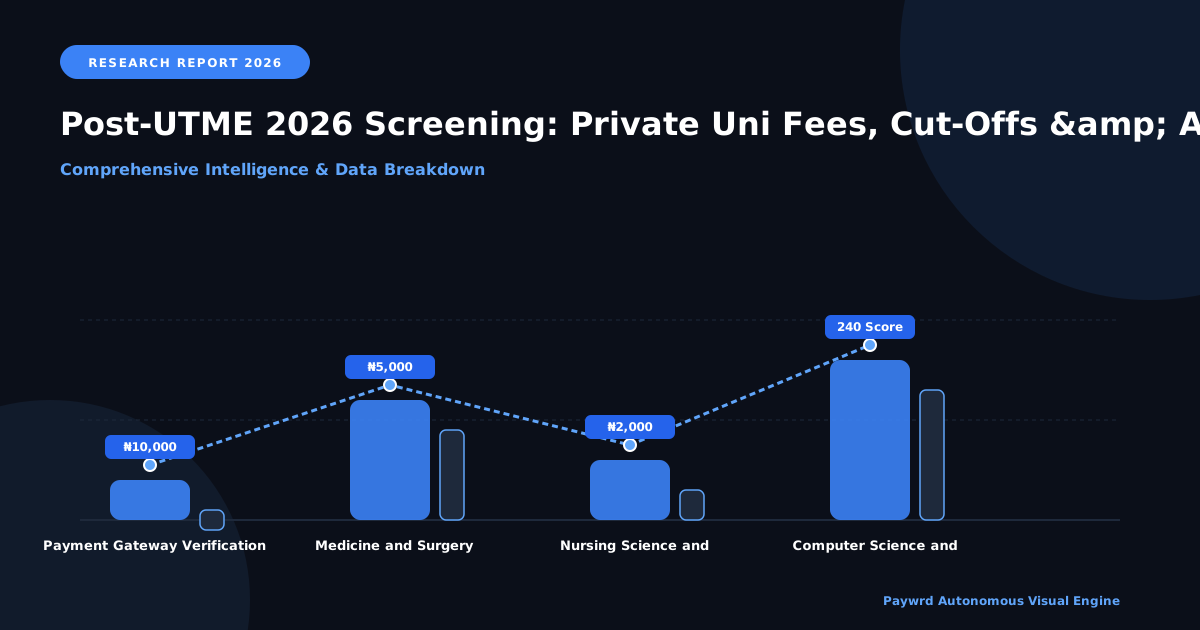
2026 Private University Post-UTME Screening Fees Breakdown
Budgeting for admission in 2026 requires more than just looking at tuition. The initial hurdle is the Post-UTME or screening fee. While federal universities often keep these costs low, private institutions vary significantly based on their infrastructure and the complexity of their internal assessment tools. For the 2026/2027 academic session, we are seeing a trend where top-tier private universities are integrating advanced CBT (Computer Based Test) simulations into their screening, which reflects in the pricing.

To help you plan your finances, here is a comparative look at the screening costs for some of Nigeria’s most sought-after private institutions:
- Joseph Ayo Babalola University (JABU): ₦2,000 — One of the most affordable entry points for quality private education.
- Afe Babalola University (ABUAD): ₦5,000 — A mid-range fee reflecting their extensive medical and engineering screening protocols.
- Covenant University: ₦7,500 — Covers both the academic assessment and the mandatory leadership aptitude test.
- Babcock University: ₦10,000 — Includes the comprehensive screening and initial health assessment documentation.
Payment Gateway Verification for 2026/2027 Session
Gone are the days of manual bank tellers. For the 2026 cycle, almost all accredited private universities have migrated to centralized payment gateways to prevent fraud and ensure instant verification on the JAMB CAPS portal. Most institutions now utilize Remita or Interswitch.
To ensure your payment is recognized and your screening slip is generated, follow these strict verification steps:
- Generate the RRR: Visit the university’s official admission portal and select “Pay Screening Fee.” This will generate a Remita Retrieval Reference (RRR) unique to your JAMB registration number.
- Execute Payment: Use the RRR on the Remita website, your mobile banking app, or at any commercial bank branch.
- Instant Validation: Once payment is successful, do not close the browser. Wait for the “Payment Successful” redirect to the university portal.
- Print the Evidence: Download the PDF receipt and the screening slip immediately. If the portal doesn’t update within 24 hours, contact the institution’s ICT helpdesk with your transaction reference ID.
Failure to use these official channels often leads to “payment not found” errors during the actual screening date, which can jeopardize your admission chances for the 2026 session.
2026/2027 Departmental Cut-Off Marks: Medicine, Nursing & Tech
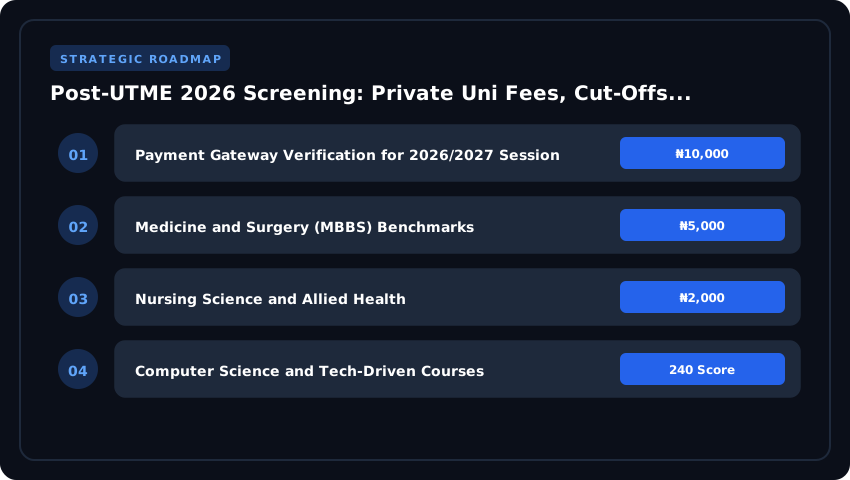
Securing a spot in high-demand programmes for the 2026/2027 academic session requires more than just meeting the general university minimum. Because private universities are increasingly adopting the NUC’s Core Curriculum and Minimum Academic Standards (CCMAS), competition for professional courses has intensified. To gauge your admission probability, you must look at departmental benchmarks rather than the broad institutional cut-off.
Medicine and Surgery (MBBS) Benchmarks
For the 2026 session, Medicine and Surgery remains the most competitive course across the board. Top-tier private institutions like Babcock University, ABUAD (Afe Babalola University), and Bowen University have maintained a strict benchmark. To be competitive for an invitation to the screening exercise, candidates should aim for a JAMB score of 260 or higher.
- High Probability: 280+ (Strong chance of admission pending Post-UTME performance).
- Competitive Range: 260 – 279 (Likely to be shortlisted for screening).
- Borderline: 240 – 259 (Admission depends heavily on available slots and internal screening scores).
Nursing Science and Allied Health
Nursing has seen a surge in applicants in 2026 due to the increasing global demand for healthcare professionals. Most reputable private universities have set the threshold at 240+. While some institutions may accept lower scores for candidates with exceptional O’Level results, a score below 230 significantly lowers your chances of securing a spot in the first batch of admissions via JAMB CAPS.
Computer Science and Tech-Driven Courses
With the 2026 shift toward AI-integrated curricula, Computer Science, Software Engineering, and Cybersecurity have become “premium” courses. While the general cut-off for these programmes typically hovers around 200+, the reality of the 2026/2027 session is that the most sought-after private universities are prioritizing candidates with 220+ to manage class sizes and maintain lab quality.
Strategic Advice for Applicants
If your score falls slightly below these benchmarks, do not panic. Many private universities offer “supplementary” windows or consider candidates who perform exceptionally well in their internal Post-UTME screenings. However, ensure your O’Level credits in Physics, Chemistry, and Mathematics are flawless, as these are non-negotiable requirements for Medicine and Tech programmes. Always verify the specific departmental requirements on the institution’s official portal before finalizing your choice on the JAMB CAPS portal.
Why Catchment Area Does Not Apply to Private Universities
One of the most persistent myths among 2026 UTME candidates is the fear that they will be rejected by a university simply because they are not from the “catchment area.” While this is a critical factor when applying to Federal or State universities, it is entirely irrelevant when applying to private institutions. If you are a candidate from Kano applying to a private university in Lagos or Enugu, your state of origin will not hinder your admission chances.
NUC CCMAS and the Merit-Only Mandate
Under the current National Universities Commission (NUC) Core Curriculum and Minimum Academic Standards (CCMAS), there is a sharp distinction between how public and private institutions manage their quotas. Federal and State universities operate under a strict quota system designed to ensure federal character and regional representation. This means a percentage of slots is reserved for candidates from specific neighboring states.
Private universities, however, operate on a merit-based admission model. Because they are privately funded and not bound by the federal character principle, they prioritize academic competence and the ability to meet financial obligations over geographical location. For the 2026/2027 session, private universities focus on two primary metrics:
- JAMB UTME Score: Meeting the institution’s specific cut-off mark.
- O’Level Results: Possessing the required credits in relevant subjects as stipulated by the NUC.
How JAMB CAPS Ranks Private University Candidates
The Joint Admissions and Matriculation Board (JAMB) Central Admissions Processing System (CAPS) handles private university applications differently than public ones. When a private university accesses its admission list on the CAPS portal, the system does not filter candidates based on their state of origin or catchment zone.
Instead, the ranking is based purely on the aggregate score and the candidate’s choice of institution. If you have a high score and have selected a private university as your first choice, you will appear at the top of their merit list regardless of where you live in Nigeria. This removes the “location bias” and allows high-performing students to migrate across the country to attend top-tier private institutions without worrying about regional quotas.
For candidates seeking financial support, remember that NELFUND loans are available for eligible students in private universities, provided you meet the 2026 verification requirements on the NELFUND portal, further removing the barriers to accessing quality education outside your home state.
Navigating JAMB CAPS: Accept Admission & Pay Acceptance Fee
Once you have cleared your Post-UTME screening and met the 2026 cut-off marks, the final hurdle is the Central Admissions Processing System (CAPS). In 2026, JAMB has tightened the integration between the CAPS portal and institutional databases. If you do not manually “Accept” your admission on the portal, your slot remains vacant, and the university cannot issue your official admission letter.
Step-by-Step Workflow for 2026 Admission Offers
To secure your spot, follow this precise sequence on the JAMB CAPS portal to avoid technical glitches or forfeiture of your admission:
- Login to CAPS: Access the official JAMB portal using your email, phone number, and password.
- Check Admission Status: Navigate to the “Admission Status” tab. If you see “Admission Offered,” you are eligible to proceed.
- The Accept/Reject Decision: Click the “Accept Admission” button. Be cautious: once you accept an offer on CAPS, you cannot easily switch to another institution without a formal change-of-course application, which may be rejected by the new school.
- Print Admission Letter: After accepting, download and print your JAMB Admission Letter. This document is mandatory for physical clearance and NELFUND loan applications.
Acceptance Fee: Costs and Deadline Enforcement
Accepting on CAPS is the legal notification to JAMB, but paying the Acceptance Fee is the financial commitment to the university. For the 2026/2027 academic session, private universities have adjusted their pricing to reflect current operational costs. Most institutions now set their acceptance fees within the ₦50,000 to ₦200,000 range.
It is critical to understand that this fee is separate from your tuition. It covers registration, ID card issuance, and portal activation. In 2026, universities are enforcing strict “payment windows”—typically 2 to 4 weeks from the date of the offer. Failure to pay within this window often results in the institution “rejecting” the candidate on CAPS, which automatically opens the slot for candidates on the waiting list.
To avoid losing your admission, generate your payment invoice via the university’s portal and complete the transaction through Remita or a verified bank gateway immediately after your CAPS acceptance. Keep your payment receipt safe, as you will need it for the final physical verification exercise on campus.
Securing NELFUND Student Loans for Private University Study
For many students admitted into private universities for the 2026/2027 academic session, the primary barrier isn’t the cut-off mark, but the tuition fee. The Nigerian Education Loan Fund (NELFUND) has fundamentally changed this landscape, offering a lifeline that allows students in private institutions to access federal funding for both tuition and upkeep. However, securing this loan requires strict adherence to the digital application process on the official nelf.gov.ng portal.
Eligibility Criteria for Private University Students
To qualify for a NELFUND loan in 2026, you must first be a bona fide student of a recognized Nigerian tertiary institution. For those eyeing private universities, the criteria are specific:
- Admission Status: You must have a confirmed admission status on the JAMB Central Admissions Processing System (CAPS).
- Institutional Accreditation: Your chosen course must be accredited by the National Universities Commission (NUC) under the current CCMAS guidelines.
- Citizenship: You must be a Nigerian citizen with a valid means of identification.
- Financial Need: While available to many, priority is given to students from low-income backgrounds who can demonstrate a genuine need for financial assistance.
Essential Documentation for a Successful Application
The NELFUND portal is integrated with several federal databases to prevent fraud and ensure funds reach the right students. To avoid application delays or automatic rejections, ensure you have the following digital copies ready for upload:
- Official Admission Letter: A scanned copy of your admission letter from your private university, clearly showing your matriculation number or application ID.
- JAMB Result Slip: Your 2026 UTME result slip, verifying that you met the institutional cut-off mark.
- National Identification Number (NIN): Your NIN must be linked to your phone number; the portal uses this for biometric verification.
- Bank Verification Number (BVN): This is mandatory for the disbursement of upkeep allowances and to verify the identity of your guarantor.
It is critical to ensure that the name on your NIN, BVN, and JAMB profile matches exactly. Any discrepancy in spelling or date of birth can trigger a verification failure, stalling your funding. Once your application is submitted and verified, NELFUND typically disburses tuition payments directly to the university’s designated account, while upkeep funds are sent to the student’s verified bank account.
Critical Deadlines & Document Checklist for 2026 Registration
Missing a single deadline or uploading a blurred document is the fastest way to get your application flagged or disqualified during the 2026/2027 admission cycle. Private universities operate on strict timelines; once the portal closes, the university typically stops accepting new entries to finalize their lists for JAMB CAPS synchronization.
Post-UTME Registration Deadlines for Top Private Universities
While dates vary slightly, most top-tier private institutions have aligned their 2026 screening windows to ensure students are settled before the official NUC-mandated resumption dates. Based on current 2026 academic calendars, here are the critical windows:
- Covenant University & Babcock University: Registration typically closes by late August 2026.
- Afe Babalola University (ABUAD) & Nile University: Portals generally remain open until mid-September 2026 for the first batch.
- Bowen University & Pan-Atlantic University: Deadlines usually fall between August 15th and September 5th, 2026.
- Baze University & Veritas University: Expect closures by late September 2026.
- Landmark University & Redeemer’s University: Strict deadlines usually coincide with the end of August 2026.
Pro tip: Do not wait until the final 48 hours. Nigerian payment gateways and university servers frequently experience downtime during the “deadline rush,” which could leave you stranded without a submitted application.
Mandatory Document Checklist for 2026 Uploads
To avoid the “incomplete application” status, ensure you have scanned copies of the following documents in PDF or JPEG format (usually under 500KB). Ensure all scans are clear and legible; AI-driven verification tools used by admissions offices in 2026 will automatically reject blurred images.
- JAMB Result Slip: The official 2026 UTME printout showing your score and chosen course.
- O’Level Results: Your WAEC, NECO, or NABTEB certificates. If you are awaiting results, upload your “Awaiting Result” notification, but be ready to update it immediately upon release.
- Birth Certificate or Age Declaration: A legal document proving your date of birth to satisfy NUC age requirements.
- Local Government Identification: A valid LG ID card or indigene certificate, which is critical for certain quota considerations and verification.
- Passport Photograph: A recent professional photo with a white background, taken within the last six months.
Once these are uploaded, double-check your JAMB CAPS portal to ensure you have officially accepted the institution as your first choice, as no private university can finalize your admission in 2026 without this step.
| University Category | Estimated Screening Fee (2026/2027) | Payment Method | Typical Cut-off Mark | Processing Timeline |
|---|---|---|---|---|
| Top-Tier Private | ₦10,000 – ₦15,000 | Remita (RRR) | 220 – 250 | 2-4 Weeks |
| Mid-Tier Private | ₦5,000 – ₦9,000 | Remita (RRR) | 200 – 219 | 3-5 Weeks |
| Budget Private | ₦2,000 – ₦4,000 | Bank Transfer/Remita | 180 – 199 | 4-6 Weeks |
Frequently Asked Questions
How much are private university Post-UTME screening fees for 2026/2027?
For the 2026/2027 academic session, private university screening fees in Nigeria typically range from ₦2,000 to ₦15,000. Costs vary based on the institution's infrastructure and the use of advanced CBT simulations. Candidates are strongly advised to use a Remita Retrieval Reference (RRR) to ensure payment validity and avoid admission delays.
What is the required cut-off mark for private universities in 2026?
Cut-off marks for 2026 vary by institution and course. Top-tier private universities generally set their benchmarks between 220 and 250, while budget-friendly private institutions may accept scores from 180 upwards. Always verify the specific departmental requirements on the university's official 2026 admission portal before applying.
How do I avoid payment errors during 2026 Post-UTME registration?
To prevent 'ghost transactions' during the 2026 registration process, always generate a Remita Retrieval Reference (RRR) before making any payment. This unique identifier ensures your payment is automatically linked to your application profile, providing a verifiable digital trail that prevents delays in your screening invitation and admission processing.
What are the steps for private university admission in 2026?
The 2026 admission process involves four key steps: first, meeting the JAMB minimum score; second, paying the screening fee via Remita; third, completing the internal university application form; and fourth, passing the CBT screening or interview. Successful candidates will then receive an admission offer via the JAMB CAPS portal.
When should I apply for private university screening for the 2026/2027 session?
Prospective students should begin their applications as soon as the 2026/2027 portals open to secure limited slots. Most private universities process admissions in waves; applying early ensures you are captured in the first batch of screening exercises, reducing the risk of missing deadlines for high-demand courses like Medicine or Law.
Strategic Final Takeaway
When evaluating Post-UTME 2026 Screening Form For Private Universities Like JABU Fees And Cut-Off Marks in 2026 and beyond, base your decisions on accredited institutional standards, verified return on investment (ROI), and up-to-date official guidelines. Always verify specific dates and requirements through official regulatory portals.

