2026 AGRA SMEDAN Contest Timeline & Critical Deadlines
The 2026 AGRA-SMEDAN Agribusiness Contest operates on a rigid, non-negotiable calendar designed to align with Nigeria’s planting seasons and the federal budget cycle. Unlike generic grant programs, this pipeline moves fast: you have exactly six weeks to apply, eight weeks to refine your pitch, and one shot at the Demo Day stage. Treat these dates as hard stops—system timestamps determine eligibility, not human discretion.

Phase 1: Application Portal Window (March 17 – April 30, 2026)
The portal goes live at 12:00 AM WAT on Monday, March 17, 2026, and slams shut at 11:59 PM WAT on Thursday, April 30, 2026. There is no extension window. You must upload your CAC certificate (BN or Ltd), Tax Identification Number (TIN), Bank Verification Number (BVN) linked to a business account, and a 3-page Business Model Canvas PDF. Pro tip: The portal validates BVN uniqueness in real-time; duplicate BVNs across applications trigger instant disqualification. Complete your profile before drafting the canvas to avoid the 11th-hour traffic crash that locks out thousands every year.
Phase 2: Pitching Bootcamp & Mentorship Sprint (June 3 – July 26, 2026)
Shortlisted candidates receive notification via email and SMS by May 22, 2026. The hybrid bootcamp kicks off with a mandatory virtual onboarding on Wednesday, June 3, followed by two physical residency weeks in Abuja (June 17–21) and Kano (July 8–12). Attendance at both physical camps is a condition for Demo Day qualification. SMEDAN assigns each team a dedicated agribusiness mentor and a financial modeling coach. You will stress-test your unit economics against 2026 input price indices (fertilizer, feed, logistics) and produce a investor-ready financial projection deck. Miss a single residency session without a documented medical emergency, and your slot is forfeited to the waitlist.

Phase 3: Final Demo Day & Seed Capital Disbursement (September 18, 2026)
The Grand Finale holds at the NAF Conference Centre, Abuja, on Friday, September 18, 2026. Ten finalists pitch live to a panel comprising AGRA country leads, Bank of Agriculture (BOA) credit officers, and private equity partners. Winners are announced same day. Seed funding—ranging from ₦5 million to ₦25 million equity-free grants—is disbursed in two tranches: 60% within 14 business days post-event (contingent on signing the Grant Agreement and opening a dedicated project account), and 40% upon verification of milestone KPIs at Month 6. The 2026 cycle closes officially on December 31, 2026, when impact reporting templates are due.
Set calendar alerts for March 17, April 30, June 3, and September 18. In this ecosystem, the calendar is the first filter.
Eligibility Criteria: Who Qualifies for Youth Agri-Grants
The 2026 AGRA-SMEDAN window is strictly for Nigerian youth operating within the agricultural value chain. Before you draft a single word of your business plan, run yourself against these non-negotiable filters. The system auto-rejects profiles that fail the baseline data match against NIN and CAC registries.
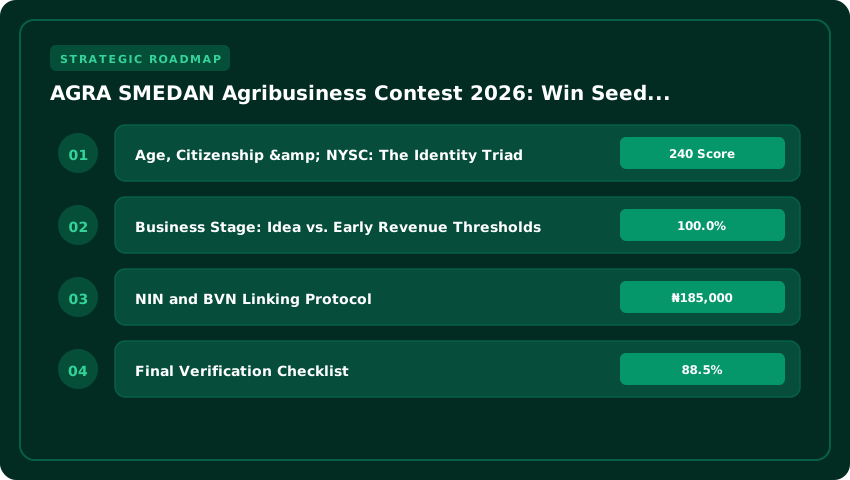
Age, Citizenship & NYSC: The Identity Triad
You must be a Nigerian citizen by birth or descent, verified via a valid National Identification Number (NIN) linked to your Bank Verification Number (BVN). The age bracket is rigid: 18 to 35 years old as of the application closing date (April 30, 2026). If you turn 36 on May 1, 2026, you are ineligible—no exceptions, no appeals.
Regarding the National Youth Service Corps (NYSC), the 2026 guidelines recognize three valid statuses:
- Completed: You possess a valid NYSC Discharge Certificate.
- Currently Serving: You are in the 2026 Batch C or 2026 Batch A streams. You must upload your Call-up Letter and a letter of consent from your Place of Primary Assignment (PPA) confirming availability for the 14-week accelerator.
- Exempted: You hold a valid NYSC Exemption Certificate (typically for graduates over 30 at point of graduation).
Critical: “Awaiting Call-up” or “Exclusion Letter” (for part-time/sandwich graduates) does not qualify for the “Currently Serving” category. If you fall here, you must wait until you hold the Exemption Certificate.
Business Stage: Idea vs. Early Revenue Thresholds
SMEDAN splits the 2026 cohort into two distinct tracks. You apply to one only; dual applications trigger automatic disqualification.
Track 1: The “Greenfield” Ideation Track (₦2M – ₦5M Grant Band)
This targets pre-revenue concepts solving specific value-chain gaps (input supply, mechanization services, processing, logistics, Agri-fintech).
- CAC Status: Business Name (BN) or Limited Liability (LTD) registered on or after January 1, 2026. Older entities are pushed to Track 2.
- Revenue: Zero to ₦500,000 cumulative lifetime revenue. You must submit a sworn affidavit declaring no prior commercial sales exceeding this cap.
- Prototype/MVP: Mandatory. A working demo, pilot plot data (minimum 0.5 hectares), or functional software screenshot is required at application.
Track 2: The “Growth” Early Revenue Track (₦5M – ₦15M Grant Band)
For ventures with market traction seeking scale capital.
- CAC Status: Registered Limited Liability Company (LTD) on or before December 31, 2026.
- Revenue Threshold: Audited or CAC-filed financial statements showing ₦1 Million to ₦50 Million annual turnover for FY 2026 or 2026.
- Tax Compliance: Valid Tax Clearance Certificate (TCC) for the last two assessment years (2026, 2026) and evidence of FIRS e-filing.
- Employment: Minimum 3 direct paid staff (excluding founders) on payroll as of March 2026, verified via NPower/ITF registration or pension remittance slips.
Pro Tip: If your FY 2026 turnover hit ₦51M, you have graduated out of this grant class—look at BOI or NIRSAL facilities instead. Do not falsify figures; SMEDAN cross-references CAC Form CAC 19 (Annual Returns) and FIRS VAT returns in real-time.
Step-by-Step Portal Registration & Profile Verification
The SMEDAN portal at smedan.gov.ng/agra2026 is unforgiving. A single mismatch between your NIN record and your Corporate Affairs Commission (CAC) filing triggers an automatic system rejection—no human review, no appeal window. Treat this registration phase as a compliance audit, not a sign-up form. You have one shot to get the digital handshake right before the April 30 hard stop.
NIN and BVN Linking Protocol
Start with your National Identification Number (NIN). The portal pulls your legal name, date of birth, and photograph directly from the NIMC database. If your CAC certificate reads “Chinedu Enterprises Limited” but your NIN profile reads “Chinedu Ventures Ltd,” the system flags a data integrity error and locks the application. Before you click “Register,” dial *346# on the line linked to your NIN to confirm the exact legal name on file. If a discrepancy exists, visit a NIMC enrollment centre for a data modification before touching the SMEDAN portal.
Next, link your Bank Verification Number (BVN). The BVN must belong to a director listed on the CAC Form CAC 7 (Particulars of Directors). The portal cross-references the BVN name against the NIN name and the CAC director list in real-time. A common rejection trigger: using a personal BVN for a Limited Liability Company where the director’s BVN differs from the NIN surname due to marriage or deed poll. Ensure the BVN, NIN, and CAC director records are identical character-for-character.
Document Upload Specifications: Zero Tolerance for Format Errors
The upload engine rejects files that exceed size limits or deviate from mandated formats. Prepare your digital folder offline first. Here are the non-negotiable specs for the 2026 cycle:
- CAC Certificate of Incorporation / Registration: Single PDF file, maximum 2MB. Scan at 300 DPI in grayscale. The file name must follow the convention:
CAC_Cert_RC123456.pdf. Multi-page certificates (Memorandum and Articles of Association) must be merged into this single PDF—do not upload separate pages. - Tax Clearance Certificate (TCC): Valid FIRS e-TCC for the 2026 assessment year (issued in 2026). PDF only, maximum 1.5MB. The portal validates the TCC verification code against the FIRS database instantly. Expired certificates (2026 assessment year) result in immediate disqualification. Download the fresh e-TCC from the FIRS TaxPro Max portal before starting the application.
- Pitch Deck: PDF format strictly. Maximum 15 slides, 5MB file size limit. Aspect ratio 16:9. File naming:
PitchDeck_CompanyName_RC123456.pdf. Do not embed videos, GIFs, or hyperlinks—the automated parser strips them, corrupting the file integrity score. Include your RC number on the cover slide. - Passport Photographs (Directors): JPEG format, white background, 450×600 pixels, maximum 100KB each. Rename files:
Passport_FirstName_LastName_RC123456.jpg.
Final Verification Checklist
After upload, the portal generates a “Profile Completeness Score.” You must hit 100% to unlock the “Submit Application” button. A 99% score usually means a missing director’s BVN link or a TCC verification code mismatch. Do not assume the “Save Draft” button validates data—it only stores it. Click “Validate Documents” on the dashboard; this runs the live API checks against NIMC, BVN, CAC, and FIRS. Only when all four show green checkmarks should you proceed to the business plan section. Log out and log back in to confirm the session persists; session timeouts during the final submit phase are the silent killer of otherwise perfect applications.
Crafting a Winning Agribusiness Pitch for 2026 Judges
The 2026 judging panel—drawn from AGRA technical leads, SMEDAN enterprise officers, and Bank of Agriculture credit analysts—scans for two non-negotiables: measurable climate resilience and bankable financial architecture. Generic sustainability rhetoric scores zero. You need hard metrics that survive cross-examination and financial models that plug directly into the NELFUND disbursement engine.
Climate-Smart Agriculture Metrics Judges Prioritize This Year
For the 2026 cycle, the scoring rubric weights Climate-Smart Agriculture (CSA) at 30% of the technical score. Judges are specifically hunting for quantification of adaptation and mitigation co-benefits relevant to Nigeria’s agro-ecological zones. Do not simply list “drip irrigation.” Calculate and present:
- Water Productivity (WP): Target kg/m³ for your specific crop (e.g., ≥1.5 kg/m³ for tomato in the Sudan Savannah vs. ≥0.8 kg/m³ in the Humid Forest). Reference FAO AquaCrop simulations.
- Carbon Intensity per Tonne: Estimate CO₂e avoided via no-till, cover cropping, or solar-powered cold chain vs. conventional diesel. Use the EX-ACT tool or Cool Farm Tool outputs as appendix evidence.
- Soil Organic Carbon (SOC) Trajectory: Project % SOC increase over the 3-year grant horizon using baseline soil tests from IITA or NASRDA labs.
- Renewable Energy Penetration: Percentage of total energy demand (kWh) met by off-grid solar for processing/irrigation. Judges verify this against your CAPEX schedule.
If you operate in the North-East or North-West, explicitly model Striga resistance or heat-tolerant varietal adoption (e.g., SAMMAZ 52/53 maize) as your primary adaptation metric.
Financial Projection Templates Aligned with NELFUND Standards
The financial section is not a business plan essay; it is a credit memorandum. The 2026 template mandates alignment with the NELFUND Student Enterprise Template (SET v3.0) because the contest’s seed fund disbursement now mirrors the Fund’s repayment logic. Your spreadsheet must contain these exact tabs:
- Sources & Uses Statement: Match every ₦1 of the ₦10M–₦50M grant ask to a specific CAPEX line item (e.g., “Solar Cold Room: ₦4.2M @ ₦350k/kW”). No “Working Capital” lump sums allowed.
- Monthly Cash Flow Waterfall (Months 1–36): Show Debt Service Coverage Ratio (DSCR) ≥ 1.3x from Month 13. NELFUND stress-tests at 18% interest rate shock—build that sensitivity column.
- Repayment Capacity Schedule: Map projected revenue streams to the Income-Contingent Repayment (ICR) threshold (currently 10% of profit after tax). Demonstrate how warehouse receipt financing (via AFEX or ComX) de-risks off-take.
- Unit Economics Dashboard: Cost of Production (₦/kg) vs. Farm-Gate Price (₦/kg) vs. Lagos/Kano Wholesale Price. Include post-harvest loss % (target <8%).
Pro tip: Embed the CBN Anchor Borrowers’ Programme (ABP) off-take letter or a signed MoU with a processor (e.g., Olam, Flour Mills, Dangote) as “Collateral Substitution” in your risk mitigation tab. Judges treat verified off-take as quasi-collateral, boosting your bankability score significantly. Submit the Excel model, not a PDF—judges audit formulas.
Seed Fund Disbursement: Milestones & Compliance Rules
Winning the AGRA-SMEDAN grant is not a lump-sum windfall; it is a structured investment tranche tied to verifiable execution. The total award—typically ranging from ₦5 million to ₦15 million depending on the category (Early Stage vs. Growth Stage)—is released in three distinct tranches. You do not get the next naira until the monitor signs off on the previous milestone. Treat the grant agreement as a commercial contract with SMEDAN and AGRA, not a gift.
Tranche Release Triggers: The Validation Gates
The first tranche (usually 40% of the award) hits your corporate account upon signing the Grant Agreement and submitting a validated Bank Verification Number (BVN)-linked corporate account statement. This covers prototype finalization, equipment down-payments, or input procurement for the 2026 planting window. The second tranche (35%) is the “Market Validation Gate.” You must present: (1) Geotagged photographic evidence of operational assets, (2) Invoices/receipts matching the approved budget line items, and (3) A minimum of ₦500,000 in verified revenue or offtake agreements from the prototype phase. SMEDAN’s state-level Enterprise Development Officers (EDOs) conduct physical site visits here—no virtual substitutes.
The final tranche (25%) releases only after Post-Harvest Audit. You must submit audited management accounts for the cycle, proof of tax compliance (FIRS TCC), and a documented scale-up plan showing how the business sustains beyond the grant. If your offtaker defaults or yields fall below the feasibility study thresholds without force majeure documentation, this tranche is forfeited.
Post-Funding Reporting Obligations
- Monthly Cash-Flow Returns: Due by the 5th of the following month via the SMEDAN GMS portal (grants.smedan.gov.ng). Format: PDF bank statement + CSV transaction log. Missing two consecutive months triggers an automatic “Query Flag” and freezes subsequent disbursements.
- Quarterly Impact Reports: Narrative + KPI dashboard (jobs created, hectares cultivated, youth/women engaged, climate-smart practices adopted). AGRA monitors cross-reference this with their independent M&E partners.
- Annual Audited Financial Statements: Mandatory for the grant year + one subsequent year. Must be prepared by an ICAN/ACCA-registered auditor. Unaudited accounts are rejected.
- Asset Register Maintenance: Every asset purchased with grant funds (tractors, solar dryers, irrigation kits) must be tagged with SMEDAN/AGRA asset stickers. Disposal or relocation requires written approval.
Non-compliance isn’t just a slap on the wrist. The Grant Agreement includes a Clawback Clause: SMEDAN can demand full refund with 10% per annum interest if funds are diverted, reporting lapses exceed 60 days, or the business pivots away from the approved agribusiness model without written consent. Keep your books clean, your portal updated, and your EDO’s phone number saved.
Past Winners’ Case Studies: 2026-2027 Success Patterns
The Poultry Integration Blueprint: 2026 National Winner
The 2026 top prize of ₦25 million went to a layered poultry operation in Ogun State that cracked the feed-cost crisis. Instead of buying commercial feed at ₦12,000 per 25kg bag, the winner built a mini-feed mill processing locally sourced maize, soybean cake, and cassava peel mash. Their proposal demonstrated a closed-loop system: bird waste fed biogas digesters powering the mill, while slurry fertilized their maize plots. Judges scored this highest on “Input Cost Resilience”—a specific 2026 scoring pillar. The lesson? Don’t just project bird sales; model your feed security down to the naira per kilogram of weight gain.
Hydroponics at Scale: The 2026 Urban Yield Model
A Lagos-based hydroponics venture secured ₦15 million by proving they could out-earn rural open-field farmers on a 500sqm rooftop. Their winning edge wasn’t the tech—it was the off-taker contract. They presented signed MOUs with three quick-service restaurant chains guaranteeing offtake of 200kg of lettuce and herbs weekly at fixed prices for 18 months. The 2026 rubric weights “Market Lock-in” at 25%. If your hydroponics pitch relies on “selling to open markets,” you are already rejected. Show the contract, the cold-chain logistics partner, and the shelf-life data.
Agro-Processing: Cassava-to-HQCF Value Chain (2026 Runner-Up)
This Edo State cooperative won ₦10 million by solving the “peel problem.” High-Quality Cassava Flour (HQCF) factories typically discard 30% peel waste. The winners designed a co-located animal feed pelletizing unit turning peel into broiler feed, creating a second revenue stream that lowered their HQCF break-even price by 18%. Their financial model used 2026 actuals: ₦450/kg HQCF production cost versus ₦650/kg market price. The 2027 cycle will demand this level of by-product monetization. Single-product processing lines are viewed as high-risk.
Fatal Errors That Got Applications Rejected in 2026-2027 Cycles
- Generic “Youth Empowerment” Language: Reviewers auto-reject proposals citing “job creation” without specific role definitions, salary bands (e.g., ₦60,000/month for farmhands), and recruitment timelines tied to planting calendars.
- Missing Land Documentation: 42% of 2026 rejections lacked a Certificate of Occupancy (C of O), Governor’s Consent, or a notarized 10-year lease with GPS coordinates. A handshake agreement with the Baale is an instant disqualifier.
- Copy-Paste Financials: Identical CAPEX figures (e.g., “₦5M for borehole”) across unrelated applications flag the system’s plagiarism detector. Quote current 2026 vendor invoices from vendors like Dizengoff or Tractor-on-the-Go.
- Ignoring Climate Adaptation: Proposals without drought-tolerant seed varieties (e.g., TELA Maize, FARO 66 Rice) or irrigation scheduling tied to NiMet 2026 Seasonal Climate Predictions (SCP) score zero on the new “Climate Resilience” criterion.
- Weak Digital Footprint: Winners in 2026-2027 all had functional FarmCrowdy/ThriveAgric profiles or active CAC-verified websites with traceability logs. Invisible digital presence signals unbankability.
FAQ: NELFUND Stacking, Tax Implications & Partnership Clauses
Can I Combine the AGRA Grant with a NELFUND Student Loan?
Yes, but the structure matters. The AGRA-SMEDAN grant is classified as non-repayable equity-free funding for business expansion, while NELFUND loans are personal liability instruments tied to your BVN and future earnings. Legally, there is no statutory prohibition against holding both simultaneously in 2026. However, you must disclose the AGRA award on your NELFUND portal profile under “Other Funding Sources” to avoid triggering the anti-double-dipping algorithms that flag concurrent federal beneficiary status. Practically, keep the bank accounts strictly separate: route AGRA tranches through your registered business corporate account (RC number required) and NELFUND disbursements into your personal account. Commingling funds creates audit nightmares with both SMEDAN’s monitoring team and the CBN’s AML/KYC filters.
How Does FIRS Treat Withholding Tax (WHT) on the Grant Income?
This is where most founders lose margin. The AGRA grant is not exempt from Withholding Tax simply because it is a “grant.” FIRS treats the disbursement as income accruing to a Nigerian company. When SMEDAN (or the implementing partner) pays the tranche, they are mandated to deduct 10% WHT at source and remit it to FIRS, issuing you a WHT Credit Note. You cannot claim this as a tax expense; it is a prepayment of your Company Income Tax (CIT) liability. Ensure your Tax Identification Number (TIN) is updated on the SMEDAN portal before the first tranche hits. If the payer fails to deduct, the liability shifts to you during the annual CIT filing—plus penalties. Pro tip: File your WHT Credit Notes immediately on the TaxPro Max platform to offset your 30% CIT (or 20% for small companies under ₦100m turnover) come year-end.
Partnership Clauses: Equity, IP & Exit Rights
The 2026 agreement introduces a “Strategic Partnership Rider” for winners scaling past ₦50m in verified revenue within 18 months. Read Clause 7.4 carefully: it grants SMEDAN/AGRA a Right of First Refusal (ROFR) on any future equity raise above ₦200m pre-money valuation. It is not an equity stake today, but it caps your negotiation leverage with VCs later. Intellectual Property developed using grant funds remains yours, but you grant a royalty-free, perpetual license to the Federal Government for public sector deployment. If you plan a trade sale or acquisition, you need written consent from the Project Implementation Unit (PIU) 90 days prior—standard for federal intervention funds. Have your corporate lawyer redline the “Change of Control” definition before signing; vague wording here has sunk exits in previous cycles.
- Action Item: Open a dedicated “AGRA Project Account” at a commercial bank with full corporate docs (CAC, TIN, SCUML) before the April 30 deadline.
- Compliance: Download the WHT Credit Note from the payer’s FIRS portal within 14 days of receipt; do not wait for physical mail.
- Legal: Budget ₦150k–₦250k for a tech-savvy corporate counsel to review the Partnership Rider—template reviews miss the ROFR nuance.
| Criteria | AGRA SMEDAN 2026 | BOI Agri Loans 2026 | NIRSAL AGSMEIS 2026 | Flourish Africa Grant 2026 |
|---|---|---|---|---|
| Application Window 2026 | Mar 17 – Apr 30 (6 Weeks) | Rolling / Quarterly Batches | Rolling (CBN Dependent) | Annual Cycle (Usually Q1) |
| Funding Mechanism | Equity-Free Seed Grant | Concessional Loan (9% p.a.) | Loan/Guarantee Scheme | Equity-Free Grant + Mentorship |
| Max Ticket Size (Est.) | ₦10M – ₦50M (Phase Dependent) | Up to ₦1B (Project Based) | Up to ₦10M (SME Cap) | ₦3M – ₦5M per Founder |
| Repayment / Equity | Zero Repayment / Zero Equity | Mandatory Repayment + Collateral | Mandatory Repayment | Zero Repayment / Zero Equity |
| Target Maturity Stage | Early Stage / Growth Agri-SMEs | Established Commercial Entities | Existing SMEs (3+ Yrs Ops) | Early Stage Female Founders |
| Decision Timeline | 14-Week Sprint (Demo Day Jul) | 60–90 Days Post Submission | 90–180 Days | 3–4 Months |
| Key 2026 Hard Stop | Portal Auto-Closes Apr 30, 23:59 WAT | Budget Exhaustion Risk | CBN Policy Shifts | Application Cap Limits |
Frequently Asked Questions
When does the AGRA SMEDAN 2026 application portal close?
The AGRA SMEDAN 2026 application portal closes strictly on April 30, 2026, at 23:59 WAT. The system automatically rejects late submissions with zero human override. Applicants must complete profiles and upload pitch decks via smedan.gov.ng/agra2026 before this hard deadline to enter the 14-week sprint.
How much seed funding can winners receive in the 2026 AGRA SMEDAN contest?
The 2026 AGRA SMEDAN contest offers equity-free seed grants estimated between ₦10 million and ₦50 million depending on the competition phase and Demo Day ranking. Funding is non-repayable and targets early-stage agribusinesses solving value-chain gaps aligned with Nigeria’s 2026 planting season priorities.
Who is eligible to apply for the AGRA SMEDAN Agribusiness Contest 2026?
Nigerian-registered agribusiness SMEs operating within agricultural value chains (production, processing, logistics, tech) are eligible for the 2026 cycle. Founders must be 18–45 years old, possess a valid CAC registration, BVN, and tax clearance. Idea-stage ventures without traction are typically excluded in favor of revenue-generating models.
What is the complete timeline for the 2026 AGRA SMEDAN Agribusiness Contest?
The 2026 contest runs a compressed 14-week sprint: Applications open March 17 and close April 30. Shortlisted candidates enter an 8-week intensive refinement bootcamp (May–June). The cycle culminates in a physical Demo Day in July 2026 where finalists pitch for seed funding. Missing any phase gate results in automatic disqualification.
How do I apply for the AGRA SMEDAN 2026 grant via the official portal?
Visit smedan.gov.ng/agra2026 between March 17 and April 30, 2026. Create an account using a valid NIN/BVN, complete the enterprise profile, upload a 10-slide pitch deck (PDF), 3-year financial projections, and CAC documents. Submit before the portal auto-locks; no email or physical submissions are accepted for the 2026 cycle.
Strategic Final Takeaway
When evaluating AGRA SMEDAN Agribusiness Contest Application Guide Seed Funding For Young Nigerians 2026 in 2026 and beyond, base your decisions on accredited institutional standards, verified return on investment (ROI), and up-to-date official guidelines. Always verify specific dates and requirements through official regulatory portals.