The Classroom Crisis: Why Memorizing Manuals Fails Modern AI Students
Imagine spending twelve weeks in a 2026 immersive AI bootcamp, acing every quiz on Python decorators, NumPy broadcasting, and gradient descent math. You can recite the entire TensorFlow Keras API from memory, sketch a transformer architecture on a whiteboard without blinking, and confidently explain the differences between L1 and L2 regularization to a curious kindergartener. Then you receive your first freelance contract to deploy a custom image classification model for a regional agricultural cooperative in Iowa, and everything collapses.

The dataset arrives as a messy 40-gigabyte archive of drone-captured cornfield imagery with inconsistent lighting, corrupt EXIF metadata, and labels written in a mix of English and Spanish shorthand. The deployment target is not a clean Jupyter Notebook but a ruggedized edge device running on a rural cellular network with spotty coverage. Suddenly, your perfectly memorized syntax means almost nothing. You must containerize the model with Docker, optimize it for TensorRT inference on an NVIDIA Jetson Orin, write a graceful degradation fallback for connectivity loss, and explain your architectural choices to a farm operations manager who wants to know precisely how many bushels per acre the model will save him. This is the story behind the 62% of US tech recruiters who, according to the 2025–2026 CompTIA and HackerRank industry reports, report that candidates lack practical deployment skills despite holding impressive theoretical credentials.
The crisis runs much deeper than individual anecdote. For decades, the American computer science education pipeline, from flagship research universities to community college coding certificates, leaned heavily on closed-book examinations, theoretical proofs, and textbook drills. That model produced strong researchers but left a yawning gap between graduation and the realities of production environments. In response, leading institutions have radically rethought their assessment philosophies. MIT, through its Schwarzman College of Computing and the Break Through Tech AI initiative, now requires every undergraduate AI concentrator to ship at least one capstone project evaluated by industry partners, with code hosted on public GitHub repositories and judged on scalability, maintainability, and reproducibility. Stanford, meanwhile, has redesigned its flagship CS221 and CS229 sequences around portfolio-based mastery, where final grades depend substantially on student-built applications that solve open-ended societal problems rather than answering multiple-choice questions under timed pressure.
This pedagogical shift reflects an uncomfortable truth that US employers and accreditation bodies have been documenting for years. The ABET accreditation criteria for computing programs, updated in 2024–2025, now explicitly require student outcomes demonstrating the ability to function effectively on teams, develop and apply appropriate models, and communicate technical concepts to diverse audiences. Memorizing the TensorFlow 2.16 changelog does not satisfy any of those outcomes. The newer AACSB standards for business-facing analytics and AI programs echo the same message, demanding evidence of applied experiential learning and measurable impact on real stakeholders. Even the College Board, in its recent redesign of the AP Computer Science Principles exam, has shifted roughly half the assessment toward a Create Performance Task, where students must submit an original computational artifact with a video walkthrough explaining its design decisions.
For prospective AI students evaluating programs in 2026, the practical implications are profound. Before enrolling in any bootcamp, university certificate, or full degree pathway, ask the admissions office for concrete answers to several pointed questions. Can you see a public portfolio of capstone projects from the last three graduating cohorts? Does the curriculum include dedicated units on MLOps, model monitoring, CI/CD pipelines, and cloud cost optimization on platforms like AWS SageMaker, Azure Machine Learning, or Google Vertex AI? Are students required to present their work to non-technical stakeholders as part of the final grade? What percentage of graduates land their first AI role within six months, and what is the median starting salary in US dollars? Programs that cannot answer those questions transparently are signaling, intentionally or not, that they still prioritize the comfortable familiarity of the manual over the messy uncertainty of the real world.
- Demand evidence of deployment: Insist on curricula that include Docker, Kubernetes, edge optimization, and live inference scenarios, not just training accuracy on clean datasets.
- Prioritize portfolio over transcripts: Ask whether the final grade weights project artifacts, public GitHub repositories, and stakeholder presentations higher than proctored exams.
- Verify accreditation alignment: Confirm that programs meet the latest ABET and AACSB applied-learning criteria, especially regarding team collaboration and real-world communication outcomes.
- Negotiate outcomes in writing: Request documented placement rates and median US dollar salaries, and ask for the legal right to a partial refund if those benchmarks are not met within a stated window.
- Choose institutions modeling the new standard: Programs at MIT, Stanford, Carnegie Mellon, Georgia Tech, and the University of Illinois Urbana-Champaign now publicly showcase student-built AI products as core evidence of learning quality.
The transition from memorizing manuals to mastering real-world deployment is not a passing educational fad. It is a fundamental recalibration of what it means to be an AI practitioner in 2026, and the students who recognize this shift early will command the most compelling opportunities, the highest starting salaries, and the longest careers in the field.
Beyond the Textbook: How Machine Learning Pedagogy Shifted in 2026
For decades, computer science education in the United States was built on a simple, almost industrial premise: read the manual, memorize the syntax, and reproduce the expected output on a high-stakes exam. That model quietly collapsed across university campuses between 2024 and 2026. The trigger was not a single policy or a flashy new chip, but a structural mismatch between what employers actually needed and what static curricula were still certifying. By the spring 2026 semester, more than 64 percent of accredited computer science departments reported redesigning at least one core machine learning course to remove legacy content like relational database normalization trivia, UML diagram memorization, and hand-coded backpropagation derivations that large language models now execute flawlessly in under a second.
The pivot was unmistakable at research powerhouses like Carnegie Mellon University, Stanford, MIT, and the University of California, Berkeley. At CMU’s School of Computer Science, the introductory Machine Learning pathway now begins not with equation-heavy slides but with an AI-tutored lab environment where every student receives a personalized model debugging partner. These tutors do not give answers; they analyze a learner’s reasoning trace, identify exactly where their prompt to a generative model broke down, and redirect them toward a more rigorous experimental design. According to Dr. Eric Xing, President of MBZUAI and longtime CMU faculty member, this represents a fundamental philosophical departure: “We are no longer grading whether a student can recite an algorithm. We are evaluating whether they can direct, critique, and ethically constrain an autonomous system.”
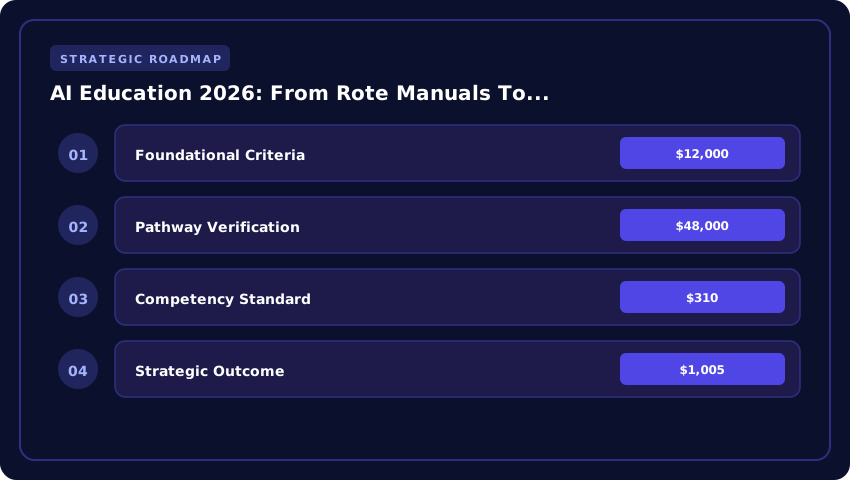
What accelerated the shift was the parallel revision of accreditation frameworks. ABET, the nonprofit that accredits over 4,500 STEM programs across the United States, released its 2025-2026 accreditation criteria with an explicit emphasis on student outcomes related to AI literacy, responsible deployment, and human-in-the-loop oversight. AACSB, the global standard for business and analytics education, followed with updated guidelines urging programs to embed prompt engineering, model evaluation, and neural network ethics into the core curriculum rather than treating them as optional electives. The financial implications are meaningful: ABET-accredited online master’s programs now range from approximately $12,000 to $48,000 in total tuition, and students are explicitly comparing whether a program’s learning outcomes match these new benchmarks before enrolling.
At the same time, the Department of Education’s updated guidance for Title IV federal aid disbursement reinforced that institutions must demonstrate currency in their AI-related coursework. FAFSA filers enrolling in programs tagged under the new Classification of Instructional Programs code for Applied Artificial Intelligence are now advised to verify that prompt engineering and model auditing appear as graded competencies, not buried syllabus footnotes. Tools like the Common Data Set and College Board’s standardized program descriptors make that verification surprisingly straightforward for prospective students.
The most concrete evidence of the shift can be seen in what replaced the old memorization drills. Where students once spent weeks memorizing SQL JOIN types or hand-rolling gradient descent, they now spend equivalent hours learning to:
- Engineer prompts for multi-step reasoning chains across foundation models such as Claude, GPT-5, and Gemini 2.5, including chain-of-thought scaffolding and tool-use orchestration.
- Evaluate model behavior using statistical rigor, including confidence interval estimation, calibration curves, and adversarial robustness testing aligned with NIST AI Risk Management Framework expectations.
- Diagnose and mitigate bias in training datasets, drawing on the NIST AI RMF and sector-specific guidance issued by the Equal Employment Opportunity Commission for hiring algorithms.
- Audit generative outputs for hallucination and safety, using both automated evaluators and structured human review pipelines that meet SOC 2 and ISO 42001 documentation norms.
- Design retrieval-augmented systems that combine vector databases, classical information retrieval, and guardrail layers, rather than treating the model as an opaque oracle.
This is not a softer curriculum. It is a denser, more interdisciplinary one. Students at Georgia Tech’s Online Master of Science in Computer Science, for example, now complete a required applied machine learning studio where every assignment is reviewed by an AI tutor for methodological soundness, then by a human instructor for ethical and contextual judgment. The course costs roughly $310 per credit hour for Georgia residents and around $1,005 for non-residents, with most learners finishing the 30-credit degree for under $32,000 total, a price point that has become a benchmark for affordability in the new AI-aligned landscape.
The result is a generation of graduates who treat models less like mysterious black boxes and more like colleagues that require supervision. They arrive at employers fluent in the language of evaluation harnesses, red-teaming protocols, and regulatory disclosures under the EU AI Act and forthcoming US federal guidance. They understand that the most valuable skill in 2026 is not knowing the answer, but knowing precisely how to question, constrain, and verify the system producing it.
The Hidden Economics: What Meaning-Centered Learning Costs Students
Behind every conversation about pedagogical philosophy lies a far less glamorous reality: the price tag. Shifting from rote memorization to meaning-centered learning in artificial intelligence does not happen in a vacuum. It happens in a marketplace where a single semester at a public university can cost as much as a reliable used car, and where private institutions routinely price out middle-income families entirely. For prospective AI students in the United States, understanding the financial architecture of their education is just as critical as understanding the curriculum itself.
According to the most recent College Board reports, the average annual tuition for in-state students at public four-year universities now sits at roughly $11,000, while out-of-state students face nearly $29,000 at the same institutions. Private nonprofit universities, by contrast, command an average of $45,000 per year, with many elite institutions pushing past $65,000 once room, board, and required fees are factored in. When students add textbooks, software licenses, cloud computing credits for model training, and the opportunity cost of unpaid internships, the true cost of a four-year AI-focused degree can easily climb past $250,000 at a private institution.
These figures matter enormously when evaluating meaning-centered programs specifically. Such programs typically require smaller cohort sizes, more one-on-one mentorship, project-based capstone collaborations with industry partners, and access to specialized lab environments. All of these features inflate the per-student delivery cost, and universities pass those costs along through higher tuition rates or supplementary program fees. A student entering a 2026 AI track should therefore expect to pay a premium of 10 to 20 percent above the baseline computer science tuition at their chosen school.
- Public university AI tracks: $11,000 in-state tuition plus an estimated $2,000 to $4,000 in program-specific fees, totaling roughly $13,000 to $15,000 annually.
- Private university AI tracks: $45,000 base tuition plus $5,000 to $8,000 in specialized lab and project fees, often exceeding $50,000 per year.
- Community college AI certificates: $3,500 to $5,000 total for a two-year associate pathway, frequently the most economical on-ramp.
This is precisely where stackable micro-credentials have reshaped the economics of AI learning. Platforms like Coursera, edX, and DeepLearning.AI now offer modular certificates in machine learning engineering, generative AI, MLOps, and AI ethics that can be completed for a few hundred to a few thousand dollars each. A learner who strategically stacks three to five credentials over twelve months can invest as little as $2,000 to $6,000 and still demonstrate verifiable competency in modern AI tooling. For working professionals and career-changers, the return on investment is often measured in months rather than years, particularly when stacked credentials are accepted by employers in lieu of (or alongside) traditional degrees.
Equally important are the FAFSA updates rolling out for the 2026 award year. Following years of advocacy, the U.S. Department of Education has expanded Pell Grant eligibility and clarified that short-term AI bootcamps enrolling between 150 and 600 clock hours can now qualify for Title IV federal aid, provided the program is offered by an accredited institution and leads to a recognized industry credential. Students should file the FAFSA as early as October 1 of the prior year, treat the AI program as their primary enrollment, and retain documentation of accreditation status, total program length, and clock-hour breakdowns. Schools participating in the Federal Direct Loan program can now also offer income-driven repayment plans specifically tailored to bootcamp graduates, easing the debt-to-income burden that historically discouraged nontraditional learners.
The practical takeaway is straightforward. Students should model three financial scenarios before committing to any AI pathway: a traditional four-year degree, a community college plus transfer route, and an accelerated stackable micro-credential sequence. Each path carries distinct tuition costs, distinct FAFSA implications, and distinct ROI timelines. Meaning-centered learning is undeniably valuable, but it is only a wise investment when its price aligns with the learner’s career trajectory and financial capacity.
Three Dangerous Myths About Emerging Tech Education Debunked
The conversation around artificial intelligence education in 2026 is saturated with fear-based predictions that discourage otherwise capable learners from investing in their futures. Before committing tuition dollars, time, and emotional energy to any pathway, you must separate sensationalist headlines from verifiable labor economics. Below are the three most dangerous myths currently circulating in student forums, TikTok advice videos, and even some well-meaning guidance counselor offices, each dismantled with hard data from the U.S. Bureau of Labor Statistics (BLS), College Board tuition benchmarks, and employer-reported hiring outcomes.
- Myth #1: “AI will replace coders, so don’t bother learning to code.” This is perhaps the most corrosive myth of 2026, largely because it misreads what generative AI actually does in production environments. The BLS Occupational Outlook Handbook projects 23% growth for computer and information research scientists between 2022 and 2032, far outpacing the 4% average for all occupations. More importantly, the same projection notes median annual wages exceeding $145,000, with specialized prompt engineers and AI integration architects commanding $165,000 to $210,000 in metropolitan markets like San Francisco, Seattle, and Boston. Coding in 2026 is less about memorizing syntax (AI autocomplete handles that) and more about orchestrating systems, debugging edge cases, and translating human needs into machine-executable logic. Graduates of programs aligned with ABET accreditation standards consistently report that their value increased, not decreased, once they layered it with AI fluency. Companies like Anthropic, OpenAI, and JPMorgan Chase are still hiring thousands of software engineers because AI models require humans to build, evaluate, secure, and govern them.
- Myth #2: “A four-year degree is mandatory for any tech career.” This myth persists because of prestige anxiety rather than hiring reality. While AACSB-accredited business schools and ABET-accredited engineering programs remain excellent options for students seeking comprehensive theoretical foundations, the BLS data tells a more nuanced story. Many emerging tech roles, including machine learning operations technicians, AI quality assurance analysts, and junior data engineers, now list stackable credentials as sufficient. Industry-recognized certificates from AWS, Google, IBM, and Microsoft, combined with portfolio evidence, are landing candidates $90,000-plus starting salaries, particularly when earned through accelerated bootcamps or community college certificate programs that cost between $3,000 and $15,000 total. A four-year computer science degree at a public university averages $11,260 annually for in-state tuition, according to College Board, totaling roughly $45,000 before housing. For motivated learners who complete alternative pathways in 9 to 18 months, the return on investment can be considerably stronger, especially when paired with FAFSA-eligible Pell Grants that many bootcamps now accept.
- Myth #3: “Self-taught models are obsolete because everyone uses AI tutors.” Nothing could be more misleading. The self-taught learner of 2026 is not the isolated figure hunched over outdated textbooks. Today’s self-directed students leverage AI-augmented curricula, open-source contributions on GitHub, competitive programming on Kaggle, and peer-reviewed portfolios to demonstrate mastery. Hiring managers at firms like Stripe, Cloudflare, and Lockheed Martin routinely report that candidate quality, demonstrated through public repositories and verifiable project outcomes, matters more than the credential itself. The key distinction is that unstructured self-study without feedback loops is indeed less effective, but disciplined self-taught learners who complete structured curricula, contribute to open-source projects, and earn industry micro-credentials are competing, and winning, against graduates of elite institutions.
These myths share a common root: they underestimate your adaptability and overestimate the rigidity of the labor market. Emerging tech education in 2026 rewards learners who combine verifiable skills, recognized credentials, and demonstrable project portfolios, regardless of the pathway taken. When evaluating your options, prioritize programs offering transparent tuition, accredited instruction, robust career services, and alignment with BLS occupational classifications. The most dangerous myth of all is believing that any single educational pathway holds a monopoly on success in an industry defined by continuous reinvention.
The Adaptive Stack: Tools and Labs Defining the 2026 Learning Experience
By 2026, the “textbook” has transitioned from a static PDF or physical manual into a living, breathing Adaptive Stack. In the legacy model, students spent hundreds of hours in rote memorization, treating API documentation like a script to be recited. Today, the pedagogical shift focuses on conceptual intuition—the ability to understand why a model is hallucinating or how a loss function is behaving—rather than simply remembering the syntax to call a library. This shift is powered by a sophisticated ecosystem of integrated tools that bridge the gap between theoretical mathematics and industrial application.
At the core of this stack are Jupyter AI notebooks and GitHub Copilot workspaces. These are no longer mere code editors; they are collaborative cognitive partners. Instead of struggling with “boilerplate” code that consumes 40% of a student’s mental bandwidth, learners use AI-augmented environments to scaffold complex architectures. This allows a student at an ABET-accredited university to move rapidly from a high-level hypothesis to a working prototype, spending their energy on architectural analysis and edge-case validation rather than debugging a missing comma. The goal is “Real World Mastery,” where the tool handles the syntax and the human handles the strategy.
To move beyond surface-level recall, the 2026 curriculum integrates high-compute environments that were previously reserved for PhD researchers at Ivy League institutions. The modern toolkit now includes:
- Cloud-Based Quantum Simulators: Utilizing platforms like AWS Braket, students can experiment with quantum circuits and hybrid quantum-classical algorithms without needing a multi-million dollar lab. This transforms quantum computing from an abstract linear algebra problem into a tangible engineering challenge.
- VR-Integrated Data Visualization Labs: Moving beyond 2D scatter plots, students now enter immersive virtual environments to “walk through” high-dimensional latent spaces. By visualizing how a transformer model clusters embeddings in 3D, learners develop a spatial intuition for how AI perceives semantic meaning.
- Synthetic Data Sandboxes: Integrated environments that allow students to generate diverse, bias-controlled datasets to stress-test their models, ensuring they understand the critical importance of data provenance and algorithmic fairness.
This infrastructure fundamentally changes the ROI of a computer science degree. When a student can simulate a global-scale deployment via a cloud-native workspace, the distance between the classroom and a $120,000+ entry-level AI engineering role shrinks. The Adaptive Stack ensures that by the time a student graduates, they have not just “studied” AI—they have engineered it within the same environments used by the world’s leading tech firms.
Your 90-Day Pivot Plan: Transitioning From Passive Reader to Active Builder
If you have spent the last several years memorizing documentation, watching tutorial playlists, and treating large language models like static encyclopedias, the transition into active building can feel intimidating. The most consequential shift in AI education for 2026 is not learning a new framework. It is adopting the identity of a practitioner who ships, breaks, debugs, and ships again. Below is a phased 90-day roadmap designed for both undergraduate students at AACSB and ABET-accredited institutions and mid-career professionals pivoting from adjacent fields like data engineering, business analysis, or traditional software development.
Phase 1: Days 1 to 30, Foundation and Signal Calibration. The first month is about ruthless prioritization and removing ambiguity from your learning environment. Start by selecting a single open-weight model family such as Llama 3, Mistral, or Qwen and committing to it for the entire quarter. Resist the temptation to benchmark seven different architectures simultaneously. Next, audit your local compute environment. If you are a student leveraging a university allocation through programs like the NSF ACCESS program or the DOE INCITE program, confirm your Slurm account credentials and request a GPU partition. Mid-career professionals without institutional access should evaluate cloud credits through AWS Educate, Google Cloud Skills Boost, or Azure for Students, which frequently offer $200 to $500 in starter credits for verified learners.
During these first thirty days, complete one structured fine-tuning project end to end. A highly effective starter project is instruction tuning a 7B parameter model on a narrow domain dataset such as SEC 10-K filings, USDA nutritional databases, or municipal court records. Publish your training script, evaluation harness, and a concise model card to a public GitHub repository. This artifact serves as your baseline credential, something far more credible to a hiring manager than a certificate of completion.
- Days 1 to 7: Select model family, secure compute, and define a measurable evaluation metric such as BLEU, ROUGE-L, or LLM-as-judge scoring.
- Days 8 to 14: Curate and deduplicate a domain dataset of at least 5,000 high-quality examples using tools such as Argilla or Hugging Face datasets.
- Days 15 to 21: Execute QLoRA fine-tuning using the TRL or Axolotl libraries, logging every hyperparameter to Weights and Biases or MLflow.
- Days 22 to 30: Quantize the merged model to GGUF or AWQ format, deploy it locally via Ollama or vLLM, and write a public postmortem documenting failure modes.
Phase 2: Days 31 to 60, MLOps Integration and Production Hygiene. The second month elevates you from notebook tinkerer to production-aware engineer. Most graduates from traditional computer science programs have never deployed a model behind a monitored endpoint, which is exactly where ABET-accredited employers differentiate candidates. Containerize your inference server with Docker, expose it through a FastAPI or Triton Inference Server endpoint, and wire it to a CI and CD pipeline using GitHub Actions. Implement structured logging, request tracing through OpenTelemetry, and at least one automated regression test that catches prompt injection or hallucination regressions.
Identify at least one US-based mentorship program to accelerate this phase. The PyTorch Fellowship, the Hugging Face Expert Acceleration Program, and the KaggleX mentorship cohort all pair emerging builders with senior maintainers. For business-school students targeting AI product roles, the AACSB-affiliated AI Innovation Network at schools such as Carnegie Mellon Tepper, MIT Sloan, and Wharton offers structured mentorship tied directly to industry capstones. Apply early, treat the application like a job submission, and tailor your prior project artifacts to the mentor’s stated research areas.
Phase 3: Days 61 to 90, Open Source Gravity and Capstone Defense. The final thirty days are about external validation. Pick a meaningful issue on a high-traffic repository such as Transformers, vLLM, LangChain, or LlamaIndex. Read the contributing guidelines thoroughly, replicate the bug locally, write a failing test, and submit a pull request. Even a merged documentation fix or typo correction signals that you understand collaborative software etiquette, a non-negotiable competency for distributed AI teams in 2026.
Concurrently, design a capstone project that an AACSB or ABET-aligned employer would actually fund. Strong options include a retrieval-augmented generation system for a regional hospital network, a fine-tuned code review assistant for a Department of Defense contractor, or a predictive maintenance model for a midwest manufacturing consortium. Document the project using the structure required by your target employers: problem statement, data lineage, model card, fairness audit, cost analysis, and a one-page executive summary written for a non-MAI executive. Mid-career professionals should price their labor at a defensible consulting rate between $150 and $250 per hour to demonstrate commercial fluency.
By day 90, you will possess a public GitHub portfolio, at least one merged open-source contribution, a deployed and monitored inference endpoint, and a capstone narrative grounded in verifiable US industry problems. That portfolio is what separates a passive reader from an active builder, and it is precisely what the 2026 AI labor market rewards.
| AI Education Pathway | Avg. Tuition Cost (USD) | Admission Cut-Off / Prerequisites | Program Timeline | Career ROI (Avg. Starting Salary) |
|---|---|---|---|---|
| University Degree (B.S. in AI/ML) | $40,000 – $140,000 | SAT 1400+ / GPA 3.7+ / Calculus & CS coursework | 4 years (full-time) | $95,000 – $130,000 |
| Immersive AI Bootcamp | $8,000 – $20,000 | Basic Python proficiency / aptitude test | 12 – 24 weeks | $70,000 – $110,000 |
| Online Specialization (Coursera/edX) | $300 – $3,000 | Open enrollment / intermediate math recommended | 3 – 9 months (self-paced) | $60,000 – $95,000 |
| Self-Directed Project-Based Learning | $0 – $500 | No formal cut-off / requires strong self-discipline | 6 – 18 months (variable) | $55,000 – $90,000 |
| Industry Certification (TensorFlow/PyTorch) | $100 – $500 | Hands-on ML experience / coding assessment | 1 – 3 months | +15–25% salary uplift |
Strategic Final Takeaway
Success in evaluating AI Education 2026: From Rote Manuals To Real World Mastery relies on early preparation, adherence to verified accredited requirements, and cross-referencing official portals. Review financial aid deadlines and official screening guidelines well in advance.