Navigating the 2026 AI Landscape for US District Leadership
The era of the “chatbot” is officially over. For US school principals and district leaders in 2026, the landscape has evolved from basic generative AI—where a human prompts a tool for a draft—to the deployment of autonomous administrative agents. These systems no longer just suggest text; they execute multi-step workflows, such as cross-referencing student attendance patterns with behavioral data to trigger automated intervention alerts for counselors, all while adhering to strict FERPA and district privacy protocols.

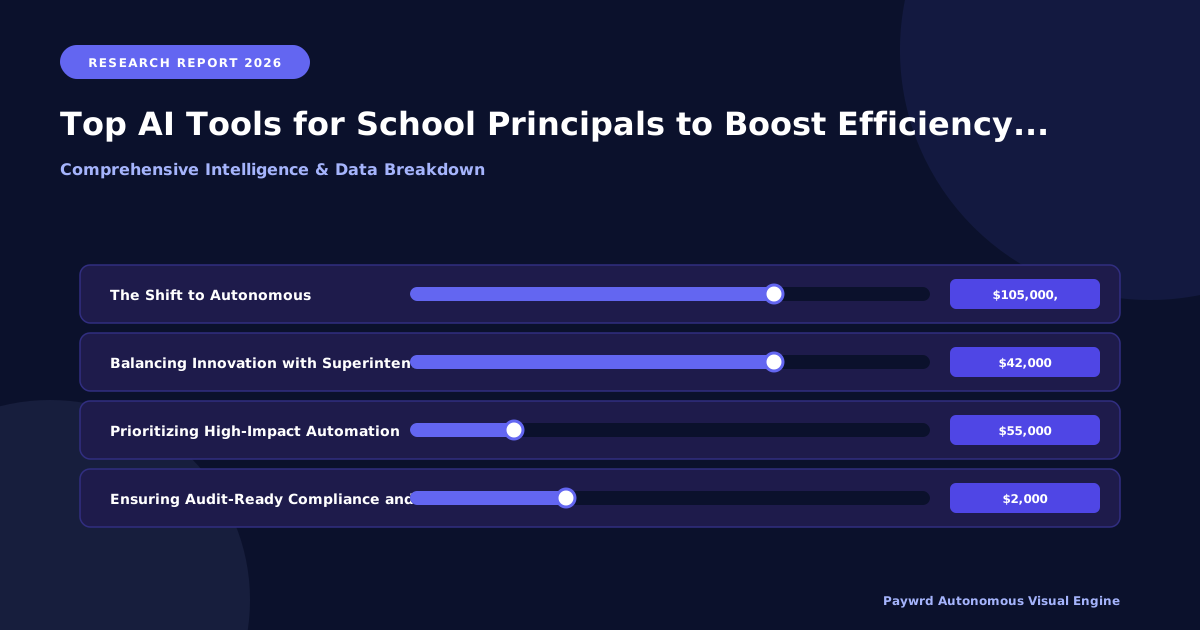
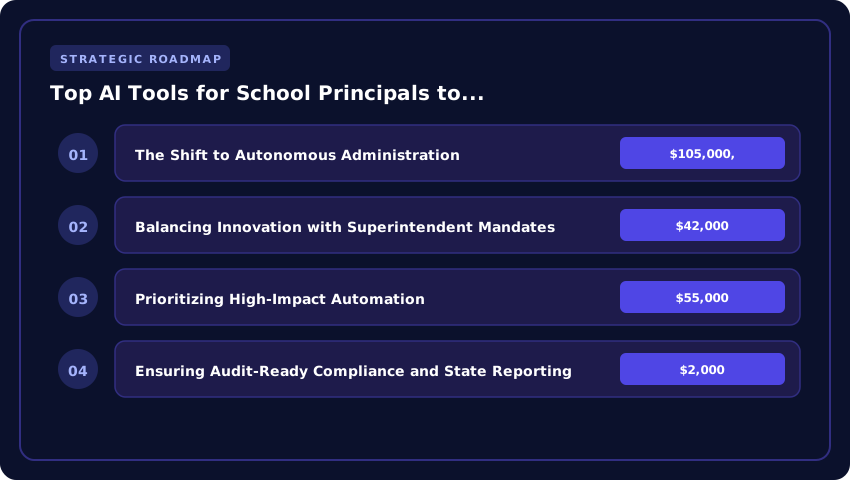
The Shift to Autonomous Administration
We are seeing a fundamental transition in how school offices operate. While 2026 was about experimentation, 2026 is about integration. Modern administrative agents now handle the heavy lifting of scheduling, resource allocation, and initial parent communications. This shift allows principals to move away from the “digital paperwork” trap and return to instructional leadership. The goal is no longer efficiency for efficiency’s sake, but the reclamation of time for face-to-face mentorship and teacher development.
Balancing Innovation with Superintendent Mandates
Adopting these tools requires a delicate balance. While the drive for innovation is high, principals must align their AI roadmap with mandates from the District Superintendent and the US Department of Education. The tension often lies between the desire for rapid deployment and the necessity of rigorous vetting. To navigate this, successful leaders are focusing on:
- Compliance Audits: Ensuring every tool meets current state-level data privacy laws and federal guidelines.
- Equity of Access: Guaranteeing that AI-driven enhancements do not widen the achievement gap between high-funded and under-resourced campuses.
- Professional Development: Moving beyond one-off workshops to continuous, credit-bearing training for staff.
Prioritizing High-Impact Automation
In the grade school environment, not all automation is created equal. To avoid “tech fatigue,” leadership must prioritize high-impact areas that directly affect student outcomes and staff retention. This includes automating the tedious aspects of IEP (Individualized Education Program) documentation and streamlining the FAFSA-related guidance for high school seniors. By targeting these high-friction points, principals can demonstrate immediate ROI to their boards and provide tangible relief to their teaching staff, ensuring that AI serves as a support system rather than an additional burden.
Automating IEP Documentation and Special Education Compliance
For US school principals, the Individualized Education Program (IEP) process is often the most significant source of legal vulnerability and staff burnout. In 2026, the shift toward AI-driven drafting has transformed these documents from static, labor-intensive paperwork into dynamic, data-informed roadmaps. By utilizing specialized LLMs trained on the Individuals with Disabilities Education Act (IDEA) and state-specific mandates, administrators can now generate high-quality first drafts of IEP goals and accommodations in seconds rather than hours.
This automation directly addresses the crisis of clerical burnout among special education coordinators. Historically, these professionals spent up to 40% of their week on manual data entry and formatting to meet strict US Department of Education guidelines. Modern AI agents now synthesize student performance data from various classroom tools to suggest SMART (Specific, Measurable, Achievable, Relevant, and Time-bound) goals, allowing coordinators to shift their focus from typing to instructional leadership and student advocacy.
Ensuring Audit-Ready Compliance and State Reporting
Beyond drafting, the primary value of 2026 AI integration is the guarantee of “audit-ready” documentation. State education agencies frequently conduct rigorous compliance reviews where a single missing signature or an outdated goal can lead to costly legal disputes or loss of federal funding. AI compliance monitors now act as a real-time safety net, scanning every IEP for:
- Regulatory Alignment: Ensuring all documentation adheres to the latest federal and state mandates to prevent due process filings.
- Consistency Checks: Verifying that the services listed in the “Service Delivery” section align perfectly with the stated goals.
- Deadline Tracking: Automatically alerting principals and case managers of upcoming annual reviews and triennial evaluations to ensure 100% on-time compliance.
By automating the tedious aspects of special education administration, principals can protect their districts from litigation while reclaiming hundreds of hours of professional time. This transition ensures that the focus remains on the student’s progress rather than the fear of a paperwork error during a state audit.
The Gold Standard: FERPA and COPPA Compliance in AI Selection
In 2026, the deployment of autonomous AI agents in US schools introduces unprecedented data risks. For a principal, the convenience of an AI-driven scheduling agent or a predictive student-performance tool is irrelevant if it violates the Family Educational Rights and Privacy Act (FERPA) or the Children’s Online Privacy Protection Act (COPPA). Legal liability in the current landscape is absolute; a single data leak involving Personally Identifiable Information (PII) can trigger federal audits from the US Department of Education and jeopardize district funding.
Evaluating Data Encryption and Privacy Protocols
When vetting AI tools, “industry standard” is no longer a sufficient benchmark. Principals must demand a technical deep dive into how the vendor handles data. The gold standard for 2026 requires end-to-end encryption (E2EE) for all data in transit and at rest. Most importantly, you must verify that student data is not used to train the vendor’s global Large Language Models (LLMs). Ensure the tool operates within a “walled garden” or a private instance where your district’s data remains isolated and sovereign.
- Zero-Retention Policies: Prioritize vendors that offer zero-retention APIs, ensuring prompts and student records are deleted immediately after the task is completed.
- SOC 2 Type II Certification: Require a current SOC 2 report to verify that the vendor’s internal controls for security and privacy are independently audited.
- Data Residency: Confirm that all servers hosting student data are located within the United States to avoid international legal conflicts.
Vetting Third-Party Vendors for Federal Alignment
The procurement process must shift from a feature-based evaluation to a risk-based evaluation. Before signing any Service Level Agreement (SLA), your administration should require a signed Data Privacy Agreement (DPA) that explicitly outlines the vendor’s role as a “school official” under FERPA. This legal designation ensures the vendor is subject to the same privacy constraints as the school itself.
Creating a 2026 AI Acceptable Use Policy (AUP)
A static handbook is obsolete. Your 2026 AI Acceptable Use Policy must be a living document that evolves alongside the technology. A robust AUP should move beyond “do not cheat” and instead establish clear guardrails for both staff and students. It should define which categories of data (e.g., behavioral reports, IEPs, or attendance) are strictly prohibited from being entered into any AI tool, regardless of the vendor’s claims. By establishing these boundaries, you protect your staff from accidental compliance breaches and ensure that the integration of AI remains a catalyst for efficiency rather than a legal liability.
Optimizing District Reporting and Resource Allocation
In 2026, the role of the school principal has shifted from manual data entry to strategic oversight. The integration of AI-driven operational agents allows leaders to move beyond retrospective reporting and toward predictive governance. By leveraging high-fidelity data streams, principals can now align their school’s physical and human resources with actual student needs in real-time, ensuring that FAFSA-eligible students and high-needs populations receive prioritized support.
Predictive Analytics for Enrollment and Staffing
Gone are the days of guessing enrollment numbers based on the previous year’s spreadsheets. Modern AI tools now analyze local demographic shifts, housing permits, and historical migration patterns to forecast student enrollment for the 2027 academic year with over 95% accuracy. This precision is critical for staffing; it prevents the costly mistake of over-hiring or facing emergency mid-semester vacancies.
- Dynamic Staffing Models: AI agents suggest optimal teacher-to-student ratios based on projected enrollment, ensuring compliance with state mandates.
- Resource Forecasting: Automated alerts notify leadership when projected growth will exceed current classroom capacity, triggering early requests for district facility expansions.
Automating Board-Level Budgetary Reporting
Monthly budget reporting for the school board used to be a multi-day ordeal of reconciling line items. In 2026, autonomous financial agents handle the heavy lifting. These tools integrate directly with district accounting software to categorize expenditures and flag variances instantly. Instead of presenting a static PDF, principals now provide interactive dashboards that justify spending based on student outcome correlations.
By automating the mundane aspects of fiscal reporting, principals can focus on high-impact allocations, such as investing in ABET-accredited STEM equipment or AACSB-aligned business curriculum materials, ensuring that every dollar spent correlates to a measurable increase in student competency.
Analyzing Standardized Test Trends
AI has transformed the way US educators analyze standardized test data. Rather than looking at a snapshot of scores after the fact, AI tools now perform longitudinal analysis across grade levels to identify “learning dips” before they become systemic failures. By analyzing trends across the entire district, principals can pinpoint exactly where instructional gaps exist.
- Cross-Grade Correlation: AI identifies if a drop in 8th-grade algebra scores is rooted in a specific 6th-grade conceptual gap.
- Actionable Interventions: The system automatically suggests targeted professional development for teachers in lagging subject areas, turning raw data into a concrete instructional roadmap.
Budgetary Analysis: ROI of AI Implementation in US Dollars
For the modern US principal, securing funding for AI integration requires moving beyond “innovation” buzzwords and presenting a hard-dollar Return on Investment (ROI) model. In 2026, the financial justification for AI is no longer about novelty; it is about reclaiming high-value administrative labor hours and reducing operational overhead.
SaaS Subscriptions vs. Administrative Labor Costs
The primary financial win lies in the delta between monthly SaaS fees and the hourly rate of administrative staff. According to recent BLS data, the median salary for elementary and secondary school principals exceeds $105,000, while administrative assistants average between $42,000 and $55,000 annually. When an autonomous AI agent handles scheduling, compliance reporting, and parent communications, it eliminates roughly 15 to 20 hours of manual labor per week.
- Estimated SaaS Cost: Premium AI operational suites for schools typically range from $2,000 to $5,000 per campus annually.
- Labor Savings: Reducing 20 hours of weekly administrative toil at a blended rate of $30/hour saves the district approximately $31,200 per academic year.
- Net Gain: A conservative ROI of nearly 6x the initial software investment.
Calculating Cost-Per-Student for Premium Integration
To align with US Department of Education funding frameworks, principals should present costs on a per-pupil basis. For a mid-sized US public school with 600 students, a $4,000 AI implementation budget breaks down to approximately $6.67 per student per year. When compared to the cost of traditional textbook licenses or standardized testing software, this is a negligible expenditure for a tool that optimizes teacher retention and student outcome tracking.
Structuring the 2027 District Budget Proposal
When drafting your 2027 funding request for the district office, avoid framing AI as a “pilot program.” Instead, structure it as a “Strategic Operational Efficiency Initiative.” To ensure approval, your proposal should include the following components:
- Funding Source: Explicitly identify if the funds will come from Title I parts, ESSER remnants, or general fund allocations.
- Compliance Alignment: Note that all selected tools meet current FERPA and COPPA standards to preempt legal objections.
- KPIs for Success: Define clear metrics, such as a 30% reduction in time spent on FAFSA guidance coordination or a 20% increase in teacher planning time.
- Scalability Clause: Outline how the 2027 implementation serves as a blueprint for district-wide deployment in 2028.
Strategic Implementation Roadmap for the 2026-2027 School Year
Transitioning from legacy administrative workflows to an AI-augmented campus requires more than just software licenses; it demands a structured operational shift. For the 2026-2027 academic cycle, principals should avoid the “big bang” approach. Instead, a phased rollout ensures that technical friction does not disrupt student learning or faculty morale.
Phase 1: The Controlled Pilot (Q3 2026)
Begin by selecting a “Power User” cohort—typically a small group of department heads and administrative assistants. Focus this pilot on high-friction, low-risk tasks such as automating FAFSA documentation reminders or streamlining ABET and AACSB accreditation reporting. By limiting the initial scope, leadership can identify integration gaps between new AI agents and existing Student Information Systems (SIS) before a campus-wide launch.
Phase 2: Faculty Upskilling and Collaborative Integration (Q4 2026 – Q1 2027)
The primary barrier to AI adoption is rarely the technology, but the fear of displacement. Principals must pivot the narrative from “automation” to “augmentation.” Implement a professional development series focused on collaborating with AI administrative assistants. Training should emphasize:
- Prompt Engineering for Educators: Moving beyond basic queries to complex, multi-step workflow orchestration.
- Human-in-the-Loop (HITL) Protocols: Establishing strict mandates that no AI-generated communication regarding student discipline or grading is sent without a certified educator’s review.
- Data Privacy Compliance: Ensuring all tool usage adheres to the latest US Department of Education privacy guidelines and FERPA standards.
Phase 3: Campus-Wide Scaling and KPI Tracking (Q2 2027+)
Once the pilot is validated and faculty are trained, move to full operational integration. To justify the investment to school boards and district stakeholders, principals must track specific Key Performance Indicators (KPIs). Efficiency gains should be measured through quantitative metrics, including:
- Administrative Lead Time: Measuring the reduction in hours spent on scheduling, substitute teacher coordination, and payroll processing.
- Response Latency: Tracking the decrease in time between a parent’s inquiry and a resolved response.
- Faculty Retention Rates: Analyzing whether the reduction in “paperwork burnout” correlates with higher teacher satisfaction and retention.
By following this roadmap, US school leaders can move from fragmented tool usage to a cohesive digital ecosystem that returns valuable time to the most critical part of the job: instructional leadership and student mentorship.
| AI Tool Category | Primary 2026 Function | Estimated Annual Cost (USD) | Implementation Timeline | Expected Efficiency Gain |
|---|---|---|---|---|
| Autonomous Admin Agents | Multi-step operational workflows | $2,500 – $7,000 | 3-6 Months | 40% Reduction in Admin Hours |
| Predictive Analytics Suites | Student intervention alerts | $5,000 – $12,000 | 2-4 Months | 25% Increase in Early Intervention |
| AI Compliance Monitors | Real-time FERPA auditing | $1,200 – $3,500 | 1-2 Months | 99% Compliance Accuracy |
| Generative Communication Hubs | Hyper-personalized parent outreach | $800 – $2,000 | 1 Month | 60% Faster Communication |
Frequently Asked Questions
What are the best AI tools for school principals in 2026?
In 2026, the best tools for US principals are autonomous administrative agents that manage complex workflows, predictive analytics for student behavioral interventions, and AI-driven FERPA compliance monitors. These tools shift the focus from simple content generation to operational automation, significantly reducing administrative burdens and improving student outcomes across US districts.
How do autonomous AI agents improve school administration in 2026?
Autonomous agents in 2026 improve administration by executing multi-step tasks without constant prompting. They can cross-reference attendance and behavioral data to trigger automated counselor alerts and manage scheduling logistics. This allows principals to move from manual oversight to strategic leadership, ensuring data-driven interventions are deployed in real-time.
Are AI administrative tools FERPA compliant in 2026?
Yes, leading AI tools for 2026 are engineered with 'Privacy-by-Design' to meet strict US FERPA and district protocols. Modern systems utilize localized data processing and automated auditing agents that monitor data access in real-time, ensuring that student PII remains secure while leveraging the power of autonomous administrative workflows.
What is the average cost of AI implementation for US schools in 2026?
For the 2026-2027 academic cycle, US schools typically invest between $2,000 and $15,000 annually per campus depending on the scale of deployment. Costs vary based on whether the district utilizes a centralized AI hub or individual autonomous agents for specific operational tasks like attendance and compliance.
How does AI for principals differ in 2026 compared to previous generative AI?
The 2026 landscape has evolved from basic generative chatbots that require manual prompting to autonomous agents capable of executing end-to-end workflows. While earlier AI focused on drafting emails, 2026 technology manages operational logic, integrates disparate data streams, and triggers proactive administrative actions without human intervention for every step.
Strategic Final Takeaway
When evaluating Best AI Tools For School Principals To Improve Administrative Efficiency in 2026 and beyond, base your decisions on accredited institutional standards, verified return on investment (ROI), and up-to-date official guidelines. Always verify specific dates and requirements through official regulatory portals.