The 2026 Nigerian Energy Landscape: TCN Infrastructure and Job Demand
Nigeria’s power sector has entered a transformative era in 2026. The Transmission Company of Nigeria (TCN) has aggressively pivoted toward a “Smart Grid” architecture, integrating advanced Supervisory Control and Data Acquisition (SCADA) systems across major transmission corridors. This infrastructure overhaul has fundamentally changed the job market; we are seeing a massive surge in demand for Power Engineers who can manage the volatility of intermittent renewable inputs alongside traditional baseload power.

The urgency is driven by the federal government’s commitment to the 2027 Net-Zero milestones. Consequently, the role of the traditional electrical engineer is evolving. Employers are no longer seeking specialists in just one domain but are prioritizing “Hybrid Energy Architects”—professionals capable of synchronizing solar PV farms and wind arrays with the national grid without compromising stability.
High-Growth Hubs for Renewable Deployment
While Lagos and Abuja remain administrative centers, the real operational growth in 2026 is concentrated in strategic regional hubs. These areas have become the epicenter for large-scale renewable deployment in West Africa:
- The Northern Solar Belt (Kano, Katsina, and Sokoto): Massive scaling of utility-scale solar parks has created thousands of roles in PV system design and high-voltage DC (HVDC) transmission.
- The South-South Wind & Hydro Corridor: Increased investment in small-scale hydro and coastal wind projects in states like Rivers and Akwa Ibom.
- The ECOWAS Interconnection Points: Engineers specializing in cross-border energy trade are in high demand as Nigeria strengthens its role as the energy powerhouse for the West African Power Pool (WAPP).
The Shift: From Fossil Fuels to Hybrid Systems
The transition from traditional fossil fuel engineering to hybrid systems is now a matter of professional survival. In 2026, the industry is witnessing a “skill migration” where petroleum engineers are retraining in geothermal energy and carbon capture technologies. The market now favors those who can implement Microgrid controllers and Battery Energy Storage Systems (BESS) to solve the perennial issue of grid instability.
For graduates and mid-career professionals, the financial incentive is clear. Hybrid energy roles currently command a 25% to 35% premium over traditional power engineering salaries in the Nigerian private sector, reflecting the scarcity of certified specialists capable of navigating the NUC’s updated CCMAS (Core Curriculum and Minimum Academic Standards) for energy engineering.
Essential Certifications for Solar, Wind, and CNG Specialization
In the 2026 labor market, a degree in Electrical or Mechanical Engineering is merely the baseline. To secure high-paying roles within Nigeria’s decentralized energy framework, you must possess industry-specific certifications that prove you can handle the actual hardware and regulatory standards of the Nigerian Electricity Regulatory Commission (NERC). Employers are now prioritizing “plug-and-play” talent over generalists.
Solar PV Installation and Grid Integration
With the surge in commercial and industrial (C&I) solar adoption, the focus has shifted from simple panel installation to complex grid integration. To be competitive, candidates should target certifications that align with the NUC’s updated CCMAS guidelines for renewable energy.
- Certified Solar PV Professional (CSPP): The gold standard for 2026, focusing on hybrid inverter synchronization and lithium-ion storage management.
- NERC Certified Electrical Inspector: Essential for those aiming to sign off on installations for government contracts or large-scale estates.
- NABCEP (North American Board of Certified Energy Practitioners): While international, this remains the most respected credential for senior consultants working with multinational firms in Lagos and Abuja.
Wind Energy Technical Pathways
Wind energy has expanded rapidly in 2026, particularly across the coastal belts of Lagos and Delta, and the high-wind corridors of the North. Technical training now emphasizes turbine maintenance and aerodynamic efficiency.
- GWO (Global Wind Organisation) Basic Safety Training: A non-negotiable requirement for any technician working on wind turbines to ensure safety at height and sea.
- Wind Turbine Technician Certification (WTTC): Specialized training focusing on the specific turbine models currently being deployed in Northern Nigeria’s hybrid mini-grids.
CNG (Compressed Natural Gas) and Gas-to-Power
As Nigeria aggressively transitions to CNG for transport and power generation to reduce diesel dependency, the “Gas-to-Power” sector has become a massive employment hub. Certification here is strictly tied to safety and pressure management.
- CNG Systems Installation & Maintenance Certificate: Provided by accredited Nigerian technical colleges or industry partners, focusing on high-pressure cylinder safety and leak detection.
- HSE Level 3 (International/Nigerian Standard): Mandatory for any professional operating in CNG refueling stations or gas-fired power plants.
- Gas Engineering Professional Certification: Specialized training in the conversion of internal combustion engines from petrol/diesel to CNG, a high-demand skill for the 2026 automotive shift.
Leveraging the Nigerian Society of Engineers (NSE) for Professional Pivot
Transitioning into the renewable energy sector in 2026 requires more than just technical skill; it requires institutional legitimacy. For engineers moving from traditional oil and gas or civil works into green energy, the Nigerian Society of Engineers (NSE) serves as the primary gateway for professional validation. Ensuring your registration is current and aligned with the latest energy standards is non-negotiable for securing high-tier consultancy roles or government contracts under the current federal energy mandates.
Navigating Professional Registration for Green Energy
To pivot effectively, practitioners must update their professional profiles within the NSE framework to reflect specialization in renewable energy. The process now emphasizes “Competency-Based Certification,” where engineers can submit evidence of projects involving solar PV arrays, wind turbine maintenance, or biomass energy systems. For those seeking the COREN (Council for the Regulation of Engineering in Nigeria) seal of approval in this niche, the NSE provides the necessary professional development paths to ensure your transition is legally recognized, preventing “practitioner drift” where skills exceed official certification.
Utilizing NSE Networking Hubs for Mentorship
The 2026 landscape is heavily driven by “who knows who” in the smart-grid ecosystem. The NSE’s regional hubs have evolved into critical networking nodes where veteran power engineers mentor newcomers in the green space. By engaging with the NSE’s specialized divisions, you can access:
- Peer-to-Peer Knowledge Transfers: Direct access to engineers who have successfully migrated from thermal power to hybrid energy systems.
- Industry-Specific Job Boards: Exclusive listings for roles within the TCN modernization projects and private IPPs (Independent Power Producers).
- Policy Briefings: Early access to regulatory changes affecting the Nigerian Electricity Regulatory Commission (NERC) guidelines for 2027.
Aligning Degrees with NUC CCMAS Standards
A critical component of professional legitimacy in 2026 is ensuring your academic foundation aligns with the National Universities Commission (NUC) Core Curriculum and Minimum Academic Standards (CCMAS). The CCMAS has integrated energy transition modules into the standard engineering curriculum to bridge the gap between theoretical physics and practical renewable application. If your degree predates these standards, the NSE offers bridging programs and Continuing Professional Development (CPD) credits. These credits are essential for demonstrating that your knowledge of grid-tie inverters, battery energy storage systems (BESS), and carbon sequestration is current and compliant with the 2026 national educational benchmarks.
The CNG Revolution: New Opportunities for Automotive Engineers
The Nigerian transport landscape has undergone a seismic shift in 2026. Following the federal government’s aggressive mandate to replace expensive petrol with Compressed Natural Gas (CNG), the nationwide deployment of CNG-powered buses and commercial fleets has moved from pilot projects to a full-scale industrial reality. For automotive engineers, this is no longer just a trend; it is a complete restructuring of the professional ecosystem. The surge in CNG adoption has created a critical demand for specialists who can bridge the gap between traditional mechanics and high-pressure gas systems engineering.
From ICE to CNG: The Skill Pivot
The transition from Internal Combustion Engine (ICE) expertise to CNG conversion is the most lucrative pivot for engineers this year. While the fundamental principles of thermodynamics remain, the technical requirements for CNG are far more stringent. Engineers are now specializing in high-pressure storage tank integration, fuel injection system recalibration, and the installation of sophisticated Electronic Control Units (ECUs) that manage dual-fuel switching. Mastery of these conversion kits—particularly those approved by the Standards Organisation of Nigeria (SON)—is now a prerequisite for high-tier employment in the automotive sector.
Emerging Job Roles and Specializations
The CNG revolution has birthed several high-growth roles that didn’t exist in the mainstream Nigerian market five years ago:
- CNG Conversion Specialists: Experts focused on retrofitting existing petrol fleets for government and private transport agencies.
- Gas Infrastructure Engineers: Professionals designing and maintaining the “mother-daughter” station networks across major Nigerian corridors.
- Pressure Vessel Safety Inspectors: Specialized engineers tasked with certifying the integrity of CNG cylinders to prevent catastrophic failures.
- Fleet Optimization Analysts: Data-driven engineers who analyze fuel efficiency and emission reductions for large-scale logistics companies.
2026 Salary Expectations and Earning Potential
Because the talent gap is so wide, compensation for certified CNG professionals has spiked. Entry-level CNG technicians are currently commanding between ₦150,000 and ₦250,000 monthly. However, experienced Systems Engineers or Lead Conversion Specialists in hubs like Lagos, Port Harcourt, and Kano are seeing monthly salaries ranging from ₦450,000 to ₦800,000, depending on their certification level and the scale of the fleet they manage. For those operating independent, SON-certified conversion centers, the revenue potential is significantly higher, driven by the massive volume of commercial vehicles transitioning to gas in 2026.
Strategic Upskilling Roadmap for 2027 and Beyond
The 2026 grid modernization push by the Transmission Company of Nigeria (TCN) has made one thing abundantly clear: the era of the siloed mechanical or electrical engineer is over. To remain employable through 2027 and beyond, you must evolve into a “hybrid-literate” power systems specialist. This roadmap bridges the gap between your current qualifications and the smart grid realities reshaping the Nigerian labor market.
Bridging the Gap: From Rotating Machines to Smart Grids
Traditional curricula in Nigerian universities—heavy on synchronous machines and basic protection schemes—fall short of the SCADA, IEC 61850, and Phasor Measurement Unit (PMU) fluency now required at TCN substations and Independent Power Plants (IPPs). Start by auditing your skillset against the NUC CCMAS benchmark for Power Systems Engineering. Prioritize certifications in Smart Grid Technology and Power System Automation from recognized bodies like the Council for the Regulation of Engineering in Nigeria (COREN) or international equivalents (IEEE PES). Focus specifically on distribution automation (DA) and distributed energy resource management systems (DERMS), as these are the immediate pain points for DisCos upgrading their networks in 2026.
Funding Your Transition: Leveraging NELFUND and Professional Grants
Upskilling costs money, but the 2026 Student Loan Act (operationalized via the NELFUND portal) has expanded eligibility beyond first degrees. As a working professional in 2026, you can access the Skill-Up Loan window for accredited professional certifications—think NABCEP PV Installation Professional, Schneider Electric EcoStruxure, or Siemens SICAM PAS training. The current cap sits at ₦2 million per cycle with a moratorium tied to income thresholds. Simultaneously, tap into the Nigerian Content Development and Monitoring Board (NCDMB) Human Capacity Development grants and the Bank of Industry (BoI) Green Energy Fund, which earmarked ₦50 billion for 2026–2027 technician upskilling. Apply early; disbursement cycles align with the federal fiscal year (January–December).
Building a 2027-Ready Portfolio: Theory to Field Implementation
Certificates get you interviewed; documented field evidence gets you hired. In 2026, a “portfolio” for a power engineer means a GitHub repository or a personal website hosting:
- ETAP/DIgSILENT PowerFactory models of a real Nigerian feeder (e.g., a 33kV/11kV injection substation) simulating fault levels with solar PV penetration.
- PLC/HMI ladder logic screenshots from a lab or internship demonstrating IEC 61131-3 compliance for load shedding automation.
- Site Commissioning Reports (redacted for NDAs) showing your role in protection coordination studies or battery energy storage system (BESS) integration.
Target the TCN Graduate Engineer Trainee program or the Rural Electrification Agency (REA) Energizing Economies Initiative for 2027 intakes. These programs explicitly score candidates on “demonstrable project experience” over CGPA. Start logging your hours now; the 2027 recruitment cycle opens in Q4 2026.
| Career Path | Avg. Entry Salary (₦/Month) | Key 2026 Certification | Demand Trend 2026/2027 | Critical Skill Gap |
|---|---|---|---|---|
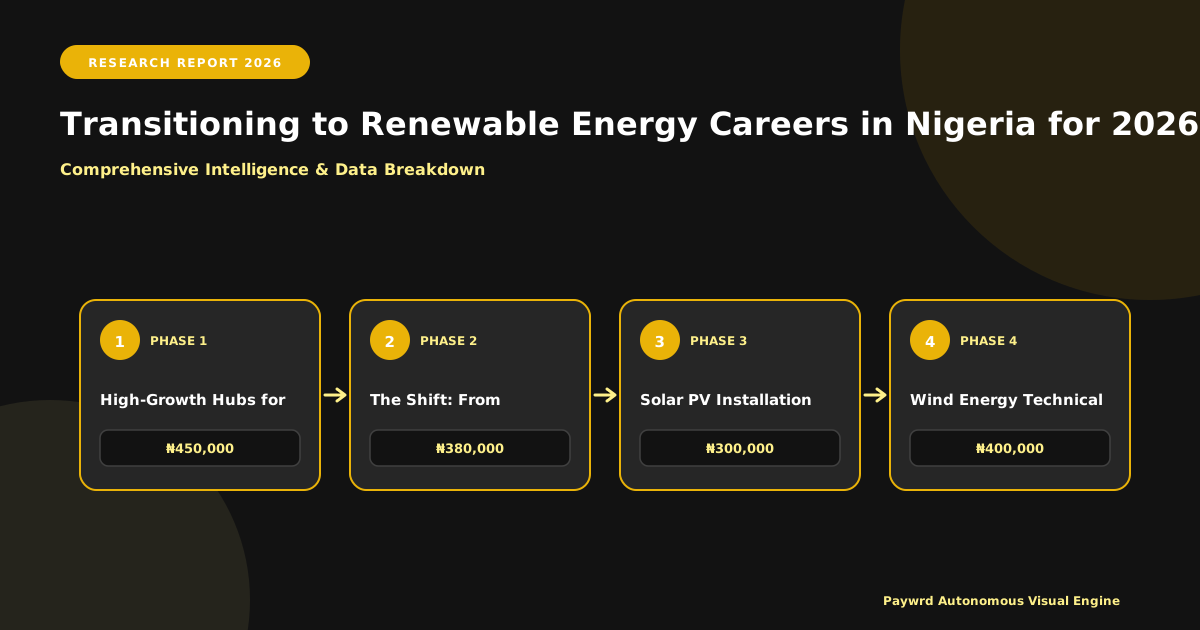
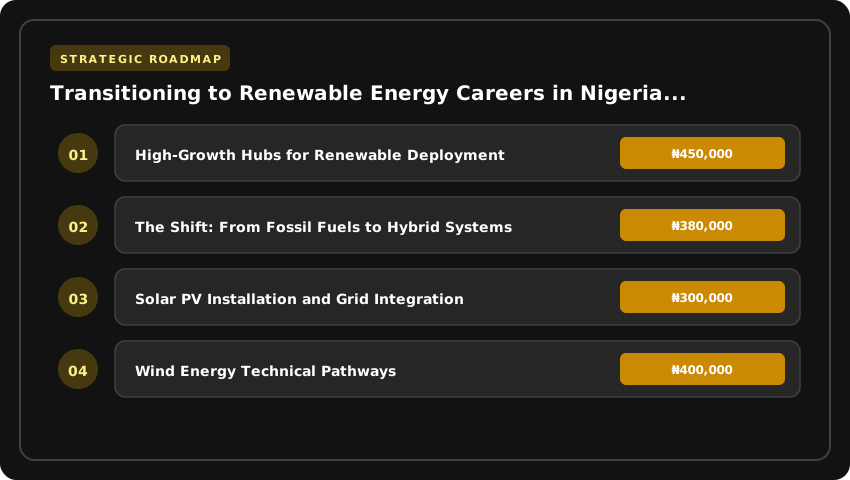
| Grid Integration Engineer | ₦450,000 – ₦750,000 | TCN SCADA Operations + NERC Grid Code | Surge (+40% YoY) | Hybrid AC/DC load balancing |
| Solar PV Project Developer | ₦380,000 – ₦650,000 | COREN Registration + NABCEP PVIP | High (Rural Electrification Agency pipeline) | Mini-grid financial modelling |
| Energy Storage Technician | ₦300,000 – ₦550,000 | BESS Safety (IEC 62619) + Vendor Certs | Emerging (Battery storage mandates) | Thermal runaway mitigation |
| Wind Resource Analyst | ₦400,000 – ₦700,000 | WAsP / WindPRO + MET Mast Ops | Moderate (Northern corridor feasibility) | Complex terrain flow modelling |
| Regulatory & Carbon Analyst | ₦350,000 – ₦600,000 | VERRA/Gold Standard + NERC Licensing | Growing (Article 6.2 Framework) | Carbon credit verification workflows |
Frequently Asked Questions
What is the average salary for a renewable energy engineer in Nigeria in 2026?
In 2026, entry-level renewable energy engineers in Nigeria earn ₦300,000–₦750,000 monthly. Grid Integration Engineers command the highest range (₦450k–₦750k) due to TCN's Smart Grid rollout, while Solar PV Developers average ₦380k–₦650k. Specialized BESS technicians start at ₦300k, scaling rapidly with IEC 62619 certification.
Which certifications are mandatory for renewable energy jobs in Nigeria for 2026?
For 2026 roles, COREN registration is mandatory for all engineering titles. Grid roles require TCN SCADA Operations and NERC Grid Code compliance. Solar developers need NABCEP PVIP; storage technicians require IEC 62619 safety certification. Carbon analysts must hold VERRA or Gold Standard auditor credentials for Article 6.2 projects.
How has TCN grid modernization affected hiring in Nigeria's 2026 power sector?
TCN's 2026 Smart Grid and SCADA integration created a 40% surge in demand for hybrid-literate power engineers. Hiring now prioritizes candidates skilled in managing intermittent renewable inputs, AC/DC load balancing, and real-time grid stability. Traditional single-discipline engineers are being upskilled or replaced by hybrid profiles.
What are the top renewable energy career paths for 2027 in Nigeria?
Leading 2027 paths include Grid Integration Engineering (TCN expansion), Battery Energy Storage Systems (BESS) deployment, and Carbon Credit Verification (Article 6.2 readiness). Mini-grid financial modelling for the Rural Electrification Agency and Wind Resource Assessment for Northern corridors remain high-growth niches.
How can a traditional electrical engineer transition to renewable energy in Nigeria in 2026?
Transition by acquiring TCN SCADA certification and NERC Grid Code fluency immediately. Supplement with NABCEP PVIP for solar or IEC 62619 for storage. Target firms executing Rural Electrification Agency contracts or TCN substation upgrades. Register with COREN if not already licensed; hybrid grid skills are the primary 2026 differentiator.
Strategic Final Takeaway
When evaluating How To Transition From Engineering To Renewable Energy Careers In Nigeria in 2026 and beyond, base your decisions on accredited institutional standards, verified return on investment (ROI), and up-to-date official guidelines. Always verify specific dates and requirements through official regulatory portals.