2026 Digital Literacy Landscape for Northern Nigerian Women
The 2026 policy environment has fundamentally shifted how digital credentials are valued across the North. The Federal Government’s Digital Literacy for All (DL4ALL) initiative, driven by NITDA, is no longer a pilot—it is the baseline benchmark for federal employment and the newly expanded 3 Million Technical Talent (3MTT) Phase 2 pipeline. If you are a woman in Bauchi or Kano targeting remote work, federal civil service roles, or NELFUND student loan eligibility, a NITDA-backed certificate is the non-negotiable standard. State-sponsored programs, while accessible, often issue certificates recognized primarily for state civil service recruitment or local government contracts.
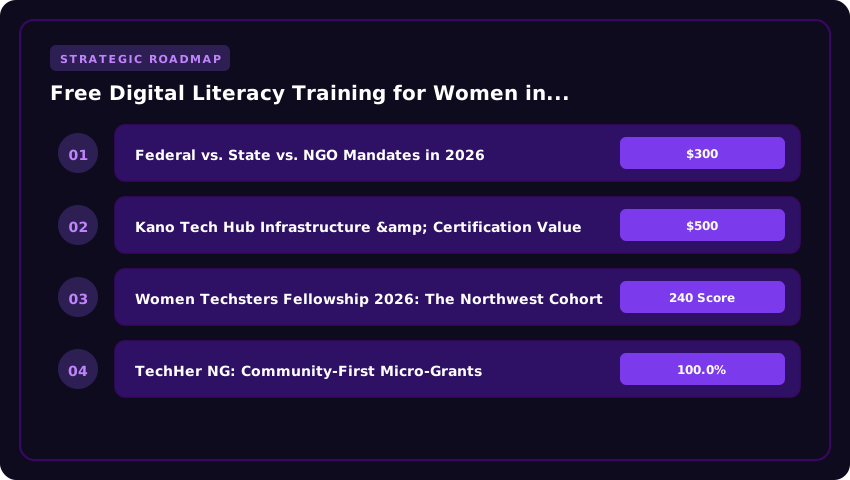
Federal vs. State vs. NGO Mandates in 2026
Understanding the hierarchy of authority saves you from wasting months on a certificate a recruiter ignores. Here is the 2026 breakdown:
- Federal (NITDA / 3MTT Phase 2): These programs mandate a standardized curriculum mapped to the National Digital Literacy Framework (NDLF). Completion logs are uploaded directly to the NITDA database, verifiable via QR code on the certificate. This is the only tier currently accepted for the Federal Civil Service Commission (FCSC) promotion exams and NELFUND’s digital skills prerequisite for loan disbursement.
- State (Bauchi State Ministry of Communications / Kano State ICT Agency): Both states run aggressive 2026 women-only cohorts. Bauchi’s “Digital Girl-Child” initiative and Kano’s “Women Tech Empowerment” scheme are fully funded (zero tuition, data stipends of ₦15,000–₦20,000 monthly). However, their certificates bear the State Governor’s seal. They guarantee priority for state-level internships and the Kano State Civil Service Commission’s new “Digital Cadre” recruitment, but they do not auto-populate the federal NITDA registry.
- NGO / Development Partners (GIZ, UN Women, Tech4Dev): These fill curriculum gaps—advanced UI/UX, Data Analysis, Cybersecurity fundamentals. Their certificates are industry-recognized by private employers (Flutterwave, Interswitch, local startups) but hold zero weight for government quota systems unless explicitly partnered with NITDA for that specific cohort.
NUC CCMAS Digital Skills Integration: The Entry Requirement Shift
The NUC Core Curriculum Minimum Academic Standards (CCMAS) 2026 update has made “Digital Fluency” a compulsory 3-credit unit (GST 102 equivalent) for all first-year students in Nigerian universities, including Bayero University Kano (BUK) and Abubakar Tafawa Balewa University (ATBU) Bauchi. This changes the game for women seeking admission or currently enrolled.
For 2026/2027 admission cycles, JAMB CAPS now flags candidates with verified NITDA DL4ALL or 3MTT certificates during the “Supplementary Data” upload phase. While not a direct UTME score booster, it serves as a tie-breaker for competitive courses like Computer Science, Information Systems, and Mass Communication. Furthermore, female undergraduates in Bauchi and Kano who complete the federal 3MTT Phase 2 “Foundation” track can petition their Dean of Student Affairs for Course Credit Exemption (CCE) for the mandatory CCMAS Digital Fluency unit, freeing up 15–20 hours per semester for core major courses or paid internships.
Strategically, prioritize the NITDA/3MTT pipeline first. Use state programs for supplementary stipends and local networking, and NGO tracks for specialized portfolio projects. In 2026, the authority behind the logo on your certificate determines whether it opens a federal door, a state door, or a private sector door.
Federal Government Programs: NITDA DL4ALL & 3MTT Women Tracks
The Federal Government’s 2026 digital economy strategy rests on two pillars you cannot ignore: NITDA’s Digital Literacy for All (DL4ALL) and the 3 Million Technical Talent (3MTT) Phase 2. Both carry the weight of federal certification—recognized for civil service promotion, NYSC deployment advantages, and NELFUND student loan eligibility verification. For women in Bauchi and Kano, the 2026 cycles have dedicated Northwest quotas and female-focused learning tracks.
NITDA DL4ALL 2026: Cohort Dates & Northwest Centers
The DL4ALL program has moved from pilot phase to full national rollout. For 2026, NITDA is running three major cohorts targeting 2.5 million Nigerians, with the Northwest zone allocated 350,000 slots. Women applicants receive priority scoring in the selection algorithm.
- Cohort 1 (H1 2026): Applications opened January 15, 2026 and closed February 10, 2026. Training commenced March 1, 2026.
- Cohort 2 (Mid-Year 2026): Application window is June 1 – June 30, 2026. Training kicks off July 15, 2026. This is your immediate entry point.
- Cohort 3 (H2 2026): Applications open October 1 – October 31, 2026 for November start.
Apply exclusively via the official portal: dl4all.nitda.gov.ng. Use your NIN for verification; BVN is required for the ₦15,000 transport stipend disbursement upon 80% attendance completion.
Physical Training Centers: Bauchi & Kano (2026 Accredited)
Online modules are mandatory, but the proctored exams and practical labs happen at these designated centers. Arrive 30 minutes early for biometric capture.
- Bauchi State: NITDA Digital Economy Center, Federal Polytechnic Bauchi, Permanent Site, Gwallameji (Hall B, ICT Complex). Contact: 0800-NITDA-DL.
- Kano State: NITDA IT Hub, Kano University of Science & Technology (KUST), Wudil (New Computer Science Building, Lab 3).
- Kano State (Metro Option): Digital Bridge Institute (DBI) Kano Campus, No. 12 Ahmadu Bello Way, Nassarawa GRA (Weekend-only batches for working mothers).
3MTT Phase 2: Specialized Tracks for Women (Data, AI, Cybersecurity)
While DL4ALL builds foundational literacy, 3MTT Phase 2 targets employable technical depth. The 2026 cycle explicitly reserves 30% of Northwest slots for women in high-value tracks: Data Analysis, Artificial Intelligence/Machine Learning, and Cybersecurity. These are 12-week hybrid programs (6 weeks virtual, 6 weeks physical capstone).
- Application Portal: 3mtt.nitda.gov.ng/phase2 (Login with your NIN + registered phone number).
- 2026 Application Window: May 15 – July 15, 2026. Aptitude test runs July 20–25, 2026.
- Stipend: ₦30,000/month for 3 months (paid via NELFUND wallet), plus a laptop grant (₦250,000 voucher) for top 10% female graduates per track.
Track Specifics for Northwest Women: The Cybersecurity track partners with Galaxy Backbone for SOC analyst internships in Abuja. The AI track feeds directly into the NITDA National Centre for AI & Robotics (NCAIR) projects. Ensure your NYSC discharge certificate or exemption letter is uploaded during registration—this is a hard filter for 2026 Phase 2 eligibility.
Kano State Initiatives: KANSICT, Kano Tech Hub & StartUp Kano
Kano State’s 2026 digital economy strategy is the most aggressive in the North-West, backed by a dedicated ₦3.2 billion allocation in the state’s supplementary budget for the “Kano Digital Leap” program. The Kano State Institute for Information Technology (KANSICT) acts as the primary implementation arm, moving beyond basic computer appreciation to industry-aligned certification. For 2026, KANSICT has ring-fenced 1,500 ‘Women in Tech’ scholarship slots specifically for the Google Career Certificates track (Data Analytics, UX Design, Project Management) and CompTIA Security+ prep. Crucially, the top 300 performers in the first cohort assessment receive a hardware stipend: a brand-new Lenovo IdeaPad Slim 3 (12th Gen Intel, 8GB RAM/512GB SSD) valued at roughly ₦650,000, or a Samsung Galaxy Tab S9 FE with keyboard cover for those opting for the UI/UX and Graphic Design pathways. Devices are distributed at the KANSICT campus in Dawakin Tofa after a mandatory 90% attendance verification via the Kano State Education Management Information System (KANEMIS) portal.
StartUp Kano Academy: Weekend Cohorts & Hardware Access
Running in parallel, StartUp Kano Academy—funded through a Public-Private Partnership (PPP) with the Kano State Investment Promotion Agency (KANINVEST) and GIZ/Digital Transformation Center Nigeria—launched its 2026 “Tech Her Up” weekend cohorts in January. Targeting girls and young women aged 15–35, the program runs Saturday-Sunday, 10:00 AM – 4:00 PM, across three physical hubs: StartUp Kano Hub (Tarauni), Kano Tech Hub (Nassarawa GRA), and the new Women’s Digital Centre, Gwale. The curriculum is stacked: Frontend Development (React), Digital Marketing (Meta Blueprint certified), and No-Code/Low-Code Automation (Zapier/Make). Unlike federal programs, StartUp Kano provides a ₦15,000 monthly transport stipend paid directly to beneficiaries’ BVN-linked accounts via the Kano State Social Investment Programme (KANSIPO) payroll platform, removing the “data vs. transport” barrier.
Kano Tech Hub Infrastructure & Certification Value
The Kano Tech Hub, renovated in late 2026 with a ₦450 million upgrade, now hosts a 200-seat testing center accredited by Pearson VUE and Certiport. This is a game-changer: graduates no longer travel to Abuja or Lagos for proctored exams. The 2026 partnership with Coursera for Government grants all KANSICT and StartUp Kano alumni 12-month unlimited access to the Career Academy catalog. For civil servants, the Kano State Head of Service has issued Circular No. HOS/EST/2026/04, recognizing KANSICT Google/CompTIA certifications for accelerated promotion (CONPSS 08–10) and mandatory ICT allowance eligibility. Registration for the Q3 2026 intake opens July 1st via portal.kansict.edu.ng and apply.startupkano.com; applicants need a valid NIN, Kano State LG of Origin certificate, and a 60-second video pitch uploaded to the portal.
- KANSICT Scholarship Value: Full tuition (₦180k–₦350k market value) + Device (₦650k) + Exam Vouchers (₦120k).
- StartUp Kano Stipend: ₦15,000/month for 6 months (₦90k total) + Free Hub Access (24/7 power/internet).
- Hardware Retention Policy: Devices remain state property for 12 months post-graduation; full ownership transfers upon proof of employment/freelance income (via CAC registration or Upwork/Fiverr earnings dashboard).
- Key Portal:
kansict.edu.ng(KANSICT) |startupkano.com(Academy) |kaninvest.gov.ng(Policy Updates).
Bauchi State Programs: BASICT & Development Partner Projects
If you are based in Bauchi, the Bauchi State Agency for Information and Communication Technology (BASICT) is your primary gateway to structured, certified digital literacy in 2026. Unlike ad-hoc NGO workshops, BASICT operates under a state mandate aligned with the National Digital Economy Policy and Strategy (NDEPS), meaning their completion certificates carry weight for state civil service recruitment quotas and NYSC placement advantages. For the 2026 cycle, BASICT has rolled out a revised curriculum moving beyond basic Microsoft Office proficiency. The new modules cover Data Analysis with Excel & Power BI, Introduction to Cybersecurity Hygiene, and Digital Entrepreneurship & E-Commerce—skills directly mapped to the Federal Government’s 3 Million Technical Talent (3MTT) Phase 2 competency framework.
Registration for the 2026 cohorts is managed via the BASICT portal (basict.bauchi.gov.ng) and requires a valid NIN and Bauchi State Local Government Identification. Critically, the agency has secured a partnership with the State Ministry of Women Affairs to waive the nominal ₦5,000 processing fee for female applicants aged 18–35, provided they present a letter of recommendation from their Ward Head or a recognized women’s cooperative leader. Classes run in three batches annually at the BASICT Complex in Bauchi metropolis and satellite centers in Azare, Misau, and Jama’are.
UNICEF & GIZ Safe-Space Digital Hubs: Removing Structural Barriers
While BASICT handles the curriculum and certification, the operational game-changer for rural women in 2026 is the network of Safe-Space Digital Hubs funded by UNICEF Nigeria and GIZ (Deutsche Gesellschaft für Internationale Zusammenarbeit) under the “Digital Skills for Her” initiative. These hubs are strategically located in high-need LGAs—specifically Bauchi, Toro, Ganjuwa, and Katagum—to solve the “last mile” problem: transport, safety, and childcare.
- Transport Stipends: Registered participants receive a weekly transport allowance of ₦3,000 paid directly via mobile money (MoMo/OPay) upon 80% weekly attendance verification. This eliminates the ₦15,000–₦20,000 monthly transport barrier that forces dropouts.
- On-Site Creche Facilities: Each hub operates a certified Early Childhood Development (ECD) creche managed by trained caregivers from the State Primary Healthcare Development Agency. Mothers can drop off children aged 6 months–5 years from 8:00 AM to 2:00 PM, Monday through Thursday. This is not a makeshift corner; it is a licensed facility with nutritional snacks provided.
- Gender-Separate Labs: Hubs feature female-only computer labs with female instructors, addressing cultural and religious barriers to mixed-gender learning environments.
- Device Access: Participants do not need personal laptops. Hubs are equipped with 30-seater solar-powered labs (backup inverters included) running the BASICT curriculum offline via Kolibri/Learning Equality servers, ensuring continuity during grid failures.
To access these hubs, women must register through the BASICT portal but select the “Safe-Space Hub” track during enrollment. Verification involves a brief physical screening at the LGA Women Affairs office. In 2026, the target is 1,200 women certified across these four LGAs, with a job-shadowing pipeline linked to the Bauchi State Geographic Information Service (BAGIS) and local fintech agents for immediate income application.
NGO & Private Academy Scholarships: Women Techsters, TechHer, Ingressive
While federal programmes provide scale, the highest completion rates in the Northwest consistently come from NGO-led cohorts that bundle hard skills with stipends and mentorship. For 2026, three players dominate the value proposition for women in Bauchi and Kano: Women Techsters, TechHer NG, and Ingressive for Good (I4G). They solve the “data cost” barrier that kills momentum in Month 2 of self-paced learning.
Women Techsters Fellowship 2026: The Northwest Cohort
Tech4Dev’s Women Techsters Fellowship remains the gold standard for deep skilling. The 2026 cycle (Cohort 6) opened applications in January 2026 with a hard deadline of March 15, 2026. Crucially for Northern applicants, the selection algorithm now weights “Geographic Equity” heavily, reserving slots for Northwest states to address the regional digital divide. The fellowship runs six months of intensive training (Cybersecurity, Data Science, Software Dev, Product Design) followed by a six-month internship placement.
- Stipend: ₦50,000 monthly data/transport allowance paid directly to the fellow’s bank account (verified via BVN).
- Mentorship: Assigned industry mentor (1:5 ratio) plus weekly “Office Hours” with hiring partners like Flutterwave, Moniepoint, and local Kano tech hubs (StartUp Kano, nHub).
- Eligibility Check: Women aged 16–40, resident in Nigeria, with a functional laptop. No prior degree required, but you must pass the logical reasoning aptitude test on the official portal.
TechHer NG: Community-First Micro-Grants
TechHer operates differently—it funds the ecosystem around the learner. For 2026, their “Digital Access Fund” targets women already enrolled in any verified course (Coursera, ALX, 3MTT, or state programmes) but struggling with connectivity. Applications are rolling quarterly; the Q2 2026 window closes June 30, 2026.
- Micro-Scholarship Amount: ₦15,000–₦25,000 one-off data grant disbursed via mobile money (PalmPay/OPay) within 48 hours of approval.
- Requirement: Proof of enrollment (screenshot/dashboard link) + 200-word statement on “How this data completes my certification.”
- Community Value: Recipients auto-join the TechHer “Digital Sisters” WhatsApp clusters moderated by alumni in Kano and Bauchi for peer accountability.
Ingressive for Good (I4G): The License & Laptop Pipeline
I4G’s 2026 strategy shifted from pure course access to licensing premium curricula (DataCamp, Coursera Plus, Pluralsight) and hardware support. Their “1000 Women in Tech” drive for the North aims to distribute 200 refurbished laptops (specs: i5 8th Gen/8GB RAM/256GB SSD) to high-performing scholars in Q3 2026.
- Data Stipend: ₦10,000/month for 3 months (active learning verification required via LMS login logs).
- Deadline: Rolling applications reviewed monthly; laptop batch selection closes August 31, 2026.
- Mentorship Edge: Access to the I4G Alumni Network on Slack—direct pipeline to remote junior roles at international firms paying $300–$500/month.
Strategic Advice: Do not pick one. Stack them. Apply for Women Techsters for the career track, claim TechHer data grants to survive the application aptitude tests, and join I4G for the premium licenses while you wait for Fellowship results. The 2026 winners in Bauchi and Kano are the women treating these not as lotteries, but as a combined financial aid package.
Eligibility Matrix & Document Checklist for 2026 Applications
To avoid immediate disqualification during the 2026 screening process, applicants in Bauchi and Kano must distinguish between mandatory identity verification and academic prerequisites. The 2026 application portal utilizes a real-time API link with the National Identity Management Commission (NIMC), meaning any discrepancy between your uploaded documents and your NIN database record will trigger an automatic rejection.
Core Verification & Academic Requirements
Unlike previous cycles, the 2026 intake prioritizes digital identity over physical certificates for the initial stage. However, for those seeking advanced tracks or federal certification, academic proof is non-negotiable.
- NIN & BVN Verification: A valid National Identification Number (NIN) is the primary key. Your BVN must be linked to your NIN to facilitate any potential stipends or data allowances provided by the program.
- Academic Credentials: Upload clear scans of your WAEC, NECO, or NABTEB results. For those applying via the vocational track, a recognized trade test certificate is acceptable.
- NYSC Status: Graduates must provide an NYSC Discharge Certificate. Those who are exempt must upload an official NYSC Exemption Letter to prove their eligibility for full-time training.
Regional & Cultural Compliance Checklist
Recognizing the cultural landscape of Northern Nigeria, the 2026 guidelines have been updated to ensure inclusivity while maintaining strict security standards. Failure to adhere to these specific documentation nuances often leads to “Pending” application statuses.
- LGA Identification: A formal Letter of Identification from your Local Government Area (LGA) office is mandatory. This confirms residency in Bauchi or Kano and prevents “application poaching” from other states.
- Guardian Consent Forms: For applicants under 21 or those in specific community-led cohorts, a signed Guardian Consent Form is required. This document must be witnessed by a community leader or a registered legal practitioner.
- ID Photo Specifications: To ensure biometric compatibility, photos must have a plain white background. For women wearing the hijab, please ensure the face is clearly visible from the chin to the forehead, with no shadows obscuring facial features, to satisfy the 2026 AI-verification protocols.
Applicants are advised to convert all documents to PDF format (maximum 2MB per file) before uploading to the portal. Ensure that your name is spelled identically across your NIN, BVN, and WAEC certificates to prevent flagging by the automated verification system.
Post-Training Pathways: Remote Jobs, NELFUND Devices & Advanced Certs
Completing your digital literacy training in Bauchi or Kano is only the first step. To convert your 2026 certification into actual economic value, you must strategically pivot from basic literacy to specialized earning. In the current 2026 economic climate, a certificate is a key that opens doors, but your hardware and advanced skill set are what keep you in the room.
Leveraging NELFUND for Device Financing
One of the biggest hurdles for women in Northern Nigeria is the “hardware gap.” However, for 2026, the Nigerian Education Loan Fund (NELFUND) has expanded its mandate. Graduates of NITDA-backed and 3MTT-aligned programs are now eligible for specialized device loans. By uploading your verified 2026 training certificate to the NELFUND portal, you can apply for low-interest laptop loans designed specifically for digital freelancers.
- Eligibility: Must possess a verified 2026 DL4ALL or 3MTT Phase 2 certificate.
- Loan Terms: Flexible repayment plans tied to your first six months of remote employment.
- Application: Processed entirely via the NELFUND student/graduate portal using your NIN.
Scaling via the 3MTT Alumni Network
Basic literacy is the foundation; advanced certification is the skyscraper. We strongly advise graduates to leverage the 3MTT alumni network to transition into professional tracks. In 2026, there are direct pipelines for alumni to access subsidized or fully funded advanced certifications from Google, IBM, and Coursera. Whether you are pivoting toward Data Analytics, Cybersecurity, or AI Prompt Engineering, these credentials transform you from a “literate user” into a “specialized professional” capable of commanding higher Naira rates.
Monetizing Skills: 2026 Remote Job Boards
The remote work landscape in Nigeria has evolved. Beyond traditional platforms, 2026 has seen the rise of localized fintech-integrated job boards. We recommend graduates explore the following avenues to secure remote roles:
- Fintech Ecosystems: Keep a close eye on Kuda and OPay’s talent portals for remote customer success and digital operations roles.
- Web3 & Crypto Hubs: For those moving into blockchain, Tether-integrated freelance boards now offer stablecoin payments, hedging against Naira volatility.
- Local Government Outsourcing: Both Bauchi and Kano state governments have increased their 2026 quotas for remote digital assistants to manage state-level e-governance portals.
By combining your NELFUND-funded hardware with an IBM or Google advanced cert, you move from seeking entry-level work to competing in the global digital economy from the comfort of your home in Northern Nigeria.
| Criteria | NITDA DL4ALL (Federal) | 3MTT Phase 2 (Technical) | State-Level Programs (Bauchi/Kano) |
|---|---|---|---|
| Cost | Free (₦0) | Free (₦0) | Free (₦0) |
| Primary Focus | General Digital Literacy | Advanced Technical Skills | Local Civil Service Alignment |
| 2026/2027 Timeline | Quarterly Cohorts | Bi-Annual Cycles | State Budgetary Cycles |
| Certification Value | Federal Civil Service / NELFUND | Global Remote Work / Tech Hubs | State Recruitment Quotas |
| Prerequisites | Basic Literacy & NIN | Intermediate Tech Interest & NIN | State Residency & NIN |
Frequently Asked Questions
Which digital literacy certificate is best for federal employment in Nigeria 2026?
For federal employment in 2026, the NITDA DL4ALL certification is the primary benchmark. It provides the necessary federal weight for civil service applications and is a critical requirement for NELFUND eligibility, making it more versatile for government-backed roles than state-specific certifications in Bauchi or Kano.
How do I apply for the 3MTT Phase 2 training for women in 2026?
Women in Bauchi and Kano can apply for 3MTT Phase 2 via the official federal portal using a valid NIN. The 2026 pipeline focuses on advanced technical talents, offering a pathway to global remote work and high-salary tech roles through specialized training modules and federal mentorship.
What are the benefits of state-level digital training in Bauchi and Kano for 2027?
State-level programs in Bauchi and Kano are specifically engineered to align with local civil service recruitment quotas for 2027. While federal certificates offer broader reach, state certifications provide a competitive advantage for women seeking employment within their specific state government ministries and local agencies.
Is the NITDA DL4ALL program free for women in Northern Nigeria in 2026?
Yes, the NITDA DL4ALL initiative remains completely free (₦0) for women across Bauchi, Kano, and other Northern states in 2026. The program is designed to eliminate financial barriers to digital entry, ensuring all women can access the baseline benchmarks required for modern federal employment.
Does digital literacy training affect NELFUND loan eligibility in 2026?
Yes, in 2026, holding a recognized federal digital credential, such as the NITDA DL4ALL certificate, enhances a candidate's profile for NELFUND student loan eligibility. The federal government now integrates digital literacy benchmarks into its financial aid framework to ensure students possess essential 21st-century skills.
Strategic Final Takeaway
When evaluating Free Digital Literacy Training Programs For Women And Girls In Bauchi Kano 2026 in 2026 and beyond, base your decisions on accredited institutional standards, verified return on investment (ROI), and up-to-date official guidelines. Always verify specific dates and requirements through official regulatory portals.