
2026/2027 JUPEB Registration Timeline & Portal Deadlines
The Joint Universities Preliminary Examinations Board (JUPEB) has fixed the 2026/2027 registration window to run from Monday, March 3, 2026 to Friday, May 29, 2026 (11:59 PM WAT). This 13-week window is your only shot at the July 2026 examinations. The portal—accessed via portal.jupeb.org.ng—opens at 12:01 AM on March 3rd. Do not wait for your centre to “notify you”; proactive candidates secure preferred centres (like UNILAG, OAU, or UNN affiliates) within the first 72 hours before capacity caps trigger.

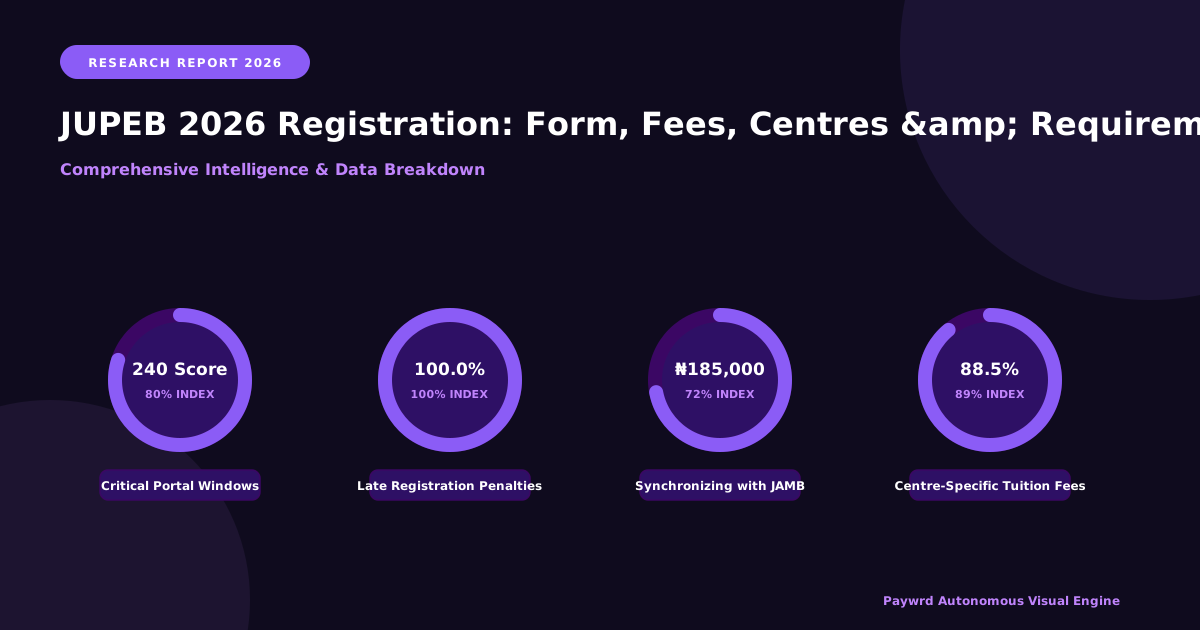
Critical Portal Windows
- Standard Registration: March 3 – May 29, 2026 (Midnight WAT deadline).
- Late Registration Window: June 1 – June 14, 2026 (Strictly 2 weeks).
- Biometric Verification & Photo Capture: Must be completed at your chosen study centre by June 20, 2026.
- Examination Timetable Release: Expected June 15, 2026.
- 2026 JUPEB Examinations: Projected July 6 – July 24, 2026.
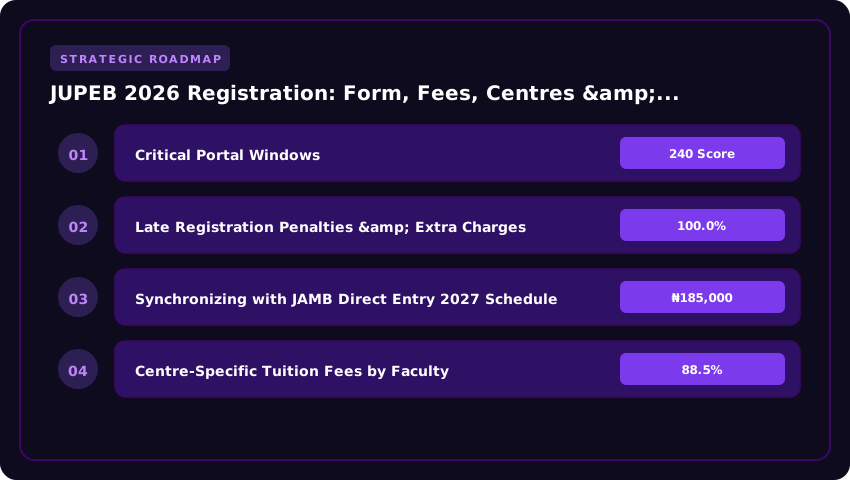
Late Registration Penalties & Extra Charges
If you miss the May 29th hard stop, the portal reopens for a punitive 14-day late window (June 1–14). The financial hit is steep: a mandatory ₦10,000 penalty fee on top of the standard ₦15,000 registration fee, bringing your total to ₦25,000 payable via Remita/RRR. Note that centre-specific administrative charges (typically ₦20,000–₦50,000 for tuition/facilities) are separate and non-negotiable. Centres often stop accepting new late registrants 48 hours before the June 14th cutoff to process biometrics, so treat June 12th as your functional deadline.
Synchronizing with JAMB Direct Entry 2027 Schedule
This timeline is engineered to feed directly into the 2027 JAMB Direct Entry (DE) registration, which historically opens in January 2027. JUPEB results are typically released by October 2026, giving you a 3-month buffer to verify your grades, secure your JUPEB certificate, and prepare DE documents. Critical Strategy: Register for JUPEB using the exact same legal name on your NIN and WAEC/NECO results. Discrepancies here are the #1 cause of DE disqualification in 2027. Lock in your 2026 JUPEB registration now; your 2027 university admission depends on it.
Complete Breakdown of Form Cost & Centre Tuition Fees in Naira
Budgeting for JUPEB in 2026 requires separating the fixed central charge from the variable centre tuition. The Joint Universities Preliminary Examinations Board (JUPEB) sets the official registration form price between ₦15,000 and ₦25,000, depending on the registration phase. Early birds who register between March 3 and April 30, 2026, typically secure the form at the base rate of ₦15,000. Late registration—running from May 1 to the hard deadline of May 29, 2026—attracts a penalty surcharge, pushing the cost to the upper band of ₦25,000. This fee covers the central examination processing, result verification, and the JUPEB certificate issuance; it does not cover tuition at your chosen affiliate centre.
Centre-Specific Tuition Fees by Faculty
Tuition varies significantly across the 80+ accredited affiliate centres (universities and affiliated colleges). Science-based programmes command the highest premiums due to laboratory consumables, practical sessions, and specialized equipment. For the 2026/2027 session, expect the following annual tuition bands:
- Sciences (Medicine, Engineering, Pharmacy, Core Sciences): ₦350,000 – ₦650,000 per session. Centres like UNILAG, OAU, and UNN often sit at the higher end of this bracket.
- Social Sciences & Management (Economics, Accounting, Mass Comm, Political Science): ₦280,000 – ₦480,000 per session.
- Arts & Humanities (Languages, History, Religious Studies, Theatre Arts): ₦250,000 – ₦420,000 per session.
Note that some centres split this into two semester payments, while others demand a lump sum before the first semester lectures commence in July/August 2026. Always confirm the exact figure on the specific centre’s portal—not the central JUPEB site—before initiating payment.
Accepted Payment Channels
JUPEB and its affiliate centres have standardized on cashless channels to curb fraud. For the central form fee, the Remita platform (via remita.net or bank apps) is the primary gateway. You generate a unique RRR (Remita Retrieval Reference), pay via card, USSD, or bank branch, and the portal auto-verifies your payment within minutes.
For centre tuition, most universities mandate payment through their proprietary portals (often powered by Remita, Interswitch, or Paystack). Accepted instruments include:
- Remita (RRR Generation): Standard for federal university centres (e.g., UI, UNIBEN, ABU).
- USSD / Mobile Banking: Dial 737 (GTB), 901 (Access), 919 (UBA), etc., using the generated RRR.
- POS / Bank Branch: Walk into any commercial bank with the printed RRR slip.
- Bank Draft: Rarely accepted now, but still listed by a few older colleges; confirm with the centre bursary before purchasing a draft.
Pro Tip: Never pay into a personal account or via a “agent” claiming to fast-track registration. Always generate your RRR from the official JUPEB portal (jupeb.edu.ng) or the specific university’s admission portal. Keep digital and hard copies of every receipt—your clearance for the 2026 examinations depends on it.
Mandatory O’Level Requirements & Subject Combinations for 2026
To avoid immediate disqualification during the Direct Entry (DE) screening process, candidates must ensure their O’Level results align perfectly with JUPEB’s 2026 eligibility criteria. The board is uncompromising: you must possess a minimum of five (5) credit passes in relevant subjects, which must include English Language and Mathematics. These credits must be obtained in no more than two sittings (WAEC, NECO, or NABTEB).
Selecting the wrong subject combination at the registration stage is a common mistake that leads to “wrong course” errors during university admission. To secure your spot in 200-level, adhere to these approved 2026 subject mappings:
- Medicine and Surgery (MBBS): Biology, Chemistry, and Physics.
- Law (LLB): Literature-in-English, Government, and any other Arts subject (e.g., CRS/IRS or History).
- Engineering (All Disciplines): Mathematics, Physics, and Chemistry.
- Business Administration/Accounting: Mathematics, Economics, and any other Commercial subject (e.g., Commerce or Government).
- Political Science/International Relations: Government, Economics, and Literature-in-English.
Handling ‘Awaiting Results’ Status for 2026 Candidates
Many candidates applying for the 2026/2027 JUPEB session are currently awaiting their WAEC or NECO results. The good news is that JUPEB allows “Awaiting Result” candidates to register and begin lectures at their chosen centres. However, this is a conditional entry.
If you are registering while awaiting your 2026 results, you must upload a provisional statement or your exam registration slip to the portal. Be warned: if your final results are released and you fail to meet the five-credit requirement—specifically in English and Mathematics—your JUPEB registration will be voided. You will not be permitted to sit for the final JUPEB examinations, and any fees paid to the centre will typically be non-refundable.
We strongly advise candidates to double-check their subject combinations against the NUC’s updated Core Curriculum and Minimum Academic Standards (CCMAS) to ensure their chosen JUPEB track remains valid for the 2027 admission cycle.
Verified List of Approved JUPEB Affiliate Centres Nationwide
Selecting a registration centre is the most critical decision you will make during the 2026 JUPEB cycle. Because the Joint Universities Preliminary Examinations Board (JUPEB) operates through an affiliation model, your choice of centre determines the quality of your tuition and the legitimacy of your final result. To avoid “miracle centres”—fraudulent hubs that promise automatic 15-point scores but fail to register candidates on the official portal—you must only enroll in NUC-approved institutions.
University-Owned Study Hubs vs. Private Accredited Centres
In 2026, candidates can choose between two primary types of centres. University-owned hubs are operated directly by federal or state institutions (e.g., University of Lagos or Ahmadu Bello University). These are generally preferred because they offer direct access to campus libraries and a higher probability of internal admission if you meet the cut-off marks.
Private accredited centres are third-party institutions licensed by JUPEB. While these often provide more intensive, “crash-course” style tutoring and smaller class sizes, you must verify their current accreditation status on the JUPEB portal before paying any registration fees. Ensure the centre provides a verifiable registration slip immediately after payment.
Regional Distribution of Top-Tier Centres
Depending on your geolocation, here are the primary hubs for the 2026/2027 session:
- Lagos & South-West: High concentration of centres in Lagos (Ikeja and Lekki axes) and Ibadan. Look for centres affiliated with the University of Lagos (UNILAG) or the University of Ibadan for maximum academic rigor.
- Abuja & Northern Region: The Federal Capital Territory hosts several premium private hubs. In the North, centres affiliated with ABU Zaria and Bayero University Kano (BUK) remain the gold standard for science and social science tracks.
- Port Harcourt & South-South: Focus on centres with strong ties to the University of Port Harcourt (UNIPORT) and the University of Benin (UNIBEN) to ensure your results are recognized for direct entry into 200 Level.
Red Flags to Avoid
Be wary of any centre that asks for “special fees” to bypass the official JUPEB registration portal or claims to have a “secret arrangement” with the board. Legitimate centres will charge the standard registration fee plus a transparent tuition fee. Always demand a printed confirmation of your registration from the JUPEB portal to ensure your name is on the official 2026 candidate list.
Step-by-Step Online Registration Walkthrough (Portal Navigation)
Navigating the 2026 JUPEB portal requires precision. A single error in your bio-data or a blurred upload can lead to registration rejection or delays in your final result processing. To avoid these technical pitfalls, follow this exact sequence on the official jupeb.gov.ng portal.
Phase 1: Profile Creation and Bio-Data
Once you land on the homepage, click the “Register Now” button to initiate your profile. The 2026 UI is streamlined, but you must be meticulous with the following:
- Bio-Data Entry: Enter your full name exactly as it appears on your WAEC/NECO certificate. Discrepancies here will cause issues during university admission screening.
- Passport Specifications: Upload a recent passport photograph with a plain white background. The file must be in JPEG format, under 100KB, and clearly show your face without glasses or headgear (unless for religious reasons).
- Biometrics: Ensure you are using a stable internet connection when submitting your digital signature and biometric data to prevent “Session Timeout” errors.
Phase 2: O’Level Uploads and Verification
The 2026 registration cycle has tightened the verification process to eliminate fraudulent entries. You are now required to upload digital copies of your O’Level results.
- Scanning Specs: Scan your original WAEC, NECO, or NABTEB result in PDF format. Ensure the scan is clear, legible, and not cropped.
- Verification Codes: You must input the unique verification code provided by the examination body. If you are using a combined result, ensure both certificates are merged into a single PDF file before uploading.
- Subject Selection: Carefully select your three core subjects based on the course you intend to study in the university. Once submitted, changing these subjects often requires a paid amendment fee.
Phase 3: Finalizing and Printing Documents
After completing the payment of the registration fee via the integrated Remita gateway, your dashboard will update to “Payment Successful.” Do not close the browser until the confirmation page loads.
- Examination Photocard: Navigate to the “Print” tab and download your Examination Photocard. This is your primary identity document for the exam hall.
- Centre Allocation Slip: Print your Centre Allocation Slip, which indicates the approved JUPEB study centre where you will attend lectures and sit for your finals.
- Verification: Double-check that your allocated centre is within your preferred region before exiting the portal.
Transitioning to 200L: JAMB Direct Entry Registration After JUPEB
Passing your JUPEB exams is a significant milestone, but it is not the final step. To officially secure your spot in 200 Level, you must navigate the Joint Admissions and Matriculation Board (JAMB) Direct Entry (DE) process. This transition bridges the gap between your preliminary results and your official university admission letter.
Converting JUPEB Grades to DE Points
Your admission depends on your aggregate score, which is calculated by converting your letter grades into points. The standard JUPEB grading scale for 2026/2027 remains consistent: an ‘A’ earns you 5 points, a ‘B’ earns 4 points, and a ‘C’ earns 3 points. These points are then weighted against the specific cut-off marks set by your chosen university for that academic session. Remember, while a high aggregate increases your chances, some competitive courses in federal universities may require a minimum of 12 points across three subjects for a guaranteed 200L slot.
JAMB DE 2027 Timeline and Registration
As you look toward the 2027 academic session, timing is everything. The JAMB DE registration portal typically opens in the first quarter of 2027. To avoid technical glitches, follow these critical steps:
- Profile Linking: You must link your JUPEB Registration Number to your JAMB profile via the official JAMB portal. This ensures your results are automatically synced for verification.
- Course Selection: Ensure the course you select on the DE form matches the subjects you sat for in JUPEB to avoid “Wrong Course” errors during the CAPS (Central Admissions Processing System) screening.
- Payment: Be prepared to pay the prescribed JAMB DE registration fee via Remita; failure to complete payment means your application will not be processed.
Funding Your 200L Education with NELFUND
Securing admission is one thing; paying for it is another. For the 2026/2027 session, students transitioning to 200 Level are fully eligible for the Nigerian Education Loan Fund (NELFUND). Once you have your JAMB admission letter and have completed your university registration, you can apply via the NELFUND portal.
To qualify, you must provide a valid BVN, a government-issued ID, and proof of admission. NELFUND covers both tuition fees and a monthly upkeep allowance, ensuring that financial constraints do not hinder your progress from the preliminary stage to your final degree.
Top 5 Registration Errors That Cause Automatic Disqualification
Registering for the 2026/2027 JUPEB session is not a mere formality; it is a legal academic contract. A single clerical error on your portal profile can lead to a “Result Withheld” status or an outright rejection during the Direct Entry (DE) screening process at your chosen university. To ensure your hard work isn’t wasted, avoid these five critical pitfalls.
1. Name Mismatch Between JUPEB Form and O’Level Certificates
This is the most common reason for disqualification. The JUPEB board and university admissions officers use strict string-matching software. If your WAEC or NECO certificate reads “Okonkwo Emeka Jude” but you register as “Emeka Jude Okonkwo,” your result will be flagged as fraudulent. Ensure your name follows the exact sequence—Surname, First Name, and Middle Name—as it appears on your O’Level documents.
2. Invalid Subject Combinations for Target Courses
Many candidates choose subjects they “like” rather than subjects required by the NUC CCMAS (Core Curriculum and Minimum Academic Standards). For example, attempting to enter Medicine and Surgery without Biology, Chemistry, and Physics is an automatic disqualification. Before submitting your form, cross-reference your subject selection with the specific requirements of the university you intend to enter via Direct Entry.
3. Double Registration Across Multiple Centres
In 2026, JUPEB has intensified its biometric integration. Attempting to register at two different study centres to “hedge your bets” is a high-risk move. The system now utilizes biometric detection to flag duplicate profiles. If the board detects double registration, both profiles are typically deactivated, and you may be barred from sitting for the final examinations.
4. Uploading Blurred or Unofficial Documents
The portal requires clear, legible scans of your O’Level results and identification. Uploading a photo of a photocopy or a blurred image leads to an “Incomplete Application” status. If the verification officers cannot read your grades, your registration will be invalidated without prior notice.
5. Incorrect Email and Phone Number Entry
While it seems minor, providing a defunct email or a wrong phone number is a fatal error. All critical updates regarding exam dates, venue changes, and result releases are sent via the registered contact. If you cannot access your portal because you entered a wrong email, you lose the ability to rectify other errors before the final deadline.
- Pro Tip: Always download and print your registration slip immediately after payment to verify all details.
- Verification: Double-check your NIN (National Identification Number) as it is now a mandatory link for all 2026 academic registrations.
| Criteria | JUPEB 2026/2027 Details | Alternative (UTME/JAMB) |
|---|---|---|
| Registration Window | March 3, 2026 – May 29, 2026 | Variable (Annual Cycle) |
| Portal Access | portal.jupeb.org.ng | jamb.gov.ng |
| Admission Path | Direct Entry (200 Level) | 100 Level Entry |
| Exam Date | July 2026 | Scheduled by JAMB |
| Risk Factor | Strict May 29 Deadline | Multiple Application Windows |
Frequently Asked Questions
When is the JUPEB 2026 registration deadline?
The JUPEB registration portal for the 2026/2027 academic session closes strictly at 11:59 PM WAT on Friday, May 29, 2026. Candidates must complete their applications via portal.jupeb.org.ng before this date, as no grace periods are granted, and missing this window results in a one-year deferment of university admission.
How do I register for JUPEB 2026/2027?
To register for JUPEB 2026, visit the official portal at portal.jupeb.org.ng starting March 3, 2026. You must select an accredited JUPEB centre, provide valid identification, and pay the required registration fees. It is highly recommended to secure your preferred centre within the first 72 hours due to limited capacity.
What are the requirements for JUPEB registration in 2026?
Requirements for the 2026 JUPEB session include five O'Level credits in relevant subjects (including English and Mathematics), a valid email address, and a digital passport photograph. Candidates must also choose a study combination aligned with their intended university degree for the 2027 Direct Entry admission cycle.
Can I still register for JUPEB after May 29, 2026?
No, registration for the 2026/2027 JUPEB session ends definitively on May 29, 2026. The Joint Universities Preliminary Examinations Board does not offer extensions beyond the official late window. Candidates who miss this deadline must wait for the 2027 registration cycle to begin their preliminary university examinations.
Which JUPEB centres are best for 2026 registration?
Top-tier accredited centres for the 2026 session include affiliates of UNILAG, OAU, and UNN. Candidates are advised to choose centres with a proven track record of high pass rates and robust facilities. Due to high demand, these preferred centres typically reach full capacity shortly after the portal opens on March 3.
Strategic Final Takeaway
When evaluating JUPEB Registration Form 2026 2026 Requirements Approved Centres And Fees in 2026 and beyond, base your decisions on accredited institutional standards, verified return on investment (ROI), and up-to-date official guidelines. Always verify specific dates and requirements through official regulatory portals.

