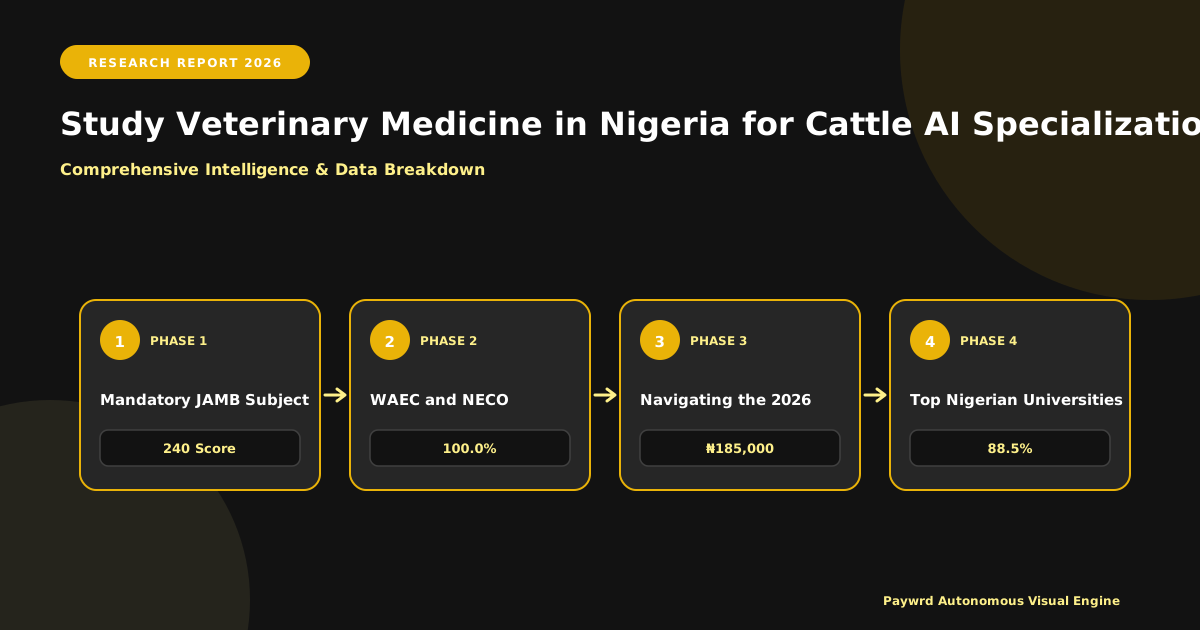
Key Takeaway: Veterinary Medicine in Nigeria is fiercely competitive. You need strong credits in core sciences, a solid JAMB score, and a well-prepared Post-UTME strategy. Start here, and you stay ahead.
Academic Entry Requirements for Veterinary Medicine in 2026
Getting into a Nigerian veterinary school is no walk in the park. With institutions like the University of Ibadan, Ahmadu Bello University Zaria, and the University of Nigeria Nsukka all offering this programme, competition is real. But if you know exactly what is required, you can plan with precision and avoid costly mistakes during the 2026 admission cycle.

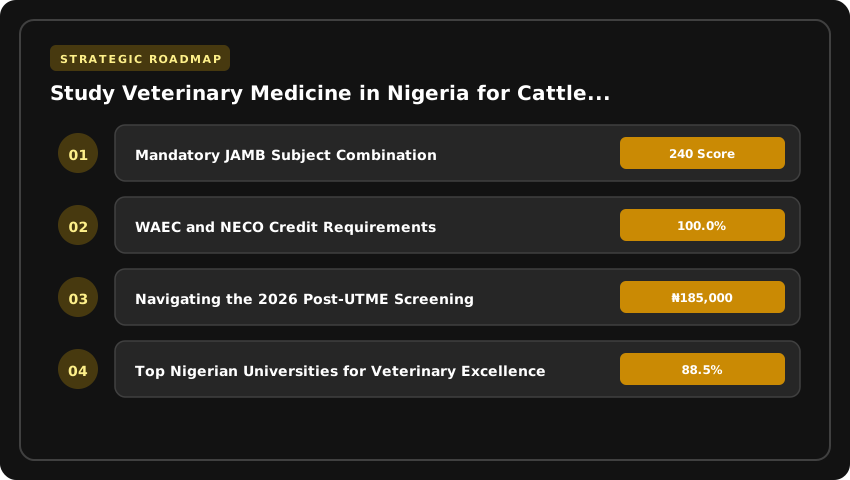
Mandatory JAMB Subject Combination
For the 2026 Unified Tertiary Matriculation Examination, the Joint Admissions and Matriculation Board mandates the following core subjects for Veterinary Medicine candidates:
- English Language (compulsory for all programmes)
- Biology
- Chemistry
- Physics
These four subjects form the non-negotiable foundation. Your JAMB UTME score matters enormously here. For top-tier institutions, competitive candidates typically aim for a score of 200 and above, though some schools set their departmental cut-off marks even higher. Always verify the specific cut-off on the JAMB CAPS portal once the 2026 admission lists go live.
WAEC and NECO Credit Requirements
Beyond your JAMB performance, your O’Level results carry significant weight. Most accredited veterinary schools under the National Universities Commission require a minimum of five credit passes at SSCE level. These must include:
- English Language
- Mathematics
- Biology
- Chemistry
- Physics
Important note: many institutions now require that these credits be obtained in no more than two sittings. If you are writing WAEC through the regular examination or via WAEC e-Registration, ensure your results are fully processed and downloadable before you begin your application cycle. NECO results are equally accepted, but confirm with your target institution’s admissions office regarding their specific recognition policy.
Navigating the 2026 Post-UTME Screening
Once you have secured a competitive JAMB score, the Post-UTME screening is your next critical hurdle. Top veterinary programmes conduct their own institutional screenings, and these often carry substantial weight in the final admission calculation. Here is what you need to do:
- Monitor the NUC CCMAS portal and your chosen institution’s admissions page for screening schedule announcements.
- Prepare thoroughly for aptitude tests that typically cover Biology, Chemistry, and Physics at a deeper conceptual level than JAMB.
- Have your O’Level results, JAMB score printout, and identification documents ready well in advance.
- Be mindful of application fees, which generally range from ₦2,000 to ₦5,000 depending on the institution.
The 2026 Post-UTME landscape is more transparent than ever, with most schools publishing screening guidelines online early. Do not rely on third-party information alone. Go directly to official university admissions portals to confirm deadlines and requirements.
Meeting these baseline academic requirements does not guarantee admission, but failing to meet them guarantees rejection. Build your preparation around these pillars, and position yourself strongly for the competitive 2026 cycle.
Top Nigerian Universities for Veterinary Excellence
If your goal is veterinary medicine with a focus on cattle AI and large animal care, your choice of institution matters enormously. Not every veterinary faculty in Nigeria has the clinical partnerships, research infrastructure, or livestock exposure you need to build real expertise. Here is a breakdown of the leading universities that consistently produce graduates equipped for the field.
University of Ibadan (UI): Research-Led Veterinary Training
The University of Ibadan’s Faculty of Veterinary Medicine remains the gold standard in Nigeria. Its approach is deeply research-oriented, with active projects in parasitology, microbiology, and large animal health. UI’s Veterinary Teaching Hospital provides hands-on clinical rotations in cattle and small ruminant medicine, giving students direct exposure to real-world cases. If you are targeting postgraduate research or academic careers, UI’s structured postgraduate college offers seamless progression into M.Vet and PhD programmes. Admission is competitive, so aim for a strong JAMB score and excellent WAEC results in Biology, Chemistry, and Physics.
University of Nigeria, Nsukka (UNN): Clinical Expertise and Livestock Focus
UNN stands out for its practical, clinically driven curriculum. Located in the agricultural heartland of Southeast Nigeria, the university benefits from proximity to active livestock farming communities. Students at UNN get meaningful field experience in cattle management, reproductive health, and AI techniques through partnerships with local farms and the university’s own livestock units. The clinical training here is arguably the most grounded in large animal medicine among southern Nigerian institutions. For 2026 entry, UNN’s veterinary programme typically demands credit passes in core sciences and a competitive UTME score aligned with their departmental cut-off.
Ahmadu Bello University (ABU Zaria): Specialized Cattle and Ruminant Studies
ABU Zaria is the institution to watch if your specific interest is cattle and ruminant science. Situated in the pastoral north, ABU has deep institutional ties with cattle-rearing communities and agricultural extension services. Its veterinary programme integrates ruminant nutrition, breeding management, and disease control into the core curriculum rather than treating them as electives. This specialisation makes ABU graduates highly sought after by livestock development agencies and private cattle farms across the Sahel region.
Comparing NUC CCMAS Standards Across Leading Veterinary Faculties
All three institutions operate under the NUC’s Core Curriculum Minimum Academic Standards (CCMAS), which set the baseline knowledge and competency requirements for every veterinary programme in Nigeria. However, execution varies significantly. UI leans into research depth, UNN prioritises clinical breadth, and ABU channels its strengths into ruminant specialisation. When comparing these faculties, check the NUC CCMAS portal for updated accreditation status and programme-specific benchmarks. A programme that exceeds CCMAS minimums in large animal medicine modules is typically your strongest bet for hands-on cattle AI training.
- UI best fits students seeking research depth and postgraduate pathways in veterinary science.
- UNN is ideal for those wanting intensive clinical rotations in large animal practice.
- ABU Zaria is the top choice for focused cattle and ruminant specialisation.
- Always verify current NUC CCMAS accreditation and JAMB cut-off marks on official portals before applying.
Specializing in Cattle Artificial Insemination (AI)
Earning your Doctor of Veterinary Medicine (DVM) degree is the gateway, but specializing in Cattle Artificial Insemination (AI) requires a deliberate pivot toward reproductive biotechnology long before you write your final professional exams. In the 2026 academic climate, Nigerian veterinary faculties—particularly at Ahmadu Bello University (ABU) Zaria, University of Ibadan (UI), and University of Nigeria, Nsukka (UNN)—are integrating advanced reproductive modules directly into the CCMAS curriculum. You are no longer waiting for a Master’s degree to touch a liquid nitrogen tank; final-year rotations now demand competency in estrus synchronization protocols, ultrasound-guided follicular monitoring, and the cryobiology of bovine spermatozoa.
Bridging Coursework and Biotechnology
The transition from general practitioner to AI specialist starts in the lecture theatre with courses like Veterinary Theriogenology and Animal Breeding. However, the real differentiation happens when you align your research project or externship with institutes like the National Animal Production Research Institute (NAPRI) in Shika or the International Livestock Research Institute (ILRI) collaborations. These partnerships expose you to genomic selection tools and sexed semen technology—skills that put you miles ahead of a standard graduate. If your faculty offers elective credits in Biotechnology or Molecular Genetics, take them. Understanding the molecular markers for fertility traits in White Fulani or Sokoto Gudali cattle makes you valuable to both private ranches and the Federal Ministry of Agriculture’s breed improvement programs.
Hands-On Mastery: From Collection to Conception
Theory counts for little if you cannot manage a liquid nitrogen flask at -196°C. Practical competence is non-negotiable. During your clinical years (500 and 600 Level), prioritize rotations at the Teaching Hospital’s Theriogenology Unit or accredited private AI centers like those partnered with the National Veterinary Research Institute (NVRI) Vom. You must log verified hours in:
- Semen Collection: Mastering the artificial vagina (AV) technique for Bos indicus bulls, which often require different handling temperament than exotic breeds.
- Evaluation & Processing: Performing Computer-Assisted Sperm Analysis (CASA) or standard microscopy for motility, morphology, and concentration, followed by extender preparation (Tris-egg yolk or commercial media) and straw filling/sealing.
- Cryopreservation & Thawing: Executing programmable freezing curves and the critical 37°C/30-second thaw protocol to maximize post-thaw viability.
- Insemination Technique: Perfecting the recto-vaginal method for cervical deposition in Zebu cattle, navigating the anatomical challenges of the cervical rings.
The VCN Mandate: Certification and Legal Standing
You cannot legally practice as an AI technician or consultant in Nigeria without the Veterinary Council of Nigeria (VCN) stamp. Upon graduation, your provisional license allows supervised practice, but full registration requires the mandatory one-year internship (Housemanship) at a VCN-accredited center. For an AI specialist, this internship must include a dedicated reproductive rotation. Post-internship, the VCN expects Continuous Professional Development (CPD) points—often earned through workshops organized by the Nigerian Veterinary Medical Association (NVMA) Theriogenology Special Interest Group or NVRI Vom short courses. Without that annual practicing license renewal (costing roughly ₦15,000–₦20,000 annually as of 2026), your AI practice operates illegally, voiding insurance and exposing you to liability if a synchronized herd fails. The VCN is also tightening regulations on semen importation and local production standards; staying compliant means staying registered.
Leveraging the Kwara State Livestock Initiative for Career Growth
If you are targeting a career in cattle artificial insemination (AI), the Kwara State Livestock Modernization Project is the single most significant economic signal in the North-Central region for 2026. The state government, under the Ministry of Agriculture and Rural Development, has moved beyond policy documents into active capital deployment—rehabilitating the Shonga Farms infrastructure, establishing new bull stations, and contracting private veterinary consortia to manage genetic improvement programs. For a veterinary student specializing in theriogenology, this is not abstract policy; it is a direct pipeline to employment and entrepreneurship.
Public-Private Partnerships Creating AI Technician Roles
The 2026 operational model relies heavily on Public-Private Partnerships (PPPs). Kwara has signed memoranda of understanding with integrated livestock firms—think L&Z Integrated Farms and regional cooperatives—to run mobile AI clinics across the 16 Local Government Areas. These partners are actively recruiting certified AI technicians and veterinary officers to manage synchronized breeding programs for the Bunaji and Rahaji breeds. Unlike federal civil service roles that stagnate on grade levels, these PPP contracts offer performance-based remuneration, often ranging between ₦250,000 and ₦450,000 monthly for fresh DVM graduates with proven AI competency, plus field allowances and motorcycle logistics.
Government Grants and NELFUND Support for Specialized Students
Funding this specialization is now more accessible. The Nigerian Education Loan Fund (NELFUND), fully operational via the nelf.gov.ng portal in 2026, explicitly covers “specialized professional training” costs. If you are in your clinical years (400–600 Level) at UNILORIN, ABU Zaria, or UI and can demonstrate enrollment in a certified AI/Embryo Transfer elective, you can apply for the Skills Acquisition Component of the loan. This covers the ₦150,000–₦300,000 cost of the National Animal Production Research Institute (NAPRI) short courses or private certification from the Veterinary Council of Nigeria (VCN) accredited centers.
- Kwara State Scholarship Board: Prioritizes indigenes in “High-Impact Agricultural Courses.” Veterinary Medicine with a Theriogenology bias qualifies. Applications typically open Q1 annually via
kwara.gov.ng/scholarship. - CBN AGSMEIS / NIRSAL Loans: Post-graduation, certified AI technicians can access single-digit interest loans (9% per annum) to set up private mobile AI units—critical for the “last-mile” service gap in Baruten, Kaiama, and Patigi LGAs.
- VCN Mandatory Continuing Professional Development (MCPD): Use your NELFUND stipend or state grant to fund the mandatory MCPD credits in Reproductive Biotechnology; it keeps your practicing license valid and your CV competitive for the PPP contracts.
The bottom line: The Kwara initiative has de-risked the career path. The infrastructure (bull stations, liquid nitrogen plants), the market (thousands of smallholder herds needing genetic upgrade), and the funding (NELFUND, State Scholarships, AGSMEIS) are aligned in 2026. Your job is to graduate with the specific technical certificate that matches the tender requirements.
Professional Licensing and the VCN Certification Path
Earning a Doctor of Veterinary Medicine (DVM) degree in Nigeria is a massive achievement, but it does not automatically qualify you to practice. The road from graduation to a fully licensed veterinary professional, especially one specializing in Cattle Artificial Insemination (AI), is regulated and structured. Here is exactly what you need to know.
Mandatory Internship and Clinical Rotation Requirements
After completing your five-year DVM programme, the Veterinary Council of Nigeria (VCN) requires every graduate to complete a mandatory one-year internship. This is not optional, and skipping it disqualifies you from sitting for the VCN professional examinations. During this internship, you will be placed in approved veterinary hospitals, livestock farms, or government veterinary laboratories where you gain hands-on clinical experience.
For those pursuing Cattle AI specialization, the internship period is critical. You will rotate through bovine reproductive health units, learn semen processing and handling protocols, and work directly under licensed veterinary reproductivists. The VCN mandates that interns log a minimum number of clinical cases and submit case reports for evaluation. This ensures that by the time you complete your internship, you have practical exposure to real-world livestock medicine and breeding management.
- One-year full-time internship in a VCN-approved facility
- Rotations across surgical, medical, and reproductive disciplines
- Supervised clinical case logbooks and reports
- Specialized placement in cattle breeding or AI units for AI-focused graduates
Passing the VCN Professional Examinations
Once your internship is complete, you must pass the VCN professional licensing examinations. These exams test your competency across core veterinary disciplines, including veterinary pathology, pharmacology, surgery, and livestock reproduction. The VCN conducts these examinations periodically, and candidates must register through the official VCN portal to secure a seat.
Passing these exams is the legal gateway to practice. Without a VCN certificate, you cannot legally treat animals, perform surgical procedures, or offer professional breeding services including Cattle AI. The credential carries weight with employers, regulatory agencies, and livestock farmers across Nigeria.
Continuing Professional Development (CPD) for AI Specialists in 2027
Licensing is not a one-time event. The VCN requires licensed veterinarians to participate in Continuing Professional Development (CPD) to maintain their practicing status. For Cattle AI specialists, this is especially important because reproductive technologies are evolving rapidly.
Looking into 2027, expect tighter CPD benchmarks and more specialized training modules in advanced AI techniques, embryo transfer, and genetic screening. Staying current through CPD ensures you remain competent, legally compliant, and competitive in Nigeria’s growing livestock sector.
- Annual CPD points accumulation as mandated by the VCN
- Workshops on modern AI technologies and reproductive biotechnology
- Attendance at veterinary conferences and certified training programmes
- Renewal of practicing license through the VCN portal each cycle
Financial Outlook for AI Specialists in Nigeria’s Livestock Sector
The economics of Cattle Artificial Insemination (AI) in Nigeria have shifted dramatically since the Federal Government launched the National Livestock Transformation Plan (NLTP) and state-level ranching initiatives. For a 2026 graduate holding a DVM with a thesis or certification in Theriogenology, the financial ceiling is no longer defined by civil service salary scales alone. The market now rewards technical precision—specifically, the ability to synchronize estrus, handle frozen semen logistics, and deliver conception rates above 55% under tropical field conditions.
2026 Starting Salaries: Public vs. Private Benchmarks
In the public sector, a fresh Veterinary Officer (CONHESS 09 entry point) earns a basic annual package of roughly ₦2.8 million to ₦3.2 million, inclusive of hazard and rural posting allowances. However, specialists attached to the National Animal Production Research Institute (NAPRI) in Zaria or the Livestock Productivity and Resilience Support Project (L-PRES) coordination units can negotiate ₦4.5 million to ₦6 million annually with a Master’s in Theriogenology.
The private sector pays for output. Integrated dairy firms like FrieslandCampina WAMCO (via their Dairy Development Programme), Chi Limited, and emerging ranches in Niger, Nasarawa, and Oyo States offer ₦5 million to ₦8 million for “Field AI Technicians” who double as herd health managers. International NGOs (FAO, ILRI, GIZ) contracting for breed improvement projects pay consultancy day rates of ₦35,000–₦60,000, translating to ₦7 million+ annually for consistent engagements.
Revenue Models for Private AI Consultancy
Going solo is viable if you structure revenue beyond “per-insemination” fees. The sustainable models in 2026 are:
- Herd Fertility Retainers: Charge commercial farms (50–200 heads) a monthly retainer of ₦150,000–₦300,000 covering synchronization protocols, quarterly pregnancy diagnosis (PD), and calving management. Ten such contracts yield ₦1.8M–₦3.6M monthly.
- Semen Sales & Liquid Nitrogen Logistics: Act as a certified distributor for imported straws (sexed Holstein/Jersey or Girolando). Margin on a ₦8,000–₦15,000 straw is ₦2,000–₦4,000. Volume matters: 200 straws/month = ₦400k–₦800k gross margin.
- Training & Capacity Building: Run 3-day “DIY AI” workshops for farm hands at ₦75,000/participant. Two batches a quarter adds ₦1.5M+ annually with low overhead.
Cost Analysis: Setting Up a Private Veterinary AI Clinic (2026 Estimates)
Capital expenditure (CAPEX) is front-loaded. A functional mobile unit beats a static clinic for cattle work.
- Liquid Nitrogen Plant Access / Dewars: You need 2x 35L dewars (₦450k) + monthly LN2 top-ups (₦15k/month). *Tip: Partner with a teaching hospital or NAPRI depot to avoid buying a ₦12M generator plant.
- AI Equipment Kit: Thaw units (₦120k), stereomicroscope for semen eval (₦350k), AI guns/sheaths stock (₦80k), ultrasound scanner (portable, rectal probe) – ₦1.8M–₦2.5M (Mindray/Chison entry models).
- Mobility: A tokunbo Toyota Hilux or Isuzu D-Max (₦18M–₦25M) is non-negotiable for ranch terrain. Budget ₦3M/year for fuel/maintenance.
- Regulatory & Cold Chain: VCN annual practicing license (₦15k), NAFDAC permit for semen import/distribution (₦50k–₦100k), State Ministry of Agriculture registration.
Total Startup Capital: ₦22M–₦30M (Vehicle heavy). Break-even typically hits Month 14–18 if you secure three retainer contracts by Month 3. The ROI isn’t theoretical—Nigeria’s dairy deficit guarantees demand for every viable heifer calf born via AI.
Strategic Final Takeaway
When evaluating How To Study Veterinary Medicine In Nigeria For Cattle Artificial Insemination Specialization in 2026 and beyond, base your decisions on accredited institutional standards, verified return on investment (ROI), and up-to-date official guidelines. Always verify specific dates and requirements through official regulatory portals.