Key Takeaway: Only programmes listed on the NUC CCMAS portal carry full degree status and NYSC mobilisation eligibility. Avoid unaccredited “AI certificate” bootcamps masquerading as university admissions.
NUC-Accredited AI & Chatbot Programmes Available For 2026 Admission
The rush into Artificial Intelligence education across Nigeria is real, but it is also riddled with traps. As of 2026, the National Universities Commission has approved a growing list of institutions to run B.Sc. programmes in Artificial Intelligence, Specialised Chatbot Engineering, and Natural Language Processing concentrations under their Computer Science faculties. Your first move before applying through JAMB CAPS is to confirm the programme on the NUC CCMAS portal — anything not listed there will not earn you a recognised degree or NYSC exemption.

Federal And State Universities With NUC-Approved AI Programmes
Several institutions have received full CCMAS accreditation for AI-focused Computer Science tracks. These include:
- University of Lagos (UNILAG) — B.Sc. Computer Science with AI and Chatbot Engineering concentration
- Ahmadu Bello University (ABU), Zaria — B.Sc. Computer Science specialising in Natural Language Processing
- Federal University of Technology, Minna (FUT Minna) — B.Sc. Artificial Intelligence under the Faculty of Computing
- University of Nigeria Nsukka (UNN) — B.Sc. Computer Science with AI specialisation
- Covenant University, Ota — B.Sc. Computer Science with Chatbot and Intelligent Systems track
- Osun State University (UNIOSUN) — B.Sc. Artificial Intelligence
- Ekiti State University (EKSU) — B.Sc. Computer Science with NLP concentration
Always cross-check each programme’s status directly on ccmas.nuc.edu.ng before you lock in your JAMB choice, as accreditation can be updated semester by semester.
Core AI Degrees vs. Elective-Heavy Data Science Programmes
This distinction matters more than most candidates realise. A core AI degree — such as B.Sc. Artificial Intelligence or B.Sc. Chatbot Engineering — builds your curriculum around machine learning architectures, neural networks, prompt engineering, conversational AI design, and deep NLP modules from day one. These are purpose-built degrees that the NUC has reviewed and approved as specialised programmes.
A Data Science programme, on the other hand, typically embeds AI as one elective track among statistics, database management, and business analytics. You will graduate with a Data Science degree, not an AI degree, and your chatbot or NLP training may amount to just two or three elective courses. That difference becomes critical when employers or postgraduate admissions boards look for a specific AI credential.
If your goal is to build, deploy, and fine-tune chatbots or work in conversational AI research, enrol in a dedicated AI programme. If you are more interested in the broader data pipeline, a Data Science degree may still serve you — but do not mistake one for the other.
For 2026 admission, use JAMB CAPS to select your preferred accredited programme, monitor your admission status, and if you need financial support, check your eligibility on the NELFUND portal for tuition coverage under the new student loan scheme.
JAMB UTME/DE Subject Combinations And 2026 Cut-Off Benchmarks
Getting your subject combination wrong on the JAMB portal is the fastest way to waste a perfectly good UTME score. For every B.Sc. Artificial Intelligence or Chatbot Engineering programme accredited under the 2026 CCMAS framework, the mandatory UTME quartet is non-negotiable: English Language, Mathematics, Physics, and Chemistry. If you are targeting the Biomedical AI niche offered at a few federal universities, swap Chemistry for Biology, but keep Physics and Mathematics locked in. Do not listen to centre agents who suggest swapping Physics for Economics or Geography; the NUC portal will reject the admission upload instantly during CAPS processing.
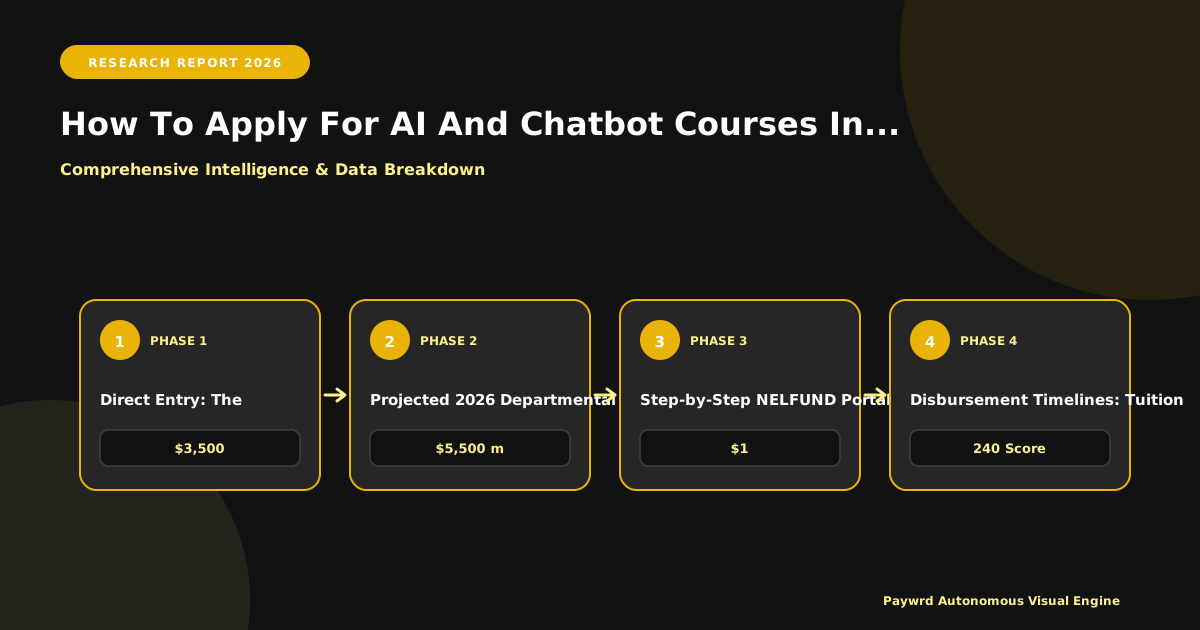
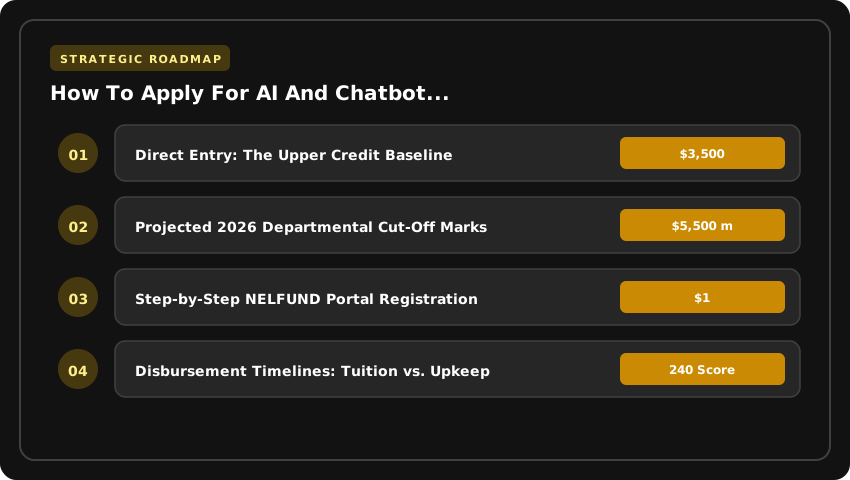
Direct Entry: The Upper Credit Baseline
For Direct Entry candidates, the 2026 benchmark is firm: Upper Credit (3.50/5.00 CGPA minimum) in National Diploma (ND) or Higher National Diploma (HND) programmes in Computer Engineering, Software Engineering, Computer Science, or Statistics. Lower Credit holders should not bother applying to the top-tier federal universities this cycle; the competition is too fierce. You must also possess five O’Level credits (WAEC/NECO/NABTEB) at not more than two sittings, including English, Mathematics, Physics, Chemistry, and one other Science subject. Ensure your JAMB DE registration number matches the name on your ND/HND transcript exactly—discrepancies cause endless clearance delays at the faculty level.
Projected 2026 Departmental Cut-Off Marks
JAMB sets the general minimum at 140, but departmental cut-offs for AI are effectively “merit lines” driven by applicant volume. Based on 2026 post-UTME trends and the 2026 capacity expansions, here are the realistic score targets you need to aim for:
- University of Lagos (UNILAG): 265–275+. The Computer Science department typically sets the highest floor; the new AI specialization will likely sit at 270+.
- Obafemi Awolowo University (OAU), Ile-Ife: 255–265. OAU’s Engineering faculty drives high Physics/Maths scores; aim for 260 to be safe.
- Federal University of Technology, Akure (FUTA): 240–250. FUTA’s niche in tech makes it a magnet; expect the cutoff to creep toward 250.
- Ahmadu Bello University (ABU), Zaria: 220–235. ABU often has slightly lower cutoffs for Northern candidates via catchment, but merit list sits at 230+.
- MIVA Open University (Abuja): 180–200. As a NUC-licensed Open and Distance Learning (ODL) institution, MIVA adheres to the JAMB minimum but sets internal competitive benchmarks around 190 for their B.Sc. AI programme.
Register these codes exactly as listed on the JAMB e-Facility portal before the 2026 registration window closes. A single wrong subject code invalidates your eligibility regardless of your score.
Step-By-Step Post-UTME Screening & Portal Registration Workflow
The Post-UTME screening stage is where many aspiring AI and Chatbot programme candidates in Nigeria get disqualified — not because they lacked merit, but because they misunderstood the portal process. Each university runs its own screening infrastructure, and the rules shift slightly from institution to institution. Here is how to navigate it cleanly for 2026 admission.
1. Identify and Access Your Institution’s Screening Portal
Universities do not share a unified Post-UTME portal. You must go directly to the institution-specific gateway. For example, the UNILAG Post-UTME portal requires candidates to log in through the university’s designated admission application URL, which is typically published on the official UNILAG website and confirmed via JAMB CAPS once your application is processed. Obafemi Awolowo University (OAU) uses its e-Post system, where candidates complete an online screening exercise that may include a CBT-based aptitude test covering English, Mathematics, and relevant subject knowledge. Other institutions rely on PUTME CBT formats administered at approved computer-based testing centres.
- Always access screening portals through official university URLs — never through third-party links or social media advertisements.
- Confirm your JAMB CAPS status shows “Screening” or “Post-UTME” before attempting portal login.
- Keep your JAMB registration number, O’Level registration number, and scratch card details readily accessible.
2. Upload O’Level Results With Correct Scratch Card Verification
This step causes the most unnecessary failures in 2026. When uploading your WAEC, NECO, or NABTEB results, the system requires you to input your scratch card PIN or verification code accurately. For the 2026 sitting cycle, WAEC has migrated toward its digital verification system accessible through the WAEC e-Registration portal, but universities still require you to confirm result authenticity during Post-UTME screening. Enter your result details exactly as they appear on your certificate — mismatched dates or incorrect subject codes will trigger automatic rejection.
- Verify your scratch card PIN is still active before starting the upload process.
- Upload only results from a single examining body unless the institution explicitly accepts dual results.
- Screenshot every confirmation page — portals crash during peak screening periods, and you need proof of submission.
3. Handling ‘Awaiting Results’ Status And Deadline Extensions
If you are a 2026 WAEC or NECO GCE candidate whose results have not yet been released, most institutions will assign an “Awaiting Results” status on their screening portal. This is not automatic disqualification, but it comes with strict conditions. Universities typically set a hard deadline by which you must submit verified results, usually within two to four weeks after the screening exercise begins. NECO GCE candidates should monitor the official NECO result release announcements closely, as institutions often align their extension deadlines with official result publication dates.
- Do not assume “Awaiting Results” means you are safe — treat the deadline as non-negotiable.
- Contact the institution’s admissions office directly if you need a formal deadline extension request.
- Keep your JAMB CAPS dashboard updated so the university can verify your result status in real time.
Funding AI Degrees: NELFUND Student Loan Application For 2026/2027 Session
The 2026 amendments to the Student Loan Act explicitly prioritised STEM disciplines, placing accredited Artificial Intelligence and Chatbot Engineering programmes on the “High Priority” funding tier. This means if you hold admission into a NUC-approved B.Sc. AI programme—verified via the CCMAS portal—your application gets faster processing and a higher approval probability. The Act defines eligibility strictly: you must be a Nigerian citizen with a valid National Identification Number (NIN), admitted into a federal or state university (private universities remain excluded from the tuition disbursement window for 2026/2027), and your household income must fall below the ₦500,000 per annum threshold verified via BVN linkage.
Step-by-Step NELFUND Portal Registration
Do not rely on third-party agents. The process is designed for direct applicant execution. Start at nelf.gov.ng and click “Apply Now.” You will need three non-negotiable credentials: your NIN (for identity verification), your JAMB Registration Number (to pull your admission letter and course code from CAPS), and your Bank Verification Number (BVN) linked to an active bank account in your name. The portal cross-references your JAMB number against the NUC CCMAS database in real-time; if your course code does not match an accredited AI programme, the system auto-rejects the tuition component. Upload a clear PDF of your admission letter and a recent passport photograph. Double-check the “Course of Study” dropdown—select the exact programme title as it appears on your JAMB admission letter (e.g., “B.Sc. Artificial Intelligence” not “Computer Science with AI Option”).
Disbursement Timelines: Tuition vs. Upkeep
Understanding the split payment structure prevents cash-flow surprises during your first semester.
- Tuition (Direct to Institution): Once approved, NELFUND pays the exact tuition figure published on your university’s official fee schedule directly to the university bursary account. For 2026/2027, federal universities typically range between ₦45,000 and ₦120,000 per session for STEM courses; state universities may hit ₦200,000. The loan covers 100% of this billed amount. You will see a “Tuition Paid” status on your student portal within 14 working days of loan approval.
- Upkeep Allowance (Direct to Student): A maintenance stipend of ₦20,000 monthly (₦240,000 per session) is paid into your personal BVN-linked account. The first tranche (₦60,000 covering months 1–3) drops within 5 working days after tuition confirmation. Subsequent quarterly tranches require you to log in and confirm “Active Enrollment” status—essentially a digital sign-off that you haven’t withdrawn or been rusticated.
Critical Deadline: The 2026/2027 application window closes September 30, 2026. Apply immediately after accepting admission on JAMB CAPS; waiting for physical clearance at the university bursary risks missing the cutoff. Keep your NIN, BVN, and JAMB details consistent across all platforms—any mismatch flags your file for manual review, adding weeks to the timeline.
Curriculum Deep-Dive: CCMAS Core Modules Vs. Industry Certifications (AWS, Google, Microsoft)
If you are investing in an AI degree in Nigeria for 2026, you need to understand exactly what the NUC CCMAS curriculum demands and how it lines up with globally recognised industry certifications. This mapping is where the real return on investment lives. A B.Sc. in AI or Chatbot Engineering is not just about theoretical knowledge; it is about stacking credentials that make you employable from day one.
CCMAS Core Modules And Their Global Certification Equivalents
The 2026 CCMAS-approved curriculum across accredited Nigerian institutions anchors around four critical pillars: Machine Learning, Deep Learning, AI Ethics, and Robotics. Each of these modules has a direct pipeline into major industry certifications that employers actively seek.
- Machine Learning: This module aligns directly with the Google TensorFlow Developer Certificate and the AWS Machine Learning Specialty. Students trained in supervised and unsupervised learning within the CCMAS framework can sit for these exams with a significant advantage, often passing on their first attempt.
- Deep Learning: Neural network architecture, CNNs, and RNNs covered in this module map to the Google Cloud Professional Machine Learning Engineer certification. Institutions embedding Google TensorFlow into their labs give students hands-on practice that directly translates to exam readiness.
- AI Ethics And Governance: This is a growing differentiator. The Microsoft Responsible AI certification and the AWS AI Ethics specialisation are increasingly demanded by multinational companies operating across Lagos, Abuja, and Nairobi.
- Robotics And Automation: CCMAS robotics modules prepare students for the AWS Robotics Certification and FANUC robot programming credentials relevant to manufacturing automation in Nigeria’s growing industrial sector.
Universities With Embedded Industry Pathways
Not all accredited programmes are equal. The institutions worth watching in 2026 are those that have built embedded certification pathways directly into their degree structures, meaning students earn industry-recognized credentials at no extra cost during their regular coursework.
- AWS Academy Partners: Selected universities now run AWS Academy modules within their AI departments, giving students free access to AWS cloud labs and direct pathways to the AWS Cloud Practitioner and AWS Solutions Architect certifications before graduation.
- Google TensorFlow Integration: Institutions partnering with Google’s education initiatives provide students with TensorFlow Developer certification preparation built into the Deep Learning module, typically costing ₦25,000 to ₦45,000 if pursued independently but included within the programme.
- Microsoft Learn Student Ambassadors: Several accredited universities host Microsoft Learn pathways where AI students gain free access to Azure AI Fundamentals and Azure AI Engineer Associate certification tracks through the Microsoft Imagine Hub.
The Capstone Project: Nigerian Language NLP
Here is where the CCMAS curriculum gets genuinely exciting for Nigerian students. The mandatory capstone project requires candidates to build a deployable chatbot capable of processing at least two major Nigerian languages, choosing from Yoruba, Igbo, Hausa, or Nigerian Pidgin. This is not a theoretical exercise; the chatbot must be functional, tested, and documented for real-world deployment scenarios such as customer service, healthcare information delivery, or agricultural advisory systems.
This project requirement alone gives graduates a portfolio piece that global bootcamp graduates cannot replicate. Local language NLP is a niche with enormous commercial value, and companies like Andela, Flutterwave, and local startups are actively hiring for it. The combination of a NUC-accredited degree, embedded AWS or Microsoft certification, and a working Yoruba or Hausa chatbot in your portfolio makes the ROI on these programmes genuinely compelling for 2026 graduates entering a competitive but rapidly expanding tech economy.
Career Trajectory & Salary Outlook For Nigerian AI Graduates (2026-2029)
The financial return on a B.Sc. in Artificial Intelligence from a NUC-accredited Nigerian university has never been more quantifiable. In 2026, the gap between local fintech compensation and foreign remote offers defines the early career calculus for graduates. Understanding these numbers—and the NYSC leverage points—determines whether you start at ₦300,000 or ₦3,000,000 monthly.
Entry-Level Salary Bands: Local Fintech vs. Global Remote
Top-tier Nigerian fintechs remain the primary domestic employers for Junior ML Engineers. As of Q2 2026, Flutterwave and Interswitch structure graduate packages between ₦450,000 and ₦750,000 monthly (gross), inclusive of housing and transport allowances, with equity vesting over four years. Andela, operating a distributed model, typically offers ₦600,000 to ₦900,000 for engineers placed on international client projects immediately post-NYSC. However, the ceiling is foreign remote roles. UK and US companies hiring Nigerian talent directly via Employer of Record (EOR) platforms like Deel or Remote.com now pay $3,500–$5,500 monthly (₦5.2M–₦8.2M at ₦1,500/$1) for juniors with production-ready MLOps portfolios. The strategy is clear: use the local fintech brand name for your NYSC year, then pivot to foreign contracts.
NYSC Placement Strategies: Yaba vs. NITDA
Your Primary Place of Assignment (PPA) is your first career filter. Do not leave it to chance. Target Yaba (Lagos) for density: proximity to Flutterwave, Paystack, Moniepoint, and the CcHub ecosystem allows weekend networking and part-time internships. Abuja offers access to NITDA (National Information Technology Development Agency) and NASRDA (National Space Research and Development Agency), where AI graduates work on satellite imagery analysis and national data strategy—critical for security clearance and research publication tracks. Port Harcourt is emerging for energy-sector AI (predictive maintenance for IOCs). Pro tip: Secure a “Request for Posting” letter from a target company before camp registration; NYSC zonal officers honour formal industry requests over random balloting.
Visa-Ready Skill Stacks for 2026-2029 Migration
Salary arbitrage relies on visa eligibility. The UK Global Talent Visa (Tech Nation) and Canada Global Talent Stream (GTS) require demonstrable “exceptional promise.” In 2026, the winning stack is not just PyTorch. You need production-grade MLOps (Kubeflow, MLflow, CI/CD for models), RAG (Retrieval-Augmented Generation) pipelines using LangChain/LlamaIndex with vector databases (Pinecone, Weaviate), and hands-on LLM fine-tuning (LoRA/QLoRA on Llama-3/Mistral) for domain-specific chatbots. Document these projects on GitHub with live API endpoints. A 2026 graduate with two deployed RAG systems and a published paper from a NITDA/NASRDA NYSC stint clears the Tech Nation endorsement threshold in 6–9 months, unlocking the £50k+ UK salary floor immediately.
Common Application Pitfalls & 2026 Deadline Calendar
The 2026 admission cycle punishes carelessness. Thousands of candidates who scored above the JAMB cut-off mark for AI programmes lose their slots every year not because of poor grades, but because of administrative blunders. This section walks you through the mistakes that end dreams and gives you a timeline you can print and pin to your wall.
Avoiding ‘Change of Course/Institution’ Errors on JAMB CAPS
The single most destructive error happens after Post-UTME screening. When a candidate is unsatisfied with their Post-UTME score or receives an admission offer from a less-preferred institution, the instinct is to rush into JAMB CAPS and hit “Change of Course” or “Change of Institution.” This is a trap. Once you initiate a change while a programme is still processing your admission file, the system flags your application as conflicting. Your original institution’s admissions office may withdraw your offer before you secure a replacement. In 2026, with AI programme slots filling fast at institutions like the University of Lagos, Covenant University, and the University of Ibadan, there is no safety net. Do not change anything on CAPS until you hold a printed JAMB admission letter in your hand.
Critical Dates: The 2026 Chronological Calendar
Mark these windows. Missing any one of them effectively ends your 2026 admission bid.
- JAMB Registration Closure: Typically closes in mid-February 2026. Do not wait until the final week; server crashes are predictable. The 2026 UTME exercise runs through early May, with results released within four to six weeks.
- Post-UTME Windows: Individual universities announce screening dates between March and July 2026. Institutions running AI programmes often close their Post-UTME registration earlier because of high demand. Bookmark the university admissions page and check weekly.
- NELFUND Application Cycle: The NELFUND portal opens its degree programme application window around May to July 2026. Candidates must submit their JAMB score, O-Level results, and institution-specific requirements. There is no rolling deadline; the portal locks on a published date, and late applications are not considered.
Document Checklist: What You Must Have Ready
Keep these originals and certified copies in a labelled folder. Admissions offices reject incomplete submissions without warning.
- Birth certificate (issued by the National Population Commission)
- Local Government Area letter confirming indigene status
- NIN slip or National Identity Number verification printout
- O-Level results (WAEC, NECO, or NABTEB) with at least five credit passes including English and Mathematics
- JAMB UTME result printout
JAMB Admission Letter Printing Protocol
Once JAMB releases your admission status on the CAPS portal, print your admission letter immediately. Do this from a reliable printer using A4 paper. Some institutions in 2026 now cross-verify admission letters against the NUC CCMAS database during orientation. A faded or torn printout creates unnecessary friction. Store a digital PDF copy on your phone and cloud storage as a backup. This document is your key to NELFUND disbursement, hostel allocation, and NYSC mobilisation eligibility once you complete your degree.
| University | NUC Programme Title (2026) | JAMB Cut-Off (2026/2027) | Est. Annual Tuition (₦) | Duration | Accreditation Status | NYSC Eligible |
|---|---|---|---|---|---|---|
| University of Lagos (UNILAG) | B.Sc. Artificial Intelligence | 240+ | ₦140,000 – ₦190,000 | 4 Years | Full Accreditation | Yes |
| Obafemi Awolowo Univ (OAU) | B.Sc. Computer Science (AI Option) | 230+ | ₦150,000 – ₦200,000 | 4 Years | Full Accreditation | Yes |
| Federal Univ of Tech, Akure (FUTA) | B.Sc. Artificial Intelligence | 220+ | ₦130,000 – ₦180,000 | 4 Years | Full Accreditation | Yes |
| Covenant University | B.Sc. Artificial Intelligence | 210+ | ₦1,200,000 – ₦1,500,000 | 4 Years | Full Accreditation | Yes |
| Federal Univ of Tech, Owerri (FUTO) | B.Sc. Cybersecurity & AI | 215+ | ₦140,000 – ₦195,000 | 4 Years | Interim Accreditation | Yes |
| Ahmadu Bello Univ (ABU) | B.Sc. Computer Science (NLP/Chatbot) | 200+ | ₦100,000 – ₦150,000 | 4 Years | Full Accreditation | Yes |
| Pan-Atlantic University | B.Sc. Data Science & AI | 200+ | ₦2,800,000 – ₦3,200,000 | 4 Years | Full Accreditation | Yes |
| Bells University of Tech | B.Sc. Artificial Intelligence | 190+ | ₦1,100,000 – ₦1,400,000 | 4 Years | Full Accreditation | Yes |
Frequently Asked Questions
What is the JAMB subject combination for Artificial Intelligence in Nigerian universities 2026?
For 2026 admission into NUC-accredited AI programmes, candidates must sit for English Language, Mathematics, Physics, and Chemistry. Some institutions like FUTA or FUTO may accept Biology in place of Chemistry, but Physics and Mathematics are mandatory core requirements for all CCMAS-listed degrees.
Which Nigerian universities have full NUC accreditation for AI degrees in 2026?
As of 2026, UNILAG, OAU, FUTA, Covenant University, ABU Zaria, and Bells University hold full NUC accreditation for standalone B.Sc. Artificial Intelligence or specialized Chatbot Engineering degrees via the CCMAS portal. FUTO currently holds interim status for its Cybersecurity & AI blend.
How much does it cost to study Artificial Intelligence in a federal university Nigeria 2026?
For the 2026/2027 session, federal universities like UNILAG, FUTA, and ABU charge estimated annual tuition between ₦100,000 and ₦200,000 for AI programmes. Total cost including acceptance, accommodation, and levies typically ranges ₦300,000 to ₦500,000 for the first year depending on hostel availability.
Are graduates from NUC-accredited AI programmes eligible for NYSC mobilization in 2026?
Yes. Only graduates from programmes listed on the NUC CCMAS portal with Full or Interim accreditation status are eligible for NYSC mobilization in 2026. Unaccredited bootcamps, professional certificates, or diplomas from unlisted centres do not qualify for the mandatory one-year national service scheme.
What is the difference between a university AI degree and an AI bootcamp certificate in Nigeria 2026?
A 2026 NUC-accredited B.Sc. AI degree takes four years, grants NYSC eligibility, and is recognized globally for further studies. Bootcamp certificates last 3-6 months, lack NUC recognition, offer no NYSC mobilization, and are viewed as upskilling credentials rather than academic qualifications by employers.
Strategic Final Takeaway
When evaluating How To Apply For AI And Chatbot Courses In Nigerian Universities 2026 in 2026 and beyond, base your decisions on accredited institutional standards, verified return on investment (ROI), and up-to-date official guidelines. Always verify specific dates and requirements through official regulatory portals.