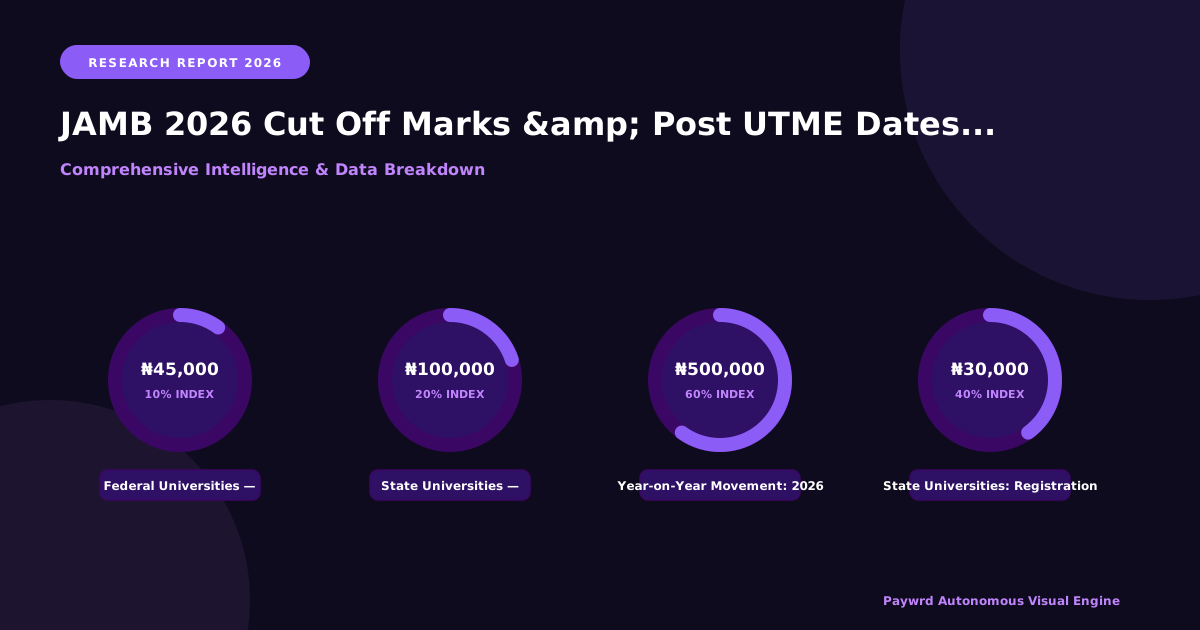
Key Takeaway: JAMB’s 2026 minimum cut-off marks are not one-size-fits-all. Federal universities generally require 140–180, elite programmes demand 200+, while private institutions set their own thresholds — all within NUC compliance floors. Knowing your tier before applying through JAMB CAPS is the single biggest advantage you can give yourself.
Official JAMB 2026 Minimum Cut Off Marks by Institution Tier
If you are targeting Nigerian tertiary admission in 2026, your first move is not filling the JAMB CAPS form — it is understanding the cut-off landscape. The Joint Admissions and Matriculation Board releases institution-specific minimum scores each cycle, and the 2026 thresholds clearly separate federal, state, and private universities into distinct competitive brackets. These official floors determine whether your profile even reaches the screening stage, so filtering by tier before you apply through the NUC CCMAS portal saves time and avoids wasted attempts.

Federal Universities — The Baseline and the Benchmarks
Federal universities in 2026 maintain a general minimum cut-off of 140 for basic admission eligibility, but this is the floor, not the target. Highly competitive programmes — medicine, law, pharmacy, and engineering at top federal institutions like UNILAG, UI, and FUTA — routinely demand scores of 200 and above. Mid-tier federal universities typically set their benchmarks between 160 and 180, depending on applicant volume and programme capacity.
- Baseline eligibility: 140 — qualifies you for screening at most federal institutions.
- Mid-competitive range: 160–180 — realistic for science and management programmes.
- Elite programmes: 200+ — essential for medicine, law, and top engineering courses.
State Universities — Variance and Catchment Advantages
State universities operate with wider variance. Many set their official minimum at 140–150, but the real differentiator is the catchment area adjustment. Institutions like Lagos State University (LASU) and Rivers State University (RSU) give significant score advantages to indigenes of the host state, sometimes effectively lowering the functional threshold by 10–20 points for qualifying candidates. Out-of-state applicants should therefore target scores of 170+ to remain genuinely competitive at popular state schools.
- Standard minimum: 140–150 for most state institutions.
- Catchment benefit: Indigenes may gain 10–20 point adjustments during post-UTME weighting.
- Safe target for non-catchment: 170+ to stay competitive.
Private Universities — Flexibility Within NUC Guardrails
Private universities enjoy more flexibility in setting cut-off marks, but they must still comply with NUC minimum accreditation thresholds. Most private institutions in 2026 set their floor between 140 and 160, though prestigious private universities like Babcock and Covenant University often demand 170–190 for their flagship programmes. Always verify the specific programme requirement on the institution’s official portal before submitting through JAMB CAPS.
- NUC compliance floor: Minimum 140 across all accredited private institutions.
- Prestige private schools: 170–190 for competitive programmes.
- Action step: Confirm programme-specific scores on the school’s official website.
Your 2026 strategy should be simple: identify your tier, hit or exceed the specific threshold, and prepare your post-UTME documents early. The JAMB CAPS portal and NUC CCMAS database are your authoritative sources — bookmark them now.
Departmental Aggregate Scores for High Demand Courses 2026
The general JAMB minimum is merely the gatekeeper. For Medicine, Law, Engineering, and Nursing across Nigeria’s top 20 universities — think UI, UNILAG, OAU, ABU, UNN, FUTA, and FUTO — the real cut-off lives at the departmental aggregate level. In 2026, we are seeing a continued hardening of scores. Medicine and Surgery at the University of Ibadan (UI) and University of Lagos (UNILAG) effectively demand aggregates of 78–82% (on the 100% scale), translating to JAMB scores north of 300 plus stellar Post-UTME performances. Law follows closely, rarely dipping below 72% at the premier federal institutions. Engineering disciplines (especially Electrical, Mechanical, and Computer) at FUTA, FUTO, and UNILAG typically settle between 68–75%, while Nursing Science has surged past 70% at UNN, OAU, and LASU due to quota restrictions and clinical placement bottlenecks.
Calculating Your Aggregate: The 2026 Weighting Formulas
Every university publishes a specific formula, but the industry standard for 2026 remains the 50:30:20 or 60:40 split. You must calculate yours before checking CAPS.
- UI / UNILAG / OAU (50:30:20 Model): (JAMB Score ÷ 8) × 0.50 + (Post-UTME Score ÷ 100) × 0.30 + (O’Level Points) × 0.20. O’Level points: A1=6, B2=5, B3=4, C4=3, C5=2, C6=1 (max 30 points for 5 subjects).
- UNN / ABU / FUTA (60:40 Model): (JAMB Score ÷ 400) × 60 + (Post-UTME Score ÷ 100) × 40. O’Level is often a screening qualifier (5 credits in 2 sittings) rather than a scored component here.
- LASU / DELSU / FUTO (Hybrid): Heavy JAMB weighting (60–70%) with Post-UTME making up the rest. O’Level grades act as tie-breakers.
Pro Tip: A JAMB score of 320 yields 40/50 in the UI model. You still need 85%+ in Post-UTME and near-perfect O’Levels (5 As) to hit the 78% Medicine threshold. Do the math before you pay for the Post-UTME form.
Year-on-Year Movement: 2026 vs 2026 Trends
Comparing the 2026 admission cycle (based on 2026/2027 session data released late 2026) against the previous year reveals three clear shifts. First, Nursing aggregates jumped 3–5 percentage points across the board — LASU Nursing moved from ~67% to ~72% — driven by NUC quota enforcement and the “Japa” effect creating artificial scarcity. Second, Engineering cut-offs stabilized at FUTA and FUTO after two years of inflation; the bubble has burst slightly as candidates pivot to Computing/IT courses. Third, Law at private universities (Babcock, Covenant, Afe Babalola) has decoupled from federal benchmarks, now sitting comfortably at 60–65% aggregates because they control their Post-UTME difficulty and applicant pools.
Bottom line: If your aggregate falls 3–5 points below the 2026 published departmental cut-off for your target course, do not bank on a “mercy list.” Adjust your course choice on JAMB CAPS now or prepare for a gap year. The 2026 data shows zero sentiment in competitive faculties.
Confirmed Post UTME Screening Timetable 2026 (Federal & State)
Now that you know your tier’s cut-off mark, the next battlefield is timing. Missing a Post UTME registration window in 2026 does not just cost you stress — it costs you admission. Below is the master calendar breaking down registration periods, screening formats, and result timelines across federal and state universities.
Federal University Registration Windows & Screening Dates
Most federal universities open Post UTME registration through their institutional portals and JAMB CAPS between May and July 2026. Screening exercises typically commence in June and run through September 2026, depending on catchment quotas and departmental capacity. Elite programmes such as Medicine at University of Ibadan and Law at University of Lagos often kick off screening earliest — sometimes mid-May — because of competitive candidate pools.
- Early-screening institutions (UI, UNILAG, UNN): Registration opens May–June; screening runs June–July.
- Mid-cycle institutions (ABU, UNIMAID, FUTA): Registration opens June–July; screening July–August.
- Late-cycle institutions (FUNAAB, FED-OTA, Michael Okpara): Registration opens July; screening August–September.
State Universities: Registration & Exam Schedule
State universities generally follow a slightly later timeline. Lagos State University (LASU) and Rivers State University (RSU) typically open registration in June, with CBT screenings in July. Institutions like Kano State University (KASU) and Imo State University often extend into August. Always confirm via the official university portal or JAMB CAPS — dates shift annually based on NUC academic calendars.
CBT vs Physical Screening Formats
The majority of federal and state universities now conduct Computer-Based Testing (CBT) for Post UTME, mirroring the JAMB UTME structure. However, some institutions still run physical screening involving written examinations on campus. CBT centres are accredited by the university and listed on their admissions page. Physical screenings require candidates to report to designated examination halls with original documents.
Required Documents for Screening
Regardless of format, carry or upload these essentials:
- JAMB 2026 admission slip (printed from CAPS)
- O’Level results (WAEC, NECO, or NABTEB) — at least five credits including English and Mathematics
- Birth certificate or declaration of age
- Local government identification letter (for state universities)
- Screening fee payment confirmation (typically ₦2,000–₦5,500 depending on institution)
Late Registration Penalties & Supplementary Screening
Most universities close registration strictly on the published deadline. Late applicants face penalties ranging from ₦5,000 to ₦10,000 surcharges, and some institutions outright reject late submissions. If you miss the primary window, select universities release supplementary screening lists — usually announced in August or September — for unfilled slots. These are genuinely your second chance, but slots are limited and competitive.
Result Release Schedule
Post UTME results are typically released two to four weeks after screening. Federal universities publish scores on their institutional portals and occasionally via JAMB CAPS. State universities vary — LASU releases within three weeks, while others may take up to six weeks. Check your applicant dashboard daily during this period.
Pro tip: Bookmark every university’s admissions page and set calendar alerts at least three weeks before each registration window opens. In 2026, the candidates who win are the ones who planned ahead.
Post UTME Registration Fees & Payment Channels for 2026
Once JAMB releases your candidate profile and you confirm eligibility through CAPS, the next financial step is paying your Post UTME registration fee. The cost varies by institution tier, and knowing exactly what to pay — and where — saves you from costly errors or missed deadlines.
Fee Breakdown: Federal vs State & Private Universities
Federal universities operate under a JAMB-mandated ceiling. The maximum registration fee for Federal institutions in 2026 is capped at ₦2,000. This applies across all federally-funded universities, from the University of Lagos to FUT Minna.
State and private universities set their own rates, which typically range from ₦2,000 to ₦5,000 or more. Some elite private institutions charge upwards of ₦5,500 depending on programme demand and facility costs. Always verify the exact fee on your target university’s official portal before initiating payment — never rely on third-party screenshots.
- Federal universities: up to ₦2,000
- State universities: ₦2,000–₦4,000 (varies by state)
- Private universities: ₦2,000–₦5,500+
Verified Payment Channels & Step-by-Step Guide
JAMB and most Nigerian universities now accept payments through three primary channels:
Remita — The most widely accepted gateway. After generating your payment reference on the university portal, select Remita as your payment option. Log in or create a Remita account, enter the reference number, choose your bank, and complete the transaction. Save the Remita receipt immediately.
Paystack — Increasingly adopted by universities for its speed. You pay directly via debit card or bank transfer through the university’s integrated Paystack checkout page. Confirmation is usually instant.
University Portal Direct Payment — Some institutions embed payment processing directly into their Post UTME portal. Generate your invoice, select your preferred bank, and follow the on-screen prompts to complete the transaction within the portal itself.
Regardless of channel, always confirm that your payment reflects on the institution’s portal before the registration deadline. Payment without portal confirmation is invalid.
Refund Policies & Double Payment Resolution
If JAMB disqualifies your candidacy after you have paid, most institutions will process a refund — but the timeline varies. Federal universities typically refund within 4–6 weeks through the original payment channel. State and private institutions may take longer, sometimes up to 12 weeks.
For double payments, do not panic. Visit the university’s bursary or admissions office with your duplicate Remita or Paystack transaction receipts. Submit a formal refund request. Most institutions resolve double payment cases within 3–8 weeks, provided you can verify both transactions with clear evidence.
Keep every digital receipt and confirmation email. These are your primary evidence for any refund or dispute resolution process throughout the 2026 admission cycle.
Catchment Area & ELDS Advantage: How 2026 Merit Lists Work
Every federal university in Nigeria builds its admission list on a strict quota formula mandated by the National Universities Commission (NUC). For the 2026 cycle, the mechanics remain: 45% Merit, 35% Catchment Area, and 20% Educationally Less Developed States (ELDS). Understanding this arithmetic is the difference between clearing a 220 departmental cut-off and sliding in at 185.
The 45/35/20 Split in Practice
When a department has 100 slots, 45 go to the highest JAMB scores nationwide regardless of state — pure merit. The next 35 seats are reserved for candidates whose state of origin falls inside the university’s designated catchment zone. The final 20 seats target applicants from ELDS, even if they sit outside the catchment map. A candidate who qualifies on both catchment and ELDS grounds effectively competes in three parallel pools simultaneously.
2026 ELDS List (Confirmed by NUC)
The following states retain ELDS status for the 2026/2027 admission cycle. If your state of origin appears here, flag it on your JAMB CAPS profile — it triggers the 20% quota automatically:
- Adamawa
- Bauchi
- Borno
- Bayelsa
- Benue
- Cross River
- Ebonyi
- Gombe
- Jigawa
- Kebbi
- Kogi
- Kwara
- Nasarawa
- Niger
- Plateau
- Rivers
- Sokoto
- Taraba
- Yobe
- Zamfara
Catchment Zones: Know Your University’s Map
Catchment areas are not uniform. The University of Ibadan prioritizes Oyo, Osun, Ogun, Ondo, Ekiti, and Lagos. Ahmadu Bello University leans heavily toward the North-West and North-Central. Nnamdi Azikiwe University favors the South-East. Before you lock in a course on JAMB CAPS, download the specific university’s 2026 admission policy PDF — usually posted on the school’s portal under “Admissions > Guidelines.” A 190 score in a catchment state often beats a 210 from a non-catchment state for the same course.
Strategic Swapping: Course & Institution Leverage
If your aggregate sits 15–20 points below the published merit cut-off for your dream course, pivot. Two high-ROI moves for 2026:
- Institution Swap: Target a federal university where your state is catchment. A candidate from Kebbi (ELDS + catchment for Federal University Birnin Kebbi) needs significantly lower scores than one applying to UNILAG from the same state.
- Course Downgrade within Same Faculty: Switch from competitive programmes (Medicine, Law, Engineering) to allied courses (Anatomy, Public Law, Agricultural Engineering) in the same faculty. The catchment/ELDS quota applies per department, so lower baseline cut-offs amplify the quota advantage.
Bottom line: Run your numbers against the 45/35/20 matrix before you pay the ₦2,500 change-of-institution/course fee on JAMB CAPS. The quota system is transparent — exploit the math, don’t guess.
Direct Entry (DE) 2026 Requirements & Screening Dates
If you already hold a diploma, NCE, or advanced level certificate, the 2026 Direct Entry (DE) window is your express lane into 200 or 300 Level — bypassing UTME entirely. But “express” does not mean “automatic.” JAMB and individual universities run parallel verification tracks, and missing a single transcript deadline or grade threshold will stall your admission for a full academic session.
Accepted Qualifications & Minimum Grade Thresholds
For the 2026 cycle, JAMB recognizes four primary DE categories. Your qualification must fall squarely within these bands; “pending results” or “awaiting verification” statuses will not hold a slot on CAPS.
- A’ Levels (GCE, Cambridge, IJMB, JUPEB): Minimum of two (2) ‘A’ Level passes in relevant subjects at grades A–E. For competitive courses (Medicine, Law, Engineering), most federal universities now demand a minimum of 8–10 points across three subjects (e.g., A=5, B=4, C=3, D=2, E=1). Two ‘O’ Level credit passes in English and Mathematics at not more than two sittings remain mandatory.
- National Diploma (ND): Minimum of Lower Credit (CGPA 2.50–2.99) from a recognized Polytechnic or Monotechnic. Upper Credit (3.00+) places you firmly in 200 Level for most courses; Lower Credit often restricts you to 200 Level entry only, with 300 Level reserved for Upper Credit/HND holders in related disciplines.
- NCE (Nigeria Certificate in Education): Minimum of Merit Pass (CGPA 3.00+) in relevant teaching subjects. A Pass grade (CGPA 2.50–2.99) is accepted only for specific Education courses in Colleges of Education affiliated to universities — rarely for mainstream faculty entry.
- HND / Bachelor’s Degree: Holders of HND (Lower Credit minimum) or a Third Class Degree enter at 200 Level. Upper Credit HND / Second Class Lower Degree qualifies for 300 Level entry in the same or closely allied discipline, subject to departmental vetting.
DE Registration Timeline & JAMB CAPS Protocol
The 2026 DE registration portal typically opens in mid-February 2026 and closes mid-April 2026 (exact dates confirmed via JAMB Bulletin). Unlike UTME, there is no CBT exam. You register at an accredited JAMB CBT centre, provide biometrics, and upload your credentials. The critical step: activate your JAMB CAPS profile immediately. Universities upload admission lists directly to CAPS; you must “Accept” or “Reject” within 72 hours or the offer lapses. Keep your profile code and email active — JAMB sends zero SMS reminders for DE CAPS updates.
University Screening & Transcript Deadlines
Post-registration, every university conducts a mandatory physical or virtual screening (aptitude test/oral interview/credential verification). Screening windows usually run May through July 2026. Federal universities (UI, UNILAG, OAU, ABU, UNN) often require original transcripts forwarded directly from the awarding institution — not student copies. Request transcripts by March 2026; processing takes 4–6 weeks. Private universities may accept certified photocopies initially but demand originals before matriculation.
Inter-University Transfer Protocols
Transferring between universities via DE (e.g., 200 Level UNILAG to 200 Level OAU) is technically a “Direct Entry” application. You need: (1) A CGPA of 3.50/5.00 minimum (varies by destination uni), (2) A release letter from your current Registrar, (3) Official transcript sent directly to the destination university’s Admissions Office, and (4) JAMB DE registration indicating “Transfer” as entry mode. NUC guidelines cap transfer admissions at 10% of departmental quota — apply early, as slots vanish by June.
Real Time Admission Status Tracking on JAMB CAPS 2026
Once JAMB releases your screening results and institutions begin making admission decisions, the JAMB Central Admission Processing System (CAPS) becomes the single most important portal you will interact with this year. Every offer, every acceptance, every printed letter flows through CAPS. If you are not checking it consistently, you risk missing deadlines that cannot be extended. Here is exactly how to navigate the 2026 workflow from offer to matriculation.
Accepting, Rejecting, and Printing Your Admission Letter
When a university uploads your name as an admitted candidate, CAPS will reflect an offer status. You must log in using your JAMB registration number and password, navigate to the admission section, and explicitly accept the offer. Acceptance is not optional if you want the admission to stand. Rejecting an offer frees up your slot for other institutions, but once you accept, the process locks in. After acceptance, CAPS generates your official admission letter, which you should download and print immediately. Keep both a digital and physical copy. Institutions and the National Youth Service Corps (NYSC) will request this document at various stages, and a missing letter can stall your entire enrollment.
Matriculation List Verification and NYSC Eligibility
After accepting your offer, JAMB publishes a matriculation list confirming all admitted students. Cross-check your name, JAMB registration number, and chosen institution against this list. If your details are incorrect, report the discrepancy through the JAMB CAPS helpdesk before the institution finalizes its records. Verified matriculation status is a prerequisite for NYSC mobilization. Once you complete your programme and meet the required academic credits, your CAPS records feed directly into the NYSC mobilization process. Any irregularity traced back to CAPS can disqualify you from the service corps queue, so treat every verification step seriously.
Troubleshooting ‘Admission in Progress’ vs ‘Not Admitted’ Statuses
The two most common CAPS statuses confuse candidates. “Admission in Progress” means your institution has not yet finalized the admission list. This is normal during screening periods and does not mean you have been rejected. Keep checking CAPS weekly. “Not Admitted” means the institution has explicitly passed over your application. At this point, you should immediately return to JAMB CAPS and accept offers from any other institution that has listed you, if available. Do not wait. Admission slots at competitive institutions fill fast, and the CAPS system operates on strict timelines. If technical errors appear, clear your browser cache, use a recommended browser, and contact the JAMB support desk through the official CAPS portal rather than third-party channels.
- Log into JAMB CAPS daily during admission cycles to catch updates early
- Accept offers immediately once confirmed to secure your slot
- Print your admission letter from CAPS and store multiple copies
- Verify your name and details on the published matriculation list
- Resolve any CAPS status discrepancies through official JAMB channels only
| Institution Tier | Official 2026 Minimum Cut-Off Range | Typical Post-UTME Screening Window 2026 | Average Annual Tuition Range (₦) | Admission Competitiveness Index | JAMB CAPS Offer Timeline |
|---|---|---|---|---|---|
| Federal Universities (Standard) | 140 – 160 | August – October 2026 | ₦45,000 – ₦120,000 | High (1:15+ applicant ratio) | September – November 2026 |
| Federal Universities (Elite Programmes: Med, Law, Eng) | 200 – 260+ | July – September 2026 | ₦45,000 – ₦120,000 | Very High (1:30+ applicant ratio) | August – October 2026 |
| State Universities | 150 – 180 | August – October 2026 | ₦100,000 – ₦250,000 | Moderate-High (Indigene preference applies) | September – November 2026 |
| Private Universities | 140 – 180 (Institution Discretion) | June – September 2026 | ₦500,000 – ₦3,500,000+ | Low-Moderate (Capacity driven) | July – October 2026 |
| Polytechnics & Colleges of Education | 100 – 120 | September – November 2026 | ₦30,000 – ₦80,000 | Moderate | October – December 2026 |
Frequently Asked Questions
What is the official JAMB 2026 minimum cut-off mark for federal universities in Nigeria?
The official JAMB 2026 minimum cut-off mark for federal universities is 140. However, competitive federal institutions and elite programmes like Medicine, Law, and Engineering typically raise their departmental benchmarks to between 200 and 260. Candidates must meet both the general floor and the specific departmental requirement to qualify for Post-UTME screening.
When will Post-UTME screening start for 2026/2027 admission in Nigerian universities?
Post-UTME screening for the 2026/2027 session typically commences in July 2026 for private universities and elite federal programmes. Federal and state universities generally open registration between August and October 2026. Exact dates vary by institution; candidates must monitor specific university portals and JAMB CAPS for official timetables.
Can I gain admission into a Nigerian university with a JAMB score of 160 in 2026?
Yes, a JAMB score of 160 meets the 2026 minimum benchmark for many federal and state universities, as well as most private institutions. However, admission is not guaranteed; you must apply for courses with cut-offs at or below 160, pass the Post-UTME screening, and secure a JAMB CAPS offer before the institution closes its admission list.
How do private university cut-off marks differ from public universities in 2026?
Private universities set internal cut-off marks at their discretion, often starting at the JAMB minimum of 140, but they are not bound by the same competitive departmental ceilings as public universities. While public universities enforce strict merit/catchment quotas driving scores above 200 for top courses, private institutions prioritize capacity and fee payment, rarely exceeding 180 for general programmes.
What is the deadline to accept admission offers on JAMB CAPS for 2026?
JAMB CAPS typically allows candidates to accept or reject admission offers from August 2026 through January 2027. However, individual universities set internal deadlines — often 2 to 4 weeks after an offer appears. Failure to click 'Accept' on CAPS before the institution's specific deadline results in automatic forfeiture of the slot for the 2026/2027 academic session.
Strategic Final Takeaway
When evaluating JAMB 2026 Cut Off Marks And Post UTME Screening Dates For All Nigerian Universities in 2026 and beyond, base your decisions on accredited institutional standards, verified return on investment (ROI), and up-to-date official guidelines. Always verify specific dates and requirements through official regulatory portals.