Key Takeaway: To secure admission into an AI programme at a top Nigerian university in 2026, you need a JAMB UTME score of at least 220, but aiming for 250+ is the real play. English, Mathematics, and Physics are non-negotiable — your fourth subject choice can make or break your aggregate score.
2026 JAMB UTME Subject Combination & Cut-Off Marks For AI Programmes
If you are targeting Artificial Intelligence degrees in Nigerian universities for the 2026/2027 session, getting your JAMB UTME subject combination right from the start is absolutely critical. AI programmes fall under the Physical Sciences and Engineering faculty clusters, which means the Joint Admissions and Matriculation Board has set a specific subject blueprint that every candidate must follow. There is no room for creative substitutions here.

The mandatory core subjects are English Language, Mathematics, and Physics. These three are compulsory across virtually every institution offering AI-related courses. Your fourth subject must come from a prescribed science or economics combo. The approved options include Chemistry, Biology, or Economics. Choosing Chemistry gives you the strongest alignment with most engineering-focused AI curricula, while Economics can boost your aggregate if you score significantly higher in it compared to Chemistry or Biology. Always consider your strongest subject when making this selection.
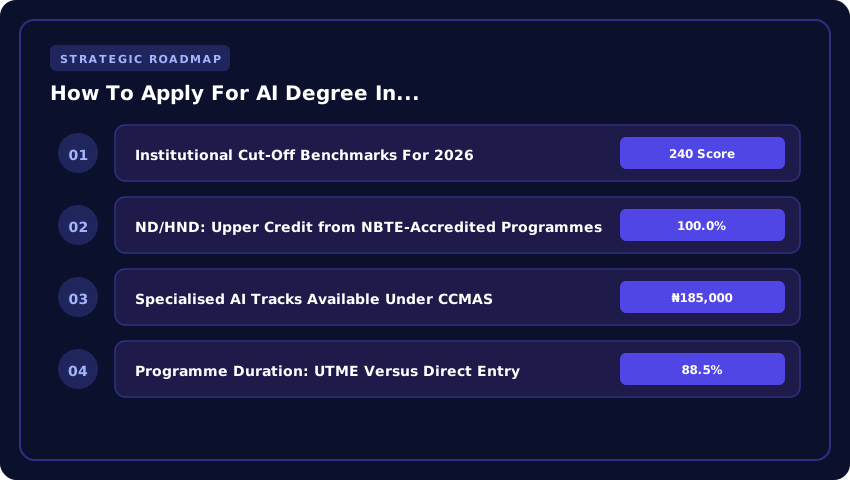
Institutional Cut-Off Benchmarks For 2026
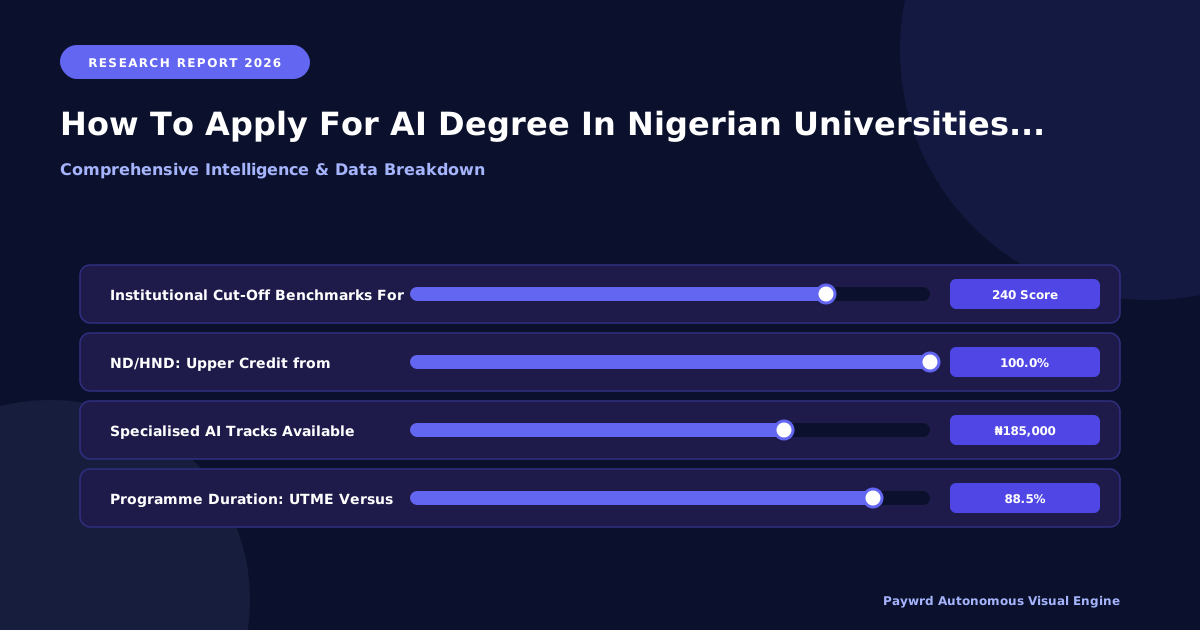
Cut-off marks vary by institution, and these benchmarks reflect the minimum JAMB scores you need to be eligible for Post-UTME screening. Meeting the cut-off does not guarantee admission — it simply opens the door.
- University of Lagos (UNILAG): 240 and above
- University of Ibadan (UI): 250 and above
- Federal University of Technology, Akure (FUTA): 220 and above
- Abubakar Tafawa Balewa University (BAUCHI): 200 and above
As a practical rule, candidates targeting UNILAG or UI should aim for scores well above the stated minimum. A 250+ JAMB score puts you in a competitive position across most federal universities offering AI programmes. At BAUCHI, the 200 threshold is more accessible, but competition has been rising steadily.
Post-UTME Screening Weightings & Aggregate Score Calculation
After your JAMB result, institutions conduct Post-UTME screenings that contribute significantly to your final aggregate. The standard formula most universities use is: Aggregate Score = (JAMB Score ÷ 8) + (Post-UTME Score × appropriate multiplier). Typically, JAMB contributes 50% and Post-UTME contributes 50% of the final admission score. Some institutions like UNILAG weight Post-UTME even more heavily, making that screening phase absolutely decisive.
Your Post-UTME often covers English, Mathematics, Physics, and your fourth subject. A weak performance here can erase a strong JAMB score. Register early through the official JAMB CAPS portal, prepare rigorously for the screening, and always verify your institution’s specific weighting formula on their admissions page before the 2026 registration window closes.
Direct Entry Pathways: A-Levels, ND/HND & IJMB Acceptance Criteria 2026
If you already hold a post-secondary qualification, the Unified Tertiary Matriculation Examination (UTME) is not your only route into an Artificial Intelligence degree. Nigerian universities running NUC-accredited AI programmes — such as UNILAG, OAU, FUTA, and the newer specialist faculties at FUTO and ABU — allocate significant admission quotas to Direct Entry (DE) candidates. For the 2026/2027 session, understanding the specific grade thresholds and subject mappings is the difference between entering at 200 Level or watching the admission list on JAMB CAPS without your name.
A-Level Requirements: The Gold Standard for 200 Level Entry
For candidates presenting GCE Advanced Level, Cambridge A-Levels, or equivalent (like NABTEB Advanced), the baseline is non-negotiable: you must possess three A-Level passes at minimum Grade C in Mathematics, Physics, and either Chemistry or Computer Science. A “Pass” (Grade D/E) in any of these core subjects will trigger an automatic disqualification during the departmental screening, regardless of your JAMB DE registration status. Universities like UNILAG and OAU often compute a points aggregate (A=5, B=4, C=3); targeting 12 points (three Cs) is the floor, but 14+ points (e.g., B, B, C) makes you competitive for merit slots in high-demand AI cohorts. Ensure your result is verified on the Cambridge Results Verification Service or the relevant exam body portal before you register on the JAMB DE portal.
ND/HND: Upper Credit from NBTE-Accredited Programmes
Holders of National Diploma (ND) or Higher National Diploma (HND) from NBTE-accredited polytechnics and monotechnics are eligible for advanced standing, but the grade ceiling is strict.
- ND Computer Science, Statistics, Computer Engineering, Electrical/Electronic Engineering, or Mathematics: Minimum of Upper Credit (CGPA 3.00 – 3.49 on a 4.0 scale). Lower Credit holders are generally restricted to 100 Level entry via UTME, though a few universities may consider them for 200 Level if they pass a rigorous departmental aptitude test.
- HND in same/relevant fields: Minimum of Upper Credit qualifies you for 300 Level (Direct Entry into Year 3). A Distinction strengthens your case for merit-based scholarships like NELFUND or PTDF.
- Industrial Training (IT): Your IT logbook and completion certificate must be presented during physical clearance. Missing IT documentation is a common reason for DE rejection at the faculty level.
Verify your institution’s accreditation status on the NBTE website before applying; qualifications from unaccredited programmes are void for DE admission.
IJMB & JUPEB: 13+ Points with Correct Subject Mapping
The Interim Joint Matriculation Board (IJMB) and Joint Universities Preliminary Examinations Board (JUPEB) remain popular pathways. For 2026 AI admissions, you need a minimum of 13 points across three relevant subjects: Mathematics, Physics, and Chemistry/Computer Science. The grading scale (A=5, B=4, C=3, D=2, E=1, F=0) means a combination like B, B, C (13 points) meets the threshold, but most competitive AI departments set their departmental cut-off at 14 or 15 points.
- Subject Mapping is Critical: “General Paper” or “English Language” points do not count towards the 13-point core requirement for STEM programmes. They are only used for tie-breaking.
- Entry Level: Successful IJMB/JUPEB candidates typically enter at 200 Level. Entry into 300 Level via IJMB is extremely rare and usually requires a separate university-specific conversion exam.
- Result Validity: IJMB/JUPEB results are typically valid for three years. A 2026 result is valid for 2026 admission; a 2026 result expires this cycle.
Pro Tip: Regardless of your qualification (A-Level, ND, HND, IJMB), you must register for JAMB Direct Entry (DE) via the JAMB portal (usually opens around March/April 2026). The DE registration generates the unique DE registration number required for university screening portals. Upload clear, certified copies of your transcripts and certificates during registration to avoid “Awaiting Result” limbo on CAPS.
NUC CCMAS-Accredited Universities Offering B.Sc. Artificial Intelligence 2026
Before you spend a single kobo on JAMB registration, you need to confirm that the university you are targeting actually holds full NUC CCMAS accreditation for the B.Sc. Artificial Intelligence programme. The 2026 academic year has seen a significant expansion, with over 13 federal universities now operating under the new CCMAS curriculum for AI. Studying at an unaccredited institution means your degree holds no weight on the NUC portal, so verify every claim through the official NUC CCMAS verification portal before applying.
Federal Universities With Full CCMAS Accreditation For AI (2026)
These institutions have received complete programme-level accreditation, not just departmental approval. The list covers a wide geographic spread across Nigeria:
- University of Lagos (UNILAG)
- Ahmadu Bello University (ABU), Zaria
- University of Ibadan (UI)
- Federal University of Technology, Minna (FUT Minna)
- Federal University of Technology, Akure (FUTA)
- University of Nigeria, Nsukka (UNN)
- Nnamdi Azikiwe University (UNIZIK), Awka
- Federal University, Oye Ekiti (FUOYE)
- University of Uyo (UNIUYO)
- Rivers State University (RSU), Port Harcourt
- Federal University, Lokoja (FUL)
- Usmanu Danfodiyo University, Sokoto (UDUS)
- Bayero University Kano (BUK)
Specialised AI Tracks Available Under CCMAS
Beyond the general B.Sc. AI degree, several of these universities now offer concentrated specialisation tracks from Year Three onward. Machine Learning focuses on predictive modelling and algorithm design. Robotics integrates hardware systems with intelligent control. Data Science emphasises statistical computing and big data analytics. Natural Language Processing covers computational linguistics and chatbot engineering. Your choice of track often depends on which electives you pick during the JAMB registration process, so choose wisely.
Programme Duration: UTME Versus Direct Entry
If you are entering through the 2026 UTME route, expect a standard four-year programme. Direct Entry candidates who qualify with A-level credits, ND upper credit, or a relevant diploma typically complete the degree in three years. Some institutions like FUT Minna and FUTA allow accelerated completion for DE students who enter directly into Year Two. Factor this into your planning because the cost difference over three versus four years is substantial when you account for tuition, accommodation, and living expenses in Nigerian universities.
Always cross-check accreditation status on the NUC CCMAS portal before committing. Admission into an accredited programme is your first real line of defence against diploma mills masquerading as legitimate institutions.
Step-by-Step 2026 Application Workflow: JAMB Portal to Matriculation
If you are targeting an Artificial Intelligence degree at a top Nigerian university, the 2026 admission cycle demands surgical precision. One wrong click on the JAMB portal can cost you an entire session. Here is the chronological workflow every serious candidate must follow.
Step 1: Profile Creation and NIN Linking
Start by creating your JAMB profile on the official CAPS portal. Use a valid email address and a strong password you can recover. Once your profile is live, link your National Identification Number (NIN) immediately. JAMB has made NIN linking mandatory — candidates without a linked NIN will be blocked from registration and screening exercises. You can verify your NIN status on the JAMB portal or through the NIMC website. Do not skip this step.
Step 2: e-PIN Purchase via USSD and Bank Channels
The 2026 JAMB e-PIN costs ₦5,000 for UTME registration. Do not buy from unverified third parties who promise discounts — they will leave you stranded. Purchase directly through JAMB’s official USSD code by dialing *800*888# from any Nigerian network. Alternatively, use Interswitch-enabled ATMs or your bank’s internet banking platform. After payment, confirm your PIN activation on the JAMB CAPS portal before selecting your institutions and courses.
Step 3: Course and Institution Change Protocol
After the 2026 JAMB Mock Examination, a window opens allowing you to change your course or institution of choice — but only before the official registration deadline, typically in early February. Log into your JAMB CAPS profile, navigate to the institution and course management section, and make your adjustments. Do not wait until the final day. Server congestion has historically crashed the portal days before deadlines, leaving candidates locked out. If you are switching into an AI programme, confirm that your target university accepts UTME candidates directly into the course and not exclusively through its Direct Entry pathway.
Step 4: Post-UTME Registration and Screening
Once your UTME results are released, each university opens its own Post-UTME registration portal. For the 2026 cycle, expect screening exercises between April and July. Key institutions handling AI-related programmes have specific document requirements:
- UNILAG — Monitor the university’s admissions portal for screening dates. Upload your O’Level results, JAMB result, and passport photograph in JPEG or PNG format, not exceeding 200KB.
- UI — The University of Ibadan opens Post-UTME registration on its admissions page. Prepare your birth certificate, O’Level results, and JAMB score sheet. Screening fee typically ranges from ₦2,000 to ₦3,500.
- FUTA — Federal University of Technology Akure runs screening through the JAMB CAPS system. Upload documents as specified on their admissions notice and confirm your O’Level results are already linked via the NECO or WAEC result checker portal.
Always cross-verify every uploaded document on the institution’s portal before your scheduled screening date. Missing or incorrectly formatted uploads are the leading reasons candidates get disqualified during the 2026 admission cycle. Stay on official portals, treat every deadline as though it will move forward — because it will.
Tuition Fees & NELFUND Loan Access For AI Students In 2026 (₦ Figures)
Funding an AI degree in Nigeria requires serious strategic planning, but the good news is that 2026 brings more financial support mechanisms than ever before. From government-backed loans to corporate scholarships, there are multiple paths to cover tuition costs. Here is everything you need to know about expected costs and funding options before you apply through JAMB CAPS or the NELFUND portal.
Sessional Fee Breakdown For AI Programmes
Tuition varies significantly across Nigerian institutions, and these figures exclude acceptance fees, accommodation, and other departmental levies. Below are the approximate sessional fees for AI-related programmes at leading universities for the 2026/2027 academic session:
- University of Lagos (UNILAG): ~₦120,000 per session
- University of Ibadan (UI): ~₦95,000 per session
- Federal University of Technology, Akure (FUTA): ~₦110,000 per session
- Abubakar Tafawa Balewa University (BAUCHI): ~₦85,000 per session
These represent baseline tuition costs. Your actual total expenditure will likely rise when you factor in laboratory charges, project fees, software licensing contributions, and departmental assessments that are common across computing and engineering faculties. Plan for an additional 15 to 20 percent on top of listed tuition.
NELFUND Student Loan: Eligibility & Portal Walkthrough
The Nigerian Education Loan Fund (NELFUND) now covers STEM courses, including Artificial Intelligence programmes at accredited institutions. To qualify, you need a confirmed admission letter, a valid means of identification, and a reliable guarantor who is typically a civil servant or verified professional. Visit the official NELFUND portal, create an account, complete the application form, upload your admission documents, and specify your course of study. Submit and wait for processing, which typically takes two to four weeks for approval.
Repayment Terms For STEM Graduates
NELFUND offers favourable conditions for STEM graduates. Repayment begins six months after programme completion, and interest rates are significantly lower than commercial bank loans. A grace period is also available for graduates pursuing further studies or awaiting employment confirmation. This makes it a practical bridge for students who need time to secure stable income after graduation.
Merit Scholarships Worth Applying For
Beyond loans, several competitive scholarships can offset tuition entirely for AI students in 2026:
- MTN Foundation Scholarship: Covers tuition and provides a monthly stipend for high-achieving students in technology-related courses
- NNPC/Total Scholarships: Targeted at STEM students, offering full academic funding and internship placements
- PTDF Scholarship: Supports students in engineering and allied programmes, including international study opportunities
- University-Specific AI Grants: Institutions like UNILAG and FUTA now offer departmental bursaries and AI-focused research grants for admitted students
Start your scholarship applications early. Most deadlines fall between January and March 2026, well before the main academic session begins. Do not wait until after securing JAMB admission to explore these options.
Career ROI & Industry Alignment: Why Nigerian AI Degrees Matter In 2026
Investing in an AI degree in Nigeria is no longer a speculative gamble — it is a calculated move backed by measurable returns. The 2026 labour market for machine learning engineers, data scientists, and AI researchers has hardened into one of the most lucrative corridors in the country’s tech ecosystem. If you are weighing whether this academic path is worth the time, fees, and JAMB stress, the numbers below should settle the debate.
Curriculum That Speaks the Global Language
The National Universities Commission (NUC) has, through its Centre for Corporate and Modular Accreditation System (CCMAS), actively mapped Nigerian AI and computer science curricula to internationally recognised certification frameworks. This means that by 2026, graduates from accredited programmes are not just walking out with a certificate — they arrive equipped with applied competencies aligned to TensorFlow developer standards, AWS Machine Learning Specialty benchmarks, and Microsoft Azure AI Engineer Associate pathways. These mappings are not cosmetic. Programmes at institutions like the University of Lagos, Ahmadu Bello University, and Covenant University now embed certification prep directly into semester coursework, reducing the need for expensive standalone bootcamps.
Entry-Level Salary Bands That Justify the Investment
The financial payoff is immediate. In Lagos and Abuja tech hubs, Junior Machine Learning Engineers commanding ₦250,000 to ₦450,000 per month is the current baseline for 2026 entry-level hires. Companies like Flutterwave, Interswitch, MTN Nigeria, and Andela consistently recruit from these pipelines, and salary figures have climbed roughly 18–25% since 2026 due to demand outpacing supply. Even remote roles servicing international clients now anchor Nigerian-based talent at competitive dollar-equivalent rates.
Mandatory SIWES & Industrial Training: Built-In Industry Access
One structural advantage many overlook is the mandatory SIWES (Students’ Industrial Work Experience Scheme) and Industrial Training (IT) components now integrated into AI degree programmes. NITDA hubs, Flutterwave’s engineering internship tracks, Interswitch’s payment intelligence divisions, and MTN Nigeria’s data science units actively host SIWES students each session. These placements are not rubber-stamp exercises — they function as extended interviews. A strong SIWES performance at any of these organisations frequently converts into a full-time offer before graduation.
- NUC CCMAS-aligned curricula embed TensorFlow, AWS ML, and Azure AI competencies into core coursework
- Junior ML Engineers in Lagos/Abuja earn ₦250k–₦450k/month as of 2026
- SIWES placements at NITDA hubs, Flutterwave, Interswitch, and MTN Nigeria provide direct hiring pipelines
- Industry-aligned training reduces the gap between academic theory and employer-ready skills
The bottom line: a Nigerian AI degree in 2026 delivers curriculum relevance, immediate earning power, and institutional pathways that most other degree tracks simply cannot match. The academic investment pays for itself — often within the first year of employment.
Strategic Final Takeaway
When evaluating How To Apply For Artificial Intelligence Degree In Nigerian Universities JAMB UTME Direct Entry Requirements in 2026 and beyond, base your decisions on accredited institutional standards, verified return on investment (ROI), and up-to-date official guidelines. Always verify specific dates and requirements through official regulatory portals.