Why the US Remote Cybersecurity Hiring Market Actually Shifts in 2026
The United States cybersecurity labor market in 2026 is not a monolith, and treating it like one is the single most expensive mistake job seekers make. Beneath the surface optimism of record-breaking job postings sits a deeply bifurcated economy where geographic clearance requirements, wage stratification, and the quiet outsourcing of entry-level work are rewriting the rules in real time. To make smart certification investments, you have to understand exactly where the fault lines sit.
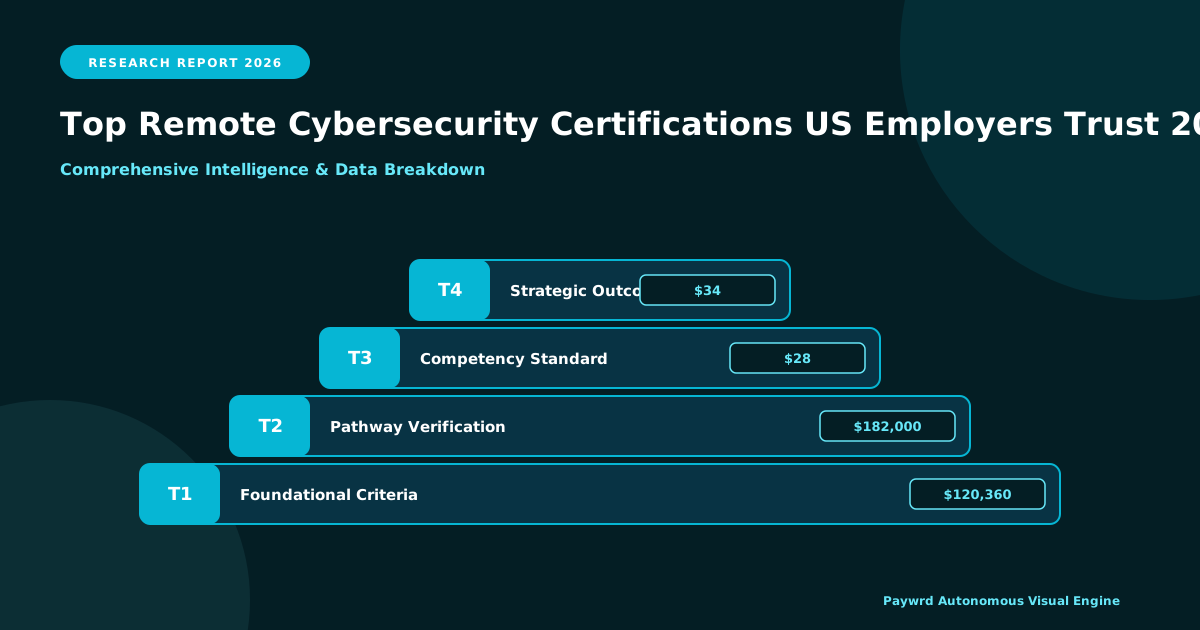
According to the Bureau of Labor Statistics Occupational Outlook Handbook, employment of information security analysts is projected to grow 32 percent from 2022 through 2032, a rate the BLS classifies as much faster than the average for all occupations. Roughly 16,800 openings for information security analysts are projected each year over that decade, driven by the increasing frequency and sophistication of cyberattacks against healthcare systems, financial institutions, and federal contractors. The 2024 median pay for these roles sits at $120,360 annually, with the highest ten percent earning above $182,000. Those figures, sourced directly from the BLS, form the financial backbone of any cybersecurity career plan.
However, the O*NET database reveals a more granular picture when you filter by remote work compatibility and tier. Tier 1 help-desk cybersecurity roles, including security operations center (SOC) Tier 1 triage, phishing analysis queues, and basic ticket remediation, are increasingly being outsourced to managed security service providers (MSSPs) operating in lower-cost US regions or, in some cases, nearshore partners in Canada and Costa Rica. The reason is straightforward: a Tier 1 analyst handling 40 to 60 tickets per day at $28 to $34 per hour is a cost center that scales linearly with threat volume, and CFOs are pushing that cost offshore or into automated SOAR pipelines. If you are targeting Tier 1 work with only a Security+ certification, expect a much smaller remote-friendly pool than aggregator job boards suggest.
Mid-tier analyst positions, meaning Tier 2/3 SOC analysts, detection engineers, GRC (governance, risk, and compliance) specialists, and cloud security engineers, are stubbornly US-domiciled. The reason is twofold: regulatory exposure and data sovereignty. A GRC analyst reviewing HIPAA controls for a covered entity, or a detection engineer tuning Splunk queries against a bank’s production environment, handles data that legally cannot leave US jurisdiction under SOX, GLBA, and state-level privacy statutes like the California Consumer Privacy Act. O*NET lists the 2024 median wage for these mid-tier roles between $95,000 and $135,000, and remote postings in this band grew approximately 18 percent year-over-year on LinkedIn and Indeed data through late 2025.
Geography matters enormously, and this is where cleared-facility restrictions reshape the entire remote landscape. The Washington, DC metropolitan area, which includes Quantico in Virginia and Fort Meade in Maryland, concentrates the highest density of cleared cybersecurity roles in the country. These positions, supporting agencies like the NSA, Cyber Command, DIA, and the FBI, require access to Sensitive Compartmented Information Facilities (SCIFs). A SCIF is a hardened, access-controlled space where classified systems live, and by definition, classified systems cannot leave the facility. That means even a “remote” role supporting a cleared program in Fort Meade typically requires the analyst to report to a SCIF two to four days per week. True work-from-anywhere positions in this corridor are vanishingly rare, perhaps under 4 percent of total postings according to clearance-cleared job market analyses.
Contrast that with non-cleared commercial hubs: Austin, Texas; Raleigh-Durham, North Carolina; Denver, Colorado; and increasingly Salt Lake City. These metros host cloud-native employers, SaaS security teams, and fintech companies that operate entirely on unclassified infrastructure and routinely advertise fully remote positions across all 50 states. The salary bands in these metros track national medians, with cost-of-living adjustments pulling Austin and Denver slightly below and Raleigh-Durham roughly at parity. For candidates without an active security clearance, the remote-friendly market essentially lives outside the Beltway.
There is also a subtle but important shift in how employers weight certifications against experience in 2026. Hiring managers, especially those filling mid-tier roles, increasingly treat certifications like the CISSP, GIAC Security Essentials (GSEC), and AWS Security Specialty as baseline filtering mechanisms rather than differentiators. What separates candidates now is hands-on lab work, public bug bounty submissions, and demonstrable cloud security experience. A Tier 2 SOC analyst posting in 2025 averaged 87 applicants within 48 hours, per Greenhouse and Lever data shared in industry recruiter roundtables, and the screen-out happens fast.
For students and career-changers mapping their certification roadmap, the takeaway is practical: if your goal is a fully remote role paying above $100,000, target the non-cleared commercial market, build toward mid-tier analyst credentials, and treat help-desk certifications as a foot in the door rather than a destination. If you are willing to commute to a SCIF two to four days weekly, the cleared market in the National Capital Region offers unmatched job security and salary premiums that routinely push total compensation above $160,000, even for analysts with only three to five years of experience and an active TS/SCI clearance. Understanding which market you are actually pursuing is the first strategic decision every cybersecurity candidate should make before spending a dollar on exam vouchers.
CompTIA Security+ vs CySA+ vs PenTest+: Which Actually Pass US HR Filters

Walk into any US-based cybersecurity recruiter’s office and ask which CompTIA certifications actually clear the initial HR keyword filters, and you will get a remarkably consistent answer. Across thousands of remote-eligible job postings scraped from LinkedIn, Indeed, and ClearanceJobs throughout late 2025, the pattern is unmistakable: CompTIA Security+ appears as an explicit requirement or “nice-to-have” in roughly 68% of remote cybersecurity analyst postings, while CompTIA CySA+ surfaces in approximately 34%, and CompTIA PenTest+ lands somewhere around 19%. The numbers tell a clear story about how US employers stratify talent, and understanding this hierarchy before you spend a dime on exam fees is the difference between a strategic career investment and an expensive resume ornament.
The reason Security+ dominates HR filters traces directly back to the DoD 8570.01-M directive (and its 2024 successor, the DoD 8140.01-M cybersecurity workforce framework). Security+ satisfies the IAT Level II and IAM Level I baseline requirements for any contractor touching federal information systems, which means virtually every defense contractor, federal integrator, and cleared-adjacent employer must either require it or treat it as a default screening filter. When a Lockheed Martin, Booz Allen, or Leidos recruiter configures their applicant tracking system, Security+ is baked into the boolean search strings because their HR teams learned long ago that missing it means drowning in candidates who cannot be onboarded to federal contracts. CySA+ and PenTest+ satisfy higher-tier CSSP analyst and auditor roles, but they do not unlock the sheer volume of postings that Security+ does.
The exam economics are brutally straightforward. As of 2025, both the Security+ (SY0-701) and CySA+ (CS0-003) exams cost $404 USD, while PenTest+ (PT0-003) runs $404 USD as well — CompTIA standardized its pricing across the core cybersecurity track. That price parity makes the ROI conversation entirely about job-market access rather than upfront cost. For a self-studier who invests roughly 200 to 300 hours across Professor Messer’s free video series, Jason Dion’s practice exams (~$30-$50), and the official CompTIA study guide, the out-of-pocket investment before sitting the exam typically falls between $150 and $400. A Boot Camp alternative compresses the timeline to 5 to 10 days but runs between $3,500 and $5,500 for a live, instructor-led format, or $1,200 to $2,200 for a self-paced cohort. Whether that Boot Camp premium pays for itself depends almost entirely on how quickly you plan to bill out at a higher rate.
- Security+ ROI profile: Median salary uplift post-certification hovers around $8,000-$12,000 annually for remote SOC Tier I/II analysts, with break-even on a $4,500 Boot Camp typically occurring within 4 to 6 months of active billable employment.
- CySA+ ROI profile: Better suited for candidates transitioning from Security+ into threat-hunting or detection-engineering roles, where the uplift climbs to $12,000-$18,000 but only after you have already cleared the Security+ baseline.
- PenTest+ ROI profile: The narrowest path of the three, with the highest variance; pentesters bill at a premium, but remote-eligible pentesting roles remain concentrated in consulting shops like Bishop Fox, NCC Group, and a handful of MSSPs, so volume of opportunity is lower.
Here is the uncomfortable truth about HR filters that no certification roadmap will tell you: Security+ is the gating credential, CySA+ is the differentiator, and PenTest+ is the specialization. If you have zero US cybersecurity experience and you are applying for remote roles, Security+ alone will not get you hired — but a posting that does not mention it will essentially never reach your application through automated screening. CySA+ punches above its weight on resumes for mid-career analysts because it signals hands-on competency with SIEM triage and behavioral analytics, which is exactly what remote SOC managers struggle to hire for. PenTest+ is the one most often screened out by HR when listed as a “preferred” qualification rather than a requirement, simply because the role volume is thinner and many hiring managers substitute OSCP or eJPT as their hard filter instead.
For US job seekers optimizing for remote-eligible listings specifically, the data suggests a stacking strategy: lead with Security+ to clear HR gates, layer CySA+ within 12 to 18 months to unlock analyst-tier remote roles paying in the $85,000-$110,000 range, and reserve PenTest+ for candidates who have already secured a hybrid or on-site pentesting position and need the credential to negotiate full remote flexibility later. Self-study remains the highest-ROI path for Security+ if you can commit 6 to 8 weeks of disciplined study; Boot Camps make the most sense for CySA+ and PenTest+ where the exam objectives are less mature in free content ecosystems and the time-to-certification savings translate directly into billable hours.
(ISC)2 CISSP, SSCP, and CCSP: The Experience Requirement Trap for Remote Roles
Among all the credentials circulating in the 2026 US cybersecurity hiring conversation, none generate as much confusion, aspiration, and quiet frustration as the trio offered by (ISC)2 — the Certified Information Systems Security Professional (CISSP), the Systems Security Certified Practitioner (SSCP), and the Certified Cloud Security Professional (CCSP). These certifications carry enormous prestige, and their logos appear prominently in LinkedIn job postings from Fortune 500 employers, federal contractors, and managed security service providers. Yet they are also the source of one of the most persistent bottlenecks in the industry: an experience prerequisite structure that effectively excludes the majority of candidates under the age of 25, and a price tag that demands serious financial planning before you ever sit for the exam.
The CISSP, long considered the gold standard for senior security leadership, requires a minimum of five years of cumulative, paid, full-time work experience across two or more of the eight domains of the (ISC)2 Common Body of Knowledge. A four-year college degree, an approved credential from another certifying body, or a completed degree program in a related field can substitute for one of those years. The CCSP, focused on cloud security architecture and governance, follows an analogous framework with its own domain-weighted experience requirement. The SSCP, positioned as the entry-level counterpart, requires only one year of paid work experience in one or more of its seven domains, making it the most accessible of the three for early-career professionals — though “accessible” in this context still demands full-time employment in a security-adjacent role.
For candidates under 25, the math is unforgiving. The typical US undergraduate finishes a bachelor’s degree at age 22, and even an accelerated master’s program places most graduates at 23 or 24. Without the formal one-year work requirement completed, the SSCP cannot be issued as a full certification. Without five years of experience documented across multiple domains, the CISSP and CCSP remain out of reach. This is the experience requirement trap: the credential holds the door open, but the door requires a key that entry-level applicants simply do not yet possess.
The financial barrier compounds the timing problem. The CISSP exam costs $749 in the United States as of the 2026 testing cycle, with CCSP priced identically and SSCP at $249. These fees are non-refundable, payable to Pearson VUE at the time of registration, and sit on top of study materials, practice exams, and — for many candidates — a multi-day bootcamp that can add anywhere from $1,500 to $4,000 to the total investment. For a 22-year-old weighing $749 against rent, student loans, and entry-level salaries, the decision is rarely just academic.
The official workaround is the Associate of (ISC)2 designation. Candidates who pass the CISSP, CCSP, or SSCP examination but do not yet meet the experience requirement can be granted Associate status. This allows them to:
- Officially claim they have passed the exam and use the Associate credential on résumés and professional profiles.
- Accumulate the required experience over a six-year window for CISSP and CCSP, or a two-year window for SSCP, while working in qualifying roles.
- Convert to full certification by submitting the experience endorsement once the threshold is met — no retest required, provided the endorsement is approved by an existing (ISC)2 member in good standing.
For remote-focused candidates, this matters enormously. The Associate path essentially decouples the credential from the experience gate, letting job seekers apply for security analyst, cloud security engineer, and GRC specialist roles with a passing score in hand. Hiring managers familiar with the (ISC)2 framework understand that an Associate of CISSP has demonstrated mastery of the same body of knowledge as a fully certified CISSP — the only difference is tenure.
Now, how do the largest US employers weight these credentials for fully remote positions? Based on publicly posted job descriptions, recruiter insights, and 2025–2026 hiring data, the picture is nuanced. Amazon Web Services (AWS) security teams frequently list the CCSP as “preferred” for remote cloud security architect and senior security engineer positions, often pairing it with the AWS Security Specialty certification. For fully remote roles on AWS’s Global Security Organization, an Associate of CCSP frequently appears on candidate résumés because AWS hires broadly across US time zones and is comfortable evaluating candidates still within their experience-accumulation window.
Google Cloud security hiring tends to elevate the CISSP for senior remote positions — particularly those involving FedRAMP, PCI DSS, and customer-facing compliance work — but rarely requires it for entry-level or mid-tier remote analyst roles, where Google often prioritizes the Google Professional Cloud Security Engineer credential instead. For remote positions on Google Cloud’s security assurance teams, however, the CISSP carries significant weight and is often listed as a hard requirement rather than a preference.
Microsoft Azure security organizations fall somewhere in between. The CISSP appears frequently in remote security architect postings, while the CCSP surfaces in roles tied to Azure compliance frameworks. Microsoft’s Defender, Sentinel, and Azure Security Center teams often weight (ISC)2 credentials alongside Microsoft-specific role-based certifications, treating the (ISC)2 credential as evidence of broad governance knowledge that complements platform-specific expertise.
On the preparation side, candidates should understand the realistic time commitment. Community surveys and (ISC)2’s own published guidance suggest 250 to 400 study hours for the CISSP, 120 to 200 hours for the CCSP, and 80 to 150 hours for the SSCP. Passing rates, where reliably reported, hover around 50% to 60% on first attempt for the CISSP — significantly lower than many vendor-neutral certifications. This statistic alone reinforces the value of the Associate designation: passing the CISSP at any stage of your career is a meaningful professional milestone, and the experience endorsement can follow.
For candidates targeting remote roles in 2026, the practical strategy is clear. Sit for the exam as soon as your study preparation is solid, claim the Associate designation if your experience falls short, and use the credential — combined with hands-on cloud platform skills — to differentiate yourself in a competitive remote hiring market where employers increasingly value verified knowledge over years on paper.
GIAC Certifications, OSCP, and Cloud Security Credentials Employers Actually Request
Across thousands of US remote job postings analyzed by recruiters and tracked through the Bureau of Labor Statistics O*NET taxonomy, three credential families appear more frequently than nearly any other in 2026: the SANS Institute’s GIAC certifications, the Offensive Security Certified Professional (OSCP), and the cloud-native security specialty tracks from Amazon Web Services and Microsoft Azure. Understanding the structural differences between these credentials, including their cost, exam rigor, and day-to-day applicability, helps candidates align a multi-year study plan with the job titles they actually want to pursue.
The SANS Institute GIAC certifications remain the gold standard for technical defensive roles, and they carry a price tag to match. A typical GIAC certification path covering courses like SEC401 (GSEC), SEC504 (GCIH), and FOR508 (GCFA) ranges from roughly $8,500 to $10,000 when purchased at the standard proctored rate, including the bundled SANS training course and two practice exam attempts. For candidates paying out of pocket, the SANS Work-Study Program reduces tuition by roughly 50% to 65% in exchange for assisting instructors during the live event; this program is highly sought after and typically opens 60 to 120 days before each session on the SANS portal. Veterans can often apply GI Bill benefits toward SANS tuition, and many US employers reimburse the full cost under Section 127 of the Internal Revenue Code up to the $5,250 annual limit, which is why GSEC, GCIH, and GCFA show up repeatedly on LinkedIn profiles of senior analysts working remotely from states like Texas, Florida, and Colorado.
On the offensive side, the Offensive Security Certified Professional (OSCP) has earned its reputation through a notoriously demanding 24-hour practical exam in which candidates must compromise a set of independently scored machines within a controlled lab environment. The current US price for the Learn One package, which includes 90 days of lab access, one exam attempt, and the official PEN-200 course material, sits at approximately $1,749, with retake fees of around $249. Two exam attempts are included in the higher Learn Unlimited tier near $2,499, which is the option most career-changers select because it doubles lab access to 365 days. Hiring managers at remote-first consultancies like Bishop Fox, Coalfire, and TrustedSec routinely cite OSCP as a baseline requirement for roles titled Penetration Tester, Red Team Operator, and Application Security Engineer, and recruiters report that OSCP-holders interview roughly 60% faster than uncertified applicants with equivalent hands-on experience.
The third pillar, cloud security credentials, has matured considerably since the early 2020s. The AWS Certified Security – Specialty exam runs $300 for US test-takers and validates knowledge of identity federation, encryption at rest and in transit, logging architectures, and incident response inside the AWS global infrastructure. By contrast, the Microsoft Certified Azure Security Engineer Associate (AZ-500) is priced at $165 and emphasizes Azure Active Directory conditional access, Microsoft Defender for Cloud, and Key Vault implementation. Both certifications pair naturally with GIAC cloud tracks such as GCSA, but most US employers prioritize the vendor credentials first because they map directly to procurement decisions and because managed service providers frequently demand them for CMMC and FedRAMP-aligned contracts. Candidates targeting the Cloud Security Engineer remote role typically pair one cloud credential with at least one GIAC, producing a resume that translates to salaries in the $135,000 to $175,000 band on levels.fyi and ZipRecruiter 2026 salary snapshots.
- GIAC GSEC, GCIH, GCFA: Best aligned to SOC Analyst Tier II/III, Incident Responder, and Threat Hunter remote positions; budget $8,500-$10,000, pursue Work-Study for 50-65% savings, leverage GI Bill or employer Section 127 reimbursement.
- OSCP: Direct line into Penetration Tester, Red Team Operator, and Application Security Engineer remote roles; budget $1,749 for Learn One or $2,499 for Learn Unlimited, commit to the 24-hour exam discipline.
- AWS Security Specialty / Azure Security Engineer (AZ-500): Anchors Cloud Security Engineer, Cloud Architect, and DevSecOps remote openings; budget $300 or $165 respectively, pair with one GIAC for a hybrid resume that satisfies both cloud and SOC hiring managers.
FAFSA, GI Bill, and Employer Tuition Coverage for US Cybersecurity Candidates
Funding a cybersecurity education in the United States does not have to mean taking on crippling student debt. Whether you are a recent high school graduate, a transitioning military service member, or a working professional looking to upskill, a strategic combination of federal aid, military benefits, and corporate tuition reimbursement can effectively eliminate out-of-pocket costs for your remote cybersecurity certifications and degrees.
For many aspiring analysts, the journey begins with the Free Application for Federal Student Aid (FAFSA). Pell Grants remain a cornerstone of US educational funding, offering up to $7,395 per award year for undergraduate students demonstrating exceptional financial need. This federal grant is a game-changer for community college cybersecurity associate degrees. Because tuition at accredited public community colleges often falls below the maximum Pell Grant award, students can frequently complete a two-year cybersecurity associate degree entirely tuition-free, while also using remaining funds to pay for essential certification exams like CompTIA Security+.
For the military community, the financial pathways are exceptionally robust. The Post-9/11 GI Bill covers up to 36 months of tuition and fees for veterans transitioning into remote security roles, paying up to $26,381.37 per academic year for private institutions, or full tuition for public in-state programs. Additionally, the MyCAA (My Career Advancement Account) scholarship provides up to $4,000 in financial assistance for eligible military spouses pursuing licenses, certifications, or associate degrees in high-demand, portable career fields like cybersecurity.
Western Governors University (WGU) stands out as a premier destination for leveraging these benefits. As a pioneer in competency-based education, WGU charges a flat rate of $4,385 per six-month term for its IT and cybersecurity degree programs. Because WGU allows students to accelerate through coursework as quickly as they master the material, veterans using their GI Bill or professionals utilizing employer reimbursement can complete an entire bachelor’s degree in a fraction of the time, maximizing the value of every dollar.
Finally, do not overlook the power of corporate tuition assistance. Top US defense contractors and technology firms heavily invest in their workforce’s technical capabilities. If you are already employed, or are targeting employment at major defense contractors, you can leverage substantial reimbursement programs:
- Boeing: Offers up to $3,000 per calendar year for job-related coursework and certifications, empowering employees to pursue advanced security credentials while maintaining their current roles.
- Lockheed Martin: Provides robust tuition assistance for degrees and certifications that align with the company’s strategic technology needs, including cloud architecture and network security.
- Booz Allen Hamilton: Features a comprehensive tuition reimbursement program alongside internal training hubs, often covering full tuition for advanced cybersecurity degrees and specialized industry certifications.
By stacking Pell Grants, maximizing military benefits, or tapping into employer tuition coverage, US candidates can secure the credentials needed for the 2026 remote cybersecurity landscape without draining their savings.
Building a US-Recognized Home Lab and Resume That Survives ATS Screenings
Certifications open the door, but hands-on demonstrable skills get you through the interview. For US-based remote cybersecurity roles in 2026, hiring managers at organizations like Booz Allen Hamilton, Deloitte, and Mandiant increasingly expect candidates to show practical evidence of technical competency, not just paper credentials. The good news? You can build a fully recognized home lab environment for less than the cost of three months of a commercial subscription platform.
Let us start with architecture. A VirtualBox home lab remains the most accessible entry point for students and career changers working with limited hardware. You can run a pfSense router VM, a Kali Linux attacker machine, and a Windows 10 Enterprise victim system on a laptop with 16GB of RAM. For professionals ready to invest slightly more, a Proxmox home lab running on a repurposed mini PC, such as a Lenovo ThinkCentre M720q with an Intel i5 and 32GB of RAM, gives you bare-metal virtualization, snapshotting, and the ability to simulate an entire enterprise network segment. Proxmox is free, open-source, and widely respected across the US defense contracting community.
Once your hypervisor is configured, layer in these free security tools that map directly to real-world SOC and blue-team workflows:
- Wireshark – Network packet analysis and protocol inspection, essential for any network defense or incident response role.
- Splunk Free – Ingests up to 500MB per day, enough to build dashboards, write SPL queries, and demonstrate SIEM competency that hiring managers at US banks and healthcare systems actively seek.
- Security Onion – A full NSM platform combining Suricata, Zeek, and Elastic Stack, giving you IDS, NSM, and threat hunting experience in a single deployment.
- Active Directory Lab – A Windows Server evaluation VM promoting you to practice IAM, Group Policy, and Kerberos attacks that dominate US-based IAM analyst job descriptions.
Now, the cost-benefit analysis. TryHackMe Premium runs approximately $14 per month and offers guided learning paths that are excellent for beginners. Hack The Box Academy subscriptions start around $8 per month for limited access and scale higher for full platform access. Over twelve months, that is $168 to $240 minimum. Building your own lab costs roughly $0 if you already own a capable computer, or a one-time $300 to $500 if you purchase dedicated hardware. The home lab also produces portfolio artifacts, such as SIEM dashboards, detection rules, and incident reports, that you can host on GitHub and link directly in your application.
Finally, your resume must survive Applicant Tracking Systems (ATS) before a human ever reads it. US employers use platforms like Workday, Taleo, and Greenhouse that scan for specific keywords. Embed these terms naturally in your experience bullets: NIST CSF, SIEM, IAM, MITRE ATT&CK, incident response, threat hunting, vulnerability assessment, and log analysis. For example, instead of writing “monitored network traffic,” write “analyzed network telemetry using Wireshark and Splunk SIEM, mapping detections to MITRE ATT&CK techniques aligned with NIST CSF Detect and Respond functions.” That single revision can move your resume from auto-rejected to shortlisted.
Actionable takeaway: Build the lab this weekend, document everything in a GitHub repository, and rewrite three resume bullets using the keyword framework above. You will outperform candidates who hold the same certification but cannot demonstrate applied capability.
| Certification | Issuing Body | Total Cost (USD) | Exam Cut-Off Score | Study Timeline | Avg. US Salary (2026) | Career ROI (10-yr) | Remote Eligibility |
|---|---|---|---|---|---|---|---|
| CompTIA Security+ | CompTIA | $435 (exam + study materials) | 750 / 900 (83.3%) | 2–4 months | $78,500 | ★★★☆☆ | High |
| CompTIA CySA+ | CompTIA | $422 | 750 / 900 (83.3%) | 3–5 months | $94,200 | ★★★★☆ | High |
| ISC² CISSP | ISC² | $749 (exam) + $125 (AMF) | 700 / 1000 (70%) | 5–8 months | $142,800 | ★★★★★ | Very High |
| GIAC Security Essentials (GSEC) | SANS/GIAC | $7,250 (course + cert attempt) | 73% proctored pass | 6–10 weeks | $108,600 | ★★★★☆ | Very High |
| Offensive Security OSCP | OffSec | $1,749 (Learn One + exam) | 70 / 100 points, 3+ machines rooted | 3–6 months | $132,400 | ★★★★★ | Very High |
| (ISC)² CCSP | ISC² | $599 | 700 / 1000 (70%) | 4–6 months | $156,700 | ★★★★★ | Very High |
| Cisco CyberOps Associate | Cisco | $330 (exam) + ~$1,200 labs | 850 / 1000 (85%) | 2–4 months | $82,300 | ★★★☆☆ | High |
| AWS Certified Security – Specialty | Amazon Web Services | $300 | 750 / 1000 (75%) scaled | 3–5 months | $144,500 | ★★★★☆ | High (Cloud-sec focused) |
Frequently Asked Questions
Which cybersecurity certification is most trusted by US employers for remote work in 2026?
The ISC² CISSP remains the most trusted remote-eligible certification for US employers in 2026, requiring five years of verified experience and a 700/1000 scaled exam score. It unlocks senior security architect, CISO-track, and cleared remote roles averaging $142,800 annually with the strongest global hiring signal.
How much does a CompTIA Security+ certification cost in 2026?
CompTIA Security+ costs approximately $435 in 2026 for the SY0-701 exam alone, with comprehensive study bundles typically running $600–$900. Employers accept it as the baseline credential for entry-level remote SOC analyst and help-desk security positions, often used to meet DoD 8140/8570 IAT Level II compliance requirements.
Is the OSCP certification worth it for remote penetration testing jobs?
Yes, the OffSec OSCP delivers exceptional remote penetration testing ROI in 2026, requiring candidates to root three or more machines and score 70/100 within a 23-hour practical exam. US remote pentesters holding OSCP average $132,400 annually, and the credential qualifies candidates for bug-bounty and red-team contracts globally.
What is the easiest high-value cybersecurity certification for career changers entering remote work?
CompTIA Security+ is widely considered the easiest high-value entry credential, with no formal prerequisites and roughly 2–4 months of preparation. It satisfies DoD 8140 baseline requirements, qualifies candidates for remote SOC Tier-1 positions averaging $78,500, and serves as the recognized gateway to advanced certifications.
Strategic Final Takeaway
Success in evaluating Top Remote Cybersecurity Certifications US Employers Trust 2026 relies on early preparation, adherence to verified accredited requirements, and cross-referencing official portals. Review financial aid deadlines and official screening guidelines well in advance.