Official 2026 Disbursement Timeline: What NELFUND Has Confirmed
Let us cut through the noise on WhatsApp groups and X (formerly Twitter): there is no single “payday” for the 2026/2027 academic session. The Nigerian Education Loan Fund (NELFUND) operates on a continuous batch-processing model, not a salary-style calendar. Managing Director Akintunde Sawyerr has repeatedly clarified via official channels—including the NELFUND portal and verified press briefings—that the 2024/2025 backlog clearance remains the operational prerequisite before the fresh 2026 cycle gains full momentum.
Here is the distinction that saves you sleepless nights: Application Approval ≠ Fund Release. When your dashboard flips to “Approved,” it means your data (JAMB registration number, NIN, BVN, and admission letter) has passed algorithmic validation. The actual credit alert—covering institutional charges (tuition) paid directly to your school and the ₦20,000 monthly upkeep paid to your linked bank account—only fires after your institution’s Bursary/Student Affairs unit uploads a verified Nominal Roll confirming you are a bona fide, registered student for the current semester.
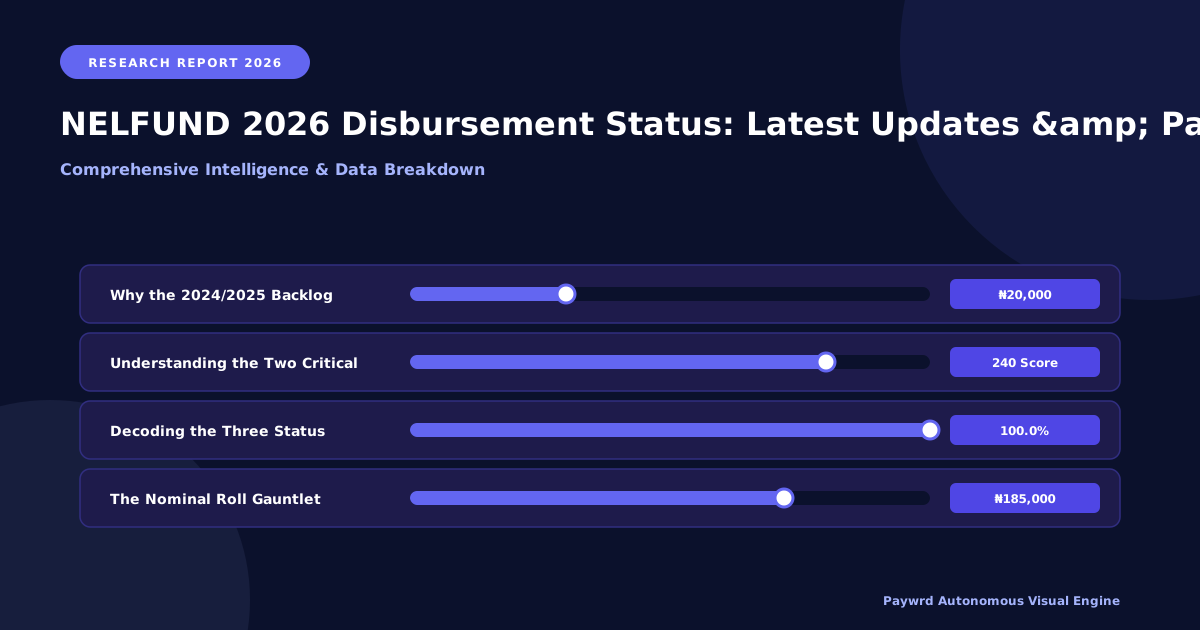
Why the 2024/2025 Backlog Dictates Your 2026 Timeline
The Fund’s capital allocation for the current fiscal year is heavily front-loaded to settle the pilot phase cohorts (2024/2025) whose institutional verification lagged due to ASUU strikes, delayed academic calendars, and BVN/NIN mismatches. Until those “legacy” batches are zeroed out, the treasury prioritizes them. This means:
- Institutional Verification is the Bottleneck: If your school has not submitted its validated student list for the 2024/2025 session on the NELFUND Institutional Portal, your 2026 application sits in a virtual queue.
- Session Alignment Matters: NELFUND aligns disbursement with the NUC-approved academic calendar (CCMAS). If your university runs a “2024/2025 session” that spills into Q1 2026, you are technically in the backlog, not the fresh 2026/2027 cycle.
- No “First-Come, First-Served” for Disbursement: Applying on Day 1 of the portal opening (typically announced mid-year) guarantees processing priority, not payment priority. Payment follows institutional sign-off.
Actionable Intelligence: Ignore rumors of “January 2026 mass payment.” Log into your NELFUND Student Dashboard weekly. If your status reads “Awaiting Institutional Verification,” your next move is the Dean of Student Affairs or Bursar’s office—not the NELFUND helpdesk. The Fund has decentralized the trigger; your school holds the gun.
Real-Time Portal Status: Checking Your Application Stage in 2026

If you submitted your NELFUND application and are now refreshing your dashboard every five minutes wondering when the money hits your account, this is for you. The single most important skill you can develop right now is reading your own portal like a seasoned analyst. The information is already there — most students simply do not know where to look or what the indicators actually mean.
Understanding the Two Critical Tabs on nelf.gov.ng
Once you log into the NELFUND Student Loan Application Portal, you will notice two tabs that serve entirely different purposes. The “Loan Application” tab displays your original submission — your personal information, institution, course, and the approval history tied to your initial request. This is where you confirm that NELFUND has your correct details on file. The “Disbursement” tab, on the other hand, is where your payment journey lives. This is the tab you need to bookmark and check consistently. It tracks your application from the moment it enters the verification queue through to actual fund transfer. If you are only checking the Loan Application tab and ignoring Disbursement, you are essentially reading the cover of a book and assuming you know the ending.
Decoding the Three Status Codes That Matter
NELFUND uses a streamlined set of status indicators, but each one tells a very different story about where you stand:
- “Awaiting Verification” — Your application has been received but is sitting in the institutional queue. Your school’s bursar or designated NELFUND liaison officer has not yet confirmed your enrollment or academic standing. This is the most common bottleneck and the one responsible for the longest delays.
- “Approved” — Both your institution and NELFUND’s central team have cleared your file. Congratulations — you have cleared the administrative hurdle. But here is the critical nuance most students miss.
- “Paid” — Funds have been physically transferred to your designated bank account. This is the only status that means money is on its way or already in your hands.
Why “Approved” Does Not Mean Your Money Is Coming Tomorrow
This is where the panic usually starts. You see “Approved,” you check your bank app, and there is nothing. Before you start drafting complaint emails, understand this: approval is a clearance signal, not a payment trigger. NELFUND processes disbursements in batches aligned with institutional verification cycles. Even after your personal status flips to Approved, your file joins a larger queue of cleared applicants awaiting batch release. The 2024/2025 backlog must be systematically cleared before newer 2026/2027 disbursements accelerate. Your payment is real and confirmed — it is simply waiting for its batch window. Keep monitoring that Disbursement tab, keep your bank details verified, and resist the urge to re-submit, which can actually reset your queue position.
Institutional Verification Bottlenecks: Why Your School Holds the Key
Here is the uncomfortable truth most student leaders won’t announce at the faculty congress: NELFUND has likely already processed your batch, but the money is sitting in a suspense account because your institution’s Bursary or ICT unit hasn’t clicked “Validate.” The federal side of the pipeline—portal architecture, BVN verification, NIN integration—is largely automated now. The human bottleneck? That lives in your school’s Senate Building.
The Nominal Roll Gauntlet
Every disbursement cycle, NELFUND pushes a “Nominal Roll” to the institution’s designated portal. This spreadsheet contains every approved applicant from that school. The Bursar’s office (often working with the ICT Directorate) must cross-reference this list against the live student database. They are checking three critical identifiers:
- Matriculation Number: A single transposed digit (e.g., CSC/2024/045 vs CSC/2024/054) auto-rejects the row.
- JAMB Registration Number: Essential for cross-year validation; mismatches here flag potential “ghost students” or admission irregularities.
- BVN/NIN Concordance: The name on the BVN must match the name on the school register exactly. “Abdulrahman Yusuf” vs “Abdul Rahman Yusuf” is a hard stop.
If your ICT unit uploads a CSV with 500 errors out of 3,000 students, the entire batch often gets kicked back to NELFUND for “Data Integrity Review.” That adds two to three weeks per iteration. Multiply that by three correction cycles, and suddenly “Q1 disbursement” becomes “Mid-Semester break disbursement.”
Onboarded vs. Pending: The CCMAS Factor
Institutions fully onboarded on the NELFUND Enterprise Portal (mostly Federal Universities like UNILAG, UI, ABU Zaria, FUT Minna and high-capacity State Universities like LASU, KASU) have dedicated verification officers. They clear rolls in 48–72 hours. However, a significant chunk of State Universities, Polytechnics, and Colleges of Education are still pending NUC CCMAS (Core Curriculum Minimum Academic Standards) data synchronization.
If your school migrated programs to the new CCMAS curriculum but hasn’t updated the NUC nominal roll mapping, your Matric numbers literally don’t exist in the federal lookup tables yet. No amount of calling the NELFUND helpdesk in Abuja fixes a missing program code in your Dean’s office.
Your Escalation Playbook (Do This Tomorrow)
Stop refreshing the portal. Walk into the Dean of Student Affairs (DSA) office with a printed copy of your “Application Approved” screenshot. Ask specifically: “Has the Bursary uploaded the verified nominal roll for Batch [X]? If not, what is the specific error count?” Request a meeting with the Head of ICT/MIS. They are the only ones who can run the validation script. If they cite “network issues” or “server downtime,” escalate immediately to the Vice-Chancellor’s or Rector’s Monitoring Committee on Student Loans—every institution was mandated to set one up in 2024. Copy the Students’ Union President on the formal letter. Institutional inertia breaks only when reputation is on the line.
Funding Mechanics: How 2026 Allocations Differ From the Pilot Phase
If you received a NELFUND disbursement during the pilot phase, what you saw in your bank account in 2024 likely looked very different from what is coming in 2026. Understanding the structural overhaul is critical—not just for transparency, but because it directly determines how much cash lands in your hands versus what gets routed to your institution.
₦50bn+ vs. the Seed Fund: A Different Animal Entirely
The 2024 pilot ran on a modest seed allocation designed to test infrastructure, verify institutions, and onboard a limited number of students. The 2026 cycle, backed by over ₦50 billion in the federal budget, operates on an entirely different scale. This is not a minor bump—it is a fundamental expansion that allows NELFUND to sustain continuous batch disbursements rather than the stop-start approvals that plagued earlier cycles. The larger pool also means the 2024/2025 backlog can finally be cleared without cannibalizing new applicants.
Maintenance Allowance vs. Institutional Charge: The Split That Matters
Here is where the 2026 model changes everything. Previously, disbursements were largely school-fee-first: NELFUND paid the institution directly, and students hoped any remainder trickled down. The new structure splits funding into two distinct streams:
- Institutional Charge: This portion is disbursed directly to your school to cover tuition, library fees, and other institutional levies. It never touches your personal account. You will not see this in your bank alert.
- Maintenance Allowance: This is the cash that hits your personal BVN-linked wallet. It covers accommodation, feeding, transportation, and textbooks. This is the money you actually control.
The split ensures accountability. Schools cannot redirect your living expenses, and students are no longer left guessing whether their allowance actually reached them. Check your NELFUND portal dashboard regularly to confirm both streams are reflected separately.
Direct-to-Student BVN Wallets vs. School-Fee-First Models
The pilot phase relied heavily on school-fee-first disbursement, which created bottlenecks and complaints about delayed personal allowances. For 2026, NELFUND has shifted toward direct-to-student BVN wallets for the maintenance portion. Your Bank Verification Number is linked to the disbursement engine, meaning funds are pushed straight to your verified account once institutional verification clears. This eliminates intermediaries and drastically reduces the processing delays that students reported during earlier cycles.
However, the institutional charge still follows the traditional route—paid directly to the school after your enrollment is confirmed through the institution’s verification portal. If your school has not yet been accredited on the NELFUND CCMAS system, your disbursement will remain on hold regardless of your personal BVN status. Always confirm your institution’s verification status before assuming a delay is a systemic issue.
Critical 2026 Eligibility Traps: Why Approved Applicants Get Zero Naira
Getting that green “Application Approved” notification on the NELFUND portal feels like a victory lap. But for thousands of students in the 2024/2025 cycle, the celebration was premature—funds never hit their accounts, and the portal offered zero explanation. As we move into the 2026/2027 session, these “silent disqualifiers” are stricter than ever. If you ignore them, your approval letter is just a decorative PDF.
The BVN/NIN Identity Lock: Fix It Before the Batch Runs
The single biggest killer of disbursement is a mismatch between your Bank Verification Number (BVN) data and your National Identification Number (NIN) record. NELFUND’s payment engine runs an automated KYC (Know Your Customer) check against the NIBSS database before any batch is released. If your BVN shows “Chinedu Okafor” but your NIN reads “Chinedu Okafor Jr.”—or worse, a date of birth discrepancy of even one day—the system hard-stops your payment. No email, no SMS, just a stuck status.
Step-by-step resolution on the portal:
- Log into the NELFUND Student Loan Application Portal and navigate to Profile > Identity Verification.
- Click “Re-verify BVN/NIN.” This triggers a fresh API call to NIBSS/NIMC.
- If it fails, you must visit your bank branch (not a POS agent) to update your BVN bio-data to match your NIN slip exactly—including middle names and date format.
- After the bank updates the NIBSS record (usually 24–48 hours), return to the portal and hit “Re-verify” again. Do not assume it’s fixed; watch for the green “Verified” badge.
The “Ghost Debt” Trap: 2024/2025 Arrears Block 2026 Access
This catches everyone off guard. NELFUND policy explicitly states: you cannot access a new loan cycle while an older cycle is in default. If you received maintenance funds for the 2024/2025 session but your institution failed to remit the institutional charge component—or if you withdrew and didn’t formalize a repayment plan—your profile carries a “Debt Flag.” The 2026 algorithm scans for this flag instantly. Even if you applied fresh for 2026, the system auto-rejects disbursement until the prior ledger clears. Check your Loan History > Repayment Schedule tab; any “Overdue” status there freezes your new money.
Ghost Applicants & Duplicate Flags: The Silent Killer
Did you register twice by mistake? Maybe you used a different email or phone number the second time because the portal timed out? The system flags this as “Duplicate Registration” or “Ghost Applicant.” It doesn’t ban you; it just quarantines both records. You will see “Approved” on one dashboard, but the payment batch skips your BVN entirely because the risk engine detects multiple active applications for one identity.
The fix: Raise a ticket via the portal’s Helpdesk > “Merge/De-duplicate Profile” category. Attach your NIN slip, BVN acknowledgment slip, and admission letter. Explicitly state: “Requesting merge of Application ID [Old ID] into Application ID [New ID] for 2026/2027 disbursement.” Follow up weekly. Without this manual intervention, the automated batch processor will bypass you every single cycle.
Escalation Matrix: Who to Contact When 2026 Payments Stall
If your NELFUND application has been stuck in “Under Verification” or your institution’s batch hasn’t moved, frustration is completely understandable. But before you panic, there is a structured escalation path designed for exactly this situation. The key is knowing which door to knock on at each stage—moving from self-service tools to institutional advocacy and, when necessary, direct engagement with NELFUND leadership. Let us walk through it.
Tier 1: Self-Service and the NELFUND Helpdesk
Before escalating, rule out simple fixes. Log into the NELFUND Student Loan Application Portal and check your application status in real time. Many disbursement delays trace back to incomplete documentation or mismatched BVN and NIN data—both of which you can correct yourself without involving anyone else. If the portal shows no updates for over 14 business days, your next move should be the NELFUND Helpdesk. Reach them through the official “Contact Us” form on nelfund.gov.ng or via their verified social media channels. Always keep your Application Reference Number (ARN) handy; support agents will not process generic inquiries without it.
Tier 2: Institutional Focal Persons and NASAP
When helpdesk responses go cold, escalate to your institution’s designated NELFUND Focal Person—typically appointed by the Vice-Chancellor’s office. This individual interfaces directly with the National Association of Students’ Aid Professionals (NASAP) system, which manages batch verification and disbursement scheduling at the institutional level. If your school lacks a clear focal contact, raise the matter with your Dean of Students immediately. NASAP coordinates verification across hundreds of institutions, so your college’s focal person holds significantly more leverage than any individual student petition ever could.
Effective channels at this tier include:
- NELFUND Helpdesk: “Contact Us” portal on nelfund.gov.ng for individual case tracking
- Institutional Focal Person: Designated by VC office; interfaces via NASAP for batch-level issues
- NASAP Coordination Desk: Handles cross-institutional verification scheduling and disbursement timelines
Tier 3: Direct Petition to MD/CEO and SUG Advocacy
For persistent stalls, draft a formal petition through the NELFUND “Contact Us” portal, addressed directly to the Managing Director and CEO. Be specific: include your ARN, institution name, the date of your last status update, and a clear statement of the financial hardship the delay has caused. Attach supporting documents. At the same time, engage your Student Union Government (SUG). SUG leaders can coordinate bulk institutional follow-up—a collective petition from hundreds of affected students carries far more weight than individual requests. A well-organized SUG delegation visiting the NELFUND national office or submitting a joint letter to the Board of Directors frequently accelerates stalled batches within weeks rather than months.
Remember, NELFUND processes thousands of applications across hundreds of institutions simultaneously. Patience matters, but strategic persistence matters more. Work through these tiers methodically, document every interaction with screenshots and reference numbers, and never skip a level. The right contact at the right time transforms a months-long stall into a genuine resolution.
Plan B: Bridging Finance Options While Awaiting 2026 NELFUND Credit
Let’s be honest—waiting for NELFUND funds when your resumption deadline has already passed is stressful. Your tuition portal is ticking, hostel fees are piling up, and the bank account looks painfully light. Before you spiral, here are practical, verified options to keep you enrolled while you wait for the disbursement cycle to catch up.
1. FCCPC-Licensed Micro-Credit Apps for Students
Several mobile lending platforms are officially licensed by the Federal Competition and Consumer Protection Commission and are accessible to Nigerian students. PalmCredit offers loans ranging from ₦5,000 to ₦100,000 with repayment windows that stretch comfortably into next semester. FairMoney is another reliable option, typically disbursing between ₦10,000 and ₦200,000 depending on your credit profile. Both are available on Google Play and the App Store. A few critical rules apply:
- Only download apps directly from official stores and verify FCCPC licensing on the commission’s website before sharing any personal data.
- Never surrender your BVN, ATM PIN, or card details to any third party claiming to “fast-track” your loan.
- Treat these as genuine bridge tools, not long-term solutions—borrow only what you can realistically repay.
2. University Emergency Bursaries and Alumni Hardship Funds
Most federal and state universities maintain an emergency bursary fund specifically for students facing financial crises, administered through the Dean of Students’ office or the institution’s Bursary department. At the University of Lagos, the Student Welfare Unit processes emergency grants of ₦25,000 to ₦75,000 on a rolling basis. Many private institutions, including Covenant University and Pan-Atlantic University, also run alumni-funded hardship schemes. Visit your Dean of Students in person, explain your situation honestly, and present your NELFUND application reference number. These funds are often disbursed within one to two weeks—which can genuinely save your semester.
3. Negotiating Deferred Payment Plans with Your Bursary Department
This is the most underused strategy in Nigerian universities. If you hold a NELFUND approval letter or application confirmation, your Bursary office can often arrange a deferred payment plan for tuition and other charges. Present your NELFUND acknowledgment slip, write a formal letter requesting a payment extension, and ask specifically for a semester-by-semester arrangement. Institutions like Ahmadu Bello University and the University of Ibadan have publicly confirmed they honour such deferrals when backed by NELFUND documentation. The key is proactivity—do not wait until your account is blocked. Walk in, be respectful, and get the arrangement in writing.
Your education is not over because of a delay. These three pathways can bridge the gap and keep you actively enrolled while NELFUND finalises the 2026/2027 disbursement cycle. Stay proactive, stay documented, and fiercely protect your academic future.
| Criteria | 2024/2025 Session (Current Cycle) | 2026/2027 Session (Upcoming Cycle) | Critical Action for Students |
|---|---|---|---|
| Application Portal Status | Closed for new applications; processing verification batches | Not yet opened; pending 2024/2025 backlog clearance | Monitor nelfund.gov.ng for official 2026 portal launch announcement |
| Disbursement Model | Continuous batch processing (Institutional + Upkeep) | Expected continuous batch model upon portal opening | Ensure BVN/NIN linkage and valid bank details are pre-verified |
| Institutional Fee Payment | Paid directly to tertiary institutions upon verification | Will trigger after institution confirms nominal roll | Confirm your institution has uploaded validated nominal roll to NELFUND |
| Upkeep Allowance | ₦20,000/month paid to student accounts post-verification | Structure expected to remain ₦20,000/month (subject to review) | Use active personal bank account; avoid closed/dormant accounts |
| Prerequisite for Payment | Institutional verification clearance is mandatory gatekeeper | Fresh application + Institutional verification + Portal approval | Follow up with your Dean of Student Affairs for verification speed |
| Official Timeline Source | NELFUND MD Akintunde Sawyerr press briefings & Portal dashboard | To be announced via verified NELFUND X handle (@NELFUND_NG) & website | Ignore WhatsApp/X rumors; only trust .gov.ng domain communications |
Frequently Asked Questions
When will NELFUND start paying 2026/2027 student loans?
NELFUND has not announced a universal start date for 2026/2027 disbursements. The Managing Director confirmed the 2024/2025 backlog clearance is the operational prerequisite. The new cycle will only gain momentum after current institutional verifications conclude, operating on a continuous batch model rather than a fixed calendar date.
How can I check my NELFUND disbursement status for 2026?
Log into the official NELFUND Student Loan Application Portal at nelfund.gov.ng using your registered credentials. The dashboard displays real-time status: 'Application Submitted,' 'Institutional Verification Pending,' 'Approved,' or 'Paid.' No third-party sites or agents can access this data; avoid phishing links requesting BVN or OTPs.
Why is my NELFUND upkeep allowance delayed in 2024/2025?
Delays typically stem from institutional verification bottlenecks, not NELFUND processing. Your institution must upload a validated nominal roll confirming your enrollment. Other causes include mismatched BVN/NIN details, dormant bank accounts, or incomplete profile data. Contact your Dean of Student Affairs to expedite institutional submission.
Does NELFUND pay institutional fees and upkeep separately?
Yes, NELFUND disburses two distinct components. Institutional fees (tuition) are paid directly to the tertiary institution's account upon verification. The upkeep allowance (₦20,000 monthly) is paid directly to the student's verified personal bank account. Both require successful portal application and institutional clearance.
Is the NELFUND 2024/2025 backlog cleared for 2026 applicants?
As of mid-2025, the 2024/2025 backlog clearance is ongoing but incomplete. NELFUND MD Akintunde Sawyerr stated fresh 2026/2027 applications will not be fully processed until the current cycle's institutional verification queues are resolved. Applicants should prepare documents now but expect the 2026 portal launch only after this clearance.
Strategic Final Takeaway
When evaluating Has NELFUND Started Disbursement In 2026?, base your decisions on accredited institutional standards, measurable return on investment (ROI), and up-to-date official guidelines. Always verify specific dates and requirements through official regulatory portals.