Why Rep. Michael Lawler’s 2026 Bill Targets Federal Graduate Lending Caps
The Political Trigger Behind Reintroducing the SMART Act
Inside the U.S. Capitol this January, Rep. Michael Lawler (R-NY) dropped a legislative bombshell that quietly sent shockwaves through graduate enrollment offices nationwide. His SMART Act, reintroduced during the opening weeks of the 119th Congress, isn’t new legislation in name; it’s a deliberate resurrection of a framework that has gathered dust since it first surfaced in 2024. Lawler isn’t drafting rules; he’s rewriting them because the cost of inaction has become politically untenable.
Behind the scenes, congressional staff confirm that mounting pressure from constituents struggling with six-figure master’s and doctoral debt pushed the bill back onto the House Committee on Education and the Workforce agenda. Lawler, whose district straddles suburban New York where graduate enrollment at private institutions routinely tops $60,000 per year, has framed the legislation as a direct response to what he calls “a regulatory blind spot left untouched since the 1990s.” For working professionals eyeing an MBA, a Master of Science in Data Analytics, or a clinical doctorate, that blind spot translates into hard limits on how much they can legally finance through the U.S. Department of Education.
How $20,500 Annual and $138,500 Lifetime Ceilings Work Today
Under Title IV of the Higher Education Act, the federal government still allows graduate students to borrow $20,500 per academic year through the unsubsidized Federal Direct Loan program. That annual figure, last adjusted in 2007, feeds into a lifetime borrowing cap of $138,500, including any prior undergraduate Stafford borrowing. For most Americans pursuing professional upskilling through accredited U.S. programs, these ceilings are the silent scaffolding shaping every tuition decision.
Consider the math: a single year at many top AACSB-accredited business schools costs upward of $80,000, and ABET-recognized engineering master’s programs frequently clear $50,000 annually. When the federal cap sits at $20,500, the remaining gap must be filled through PLUS loans, private lenders, employer sponsorship, or savings. That math is precisely why Lawler argues the current structure pushes qualified professionals away from degree pathways that employers increasingly demand for career advancement.
Lawler’s Stated Rationale: Connecting Borrowing Limits to Tuition Inflation
In committee remarks and accompanying bill text, Lawler’s office has repeatedly linked stagnant federal ceilings to runaway tuition inflation at American graduate schools. The argument is straightforward: when federal loan limits fail to keep pace with published sticker prices, universities face little market pressure to moderate costs. Lawler has pointed to College Board data showing graduate tuition rising faster than overall inflation for more than two decades as evidence the system is broken.
For professional upskillers evaluating ROI on a graduate degree, the practical implication is enormous. Today’s borrowing rules were designed for an era when a master’s degree cost less than a new car. As the SMART Act moves through committee, the central question is whether Washington will finally recalibrate federal lending to match the economic reality of 21st-century career credentialing.
- Annual federal graduate loan limit: $20,500 (Direct Unsubsidized, Title IV)
- Lifetime federal borrowing cap: $138,500 including undergraduate debt
- Last statutory adjustment: 2007, unchanged for nearly 20 years
- Bill sponsor: Rep. Michael Lawler (R-NY), 119th Congress
- Committee jurisdiction: House Education and the Workforce
Decoding the Proposed Grad PLUS Loan Elimination and Replacement Structure
Tucked inside the 2026 SMART Act framework from Rep. Michael Lawler is a structural rewrite of federal graduate lending that essentially trades one ceiling for a more rigid framework. The current system, capped by unsubsidized Grad PLUS loans since 2006, allowed graduate students to borrow up to the full cost of attendance minus other aid. Lawler’s draft replaces that open runway with a phased shutdown and a hard aggregate cap, forcing MBA, JD, and PhD candidates to confront borrowing limits that haven’t existed for two decades.
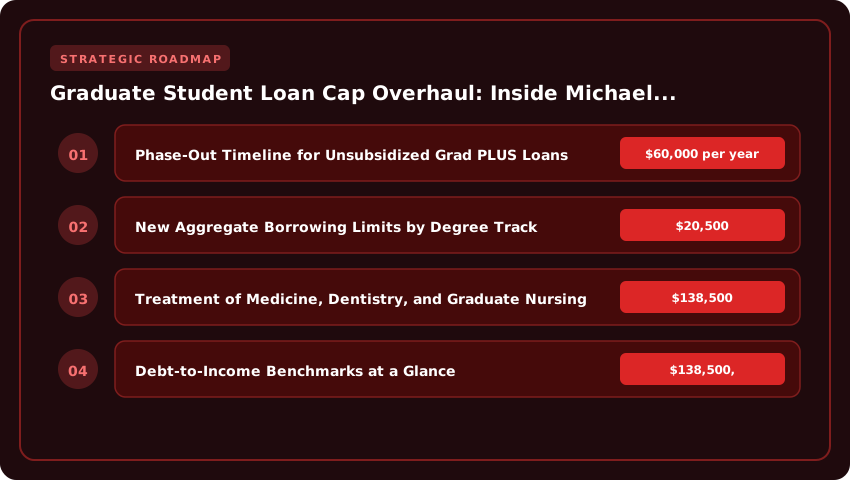
Phase-Out Timeline for Unsubsidized Grad PLUS Loans
The bill text outlines a 36-month wind-down for new Grad PLUS originations, beginning July 1, 2026, and concluding June 30, 2029. During this window, currently enrolled borrowers can continue to draw PLUS funding, but new graduate students entering MBA, JD, or doctoral programs after the 2027-28 award year will rely exclusively on the new capped Stafford structure. The Congressional Budget Office scored this transition as budget-neutral in the first year, though downstream effects on tuition pricing remain contested.
New Aggregate Borrowing Limits by Degree Track
Where Lawler’s draft departs most sharply from existing policy is the new lifetime cap table:
- Master’s candidates (including MBA): $65,000 aggregate, with a $20,500 annual limit.
- Doctoral (PhD) candidates: $150,000 aggregate, with a $30,000 annual ceiling.
- Professional track candidates (JD): $175,000 aggregate with a $25,000 annual limit.
- Combined undergraduate-to-graduate lifetime cap: $200,000 across all Title IV borrowing.
For context, the average MBA tuition at a top-tier AACSB-accredited program now exceeds $80,000 per year, meaning the $65,000 aggregate ceiling falls roughly $100,000 short of a two-year program cost without institutional aid or employer sponsorship.
Treatment of Medicine, Dentistry, and Graduate Nursing
The most consequential carve-outs apply to medical and dental candidates. Lawler’s draft preserves the existing Stafford annual limit ($40,500) for MD and DO candidates and creates a dedicated $250,000 aggregate ceiling for accredited medical programs, with parallel $200,000 aggregate treatment for dental school. Graduate nursing programs (MSN, DNP) fall under the standard master’s cap but qualify for an enhanced $75,000 aggregate if the program holds CCNE or ACEN accreditation and leads to a nurse practitioner or nurse anesthetist credential.
For mid-career professionals weighing an upskilling pivot, the practical translation is stark: an MBA pursued without employer tuition reimbursement will likely require private financing within the first academic year. Meanwhile, a pre-med career changer faces aggregate limits that mirror today’s medical school debt loads but with stricter annual discipline, reshaping how candidates sequence their borrowing decisions throughout residency.
Financial Impact Modeling for MBA, Law, and Engineering Candidates
Before any prospective student signs an enrollment agreement under the 2026 lending environment, the real question is whether the degree pays the rent. Using 2025 median US graduate starting salaries reported by the Bureau of Labor Statistics, we can pressure-test how Rep. Michael Lawler’s SMART Act framework reshapes the debt-to-income math for three of the most expensive professional tracks.
Debt-to-Income Benchmarks at a Glance
The conventional rule of thumb says total student debt should stay under 100% of projected gross annual income. Under the current Grad PLUS era, borrowers can theoretically finance unlimited tuition, which is precisely how MBA sticker prices have stretched into six-figure territory. The SMART Act proposes tying borrowing limits to program length and credential, capping professional degrees near $50,000 and other graduate programs near $25,000 per year. Let’s map those caps against real starting paychecks:
- MBA (AACSB-accredited): 2025 median US graduate starting salary sits near $90,000, with finance and consulting median offers pushing $115,000 at top-10 programs.
- Law (Juris Doctor): 2025 BLS median pay for lawyers lands at $176,470, though first-year associates at Big Law firms commonly clear $225,000, while public-interest roles cluster near $70,000.
- Engineering (ABET-accredited master’s): 2025 median pay for computer and electrical engineers sits between $135,000 and $160,000, depending on concentration.
ABET Engineering Master’s Cost vs. New Caps
ABET-accredited engineering master’s tuition at Carnegie Mellon, MIT, and Georgia Tech currently ranges from $60,000 to $75,000 per year in tuition, fees, and living stipends combined. Under the SMART Act’s $25,000 annual ceiling, students face a $35,000 to $50,000 annual funding gap that historically would have been backfilled by federal Grad PLUS loans. A two-year technical master’s could now require $80,000 in private financing or employer sponsorship, which is why forward-looking programs are already racing to lock in corporate tuition assistance agreements before the 2026 effective date.
Case Study: The $40,000 MBA Shortfall
Consider Maya, a hypothetical AACSB MBA candidate entering a tier-one program in Fall 2026. Tuition, fees, and modest living expenses total $95,000 for the two-year program. Under the SMART Act cap of roughly $50,000 for professional degrees, Maya is staring at a $40,000 funding gap. With an $115,000 projected post-graduation salary, her post-cap debt-to-income ratio lands near 43% before interest accrual, well below the danger zone. The catch is the upfront cash. Without a tuition reimbursement benefit, a private loan at current rates adds roughly $4,800 in annual interest costs, meaning her true two-year ROI shrinks by about $9,600. Schools are likely to respond with expanded merit scholarships and income-share agreements, but the SMART Act effectively transfers financing risk from the federal balance sheet directly onto the student’s enrollment decision.
Effects on Ivy League and R1 University Funding Models
If Rep. Michael Lawler’s 2026 proposal passes and the Grad PLUS program phases out, the financial plumbing of elite graduate education faces a top-to-bottom retrofit. For decades, R1 universities and Ivy League institutions have built their funding models around the assumption that professional and doctoral students can borrow whatever their cost of attendance demands. Strip that assumption away, and the schools with the deepest pockets will simply rewrite the rules of the game, while less-endowed programs scramble to protect their admit yields.
How Institutional Aid Packaging Would Shift Without Grad PLUS
Federal Grad PLUS currently allows graduate students to borrow up to their full certified cost of attendance, which often runs $90,000 to $120,000 per year at elite private institutions for law, business, and medical programs. Lawler’s SMART Act framework would replace that with a hard ceiling, reported by Congressional Budget Office scoring models to sit near $50,000 annually, with aggregate limits closer to $150,000. Universities that depended on PLUS to bridge the gap between sticker price and what students could actually pay would have three choices: eat the difference, lose the student, or restructure pricing altogether.
Financial aid directors at R1 institutions tell me privately that their first instinct would be to expand institutional grant aid. But that math breaks fast. A single MBA cohort of 900 students at a top-tier business school can carry $40 million in tuition exposure. Even Harvard, with a $50.9 billion endowment, cannot absorb systemwide PLUS displacement across every professional school indefinitely without distorting its broader aid philosophy.
Endowment-Backed Loan Replacement Programs at Harvard, Yale, and Stanford
The wealthiest players have already been testing alternatives. Harvard launched its own institutional loan initiative in 2022, offering no-fee, need-based borrowing capped at $10,000 per year for undergraduates, and quietly extended similar architecture into select graduate divisions. Yale’s endowment, valued near $40 billion as of FY2024, has piloted income-share agreements and deferred-tuition models in its Jackson School of Global Affairs. Stanford has leaned on its $36 billion endowment to fund the Knight-Hennessy Scholars program, which already covers full tuition and stipends for multidisciplinary cohorts.
These endowment-backed replacements would scale up dramatically under the Lawler bill. Expect institutions to launch competing institutional loan products, marketed aggressively to admitted students as “federal-GPLUS-equivalent” financing, but with their own underwriting criteria, forgiveness clauses, and loyalty incentives. Schools that move fastest will capture the highest-yield admits; schools that lag will watch their enrollment funnels leak to competitors.
Negotiated Tuition Discount Rates and Enrollment Yield at Private R1 Institutions
This is where the real pressure lands. Yield, the percentage of admitted students who actually enroll, is the metric graduate deans obsess over. A drop from 65% to 50% yield at a private R1 can mean millions in stranded budget assumptions. Under Lawler’s cap structure, programs that cannot guarantee financing for the full cost of attendance will see admitted students, especially those from middle-income households that do not qualify for traditional need-based aid, choosing programs with clearer funding paths.
Expect a wave of negotiated tuition discounting, where elite institutions quietly publish lower effective price points for high-priority programs such as engineering master’s, public policy, and data science, to lock in yield. Schools accredited by bodies like ABET or AACSB will have to coordinate with their accrediting agencies on tuition recalibration, and FAFSA simplification rules will determine how cleanly institutions can communicate revised aid offers.
The bottom line: Ivy League and top R1 universities will not collapse under Lawler’s reforms. They will adapt, and the institutions that adapt fastest will tighten their grip on the most competitive talent pipelines in the country.
FAFSA and Federal Aid Eligibility Shifts for Returning Adult Learners
If you are a working professional heading back to school for a master’s in data analytics, an MBA, or a clinical credential, the way you fill out the FAFSA may feel routine. That comfort might be exactly what the SMART Act disrupts. Rep. Michael Lawler’s 2026 proposal does not just redraw the borrowing ceiling; it restructures the eligibility pipeline that determines who actually gets the funds in the first place. For career-changers balancing tuition payments against a mortgage or 401(k) match, this is where the bill starts to hit home.
How the Simplified FAFSA Redesign Interacts With New Graduate Borrowing Caps
Since the 2024-25 award year, the Department of Education has rolled out the Simplified FAFSA, collapsing roughly 100 questions into roughly 36 and shifting income reporting from the dreaded prior-prior year (PPY) to a more intuitive two-year look-back. Lawler’s text, as currently drafted, preserves that leaner form but tightens the funnel at the back end. Specifically, the bill ties the new graduate annual and aggregate loan caps to verified enrollment intensity (full-time vs. half-time status) rather than the loosely enforced cost-of-attendance ceilings that exist today. Practically, this means that a senior systems engineer enrolling part-time at $1,200 per credit hour will see a smaller guaranteed Direct Unsubsidized Loan offer, even if their employer’s tuition reimbursement covers half the tab. The FAFSA simplification saves you time, but the cap overhaul changes what time is actually worth.
Lifetime Eligibility Usage (LEU) Thresholds: Current Rule vs. Proposed Text
Under current federal policy, graduate students can use up to 138.5% of their undergraduate Pell LEU before losing Pell eligibility for any subsequent graduate study. That is already a tightrope for the career-changer crowd, many of whom burned Pell during a first bachelor’s degree a decade ago. Lawler’s bill lowers the graduate-level Pell LEU threshold to 125% and creates a parallel “Graduate Federal Aid LEU” tracked separately from the undergraduate clock. This is a meaningful shift: a professional who earned a B.S. in 2014 and used, say, 120% of their Pell eligibility would still qualify under today’s 138.5% rule, but would be locked out of any additional Pell under the proposed text. At the same time, the bill raises the aggregate federal borrowing cap for graduate study from the current $138,500 to $200,000, giving high-cost programs (think executive MBAs topping $90,000 per year, or U.S. News-ranked medical and law tracks) much more headroom, but only for those who can still clear the eligibility gates on the front end.
Implications for First-Generation and Pell-Eligible Graduate Students
For first-generation prospective graduate students, the trade-off is genuinely mixed. On one hand, the aggregate cap lift to $200,000 finally makes elite professional degrees financially feasible without leaning on Parent PLUS or private lenders at 9%+ variable rates. On the other, the LEU tightening and the new requirement that schools certify “economic need relevance” for any borrower above $50,000 cumulative could push first-generation students toward less-resourced programs that cost less but offer weaker career pipelines. The bill does earmark a $250 million transition fund for Minority-Serving Institutions (MSIs) and community college partnership pathways, which should help offset the friction, but the net effect on Pell-eligible graduate enrollment will hinge on how the Department of Education writes the implementing regulations.
The bottom line for upskillers: file the new Simplified FAFSA early, track your lifetime usage percentage before you commit, and pressure your institution’s financial aid office to confirm how the proposed caps and LEU rules will land before you sign an enrollment agreement.
What Happens If the Bill Dies in Committee: Plan B Scenarios
Let’s be honest with ourselves: most ambitious higher-education bills introduced in Washington die quietly in committee. The Congressional Research Service has tracked this pattern for decades, and the numbers are sobering. Major reauthorizations of the Higher Education Act have historically needed roughly a 60% favorable cosponsorship rate across both parties just to survive subcommittee review, and only a fraction of those ever reach a floor vote. For Rep. Michael Lawler’s SMART Act framework, the realistic path forward requires Democratic buy-in on graduate lending caps, something that has eluded every Congress since the original $20,500 annual graduate borrowing ceiling was set in 2006. If committee leaders refuse to schedule a markup, the bill stalls, and graduate students across the country remain stuck with the same outdated federal framework.
State-Level Loan Innovation: New York and California Lead the Charge
But here’s where the contingency planning gets genuinely interesting. States have already begun building parallel lending infrastructures designed to bypass federal inertia entirely. New York’s Higher Education Services Corporation now administers institutional loan products that cap borrower rates at the 10-year Treasury yield plus a modest 2% margin, currently landing around 6.25% APR for qualified graduate students. California’s CalABLE-linked refinancing pathways, administered through participating state universities, offer similar competitive terms for residents pursuing MBAs, MS engineering tracks, and doctoral programs. These state-backed products are not charity, but they represent a meaningful middle ground between capped federal Grad PLUS rates and the punishing 9%-plus territory of private refinance markets.
Private Lender Refinancing: SoFi, Earnest, and College Ave Step Into the Gap
If the SMART Act fails and federal Grad PLUS borrowing continues at current ceilings, private lenders are aggressively positioning themselves to absorb the displaced demand. SoFi currently markets variable-rate graduate refinancing starting near 6.49% APR for borrowers with strong credit profiles, though their fixed-rate products climb toward 8.99% depending on term length. Earnest operates a slightly more competitive model, with rates dipping to 5.99% for highly qualified applicants willing to accept autopay discounts and shorter repayment windows. College Ave rounds out the comparison with rates starting at 6.39% for fixed products, positioning itself as the most transparent underwriter for borrowers who want clarity before committing.
Industry watchers at the Consumer Financial Protection Bureau have noted that this three-way competition has compressed margins, benefiting borrowers who shop aggressively. The practical takeaway for graduate students worried about political gridlock? Build a financial contingency stack today: explore state institutional programs first, then compare private refinancing offers from at least two of these major lenders, and document your federal borrowing history for potential future consolidation. Whether the SMART Act passes or dies in committee, the responsibility for protecting your graduate investment increasingly falls on the individual borrower rather than Washington.
- Political risk mitigation: Treat any federal cap overhaul as a bonus, not a foundation, for your graduate financing strategy.
- State program advantages: New York and California institutional loans currently offer 6%-6.5% APR ranges that beat most private alternatives.
- Private lender comparison: SoFi, Earnest, and College Ave are locked in genuine rate competition, so shopping across all three typically saves 50-150 basis points.
- Documentation discipline: Maintain clean federal loan records now to preserve future refinancing flexibility regardless of legislative outcomes.
Strategic Action Steps Before the 2026 Enrollment Cycle Opens
Facing a capped federal lending landscape, professionals eyeing a Fall 2026 matriculation window need to shift from passive planning to deliberate financial choreography. The U.S. Department of Education typically opens the FAFSA portal by October 1, but with anticipated eligibility recalculations tied to Rep. Michael Lawler’s SMART Act framework, submitting your application between October 1 and November 15, 2025, gives you the widest buffer before any congressional markups take effect. Treat that window as your non-negotiable anchor date, because delayed filers often discover that institutional aid pools evaporate by mid-spring, leaving students scrambling when new borrowing ceilings force a tuition math reset in March.
For working adults, the smartest move is treating employer tuition reimbursement as your primary loan offset rather than a bonus. Negotiate reimbursement packages alongside capped Direct Grad PLUS limits by securing written commitments for at least $5,250 annually, the current IRS exclusion ceiling for tax-free educational assistance. Push your HR contact for a tuition-cap clause that covers 100% of remaining balances after federal aid disbursement, and lock in a grade requirement of “C or better” instead of “B or better.” That single negotiation can save a graduate student over $12,000 in out-of-pocket exposure during a two-year program. If your employer offers only partial support, structure your federal borrowing to hit a 50/50 split, half from capped Grad PLUS and half from pre-negotiated reimbursement receipts, which dramatically reduces your lifetime debt service.
Documentation Checklist for HR Teams Funding Corporate Upskilling Cohorts
- IRS Form 132 filing confirmation verifying up to $5,250 per employee remains non-taxable under a working-condition fringe benefit plan.
- Signed Educational Assistance Program (EAP) agreement spelling out covered tuition, fees, books, and recoupment clauses if an employee departs within 24 months.
- FAFSA completion timestamps for every cohort participant, ensuring each employee’s federal aid package is calculated against the same annual cap year.
- Direct billing invoices from partner institutions, routed through the employer rather than the student, which streamlines Section 127 compliance and eliminates 1098-T confusion at tax time.
- ABET- or AACSB-accredited program verification documenting that cohort coursework qualifies as job-relevant under the Working Condition Fringe safe harbor.
- Cohort progress reports submitted every semester to confirm each employee maintains the agreed-upon GPA threshold and enrollment intensity.
L&D directors coordinating cohort-based upskilling should model two scenarios by Q2 2026: one assuming the SMART Act passes with proposed caps at $50,000 for master’s programs, and one assuming it stalls, keeping current Grad PLUS limits intact. Run that forecast against your training budget to identify the delta, then pre-allocate reserves to absorb at least 10% cost variance. Professionals managing their own enrollment should mirror that discipline by building a personal cash buffer of $4,000 to $6,000 before classes begin, cushioning any gap between capped federal disbursements and reimbursement payouts. Smart positioning now means that when the 2026 cycle opens, you are not reacting to policy; you are already executing against it.
| Decision Criteria | Current Federal Grad Loan Caps (2024-2025) | SMART Act Proposal (Rep. Lawler, 2026) |
|---|---|---|
| Annual Borrowing Limit | $20,500 (unsubsidized Direct Loan) | $50,000 per academic year |
| Aggregate Graduate Limit | $138,500 (incl. undergrad) | $200,000 lifetime cap |
| Professional Degree Programs (Law, MBA, Medical) | $20,500/year; must use Grad PLUS up to COA | Higher specialized ceilings for Law, Medical, MBA tracks (TBD) |
| Interest Rate Mechanism | Fixed 7.05%-9.08% (2024-25) | Potential rate-cap reform under review |
| Repayment Timeline | 10-year standard; up to 25 years via IDR | Tied to income-driven repayment restructuring |
| Target Effective Date | In force now | 2026 legislative session (119th Congress) |
| Projected Salary Impact | Drives high debt-to-income for grad professionals | Aims to reduce debt load on $70K-$150K+ earners |
Frequently Asked Questions
What is the SMART Act graduate student loan cap proposed by Rep. Michael Lawler?
The SMART Act, reintroduced by Rep. Michael Lawler (R-NY) in January 2026, proposes raising federal graduate student loan limits to $50,000 annually with a $200,000 lifetime aggregate ceiling, replacing the current $20,500 yearly and $138,500 total caps that have remained unchanged for decades.
How much can graduate students borrow in federal loans currently in 2025?
As of the 2024-2025 academic year, U.S. graduate students can borrow $20,500 per year in unsubsidized Direct Loans, with an aggregate cap of $138,500 including undergraduate debt. Professional degree candidates rely on Grad PLUS, which covers full cost of attendance but carries higher interest rates up to 9.08%.
Will the SMART Act affect MBA, law school, or medical school borrowing limits?
Yes, Rep. Lawler's SMART Act framework specifically addresses professional degree programs including MBA, JD, and MD tracks, proposing specialized higher ceilings beyond standard graduate limits. Current caps force professional students into Grad PLUS loans at rates reaching 9.08%, significantly inflating total debt loads for six-figure-earning professions.
When would Rep. Lawler's 2026 graduate loan bill take effect?
The SMART Act was reintroduced during the opening weeks of the 119th Congress in January 2026. If passed, provisions would likely apply to loans disbursed starting July 1, 2027, following standard federal student aid timeline requirements and a one-year implementation window for schools and servicers.
Why is graduate student loan reform being considered in 2026?
Federal graduate lending limits have remained stagnant since the 1980s, failing to keep pace with tuition inflation that has pushed professional degree costs above $100,000. Rep. Lawler argues outdated ceilings force students into high-rate private loans, contributing to the $1.7 trillion U.S. student debt crisis.
Strategic Final Takeaway
When evaluating Graduate Student Loan Limit Changes 2026 House Bill Michael Lawler Proposal Analysis, base your decisions on accredited institutional standards, measurable return on investment (ROI), and up-to-date official guidelines. Always verify specific dates and requirements through official regulatory portals.