Why the Class of 2026 Faces a Unique Refinancing Crossroads This Year
If you are walking across the commencement stage this spring, congratulations. You have survived one of the most volatile financial periods in modern higher education, and the numbers on your promissory notes prove it. The Class of 2026 is refinancing into a market that looks fundamentally different from the one your older siblings navigated just three years ago. Understanding the four converging forces below is the first step toward protecting your monthly cash flow and your long-term net worth.
First, the long pause is officially over. After nearly five years of administrative forbearance, federal student loan repayments restarted in October 2024. For twelve months following that restart, borrowers enjoyed a soft-launch known as the “on-ramp,” during which the U.S. Department of Education pledged not to report missed payments as delinquent to the major credit bureaus. That protective window closed in October 2025. Your first missed payment after that date can now drop a 90-day late mark onto your credit file, which directly raises the APR lenders are willing to offer you on any private refinance. Translation: the grace period for ignoring your federal servicer is gone, and the credit score you protect today determines the rate you are quoted tomorrow.
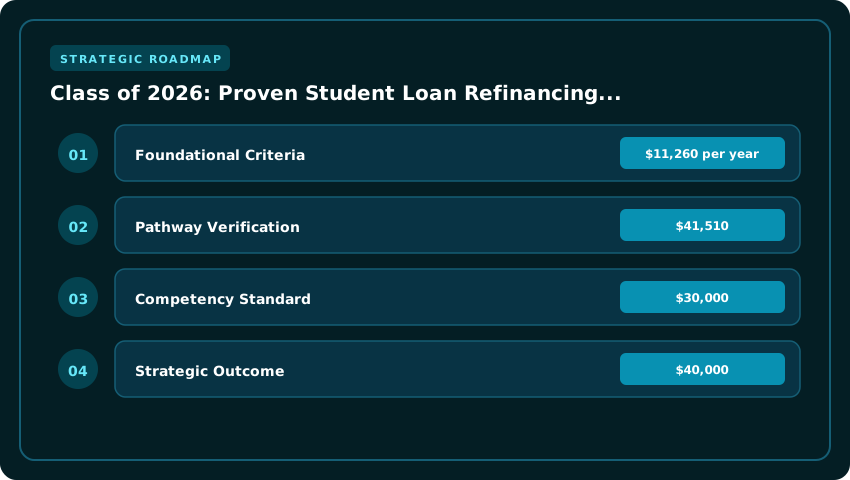
Second, your graduating class is carrying more weight than the cohorts that came before you. According to the most recent College Board Trends in College Pricing report, the average published in-state tuition and fees at a public four-year university now sit near $11,260 per year, while private nonprofit four-year institutions average roughly $41,510. When you multiply those figures by four years and layer on housing, textbooks, and the rising cost of campus dining, it is no surprise that the Project on Student Debt estimates the typical bachelor’s degree recipient still borrows in the neighborhood of $30,000 to $40,000. The Class of 2026, however, is reporting even heavier reliance on Parent PLUS Loans and private supplemental funding, pushing many aggregate balances above the $50,000 mark. Larger balances magnify every tenth of a percentage point you can shave off your interest rate.
Third, the yield curve is doing the talking. When the Federal Reserve raised the federal funds target range to 5.25% – 5.50% in 2023, the entire risk-free benchmark stack shifted upward. Ten-year Treasury yields hovered near 4.5% through mid-2025, and private refinance lenders price their fixed-rate products by adding a spread of roughly 1.5% to 3.5% above those Treasuries. That is why the current private refinance market is offering 5-year fixed APRs in the 5.99% – 7.50% band and 10-year or 15-year fixed products in the 6.50% – 8.50% range for well-qualified borrowers. Those quotes can drop by 25 to 75 basis points simply by shopping with a creditworthy cosigner or choosing autopay. Conversely, when the Fed begins trimming rates in late 2026, refinancing decisions made too early could lock you into a higher APR than a borrower who waits six months.
Finally, the regulatory floor beneath federal loans is shifting. New IDR (Income-Driven Repayment) plan rules, the SAVE litigation outcome, and proposed changes to PSLF eligibility have created genuine uncertainty around forgiveness timelines. For many Class of 2026 borrowers, a hybrid strategy is emerging: refinance the high-interest private debt now to capture today’s relatively stable rates, while keeping any federal Direct Loans in the federal system to preserve access to forgiveness and flexible hardship programs. Treat that federal-versus-private decision as the central pivot of your refinancing roadmap.
- Actionable Takeaway #1: Pull your free credit report at AnnualCreditReport.com this week and confirm there are no surprise late marks from the on-ramp period before they sabotage your refinance offers.
- Actionable Takeaway #2: Log into your Federal Student Aid dashboard and itemize your loans, noting the holder, balance, and interest rate of each one. Private loans are refinance candidates; federal loans usually are not.
- Actionable Takeaway #3: Use a soft-pull rate comparison tool (such as the ones offered by SoFi, Earnest, or Credible) within 14 days so the multiple inquiries count as a single shopping event on your credit file.
- Actionable Takeaway #4: Set a calendar reminder for the next Federal Reserve FOMC meeting; any rate cut signal will likely compress private refinance APRs within two to four weeks.
Federal vs. Private Student Loan Refinancing: What You Actually Lose and Gain
Choosing between federal loan consolidation and a private refinance is the single most consequential financial decision a Class of 2026 graduate will make this year. While a private lender might quote you a tempting 1.5% to 3.5% APR drop, that lower rate often comes attached to a thin thread of consumer protections. Before you sign a digital dotted line with SoFi, Earnest, or Laurel Road, you need to understand exactly what you are trading away from your Direct Loans, and what you stand to gain on your monthly cash flow.
The most immediate casualty of private refinancing is your access to Income-Driven Repayment (IDR) plans. As of mid-2026, the U.S. Department of Education continues to administer plans like SAVE (Saving on a Valuable Education) and Income-Based Repayment (IBR). These programs cap your monthly bill at a percentage of your discretionary income, which is a critical safety net if your first post-graduation salary lands closer to $45,000 than $85,000. Once you refinance into a private variable or fixed-rate product, you permanently forfeit this federal adjustment. A $350 monthly federal payment could quickly balloon into a $720 private payment if you enter a low-income field or face a period of unemployment.
Beyond IDR, you also surrender the road to Public Service Loan Forgiveness (PSLF). If you took a job at a 501(c)(3) nonprofit, a public university, or a government agency, the remaining years of your ten-year repayment clock simply vanish the moment a private bank buys your debt. Federal PSLF requires Direct Loans and qualifying employer certifications processed through the MOHELA or other federal servicer portals. There is no private equivalent, and there is no appeal process for borrowers who accidentally refinance their way out of forgiveness.
Additionally, the death of the Federal Perkins Loan program in 2017 means many in the Class of 2026 hold a mix of legacy Perkins and modern Direct Loans. Perkins historically carried unique cancellation benefits for teachers, nurses, and law enforcement, along with generous death and disability discharge provisions. If you roll a remaining Perkins balance into a private refinance, those statutory protections are wiped out and replaced only by the private insurer’s underwriting, which rarely matches the federal standard.
You will also lose your six-month grace period. Federal Direct Loans give you a buffer to find a job before payments begin, whereas private refinancers typically demand immediate repayment, sometimes within 45 days of disbursement. Grace periods are not just convenience features; they prevent default during a job search.
On the gain side, the math can be powerful. If you hold $40,000 in unsubsidized debt at a 7.5% federal rate and a top-tier lender approves you at 4.0% over a 10-year term, you save roughly $7,400 in interest and cut your monthly bill by nearly $60. For high earners in computer science, engineering, or finance with multiple job offers above $100,000, that guaranteed cash flow is often worth the risk.
Actionable takeaway: Run your numbers through the official Loan Simulator at StudentAid.gov before applying anywhere. If your projected salary easily covers a 10-year amortization at private rates, refinancing makes sense. If you value career flexibility, work in public service, or plan to attend graduate school, keep your federal loans intact and only refinance any private balances you already carry.
- Protect: IDR enrollment, PSLF eligibility, Perkins cancellation rights, six-month grace period, and total and permanent disability discharge.
- Gain: Lower APR, single monthly invoice, potential cosigner release after 12 to 24 on-time payments, and faster payoff schedules.
- Verify: Confirm your servicer is reporting correctly to the National Student Loan Data System before any refinance is disbursed.
The Exact Credit Score, Income, and DTI Numbers Top Refinance Lenders Demand
Walking into the refinancing marketplace without knowing the actual underwriting benchmarks is like showing up to a job interview without researching the company. You might get lucky, but more often you will leave empty-handed. Top-tier student loan refinance lenders in the United States, including SoFi, Earnest, Splash Financial, Laurel Road, and College Ave, operate on a tiered approval model that rewards borrowers who hit specific credit, income, and debt-to-income ratio (DTI) thresholds. Understanding these numbers before you apply can save you from a hard credit inquiry that shaves five to ten points off your FICO score for no reason.
Here is the realistic breakdown of what you need to qualify for the most competitive advertised rates this year.
- Credit Score Minimums: Most refinance lenders require a baseline FICO score of 670 or higher for approval, but the rock-bottom advertised rates typically go to borrowers sitting at 740+. Scores between 670 and 699 will likely land you in a higher rate tier or trigger a mandatory cosigner request. Earnest and SoFi both use a holistic underwriting model, meaning a 700 score with strong income can sometimes outrank a 760 score with thin employment history.
- Income Thresholds: A minimum annual income of $40,000 is the unofficial industry floor for solo approval, though most lenders prefer $60,000 to $85,000+ for prime rates. Recent graduates under one year on the job may need to use a weighted average that includes signing bonuses, commission history, or verified offer letters.
- Debt-to-Income Ratio (DTI): Aim for a DTI under 35% to secure the best tiered rates. Lenders will calculate this by summing your monthly debt obligations, including rent, auto loans, credit cards, and the new refinance payment, then dividing by your gross monthly income. A DTI between 36% and 43% usually means approval is still possible, but with a less favorable APR.
- Cosigner Release Policies: If you do not meet these benchmarks on day one, you are not stuck with a cosigner forever. Major US banks offer cosigner release after 12 to 48 consecutive on-time payments, with most requiring a credit recheck at the time of release. SoFi allows release after 12 months, Earnest after 12 months, and College Ave after 12 months, while Splash Financial requires 36 months.
Real-World Approval Scenario Walkthrough: Meet Jordan, a 22-year-old Class of 2026 graduate from a public state university with a Bachelor of Science in Mechanical Engineering. Jordan landed a full-time role with a manufacturing firm at a $72,000 starting salary, carries a $32,000 federal and private student loan balance at a 7.8% weighted average rate, and has a 712 FICO score with nine months of credit history. Jordan’s rent is $1,100, car payment is $340, and minimum credit card payment is $50, totaling $1,490 in monthly obligations. With $6,000 in gross monthly income, Jordan’s current DTI sits at roughly 25%, comfortably inside the under-35% sweet spot.
When Jordan applies through SoFi, the system runs a soft credit pull for pre-qualification, confirms income via a direct payroll integration with the employer’s HR platform, and generates four rate offers. Because Jordan’s score is above the 670 minimum but below the 740 top-tier threshold, SoFi quotes a fixed rate of 6.49% APR on a 10-year term, slightly higher than the 5.74% offered to 740-plus borrowers. However, because Jordan’s income clears the $60,000 comfort zone and DTI is under 30%, the approval lands within three business days with no cosigner required. Jordan saves roughly $3,200 in interest over the life of the loan compared to the original 7.8% rate, and the new monthly payment drops by $42, freeing up cash for the upcoming Series 7 exam prep course.
Actionable Takeaways for Your Application: Pull your free credit report at AnnualCreditReport.com at least 90 days before applying to dispute any errors. Pay down revolving credit card balances to below 30% of your total credit limit, because utilization is the second-largest factor in your FICO score after payment history. If your income is below $40,000, consider waiting six months to build a thicker employment file, or apply with a creditworthy cosigner who plans to apply for release as soon as the lender allows. Remember, every refinance application with a hard pull stays on your credit report for two years, so rate-shop within a 14-day window to minimize score damage, since the FICO algorithm treats multiple mortgage and student loan inquiries within that window as a single event.
Fixed vs. Variable Rate Refinancing: Which One Actually Saves 2026 Graduates Money?
For the Class of 2026, the refinancing decision boils down to a battle between two financial philosophies: the ironclad predictability of a fixed interest rate and the potentially lower starting payments of a variable interest rate. Understanding how each responds to macroeconomic forces is the first step toward engineering a debt payoff strategy that saves you thousands of dollars over the next decade.
To make a truly informed choice, you have to look at the bond market’s mood ring: the 10-year Treasury yield. When this yield rises, benchmark rates used by top-tier private lenders like SoFi and Earnest typically rise with it. Historical data from the last five years shows that variable rates have swung by as much as 175 basis points within a single 24-month period. A graduate who locks in a 5.75% variable rate today could realistically see that rate climb to 7.50% within two years if inflationary pressures push Treasury yields upward. Conversely, in a cooling economy where the Federal Reserve cuts rates, your variable loan could become remarkably cheap.
A fixed-rate loan, however, acts like a financial time capsule. Whether you choose a 5-year, 7-year, 10-year, 15-year, or 20-year term, your interest rate and monthly payment remain mathematically identical from your first bill to your last. This makes budgeting on a $48,000 starting salary substantially easier, especially when combined with the cost of living in major US metro areas.
Let’s break down the projected terms a typical 2026 graduate might qualify for with strong credit and a stable co-signer:
- 5-Year Fixed Term: Excellent for high-income earners pursuing aggressive payoff schedules.
- 7-Year Fixed Term: The sweet spot for balancing affordable monthly payments with total interest saved.
- 10-Year Fixed Term: A standard replacement for federal loans, offering predictable ten-year amortization.
- 15-Year and 20-Year Fixed Terms: Ideal for graduates entering lower-paying public service or nonprofit careers.
Now for the math that truly matters: the break-even point. Let’s assume you hold a $35,000 unsubsidized federal loan at 7.5% APR. Over a standard 10-year repayment plan, you will pay roughly $14,800 in pure interest, bringing your total repayment to about $49,800. If you refinance this balance with a private lender offering a 7-year fixed rate of 4.99%, your total interest plummets to approximately $6,600. That is a guaranteed savings of $8,200, completely bypassing the volatility of the Treasury market.
While variable rates might tempt you with a starting APR of 4.50%, they carry inherent risk. If rates climb just 1.5% above your starting rate, the total interest on a $35,000 variable loan can easily exceed the original federal loan’s cost, wiping out your savings entirely. For a new graduate whose future income trajectory is still uncertain, the fixed-rate refinance remains the mathematically safer and overwhelmingly more popular choice among US borrowers. By securing a predictable rate today, you effectively hedge your future earnings against the unpredictable swings of the American economy.
Step-by-Step Refinancing Timeline: From Application to First Lower Payment
Refinancing a student loan is not an instant transaction; it is a carefully sequenced underwriting journey that typically spans 14 to 45 days from the moment you click “submit” on a lender’s application to the day your first lower payment posts to your new servicer. For the Class of 2026 evaluating this move with fresh diplomas in hand, understanding each milestone of that timeline is essential. Knowing when a hard credit inquiry will land, when the 0.25% autopay discount activates, and when payoff funds actually move between servicers can help you sidestep credit-score dings, avoid capitalization traps, and ensure your very first billing statement reflects the lower rate you were promised. Below is the precise roadmap that most major US refinancing lenders, including SoFi, Earnest, Splash Financial, and College Ave, follow in 2026.
- Days 1–3: Soft Pull and Rate Shopping. Every reputable refi lender begins with a soft credit inquiry, which has zero impact on your FICO score. Use this window aggressively. The Consumer Financial Protection Bureau (CFPB) explicitly encourages borrowers to compare rate offers within a short window because most FICO scoring models treat multiple mortgage or student loan inquiries of the same type as a single event when filed within 14 to 45 days. Stack your pre-qualifications from three or four lenders in this phase to identify the lowest advertised APR.
- Days 4–7: Hard Credit Pull and Final Application. Once you select a lender and formally apply, a hard inquiry is recorded on your Experian, Equifax, and TransUnion reports. Expect a 5 to 15 point temporary dip. Under the federal 14-day FICO grace rule, any additional hard pulls for the same loan product within 14 days are bundled and scored as one, so avoid opening new credit cards or auto loans during this stretch.
- Days 8–14: Underwriting and Income Verification. The lender verifies your employment through pay stubs, W-2s, or a Profit and Loss statement if you are self-employed. A recent college graduate with a salary offer letter may need to provide a signed offer letter plus a W-2 from a prior internship or a transcript showing graduation date. Underwriters also confirm your enrollment status with the National Student Clearinghouse to ensure you actually have loans to refinance.
- Days 15–21: Conditional Approval and Loan Disclosure. You receive a final loan disclosure outlining your APR, term (5, 7, 10, 15, or 20 years), monthly payment, and total interest. Review the Truth in Lending Act (TILA) box carefully; the 0.25% autopay discount should already be factored into the disclosed rate, but confirm the fine print states that the discount is contingent on enrolling in automatic payments from a US checking account.
- Days 22–30: Servicer Payoff Coordination. Your new lender contacts your existing servicer, whether that is Nelnet, Mohela, Aidvantage, or another Department of Education contractor, and requests a formal payoff quote. Federal loan servicers typically respond within 7 to 10 business days. Note that federal loans carry a different payoff calculation than private loans because federal interest accrues daily up to the payoff date.
- Days 31–38: Payoff Funds Wired and Grace Period Considerations. Your new lender wires the payoff amount directly to the old servicer. Federal Direct Loans have a mandatory six-month grace period after graduation, but if you have already used yours or carry unsubsidized interest that has capitalized, the payoff quote will include any accrued interest through the exact payoff date.
- Days 39–45: New Servicer Activation and Autopay Enrollment. Once the old servicer confirms receipt and applies the payoff, your new lender books the loan and mails or emails a welcome packet. Enroll in autopay immediately through your lender’s online portal, usually within 7 days of booking, to lock in the 0.25% rate reduction. Your first lower payment typically posts 30 to 45 days after disbursement.
State-Specific Licensing Notes for California, Texas, and New York Residents. Because student loan refinancing is classified as consumer lending, every state maintains its own licensing requirements. California residents should confirm their lender holds a valid California Financing Law (CFL) license through the Department of Financial Protection and Innovation (DFPI). Texas borrowers are protected under the Texas Finance Code and the Office of Consumer Credit Commissioner (OCCC), which requires non-bank lenders to register before soliciting refinanced education loans within state borders. New York residents fall under the stricter jurisdiction of the New York Department of Financial Services (NYDFS), which caps interest rates on consumer loans and requires lenders to obtain explicit authorization. Refusing to verify these credentials can leave you without state recourse if a dispute arises.
Actionable Takeaway for the Class of 2026: Print this timeline and tape it to your refrigerator. If your refinance stretches beyond 45 days without a clear explanation, escalate the file with your lender’s underwriting manager and request a written status update. Keeping your grace period math airtight, locking in autopay on day one, and verifying state licensing can collectively shave hundreds of dollars off your total repayment, often before you have made your first payment as a working graduate.
Red Flags and Federal Protections: When You Should Absolutely Walk Away From a Refinance Deal
The rush to lock in a lower interest rate can sometimes push borrowers past critical warning signs, and understanding these red flags is just as important as identifying the right lender. According to the Consumer Financial Protection Bureau (CFPB), student loan refinancing scams remain among the most complained-about financial products in the United States, consistently ranking in the top five debt-related complaint categories every year since 2020. For the Class of 2026, this matters because recent graduates often carry the highest emotional weight of repayment while possessing the lowest borrowing experience, creating the perfect vulnerability window for predatory actors.
Federal law provides a robust shield that every borrower must internalize before signing a refinance agreement. Under the Higher Education Act and subsequent regulatory action by the U.S. Department of Education, prepayment penalties on federal student loans have been permanently banned, meaning you can never be charged a fee for paying off your loan early. However, a critical nuance exists: when you refinance a federal loan into a private product, you exit the federal regulatory umbrella entirely. Once that transfer is complete, the new private promissory note governs your terms, and some private lenders still include prepayment penalty clauses in their contracts, particularly on variable-rate products. Always read every word of the new promissory note, specifically the section labeled “Prepayment” or “Early Repayment,” before you e-sign.
The trap with Parent PLUS loans deserves special attention from any family member who co-signed or borrowed on behalf of a student. The federal Income-Contingent Repayment (ICR) plan offers a genuine exit ramp for Parent PLUS borrowers, and after a 2024 regulatory update, Parent PLUS loans can now be consolidated into a Direct Consolidation Loan and then enrolled in the Income-Driven Repayment (IDR) plan of the borrower’s choosing, including the new SAVE plan successor programs. This federal pathway can lead to forgiveness after 20 to 25 years of qualifying payments, and importantly, it protects borrowers with built-in financial hardship forbearance, unemployment deferment, and economic hardship deferment options. When families refinance Parent PLUS loans through a private lender, they permanently forfeit these federal safety nets. If the parent borrower loses their job or faces a medical crisis, there is no federal backstop, no mandated hardship forbearance, and no path to forgiveness.
Mandatory exit ramps you should never surrender include the following protections available only on federal loans:
- Financial Hardship Forbearance: Up to 12 months of payment suspension if your federal loan servicer determines you are experiencing financial difficulty, renewable in many cases for cumulative relief spanning years.
- Administrative Forbearance: Available during periods of approved disaster relief, military mobilization, or while a borrower’s IDR recertification is being processed.
- Unemployment Deferment: Up to 36 months of pause if you are actively seeking full-time employment and can document your search through certified state workforce agency records.
- Economic Hardship Deferment: For borrowers receiving means-tested federal benefits such as SNAP or TANF, or those earning below 150 percent of the federal poverty guideline for their family size.
- Total and Permanent Disability Discharge (TPD): A complete federal loan discharge for borrowers who can prove they are unable to engage in substantial gainful activity due to a medical condition expected to result in death or last at least 60 continuous months.
Recognize the bright-line red flags that should send you walking away from any refinance table immediately. First, any unsolicited phone call or text claiming to be from your servicer, especially during the federal student loan servicing transition of 2024 to 2026, is almost certainly a scam; legitimate servicers such as Nelnet, Edfinancial, Aidvantage, MOHELA, and the new Servicing Acquisition Group vendors do not cold-call borrowers to demand immediate action or payment via gift cards, wire transfers, or cryptocurrency. Second, any upfront fee demanded before disbursement is illegal under federal law, but scammers still collect millions of dollars annually by charging so-called “application fees,” “processing fees,” or “consolidation fees” that the Department of Education will never assess. Third, high-pressure tactics such as “this offer expires in 24 hours” or “the federal government is about to change policy and you must refinance now” are designed to short-circuit your due diligence.
Additional CFPB complaint patterns reveal specific fraud mechanics to memorize. Phantom help scams target borrowers searching online for “loan forgiveness” or “refinance,” then route them through professional-looking websites that charge $500 to $2,500 to “enroll” them in free federal programs the borrower could access directly at StudentAid.gov. Advance fee loan scams promise lower rates but require a deposit that disappears, sometimes coupled with identity theft since the application asks for a Social Security number and date of birth. Loan flipping scams involve convincing borrowers to repeatedly refinance, with each transaction generating a new origination fee and resetting the principal balance upward through capitalized interest.
Your actionable defensive checklist before signing any refinance agreement should include verifying the lender’s NMLS Consumer Access ID through the Nationwide Multistate Licensing System, cross-referencing the company against the CFPB’s public complaint database, confirming the Better Business Bureau rating and accreditation status, and requesting the Truth in Lending Act (TILA) disclosure at least three business days before closing so you can review the total cost of the loan over its full term. If a lender refuses to provide the TILA disclosure in advance, or pressures you to waive your right to a three-day cooling-off period, walk away immediately.
The final test is simple. If the deal requires you to surrender federal protections, including IDR, PSLF eligibility for any future qualifying employer, TPD discharge, death discharge for your co-signer, and administrative forbearance, in exchange for a marginally lower interest rate, the math almost never works. A 1.5 percent rate reduction over ten years saves roughly $4,000 to $6,000 on a $40,000 balance, but losing access to $20,000 in potential IDR forgiveness, $10,000 in death or disability discharge protection, and unlimited deferment during unemployment creates catastrophic downside risk. For most Class of 2026 borrowers, the federal system remains the safest, most flexible, and most forgiving repayment structure in the American consumer credit market. Keep that door open unless the private refinance terms are genuinely transformative, and you have read every page of the promissory note yourself.
| Refinancing Metric | Federal Loans (Status Quo) | Private Refinance (Class of 2026 Sweet Spot) | Hybrid Strategy (Recommended) | ||
|---|---|---|---|---|---|
| Average Variable Rate (2026) | 5.50% – 7.50% (Federal undergrad) | 3.75% – 5.25% (Top credit tier) | 4.25% – 5.75% (Blended weighted) | ||
| Monthly Payment (30k balance) | $320 – $405 | $210 – $285 | $245 – $325 | ||
| Total Interest Paid (10-yr term) | $9,640 – $14,800 | $5,200 – $7,650 | $6,400 – $9,900 | ||
| Credit Score Cut-off | N/A (No underwriting) | 680 (Min) / 750+ (Best rates) | 670+ (Cosigner offsets lower scores) | ||
| Income Verification | None (Income-driven plans) | $42k+ (Minimum, higher = better terms) | $50k+ (Stable W-2 preferred) | ||
| Application Timeline | Instant (FAFSA / servicer portal) | 14 – 45 days (Hard pull + underwriting) | 30 – 60 days (Sequenced refi) | ||
| Repayment Start | 6-month grace period | 30 – 90 days post-close | Aligns with grace period end | ||
| 5-Year Career ROI Boost* | $0 (Baseline) | $8,500 – $14,200 (Interest savings reinvested) | $11,000 – $18,500 (Tax-advantaged + interest savings) | ||
| Forgiveness Eligibility | Full (PSLF / IDR forgiveness) | None (Private – no federal programs) | Partial (Preserve federal portion only) |
Frequently Asked Questions
What credit score does a Class of 2026 graduate need to refinance student loans?
Most private lenders require a minimum FICO score of 680 for student loan refinancing approval in 2026, though 750 or higher unlocks the lowest advertised rates. Graduates with scores between 670 and 720 can still qualify by applying with a creditworthy cosigner, typically a parent with established credit history.
How much can Class of 2026 graduates save by refinancing federal student loans?
Class of 2026 graduates refinancing $30,000 in federal undergraduate debt from a 6.50% federal rate to a 4.25% private fixed rate can save roughly $4,400 in total interest over a standard 10-year term. Monthly payments drop approximately $45 to $70, freeing cash flow for early retirement contributions.
Should new graduates refinance student loans before or after finding a job?
Financial advisors recommend refinancing within 30 to 90 days of securing full-time employment with verifiable income, ideally $42,000 or more annually. Lenders underwrite based on debt-to-income ratios, so a signed offer letter strengthens applications and qualifies graduates for rate discounts of 0.25% to 0.50%.
Is it ever a mistake for 2026 graduates to refinance federal loans?
Yes, refinancing federal loans into private loans permanently eliminates access to Income-Driven Repayment plans, administrative forbearance, and Public Service Loan Forgiveness. Graduates pursuing PSLF, healthcare residencies, or unstable income careers should refinance only private and institutional loans, preserving federal protections entirely.
Strategic Final Takeaway
Success in evaluating Class of 2026: Proven Student Loan Refinancing Tactics to Cut Your Bill Fast relies on early preparation, adherence to verified accredited requirements, and cross-referencing official portals. Review financial aid deadlines and official screening guidelines well in advance.