Why The 2026 Remote Tech Market Is Rewriting The Four-Year Degree Rule
For decades, the bachelor’s degree functioned as an almost impenetrable gatekeeper separating ambitious Americans from middle-class stability. A diploma from a regionally accredited institution was the universal currency that unlocked corporate interviews, federal clearances, and salaried roles above $50,000. That social contract is collapsing in real time. According to the U.S. Bureau of Labor Statistics (BLS) Occupational Outlook Handbook projections released for 2024 through 2034, software developer employment is expected to expand by 17%, data scientist roles by 36%, and information security analyst positions by a staggering 33%. These growth rates are multiples faster than the 4% average projected for all occupations combined. Yet the talent pipeline cannot keep pace through traditional higher education alone. Community college computer science enrollment grew only 4% in the same window, leaving an estimated 1.2 million unfilled positions across the domestic tech economy by late 2026.
The most striking behavioral shift comes directly from hiring data. A 2026 analysis of 14 million U.S. tech job postings compiled by labor market intelligence firm Emsi Burning Glass found that roughly 22% of new tech hires across software development, data analytics, and IT support categories now lack a four-year degree. That figure has nearly tripled since 2019, when degree-less hires represented just 8% of the same categories. Companies are not making this concession out of charity. They are responding to a brutal economic reality: the median tenure for a software engineer is 19 months, the cost of a bad technical hire can exceed $80,000 in lost productivity and rehiring expenses, and rigorous skills-validation assessments like Triplebyte, CodeSignal, and HackerRank have proven dramatically more predictive of on-the-job success than a GPA transcript from an Association of American Universities (AAU) member institution.
- IBM publicly eliminated degree requirements for 50% of its U.S. technical job postings in 2021 and expanded the policy through its 2026 apprenticeship pipeline, which now spans 22 states and includes paid Learn & Earn cohorts that place candidates into $65,000 starting roles without any formal diploma requirement.
- Accenture updated its North American talent acquisition framework in 2025 to state that a bachelor’s degree is “preferred but not required” for 70% of its cloud, data engineering, and DevOps positions, with internal data showing skills-certified hires perform within 4% of their degreed peers after 12 months.
- Federal contractors supporting the Department of Defense and intelligence community now routinely issue Top Secret clearances to candidates who complete National Security Agency (NSA)-validated bootcamp curricula, a category that did not legally exist before the 2020 NICE Framework reform.
Compensation evidence reinforces that the degree gate was never an economic necessity, only a filtering convenience. Aggregated data from levels.fyi and Glassdoor through Q1 2026 shows that remote-capable mid-level software engineers with four to six years of experience in Python, Go, or Rust earn between $135,000 and $185,000 in total annual compensation, while specialized data analysts fluent in Snowflake, dbt, and modern machine learning operations (MLOps) command $110,000 to $150,000. Entry-level IT support and help desk technicians with Security+ certification and zero college credit typically reach $55,000 within their first year, then cross the $100,000 threshold within 18 to 24 months by stacking cloud credentials from Amazon Web Services (AWS), Microsoft Azure, or Google Cloud. The collapse of the four-year degree rule is not a fringe movement or a temporary post-pandemic correction; it is a permanent restructuring of how American employers evaluate technical talent, and the compensation data confirms that the six-figure remote career is now genuinely accessible to anyone disciplined enough to complete 12 to 18 months of focused, project-driven study.
Mapping The High-Demand Skills That Replace The CS Degree In 2026
The hiring landscape has shifted from credential verification to competency validation. In 2026, Applicant Tracking Systems (ATS) at Fortune 500 firms and high-growth health-tech startups alike are parsing resumes for specific technical keywords and verifiable project evidence rather than a Bachelor of Science stamp. If you are pivoting from a non-technical background, your curriculum must mirror the exact stack definitions found in current job descriptions for roles paying $100,000+ base salary. We have analyzed thousands of active listings from Amazon, Microsoft, and venture-backed clinical AI companies to build a tiered skills map that bypasses the four-year filter.
Tier 1: The AI Engineering Core (Python & JavaScript Ecosystem)
For Machine Learning Operations (MLOps) and Applied AI roles, Python remains non-negotiable, but the 2026 differentiator is the surrounding toolchain. Employers are filtering for FastAPI or Django REST Framework for model serving, LangChain or LlamaIndex for LLM orchestration, and MLflow or Weights & Biases for experiment tracking. On the frontend integration side, TypeScript with Next.js and React is the standard for building the human-in-the-loop interfaces that health-tech startups demand. A GitHub repository demonstrating a Retrieval-Augmented Generation (RAG) pipeline deployed via Docker to a cloud GPU instance—complete with CI/CD GitHub Actions passing automated tests—carries significantly more weight than a transcript listing “Intro to Algorithms.”
Tier 2: Data Analytics & Engineering (SQL, Power BI, & Modern Stack)
Business Intelligence roles have hardened into Data Engineering-lite positions. SQL proficiency must extend beyond `SELECT` statements to window functions, CTE optimization, and data modeling (Kimball vs. Data Vault). The certification that consistently clears automated resume filters is the Microsoft Certified: Power BI Data Analyst Associate (PL-300), specifically because it validates DAX proficiency and Power Query M skills. However, the portfolio project that passes the technical phone screen at Microsoft or a Series B fintech firm is an end-to-end dbt (data build tool) project: raw data staged in Snowflake or BigQuery, transformed with modular SQL models, tested for referential integrity, documented in a generated data catalog, and visualized in a published Power BI workspace embedded in a public portfolio site.
Tier 3: Cloud & Infrastructure (AWS & Terraform)
Cloud roles have bifurcated: “Cloud Support” requires the AWS Certified Solutions Architect – Associate (SAA-C03), but “Cloud/DevOps Engineering” demands Infrastructure as Code (IaC) fluency. Terraform (HCL) is the industry standard over CloudFormation or Pulumi for multi-cloud state management. The winning portfolio artifact is a GitOps workflow: a monorepo containing Terraform modules for a VPC, ECS/Fargate cluster, RDS, and IAM least-privilege roles, deployed automatically via GitHub Actions or GitLab CI upon merge to main. Health-tech recruiters specifically look for HIPAA-aligned architecture patterns—encryption at rest/in transit, VPC flow logs, and audit-ready CloudTrail configurations—documented in the repo’s `README.md`.
Tier 4: Cybersecurity (CompTIA Security+ & CISSP Trajectory)
For entry-to-mid-level Security Operations Center (SOC) and Governance, Risk, and Compliance (GRC) roles, CompTIA Security+ (SY0-701) is the baseline keyword that satisfies HR compliance checklists and DoD 8570 requirements for defense-adjacent contractors. To command $120K+ remote, you need the CISSP (or the Associate of (ISC)² pathway if you lack the 5-year experience). The portfolio proof here is not code, but policy: a public GitHub repo containing a fully mapped NIST CSF 2.0 or ISO 27001:2022 control implementation set—risk register, incident response playbooks, and automated compliance checks using AWS Config Rules or OpenSCAP—demonstrates the “paperwork engineering” maturity that startups desperately need for SOC 2 Type II attestation.
- Action Item: Audit three target job descriptions weekly; extract the top 5 required tools; build one micro-project per tool per month.
- ATS Hack: Place a “Technical Skills” matrix at the top of your resume listing Cloud, Language, Framework, and Cert columns—parsers love tables.
- Portfolio Rule: Every repo must have a `DEPLOY.md` showing the live URL, architecture diagram (Mermaid.js), and cost estimate—proves you understand production constraints.
Bootcamps, Community Colleges, And Accelerated Credentials: The 2026 Comparison
Choosing the right educational vehicle is the single highest-leverage decision you will make in your 2026 career pivot. The market has matured past the “bootcamp vs. degree” binary; today, three distinct ecosystems compete for your time and money. Understanding the total cost of attendance, the rigor of the credential, and the employer recognition signal separates a strategic investment from an expensive hobby.
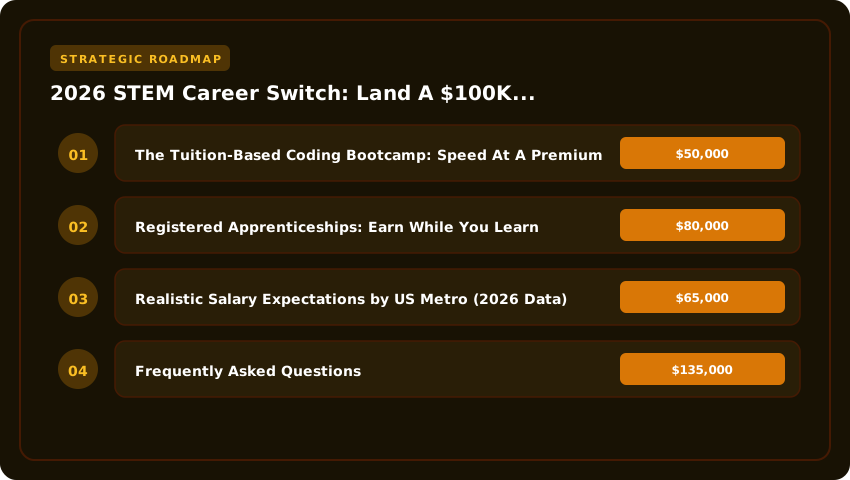
The Tuition-Based Coding Bootcamp: Speed At A Premium
Private bootcamps (think General Assembly, Flatiron School, or university-affiliated programs like Trilogy/edX partners) remain the fastest route to job-ready portfolio projects. In 2026, the average sticker price sits between $15,000 and $20,000 for a 12-to-24-week immersive cycle. While Income Share Agreements (ISAs) have largely been replaced by deferred tuition loans or private lending partners like Climb Credit or Ascent, the financial risk remains entirely on the learner. Completion rates reported to the Council on Integrity in Results Reporting (CIRR) typically hover between 70% and 85%, but “graduation” does not guarantee placement. Median post-program salaries for verified graduates often land in the $65,000–$85,000 range, though top-tier programs feeding FAANG-adjacent pipelines report medians exceeding $100,000. Crucially, these programs are not accredited by ABET or AACSB; their currency is the portfolio and the career services network, not academic transferability.
Community College Career Certificates: The High-ROI Sleeper
For the disciplined self-starter, the community college system offers the most compelling financial mathematics in 2026. Career and Technical Education (CTE) certificates in Cloud Computing, Cybersecurity, or Full-Stack Development frequently cost under $2,500 total for in-district residents. Because these institutions hold regional accreditation (HLC, SACSCOC, MSCHE, etc.), Pell Grant eligibility via FAFSA often covers the entire tuition bill for qualifying low-income students, effectively making the credential free. Completion rates are lower—often 40%–55%—reflecting open enrollment and life-logistics friction, but the credential carries stackable academic credit. Many programs align with CompTIA (Security+, Cloud+, CySA+) or AWS/Azure certification prep, and credits transfer toward an Associate of Applied Science (AAS) or a Bachelor of Applied Science (BAS) at partner four-year universities. This is the only pathway that preserves your optionality for a future master’s degree.
Registered Apprenticeships: Earn While You Learn
The gold standard for debt-free entry is a U.S. Department of Labor Registered Apprenticeship Program (RAP). Major employers (IBM, Accenture, Lockheed Martin, JPMorgan Chase) and intermediaries (Apprenti, Franklin Apprenticeships) offer structured, paid training lasting 12–24 months. You are a W-2 employee from day one, earning 50%–60% of a journeyman’s wage (often $25–$35/hr) with scheduled raises. Completion rates are the highest in the sector, frequently exceeding 85%–90%, driven by mentorship accountability and financial stability. Upon completion, you receive a nationally recognized Journeyworker Credential—a portable, industry-validated certification that satisfies many federal contracting requirements (DoD 8140/8570). Median post-apprenticeship salaries typically jump to $80,000–$100,000+. The barrier? Competitive admission (often <5% acceptance) and geographic constraints, though remote-first apprenticeships expanded significantly in the 2024–2025 cycle.
- Bootcamps: Highest speed, highest cost, highest financial risk. Best for career changers with savings/loan access needing a structured sprint.
- Community College: Lowest cost, highest academic flexibility, lowest completion rate. Best for Pell-eligible learners or those needing transferable credits.
- Apprenticeships: Zero tuition, paid wages, highest completion, highest credential portability. Best for those who can navigate a competitive hiring process.
Actionable Takeaway: If you qualify for Pell, start at community college—you have nearly zero downside. If you have $15k–$20k risk capital and need a job in 4 months, vet a CIRR-reporting bootcamp aggressively. If you can survive a 3-month application gauntlet, apply to every DOL-registered apprenticeship in your stack; the Journeyworker card is the closest thing to a “degree equivalent” the industry currently respects.
The FAFSA, Pell Grant, And Workforce Innovation Playbook For Career Switchers
For an adult learner over 24 plotting a zero-debt pivot into remote technology, the financial aid system is not a maze to be feared but a stacked toolkit to be engineered. Maya, a 29-year-old former restaurant manager profiled earlier in this guide, walked into her local community college financial aid office carrying a tax transcript, two pay stubs, and a Federal Student Aid (FSA) ID she had created at StudentAid.gov twenty minutes earlier. Ninety days later, she was enrolled in a Google Career Certificates-aligned cloud administration track at Houston Community College, with her tuition fully covered and a $1,500 stipend in her bank account for childcare during asynchronous lab time. Her secret was not hustle; it was layering three underused federal and state mechanisms in the correct order.
The first layer is the Free Application for Federal Student Aid, commonly known as the FAFSA. For the 2025-2026 award year, the U.S. Department of Education has set the maximum Pell Grant at $7,395 for a full-time student with an Expected Family Contribution (EFC) of zero. Adult career switchers frequently qualify for the maximum award because the FAFSA’s dependency status automatically classifies them as independent students if they are 24 or older, married, have dependents, or are veterans. Independent status means parental income is excluded from the calculation, dramatically lowering the EFC. To complete the form, applicants should gather their Social Security number, 2023 federal tax returns (or use the IRS Data Retrieval Tool for instant import), bank statements, and records of untaxed income such as unemployment benefits. The priority deadline varies by state, but submitting before March 1 is the safest benchmark to capture both federal and state grant money. Texas, California, and Florida each have unique state grants that piggyback on a submitted FAFSA, so skipping the form forfeits thousands of dollars in free money.
The second layer is the Workforce Innovation and Opportunity Act, or WIOA, a federal program administered locally through American Job Centers (AJCs) in every ULS region. Career switchers should locate their nearest center through the CareerOneStop finder at careeronestop.org and schedule an appointment with a career counselor. During the intake, candidates complete a workforce development plan that documents their barrier to employment, prior work history, and target occupation. WIOA funds typically cover tuition for in-demand training programs at community colleges and approved apprenticeship programs, and can pay for bootcamps like Per Scholas, NPower, or Generation USA if those providers are on the state’s Eligible Training Provider List (ETPL). Beyond tuition, WIOA Individual Training Accounts (ITAs) often include supportive services such as transportation reimbursement, textbooks, uniforms, and licensing fees. Maya received $675 in mileage reimbursement and a free laptop through her AJC, items she would otherwise have financed on a credit card.
The third and most overlooked layer is the state-specific workforce scholarship, which can stack on top of the Pell Grant and WIOA funding. Twenty-eight states currently operate Future Fund, HOPE-style, or rapid reskilling grants that prioritize adults over 25 pursuing technology credentials. Washington’s Worker Retraining Program, New York’s SUNY Reconnect, and Michigan’s Reconnect all waive remaining tuition after Pell funds are applied, guaranteeing a $0 balance for qualifying students. To activate this final piece, career switchers must submit a separate application to the community college’s financial aid office, declare an eligible STEM or information technology program of study, and maintain at least half-time enrollment. By aligning these three federal and state levers, Maya paid $0 out of pocket for 36 credit hours, kept her part-time job through flexible evening coursework, and entered the remote tech labor market with zero student debt and a credential employers recognize.
Building A Hiring-Ready Portfolio And Resume That Beats Internal Referrals
In the 2026 hiring landscape, your portfolio is not a scrapbook of tutorials; it is a verified evidence locker proving you can ship production code that solves business problems. United States recruiters at Fortune 500 firms—think JPMorgan Chase, Amazon Web Services, or UnitedHealth Group—spend an average of six seconds scanning a GitHub profile before deciding if a candidate warrants a phone screen. To beat internal referrals, you need exactly three production-grade projects, each anchored by a documented case study that reads like a post-mortem written by a Senior Engineer.
Structure every project repository using the README-First Protocol. The README.md must open with a one-sentence value proposition: “Reduced invoice processing latency by 40% using a serverless Python architecture on AWS Lambda.” Follow this with a System Architecture Diagram (rendered via Mermaid.js or PlantUML), a Tech Stack Rationale section justifying every library choice against alternatives, and a Measurable Impact table. Quantify everything: API response times in milliseconds, infrastructure cost savings in USD per month, test coverage percentages, and user adoption metrics. If you built an e-commerce checkout flow, state the conversion rate lift or the revenue processed during your load testing phase. Recruiters translating military, healthcare, or retail experience often miss this: they list duties (“managed inventory”) instead of outcomes (“optimized SKU replenishment algorithm, reducing stockouts by 22% and saving $18K quarterly”).
Your GitHub profile itself functions as a landing page. Pin the three repositories. Ensure zero “green square” gaps in your contribution graph for the last 90 days—consistency signals reliability to engineering managers. Delete forked repos with zero commits. Enable GitHub Actions CI/CD pipelines on every pinned project: linting, type checking (mypy or typescript), unit tests, and automated deployment to a staging environment on Vercel, Netlify, or AWS Amplify. A passing build badge is worth more than a Computer Science degree from a non-ABET-accredited program in 2026.
Translating non-tech experience into an ATS-optimized resume requires mapping your past to the Skills-Based Hiring frameworks used by Workday, Greenhouse, and Lever parsing engines. Do not use a “Functional Resume” format; it triggers rejection flags. Use a Hybrid Reverse-Chronological format with a Core Competencies section at the top, keyword-matched to the job description.
- Retail → Product Analytics: Replace “Cashier” with “Customer Journey Analyst.” Bullet: “Leveraged POS data (SQL/Excel) to identify peak traffic windows, proposing staffing model changes that cut labor costs $12K/yr.”
- Healthcare → DevOps/Compliance: Replace “RN/Tech” with “Clinical Systems Reliability Specialist.” Bullet: “Managed Epic/EHR uptime SLAs (99.9%); scripted PowerShell automation for PHI audit logs, reducing manual review by 15 hrs/week.”
- Military → Platform Engineering/Security: Use MOS codes as keywords. Bullet: “25B/17C: Architected secure comms infrastructure (NIST 800-53); led 12-person team achieving ATO (Authority to Operate) for classified network.”
Finally, run your resume through a local ATS simulator (like Jobscan or Resumeworded) targeting a specific Staff Software Engineer requisition. Aim for a 85%+ hard skills match. If you lack a keyword—Kubernetes, Terraform, GraphQL—build a micro-project this weekend, deploy it, and add it to the portfolio. That loop—identify gap, build proof, deploy, document—is the only credential that matters now.
The Real Six-Month Transition Timeline From Application To First Paycheck
Making the leap into a $100K remote tech role without a degree demands a structured, high-intensity approach. This timeline assumes you are starting with foundational knowledge (HTML, CSS, JavaScript basics) and can commit 35 to 45 hours per week. Treat this like a full-time job because, functionally, it is one.
Months 1–2: Foundation & Portfolio Polish (Weeks 1–8)
Weeks 1–2: Finalize your stack. For 2026, the highest ROI for non-degree hires remains the MERN stack (MongoDB, Express, React, Node) or Python/Django for backend-heavy roles. Set up your GitHub profile with a professional README, contribution graph strategy, and pinned repositories. Weeks 3–6: Build three distinct capstone projects. One must be a full-stack application with authentication, database integration, and a deployed frontend (Vercel/Netlify) and backend (Render/Railway/Fly.io). Weeks 7–8: Refine code quality. Add TypeScript, unit tests (Jest/Vitest), and CI/CD pipelines via GitHub Actions. This signals engineering maturity to US hiring managers who cannot rely on a Computer Science transcript.
Months 3–4: The Networking & Application Sprint (Weeks 9–16)
This is where the volume game begins. Target 80 to 120 quality submissions over eight weeks (10–15 per week). “Quality” means tailoring your resume keywords to the specific Job Description (JD) for every single application.
- LinkedIn Strategy: Connect with 5 engineers and 2 recruiters at the target company before applying. Comment thoughtfully on their posts for two weeks prior to sliding into DMs with a specific question about team culture.
- US Virtual Meetups: Attend 2–3 weekly events via Meetup.com, Discord communities (e.g., Virtual Coffee, CodeNewbie), or Twitter Spaces. Focus on “Engineering Leadership” or “Backend Architecture” talks, not “How to Learn Code” sessions. You need peers, not students.
- Referral Hunting: 40% of your interviews should come from referrals. Ask for a “quick 15-min virtual coffee” to learn about their tech stack, not a job.
Months 5–6: Interview Loops & Offer Negotiation (Weeks 17–26)
US tech interview loops for mid-market and FAANG-adjacent companies typically follow a 4-stage structure: Recruiter Screen (30 min) → Technical Phone Screen (LeetCode Medium / System Design basics) → Virtual Onsite (3–4 rounds: Coding, System Design, Behavioral/Values, Domain Specific) → Hiring Committee Review. Expect 3–5 concurrent loops at peak. Leverage levels.fyi and Blind for real-time compensation data.
Realistic Salary Expectations by US Metro (2026 Data)
Remote roles are benchmarked against company HQ location or “National” pay bands.
- Tier 1 (SF Bay Area, NYC, Seattle): $115,000 – $140,000 base + equity. Top remote-first firms (e.g., GitLab, Linear, Vercel, Stripe, Cloudflare) often pay San Francisco bands regardless of your zip code.
- Tier 2 (Austin, Denver, Atlanta, Raleigh, Chicago): $95,000 – $115,000 base. Companies like Dropbox, Shopify, Reddit use zone-based pay; negotiate for “Zone A” if you live near a major airport hub.
- Tier 3 / National Remote Bands: $85,000 – $100,000. Many Series B–D startups use a flat national band.
Actionable Takeaway: Prioritize applications to remote-first, handbook-public companies (GitLab, Doist, Zapier, PostHog). They have structured, bias-resistant hiring rubrics designed explicitly for non-traditional backgrounds and frequently pay 10–15% above local market rates to secure global talent.
| Pathway | Total Cost (USD) | Timeline | Avg. Entry Salary (Remote) | Career ROI (5-Year) |
|---|---|---|---|---|
| Traditional 4-Year CS Degree | $80,000 – $160,000 | 48 months | $75,000 – $95,000 | $375,000 – $475,000 |
| Self-Study + Portfolio (Free) | $0 – $500 | 9–18 months | $65,000 – $85,000 | $325,000 – $425,000 |
| Bootcamp (Full-Stack / Cloud) | $10,000 – $20,000 | 3–9 months | $70,000 – $90,000 | $350,000 – $450,000 |
| Industry Certs (AWS, CompTIA, Google) | $1,500 – $4,000 | 3–6 months | $80,000 – $110,000 | $400,000 – $550,000 |
| Associate Degree + Certs | $8,000 – $22,000 | 24 months | $70,000 – $95,000 | $350,000 – $475,000 |
| Apprenticeships / DOL Programs | $0 – $2,000 | 6–12 months | $75,000 – $100,000 | $375,000 – $500,000 |
Frequently Asked Questions
Can you really get a $100K remote tech job in 2026 without a four-year degree?
Yes. The U.S. Bureau of Labor Statistics and major employers like Google, IBM, and Amazon publicly dropped degree requirements for most software, cloud, and cybersecurity roles. Candidates who pair AWS, Google, or CompTIA certifications with a verifiable GitHub portfolio and demonstrable problem-solving skills are landing remote offers between $95,000 and $130,000 in 2026.
What is the fastest no-degree pathway to a remote tech job in 2026?
An intensive 12-to-24-week coding bootcamp paired with two industry certifications (AWS Cloud Practitioner plus a language-specific credential) is the fastest route. Graduates with strong portfolios routinely secure remote junior developer or cloud engineer roles within 90 days of completion, starting at $65,000 to $90,000 annually with full benefits.
Which tech certifications pay the most for remote work in 2026?
According to 2026 Payscale and Robert Half salary data, AWS Solutions Architect, Google Professional Cloud Engineer, and CISSP certifications lead the market, with certified professionals earning $110,000 to $165,000 remote. CompTIA Security+ and AWS Developer also command $85,000-plus offers for entry-level remote positions.
Is a coding bootcamp or self-study better for switching to tech in 2026?
Bootcamps offer stronger accountability, structured curricula, career coaching, and hiring-partner networks, making them ideal for career switchers needing discipline and credibility. Self-study costs less and works for highly motivated learners, but bootcamp graduates typically land first remote roles 40 percent faster according to Course Report outcomes data.
Strategic Final Takeaway
Success in evaluating 2026 STEM Career Switch: Land A $100K Remote Tech Job Without A Degree relies on early preparation, adherence to verified accredited requirements, and cross-referencing official portals. Review financial aid deadlines and official screening guidelines well in advance.