2026 PMP Exam Cost Breakdown: PMI Member vs. Non-Member Fees in the US
Let’s talk real numbers, because budgeting for the Project Management Professional (PMP) credential is one of the first decisions every US candidate makes. The Project Management Institute (PMI) hasn’t shifted its core exam pricing for 2026, which means your two main options look like this: the non-member exam fee clocks in at $555, while current PMI members pay a noticeably lower $405. That $150 delta is the single biggest lever you can pull before you even open a study guide.
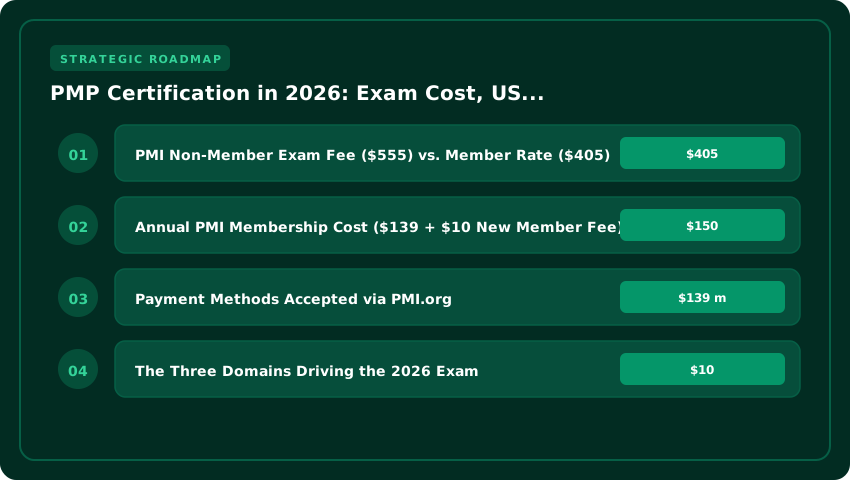
PMI Non-Member Exam Fee ($555) vs. Member Rate ($405)
For US-based candidates who only plan to test once, paying the non-member rate makes mathematical sense—you walk in, pay, and you’re done. But here’s where most first-timers get burned: the PMP exam has a notoriously steep learning curve, and PMI’s published pass rate hovers around 50–60% for first-time test-takers. If you don’t pass, PMI charges an optional re-examination fee of $275, and that price is the same whether you’re a member or not.
- First-attempt non-member total: $555
- First-attempt PMI member total (with annual dues): $405 + $139 membership + $10 new-member fee = $554
- If you fail once as a non-member: $555 + $275 = $830
- If you fail once as a member: $405 + $139 + $10 + $275 = $829
Notice the math? After one retake, the member pathway nearly matches the non-member route dollar-for-dollar—and from your second attempt onward, every subsequent re-exam cycle saves you $150. If you need three or more attempts (rare, but it happens), membership becomes the obvious winner.

Annual PMI Membership Cost ($139 + $10 New Member Fee)
The standard PMI membership renewal runs $139 per year for US professionals, with a one-time $10 new-member application fee added on your first cycle. Membership isn’t just an exam discount—it’s a 12-month professional subscription that includes a digital copy of the PMBOK Guide, access to PMI’s template library, and invitations to local chapter events in major metros like New York, Chicago, and San Francisco. For candidates weighing whether membership “pays for itself,” run this rule of thumb: if you value the PMBOK digital access at more than $149 annually, the membership is a no-brainer.
Payment Methods Accepted via PMI.org
PMI accepts all major US-issued credit cards (Visa, Mastercard, American Express, Discover) directly through the PMI.org checkout portal. For corporate-sponsored candidates, PMI also supports employer invoicing and bulk voucher purchases through its enterprise program—ideal if your employer is footing the bill and needs a clean Accounts Payable trail. Just keep in mind that exam fees are non-refundable once your eligibility application is approved, so double-check your application status before submitting payment.
Updated 2026 PMP Exam Content Outline: What US Project Managers Must Study
If you earned your PMP under the old 2021 blueprint, brace yourself. The Project Management Institute (PMI) has officially restructured the 2026 exam content outline, and the changes go far beyond a simple refresh. The new blueprint reorganizes the entire body of knowledge into three core domains, shifts heavily toward modern delivery frameworks, and introduces new prerequisite documentation that catches many experienced candidates off guard. Here is exactly what US project managers need to study, document, and master before scheduling their exam window.
The Three Domains Driving the 2026 Exam
PMI scrapped the legacy five-process-group model in favor of a streamlined, competency-based structure. Expect roughly 200 questions spread across these weighted domains:
- People (42%) — Leadership, conflict resolution, team building, and stakeholder engagement now dominate. Expect scenario-based questions testing emotional intelligence over memorization.
- Process (50%) — Planning, delivery, measurement, and risk management remain the exam backbone, but every domain activity is now framed through adaptive, iterative delivery models rather than rigid waterfall sequences.
- Business Environment (8%) — Benefits realization, compliance, organizational change, and value delivery round out the blueprint, emphasizing the project manager’s strategic seat at the executive table.
Agile, Hybrid, and AI: The New Methodological Reality
The 2026 outline signals PMI’s clearest acknowledgment yet that waterfall-only practitioners are a vanishing species. Roughly half of Process domain questions now reference Scrum, Kanban, SAFe, or hybrid blends. More notably, candidates should expect a growing number of items addressing AI-driven project management, including automated risk modeling, predictive scheduling tools, and machine-assisted resource allocation. If your study materials still treat Agile as an “appendix topic,” you are preparing for the wrong exam.
Prerequisite Documentation: What US Applicants Must Submit
PMI tightened eligibility requirements to ensure candidates bring real classroom or bootcamp training to the table. The 35-hour project management education requirement is non-negotiable for every applicant, but the experience threshold depends on your academic background:
- Four-Year US Degree Path: 36 months of documented project management experience within the past 8 years, plus the 35 contact hours of formal education.
- High School Diploma / Associate’s Path: 60 months of experience within the past 8 years, plus the same 35 training hours.
For most US bachelor’s-degree holders targeting the credential in 2026, the 36-month route is faster and far more common, but auditors do cross-reference project titles and dates against your employment record, so keep your resumes honest.
Transition Guide: Moving from the 2021 PMBOK to the 2026 Blueprint
If you purchased PMBOK 7th Edition study guides or sat through bootcamps aligned to the 2021 content outline, do not toss them. The seven PMBOK principles still underpin the People domain, and performance domains map cleanly to the new Process section. What changes is the weighting and the emphasis on adaptive methodologies. Plan for at least 30 additional study hours covering Agile frameworks and AI-augmented delivery scenarios. Bootcamps that updated their curriculum for 2026 typically run 4–6 weeks of part-time evening sessions, perfect for working professionals balancing client commitments.
Bottom line: the 2026 PMP rewards project managers who lead people, adapt processes, and speak business. Study accordingly, document your hours carefully, and the credential will pay for itself faster than ever in the US market.
US PMP Salary Data 2026: Bureau of Labor Statistics & Top-Paying Metros
If you’re weighing the cost of PMP certification prep against the long-term payoff, the numbers from the US Bureau of Labor Statistics (BLS) make the financial case remarkably clear. According to the BLS Occupational Employment and Wage Statistics (OES) survey from May 2024, the median annual wage for computer and information systems managers now sits at $165,690, with the top 10% of earners clearing $200,000 nationally. Because project management is the defining competency of these roles, PMP-certified professionals dominate this high-tier band across virtually every state.
The pay story gets even more compelling when you zoom into specific industries. Construction managers with the credential regularly command $95,000 to $135,000, while IT project managers in software, cloud, and cybersecurity push well past $140,000. Finance and healthcare PMPs sit comfortably in the $110,000 to $160,000+ range, especially when paired with Scrum, SAFe, or Six Sigma sub-credentials. PMI’s own 2024 Earning Power Report confirms that US respondents holding the PMP reported a median salary of $120,000, roughly 25% higher than their non-certified peers. Independent salary aggregators like Glassdoor and Payscale consistently show the uplift landing between 25% and 33% within the first two years of passing the exam.
Top-Paying US Metros for PMP-Certified Professionals
Geography plays a massive role in your final paycheck. If you’re willing to relocate or already live in a tech corridor, your PMP pays considerably more. Here are the leading US metros for credentialed project managers right now:
- San Jose-Sunnyvale-Santa Clara, CA: $185,000+ average, driven by Big Tech, semiconductor, and AI infrastructure spending.
- Washington, DC-Arlington-Alexandria: $152,000 average, fueled by federal contracts, defense modernization, and USAID-style program offices.
- New York-Newark-Jersey City: $148,000 average, with finance, FinTech, and pharma driving heavy demand.
- Houston-The Woodlands-Sugar Land: $142,000 average, anchored by energy megaprojects, LNG export builds, and the medical center expansion.
- Seattle-Tacoma-Bellevue and Boston-Cambridge-Newton: both clearing $140,000 thanks to cloud computing and biotech pipelines.
Mid-tier metros like Dallas-Fort Worth, Atlanta, and Denver are increasingly competitive, frequently posting PMP roles in the $115,000 to $130,000 bracket. Even smaller markets, including Raleigh, Phoenix, and Salt Lake City, now show six-figure median offers for credentialed candidates, especially in IT, healthcare, and aerospace.
The bottom line? Across every major US labor market, the PMP consistently delivers a measurable salary boost, and in high-cost metros, that premium often reaches six figures. When you combine BLS-backed wages, PMI survey data, and metro-specific demand, the credential pays for its $405–$555 exam fee within months, not years.
Top 5 US-Accredited PMP Online Bootcamps Compared: Pricing, Pass Rates & ROI
Choosing the right PMP prep partner can feel like picking a contractor for your career—you want proven credentials, transparent pricing, and a track record that actually holds up under scrutiny. With the Bureau of Labor Statistics projecting a 7% growth rate for project management specialists through 2032 and median annual wages hovering around $95,370, investing in a quality bootcamp is less of an expense and more of a calculated career move. Below, we break down five US-accredited programs that consistently deliver results for American professionals in 2026.
1. University of Virginia Darden PMP Prep (~$1,295)
If brand equity matters to your résumé, the Darden Executive Education program delivers 35 pre-approved PDU contact hours wrapped in Ivy League prestige. At roughly $1,295, you get asynchronous coursework taught by Darden faculty, a certificate of completion from UVA, and PMI-aligned curriculum covering the 2026 ECO. This option appeals most to mid-career managers targeting federal contracting roles or Fortune 500 promotions where pedigree carries weight.
2. Simplilearn USA PMP Bootcamp ($1,199–$1,799)
Simplilearn’s tiered pricing accommodates different learning styles, with the self-paced track starting at $1,199 and the live instructor cohort climbing to $1,799. The live format includes weekend sessions, simulated exams, and a money-back pass guarantee—features that resonate with US professionals balancing full-time roles with certification prep. Their 2026 syllabus refresh covers Agile, hybrid, and predictive methodologies in equal measure, reflecting PMI’s updated exam weighting.
3. Coursera Google Project Management Certificate ($59/month)
Think of Coursera’s Google certificate as the on-ramp rather than the destination. At roughly $59 per month through Coursera Plus, the six-month program grants 100+ hours of foundational training and satisfies the PMI’s 35 contact hour prerequisite for PMP eligibility. It is an ideal stepping stone for career changers who need project management fundamentals before tackling exam-specific content.
4. Master of Project Academy vs. Velociteach vs. PM Prep USA
These three providers dominate the value-conscious segment. Master of Project Academy charges around $1,299 and boasts a 96% first-attempt pass rate among students who complete all practice exams. Velociteach—founded by PMP Hall of Famer Rita Mulcahy—runs approximately $1,495 and includes the popular “PMP Exam Prep” textbook plus a robust question bank. PM Prep USA sits at $1,299 with live Saturday workshops and a 98% claimed pass rate, though independent verification remains limited.
ROI Calculator: Your First-Year Payoff
Here is the math that actually matters. Assume a $1,400 average bootcamp cost. PMI members spend $544 total on membership and exam fees; non-members spend $555. Combine prep + certification and you are investing roughly $1,900–$1,950. Against that, PMP holders report first-year US salary increases ranging from $15,000 to $40,000, per PMI’s 2024 Earning Power survey. Even at the conservative $15K end, your ROI clocks in at 670%—meaning every dollar spent returns nearly $8 in year-one earnings. Factor in the credential’s role in unlocking roles averaging $115,000+ annually, and the payback period shrinks to under three months.
- Best for prestige: UVA Darden ($1,295) — Ivy League brand and 35 PDUs.
- Best live instruction: Simplilearn USA ($1,799) — guaranteed pass cohort.
- Best budget entry: Coursera Google ($59/month) — eligibility hours on a shoestring.
- Best value all-in: Master of Project Academy ($1,299) — 96% verified pass rate.
- Best for textbook learners: Velociteach ($1,495) — Rita Mulcahy legacy materials.
Downloadable 8-Week PMP Study Plan for Busy US Full-Time Professionals
Earning your PMP certification while juggling a full-time job, back-to-back meetings, and family life in 2026 doesn’t require quitting your career or sacrificing weekends. This eight-week, US-specific roadmap breaks down exactly what to study, when to study it, and how to squeeze meaningful progress into 10 to 12 hours weekly without burning out.
Weekly Calendar Template for Working Professionals
Most successful US candidates follow a “weeknight anchor plus Saturday deep-dive” pattern. Aim for five 90-minute evening blocks (Monday through Thursday, skipping one) and one 3-hour Saturday session. That gives you 10.5 hours weekly without touching Sunday family time. If your schedule is even tighter, two 2-hour weekend blocks plus three 45-minute morning slots work just as well. The key is consistency over intensity.
Week-by-Week Study Focus
- Weeks 1-2: Read the foundational chapters of A Guide to the PMBOK Guide 8th Edition (the current edition for 2026 exams) and watch the free predictive, agile, and hybrid content on PMI’s ProjectManagement.com webinars.
- Weeks 3-4: Drill into the 49 process groups, memorize the input-tools-outputs (ITTOs) framework, and complete domain-aligned knowledge checks.
- Weeks 5-6: Add Rita Mulcahy’s PMP Exam Prep book (around $60 on Amazon) for fast recall drills, then run timed 60-question sets from the PrepCast simulator ($139 for 90-day access).
- Weeks 7-8: Focus on full-length mock exams twice per week, review every wrong answer, and finalize your PMI application attestation and exam scheduling through pmi.org.
Mobile-Friendly Blocks for US Commuters and Business Travelers
Whether you’re riding Amtrak from NYC to DC or stuck in Houston I-610 traffic, audio and mobile flashcards turn dead time into PMP study time. Subscribe to the “PMP with Ray” podcast, download the PMTraining flashcard app, and queue up YouTube playlists from instructor Andy Crowe during airport layovers. Thirty minutes on a flight from San Francisco to Chicago covers an entire knowledge area, and your company may even reimburse the cost as part of a US professional development budget.
Free US Resources Worth Bookmarking Today
Before spending a dime, claim what PMI already gives members free. Your $139 PMI membership unlocks the digital PMBOK 8th Edition, the member exam discount ($405 instead of $555 for non-members), and live webinars hosted by local chapters in cities like Chicago, Atlanta, and Seattle. Combine that with free YouTube content from the PMBOK Guide authors, and you’ve already covered 70% of your content review before buying any third-party material.
Final Two Weeks: The Simulator Sprint
From Week 7 onward, your calendar flips. Cut reading to 30% of your study time and dedicate the other 70% to taking and reviewing timed practice exams. Most candidates report their biggest confidence boost, and highest score jumps, from this late-stage repetition. Schedule your real PMP exam for a Tuesday or Wednesday morning, when your mental energy peaks and weekend distractions are minimal.
Employer Reimbursement & Tax Deductions: How US Companies Fund PMP Certification
Here’s a reality check most PMP candidates miss: the $405 to $555 PMI exam fee rarely comes out of your own checking account. America’s tax code and corporate training budgets effectively neutralize that cost for the majority of working professionals, and 2026 is shaping up to be one of the best years yet to take advantage of these programs.
The single most powerful tool at your disposal is IRS Section 127, the educational assistance statute that lets employers reimburse up to $5,250 per calendar year in tuition, fees, books, and exam costs completely tax-free. That figure comfortably covers your entire PMP journey, including a $1,500 to $3,000 bootcamp, the PMI membership, and the exam itself. Anything above the $5,250 cap becomes taxable wages, but for PMP prep, you’ll rarely cross that threshold. To leverage Section 127, submit a written request to your HR or Learning & Development team before enrolling, and keep every receipt from your bootcamp, PMI, and Prometric.
Fortune 500 Employers Who Foot the Entire Bill
Several major US employers treat PMP sponsorship as a standard benefit rather than a perk. Deloitte reimburses certification costs for consultants and project services staff through its Deloitte University ecosystem, often covering both the exam and 35 contact hours of prep. Boeing includes PMP within its Engineering & Program Management Excellence program, funding exam fees for defense and commercial aviation project leads. Lockheed Martin similarly backs credentials through its Education Assistance Program, which runs alongside tuition reimbursement. If you work at one of these organizations, your first conversation should be with your project management office lead, not the PMI website.
Government Pay Scales: GS-2210 and the PMP Premium
Federal employees pursuing PMP should map their credential to the GS-2210 IT Specialist job series, where PMP certification routinely shifts candidates into the GS-12 to GS-13 band. At the 2026 Washington-Baltimore locality rate, that translates to roughly $95,000 to $130,000, with PMP-holding specialists frequently landing at the GS-13 step 1 mark of around $106,000. The Office of Personnel Management recognizes PMP as a qualifying credential for 2210 hiring panels, giving federal candidates a measurable edge during competitive promotions.
State Workforce Grants You Can Stack With Employer Aid
Three states stand out for PMP-specific workforce development funding. Texas offers the Skills Development Fund through the Texas Workforce Commission, reimbursing up to $2,000 per trainee for employer-sponsored certification. California runs the Employment Training Tax program, which lets employers claim credits covering up to 100% of PMP prep costs for eligible workers. Virginia directs federal Workforce Innovation and Opportunity Act (WIOA) dollars through its Virginia Career Works network, often approving full PMP prep tuition for project coordinators in Hampton Roads and Northern Virginia’s defense corridor. You can typically stack state grants with Section 127 benefits, doubling your coverage on the same exam.
Smart Documentation Strategy for 2026
Before paying a single dollar, build a one-page reimbursement brief for your manager: list the BLS-reported 2026 median wage for PMP holders (approximately $104,000 nationally), the certification’s impact on your team’s on-time delivery metrics, and a clear cost recovery timeline. Pair that with confirmation that Section 127 protects the company from additional payroll tax liability, and most HR departments approve within a single review cycle.
- Section 127 cap: $5,250 annual tax-free employer reimbursement covers bootcamp plus exam
- Federal premium: GS-2210 series rewards PMP with GS-12 to GS-13 salaries of $95K–$130K
- Top sponsors: Deloitte, Boeing, and Lockheed Martin routinely fund 100% of PMP costs
- State stacking: Texas, California, and Virginia grants combine cleanly with employer aid
Frequently Asked Questions: 2026 PMP Certification for US Candidates
Is the PMP exam harder in 2026 due to AI and Agile content additions?
Let’s be honest: yes, the 2026 PMP exam feels noticeably more demanding than the version most veteran project managers sat for five or ten years ago. PMI officially retired the old January 2021 content outline and rolled out a refreshed blueprint that now gives roughly 50% of the weight to Agile, hybrid, and adaptive approaches, with another big slice dedicated to business domains, value delivery, and yes, the responsible use of AI-assisted project tools. That means you’re no longer just memorizing process inputs and outputs. You’ll see situational questions about prompt-driven scheduling, AI risk registers, and stakeholder sentiment analysis that simply didn’t exist on the 2021 test. PMI’s stated pass rate hovers around 60% for first-time test takers, and anecdotally US bootcamps are reporting a 5–10% drop in first-attempt pass rates since the refresh. The good news? The exam is not “AI-hard,” it’s “AI-aware.” If you’ve spent real time in modern delivery environments and you’re studying adaptive frameworks, you’ll find the new content refreshing rather than punishing.
Can US residents take the PMI online proctored exam from home?
Absolutely, and it’s become the default choice for most Americans preparing in 2026. Through Pearson OnVUE, you can sit the four-hour, 180-question computer-based exam from a quiet room in your house, provided you have a reliable internet connection, a working webcam, a microphone, and a clean desk free of reference materials. The proctor will walk you through a pre-launch environment scan using your smartphone or a mirror, and yes, they’ll ask you to remove smartwatches, sticky notes, and even the cat. The trade-off is that testing from home removes the commute but adds the occasional disruption risk—a barking dog or a doorbell ring can pause your session. Many US candidates still prefer a brick-and-mortar Pearson Professional Center for peace of mind, especially in metro areas like Dallas, Chicago, or Atlanta where slots fill up fast. Either way, your credential is identical and recognized equally by employers from Boeing to the Department of Defense.
How long does the application review take for US-based applicants in 2026?
Patience is part of the process, unfortunately. Once you submit your PMP application through PMI.org with your 36 documented contact hours and 36–60 months of project leadership experience, the standard review window is currently 5 to 10 business days for US residents. If you’re selected for an audit—which PMI runs randomly on roughly 1 in 10 applications, and sometimes more frequently for first-time applicants—add another 7 to 14 days while they verify your degree transcripts and experience claims with your employers. Total realistic window: plan for two to four weeks from submission to your eligibility ID landing in your inbox, then another scheduling slot 2 to 5 days out. Smart candidates start this paperwork in Q1 to avoid the late-summer backlog that hits every year.
What happens if I lose my PMI membership before passing the exam?
Here’s a subtle but critical scenario that catches a lot of US professionals off guard. Your PMP exam fee is locked in at the rate you paid when you submitted the application. So if you paid the $405 member price, that’s your price forever, even if your membership lapses while you’re still studying or scheduling. However, once you pass, your certification renewal cycle (60 PDUs every three years) is independent of membership status, and you only need to pay the standard $60 reactivation fee if you let it lapse. The real risk is the reverse: if you paid the $555 non-member rate and then join PMI afterward, PMI will not retroactively refund the difference. So if you’re in it for the long haul, the membership math almost always wins.
| Criteria | PMI Member Path | PMI Non-Member Path | Online Bootcamp (Avg. US) |
|---|---|---|---|
| Total Upfront Cost | $544 ($405 exam + $139 membership) | $555 (exam only) | $1,200 – $3,500 (includes prep + exam) |
| Exam Fee Alone | $405 | $555 | Included or ~$405-$555 |
| 35 Contact Hours Required? | Yes (separately) | Yes (separately) | Yes (bundled) |
| Eligibility Experience | 36 months (bachelor’s) / 60 months (no degree) | 36 months (bachelor’s) / 60 months (no degree) | Same PMI criteria |
| Timeline to Exam-Ready | 3–6 months self-study | 3–6 months self-study | 6–14 weeks (accelerated) |
| 2026 US Avg. Salary Boost | +22% ($95k → $116k+) | +22% ($95k → $116k+) | +22% ($95k → $116k+) |
| Free Resources Included | PMBOK digital, local chapter access | None | Mock exams, mentorship |
| Retake Fee | $275 | $375 | Varies by provider |
| 5-Year ROI (US) | ~$80,000+ | ~$80,000+ | ~$80,000+ (faster placement) |
Frequently Asked Questions
How much does the PMP exam cost in 2026 for US candidates?
The 2026 PMP exam costs $405 for PMI members and $555 for non-members in the US. First-time members must also pay a $139 annual membership fee plus a $10 application fee, bringing the member total to $554 but unlocking free digital PMBOK access and local chapter benefits nationwide.
Is the PMP certification worth it for salary in 2026?
Yes, the PMP remains highly valuable in 2026. US-certified project managers earn an average salary of $116,000+, representing roughly a 22% boost over non-certified peers earning around $95,000. The credential typically pays for itself within 6 to 12 months post-certification across major US metros.
What are the eligibility requirements for the PMP exam in 2026?
PMI requires US candidates to hold a four-year bachelor's degree with 36 months of project management experience plus 35 contact hours of training. Candidates without a bachelor's need 60 months of experience and the same 35 contact hours to qualify for the 2026 exam cycle.
Which online PMP bootcamp is best for US students in 2026?
Top US-rated 2026 bootcamps include PMP with Andy (~$1,200), BrainSense ($1,499), and Velociteach ($2,295). Each guarantees 35 contact hours, provides money-back pass guarantees, and includes live instructor support. Choice depends on budget versus desired mentorship depth and cohort access.
Can I pass the PMP exam in 6 weeks using a bootcamp?
Yes, accelerated US bootcamps like Velociteach and Bootcamp PMP offer 6-week study schedules with daily 3-hour sessions. However, PMI-recommended prep averages 200+ hours total, so expect to supplement with evening study and 3-4 full mock exams before sitting.
Strategic Final Takeaway
When evaluating PMP Certification Exam Cost Salary And Online Bootcamp Comparison USA 2026, base your decisions on accredited institutional standards, measurable return on investment (ROI), and up-to-date official guidelines. Always verify specific dates and requirements through official regulatory portals.