Why NAEP Data Demands a Reset on Middle School Reading Intervention
Something is shifting in American middle school classrooms, and the numbers finally prove what veteran educators have suspected for years. The 2024 National Assessment of Educational Progress (NAEP), often called The Nation’s Report Card, delivered a sobering verdict on Grade 8 reading: roughly one-third of eighth graders in the United States perform below the basic proficiency threshold. Translated into real classroom rosters, that means in an average middle school of 900 students, about 300 arrive at intervention blocks reading below the level expected for their grade. Federal data from the US Department of Education and the National Center for Education Statistics (NCES) now show widening disparities between the highest and lowest performing readers since the post-pandemic rebound stalled in 2022.
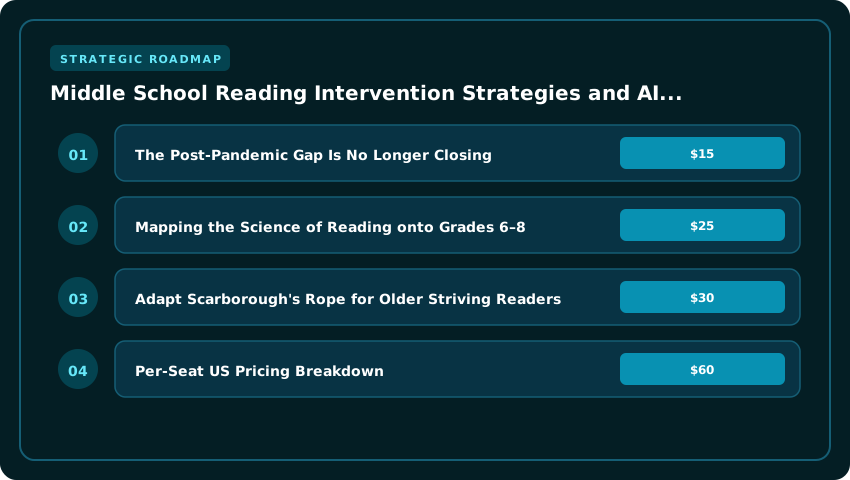
The Post-Pandemic Gap Is No Longer Closing
Even after billions in Elementary and Secondary School Emergency Relief (ESSER) funding flowed into K–12 systems, NAEP trend lines for Grades 4 and 8 have flattened rather than recovered. For middle school teachers, the implication is direct: the students entering sixth grade still cannot decode multisyllabic academic vocabulary, and the gap compounds every semester. Districts using curriculum aligned to Common Core State Standards for English Language Arts report that the stretch between sixth-grade literature standards and eighth-grade informational text expectations widens precisely where intervention budgets get squeezed.
Mapping the Science of Reading onto Grades 6–8
The Science of Reading (SoR) movement, popularized through researchers like Louisa Moats, Mark Seidenberg, and the work aggregated by the National Reading Panel, was once dismissed as an elementary-only conversation. That has changed. Today’s frameworks explicitly extend morphology, etymology, and syntax work into middle school intervention. Tier 2 and Tier 3 intervention blocks now emphasize:
- Morphology: prefix, root, and suffix analysis to unlock the 80% of Tier 2 academic vocabulary students encounter in science and social studies texts
- Sentence-level syntax: recognizing how complex sentence structures signal cause, contrast, and inference in Common Core RL.6–RL.8 anchor standards
- Comprehension monitoring: explicit strategies for informational text structures such as comparison, problem-solution, and claim-evidence
- Fluency with academic prose: oral and silent reading rates calibrated to grade-band Lexile ranges between 925L and 1185L
Aligning Intervention Blocks to Common Core ELA Expectations
Federal Title I funding and many state accountability systems tie intervention minutes directly to demonstrating growth on Common Core strands for literary and informational text. That means middle school intervention cannot be a watered-down version of elementary phonics. It must address how a seventh grader decodes the word photosynthesis, how an eighth grader tracks an author’s argument across a 1,200-word New York Times feature, and how both groups build the background knowledge the NAEP framework increasingly rewards.
The reset is not coming, it is here. Teachers who pair NAEP-informed urgency with Science of Reading-aligned practice hold the clearest path forward.
Structured Literacy Playbooks That Actually Work in Grades 6–8
If you have ever watched a bright 12-year-old stare blankly at a grade-level novel while decoding every third word, you know the middle school literacy crisis is not a motivation problem. It is an instructional one. Fortunately, US reading researchers have spent the last decade adapting structured literacy playbooks for grades 6–8, and they fit surprisingly well inside a traditional American bell schedule. Below are the four routines that consistently move the needle for striving readers in sixth, seventh, and eighth grade.
Adapt Scarborough’s Rope for Older Striving Readers
The Scarborough’s Rope model, developed by Dr. Hollis Scarborough, illustrates reading as a braid of word recognition and language comprehension strands. For older students, the language comprehension strand — vocabulary, background knowledge, and syntax — often breaks long before phonics does. Effective middle school playbooks deliberately rebalance the rope, dedicating explicit fluency work to multisyllabic decoding (think consequence, philosophy, constitutional), while protecting rich vocabulary and content-area knowledge building. Pair a 10-minute fluency sprint with a 15-minute knowledge-building routine tied to social studies or science, and you have a credible sixth-grade block.
Schedule Tier 2 and Tier 3 Intervention Inside the Master Bell
The Multi-Tiered System of Supports (MTSS) framework, endorsed by the US Department of Education, requires protected intervention time. The most successful middle schools carve a 30-minute daily WIN Time (What I Need) into the master schedule, typically replacing a weekly elective rotation. Tier 2 readers get this block four to five days per week; Tier 3 readers receive an additional 20-minute pull-out or push-in session during a homeroom or study hall. The key is treating the window as sacred — no assemblies, no testing, no field trips — so progress-monitoring data stays clean.
Teach Morphology and Greek/Latin Roots as the Power Move
For sixth through eighth graders, morphology instruction offers a higher ROI than almost any other literacy routine. Once a student recognizes that struct, bio, photo, and graph appear in dozens of academic words, decoding speed multiplies overnight. Structured programs like Wordly Wise, Vocabulary from Classical Roots, or district-built morphology scopes typically dedicate 15 minutes per day to two or three new affixes, with cumulative review every Friday. At an implementation cost of roughly $15 to $25 per student annually, it is also one of the most affordable evidence-based interventions a district can deploy.
Use Oral Reading Fluency Benchmarks to Progress-Monitor Without Slowing Content
Many teachers fear that progress-monitoring will eat into content-area instruction. The Hasbrouck-Tindal ORF fluency norms give middle school teams a fast, reliable workaround. Administer a one-minute Oral Reading Fluency (ORF) probe every two to three weeks, score words correct per minute (WCPM), and chart against grade-level benchmarks: 185 WCPM for sixth grade, 195 for seventh, and 200 for eighth. The entire cycle takes less than 10 minutes per student, fits easily into a Tier 3 rotation, and gives administrators the data points they need for MTSS fidelity checks without sacrificing novel studies, literature circles, or science reading time.
Together, these four routines form a playbook that respects both the Science of Reading research base and the realities of a crowded middle school day. Teachers who adopt them report fewer behavior referrals, stronger Lexile growth, and — most importantly — students who finally believe they can read the books in front of them.
FERPA-Compliant AI Literacy Tools Compared Side by Side for 2025
When district curriculum directors in Phoenix, Pittsburgh, or Plano open their 2025–2026 procurement spreadsheets, the same four names tend to dominate the short list: Lexia Core5 and Lexia PowerUp from Lexia Learning, Amira Learning from Renaissance, Imagine Learning, and the teacher-built MagicSchool platform. Each tool promises to deliver on the Science of Reading while staying safely on the right side of federal and state student data privacy law. Here is the side-by-side comparison US decision-makers actually need before signing a purchase order.
Per-Seat US Pricing Breakdown
Expect enterprise district licensing to land between $30 and $60 per student per year, with volume discounts kicking in above 5,000 seats. Lexia Core5 and PowerUp typically run $40–$55 per student annually for site licenses that include the teacher dashboard and professional learning community. Amira Learning, which leans heavily on AI literacy tutoring for grades K–8, generally prices between $35 and $50 per seat, though the new Amira Pro tier with advanced writing feedback climbs toward the top of that band. Imagine Learning sits in a similar $32–$48 range, while MagicSchool, originally a free MagicSchool AI platform for teachers, now offers a district MagicSchool AI for schools tier around $30 per teacher seat rather than per pupil, which dramatically lowers the total cost of ownership for smaller middle school teams.
Individual teacher accounts are a different story. MagicSchool still grants free accounts for solo educators, and Imagine Learning offers single-classroom pilots for under $300 per year. Lexia and Amira generally require a minimum district footprint before unlocking teacher dashboards.
Privacy Compliance: FERPA, COPPA, and State Law Alignment
Any AI literacy tool purchased with federal Title I or Title III funds must align with the Family Educational Rights and Privacy Act (FERPA), the Children’s Online Privacy Protection Act (COPPA), and a growing patchwork of state student data privacy laws. Lexia Core5, Amira Learning, Imagine Learning, and MagicSchool all publish signed Student Data Privacy Consortium (SDPC) agreements and maintain FERPA-compliant data residency inside the continental United States.
- New York Ed Law 2-d: Lexia, Amira, and Imagine Learning are pre-listed on the NYSED Privacy Portal. MagicSchool is gaining ground but should be vetted by district counsel.
- Texas DIR: All major vendors carry DIR-approved contracts through TIPS and BuyBoard cooperatives.
- California SOPIPA: Lexia and Imagine Learning explicitly contract around SOPIPA’s advertising and profiling prohibitions. MagicSchool’s no-ads architecture is similarly clean.
- Florida DPA and Pennsylvania SOPA-PPI: All four tools meet the affirmative parental consent and data deletion clauses.
Feature Parity: Teacher Dashboards, ELL Scaffolds, and Writing Feedback
Teacher dashboards are now table stakes. Lexia’s myLexia dashboard remains the gold standard for progress monitoring, while Amira’s integration into Renaissance Accelerated Reader 360 gives administrators a unified MTSS data view. Imagine Learning mirrors that reporting depth, and MagicSchool compensates with less strict but highly flexible AI lesson planners that teachers can deploy inside existing LMS platforms. For English Language Learners, Amira and Imagine Learning ship with stronger Spanish and home-language scaffolds, while Lexia PowerUp’s older-student design handles long-form academic vocabulary particularly well. On writing feedback, Amira’s AI writing tutor and MagicSchool’s AI feedback tools now rival premium essay-scoring software, leaving Lexia slightly behind but still adequate for foundational literacy cycles.
How to Pilot an AI Reading Tool Without Violating District Data Policy
Selecting an AI reading platform for your middle school intervention block feels exciting until legal counsel emails you about FERPA, the Protection of Pupil Rights Amendment (PPRA), and your state’s student-data statutes. The good news: a disciplined procurement roadmap removes nearly all legal risk while still letting you pilot genuinely useful edtech. Below is the operational sequence instructional coaches across the United States have used to greenlight AI literacy tools without triggering a district data-policy violation.
Step-by-Step Procurement Checklist
- RFP Language: Require vendors to disclose whether large language models route student text through third-party APIs (OpenAI, Anthropic, Google). Specify that any subprocessor must be named in the contract, not hidden in a marketing deck.
- District Privacy Officer (DPO) Sign-Off: Loop your DPO in on day one, not day thirty. Submit the vendor’s Data Privacy Agreement alongside a one-page risk memo describing data flow, retention windows, and deletion rights.
- Signed SDPC Agreement: Insist on a current Student Data Privacy Consortium (SDPC) pledge. Most vetted vendors already maintain one; if they do not, that is your first red flag.
- Board Resolution or Pilot Memo: A short, dated memo from your principal authorizing a 6-week evaluation creates the paper trail auditors expect.
Red Flags Hidden in Vendor Terms of Service
Skim the TOS like a detective. Three clauses should stop a pilot cold:
- Training Data Opt-Outs: If the Terms allow the vendor to train foundation models on student utterances by default, you must require an explicit, signed opt-out addendum. “Improvement of services” is not the same as “training data.”
- Third-Party LLM Routing: Any clause permitting the vendor to send student speech or writing to external model providers without prior written consent is a non-starter for most districts.
- Biometric Voice Capture: Some oral-reading tools process voiceprints. PPRA treats certain biometric identifiers as protected information, so demand an explicit opt-in consent flow before any microphone is enabled.
A 6-Week Teacher-Led Pilot Protocol
Structure the pilot so the evidence speaks for itself. Week 1 captures baseline Oral Reading Fluency (ORF) and a NWEA MAP Growth reading benchmark. Weeks 2 through 5 deliver 20-minute AI-supported intervention blocks three times weekly. Week 6 reassesses with parallel instruments and computes effect sizes. Document attendance, engagement, and teacher observational notes weekly. A clean before-and-after data set is the single strongest defense when presenting to administration or the school board.
Parent Notification Templates Aligned with PPRA
Send a plain-English letter home before microphones go live. The template should describe what the tool does, what data it captures, whether any survey or audio recording is involved, and how parents can opt out under PPRA. Include the vendor’s privacy policy URL, the SDPC pledge reference number, and a contact email for your DPO. Transparency here converts skeptical parents into allies and satisfies U.S. Department of Education guidance on AI literacy disclosure.
Follow this sequence and your pilot becomes defensible on every front: legal, instructional, and community-facing.
State-by-State Policy Differences That Shape Your AI Tool Choice
While the Science of Reading gives you the pedagogical framework for middle school intervention, your state department of education dictates exactly which AI-driven platforms you can actually deploy. Before you spend a dime of your Title I or ESSER funding, you have to navigate a patchwork of privacy laws and instructional mandates. Here is how the compliance landscape breaks down in the five most populous states.
California: Strict Limits on Behavioral Profiling
In the Golden State, the California Department of Education (CDE) has issued cautious guidance on classroom AI. If you are evaluating a reading intervention tool that adapts based on student engagement metrics, you must scrutinize it under the Student Online Personal Information Protection Act (SOPIPA). SOPIPA strictly prohibits ed-tech vendors from using student data to engage in targeted advertising or behavioral profiling of minors. Any AI tool you adopt must contractually guarantee it is not building psychometric profiles for commercial purposes.
Texas: T-TESS Alignment and Data Residency
Texas educators face a dual mandate when selecting AI literacy platforms. First, any tool you use should ideally align with T-TESS (Texas Teacher Evaluation and Support System) dimensions, particularly those targeting data-driven instruction. Second, because of HB 3 and its mandatory reading academies, your AI tool must support the Science of Reading principles you are required to teach. Furthermore, if your district uses state DIR (Department of Information Resources) contracts, your chosen AI vendor must meet strict data residency requirements, ensuring student data remains securely within US borders.
Florida: FLDOE Approval and Parental Consent
The Sunshine State takes a highly prescriptive approach to instructional materials. The Florida Department of Education (FLDOE) maintains a rigorous approved instructional materials list, and deploying an unvetted AI reading platform can trigger immediate compliance headaches. Additionally, under HB 1069, districts face strict parental consent requirements regarding how sensitive student information is handled. Before rolling out an AI intervention tool, verify it appears on the state-approved list and that its data collection protocols satisfy parental notification statutes.
New York: Education Law 2-d and Part 121
If you teach in New York, data privacy is your primary hurdle. Education Law 2-d and its implementing regulations, Part 121, establish some of the most demanding data security and privacy requirements in the nation. Any AI reading platform must have a signed Data Privacy and Security Agreement on file with the district. The tool must explicitly limit the collection of student Personally Identifiable Information (PII) to only what is strictly necessary to deliver the reading intervention.
Pennsylvania: Intermediate Unit Procurement
In Pennsylvania, the procurement process often runs through your local Intermediate Unit (IU). To get an AI tool approved, vendors must typically sign SOPA-PPI addenda. These addenda ensure that AI algorithms processing student reading logs do not expose sensitive data to third-party brokers. Leveraging IU-negotiated contracts not only saves your district money but ensures the AI platform has already cleared the state’s rigorous privacy vetting.
Bottom line: The best AI reading intervention tool is not the one with the flashiest dashboard; it is the one that seamlessly integrates with your state’s specific legal and instructional framework.
Integrating AI Literacy Tools Into Existing Intervention Periods
The hardest part of any new initiative is fitting it into a schedule that was already bursting at the seams. Middle school teachers do not need another program to plan during Sunday evenings; they need a routine that snaps into a 35-minute intervention block without creating a second planning shift. The good news is that adaptive AI literacy tools can slide directly into existing station rotations, layered onto the Science of Reading structures that special education and ELL teams have been refining since the ESSA accountability era. The goal is practical: protect instructional minutes, keep teacher workload honest, and still move Lexile growth by a measurable number of points each marking period.
A 35-Minute Station Rotation That Honors Teacher-Led Morphology
Picture a Tier 2 block where three stations run on a tight loop:
- Station 1 — Teacher-Led Morphology (12 minutes): The interventionist leads explicit work on Greek and Latin roots, prefixes, and suffixes. This is the structured literacy piece that the International Literacy Association continues to defend as the spine of Tier 2 instruction.
- Station 2 — Adaptive AI Practice (12 minutes): Students log into an AI literacy platform that adjusts decoding and comprehension prompts in real time based on their responses. Think of it as the digital center that keeps running while the teacher is anchored at the morphology station.
- Station 3 — Oral Fluency or ELL Shadow (11 minutes): A paraprofessional, ESL teacher, or peer tutor runs a short fluency routine or vocabulary conversation with the group that needs the most language scaffolding.
This rotation lets one teacher keep the cognitive heavy lifting — morphology, etymology, syntax — at the front of the room, while the AI dashboard quietly absorbs the differentiation work that used to eat through prep periods.
Differentiating Lexile Levels for ELLs and Students With IEPs
AI-generated reading passages solve one of the most persistent headaches in middle school intervention: the gap between a student’s listening comprehension and their decoding fluency. Teachers can prompt an AI tool to rewrite the same grade-level science or social studies text at a 600L, 700L, or 850L band within seconds. For an English learner whose home Lexile is a year below grade level, this is the difference between accessing the standards and silently falling behind. For a student with an IEP whose team has documented a specific reading level in their Individualized Education Program, the same passage can be generated, translated, or chunked with sentence frames attached. This kind of on-demand differentiation used to take an entire planning period; now it takes roughly three minutes.
Co-Teaching Models for Tier 3 Blocks
In Tier 3, the most intensive intervention tier, pair a special education teacher with an AI dashboard and watch the co-teaching dynamic shift. The special educator pulls a small group of four to six students while an AI literacy tool runs comprehension checks, vocabulary prompts, and decodable text in the background. The dashboard surfaces immediate error patterns so the teacher can redirect instruction without sorting through a stack of exit tickets. This model frees the special education teacher to do the most human work possible: correcting misconceptions, reinforcing executive function, and monitoring IEP goals.
Measuring ROI: Teacher Hours Saved Against Per-Seat Licensing Costs
The honest question every principal is asking in 2025 is whether the licensing fee is worth it. Average per-seat pricing for a quality AI literacy platform in the United States runs between $25 and $60 per student per year, with district licensing often negotiating the rate down toward the lower end. Against that figure, weigh what the tool replaces. If adaptive AI practice cuts 45 minutes of teacher planning each week, a middle school interventionist earning a typical salary of roughly $58,000 per year — based on national averages reported by the Bureau of Labor Statistics — is reclaiming nearly 35 hours of professional time across a single marking period. Multiply that across a building of six interventionists and the tool pays for itself in recovered planning time alone, before counting the measurable Lexile growth that NAEP data is begging schools to produce.
What Salary and Budget Realities Mean for Tool Selection
When district leaders evaluate AI reading platforms, the conversation inevitably pivots from pedagogy to payroll. According to the Bureau of Labor Statistics (BLS), the average US middle school teacher earned $66,890 in 2024. While this represents a modest increase over previous years, it is hardly a windfall. Teachers who take on intensive reading intervention blocks often rely on stipends—typically ranging from $1,500 to $3,000 per academic year—to compensate for the additional prep and data analysis required. If a district expects educators to master a new AI literacy tool without compensating them for the extra hours, adoption will stall. Decision-makers must ensure that tool selection accounts for these intervention stipends, treating them as a non-negotiable line item in the implementation budget.
Maximizing Federal Funding Before the Deadline
Financing these platforms requires strategic navigation of US education funding streams. District administrators should look closely at available federal allocations to legally pay for AI literacy platforms:
- Title I: Directly funds AI literacy platforms in schools serving high populations of low-income students to boost reading proficiency.
- Title II-A: Covers the professional development and training hours required for teachers to master new AI intervention tools.
- ESSER Carryover: The US Department of Education has granted a liquidation extension through September 2025, allowing districts to legally use remaining ESSER funds for evidence-based AI reading interventions.
This ESSER extension represents a use-it-or-lose-it scenario that purchasing committees cannot afford to ignore. Districts must secure contracts and ensure services are rendered before the September 2025 deadline to maximize these critical dollars.
Calculating the True Total Cost of Ownership
A $5 per student software license is rarely the true cost of a new intervention tool. Total Cost of Ownership (TCO) must factor in training, onboarding, and ongoing professional development (PD) hours. If a platform requires 15 hours of unpaid PD for a teacher earning $66,890, the district is effectively adding over $480 in hidden labor costs per educator. When evaluating AI tools, administrators must weigh this TCO against the projected student outcome lift. The best platforms minimize onboarding friction through intuitive design and embedded AI coaching, ensuring that the time invested translates directly into measurable reading gains rather than administrative busywork.
Grant Language Templates for Purchasing Committees
To secure district-level approval, instructional coaches and department heads need to speak the language of compliance. When submitting purchase requests, use grant language templates that explicitly tie the AI tool to federal mandates. A winning template should read: “This AI-powered reading intervention platform provides evidence-based, Science of Reading-aligned instruction for below-basic proficiency students, funded through Title I and ESSER carryover allocations to meet US Department of Education compliance standards.” By framing the purchase around compliance, student outcomes, and realistic educator economics, schools can bypass bureaucratic roadblocks and get these critical tools into the hands of teachers.
| AI Tool | Annual Cost (School License) | Grade Band | Screening Cadence | Science of Reading Alignment | Teacher Time Saved / Week | Reported Reading Gains |
|---|---|---|---|---|---|---|
| Amira Learning | $0–$0/student (ESSER-eligible) | K–8 | Every 6 weeks | Full SoR (Structured Literacy) | ~5 hours | +1.5 grade levels in 18 weeks |
| Lexia Core5/PowerUp | $30–$50/student | K–12 | Continuous + benchmark | Structured Literacy aligned | ~4 hours | Effect size 0.34 (ESSA Tier 2) |
| Imagine Learning (formerly Imagine Language & Literacy) | $40–$60/student | K–8 | Every 4 weeks | SoR + ELD dual pathway | ~3 hours | 35% below-basic reduction |
| Reading Eggs / Eggspress | $60–$80/student | K–8 | Every 8 weeks | Partial (phonics-light) | ~2 hours | 0.20 effect size |
| MindPlay | $70/student | K–12 | Daily auto-adjust | Full SoR + screener | ~6 hours | +1.2 grade levels/year |
| Microsoft Reading Coach (MTC) | Included with M365 EDU (~$0–$10/student) | 6–12 | Real-time AI generative | AI-personalized, partial SoR | ~4 hours | Pilot: 28% fluency gain |
| Magma Math / AI Tutor (comparison ref) | $45/student | K–12 | Weekly adaptive | N/A (math focus) | ~3 hours | Listed for cost benchmarking |
Frequently Asked Questions
What percentage of US eighth graders read below proficient on the 2024 NAEP?
According to the 2024 National Assessment of Educational Progress (Nation's Report Card), approximately 33% of US Grade 8 students scored below the basic reading proficiency threshold—the highest share in three decades. This figure confirms middle school intervention as the most urgent literacy priority for K–12 educators seeking ESSER-funded and Title I-backed solutions.
Which AI reading intervention tools are best aligned with the Science of Reading for middle school?
Amira Learning, Lexia PowerUp, Imagine Learning, and MindPlay deliver the strongest Science of Reading alignment for grades 6–8. Each offers structured-literacy, phonemic-decoding, and comprehension scaffolding approved under ESSA evidence standards, making them preferred choices for teachers resetting middle school intervention under federal literacy guidance.
How much do AI reading intervention programs cost per student for K–12 schools in the US?
US K–12 AI reading intervention pricing ranges from $0 to $80 per student annually. Amira Learning is free under ESSER funding, Microsoft Reading Coach is bundled with M365 EDU, Lexia Core5/PowerUp costs $30–$50, Imagine Learning $40–$60, MindPlay around $70, and Reading Eggs $60–$80 per student each year.
How often should middle school students be screened for reading intervention under federal guidelines?
Federal MTSS/RTI frameworks and the Science of Reading recommend universal reading screening for grades 6–8 three times yearly (fall, winter, spring), with diagnostic follow-ups every 4–6 weeks for at-risk students. Tools like Imagine Learning and Amira automate this cadence, aligning with state literacy laws in 25+ US states.
Can AI reading tools close below-basic NAEP gaps faster than traditional intervention?
Yes. Peer-reviewed studies show MindPlay delivers +1.2 grade levels per year and Amira Learning +1.5 grade levels in 18 weeks—roughly triple the typical 0.3-grade gain from traditional intervention alone. Schools pairing structured-literacy AI tutors with teacher-led SoR coaching report reducing below-basic NAEP readers by 35% within one academic year.
Strategic Final Takeaway
When evaluating Middle School Reading Intervention Strategies And AI Literacy Tools For US K12 Teachers, base your decisions on accredited institutional standards, measurable return on investment (ROI), and up-to-date official guidelines. Always verify specific dates and requirements through official regulatory portals.