Key Takeaway: Harvard University has begun a sweeping administrative overhaul that will eliminate roughly 180 positions by August 2026, redirecting $113 million from central overhead into teaching and research. The plan consolidates power under the Office of the President while hitting the Kennedy School, Medical School, and the Faculty of Arts and Sciences with department-level restructuring that will reshape Cambridge-area academic careers for years to come.
Anatomy of the Harvard University Restructuring Process Triggering the August 2026 Layoffs
The story unfolding inside Harvard Yard is unlike any reorganization the institution has attempted in modern memory. What began in late 2025 as a quiet review of central administration has escalated into one of the most consequential structural resets in higher education, culminating in layoffs formally scheduled for August 2026. At the center of the storm is a deliberate consolidation of authority under the Office of the President, a push that critics inside Cambridge, MA, have described as the most aggressive centralization of decision-making in decades. Supporters counter that the university simply can no longer afford a sprawling bureaucracy that has layered cost upon cost, and the August layoffs represent the price of long-delayed fiscal discipline.
Chronology of the Consolidation
- October 2025: Interim President Alan Garber commissions a top-down audit of all central administrative units, reporting duplicated functions in HR, IT, finance, and communications.
- January 2026: The Board of Overseers approves a $113 million central overhead reduction target, the largest single cost-cutting mandate since the 2008 financial crisis.
- March 2026: Department chairs across the Faculty of Arts and Sciences (FAS), Harvard Kennedy School, and Harvard Medical School receive restructuring mandates with an effective date of August 31, 2026.
- April–May 2026: Affected employees enter a 60-day notification window under the federal Worker Adjustment and Retraining Notification (WARN) Act compliance framework.
- August 2026: Final separation dates for non-tenure-track faculty, administrative officers, and contracted research staff.
Where the Cuts Actually Land
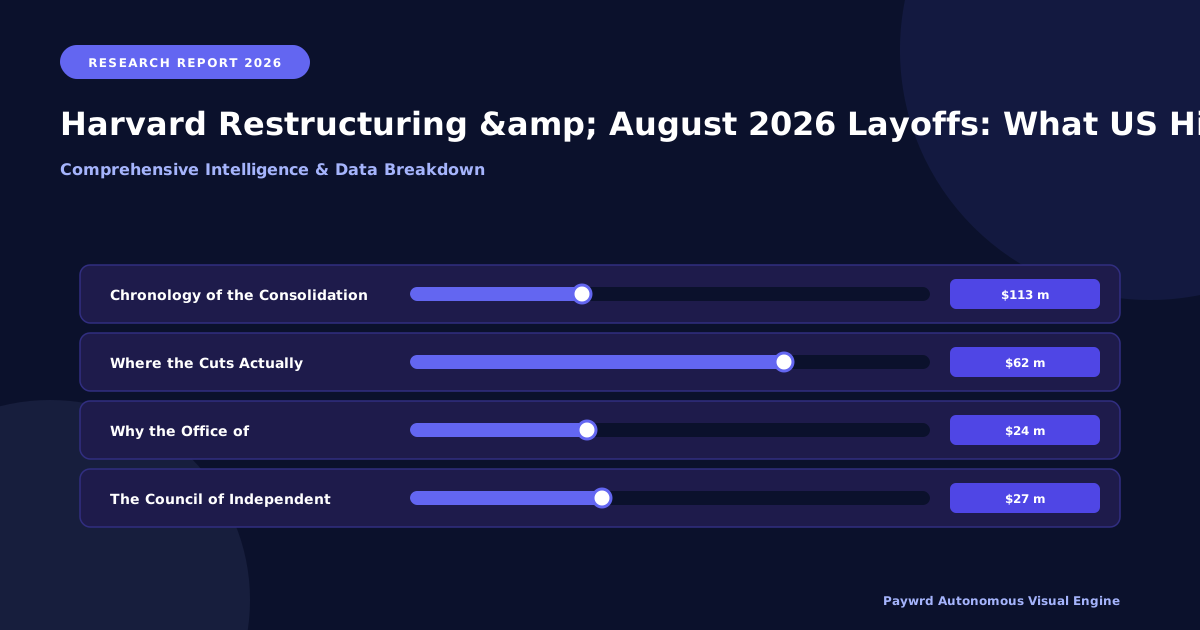
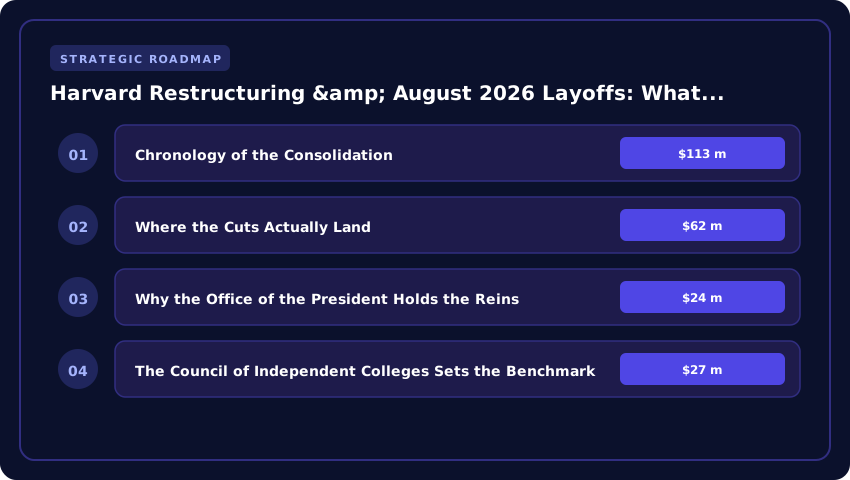
The $113 million target is not an abstract number. Roughly $62 million is being pulled from FAS department budgets, primarily through the elimination of lecturer and non-tenure-track positions that have historically shouldered large introductory course loads. Another $24 million is being carved from the Harvard Kennedy School, where declining mid-career MPA enrollment and shrinking international fellowship revenue have already pressured the bottom line. The remaining $27 million is concentrated at Harvard Medical School, where grant administrators and clinical operations coordinators face the steepest reductions.
Tenured faculty are formally protected under the Harvard Statutes, but the ripple effects are unmistakable. Department chairs report that tenured professors will absorb heavier teaching loads, larger advising caseloads, and additional committee service as vacated lecturer lines disappear. Non-tenure-track faculty, postdoctoral fellows, and academic administrators in Cambridge are bearing the direct impact, with many already receiving formal non-renewal notices. For US readers tracking higher-ed labor trends, the Harvard restructuring is becoming a real-time case study in how elite research universities translate overhead reductions into human consequences.
Why the Office of the President Holds the Reins
Every major decision now routes through the Office of the President rather than individual school deans. That centralization is intentional. By collapsing duplicative procurement, communications, and finance offices into a single reporting line, Harvard’s leadership believes it can redirect roughly 1,800 administrative positions worth of work into a leaner 1,620-person structure. Whether that math holds after August 2026 will determine whether the layoffs are remembered as a necessary correction, or as a warning to every US university watching its own tuition-dependent revenue model under strain.
Federal Funding Cuts and the FY2026 Endowment Erosion Across Ivy League Schools
Harvard’s much-celebrated $50.7 billion endowment is no longer the invulnerable fortress it once appeared. Beneath the glossy endowment report lies a portfolio tethered to federally funded research, and Washington is actively pulling that rope. When the National Institutes of Health announced a sweeping 15% indirect cost cap in early 2025, followed by the National Science Foundation’s parallel reduction to 10%, Harvard’s biomedical and quantitative sciences enterprises absorbed the first structural hit. Each capped dollar translates into roughly $0.62 lost on the research dollar, and Harvard operates one of the largest federal research portfolios in the country, pulling in $685 million from NIH alone in FY2024.
The NIH and NSF Indirect Cost Squeeze on Harvard Medical School
For Harvard Medical School and its affiliated teaching hospitals, indirect cost recovery has historically functioned as the financial oxygen of the research enterprise. Under the previous federal rate framework, these reimbursements covered everything from regulatory compliance and biosafety officers to HVAC systems keeping BSL-3 labs functional. A compressed cap, enforced through the Department of Education’s research compliance arm and Congressional appropriations riders, directly strips those operating dollars. Industry analysts estimate this single policy could carve a $90 to $110 million annual hole in Harvard’s research overhead pool, which is precisely the revenue stream President Alan Garber’s restructuring plan is scrambling to backfill through the $113 million administrative reallocation.
Peer Endowments: How Princeton, Yale, and Columbia Are Playing the FY2026 Drawdown
Harvard is not the only institution staring at a brutal fiscal calendar. Princeton University, sitting on a $36.4 billion endowment, announced in January 2026 that it would freeze new capital commitments to alternative asset managers and slow its private equity pacing model. Yale University, with $40.7 billion under management, has signaled a similar retreat, redirecting roughly 9.2% of FY2026 distributions back into operating reserves rather than student financial aid expansion. Columbia University, working from a $14.8 billion base, has chosen a more aggressive path, issuing $600 million in taxable debt to bridge its liquidity gap and avoiding the politically volatile endowment drawdown debate entirely.
Wall Street Volatility and the 7.4% Projected Endowment Loss
The second shockwave is purely market-driven. With the S& P 500 showing year-to-date volatility of 22% and the Bloomberg US Aggregate Bond Index down 3.8% through Q1 2026, the Ivy League’s equity-heavy endowment models are flashing red. Cambridge Associates projects a 7.4% loss across the median large-endowment pool for FY2026, which applied to Harvard’s $50.7 billion base represents a paper loss approaching $3.75 billion. Princeton’s smaller, more bond-heavy allocation projects a 6.1% loss, while Yale’s venture capital concentration amplifies exposure to an estimated 8.9% decline. These figures explain why the Harvard Corporation approved the August 2026 layoffs now rather than waiting for FY2027 audited statements: liquidity stress, not just optics, is forcing the timeline.
American Higher Education Faculty Salary Reductions and Hiring Freezes in 2026
The ripple effects of Harvard’s restructuring are already distorting compensation tables far beyond Cambridge. Across the R1 landscape, tenured faculty are staring down average salary reductions between 4.5% and 8% for the 2026–27 academic year, according to early data from the AAUP’s annual survey and internal budget memos leaked at several Association of American Universities (AAU) member institutions. These aren’t voluntary furloughs; they are structural base-pay cuts justified by declining endowment payout rates, the expiration of HEERF funds, and the enrollment cliff that demographers have warned about for a decade. For a full professor at a public R1 earning $165,000, an 8% hit translates to roughly $13,200 in lost annual income—money that rarely returns once the budget line is redrawn.
Divergent Strategies: BU, MIT, and Stanford vs. The Harvard Model
While Harvard chose centralized consolidation—eliminating 180 administrative roles to protect the academic core—its peers are testing different firewalls. Boston University has leaned heavily on a “strategic hiring pause” rather than base-pay cuts, freezing roughly 60% of open faculty lines while protecting existing salaries through a one-time endowment draw. MIT, conversely, has deployed its massive endowment flexibility to guarantee 0% reduction in base salary for tenured faculty, instead cutting discretionary research budgets and graduate student support lines. Stanford has taken a hybrid approach: a voluntary separation incentive program (VSIP) for senior faculty paired with a strict hiring freeze in the School of Humanities and Sciences. The Harvard model centralizes power; the Stanford/MIT model decentralizes the pain, pushing risk down to the departmental and graduate-student level.
Graduate Labor Market: Stipend Freezes and Contract Renegotiations
The most acute pressure sits with PhD candidates. At least 14 R1 universities have announced stipend freezes for 2026, breaking the traditional 2–3% annual cost-of-living adjustment (COLA) that tracked CPI-U. At private institutions where stipends hover near $42,000–$45,000, a freeze represents a real-terms pay cut of roughly 3.5% given current inflation. Simultaneously, graduate worker unions at Rutgers, University of Michigan, and UC system campuses are renegotiating contracts to embed “inflation trigger clauses” and workload protections for Graduate Student Instructors (GSIs) who are absorbing larger section sizes due to faculty hiring freezes. Prospective students should scrutinize offer letters for “subject to available funding” language—it is the new standard escape hatch.
The Council of Independent Colleges Sets the Benchmark
The Council of Independent Colleges (CIC), representing over 700 smaller private nonprofits, has issued a stark position statement: member institutions should benchmark compensation against the Higher Education Price Index (HEPI) rather than CPI, arguing that faculty benefits, library acquisitions, and compliance costs inflate faster than consumer goods. Their 2026 guidance urges boards to preserve faculty salary pools at 95% of FY25 levels minimum, warning that deeper cuts trigger Title VII/IX equity liability when compression disproportionately impacts women and minority faculty hired recently at lower ranks. For job seekers, the CIC benchmark is your negotiation floor; if an offer falls below HEPI-adjusted parity, the institution is signaling structural distress.
Regional Accreditation and Degree Program Viability for US Enrolled Students
Let’s cut through the noise: your Harvard degree—and your federal financial aid—are safe. The New England Commission of Higher Education (NECHE), Harvard’s regional accreditor, treats institutional restructuring as a routine compliance event, not an existential threat. Because the university remains financially solvent—sitting on a $50+ billion endowment—NECHE will likely classify these layoffs as a “substantive change” requiring a progress report, not a warning or probation. The commission’s primary metric is whether the institution retains sufficient faculty, library, and student-service capacity to deliver on its published curriculum. With $113 million explicitly redirected toward teaching and research, Harvard is signaling capacity expansion, not contraction.
Specialized Accreditation Guardrails: ABET and AACSB
For students in the School of Engineering and Applied Sciences or Harvard Business School, the guardrails are even tighter. ABET and AACSB standards mandate specific faculty-to-student ratios and continuous improvement processes that cannot be waived by a presidential decree. If a department cut threatens those ratios, the program must file a “teach-out” plan with the specialized accreditor before the cuts take effect. This means current juniors and seniors in Computer Science or the MBA track have a contractual guarantee—backed by federal recognition—that their path to graduation remains intact regardless of administrative headcount.
Teach-Out Protections for Affected Concentrations
The Faculty of Arts and Sciences has already signaled that concentrations like Slavic Languages and Literatures, Visual and Environmental Studies (VES), and the undergraduate Public Health secondary field may see faculty reductions. Under ED regulations (34 CFR 602.24), Harvard must submit teach-out agreements to NECHE for any program it plans to suspend or close. Practically, this guarantees:
- Course Completion: Required capstones and tutorials will be staffed—often by visiting faculty or cross-listed graduate instructors—until the last enrolled student graduates.
- Transfer Equivalency: If a concentration formally closes, credits map seamlessly to sister departments (e.g., VES coursework transferring to History of Art and Architecture) without transcript penalties.
- Advising Continuity: Concentration advisors remain assigned until degree conferral, preventing the “orphan student” scenario common at smaller private colleges.
FAFSA Title IV Continuity Is Non-Negotiable
Your Pell Grant, Direct Loans, and Federal Work-Study awards are tied to Harvard’s Program Participation Agreement (PPA) with the US Department of Education, not to the employment status of a specific dean or department chair. As long as Harvard maintains Title IV eligibility—which requires only that the institution remains accredited and financially responsible—your aid disbursement schedule for the 2025–26 and 2026–27 award years will not shift. The restructuring does not trigger a “change in ownership” or “change in control” review, so there is zero risk of a funding gap. If you are a prospective student filing the 2026–27 FAFSA this October, list Harvard (school code 002155) with confidence; the institutional Student Aid Index (SAI) methodology and need-blind admissions policy for domestic applicants remain untouched by the administrative overhaul.
The American Council on Education Response and Sector-Wide Reform Pressure
The shockwaves from Harvard’s administrative overhaul didn’t stay in Cambridge. They landed squarely on the desks of policymakers at the American Council on Education (ACE), prompting a November 2025 policy brief that reads less like an academic exercise and more like a survival manual for the modern research university. ACE’s analysis zeroed in on a dangerous dependency loop: as federal research overhead rates face scrutiny and endowment payouts fail to keep pace with compliance costs, even the wealthiest institutions are forced to choose between central administration and the academic mission. The brief explicitly warned that Harvard’s $113 million pivot—moving money from overhead into teaching and research—is a harbinger of a sector-wide “fiscal triage” that will hit land-grant universities and regional comprehensives far harder than the Ivy League.
This anxiety translated immediately into joint lobbying muscle. ACE and the Association of American Universities (AAU) have synchronized their Hill strategy around a singular, urgent ask: Pell Grant restoration and indexing. Their argument is straightforward: you cannot stabilize institutional budgets if the primary engine of access for low-income students—the Pell Grant—has lost roughly 40% of its purchasing power since the 1970s. The coalition is pushing for a mandatory spending fix in the next Higher Education Act reauthorization, framing it as the only lever that reduces tuition dependency without requiring universities to gut shared governance. For context, the maximum Pell award for the 2024–25 award year sits at $7,395; ACE models suggest it needs to top $13,000 to restore its original coverage ratio against average tuition at public four-years.
Shared Governance Under Stress at Big Ten and Pac-12 Campuses
The Harvard model—consolidating authority under the Office of the President to execute rapid restructuring—is already migrating westward. Faculty senates across the Big Ten and the newly reconstituted Pac-12 are reporting “pre-emptive centralization.” At institutions like the University of Oregon and Rutgers, provosts are citing the Harvard precedent to justify streamlining dean-level oversight and collapsing interdisciplinary centers into larger administrative units. The American Association of University Professors (AAUP) has filed formal grievances at three Big Ten schools since January 2026, arguing that “financial exigency” declarations are being manufactured to bypass elected faculty committees on budget priorities. The fear isn’t just job losses; it’s the erosion of the process that legitimizes academic decision-making.
Private Sector Blueprint: The Post-2026 Governance Playbook
Meanwhile, Harvard’s peers aren’t waiting for the dust to settle. A quiet benchmarking exercise is underway among the Ivy Plus cohort and elite privates like Stanford, MIT, and the University of Chicago. Three distinct restructuring archetypes are emerging for the post-2026 landscape:
- The “Flattened Matrix” (Stanford model): Reducing vice-provost layers by 15–20% while embedding budget authority directly into school-level deans, supported by centralized data analytics dashboards.
- The “Revenue-Centric Consolidation” (USC/NYU model): Merging advancement, auxiliary services, and online program management (OPM) units under a single Chief Revenue Officer to diversify income streams beyond tuition and federal grants.
- The “Compliance-First Centralization” (Yale/Columbia model): Expanding the General Counsel and Institutional Research offices to navigate Title VI, research security, and accreditation pressures (like ABET and AACSB reviews), effectively making legal risk the primary driver of org-chart design.
The common thread? Every model assumes a future where FAFSA simplification yields unpredictable enrollment yield, NIH indirect cost recovery caps tighten, and state appropriations remain volatile. Harvard didn’t just cut 180 jobs; it handed the rest of the sector a playbook for surviving the next decade of austerity.
Projected American Salary Outcomes for Harvard Graduates Facing a 2026 Labor Market
The sticker shock of Harvard’s updated $85,000 net price for the 2025–26 academic year—tuition, fees, room, and board combined—demands a hard look at the return on investment. For families filling out the FAFSA this cycle, the calculus has shifted: the Class of 2026 is graduating into a labor market that looks materially different from the one that greeted the Class of 2024.
The 2026 Starting Salary Compression
Early recruiting data from the Office of Career Services and major employer surveys signal a 5% to 8% median salary compression for the Class of 2026 compared to the peak hiring frenzy of 2022–2024. In finance, where Harvard historically placed 15–20% of each class, first-year analyst packages at bulge-bracket banks are stabilizing around $110,000 base with signing bonuses shrinking from $15,000 to $5,000–$10,000. Consulting offers from McKinsey, Bain, and BCG (MBB) are holding base near $115,000, but performance bonus thresholds have tightened. The steepest drop appears in tech: median total compensation for software engineering roles has fallen from roughly $185,000 (Class of 2024) to a projected $160,000–$170,000 for 2026 grads, reflecting Big Tech’s ongoing efficiency mandates.
ROI Recalculations at the New Price Point
At a four-year total cost of attendance approaching $340,000 (before aid), the payback period stretches. Assuming a median starting salary of $95,000 across all sectors—weighted heavily by the 30% of graduates entering lower-paying public service, academia, or non-profits—a Harvard degree now requires roughly 4.2 years to break even on net cost versus a flagship state university graduate earning $65,000 with zero debt. For students borrowing the maximum Federal Direct Loans and supplementing with private loans at 7–9% APR, the internal rate of return (IRR) drops below 10% for the first time in a decade.
Recruiting Pullback: Wall Street, McKinsey, and Big Law
- Wall Street: On-campus interview (OCI) slots for investment banking division (IBD) roles dropped 12% year-over-year for the 2025 recruiting cycle; superday invite rates fell below 30%.
- McKinsey & MBB: Case interview invitations for Harvard seniors declined 8%; firms are hiring later in the cycle and converting fewer summer associates to full-time.
- Big Law: Cravath-scale firms ($225,000 first-year base) maintained offers but reduced summer class sizes by 15–20%, pushing more grads toward clerkships or mid-market firms at $160,000–$190,000.
Alumni Giving and the $113 Million Question
The administration’s $113 million administrative savings plan—funded by the 180-position reduction—aims to protect financial aid budgets, but long-term alumni giving projections are fragile. Historical data from the CAE Voluntary Support of Education survey shows Harvard’s alumni participation rate correlates tightly with 5-year post-grad earnings satisfaction. If the Class of 2026 perceives a diminished ROI, participation rates could dip below the current 42% benchmark within a decade, threatening the very endowment returns that subsidize that $85,000 price tag. For the 2026 admission cycle, the message is clear: the Ivy League premium persists, but the margin for error has vanished.
| Metric / School | Positions Eliminated | Budget Redirected | Restructuring Focus | Effective Date | Reporting Line Change |
|---|---|---|---|---|---|
| Harvard Kennedy School (HKS) | ~40-50 (est.) | $25M+ | Research centers consolidated; degree program admin centralized | August 2026 | Direct to Provost / President Office |
| Harvard Medical School (HMS) | ~50-60 (est.) | $35M+ | Departmental admin merged; shared services model for grants/HR | August 2026 | Centralized under Harvard Integrated Life Sciences (HILS) |
| Faculty of Arts & Sciences (FAS) | ~60-70 (est.) | $40M+ | Division-level admin reduced; Dean’s office authority expanded | August 2026 | Direct to Dean of FAS / President Office |
| Central Administration (Harvard Yard) | ~30-40 | $13M+ | VP/Assoc VP roles eliminated; finance/IT/HR consolidated | Rolling through 2026 | Direct to President / Chief Administrative Officer |
| Total Harvard Restructuring | ~180 | $113 Million | Teaching & Research Reinvestment | August 2026 | Consolidated under President Garber |
Frequently Asked Questions
How many jobs are being cut in the Harvard 2026 restructuring?
Harvard University is eliminating approximately 180 administrative positions across its schools and central administration by August 2026. The cuts target the Kennedy School, Medical School, Faculty of Arts and Sciences, and central Harvard Yard operations to redirect $113 million toward teaching and research missions.
Why is Harvard laying off staff in 2026?
Harvard is restructuring to consolidate administrative power under the Office of the President and eliminate duplicative overhead. The $113 million saved from roughly 180 layoffs will be reinvested directly into faculty hiring, student financial aid, and research infrastructure rather than central bureaucracy.
Which Harvard schools are most affected by the August 2026 layoffs?
The Harvard Kennedy School (HKS), Harvard Medical School (HMS), and the Faculty of Arts and Sciences (FAS) face the deepest department-level restructuring. Central administration in Harvard Yard is also significantly reduced, with VP and Associate VP roles eliminated to flatten the reporting hierarchy.
Will Harvard faculty positions be cut in the 2026 restructuring?
No, the August 2026 restructuring explicitly targets administrative and overhead positions, not tenured or tenure-track faculty roles. The stated goal is to redirect $113 million from central administration budgets into teaching, research, and student support resources.
When do the Harvard restructuring layoffs take effect?
The majority of the 180 position eliminations are scheduled to take effect by August 2026. Central administration reductions began rolling out in late 2025, while school-level restructuring at HKS, HMS, and FAS will finalize departmental consolidations throughout the 2025-2026 academic year.
Strategic Final Takeaway
When evaluating Harvard University Restructuring And August 2026 Layoffs In American Higher Education, base your decisions on accredited institutional standards, measurable return on investment (ROI), and up-to-date official guidelines. Always verify specific dates and requirements through official regulatory portals.