
What the ₦4,000 JAMB & WAEC Verification Fee Actually Covers in 2026
Let us kill the confusion first. The ₦4,000 JAMB & WAEC verification fee is the consolidated levy that Nigerian tertiary institutions generate on the Joint Admissions and Matriculation Board portal when the school needs to confirm that your O’level (WAEC, NECO, or NABTEB) result is genuine. It also covers the real-time confirmation of your UTME score and your personal details against the JAMB database. That is the core of the transaction. Nothing more, nothing less.

For the 2026 UTME cycle, JAMB officially migrated the fee structure upward from ₦2,500 to ₦4,000. The board attributed the hike to rising server maintenance costs, the integration of the upgraded National Identity Number (NIN) verification layer, and the new direct sync with the WAEC digital certificate repository. In plain English: JAMB is doing more background work on every candidate, and they are passing the cost to you. Annoying? Yes. Legal? Absolutely, because verification remains optional and institution-driven.
Where Exactly Does the ₦4,000 Go on Remita vs JAMB IBASS?
You will likely pay this fee through one of two channels, and the breakdown differs slightly:
- JAMB IBASS (Institutional Billing): When the school generates the invoice, the ₦4,000 splits into roughly ₦3,500 for JAMB’s verification service and ₦500 as a portal administrative surcharge. You see this itemised on your IBASS profile under “O’level/UTME Confirmation.”
- Remita Direct Payment: If your institution routes the payment through Remita using a generated Remita Retrieval Reference (RRR), the ₦4,000 lands as a single line item labelled “JAMB Verification Levy.” There is no visible split, but Remita charges an additional ₦250 convenience fee that JAMB IBASS does not charge.
This distinction matters because some candidates pay ₦4,000 on IBASS and think they are done, then later get prompted for the Remita convenience fee when printing their receipt. Knowing the channel ahead of time saves you that double-take moment at the ATM.
The Hidden Costs Most Candidates Forget to Budget For
The ₦4,000 is just the entry ticket. In practice, Nigerian candidates spend significantly more by the time the transaction is complete. Here is what you should budget realistically in 2026:
- Bank USSD or app charges: Expect between ₦100 and ₦300 depending on whether you use your bank’s app, USSD code, or a mobile wallet to settle the Remita RRR.
- Cyber café or POS commissions: If you do not have a smartphone or stable data, agents typically charge ₦500 to ₦1,500 just to generate the RRR, pay, and print the receipt for you.
- Data bundle for portal access: Accessing JAMB IBASS and downloading your verification slip consumes roughly 30MB to 50MB of data, which is negligible but worth noting if you are on a tight Kobo budget.
- Printing costs: The verification slip must be printed in colour in most cases, costing ₦100 to ₦200 per page at a business centre.
So, what looks like a ₦4,000 levy often becomes ₦4,500 to ₦5,800 once you factor in the realistic Nigerian payment ecosystem. Plan for this total, not just the headline figure, and you will not be caught off guard when the admission officer asks for your slip and you are still scrambling to settle the agent.
Step-by-Step Payment on the JAMB IBASS Portal Using Remita in 2026
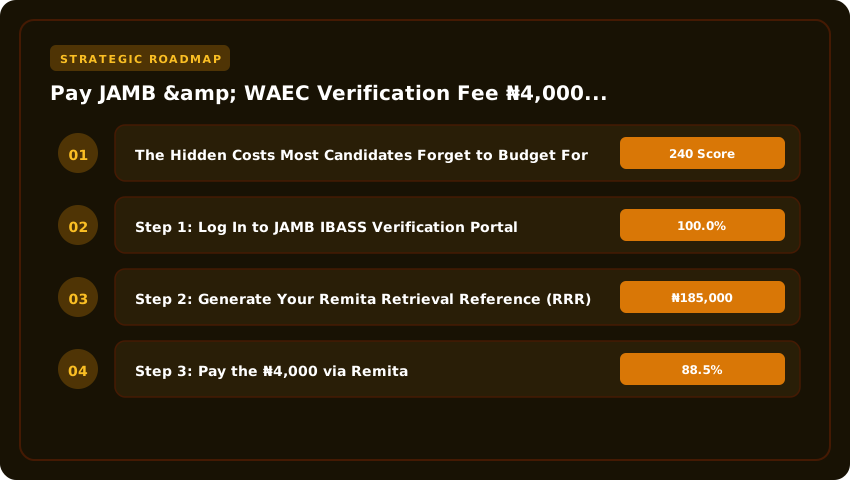
You have confirmed what the ₦4,000 covers, and you are ready to pay. The next ten minutes are all about clicking the right buttons in the right order. The JAMB IBASS (Internet Based Admission Screening System) portal is the only legitimate channel for generating your Remita Retrieval Reference, and skipping any stage usually leads to payment errors or duplicate debits. Follow this frictionless walkthrough on a laptop or a strong internet connection; avoid rushing it on a flimsy 3G network.
Step 1: Log In to JAMB IBASS Verification Portal
Open your browser and go directly to portal.jamb.gov.ng/IBASS/Verification. Bookmark the page once it loads, so you do not fall for a phishing clone later. Enter your active email address and password, then tap Sign In. If you forgot your password, use the Reset Password link. JAMB will send a confirmation code to your registered email, not SMS, so check your inbox (including spam). First-time users on IBASS will be prompted to create a password after entering their registered email and phone number.
Step 2: Generate Your Remita Retrieval Reference (RRR)
Once your dashboard opens, locate and click Payment of Verification Fee from the menu. A form will pop up requesting your JAMB registration number, email, phone number, and the institution or employer requesting the verification. Double-check the spelling of your name and the requesting body. Click Generate RRR, and the system will instantly produce a 12-digit Remita Retrieval Reference along with the ₦4,000 amount. Copy the RRR or write it down immediately. This is the only code you will use to pay, and the RRR remains valid until you complete payment.
Step 3: Pay the ₦4,000 via Remita
You can pay using any of these options:
- Card Payment: Click Pay via Remita on the same page, select Pay with Card, input your Verve, Visa, or Mastercard details (card number, expiry, CVV), and authenticate with the OTP sent to your phone. This is the fastest route, and the system immediately confirms the ₦4,000 debit in under 60 seconds.
- Bank Branch or USSD: Take the RRR to any commercial bank in Nigeria, or dial the bank-specific USSD code (such as *737# for GTBank, *329# for Zenith, or *901# for UBA). Ask for Remita payment, enter the 12-digit RRR, confirm Joint Admissions and Matriculation Board as the beneficiary, and authorize the ₦4,000 deduction.
Step 4: Enter WAEC/NECO Details and Upload Card Receipt
Return to the IBASS portal, refresh, and click Continue Verification. You will be asked to provide your WAEC or NECO exam year, exam number, scratch card PIN, and serial number. Type each character carefully; the system will reject entries with spaces or dashes. After entering the PIN, upload a clear scan or phone snapshot of the WAEC/NECO scratch card showing the full PIN, serial number, and your name. Blurry images are the number one reason verification is rejected, so take the photo in good lighting.
Step 5: Confirm Payment and Download Your Official Receipt
Hit Submit and wait for a green confirmation bar showing ₦4,000 successfully debited. An email from JAMB will land in your inbox with a payment acknowledgment. To get your downloadable PDF receipt, click Print Receipt on the dashboard. Save the file in two places: your phone and a Google Drive or email draft. Print a colored copy, sign and date it, and keep it in a folder. This PDF is the only proof the bank or JAMB will accept if you ever need to dispute the ₦4,000 charge or re-verify your credentials in 2026.
How to Pay ₦4,000 Through Banks, USSD, and the WAEC Digital Platform
Let’s be honest: the JAMB IBASS portal has a nasty habit of freezing up right when thousands of candidates rush to generate their RRR codes. If you stare at a spinning loader long enough, you’ll miss your admission window. The good news? You don’t have to rely solely on the JAMB profile. The ₦4,000 verification levy can be settled through multiple redundant channels—bank branches, mobile apps, USSD, and the WAEC portal itself—so you stay in control even when the main gateway chokes.
Walk into Any Commercial Bank Branch
This remains the most bulletproof method. Walk into Access Bank, GTBank, Zenith, UBA, First Bank, or Polaris and request a “JAMB Verification Fee” or “WAEC Verification” payment on the Remita or Paystack biller menu. Hand the teller your JAMB registration number and phone number. They will generate the RRR instantly on their terminal, you pay ₦4,000 plus the bank’s negligible commission (usually ₦100–₦200), and you walk out with a printed receipt bearing the Remita Retrieval Reference. Keep that paper safe; it is your proof of life if the portal refuses to sync.
Mobile Banking Apps & Fintech Wallets (GTWorld, AccessMore, Opay, Palmpay)
If you have data and a smartphone, skip the queue. Open your banking app—GTWorld, AccessMore, FirstMobile, or fintechs like Opay and Palmpay—navigate to “Bills” or “Remita Payments,” select “JAMB” or “WAEC Verification,” input your registration number, and authorize with your PIN or FaceID. The RRR generates automatically, the ₦4,000 deducts, and the receipt lands in your transaction history. Screenshot it immediately. For Opay users, the path is Pay Bills → Education → JAMB/WAEC Verification. It takes 90 seconds flat.
USSD: The *737# Lifeline (Zero Data Required)
No data? No app? Dial *737*50*1*RegistrationNumber# on the line linked to your GTBank account (other banks have similar strings: *901# for Access, *919# for UBA). Follow the prompts: select “JAMB Verification,” confirm the ₦4,000 amount, enter your 737 PIN, and the RRR flashes on screen. Copy it out or screenshot the USSD response. This works on any feature phone and is immune to browser cache errors.
Paying Directly on waecdirect.org (For Non-JAMB Candidates)
If you are not a 2026 UTME candidate—maybe you need verification for NYSC, a foreign scholarship, or employment—head straight to waecdirect.org. Click “Verify Certificate”, enter your WAEC exam number, year, and type (May/June or Nov/Dec). The system calculates the ₦4,000 fee and offers payment via Remita (Card, Bank Transfer, or USSD) or the WAEC Digital Token. The Token is essentially a scratch-card PIN you can buy at WAEC zonal offices, Fidelity Bank branches, or authorized dealers. Scratch, enter the PIN on the portal, and verification unlocks instantly without touching JAMB infrastructure.
Reading the Green Tick: Dashboard Screenshot Walkthrough
Once payment clears—whether via bank, USSD, or Token—log back into waecdirect.org or your JAMB CAPS profile. You will land on a dashboard showing your passport photo, exam details, and a bright green status tick labeled “Verification Successful” or “Certificate Verified”. Beside it sits the RRR, transaction date, and a “Download Verification Slip” button. That green tick is your golden ticket; admissions officers and employers recognize it instantly. If you see a yellow clock icon (“Pending”), wait 24 hours and refresh—bank settlement sometimes lags. Red cross? Payment failed; retry with a different channel.
- Pro Tip: Always use the phone number registered on your JAMB profile; mismatched numbers cause reconciliation nightmares.
- Receipt Hygiene: Save the RRR in three places: phone gallery, email drafts, and a printed copy in your document folder.
- Token Alternative: The WAEC Digital Token (scratch card) costs exactly ₦4,000 at approved vendors—reject anyone selling it higher.
Using Verified Results for NYSC Mobilization, University Screening, and Foreign Equivalence
You have paid the ₦4,000 verification fee, downloaded the slip, and maybe even framed the receipt. Now what? The real value of this transaction isn’t the PDF sitting in your downloads folder; it is the interoperability it unlocks across three critical pillars of your academic journey: NYSC mobilization, institutional admission screening, and international credential evaluation. Think of this fee as the master key that stops you from running from pillar to post later.
NYSC Mobilization: The Senate List Connection
This is where most graduates learn the hard way. The National Youth Service Corps (NYSC) does not accept “original” certificates sight-unseen during online registration. They cross-reference your data against the JAMB Matriculation List and the Senate-Approved Mobilization List uploaded by your institution. If your WAEC/NECO details were never verified on the JAMB CAPS portal—backed by that ₦4,000 payment—your name will simply not appear on the Senate list. No verification record equals no call-up letter, regardless of your CGPA. The fee ensures your O’Level grades are permanently synced to your JAMB profile code, making the Senate upload seamless for your school’s Student Affairs Division.
Post-UTME & Direct Entry Screening: Stop Paying Twice
Remember the previous warning: this fee is not the Post-UTME screening fee. However, it is the prerequisite. When you apply for the University of Lagos, ABU Zaria, or UNN Post-UTME, the portal pulls your verified O’Level data directly from the JAMB/WAEC database. Without the verification token generated by this ₦4,000, you will be forced to manually upload results, pay for “result verification” at the cyber café (again), or risk disqualification for “unverified credentials.” For Direct Entry candidates, this is non-negotiable; JAMB will not process your DE application without a verified O’Level status attached to your registration number.
Foreign Equivalence: UK, Canada, and US Study Visas
Planning to japa for a Master’s in the UK, Canada, or the US? Admissions officers at institutions like the University of Toronto, Manchester, or Howard University require WAEC/NECO Verification Cards or direct database confirmation. That ₦4,000 payment generates the verification PIN and serial number required by WES (World Education Services), ICAS, or UK ENIC (formerly UK NARIC). Without it, you are stuck paying third-party agents exorbitant fees to “source” verification codes that should be yours by right. The fee covers the WAEC endorsement stamp that these foreign evaluators trust implicitly.
Timeline: How Long Does the Record Stay Active?
This is the hidden ROI. The verification record is permanent on the JAMB and WAEC central databases. It does not expire after the 2026 admission cycle.
- JAMB Archive: Your verified status remains tied to your JAMB Registration Number for life. Whether you apply for DE in 2028 or need a transcript verification for a 2030 employer background check, the record persists.
- WAEC Database: The verification PIN generated remains valid for WAEC Result Checker and WAEC Direct Verification System (DVS) requests indefinitely.
- NYSC: Once mobilized, the verified data sits in the NYSC corpus permanently for future exemption certificates or re-validation.
Bottom line: That ₦4,000 is a one-time infrastructure investment. It builds the digital rail tracks your academic train will run on for the next decade. Don’t treat it as a cost; treat it as capital expenditure on your future.
Common Payment Errors, Refund Disputes, and JAMB CBT Support Channels
Even with the best intentions, payment hiccups can turn the ₦4,000 verification levy into a source of stress. Below is a step‑by‑step troubleshooting guide that maps the most frequent issues to the exact channels you need to reach—so you can resolve them quickly and get back to focusing on your exams.
1. Remita debited your account but IBASS shows “No Payment”
This mismatch usually occurs when the transaction is still in the bank’s settlement queue or when the RRR (Remita Retrieval Reference) was entered incorrectly on the IBASS portal.
- Wait 24 hours: Most interbank transfers clear within one business day. Check IBASS again after this period.
- Verify the RRR: Log into your Remita receipt (SMS or email) and confirm the 12‑digit RRR matches exactly what you typed on IBASS. Even a transposed digit will cause a mismatch.
- Capture proof: Take a screenshot of the Remita debit notification (including date, time, amount, and RRR).
- Escalate: If the status remains unchanged after 24 hours, forward the screenshot and your RRR to
support@portal.jamb.gov.ngwith the subject line “Remita debit – IBASS shows no payment – RRR: [your RRR]”. Include your full name, JAMB registration number, and a contact phone number.
2. Double ₦4,000 charges – how to get a refund
Being charged twice can happen when a candidate pays via both bank branch and online Remita, or when a cyber café processes the payment on your behalf without your knowledge.
- Identify duplicate entries: Download your bank statement or Remita transaction history and highlight any two ₦4,000 entries with the same RRR or payment date.
- Prepare a refund request: Write a concise email to
support@portal.jamb.gov.ng(subject: “Duplicate ₦4,000 verification fee – Request for refund”). Attach:- Scanned copy of both payment receipts (or bank statements).
- A brief timeline: when each payment was made, via which channel, and the RRR used.
- Your JAMB profile code, full name, and registration number.
- Follow‑up: If you do not receive an acknowledgement within 48 hours, send a polite reminder and copy
info@jamb.gov.ng. Keep a record of all correspondence.
3. Cyber café risk – never share your profile code or RRR
Some cafés offer to “handle the payment for you” and then ask for your JAMB profile code or the RRR generated on the IBASS portal. Sharing these details exposes you to:
- Unauthorized payments on your behalf.
- Potential identity theft if the code is used to access your JAMB profile.
- Difficulty disputing charges, as the café may claim you authorized the transaction.
Always complete the payment yourself on a secure device (personal smartphone, laptop, or trusted bank app). If you must use a café, insist on doing the transaction under your supervision and never hand over your profile code or RRR.
4. Contacting WAEC verification desk
For issues specific to the WAEC verification component of the ₦4,000 fee (e.g., WAEC result upload failures, verification mismatches), reach out directly to WAEC’s support team:
- Email:
support@waecdirect.org– include your WAEC examination number, year, and a clear description of the problem. - Phone hotlines:
- Lagos office: 09‑4613222
- Abuja office: 09‑4613223
- Port Harcourt office: 084‑222111
- When calling, have your WAEC exam number, the RRR used for the ₦4,000 payment, and any error messages ready for the agent.
By keeping these steps handy, you can turn payment anxiety into swift action. Remember: the ₦4,000 levy is solely for credential verification—any claim that it covers admission processing or Post‑UTME screening is either a misunderstanding or an attempt to overcharge you. Stay vigilant, keep your credentials private, and use the official channels above to resolve any issues promptly.
FAQ: Why Verification Costs ₦4,000, Cyber Café Safety, and Processing Time
Why is JAMB and WAEC verification ₦4,000 in 2026?
The ₦4,000 charge is a statutory service fee approved by the Joint Admissions and Matriculation Board (JAMB) for the verification of results—specifically confirming the authenticity of your UTME and O’Level (WAEC/NECO) credentials against the central database. It is not a revenue-generating scheme for schools. The fee covers the backend API calls, server maintenance, and the manpower required to cross-reference your data with the West African Examinations Council (WAEC) or NECO databases in real-time. Think of it as the cost of a digital background check that prevents certificate forgery.
Can I pay the ₦4,000 fee at a cyber café safely?
Technically, yes—but only if you initiate the transaction yourself on the official JAMB e-Facility portal. The safest workflow: log in to your JAMB profile on your personal device, generate the RRR (Remita Retrieval Reference), and pay via your bank app or POS. If a café operator insists on using their account, paying into a personal PalmPay/Opay account, or charging an extra “processing fee” above ₦4,000, walk away. That is a red flag for credential theft or invoice padding. Always demand the official Remita receipt bearing the Federal Government TSA header.
How long does the ₦4,000 verification take to reflect on the portal?
In 2026, the system is largely automated. Once payment is confirmed on the Remita gateway, verification status typically updates on your JAMB CAPS profile within 15 minutes to 4 hours. Network latency from the bank or WAEC’s server occasionally pushes this to 24 hours during peak admission seasons (August–October). If it exceeds 48 hours, log a ticket via the JAMB Support Portal with your RRR and registration number—do not pay twice.
Is the ₦4,000 fee refundable if my admission is denied?
No. The fee pays for the verification service rendered, not the admission outcome. JAMB has verified your results; whether a university offers you a slot depends on cut-off marks, quota, and departmental requirements. The service was delivered the moment your status turned “Verified.” Treat it like a visa application fee—non-refundable regardless of the decision.
Does the ₦4,000 cover NELFUND loan documentation?
Absolutely not. The Nigerian Education Loan Fund (NELFUND) requires a separate identity verification chain (NIN, BVN, and institutional admission letter). The ₦4,000 JAMB verification only confirms your academic credentials for admission processing. If you are applying for the student loan, budget separately for any NELFUND-mandated charges or cyber café assistance fees for their distinct portal.
| Criteria | JAMB/WAEC Verification Fee (₦4,000) | Post-UTME Screening Fee | JAMB Regularization/Indemnity |
|---|---|---|---|
| Primary Purpose | Verifies authenticity of O’level results (WAEC/NECO/NABTEB) on JAMB CAPS | Institution-specific aptitude test or credential screening for admission | Rectifies admission status for graduates without valid JAMB numbers |
| Cost (2026 Estimate) | ₦4,000 (Fixed nationally via JAMB portal) | ₦2,000 – ₦5,000 (Varies by institution) | ₦5,000 – ₦10,000 (Plus cyber cafe charges) |
| Payment Channel | JAMB Portal → e-PIN/Remita → Bank/Card/USSD | University Portal → Remita/Interswitch/Paystack | JAMB Portal → Approved CBT Centres/Banks |
| Mandatory For | All candidates with O’level results uploaded to JAMB CAPS | Only candidates who meet institution’s cut-off mark | Graduates mobilized for NYSC with ‘No JAMB’ status |
| Refundable? | No | Rarely (Policy dependent) | No |
| Deadline 2026 | Before Institution’s Admission Closure on CAPS | Usually 2–4 weeks post UTME result release | Before NYSC Batch Mobilization |
Frequently Asked Questions
What does the ₦4,000 JAMB verification fee cover in 2026?
The ₦4,000 fee covers the mandatory verification of your WAEC, NECO, or NABTEB results on the JAMB CAPS portal. It confirms O'level authenticity for admission processing. It does not cover Post-UTME screening fees, acceptance fees, or tuition.
How do I pay the JAMB WAEC verification fee on the portal?
Log into your JAMB profile at portal.jamb.gov.ng, select 'Verification of O'level Result', generate a payment invoice (Remita RRR), and pay ₦4,000 via card, bank transfer, or USSD. The status updates automatically upon successful payment.
Is the ₦4,000 verification fee the same as Post-UTME fee?
No. The ₦4,000 is a federal levy paid to JAMB for result verification. Post-UTME fees (₦2,000–₦5,000) are paid separately to your chosen university for their specific screening exercise. Paying one does not substitute the other.
Can I pay the JAMB verification fee at a cyber cafe?
You can generate the RRR invoice at a cyber cafe, but payment must be made via the Remita platform (card, bank app, or bank branch). Never pay cash directly to a cafe operator for this fee; always ensure the receipt bears your name and JAMB registration number.
What happens if I don't pay the verification fee before admission closes?
Your O'level results will remain 'Unverified' on JAMB CAPS. The institution cannot recommend you for admission on the matriculation list, leading to automatic disqualification for the 2026/2027 session regardless of your UTME score.
Strategic Final Takeaway
When evaluating JAMB WAEC Verification Fee ₦4000 Payment Portal 2026, base your decisions on accredited institutional standards, measurable return on investment (ROI), and up-to-date official guidelines. Always verify specific dates and requirements through official regulatory portals.

