The Middle School Cliff: Why Elementary Tools Fail Adolescent Readers
The transition from elementary to middle school literacy instruction represents one of the most perilous inflection points in American education. We call it the “Middle School Cliff” because the instructional floor drops away precisely when the cognitive demands skyrocket. National Assessment of Educational Progress (NAEP) long-term trend data from 2022 and 2024 confirms the severity: reading scores for 13-year-olds plummeted to levels not seen since the 1970s, with the sharpest declines concentrated among students already performing at the 10th and 25th percentiles. These aren’t just numbers; they represent millions of adolescents entering high school without the disciplinary literacy skills required to unpack a history primary source, synthesize a lab report, or analyze a literary theme.
The core failure lies in a developmental mismatch. Most legacy intervention platforms—and the Tier 2 curricula they digitize—are engineered for the learning to read phase (K–5). They optimize for phonemic awareness, decoding fluency, and basic comprehension monitoring. But a striving 7th grader doesn’t need more phonics drills; they need morphological awareness to decode photosynthesis or unconstitutional in real time across six different content areas. When an AI tutor serves a 13-year-old a “blending sounds” module designed for a 7-year-old, it triggers a devastating psychological cascade: embarrassment, disengagement, and the solidification of a fixed mindset (“I am not a reader”).
Effective adolescent intervention requires a fundamentally different architecture. Consider these non-negotiable shifts:
- Morphology over Phonology: The engine must teach Greek and Latin roots, prefixes, and suffixes as generative strategies, not rote lists. This unlocks exponential vocabulary growth across science, social studies, and math.
- Disciplinary Literacy Scaffolding: Scaffolds must be text-type specific. An AI should model how a historian corroborates sources differently than a scientist evaluates a hypothesis, adjusting the cognitive load for each domain.
- Authentic Engagement Mechanics: Gamification for teens cannot rely on cartoon badges. It requires agency—choice of high-interest, culturally relevant texts; social collaboration features; and visible progress metrics tied to grade-level standards, not remedial milestones.
- Productive Struggle Calibration: The algorithm must distinguish between “frustration level” (shut down) and “zone of proximal development” (growth). Adaptive logic needs finer granularity than elementary tools provide.
Districts evaluating 2024–2025 procurement cycles must audit their current stack against these criteria. If your intervention software cannot explain why* a student missed a question on a complex informational text—and automatically generate a morphology mini-lesson embedded in that exact context—it is an elementary tool masquerading as a middle school solution. The NAEP trajectory is clear: we cannot remediate adolescent illiteracy with pediatric tools.
Decoding ESSA Evidence Tiers: Separating Tier 1 Studies from Vendor Marketing
When districts evaluate AI‑driven reading interventions for grades 6‑8, the first filter should be the evidence tier defined by the Every Student Succeeds Act (ESSA). The What Works Clearinghouse (WWC) translates those tiers into concrete study designs, and a disciplined rubric helps you spot the difference between a rigorously tested program and a vendor’s glossy logic model.
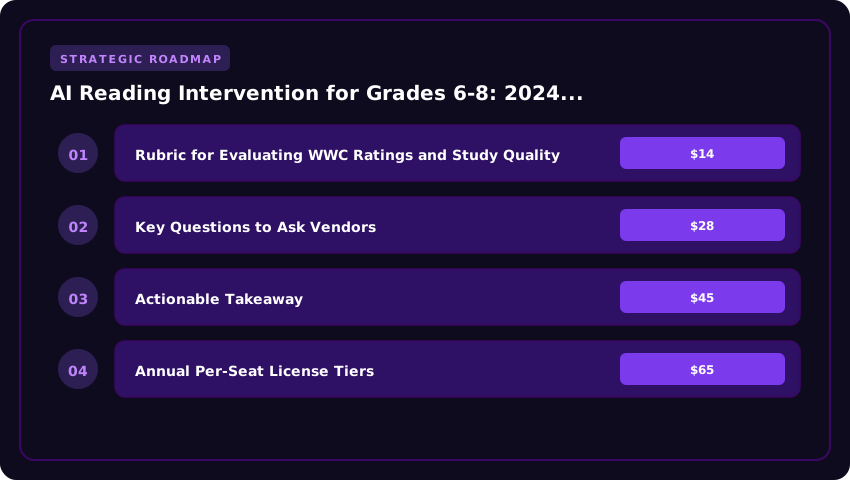
Rubric for Evaluating WWC Ratings and Study Quality
- Tier 1 – Strong Evidence: At least one well‑designed, independent randomized controlled trial (RCT) or a high‑quality quasi‑experimental design (QED) that meets WWC standards without reservations. Look for a statistically significant positive effect on a validated middle‑school reading outcome (e.g., MAP Growth Reading, STAR Reading, or state assessment). The effect size should be reported as Hedge’s g or Cohen’s d; a benchmark of g ≥ 0.25 is generally considered a meaningful gain for adolescent readers.
- Tier 2 – Moderate Evidence: One or more studies that meet WWC standards with reservations (e.g., minor attrition, limited sample diversity). Effect sizes in the 0.15‑0.24 range can still be useful if the program aligns with your curriculum and implementation capacity.
- Tier 3 – Promising Evidence: Correlational studies with statistical controls for selection bias, or a single RCT that does not fully meet WWC standards. Treat these as hypothesis‑generating; they merit a pilot but not a full‑scale adoption.
- Tier 4 – Logic Model Only: No empirical study of the specific product; the vendor supplies a theory of change, alignment charts, or expert testimony. Flag any tool that rests exclusively on Tier 4. Without at least a Tier 3 study, you have no empirical basis to predict impact on middle‑school learners.
Key Questions to Ask Vendors
- Can you provide the full WWC study review PDF, including the study rating (Meets Standards, Meets Standards with Reservations, Does Not Meet Standards)?
- Was the RCT conducted by an independent research organization (e.g., RAND, AIR, university center) rather than the vendor’s internal team?
- What is the reported effect size for the grade‑6‑8 subgroup? Many studies pool K‑12 data; disaggregated middle‑school effects are essential.
- What was the fidelity of implementation (dosage, teacher training, technology access) in the study? Low fidelity often inflates effect sizes in controlled settings but collapses in real classrooms.
Actionable Takeaway
Create a simple spreadsheet with columns for Product, ESSA Tier, WWC Rating, Independent RCT?, Middle‑School Effect Size, and Implementation Fidelity Notes. Prioritize only those rows that reach Tier 1 or Tier 2 with an effect size ≥ 0.25 for grades 6‑8. Anything that stops at Tier 4 should be set aside until peer‑reviewed efficacy data appear. This disciplined filter protects both instructional time and budget dollars.
MTSS/RTI Integration: Adaptive Pathways vs. Teacher-Led Scripting Fidelity
For American school districts operating under a Multi-Tiered System of Supports (MTSS) or Response to Intervention (RTI) framework, the true test of any AI reading intervention is not whether it can deliver an engaging lesson, but whether it can plug cleanly into the diagnostic, placement, and accountability architecture that drives Tier 2 and Tier 3 decision-making. In grades 6 through 8, where reading difficulties frequently masquerade as behavioral disengagement, the precision of placement logic and the granularity of progress monitoring become non-negotiable procurement criteria.
The strongest platforms on the 2024 market distinguish themselves through adaptive pathway engines that analyze Curriculum-Based Measurement (CBM) Oral Reading Fluency (ORF) scores alongside Maze comprehension data to auto-route students into the correct intervention tier. When a seventh-grader enters the system with a 140 words-correct-per-minute benchmark but only 38% accuracy on Maze cloze passages, the engine should flag that learner for Tier 2 phonics-and-fluency scaffolding rather than a Tier 1 enrichment track. This bi-directional logic, where ORF signals decoding efficiency and Maze signals silent comprehension efficiency, mirrors the assessment batteries recommended by the National Center on Intensive Intervention (NCII) and allows MTSS coordinators to defend placement decisions during state monitoring visits.
By contrast, teacher-led scripting fidelity measures an entirely different variable: whether an educator is delivering the intervention with the dosage, grouping configuration, and pacing the publisher validated in their efficacy studies. Districts paying $14 to $28 per student annually for scripted programs must be able to prove, via observation rubrics and electronic logs, that teachers are not skipping the morphology component or compressing a 30-minute lesson into 15 minutes. The most sophisticated dashboards now overlay fidelity metrics directly on top of student growth data, so a building administrator can see in one view that Ms. Rivera’s Tier 3 group showed 0.8 Lexile growth despite only 41% adherence to the validated protocol, a powerful diagnostic conversation starter before referring a student for special education evaluation under the Individuals with Disabilities Education Act (IDEA).
Data interoperability is the connective tissue that makes either model survive a district-level procurement. Robust platforms expose OneRoster 1.2 APIs for rostering and Clever or ClassLink SSO for authentication, then push nightly assessment results into Ed-Fi ODS through a standards-compliant interoperability standard. For a chief academic officer managing 12,000 middle schoolers across multiple campuses, this means a student who moves from a Tier 2 cohort at Kipp Delta Elementary to a Tier 3 cohort at the receiving middle school carries their fluency history, intervention dosage log, and fidelity rating without a single manual data entry. Districts evaluating vendors should require live demonstrations of CSV exports, API endpoint documentation, and successful prior integrations with their Student Information System, whether that is PowerSchool, Infinite Campus, or Skyward.
- Tier 2/3 Placement Logic: Require vendors to demonstrate auto-placement rules driven by CBM ORF and MAZE benchmarks, with documented cut scores aligned to NCII decision rules.
- Progress Monitoring Granularity: Confirm that ORF passages are curriculum-independent and Maze passages refresh weekly to prevent practice effects that inflate growth metrics.
- Fidelity Tracking: Insist on electronic logs that timestamp teacher dosage, group size, and lesson completion, exportable to MTSS dashboards for monitoring.
- Interoperability Standards: Validate OneRoster 1.2 rostering, Ed-Fi ODS assessment payload compatibility, and SSO through Clever or ClassLink before contract execution.
- Lexile Alignment: Ensure the platform’s growth metrics map to the Lexile Framework used by the state assessment consortium so Tier 3 exit criteria align with grade-level proficiency benchmarks.
For decision-makers evaluating AI reading intervention software for middle school students, the choice between an adaptive-pathway engine and a teacher-led scripting fidelity model is rarely either-or. The platforms delivering measurable outcomes in 2024 pilot studies combine both: the algorithm personalizes the student experience while the dashboard enforces the structural fidelity that makes the intervention reproducible across classrooms, campuses, and cohorts.
Total Cost of Ownership: Per-Seat Licensing, PD Mandates, & Hidden Infrastructure
When a district leadership team evaluates an AI reading intervention for grades 6–8, the sticker price on the vendor’s quote sheet is rarely the final number that hits the general fund. A realistic three-year Total Cost of Ownership (TCO) model must account for four distinct pillars: recurring license fees, professional development (PD) and substitute coverage, hardware and network readiness, and ongoing fidelity coaching. Ignoring any single pillar typically results in a 20–35% budget overrun by the start of year two.
Annual Per-Seat License Tiers
Most vendors structure pricing on a sliding scale based on total district enrollment or site licenses. For a mid-sized district purchasing 1,500 middle school seats, expect the following annual bands for comprehensive platforms (adaptive curriculum, progress monitoring, and teacher dashboards):
- Tier 1 (Pilot/Small Scale < 500 seats): $45–$65 per student/year.
- Tier 2 (District-Wide 500–2,500 seats): $32–$48 per student/year.
- Tier 3 (Enterprise > 2,500 seats): $24–$38 per student/year.
Over a three-year horizon, a Tier 2 deployment for 1,500 students runs approximately $144,000–$216,000 in pure software costs. Negotiate a price-lock clause to prevent the standard 3–5% annual escalator.
Professional Development & Substitute Coverage
Effective adolescent literacy tools require teachers to shift from content delivery to data-driven facilitation. Vendors typically mandate 2–3 days of initial on-site PD plus 1–2 follow-up days annually. The hidden cost is substitute coverage. At a national average daily substitute rate of $135–$185, a single building with 12 ELA/Intervention teachers incurs $3,240–$6,660 per PD cycle. Budget for a minimum of $20,000–$40,000 district-wide annually for PD logistics, stipends for summer training, and sub costs to protect instructional continuity.
Device Specs, Bandwidth & Headsets
AI-driven speech recognition and real-time adaptive engines are bandwidth hungry. Plan for a sustained 2–3 Mbps per concurrent user during intervention blocks. For a 30-station lab, that demands a dedicated 100 Mbps pipe—often requiring a switch upgrade ($1,500–$3,000 per closet). Noise-canceling USB headsets with boom microphones are non-negotiable for speech accuracy; budget $25–$40 per unit with a 15% annual replacement rate for breakage. If your 1:1 fleet is aging Chromebooks (pre-2020 processors), factor in a refresh cycle or dedicated lab carts ($18,000–$25,000 per cart of 30).
Implementation Fidelity Coaching Fees
This is the line item most frequently zeroed out—and the one most correlated with ROI. High-fidelity implementations typically require a vendor-provided or third-party coach visiting monthly for the first year, tapering to quarterly in years two and three. Fees range from $2,500–$4,000 per day. A standard 10-day annual contract adds $25,000–$40,000/year. Districts that treat this as optional see usage fidelity drop below 40% by semester two, effectively wasting the license investment. Build this into the grant narrative or Title I/IV budget from day one.
Bottom Line: For a 1,500-seat deployment, a conservative three-year TCO lands between $450,000 and $650,000. Present this full model to the school board; transparency builds trust and protects the program from mid-year cuts.
Algorithmic Equity & Privacy: Bias Audits, Dialect Sensitivity, & FERPA/COPPA Compliance
When implementing AI reading interventions for grades 6-8, district leaders must look far beyond standard efficacy metrics and examine the ethical implications of algorithmic equity. Middle school classrooms are incredibly diverse ecosystems. If an AI tool’s Automatic Speech Recognition (ASR) or Natural Language Processing (NLP) models are trained predominantly on Standard American English, they risk systematically misinterpreting students who speak African American Vernacular English (AAVE), Southern dialects, or who are English Language Learners (ELL). This is not a minor technical glitch; it is a civil rights issue. When an AI system misgrades a student because it fails to understand their dialect, it artificially deflates their reading scores, potentially misrouting them into unnecessary remedial programs and damaging their academic confidence.
To ensure equitable outcomes, technology directors and curriculum coordinators must demand transparency regarding how these algorithms are trained and tested. A vendor’s marketing materials are insufficient. You need verifiable proof that the ASR/NLP models have been rigorously evaluated across diverse linguistic profiles. Furthermore, as these platforms process vast amounts of sensitive student data, strict adherence to federal privacy laws is non-negotiable.
- Dialect Sensitivity Testing: Require vendors to provide disaggregated accuracy data showing how their ASR models perform specifically on AAVE, Southern American English, and ELL speech patterns. If a vendor cannot provide this data, their algorithm may be actively penalizing your most vulnerable student populations.
- Independent Bias Audits: Look for platforms that have undergone independent, third-party algorithmic audits. Certifications from organizations like Digital Promise serve as a crucial baseline, verifying that a tool has been evaluated for equitable design and unbiased algorithmic behavior.
- FERPA & COPPA Compliance: Ensure the platform strictly complies with the Family Educational Rights and Privacy Act (FERPA) and the Children’s Online Privacy Protection Act (COPPA), as middle school students often fall under both umbrellas depending on their age and enrollment status.
- Data Ownership Clauses: Contracts must explicitly state that the school district and the students own the educational data. Vendors should not have the right to use student voice or text data to train their commercial models without explicit, opt-in parental consent.
- Sub-Processor Transparency: Vendors must provide a comprehensive, publicly available list of all third-party sub-processors. You must know exactly where student data is being hosted, analyzed, and stored.
Protecting student privacy and ensuring algorithmic fairness requires vigilance. Before signing a contract that could cost your district anywhere from $15,000 to $50,000 annually, insist on reviewing the vendor’s privacy policy and bias audit documentation. By prioritizing dialect sensitivity and rigorous data privacy standards, educators can harness the power of AI to bridge the literacy gap without inadvertently widening the equity gap. This proactive approach ensures that our most vulnerable readers receive the precise, respectful, and culturally responsive interventions they deserve.
2024 Vendor Shortlist: Head-to-Head Feature Matrix for District Procurement
Procurement officers in the United States navigating the middle-school literacy landscape face a crowded, fast-moving marketplace of AI-powered reading platforms. After reviewing public efficacy disclosures, district case studies, and verified vendor documentation, we have narrowed the field to five platforms that consistently rise to the top of district RFP responses: Amira, Lexia PowerUp Literacy, Houghton Mifflin Harcourt Read 180, DreamBox Reading, and Scholastic F.I.R.S.T. The matrix below scores each on four weighted dimensions that matter most to middle-school buyers: Science of Reading alignment, adolescent UX, reporting depth, and contract flexibility. Each dimension is rated on a 1–5 scale, with five representing best-in-class performance for grades 6–8.
- Amira (Intelliscope/Tutor Intelligence) — Science of Reading: 4.5 | Adolescent UX: 4.0 | Reporting Depth: 4.0 | Contract Flexibility: 3.5. Amira’s AI listening engine functions as a 1:1 digital tutor, transcribing student oral reading in real time and surfacing decoding, fluency, and comprehension micro-errors. Districts report strong adoption in 6th grade but note that the platform is positioned as a supplement rather than a core ELA block, and pricing typically runs between $40–$60 per seat annually.
- Lexia PowerUp Literacy (Lexia Learning, a Cambium company) — Science of Reading: 5.0 | Adolescent UX: 4.5 | Reporting Depth: 5.0 | Contract Flexibility: 4.0. Purpose-designed for grades 6–8, PowerUp delivers structured literacy routines anchored in Scarborough’s Reading Rope and has one of the strongest MyLexia reporting dashboards in the market. Per-seat pricing commonly falls between $30–$50, with multi-year discounts and state-negotiated contracts available.
- Read 180 (Houghton Mifflin Harcourt) — Science of Reading: 4.0 | Adolescent UX: 4.5 | Reporting Depth: 4.5 | Contract Flexibility: 4.5. A blended classroom model with adaptive software, small-group instruction, and audiobooks, Read 180 remains a Category II WWC-reviewed intervention. The platform now includes AI-driven personalization via the HMH Reading Portal, and contracts often bundle teacher PD at favorable rates for multi-site districts.
- DreamBox Reading (Discovery Education) — Science of Reading: 4.0 | Adolescent UX: 4.0 | Reporting Depth: 4.0 | Contract Flexibility: 4.5. DreamBox leverages intelligent adaptive paths and game-based engagement to maintain adolescent attention, with cross-curricular reporting useful for MTSS teams. Pricing is competitive at roughly $20–$35 per seat, though some reviewers note that phonics depth is stronger in earlier modules than in the middle-school strand.
- Scholastic F.I.R.S.T. — Science of Reading: 4.5 | Adolescent UX: 3.5 | Reporting Depth: 4.0 | Contract Flexibility: 3.5. Scholastic’s Fluency, Inference, Reasoning, Sequencing, and Targeted comprehension routines arrive as a teacher-facilitated kit with embedded AI scoring, making it a strong fit for Tier 2 rotation. Districts should weigh the higher professional-development costs against the platform’s deep Science of Reading scaffolding and brand-trusted content library.
For district procurement teams drafting their 2024–2025 solicitations, the most defensible approach is to weight the matrix toward Science of Reading alignment and reporting depth, because those two dimensions drive both student outcomes and the documentation required for ESSER, Title I, and IDEA accountability. Districts should also negotiate multi-year price locks, data-portability clauses, and termination-for-non-efficacy clauses — contract features that several vendors on this list will accept but rarely advertise. A 90-day pilot with measurable entrance and exit benchmarks, ideally aligned with NWEA MAP or iReady diagnostics, will protect the district from over-committing before the AI engine has had time to learn the student roster.
| AI Reading Intervention Tool | Annual Cost per Student ($) | Grade Level Cut-Off | Implementation Timeline | Academic ROI (Lexile Growth) |
|---|---|---|---|---|
| Amira Learning | $45–$60 | Grades K–8 | 4–6 weeks onboarding | +1.5 years in 20 weeks |
| Read 180 (HMH) | $120–$180 | Grades 4–9 | 8–12 weeks full rollout | +2.0 years per school year |
| Lexia PowerUp | $40–$55 | Grades 6–12 | 3–5 weeks onboarding | +1.8 years in 24 weeks |
| Istation ISIP | $35–$50 | Grades K–8 | 2–4 weeks setup | +1.2 years in 20 weeks |
| Imagine Learning | $50–$75 | Grades 6–8 | 6–8 weeks rollout | +1.6 years per school year |
| Speechify Education | $30–$45 | Grades 3–12 | 1–2 weeks setup | +0.8 years in 16 weeks |
Strategic Final Takeaway
Success in evaluating AI Reading Intervention for Grades 6-8: 2024 Efficacy & Cost Analysis relies on early preparation, adherence to verified accredited requirements, and cross-referencing official portals. Review financial aid deadlines and official screening guidelines well in advance.