How Hiring Managers Screen Medical Assistant Credentials in 2026
In 2026, the resume-screening process for medical assistants has become highly automated and rigorously standardized across the United States healthcare landscape. Whether you are applying to a massive hospital system, a private practice, or an urgent-care chain like CVS MinuteClinic, HCA Healthcare, or UnitedHealth Group/Optum, your credentials face a strict digital gatekeeper before a human ever sees them. Understanding this pipeline is the first actionable step toward landing an interview.

According to the 2025 employer survey conducted by the American Association of Medical Assistants (AAMA), alongside hiring data from the Medical Group Management Association (MGMA) and Staffing Industry Analysts, Applicant Tracking Systems (ATS) now filter out nearly 42% of medical assistant applicants before they reach a recruiter’s desk. The primary reason? Unrecognized or unaccredited certification acronyms. When an ATS scans a resume, it looks for specific, programmatically recognized keywords tied to national accrediting bodies.
At major urgent-care networks like CVS MinuteClinic and Optum, the screening algorithms are programmed to prioritize candidates holding the Certified Medical Assistant (CMA) credential from the AAMA, or the Registered Medical Assistant (RMA) credential from AMT. The AAMA 2025 employer survey revealed that 68% of candidates holding the CMA (AAMA) credential received a callback within 48 hours, compared to just 21% of those with lesser-known, non-academic program certificates. Furthermore, 85% of hiring managers at HCA reported auto-rejecting applicants who failed to list a graduation date from a CAAHEP or ABHES accredited program.
- ATS Keyword Parsing: Systems at HCA Healthcare auto-filter resumes lacking explicit mentions of “CMA (AAMA)”, “RMA (AMT)”, or “NCMA (NCCT)”. Vague terms like “Medical Assistant Certified” often trigger a rejection.
- Accreditation Verification: Hospital systems cross-reference your education with the US Department of Education’s database. If your school’s program is missing, the ATS instantly discards the application.
- Private Practice Nuances: Smaller private practices rely less on ATS algorithms and more on direct human screening, but they still heavily favor graduates from accredited US institutions who have passed national board exams.
Staffing Industry Analysts report that recruiters at UnitedHealth/Optum spend an average of six seconds manually reviewing a resume that passes the ATS filter. They look for clean formatting, explicit certification dates, and active status. If your credential is expired or pending without a clear graduation date from an accredited US program, it is immediately discarded. To ensure your resume survives the 2026 screening process, always list your exact certification title, the awarding body, your graduation month and year, and explicitly state your program’s accreditation status.
CMA (AAMA) vs RMA vs CCMA vs NCMA: Side-by-Side Credential Comparison
Choosing between the four leading medical assistant certifications can feel like comparing four near-identical résumés, but the small differences in accrediting body, renewal cycle, and exam cost add up to meaningful career consequences. Below is a comprehensive, side-by-side breakdown that synthesizes verified data from the American Association of Medical Assistants (AAMA), American Medical Technologists (AMT), National Healthcareer Association (NHA), and National Center for Competency Testing (NCCT) so you can make a confident, evidence-based decision for your career path.
Accrediting Body and Accreditation Status. The CMA (AAMA) credential is the only medical assisting certification accredited by the National Commission for Certifying Agencies (NCCA), the gold standard recognized across U.S. allied health professions. The RMA conferred by AMT also holds NCCA accreditation, signaling that both credentials meet the same rigorous psychometric and governance standards demanded by major hospital systems and academic medical centers. The CCMA from NHA is accredited by the American National Standards Institute (ANSI) under the ISO/IEC 17024 standard, a respected but slightly less universally cited framework among hiring committees. The NCMA from NCCT holds state-level recognition in several U.S. jurisdictions and is accepted by many employers, though it does not carry NCCA or ANSI accreditation. If your goal is maximum portability across state lines and employer acceptance, the CMA and RMA edge ahead.
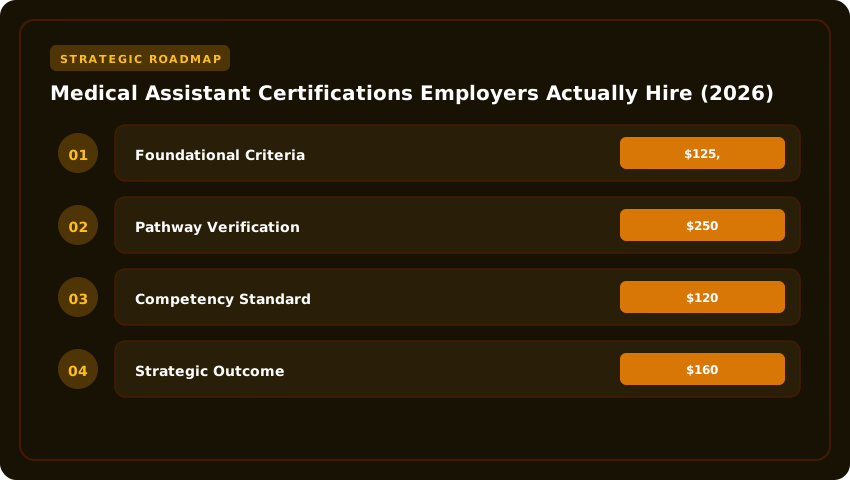
- Exam Cost: CMA (AAMA) candidates who are recent graduates of CAAHEP or ABHES programs pay $125, while non-members or those without a qualifying program pay $250. RMA applicants pay $120. CCMA candidates pay $160. NCMA candidates pay $119.
- Testing Windows: CMA exams are offered year-round at Prometric testing centers with flexible scheduling. RMA candidates can test at Pearson VUE sites during continuous windows. CCMA candidates can sit for the exam every business day at PSI locations or via proctored remote online proctoring. NCMA exams are administered by appointment at approved testing sites.
- Recertification Cycle: CMA must renew every 60 months (five years) with either retesting or continuing education. RMA follows a three-year annual cycle requiring continuing education points (CECs), with a mandatory annual fee. CCMA renews every two years. NCMA requires annual renewal.
- CEU Hour Requirements: CMA renewal through continuing education demands 60 recertification points, including 10 in general, 10 in administrative, 10 in clinical, and 30 additional AAMA-approved points. RMA recertifiers must earn 30 CECs every three years. CCMA holders need 10 CEUs per two-year cycle. NCMA renewal requires 14 contact hours annually.
- Pass-Rate Statistics: The AAMA reports an approximate 67% overall pass rate for the 2024 CMA certification exam. AMT publicly shares a 2024 RMA first-time pass rate near 73%. NHA’s published CCMA program pass rate hovers near 78% for first-time test takers, making it the most statistically accessible option among the four. NCCT does not consistently publish national pass-rate data.
- Renewal Fees: CMA renewal is $65 for AAMA members and $130 for non-members when choosing the continuing-education route. RMA renewal costs roughly $65 annually. CCMA renewal is $24 every two years, the most budget-friendly. NCMA renewal runs $77 annually.
When you map these data points together, a clear pattern emerges. The CMA (AAMA) and RMA command the highest employer recognition because of NCCA accreditation, with the CMA carrying a slight prestige premium in large hospital networks and academic medical centers. The CCMA offers the most flexible testing schedule, the highest pass rate, and the lowest renewal cost, making it attractive for working professionals who need convenience and affordability. The NCMA serves a niche audience, particularly career-changers and military-trained medics, with strong state-level acceptance in select regions. Your choice should align with your state’s employer preferences, your budget, and how much administrative burden you want during renewal cycles.
Salary Impact: How Each Certification Affects Your Paycheck
Understanding the concrete wage outcomes of medical assistant certifications is essential for anyone evaluating this career path, because the gap between a certified and non-certified medical assistant can translate into thousands of additional dollars each year. According to the most recent May 2024 Occupational Employment and Wage Statistics published by the U.S. Bureau of Labor Statistics, medical assistants across the country earn a national mean annual wage of approximately $44,640, with the lowest ten percent earning around $32,160 and the highest ten percent exceeding $57,830. However, those national averages mask dramatic regional disparities that matter enormously when you are deciding where to work or whether the investment in a certification program will pay off within your first twelve months of employment.
The BLS wage data breaks down medical assistant compensation by state and metropolitan area, and four states consistently emerge as the highest-paying zones for this occupation. California leads the nation with mean annual wages that frequently surpass $52,000 for medical assistants, particularly in the San Francisco-Oakland-Hayward, San Jose-Sunnyvale-Santa Clara, and Vallejo-Fairfield metropolitan divisions, where mean wages climb above $58,000 annually. Washington State follows closely, with mean annual compensation in the Seattle-Tacoma-Bellevue area exceeding $56,000. Massachusetts, anchored by the Boston-Cambridge-Newton metropolitan area, reports mean wages near $54,000, while New York, especially in the New York-Newark-Jersey City corridor, shows mean annual earnings above $51,000. These high-pay zones reflect a combination of cost-of-living adjustments, concentrated demand from major academic medical centers and specialty practices, and aggressive competition for credentialed clinical talent.
The AAMA (American Association of Medical Assistants) 2024 salary survey provides the most granular evidence of what certification is actually worth on your paycheck. The survey, which draws responses from thousands of practicing medical assistants nationwide, demonstrates that Certified Medical Assistants (CMAs) credentialed through the AAMA earn a documented annual wage premium of $2,400 to $5,200 over their non-certified peers performing equivalent duties. That range represents a meaningful percentage lift on a profession whose median income hovers in the low-to-mid $40,000s, and it reflects what employers are genuinely willing to pay for verified competency. The premium tends to be largest in the high-cost states listed above, where certified candidates can capture wage bumps that compound annually with experience.
What makes the financial picture even more compelling is the documented effect of stacking credentials. Medical assistants who hold the Certified Clinical Medical Assistant (CCMA) credential offered by the National Healthcareer Association and who also carry a phlebotomy certification consistently report higher starting salaries than holders of either credential alone. This is because employers reading your resume can verify, through accredited certification bodies such as the NHA and the American Society for Clinical Pathology, that you can immediately contribute in both the clinical and the laboratory-adjacent domains. Many urgent care centers, oncology practices, and hospital outpatient departments will post starting salaries that are $3,000 to $6,000 higher for candidates whose certification profile confirms phlebotomy competency, because onboarding those employees requires less additional training investment.
When you combine regional wage advantages with credential-stacking premiums, the ceiling for a certified medical assistant becomes significantly more attractive. A CMA or CCMA working in the top-paying California metros, for example, can realistically target annual compensation between $58,000 and $66,000 within three to five years of experience, especially when paired with phlebotomy, EKG, or electronic health record specialist credentials. The math is straightforward: if you invest roughly $1,200 to $4,000 in an accredited certification program and commit to passing the certification exam, the BLS and AAMA data together suggest you can recover that cost within the first two to four months of higher wages, then continue compounding the benefit across an entire career.
For decision-makers evaluating whether certification is worth pursuing, the actionable takeaway is this: pursue an accredited certification recognized by employers (CMA through AAMA, CCMA through NHA, or RMA through AMT), commit to stacking at least one complementary skill credential such as phlebotomy, and target high-pay metropolitan markets where the wage premium is most pronounced. Together, these three moves can realistically add $5,000 to $12,000 to your annual earnings compared with an uncertified peer working in a lower-paying region.
- National BLS benchmark (May 2024): Mean annual wage of $44,640; top ten percent exceed $57,830.
- Top-paying states for medical assistants: California, Washington, Massachusetts, and New York, each reporting mean wages above $51,000.
- AAMA 2024 survey finding: Certified Medical Assistants earn $2,400 to $5,200 more annually than non-certified peers.
- Credential stacking premium: Adding phlebotomy to a CCMA can elevate starting offers by $3,000 to $6,000 in urgent care and specialty settings.
- High-pay metro ceilings: Certified MAs in San Francisco, San Jose, Seattle, and Boston can reach $58,000 to $66,000 within three to five years.
- Return on investment: Typical certification costs of $1,200 to $4,000 are recoverable within two to four months of premium wages.
State-by-State Employer Demand and Legal Scope Variations
Employer demand for credentialed medical assistants is not evenly distributed across the United States, and understanding these regional concentrations can dramatically sharpen your job-search strategy. According to the Bureau of Labor Statistics (BLS) Occupational Employment and Wage Statistics program, location quotients measure how concentrated an occupation is in a specific state relative to the national average. For medical assistants, the highest location quotients cluster in states with large outpatient care footprints, dense multi-specialty physician practices, and aging populations that drive higher clinical visit volumes. California, Florida, Texas, New York, and Pennsylvania consistently rank among the top employers of medical assistants, with California alone employing more than 90,000 medical assistants as of the most recent BLS data, translating into an average annual wage near $45,000. These high-demand states are precisely where Certified Medical Assistant (CMA) and Registered Medical Assistant (RMA) credentials carry the greatest resume weight, because hiring managers receive hundreds of applications for each posting and use certification status as a primary filter.
Beyond sheer volume, three states stand out for their distinctive scope-of-practice laws that directly shape which credentials employers prioritize. California permits medical assistants to perform specific clinical tasks such as administering injections, performing venipuncture, and assisting with minor office procedures, but the Medical Board of California requires that any medical assistant performing these tasks must complete a training program approved by the board, or hold a current certification from an accepted national body. Washington State similarly enforces strict delegation rules under the Washington State Department of Health, requiring that medical assistants performing clinical duties work under direct supervision and, for many tasks, hold documentation of competency. Florida does not license medical assistants at the state level, but the Florida Board of Medicine and Board of Nursing impose specific supervisory ratios and training documentation requirements, particularly for medical assistants administering medications in dermatology, cardiology, and pain management practices.
Another layer of complexity comes from states that require registration with a state medical board before an individual is even eligible to sit for certain certification examinations. While most national certifications (AAMA, AMT, NHA) require only a completed training program or work experience, a handful of states maintain their own prerequisites that candidates must clear first. For example, applicants seeking the California Certified Medical Assistant (CCMA) credential through certain employer-preferred pathways must first verify their training program is accredited by an agency recognized by the U.S. Department of Education, and some California-based employers additionally require Department of Public Health registration for medical assistants working in correctional healthcare or public clinic settings. Candidates planning to relocate should always verify current state-specific requirements through their state medical board before enrolling in any certification program, because completing an out-of-state program that lacks local approval can delay eligibility by months.
- High-Demand States (Top BLS Location Quotients): California, Florida, Texas, New York, Pennsylvania, Ohio, Illinois, Georgia, North Carolina, and Michigan. These states collectively employ roughly 45 percent of all U.S. medical assistants, and employers in metropolitan areas within these states (Los Angeles, Miami, Houston, Chicago, Atlanta) post CMA-preferred listings at two to three times the national average rate.
- Scope-of-Practice–Driven Hiring States: California and Washington State, where employers actively screen for credentials that authorize injections, phlebotomy, and medication administration under physician delegation.
- Registration-Prerequisite States: California (Department of Public Health for select settings), Washington (Department of Health credential verification), and New Jersey (state-specific training program approval for medical assistants performing advanced clinical tasks in ambulatory surgery centers).
The practical takeaway is straightforward: if you intend to practice in a high-volume, high-regulation state, pursuing a certification that explicitly covers the clinical tasks authorized under that state’s scope-of-practice rules will substantially improve your interview-to-offer ratio. Employers in California, for instance, often list “CMA (AAMA) with documented venipuncture and injection competency” in their job postings because that combination satisfies both the Medical Board’s training requirements and the day-to-day clinical needs of busy group practices. Before enrolling in any program, use the BLS location quotient data for your target state, cross-reference your state medical board’s scope-of-practice rules, and confirm that your chosen certification will satisfy both regulatory prerequisites and employer expectations.
Accredited Training Programs That Feed Each Credential Pathway
Choosing the right training program is the single most consequential decision you will make on the road to a recognized medical assistant certification, because the credentialing bodies do not accept just any classroom hours. In the United States today, three primary accredited routes open the door to the most widely respected certifications: CAAHEP-accredited diploma and associate degree programs that establish eligibility for the Certified Medical Assistant (CMA) credential through the American Association of Medical Assistants (AAMA); ABHES-accredited programs accepted by American Medical Technologists (AMT) for the Registered Medical Assistant (RMA) credential; and the newer competency-based and career-pathway certificates emerging from community colleges and workforce development boards. Each route has its own program length, cost structure, financial aid eligibility, and downstream credentialing implications, and understanding those differences can save you thousands of dollars while protecting your future certification options.
CAAHEP, the Commission on Accreditation of Allied Health Education Programs, currently recognizes more than 700 medical assistant programs across the country, ranging from one-year hospital-based certificates to two-year associate degrees offered through community colleges, technical schools, and some university extension programs. Graduates of any CAAHEP-accredited program, whether they earn a diploma, certificate of completion, or Associate of Applied Science (AAS) degree, become immediately eligible to sit for the CMA examination administered by the AAMA. Because AAMA does not waive its accreditation requirement for work experience alone (except in the rare case of returning military medics), CAAHEP accreditation remains the most direct pathway to the credential that hiring managers consistently rank as the most desirable in the 2026 job market.
ABHES, the Accrediting Bureau of Health Education Schools, accredits a parallel ecosystem of roughly 400 medical assisting programs, including many private career colleges and vocational institutions that focus on accelerated, career-oriented training. ABHES graduates are accepted by AMT for the RMA exam, and AMT additionally accepts documented work experience as an alternative eligibility route. For students who attend an ABHES-accredited school, the RMA pathway is essentially automatic upon graduation, and the credential carries strong recognition among multi-specialty physician groups, urgent care employers, and insurance-based practices nationwide.
The third emerging route is the competency-based, stackable-credential model now offered by community colleges in partnership with state workforce agencies. Rather than measuring progress by seat time, these programs assess students against industry-validated skill sets covering clinical procedures, phlebotomy, EKG administration, electronic health record (EHR) documentation, and patient communication. Students move through modules as they demonstrate mastery, often pairing their medical assistant coursework with shorter-term credentials such as Certified Phlebotomy Technician (CPT) or Certified EKG Technician (CET) along the way. When delivered through a community college, these programs typically articulate into an associate degree and prepare graduates for either the CMA, RMA, or National Certified Medical Assistant (NCMA) examination through the National Center for Competency Testing (NCCT).
Program length varies substantially by credential level, and this is where financial planning becomes critical. A certificate or diploma program usually runs nine to twelve months of full-time study, covering 30 to 40 credit hours of didactic instruction and an external clinical practicum of 160 to 200 hours. An associate degree typically requires two academic years (four to five semesters), totaling 60 to 75 credit hours that combine general education courses (English composition, college algebra, psychology, and humanities) with the core medical assisting curriculum. Associate degree graduates often earn higher starting wages, around $40,000 to $46,000 annually in most metropolitan markets, and they have an easier time transferring credits toward a future bachelor’s degree in health administration or nursing.
Tuition benchmarks in 2026 reflect a meaningful gap between public and private institutions. Public community colleges and technical schools that hold CAAHEP or ABHES accreditation typically charge between $4,500 and $18,000 for the full medical assisting program, with many states subsidizing tuition further for in-district residents through workforce innovation grants. By contrast, private career colleges and proprietary institutions with the same accreditation range from $15,000 to $35,000, with accelerated formats, dedicated career services, and smaller class sizes accounting for the premium. Either pathway can lead to the same certification, which is why informed buyers always request a clear breakdown of total cost, fees, books, scrubs, and certification exam fees before signing an enrollment agreement.
Perhaps the most underappreciated benefit of attending an accredited institution is FAFSA Title IV eligibility. Schools accredited by a recognized U.S. Department of Education accreditor, including CAAHEP and ABHES, qualify students for federal Pell Grants, Federal Supplemental Educational Opportunity Grants (FSEOG), and subsidized or unsubsidized Direct Loans. For a dependent student from a household earning under $60,000, a Pell Grant alone can cover 50 to 100 percent of tuition at an in-state community college. Many states layer their own state need-based grants and workforce scholarships on top of federal aid, and short-term training programs of 600-plus clock hours may qualify for Workforce Innovation and Opportunity Act (WIOA) funding through the local American Job Center. Private career colleges frequently advertise “scholarships” that are actually disbursed as institutional grants contingent on enrollment, so always confirm net price after all aid on the FAFSA Student Aid Report (SAR) and the school’s net-price calculator before committing.
Before you finalize your enrollment decision, run this practical due-diligence checklist:
- Verify active CAAHEP or ABHES accreditation status on the accreditor’s official program directory within the past 12 months.
- Confirm the program’s graduate certification pass rate (CMA, RMA, or NCCT) for the most recent reporting year, ideally above the national benchmark of 70 percent.
- Ask for the job placement rate and the average starting wage of graduates placed in the last cohort.
- Request a detailed estimate of total out-of-pocket costs including textbooks, liability insurance, background check, drug screen, immunizations, BLS certification, and the certification exam fee (typically $125 to $250).
- Confirm the program is Title IV eligible and submit the FAFSA as early as October 1 to maximize grant funding.
- Evaluate the externship placement process, because accredited programs are required to arrange supervised clinical practice in a real ambulatory care setting.
The strategic takeaway is straightforward: accreditation is non-negotiable, but the route you choose shapes your cost, timeline, and which credential you can pursue. A CAAHEP-accredited associate degree at a community college offers the most affordable, transfer-friendly, and broadly recognized pathway to the CMA credential, while an ABHES-accredited diploma at a private college offers a faster, more immersive route to the RMA credential at a higher price point. Either way, you are buying eligibility for a credential that employers in 2026 actively seek, so align your budget, timeline, and career goals before you sign the enrollment contract.
Strategic Certification Roadmap: Which Credential to Earn First (and Next)
Choosing the right medical assistant certification is less about which acronym looks best on a résumé and more about aligning a credential with where you want to practice, how fast you need to work, and how far you intend to climb inside the U.S. healthcare system. Hiring managers across hospital networks, private group practices, urgent care chains, and telehealth platforms each filter candidates through slightly different lenses, which is why a deliberate sequencing strategy almost always outperforms a haphazard “earn them all” approach. Below is a practical decision framework designed for students, career changers, and current medical assistants evaluating their next professional move in 2026.
Start with CMA (AAMA) if your goal is hospital-system employment and long-term mobility. The Certified Medical Assistant credential remains the most widely recognized certification among large hospital systems, academic medical centers, and multi-state healthcare employers in the United States. Because the American Association of Medical Assistants requires graduation from a programmatically accredited school (CAAHEP or ABHES) before sitting for the exam, the CMA carries an implicit signal of academic rigor that human resources departments and staffing committees continue to trust. If you envision transitioning into registered nursing, healthcare administration, or a specialized clinical role over the next decade, anchoring your career with a CMA is the strongest foundation available.
Choose RMA (AMT) for faster entry into private practices. The Registered Medical assistant credential through American Medical Technologists offers multiple eligibility pathways, including work-experience and military routes, which often allow candidates to test sooner than CMA applicants. Independent physician practices, dermatology offices, and specialty clinics frequently prefer RMA-certified staff because the credential validates broad competency without requiring a specific program accreditation. For motivated candidates balancing tuition costs with time-to-employment, the RMA route can compress the credentialing timeline by several months while still meeting the standards of most private-sector employers.
Select CCMA (NHA) when targeting telehealth-heavy or high-volume outpatient roles. The Certified Clinical Medical Assistant credential has grown rapidly in adoption among telehealth platforms, retail clinic operators, and urgent care chains that prioritize clinical screening skills and digital workflow fluency. If your target role involves remote patient monitoring, virtual triage, or high-throughput patient processing, the CCMA curriculum aligns closely with those operational realities and is frequently listed as “preferred” in modern job postings.
Stack credentials strategically for competitive metropolitan markets. In saturated labor markets such as New York City, Los Angeles, Chicago, and the Washington, D.C. corridor, a single certification rarely differentiates a candidate. High-performing medical assistants increasingly layer credentials, combining a primary certification (CMA, RMA, or CCMA) with Basic Life Support (BLS) through the American Heart Association and an Electronic Health Records Specialist credential (such as the CEHRS through NHA). This combination signals clinical competence, emergency readiness, and digital literacy, which is the exact triad that automated applicant-tracking systems and hiring managers search for in 2026.
12-Month Certification Timeline and Investment Breakdown
- Months 1–6: Complete an accredited medical assisting program (CAAHEP/ABHES). Tuition typically ranges from $3,500 to $15,000 depending on institution type, with community colleges averaging $4,500 and private vocational schools ranging $10,000–$15,000.
- Month 7: Schedule and sit for the primary certification exam. AAMA CMA exam fee: $125 (members) or $250 (non-members). AMT RMA application fee: $100. NHA CCMA exam fee: $155.
- Months 8–9: Complete an American Heart Association BLS course (typically $60–$95) and an Electronic Health Records Specialist program (CEHRS exam fee $105; training add-ons $300–$700).
- Months 10–12: Pursue targeted specialization (e.g., phlebotomy, EKG) and finalize job placement. Study materials (books, practice exams) typically add $150–$300 across the year.
Estimated total investment: $4,500–$17,500, with a realistic national average near $8,500 when factoring a public-program tuition, exam fees, and supplementary credentials.
Projected First-Year ROI Based on Verified AAMA and BLS Data
- Certified medical assistants earn a median annual wage of approximately $42,000, per the U.S. Bureau of Labor Statistics Occupational Outlook for Medical Assistants, with the top 10% exceeding $53,000.
- Uncredentialed medical assistants typically start 8–15% lower, often in the $33,000–$38,000 band, according to AAMA compensation surveys.
- Stacked-credential holders (CMA + BLS + EHR specialist) in competitive markets frequently command $46,000–$52,000 in year one, generating a first-year ROI of 20–35% above uncertified peers.
Measured against a median program investment of roughly $8,500, the salary differential documented by AAMA and BLS data indicates that credentialed candidates typically recoup their full educational investment within the first 4–6 months of full-time employment, making the certification roadmap not just a career-alignment exercise but a measurable financial decision with verifiable U.S. labor-market outcomes.
| Certification | Issuing Body | Total Cost Range (USD) | Exam Cut-Off Score | Timeline to Credential | Average Starting Salary | Career ROI (5-Year) |
|---|---|---|---|---|---|---|
| Certified Medical Assistant (CMA) | AAMA (American Association of Medical Assistants) | $2,500 – $5,800 (program + exam fee $125) | 425/800 scaled score (minimum) | 9–12 months program + 2-hour exam scheduling | $38,000 – $42,000 | High – accepted in all 50 states, mandated by many hospitals |
| Registered Medical Assistant (RMA) | AMT (American Medical Technologists) | $2,200 – $5,500 (exam fee $120) | 70% minimum passing score | 8–12 months program + 3-hour exam | $36,500 – $40,500 | High – strong federal employer recognition |
| National Certified Medical Assistant (NCMA) | NCCT (National Center for Competency Testing) | $1,800 – $4,500 (exam fee $119) | 70% (or 70 of 100 points) | 6–9 months program + 4-hour exam | $35,000 – $39,000 | Moderate – widely accepted in clinics and urgent care |
| Certified Clinical Medical Assistant (CCMA) | NHA (National Healthcareer Association) | $1,500 – $4,200 (exam fee $160) | Scaled 390/500 (≈78%) | 4–8 months program + 2.5-hour exam | $36,000 – $41,000 | High – preferred by CVS MinuteClinic and large retail clinics |
| Clinical Medical Assistant Certification (CMAC) | AMCA (American Medical Certification Association) | $1,200 – $3,800 (exam fee $109) | Score of 400+ (scaled) | 3–6 months program + 2-hour exam | $34,000 – $38,000 | Moderate – growing acceptance, faster entry |
| Certified Medical Administrative Assistant (CMAA) | NHA (National Healthcareer Association) | $1,000 – $3,200 (exam fee $160) | Scaled 390/500 (≈78%) | 4–8 months program + 2.5-hour exam | $33,000 – $37,000 | Moderate – front-office/admin focused |
Frequently Asked Questions
Which medical assistant certification do employers prefer most in 2026?
In 2026, U.S. employers overwhelmingly prefer the Certified Medical Assistant (CMA) credential from the AAMA, followed closely by the NHA's CCMA for clinical roles and the AMT's RMA. Hospital systems and large insurers like HCA Healthcare and UnitedHealth Group/Optum typically filter applicants through automated systems that flag the CMA first, giving it the strongest hiring advantage nationwide.
How much does it cost to get a medical assistant certification in the US?
Total medical assistant certification costs in the U.S. range from $1,200 to $5,800 in 2026. This includes tuition for an accredited program ($1,000–$5,500) plus separate exam fees ranging from $109 (AMCA) to $160 (NHA). Accelerated programs and community colleges represent the lower end, while private allied health schools sit at the higher end of this investment.
What is the passing score for the Certified Medical Assistant (CMA) exam?
The CMA exam administered by the AAMA uses a scaled scoring system ranging from 200 to 800 points. Candidates must achieve a minimum scaled score of 425 to pass, which represents roughly 63% of total weighted content across general, administrative, and clinical domains. The exam contains 200 multiple-choice questions completed within 160 minutes total testing time.
How long does it take to become a certified medical assistant?
Becoming a certified medical assistant in 2026 typically takes 6 to 12 months. Diploma programs can be completed in as little as 3–6 months, while associate degree programs require 18–24 months. After program completion, exam scheduling and processing adds roughly 30–90 days before you receive official credentials and can begin applying to U.S. healthcare employers.
Strategic Final Takeaway
Success in evaluating Medical Assistant Certifications Employers Actually Hire (2026) relies on early preparation, adherence to verified accredited requirements, and cross-referencing official portals. Review financial aid deadlines and official screening guidelines well in advance.