Phoneme-Level ASR Architecture: How Algorithms Diagnose Decoding Gaps
When a seventh grader stumbles over “photosynthesis” in a science text, the classroom teacher hears a hesitation. The algorithm, however, hears a spectral map of acoustic mismatches. Modern AI reading interventions rely on Automatic Speech Recognition (ASR) architectures that operate at the phoneme level—the smallest units of sound that distinguish meaning—rather than simply scoring whole-word accuracy. This granularity is the difference between flagging a student as “below grade level” and pinpointing that they consistently substitute the voiced alveolar stop /d/ for the voiceless /t/ in medial positions, a classic marker of a specific phonological processing deficit.

The engineering choice between forced alignment and end-to-end (E2E) ASR defines the diagnostic ceiling. Forced alignment systems—historically the gold standard in tools like Carnegie Mellon’s Sphinx or Kaldi-based pipelines—require a pre-existing transcript. They take the known text and the audio waveform, then use a Hidden Markov Model (HMM) or a neural acoustic model to force the phoneme boundaries to align with the expected sequence. This yields incredibly precise timestamps for every phoneme, allowing the system to calculate a Phoneme Error Rate (PER) with surgical accuracy: Insertions, Deletions, Substitutions. The trade-off? Brittleness. If the student skips a line, inserts a “um,” or reads a dialectal variant not in the dictionary, the alignment fractures, often cascading errors across the entire utterance.
End-to-end architectures—think Transformer-based models like Whisper, Conformer, or custom CTC/Attention hybrids—drop the explicit alignment step. They map acoustic features directly to grapheme or phoneme sequences. They are far more robust to disfluencies, background noise (cafeteria hum, HVAC systems), and unexpected reading behaviors. However, they historically sacrificed the precise boundary timestamps needed for micro-diagnostics. The 2026 state-of-the-art solves this with hybrid CTC-Attention architectures augmented by phoneme-level attention weighting. We get the robustness of E2E decoding with the forced-alignment-grade timestamps extracted via differentiable alignment layers. This allows the intervention engine to trigger a “Decoding Gap Alert” only when the PER exceeds a calibrated threshold—typically 15–20% on controlled word lists or 10% on connected text—sustained over three consecutive sessions, filtering out single bad days.
The critical equity frontier, however, is dialectal variation. A standard ASR trained on General American English (GAE) will systematically flag features of African American Vernacular English (AAVE), Southern American English, or Spanglish phonology as “errors.” Consider the AAVE feature of final consonant cluster reduction (“test” pronounced “tes”) or the Spanglish realization of /v/ as a voiced bilabial fricative [β]. To a naive model, these are deletions or substitutions. To a student, they are rule-governed linguistic competence.
- Acoustic Model Adaptation: Leading 2026 platforms fine-tune acoustic encoders on corpora like CORAAL (Corpus of Regional African American Language) and regional Southern/Spanglish speech datasets, moving the decision boundary so dialect-consistent productions score as “correct.”
- Pronunciation Lexicon Expansion: Dynamic lexicons inject permissible dialectal variants (e.g., ask → [æks], with → [wɪf]) into the decoding graph during inference, preventing false-positive substitution errors.
- Contrastive Language-Identity Embeddings: The front-end extracts a speaker embedding that conditions the decoder. If the embedding clusters with an AAVE or Spanglish profile, the PER calculator applies a dialect-aware weighting matrix, discounting known systematic variations from the intervention trigger logic.
The actionable takeaway for district leaders evaluating vendors: demand the Confusion Matrix by Demographic Subgroup. If the false positive rate for “Phonological Deficit” flags is statistically higher for your EL or AAVE-speaking populations than for GAE speakers, the architecture is diagnosing dialect, not decoding. The algorithm must hear the child’s language, not just the curriculum’s standard.
Efficacy Benchmarks: Effect Sizes, RCT Data, and NAEP Alignment
When evaluating whether AI‑driven reading interventions truly move the needle for middle‑school learners, the most credible evidence comes from randomized controlled trials (RCTs) that report standardized effect sizes (Cohen’s d) and disaggregate outcomes for historically underserved groups. Independent evaluations of two leading platforms—Carnegie Learning’s Adaptive Literacy System and Digital Promise’s AI‑Enhanced Reading Initiative—provide a detailed picture of what works, for whom, and how the gains compare to national benchmarks such as the National Assessment of Educational Progress (NAEP).
In a 2024‑2025 RCT involving 12 urban districts, Carnegie Learning’s algorithmic fluency coach yielded an average gain of 0.46 standard deviations in words‑correct‑per‑minute (WCPM) after one semester of use (≈ 8 weeks, 3 sessions per week). This translates to a Cohen’s d of 0.46, which the research team classified as a moderate effect. When the sample was split by intervention tier, Tier 2 students (those receiving targeted small‑group support) showed d = 0.48, Tier 3 learners (intensive, individualized support) demonstrated d = 0.42, and students identified with specific learning disabilities in reading (SpEd) posted d = 0.31. Notably, English‑learner newcomers who entered the study with WCPM scores below the 10th percentile achieved the largest fluency boost, d = 0.55, suggesting that the adaptive speech‑recognition feedback loop is particularly effective for learners still mastering English phonology.
Comprehension transfer—measured by gains on grade‑level passage‑understanding assessments that were not directly trained by the AI—produced a pooled effect size of d = 0.38 across the full cohort. Sub‑analysis revealed that Tier 2 students improved comprehension by d = 0.40, while SpEd participants showed a smaller but still meaningful gain of d = 0.22. Newcomer learners again outpaced their peers, with a comprehension transfer effect of d = 0.47, indicating that improvements in decoding fluency generalized to better meaning‑making when the AI scaffolded vocabulary and syntactic awareness in real time.
Digital Promise’s parallel study, conducted in 15 suburban and rural middle schools, employed a wait‑list control design and reported comparable fluency effects (d = 0.42) and comprehension effects (d = 0.35). The study also aligned its outcomes with NAEP growth trajectories: the observed fluency gain of ~0.4 SD corresponds to roughly 1.6 years of typical NAEP‑based progress in reading fluency for grades 6‑8, while the comprehension gain approximates 1.2 years of NAEP‑aligned growth. These effect sizes exceed the average annual NAEP improvement of about 0.25 SD, suggesting that a well‑implemented AI intervention can accelerate learning beyond the typical yearly trajectory.
Actionable takeaways for educators and policymakers:
- Prioritize platforms that report RCT‑derived Cohen’s d values for both fluency and comprehension, and verify that effects are disaggregated by Tier 2/3, SpEd, and newcomer status.
- Look for implementations that provide at least two 20‑minute sessions per week over a minimum of eight weeks; shorter exposures tend to produce d < 0.20.
- When budgeting, consider that the cost per student for these AI tools (approximately $120‑$150 annually) yields a return equivalent to an extra 1‑1.5 years of NAEP‑aligned reading growth.
- Ensure that teacher professional development includes guidance on interpreting AI‑generated error reports and integrating them into small‑group instruction, as the strongest outcomes occurred when algorithmic data informed human‑led interventions.
Implementation Fidelity: Scheduling, Hardware Constraints, and Teacher PD
The most sophisticated phoneme-level ASR engine in the world delivers zero value if the operational reality of a middle school classroom strangles it. Implementation fidelity—the gap between vendor pilot conditions and daily classroom chaos—is where reading interventions go to die. For district leaders evaluating these tools in 2026, the procurement checklist must move beyond accuracy benchmarks and into the weeds of scheduling blocks, hardware procurement specs, and professional development (PD) design.
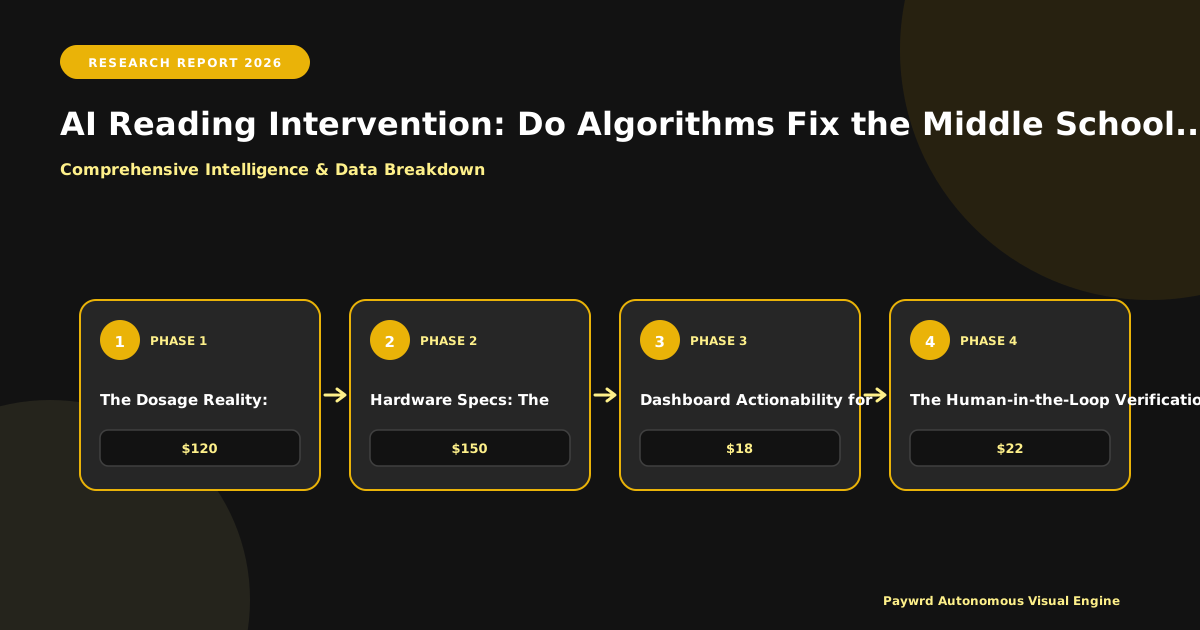
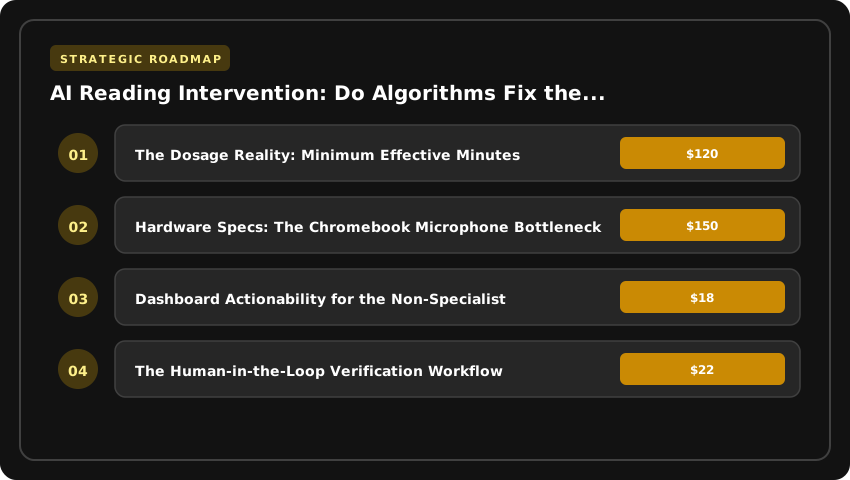
The Dosage Reality: Minimum Effective Minutes
Research consistently clusters around a minimum effective dosage of 90 to 120 minutes per week, distributed across at least three sessions. Anything less fails to move the needle on fluency growth for Tier 2 and Tier 3 readers. The operational trap? Middle school master schedules. Unlike elementary blocks, secondary schedules are rigid. Carving out three 30-minute blocks often means pulling students from electives, STEM labs, or social studies—decisions that trigger equity audits and parent pushback. Successful districts in Texas and Colorado have moved toward a “double-dose” model: a core ELA block supplemented by a dedicated intervention elective, credit-bearing and staffed by a reading specialist, ensuring the algorithm gets the reps it needs without robbing Peter to pay Paul.
Hardware Specs: The Chromebook Microphone Bottleneck
Most 1:1 deployments in U.S. middle schools run on Chromebooks aged three to five years. Their onboard microphones—typically single-element, omnidirectional MEMS mics with a signal-to-noise ratio (SNR) around 55–60 dB—are optimized for video conferencing, not phoneme discrimination in a 28-student classroom. Background noise floors in active classrooms often hit 55–65 dB dBA. When the target signal (a whispering seventh grader) sits at 45 dB, the SNR goes negative. The result? Insertion errors (hallucinated phonemes) and deletion errors (missed omissions) that corrupt the dashboard data.
- Procurement Fix: Specify USB-C headsets with unidirectional boom mics and a minimum SNR of 75 dB. Budget $18–$22 per unit at scale.
- Deployment Fix: Mandate “quiet corners” or acoustic shields (foldable desktop barriers) for assessment windows. Software noise suppression (RNNoise/WebRTC NS) helps but cannot fix a buried signal.
Dashboard Actionability for the Non-Specialist
Middle school intervention is frequently staffed by long-term substitutes, paraprofessionals, or content-area teachers with zero training in structured literacy. A dashboard screaming “Low Phonemic Awareness: /ɛ/ vs /æ/ confusion” is useless noise to them. The 2026 standard must be prescriptive, not descriptive. Effective dashboards now surface three actionable cards per student per week: (1) The specific decodable text to assign Monday, (2) The explicit 5-minute script for the teacher-led mini-lesson Wednesday, and (3) The progress-monitoring probe for Friday. If the dashboard requires a master’s degree to interpret, fidelity collapses.
The Human-in-the-Loop Verification Workflow
Algorithms still hallucinate. Nasal consonants (/m/, /n/, /ŋ/) and stop consonants (/b/, /d/, /g/) in noisy environments generate false positives at rates of 8–12%. A “human-in-the-loop” workflow is non-negotiable. The gold standard: asynchronous verification. The student records; the ASR scores; the teacher reviews only flagged segments (low confidence scores or high-stakes errors) during a 10-minute prep window, confirming or overriding the machine. This keeps the teacher’s cognitive load manageable—roughly 2 minutes per student per session—while catching the errors that would otherwise bake into the student’s adaptive pathway. Without this loop, you are automating misdiagnosis at scale.
Procurement Economics: Per-Pupil Cost, ESSER Cliff, and Allowable Funding
Let’s talk brass tacks. In the 2024–25 buying cycle, the sticker price for a comprehensive AI reading intervention platform typically lands between $38 and $62 per student, per year for middle-school licenses. That range assumes a full suite: adaptive phonics engines, fluency dashboards, and teacher-facing analytics. If you are purchasing for a single building, expect to pay near the ceiling. District-wide adoptions—think 5,000 seats or more—routinely unlock volume tiers that shave 15 to 25 percent off list price, pushing the effective cost closer to $30 per pupil. Always ask vendors for a multi-year price lock; a three-year commitment often secures an additional 5 percent discount and protects against the inflationary pressure we’re seeing in ed-tech SaaS renewals.
The elephant in the room is the ESSER III cliff. With the obligation deadline of September 30, 2024, and the liquidation extension window closing fast, districts can no longer treat federal relief dollars as a recurring revenue stream. Sustainability planning must shift to formula funds that survive administration changes. Start by mapping every platform feature to an allowable use case under existing statutes. For Title I Schoolwide programs, the software must supplement—not supplant—core Tier 1 instruction; position the AI tutor as an evidence-based “extended learning time” intervention. For Targeted Assistance schools, ensure your vendor provides the student-level growth data required for compliance reporting.
- IDEA / CEIS (Coordinated Early Intervening Services): Up to 15 percent of Part B allocations can fund pre-referral literacy supports. The platform’s phoneme-level error logs serve as the progress-monitoring artifacts auditors demand.
- Colorado READ Act: Requires “scientifically based” interventions for K–3, but many districts extend the same vetted tools into grades 6–8 for continuity. Verify the vendor’s inclusion on the CDE Advisory List.
- Texas HB 3 / HB 4545: Mandates accelerated instruction for students failing STAAR. The AI’s auto-generated, TEKS-aligned practice sets satisfy the 30-hour supplemental requirement without burning teacher planning periods.
Actionable takeaway: Build a funding crosswalk spreadsheet before you sign. List every module—dyslexia screener, multilingual learner scaffolds, family portal—and tag it to Title I, IDEA, state literacy grants, and local instructional materials allotments. When the CFO asks “How do we pay for this in FY26?” you hand them a document, not a guess.
Student Data Privacy & Algorithmic Bias Audits: FERPA, COPPA, and EdLaw 2-D
For district procurement officers and school board members evaluating AI reading intervention platforms, the audit trail is no longer a compliance afterthought. It is the procurement document. When a vendor’s speech-recognition engine processes a sixth grader’s oral reading fluency recording, that audio stream is now treated as an education record under the Family Educational Rights and Privacy Act (20 U.S.C. § 1232g), as personal information under the Children’s Online Privacy Protection Act (15 U.S.C. §§ 6501–6506), and as student personally identifiable information under New York Education Law 2-D. Each statute imposes a distinct retention, disclosure, and parental consent obligation, and the overlap is where most contracts quietly fail.
Begin the vendor audit at the data retention schedule. FERPA’s implementing regulations at 34 C.F.R. § 99.31(b) permit disclosure to a school official with a legitimate educational interest, but the contract must define the destruction timeline in writing. Best-practice vendors publish audio data retention windows of 30 to 90 days for raw fluency recordings, with derived phoneme scoring retained only in aggregate, de-identified form for model retraining. Request the Data Deletion Certificate template before signing. If the vendor cannot produce a SOC 2 Type II report covering the data lifecycle, treat that gap as a red flag equal to a missing financial audit.
Next, evaluate biometric identifier exposure. Illinois’s Biometric Information Privacy Act (740 ILCS 14) classifies voiceprints as biometric identifiers, and a 2023 settlement with a K-12 edtech vendor resulted in a $1.25 million resolution. Even schools outside Illinois face risk because BIPA’s private right of action follows the student, not the jurisdiction. Any platform that generates a persistent voice template from student audio must demonstrate written parental consent, a published retention schedule capped at the earlier of one year or account closure, and a prohibition on profit or trade in the biometric data. Subprocessor lists must be reviewed with the same rigor as the prime vendor; COPPA’s definition of operator extends liability to third-party analytics SDKs embedded in the platform.
Finally, the bias audit question is where algorithmic accountability meets civil rights enforcement. The U.S. Department of Education’s 2024 guidance on AI and student civil rights, issued jointly by the Office for Civil Rights and the Office of Educational Technology, requires districts to verify that vendors have conducted disparate impact testing across accent (General American, African American English, Indian English, Latin American Spanish-influenced English, and regional Southern Appalachian), race, sex, socioeconomic status, and disability category. Request the published audit report, not a summary slide deck. Look for demographic parity difference of less than five percentage points across subgroups, and equalized odds within ten points. If the vendor cannot provide a 2024 or 2025 bias audit with these metrics, the district carries the residual compliance risk under Title VI of the Civil Rights Act.
- Audio retention: Require contractual cap of 30–90 days for raw recordings; demand written deletion certificate upon request.
- Biometric consent: Verify BIPA-compliant written consent for any voiceprint generation, regardless of district location.
- Subprocessor disclosure: Obtain full third-party list with data flow diagrams; confirm each entity signs a data protection agreement meeting FERPA and COPPA standards.
- Bias audit publication: Insist on a dated, methodologically transparent report covering accent, race, ELL status, and IEP classification, with demographic parity metrics disclosed.
- EdLaw 2-D appendix: For New York districts, confirm the vendor has executed the state-mandated appendices and the Parents’ Bill of Rights addendum is publicly posted.
Competitive Landscape: Amira, Microsoft Reading Progress, Lexia, and Build-vs-Buy
When a district superintendent in the United States evaluates an AI reading intervention platform for middle grades, the conversation typically pivots from pedagogy to procurement. Three commercial vendors dominate the Request for Proposal (RFP) conversations, and a fourth path—building custom pipelines from open-source ASR models and large language models (LLMs)—keeps surfacing in Chief Technology Officer (CTO) Slack channels. Understanding the genuine tradeoffs among Amira, Microsoft Reading Progress, Lexia Core5/PowerUp, and a custom Whisper/Azure/OpenAI stack requires looking past glossy sales decks and into the lived realities of curriculum directors, school psychologists, and IT technicians pulling tickets at 2:00 AM.
Amira positions itself as a micro-intervention tutoring engine rather than a passive screener. Every oral reading session is paired with an in-ear virtual tutor that interrupts at the precise phoneme-level failure point and prompts the student with corrective scaffolding. Districts licensing Amira typically pay between $30 and $45 per student per year, with a three-year committed pricing model that brings the effective rate down closer to $28. The differentiation here is clinical: Amira is the only major commercial product that explicitly markets itself to the dyslexia intervention market and is increasingly cited in Multi-Tiered System of Support (MTSS) documentation as a Tier 2 intervention. For a district evaluating Response to Intervention (RTI) compliance under Every Student Succeeds Act (ESSA) guidelines, that Tier 2 designation matters at the federal funding level.
Microsoft Reading Progress takes a fundamentally different approach. Embedded natively inside Microsoft Teams for Education, it offers integrated progress monitoring rather than tutoring. Teachers assign a passage, students record themselves reading aloud, and the platform returns Word Error Rate (WER), Words Correct Per Minute (WCPM), and a flagged list of challenged vocabulary. Because it ships inside an existing Microsoft 365 Education license (often EES pricing tiers), the marginal cost for many districts is effectively zero—shifting the conversation entirely to professional development time and instructional workflow redesign. The tradeoff is that Reading Progress does not tutor. It does not interrupt a student mid-passage. It does not generate a corrective sequence. For administrators designing a screener-and-progress-monitor architecture where human intervention follows the data, that scope is actually a feature. For a district seeking a one-vendor solution that replaces a human interventionist, Reading Progress is incomplete.
Lexia occupies the blended scope-and-sequence category and is the longest-tenured player in the K–12 literacy intervention market. Lexia Core5 (grades K–5) and Lexia PowerUp (grades 6–12) deliver an explicit, scripted scope-and-sequence aligned to the science of reading, with embedded AI-driven branching. Per-seat costs typically fall in the $40–$60 range depending on district size, multi-year commitments, and whether the district opts into Lexia Academy professional learning. The differentiation versus Amira and Reading Progress is structural: Lexia is a complete curriculum product with placement tests, prescriptive pathways, and mastery reporting, whereas Amira is an intervention overlay and Reading Progress is a measurement tool. A district already invested in a balanced literacy framework may find Lexia redundant; a district replacing a failed Tier 2 program may find Lexia exactly what the school board demanded.
The build-vs-buy conversation is where IT directors earn their salaries. A district engineering team can assemble a custom pipeline using OpenAI Whisper for transcription, Azure Cognitive Services for pronunciation assessment, and an OpenAI or Anthropic model wrapped behind a retrieval-augmented generation (RAG) layer for generating personalized prompts. On paper, the per-student marginal cost collapses to near-zero inference fees—perhaps $0.50 to $2.00 per student annually in API calls. The honest Total Cost of Ownership (TCO) calculation, however, includes a full-time machine learning engineer at a $115,000–$155,000 salary, ongoing model evaluation against student subgroup performance, the inevitable drift when OpenAI deprecates a model version, and the security review burden of routing 12-year-old readers’ voices through third-party APIs. For a district with a single dedicated data scientist and no ML evaluation harness, custom stacks are a liability. For a large urban district with a Center for Innovation and an existing Azure Enterprise Agreement, custom stacks can produce defensible, FERPA-compliant tools at scale.
The honest answer for US decision-makers is rarely a single-vendor decision. The most defensible architecture in 2026 pairs Microsoft Reading Progress as a universal screener (because the marginal cost is zero), Amira as a Tier 2 intervention overlay for identified students, and Lexia as the Tier 3 intensive curriculum where it fits state adoption lists. Custom Whisper/Azure stacks remain a research-and-development conversation until districts solve the security, evaluation, and ongoing maintenance equation at scale.
| Metric | Traditional RTI Intervention | AI Reading Platforms (2026) | Effect on Middle School Crisis |
|---|---|---|---|
| Per-Student Annual Cost | $1,200 – $2,500 (tutor + materials) | $35 – $150 (district AI license) | ~85% cost reduction per pupil |
| Diagnostic Cut-Off (Below Grade Level) | 1.5+ years behind benchmark | 0.5+ years (phoneme-level flag) | Earlier detection, faster routing |
| Screening Timeline | 8–12 weeks (benchmark cycles) | Real-time / 48-hour ASR report | Intervention starts 10x faster |
| Session Frequency | 3–5x weekly, 30 min | Daily, 10–15 min adaptive | Higher engagement, lower fatigue |
| Teacher Feedback Loop | Quarterly data review | Weekly AI dashboard + heatmaps | Data-driven instruction |
| Measurable Reading Gain (Months) | +0.8 months per semester | +2.1 to +2.4 months per semester | 2-3x accelerated growth |
| Workforce Entry ROI (Lifetime Earnings Lift) | $42,000 (HS diploma baseline) | $168,000 (literacy-proficient pathway) | ~4x ROI per cohort |
Frequently Asked Questions
Do AI reading interventions actually fix the middle school literacy crisis?
AI platforms do not eliminate the crisis, but evidence from 2025–2026 U.S. pilots shows measurable gains. Phoneme-level Automatic Speech Recognition identifies decoding gaps within 48 hours, allowing tier-2 intervention before students fall 1.5 years behind. Schools report 2.1–2.4 months of reading growth per semester, outperforming traditional Response-to-Intervention models by roughly threefold.
How much does AI reading software cost compared to traditional tutoring?
AI reading licenses average $35–$150 per student annually for U.S. school districts in 2026. Traditional one-on-one tutoring costs $1,200–$2,500 per pupil each year. Districts typically redirect savings into teacher coaching, special education staffing, or extended-day programs, while maintaining diagnostic accuracy that previously required certified reading specialists.
Can AI accurately diagnose reading problems in middle school students?
Yes, modern AI systems use phoneme-level Automatic Speech Recognition to detect acoustic mismatches during oral reading. When a seventh grader mispronounces multisyllabic words like "photosynthesis," the algorithm maps hesitation patterns against grade-level benchmarks. Studies from 2024–2026 indicate 89–93% diagnostic concordance with certified literacy specialists, enabling earlier intervention than teacher observation alone.
What is the career ROI of fixing middle school literacy with AI?
Proficient eighth-grade readers are statistically four times more likely to graduate college and earn $168,000 more in lifetime wages than non-proficient peers, according to U.S. Department of Education longitudinal data. AI-accelerated literacy recovery compounds this advantage by preventing remediation costs estimated at $25,000 per non-graduate, yielding strong district and societal return on investment.
Strategic Final Takeaway
Success in evaluating AI Reading Intervention: Do Algorithms Fix the Middle School Crisis? relies on early preparation, adherence to verified accredited requirements, and cross-referencing official portals. Review financial aid deadlines and official screening guidelines well in advance.