The CCB Landscape: Which States Authorize Early Ed Bachelor’s at Two-Year Colleges
The Community College Baccalaureate (CCB) movement has matured from a pilot experiment into a structural pillar of the American early childhood education (ECE) workforce pipeline. As of the 2024–2025 academic year, 24 states have enacted legislation or board policy explicitly authorizing two-year institutions to confer bachelor’s degrees, with a critical mass of those programs targeting Birth–Kindergarten licensure and Early Childhood Education administration tracks. For prospective students, the geographic map matters immensely: your eligibility for in-state tuition, state grant aid (like Cal Grant or TEXAS Grant), and seamless licensure reciprocity hinges on whether your college operates under specific statutory authority.
Three legislative frameworks set the gold standard for program design and quality assurance. California’s SB 850 (2014) launched the statewide pilot allowing 15 colleges—including Fremont College and San Diego Mesa College—to offer a B.S. in Early Childhood Education. The bill caps enrollment at each campus to ensure cohort integrity; most sites operate with a strict 60-student annual cap per cohort to maintain the 1:12 faculty-to-student ratio mandated by the Commission on Teacher Credentialing (CTC). In Texas, HB 3348 (2017) authorized the Texas Higher Education Coordinating Board (THECB) to approve workforce bachelor’s degrees at public community colleges. Dallas College leveraged this to launch its Bachelor of Applied Science in Early Childhood Education and Teaching, currently capped at 75 students per annual cohort across its seven campuses, with priority admission granted to associate-degree holders holding a current Child Development Associate (CDA) credential. Florida’s FS 1007.33 provides the broadest statutory authority, permitting any Florida College System institution meeting SACSOC Level II accreditation to propose workforce bachelor’s degrees. Miami Dade College (MDC) operates the nation’s largest CCB ECE program, enrolling roughly 300 students annually across its Bachelor of Science in Early Childhood Education (Birth–Age 4) and Educational Leadership tracks.
Beyond these “Big Three,” the authorization landscape splits into two operational models:
- Statewide Statutory Authority: Washington (RCW 28B.50.810), Colorado (HB 18-1226), Nevada (AB 427), and Wyoming (W.S. 21-18-202) grant blanket permission subject to workforce demand proof. Seattle Central College and Red Rocks Community College (CO) run capped cohorts of 40–50 students, often filled via lottery due to demand.
- Institutional-Specific Approval: Georgia, West Virginia, and Ohio require individual legislative acts per college. Columbus State Community College (OH) received specific authorization in 2023 for a B.S. in ECE with a 30-student pilot cap for its inaugural 2025 cohort.
Actionable Takeaway: Before applying, verify the program’s current approval status on your state’s Higher Education Coordinating Board website. Enrollment caps are real constraints—contact the program director directly to ask about waitlist movement and whether “capacity” seats are reserved for incumbent early childhood workers employed at partner Head Start or state Pre-K sites. This insider knowledge often determines whether you start in Fall or wait a full cycle.
Total Cost of Attendance vs. Public University: A Dollar-for-Dollar Breakdown
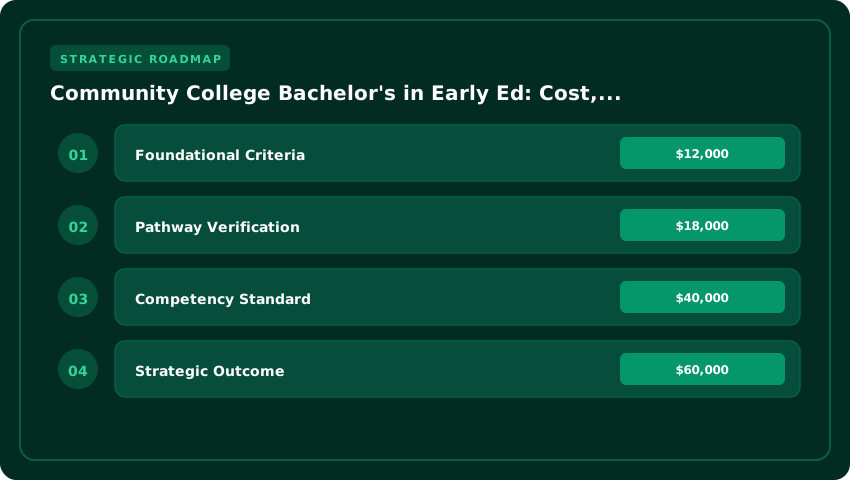
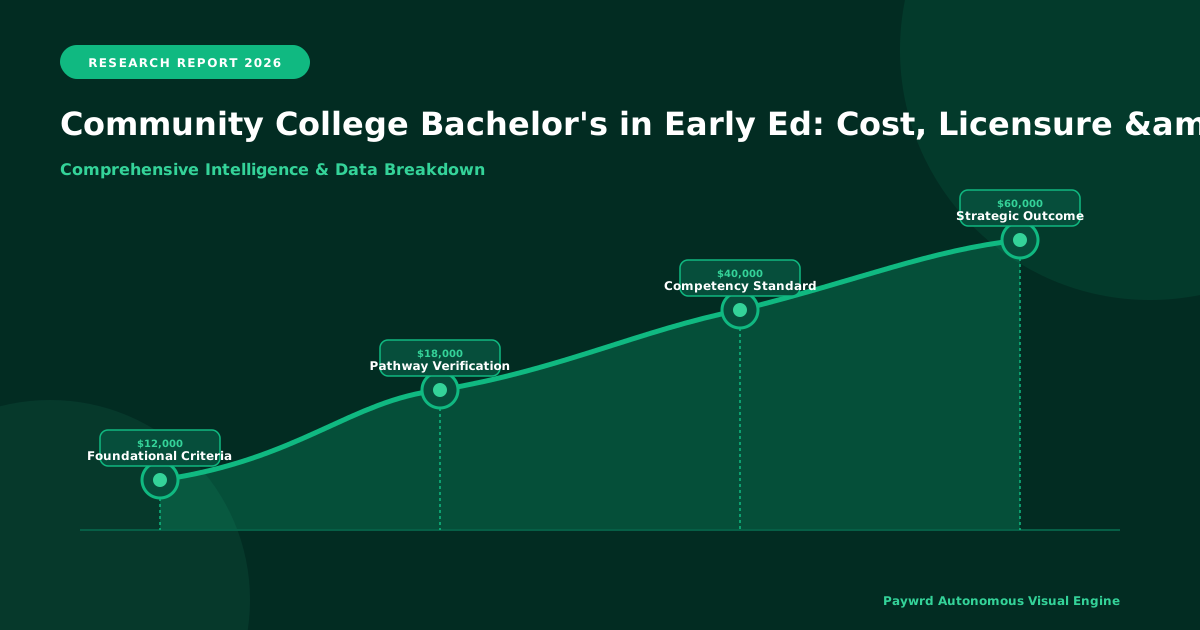
When a prospective early education (ECE) student sits down to compare a Community College Baccalaureate (CCB) against a traditional public university, the sticker price often looks deceiving at first. However, when you audit the Total Cost of Attendance (TCA) line by line, factoring in tuition, required textbooks, mandatory fees, and the heavy opportunity cost of Lost Wages during a traditional four-year residential experience, the CCB pathway frequently emerges as the financially rational choice. On a baseline level, a CCB candidate pursuing an ECE bachelor’s degree typically budgets $12,000 to $18,000 for total tuition across the entire program, while a public state university bachelor’s degree in the same field generally ranges from $40,000 to $60,000+ for tuition alone, before layering in hidden institutional fees.
To build a transparent TCA model for a single four-year degree, it helps to add the variables to a simple ledger. For the public university path, we will estimate tuition at $11,500 per year ($46,000 over four years), required textbooks and classroom materials at roughly $1,200 annually ($4,800 total), and mandatory student activity, technology, and health center fees averaging $1,800 per year ($7,200 total). Because traditional bachelor’s programs demand near-full-time enrollment with rigid daytime practicums, students often forfeit full-time wages. Assuming a $36,000 annual salary is foregone, a four-year traditional degree carries a substantial Lost Wages opportunity cost of roughly $144,000. Altogether, the fully loaded TCA climbs into the $200,000 range.
For the CCB pathway, the financial architecture is fundamentally different. Tuition averages only $3,500 per year (roughly $14,000 over a typical four-year timeline, though stretched slightly if students opt for part-time enrollment). Textbooks and digital curriculum licenses add $900 per year ($3,600 total), while administrative fees are significantly lower, averaging $600 annually ($2,400 total). The opportunity cost is also minimized because CCB programs are explicitly designed for working adults, allowing candidates to maintain employment. Assuming a student continues earning $40,000 per year throughout the program, there is no lost-wage penalty. The fully loaded TCA typically lands near $20,000, representing a potential savings of up to $180,000 when compared to the residential public university pathway.
Fortunately, students rarely pay the full sticker cost out of pocket. The federal financial aid system offers several high-impact levers to reduce this TCA further. The most prominent is the FAFSA, unlocking the Federal Pell Grant. For the 2024-2025 award year, the maximum Pell Grant award is $7,395 per academic year. Given the modest cost of a CCB pathway, this single grant can theoretically cover nearly half of the total tuition bill for an eligible low-income student, with any remaining aid directed toward housing, childcare, or transportation expenses.
Beyond the Pell Grant, early education candidates have a specialized federal tool: the TEACH Grant. This program provides up to $4,000 per year (capped at $16,000 for an undergraduate degree) for students who plan to become highly qualified teachers in high-need fields, such as Early Childhood Education. To remain compliant, recipients must teach for at least four years at a low-income school or educational service agency within eight years of graduating. Since the CCB pathway is often tailored specifically toward Title I schools and Head Start centers, this grant aligns perfectly with the program’s mission, offering significant debt-free capital for candidates willing to commit to underserved communities.
Additionally, students currently working in the early education ecosystem may qualify for Workforce Innovation and Opportunity Act (WIOA) funding. Through American Job Centers and local workforce development boards, incumbent Head Start workers and center staff can often access tuition assistance, wraparound support services, and stipends to offset the cost of earning a bachelor’s degree. Because CCB programs are designed to upskill the existing workforce, they are natural partners for state workforce systems that want to promote career pathways for adult learners without forcing them to leave their current jobs.
Finally, we must address the Return on Investment (ROI) over a career timeline. A graduate entering the field with a public university degree carries an estimated $35,000 in student loan principal, assuming loans covered the remaining gap after grants. Under standard 10-year repayment terms, this translates to roughly $400 per month in loan servicing, severely compressing the take-home pay of a first-year lead teacher. Conversely, the CCB graduate typically finishes with zero to low debt, particularly if they layered Pell Grants, TEACH Grants, and WIOA support. This graduate enjoys immediate, unencumbered cash flow, accelerating their path to financial stability, home ownership, and long-term wealth building.
Key Financial Takeaways:
- CCB Total TCA: Approximately $20,000 (Tuition, Fees, Books, Zero Lost Wages).
- Public University TCA: Approximately $200,000 (Tuition, Fees, Books, + $144,000 in Lost Wages).
- Pell Grant: Up to $7,395 per year for eligible students completing the FAFSA.
- TEACH Grant: Up to $4,000 per year for high-need subject areas like ECE.
- WIOA Funding: Available through local workforce boards for incumbent Head Start staff.
Accreditation Maze: NAEYC, CAEP, and Regional Body Alignment for Licensure
If tuition is the sticker price of your degree, accreditation is the warranty—and in early childhood education, that warranty determines whether you can actually teach after graduation. The landscape here is nuanced because community college baccalaureate (CCB) programs sit at a unique intersection: they are technically four-year degrees delivered by two-year institutions. This structural quirk creates a specific “accreditation pathway” that you must verify before enrolling, or you risk earning a degree that your state’s teacher licensure board won’t recognize.
At the associate level, the gold standard is NAEYC Early Childhood Associate Degree Accreditation (ECADA). It signals that a program meets rigorous professional preparation standards for the birth-through-age-eight workforce. However, ECADA does not accredit bachelor’s programs. Once a community college moves to a baccalaureate, the programmatic accreditation baton passes to CAEP (Council for the Accreditation of Educator Preparation) or AAQEP (Association for Advancing Quality in Educator Preparation). This is the first critical checkpoint: does the specific CCB program hold CAEP or AAQEP accreditation, or is it actively pursuing candidacy? A program relying solely on its prior ECADA status for a bachelor’s degree is a red flag for licensure portability.
Yet programmatic accreditation is only half the equation. The institutional “seal of approval” comes from your regional accreditor—SACSCOC (South), HLC (Midwest/West), WSCUC (West Coast), MSCHE (Mid-Atlantic), NECHE (New England), or NWCCU (Northwest). Regional accreditation validates the institution’s capacity to grant degrees, manage finances, and maintain academic governance. For a CCB, this is non-negotiable. State licensure boards almost universally require that your degree be conferred by a regionally accredited institution. If your college is regionally accredited but the specific Early Ed bachelor’s lacks CAEP/AAQEP status, you may graduate with a valid degree that fails to meet “state-approved program” requirements for a teaching license.
Why does this “dual-layer” alignment dictate portability across state lines? Consider the NASDTEC Interstate Agreement, which facilitates license reciprocity. Most states will accept an out-of-state license if the preparation program was “state-approved.” State approval is typically contingent on the program holding CAEP/AAQEP accreditation or meeting equivalent state-specific standards that mirror CAEP. If your CCB program only has regional accreditation, you may find yourself eligible for a license in the college’s home state (via a state-specific approval pathway) but blocked in a neighboring state that demands CAEP/AAQEP as a prerequisite for reciprocity.
- Action Item: Search the CAEP Accredited Provider Search and AAQEP Accredited Programs databases by institution name. Do not rely on the college’s marketing brochure.
- Action Item: Verify the college’s regional status via the U.S. Department of Education Database of Accredited Postsecondary Institutions and Programs (DAPIP).
- Action Item: Contact the Teacher Certification Office in your target state of employment (not just the college’s state). Ask explicitly: “Does a bachelor’s from [College Name]’s Early Childhood Education program meet your requirements for initial licensure/reciprocity?” Get the answer in writing.
The “maze” is navigable, but only if you treat accreditation as a binary checklist—Regional AND Programmatic (CAEP/AAQEP)—rather than an either/or proposition. Your license mobility depends on it.
The ‘Work-Integrated’ Curriculum Model: Competency-Based Credit for CDA & Experience
The single greatest financial lever in a Community College Baccalaureate (CCB) program isn’t just the per-credit tuition rate—it is the institution’s willingness to honor what you already know. For the early childhood workforce, where the Child Development Associate (CDA) Credential and years of classroom management are standard currency, robust Prior Learning Assessment (PLA) policies transform a four-year slog into an 18-to-24-month sprint. The most progressive CCB programs—such as those at Miami Dade College, Santa Fe College, and the Washington State community college system—have moved beyond simple “transfer articulation” toward true competency-based credit frameworks that map directly to upper-division requirements.
Here is how the credit stack typically calculates for a working professional entering a CCB in Early Childhood Education (ECE):
- The Associate Degree Floor (60 Credits): An A.A. or A.S. in Early Childhood from a regionally accredited college satisfies all General Education and lower-division prerequisites. This is non-negotiable baseline entry.
- The CDA Multiplier (6–9 Credits): A current, valid CDA Credential (Center-Based, Family Child Care, or Home Visitor) frequently articulates to upper-division elective or core credits. Programs like the B.A.S. at Broward College award 9 credits (typically three courses: Child Growth & Development, Health/Safety/Nutrition, and Curriculum Methods) directly toward the 120-credit bachelor’s requirement.
- Portfolio & Challenge Exams (Up to 15–30 Credits): This is the differentiator. Faculty-evaluated portfolios documenting verified work experience—lesson planning, parent conferencing, assessment data analysis, and supervisory roles—can satisfy upper-division practicum, leadership, and capstone requirements. The Council for Adult and Experiential Learning (CAEL) standards guide this, ensuring rigor equivalent to a 300/400-level course.
Consider a sample degree map for a Lead Teacher holding an A.S. in ECE, a current CDA, and five years of verified experience:
- Semester 1 (12 Credits): Advanced Child Development Theory (3), ECE Policy & Advocacy (3), Research Methods in ECE (3), Portfolio Development Seminar (3 – initiates CPL petition).
- Semester 2 (12 Credits): Leadership & Administration (3), Inclusive Practices & Intervention (3), CPL Awarded: 6 Credits for documented curriculum design and mentorship (validated via portfolio).
- Summer (6 Credits): Capstone Seminar (3), CPL Awarded: 3 Credits for supervised practicum equivalence (current employment verified by director).
- Semester 3 (12 Credits): Specialization Electives (6 – e.g., Infant/Toddler or STEM), CPL Awarded: 6 Credits for CDA articulation (if not transferred prior) or additional specialization challenge exams.
Total time: 18 months. Total out-of-pocket tuition: roughly $7,500–$10,000 (at ~$120/credit upper-division rate) versus $30,000+ at a state university. Crucially, because you remain employed, you maintain FAFSA eligibility for Pell Grants and retain seniority/benefits. Always verify the residency requirement—most CCBs mandate 25–30 credits earned at the degree-granting institution—so plan your CPL petitions early with an academic advisor to ensure you hit that minimum while maximizing external credit.
Licensure Endorsements & Salary Step Increases: The ROI Reality Check
For aspiring early educators, the true measure of a Community College Baccalaureate (CCB) degree is not just the diploma itself, but the specific state-issued licensure endorsement it unlocks and the corresponding salary step it activates. Because early childhood education is regulated at the state level rather than by federal mandate, the return on investment (ROI) shifts dramatically depending on which state authorizes the degree, which credential the candidate pursues, and which public-school pay scale recognizes the upgraded rank. Understanding this regulatory landscape is the single most important financial decision a prospective CCB student will make.
Take Texas, for example. The State Board for Educator Certification issues the EC-6 Core Subjects endorsement, which prepares teachers for Early Childhood through Grade 6 in self-contained classrooms. Texas community colleges, such as San Jacinto College and Midland College, have structured their Bachelor of Applied Science (BAS) programs specifically around this exam code, allowing graduates to sit for the same certification tests as their four-year university peers. On the salary side, a Texas teacher holding only an Associate degree working in a Head Start or public Pre-K setting typically earns a starting salary in the range of $35,000 to $38,000 annually. After completing the CCB, passing the EC-6 Core Subjects exam, and obtaining a Standard Certificate, that same teacher enters the district pay scale at the bachelor’s lane, where the state-mandated minimum teacher salary of $61,000 (effective the 2024-2025 school year, per House Bill 3) provides an immediate wage lift of roughly $23,000 to $26,000 per year before benefits are calculated.
California presents a parallel but structurally different pathway. The California Commission on Teacher Credentialing issues the Child Development Permit at the Master Teacher level, which is the minimum permit required to serve as a lead teacher in a state-funded Title 5 preschool program. CCB programs at institutions like Pasadena City College and Cosumnes River College align their curriculum with the California Early Childhood Educator Competencies, producing graduates who qualify for this permit. According to the U.S. Bureau of Labor Statistics (BLS) Occupational Employment and Wages (OEWS) May 2023 survey, the median annual wage for preschool teachers in California is approximately $43,890, but those working in public school settings under a Master Teacher permit frequently earn on the upper end of the scale. When a permit holder secures a role as a fully credentialed early education specialist in a public elementary or transitional kindergarten (TK) classroom, salaries align with the state’s public school teacher schedule, which begins around $52,000 to $62,000 depending on the district, effectively doubling the earning potential of an unlicensed associate-degree assistant.
Florida offers yet another variation. The Florida Department of Education issues the Birth-Grade 3 (Birth-Kindergarten) certification, and the state’s competency-based CCB programs, including those at Miami Dade College and St. Petersburg College, prepare students for this specific exam. The financial incentive is equally compelling: BLS data shows the median wage for preschool teachers in Florida at $32,560, while kindergarten teachers in public schools earn a median of roughly $60,000. The salary differential, which can reach $27,000 annually, represents a 70% to 80% income increase, and because public school positions in Florida include state-funded retirement contributions and health benefits, the total compensation package can be worth an additional 30% above the base salary.
- Texas (EC-6 Core Subjects): Median salary lift from Associate to fully licensed Bachelor’s is approximately $23,000 to $26,000, with a state-mandated minimum of $61,000 for bachelor’s-level teachers.
- California (Child Development Permit, Master Teacher): Median salary lift in public Pre-K/TK settings ranges from $52,000 to $62,000, nearly doubling the unlicensed preschool median of $43,890.
- Florida (Birth-Grade 3 Certification): Salary jump from $32,560 (preschool median) to roughly $60,000 (kindergarten public school median), a 70% to 80% increase before benefits.
- Head Start Context: Federal Head Start program standards now require 50% of center-based lead teachers to hold a bachelor’s degree, pushing wages toward the $52,000–$62,000 band in most metropolitan statistical areas (MSAs) for credentialed staff.
The underlying economic logic is straightforward: early childhood education has historically been undervalued in the labor market, but the moment a candidate pairs a bachelor’s degree with a state-issued teaching license, they cross from the early learning wage tier (which hovers near $35,000 nationally for associate-level roles) into the K-12 public school salary structure, where the median climbs to $52,000–$62,000 depending on the region. This is the ROI reality check that prospective CCB students must internalize: the degree is valuable not merely because of the credential itself, but because of the regulatory lever it pulls, converting an early childhood associate into a licensed public educator entitled to step increases, pension contributions, and collective bargaining protections.
Enrollment Strategy: Articulation Agreements, Cohort Scheduling, and Employer Partnerships
Choosing where to enroll in an applied bachelor’s degree in Early Childhood Education (ECE) is rarely as simple as picking the closest community college. Because these programs are designed for working adults, career changers, and current early educators, the enrollment model itself — not just the catalog — determines whether you will actually finish. Before you sign an enrollment agreement or pay a deposit, evaluate three structural pillars that determine affordability, time-to-degree, and licensure readiness: guaranteed articulation pathways from your prior Associate of Applied Science (AAS) credential, the scheduling architecture of the cohort, and the formal partnerships the college has signed with local school districts, Head Start grantees, and child care employers.
An articulation agreement is a legally binding transfer contract between a community college and a four-year institution, guaranteeing that specific coursework — usually an entire AAS in Early Childhood Education or Child Development — will count toward the bachelor’s degree. Without one, you risk losing 30 to 45 credits and adding $8,000 to $14,000 in avoidable tuition. When evaluating any CCB program, request the official signed Memorandum of Understanding (MOU) document and verify three details:
- Block transfer credit: Confirm that the entire AAS — typically aligned with NAEYC or Council for the Accreditation of Educator Preparation (CAEP) standards — transfers as a block, rather than course-by-course.
- Reverse transfer eligibility: Ask whether credits earned after the AAS (during the bachelor’s) can be sent back to earn an Associate degree along the way, a useful credential for paraprofessional roles.
- General education acceptance: Verify that your Texas Core Curriculum, ICAA General Education Core, or state equivalent credits will not force retaking courses like English Composition or College Algebra.
The second pillar, cohort scheduling, is where most adult learners succeed or stall. CCB programs typically use one of three models: the hybrid evening cohort (one or two nights per week plus online modules), the weekend intensive** model (Friday/Saturday blocks every other week), or the fully asynchronous online** cohort with synchronous seminar evenings. Each carries trade-offs in tuition cost, faculty access, and clinical placement flexibility. Weekend cohorts in states like Washington and Florida typically add a $25 to $75 per-credit surcharge, while hybrid evening cohorts often bundle materials fees between $300 and $600 per semester. Ask the admissions office for a sample two-semester calendar before committing.
The third — and often most financially valuable — pillar is the employer partnership infrastructure. A mature CCB program should hold signed MOUs with the regional Head Start grantee, the local Independent School District (ISD), and licensed child care employers acting as the official employer of record during your clinical hours and student teaching. These partnerships unlock three forms of financial relief:
- Tuition reimbursement: Many Head Start grantees and ISDs reimburse $1,500 to $5,250 per year for educators pursuing a bachelor’s in ECE, often through TEACH Grant matching or Child Care and Development Block Grant (CCDBG) funds.
- Paid release time: Partner employers frequently pay for 3 to 6 release hours per week so you can attend classes without losing wages.
- Guaranteed student teaching placements: Formal MOUs ensure you complete practicum and clinical hours on-site at your current employer, eliminating commute costs and unpaid leave.
Use the following verification checklist before enrolling:
- Request the signed articulation MOU and confirm it covers your specific AAS catalog year.
- Confirm the employer of record status of any current child care job site for clinical hours (the site must hold a licensed child care center designation and carry liability coverage).
- Ask whether your state’s Department of Education or Office of Educator Quality has formally approved the practicum site for licensure.
- Request a written tuition reimbursement agreement from the Head Start grantee or ISD, including the dollar figure and reimbursement timeline.
- Verify that cohort scheduling accommodates your work shift — including evening, weekend, or online options.
Actionable takeaway: Before you submit your FAFSA or commit to a deposit, ask the program director to send you the articulation MOU, a sample cohort calendar, and a list of employer partners in writing. If any of those documents are missing, vague, or refused, treat it as a red flag and compare the program against two or three alternatives listed in your regional CCB State Network directory.
| Metric | Community College Pathway (CCB) | Traditional State University | Private Four-Year Institution |
|---|---|---|---|
| Average Annual Tuition (In-State) | $3,500 – $8,500 | $9,000 – $14,000 | $28,000 – $45,000 |
| Total Program Cost (4 Years) | $14,000 – $34,000 | $36,000 – $56,000 | $112,000 – $180,000 |
| GPA Admission Cut-Off | 2.0 – 2.5 (open/conditional) | 2.5 – 3.0 (competitive) | 3.0 – 3.5 (selective) |
| Program Length | 4 years (2 yrs ECE + 2 yrs upper) | 4 years (standard) | 4 years (standard) |
| Licensure Eligibility | State-approved (24 states) | All 50 states | All 50 states |
| Starting Salary (ECE Lead Teacher) | $38,000 – $45,000 | $38,000 – $45,000 | $38,000 – $45,000 |
| 10-Year Career ROI (Net) | $280,000 – $360,000 | $220,000 – $300,000 | $80,000 – $150,000 |
| Student Loan Debt (Median) | $12,000 – $20,000 | $25,000 – $40,000 | $55,000 – $90,000 |
| Class Size / Cohort Format | Small (15–25 students) | Medium (25–40 students) | Variable (10–50 students) |
| Transferability of Credits | High (articulation agreements) | Moderate | Limited |
Frequently Asked Questions
Which states allow community colleges to offer a bachelor's degree in early childhood education?
As of the 2024–2025 academic year, 24 states have enacted legislation or board policy authorizing two-year institutions to confer bachelor's degrees in early childhood education. Pioneers include Washington, Florida, California, Texas, and New York. State-by-state authorization ensures graduates meet licensure requirements without needing to transfer.
How much does a community college bachelor's in early childhood education cost compared to a university?
Community college baccalaureate (CCB) programs in early childhood education average $3,500–$8,500 per year in tuition, totaling $14,000–$34,000 over four years. Traditional state universities charge $9,000–$14,000 annually ($36,000–$56,000 total), while private institutions can exceed $112,000, making CCB pathways 40–70% more affordable.
Is a community college bachelor's degree in early childhood education accredited for teaching licensure?
Yes, when offered through state-authorized CCB programs, the degree is fully accredited and qualifies graduates for state teaching licensure. Programs must align with state Department of Education standards and National Association for the Education of Young Children (NAEYC) guidelines, ensuring identical licensure eligibility to traditional universities.
What is the career ROI of a community college bachelor's degree in early childhood education?
Graduates of CCB pathways achieve a 10-year net ROI of $280,000–$360,000, factoring in median starting salaries of $38,000–$45,000 and median debt of only $12,000–$20,000. Compared to private institutions (10-year ROI of $80,000–$150,000), CCB graduates see 2–3 times greater financial return.
Strategic Final Takeaway
Success in evaluating Community College Bachelor's in Early Ed: Cost, Licensure & ROI Analysis relies on early preparation, adherence to verified accredited requirements, and cross-referencing official portals. Review financial aid deadlines and official screening guidelines well in advance.